PWM Generation using PIC16F877A for
Bidirectional V/F control of Single-Phase
Induction Motors
Prof. Latha.L.R1, Prof. Deepa V.Bolanavar2
Assistant Professor, Dept. of EEE, New Horizon College of Engineering, Bangalore, Karnataka, India1
Assistant Professor, Dept. of EEE, New Horizon College of Engineering, Bangalore, Karnataka, India2
ABSTRACT:Single-Phase Induction motors are extensively used in appliances and Industrial controls. The permanent split capacitor (PSC) single-phase induction motor is the simplest and most widely used of this type. By design, PSC motors are unidirectional. By adding either extra windings, and external relays and switches, or by using gear mechanisms, the direction of rotation can be changed. When mechanical gears are used, the motor shaft runs in one direction, and the gears for forward and reverse engage and disengage according to the direction required. Using relays and switches, the polarity of the starting winding is electrically reversed based on the direction required. Unfortunately, all of these components increase the cost of the system for basic ON and OFF control in two directions. In this paper, the study is carried out to understand how to control the speed of PSC motor in both the directions using PIC16F877A microcontroller and 3-Phase Inverter Bridge by PWM technique. The PIC16F877A microcontroller-based control for PSC motor makes the system easy to implement and to have control over the motor in two directions. Implementing the algorithm using a 3-phase inverter bridge gives flexibility and efficiency of control. The PIC16F877A is a popular low cost general purpose microcontroller from Microchip that can be used to implement the control algorithm.
KEYWORDS: Permanent Split Capacitor (PSC) Motor, Pulse Width Modulation (PWM), PIC16F877A microcontroller.
I.INTRODUCTION
AC induction motors are the most common motors used in industrial motion control systems, as well as in main powered home appliances. Like most motors, an AC induction motor has a fixed outer portion, called the stator and a rotor that spins inside with a carefully engineered air gap between the two. There are probably more single-phase AC induction motors in use today than the total of all the other types put together because they are least expensive, lowest maintenance is required. To achieve better efficiency induction motor has to be controlled by some control techniques. Among different methods of control, Variable frequency drives serve the purpose to a good extent for low dynamic requirements. Even today it is commonly used for the open-loop speed control. Most single-phase induction motors are unidirectional. Using microcontroller-based control systems, one can add speed variation to the system. In addition to the option of speed variation, the direction of rotation can also be changed, depending upon the motor control algorithms used.
II. LITERATURE SURVEY
1. A New Induction Motor V/f Control Method Capable of High-Performance Regulation at Low Speeds:
Alfredo Munoz et al. proposed a novel open-loop speed control method for induction motors.
The control scheme is based on the popular constant volts per hertz (V/f) method that uses low-cost open-loop current sensors. In this control scheme, stator current measurement is required to compensate for both stator resistance drop and slip frequency. The scheme proposed fully compensates for the current–resistance (IR) voltage drop by modifying the stator voltage and keeping the magnitude of the stator flux constant, regardless of changes in frequency or load. This provides high output torque and nearly zero steady-state speed error at any frequency. Also from the proposed method, the speed can be accurately controlled with higher values of load torque than the rated value.2. A Review on Speed Control Techniques of Single Phase Induction Motor: Atul Gajare et al. described the speed control of single phase induction motor by means of frequency. Here, SPIM has been controlled by frequency control method by using PWM control circuit and H-bridge inverter. These MOSFET are used in H-bridge configuration to form inverter to supply AC current to the motor.
3. Optimization of Single-Phase Induction Motors—Part I: Maximum Energy Efficiency Control: Christos Mademlis et al. proposed a triac-based drive with an optimal efficiency voltage controller and an experimental procedure was followed for adjusting its parameters. The control scheme employed satisfies all of the prerequisites of simplicity, reliability, and cost-effectiveness that are imposed by the utilization of a single-phase motor.
4.PWM AC chopper control of Single phase induction motor for variable speed fan application: Deniz Yildirim et al. presented a variable speed control method in which a pulse-width-modulated (PWM) AC chopper technique is used to change the effective value of the supply voltage and is applied to a single-phase induction motor. This variable supply voltage gives the ability to control the speed of the motor. Harmonics generated by the speed control unit are altered by an input according to the limits using harmonic current emissions standards.
5. Adjustable-Speed Single-Phase IM Drive With Reduced Number of Switches: Miroslav Chomat et al. focused on the properties of a drive that uses a single-phase machine of permanent-split capacitor type to drive a fan-type load with variable mechanical speed. To generate the supply voltage with variable frequency a converter with the minimal number of active switches and diodes is used.
6. Development of Single Phase Induction Motor Adjustable Speed Control Using M68HC11E-9 Microcontroller: Senan Bashi et al. investigated the performance of single-phase induction motor using microcontroller M68HC11E-9. The microcontroller has been programmed to vary the pulse width variation that controls the duty cycle of the dc chopper. The inverter receives the dc signal from the chopper and converted to ac power to feed the motor. Speed’s feedback signal is sensed by the microcontroller and consequently pulse width variation signal is provided that sets the gate voltage of the chopper, which in turn provides the required voltage for the desired speed. Here, buck chopper has been used to control the input voltage of a fully controlled single phase isolated gate bipolar transistor (IGBT) bridge inverter. PWM technique has been employed in this inverter to supply the motor with ac voltage. The problem for this microcontroller was that it had no dead band register and only had a three PWM output.
III. METHODOLOGY
In scalar control, the motor is fed with variable frequency signals generated by the PWM control from an inverter using the feature rich PIC microcontroller. Here, the V/f ratio is maintained constant in order to get constant torque over the entire operating range. Since only magnitudes of the input variables – frequency and voltage – are controlled, this is known as “scalar control”. Generally, the drives with such a control are without any feedback devices (open loop control). Hence, a control of this type offers low cost and is an easy to implement solution. In such controls, very little knowledge of the motor is required for frequency control. There are number of ways to implement scalar control. In this project, the popular Pulse Width Modulation technique is used.
have Analogue to Digitals Convertors (ADC) to convert a voltage from the analogue world to a number but to convert from Digital to Analog PWM technique is used.
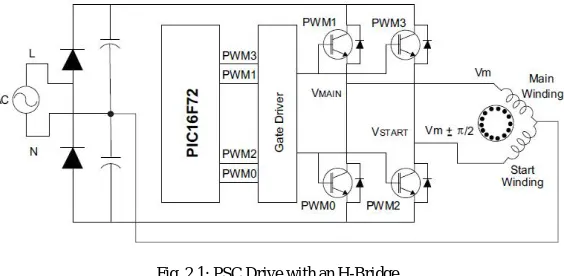
VF control in one direction makes the drive topology and control algorithm relatively easy. The task is to generate a variable voltage and frequency power supply from a fixed voltage and frequency power supply (such as a wall-outlet power supply). Most PSC motors are designed to run in one direction. However, many applications call for bidirectional motor rotation. In this section, we will discuss bidirectional speed control of PSC motors using a microcontroller-based drive and H-Bridge Inverter. The drive topologies discussed here produce effective voltages, which drive the main winding and start winding at 90-degree phase shifts to each other. This enables the system designer to remove the capacitor, which is in series with start winding, from the circuit permanently—thereby reducing the total system cost.
Using H-Bridge Inverter
This method has a voltage doubler on the input side; on the output side an H-bridge or two-phase inverter is used. One end of the main and start windings are connected to each half bridge; the other ends are connected together at the neutral point of the ac power supply, which also serves as the center point for the voltage doubler.
Fig. 2.1: PSC Drive with an H-Bridge
The control circuit requires four PWMs with two complementary pairs and sufficient deadband between the complementary outputs. PWM0-PWM1 and PWM2-PWM3 are the PWM pairs with dead band. Using PWMs, the dc bus is synthesized to provide two sine voltages at 90 degrees out of phase with varying amplitude and varying frequency, according to the VF profile. If the voltage applied to the main winding lags the start winding by 90 degrees, then the motor runs in the forward direction. To reverse the direction of rotation, the voltage supplied to the main winding should lead the voltage supplied to the start winding.
This H-bridge inverter method of controlling a PSC type motor has following disadvantages.
1. The main and start windings have different electrical characteristics. Thus, the current flowing through each switch is unbalanced. This can lead to the premature breakdown of switching devices in the inverter.
2. The common point of the windings is directly connected to the neutral power supply. This may increase the switching signals creeping into the main power supply, and may increase the noise emitted onto the line. In turn, this may limit the EMI level of the product, violating certain design goals and regulations.
3. The effective dc voltage handled is relatively high due to the input-voltage doubler circuit.
4. The cost of the voltage doubler circuit itself is high due to two large power capacitors.
A better solution to minimize these problems would be to use a three-phase inverter bridge, as discussed in the proposed technique.
voltages with 120-degree phase shift to each other, which drives a three-phase induction motor. This reduces the development time.
Single-phase induction motors are very popular in appliances, and industrial and consumer applications. PSCs are the most popular type of single-phase induction motors. Controlling the motor speed has many advantages, such as power efficiency, reduced audible noise and better control over the application.
IV. PROPOSED CONTROL METHOD
An uncontrolled diode bridge rectifier is used at the supply side of the circuit to convert the AC voltage from the utility supply into DC. After the conversion, the DC Voltage will be filtered by a capacitor of 470μF.
A PSC motor is usually a 2-Φ asymmetrically wound motor. The current flowing through the start winding is much less than the main winding. In order to produce the MMF by start winding very near to main winding, the start winding has additional turns, higher resistance and reduced current flowing through it. The value of capacitor in motor circuit is chosen so that the total impedance on the start winding produces sufficient phase shift in current to generate a RMF in the air gap. Typically current flowing through the start winding leads the current flowing through the main winding by 90o. By adding a microcontroller based PWM control of three phase inverter circuit to the motor, the voltage across main and start winding can be maintained at 90o.
Fig. 3.1 Controlling a PSC motor with a 3-phase inverter bridge
3-phase bridge inverters are widely used for ac motor drives and general purpose ac supplies. The circuit consists of three half-bridges. It is a Variable Frequency Drive. The VFD is a system made up of active/passive power electronics devices (IGBT, MOSFET, etc.), a high speed central controlling unit (a microcontroller) and optional sensing devices, depending upon the application requirement. The basic function of the VFD is to act as a variable frequency generator in order to vary speed of the motor as per the user setting. The rectifier and the filter convert the AC input to DC with negligible ripple. The inverter, under the control of the microcontroller, synthesizes the DC into three-phase variable voltage, variable frequency AC.
In this paper, one end of main winding and start winding are connected to one half bridges each. Other ends are tied together and connected to the third half bridge. With this drive topology, control becomes more efficient. The phase voltages Va, Vb and Vc should be controlled to achieve the phase difference between the effective voltages across the
main and start winding to have a 90 degree phase shift to each other.
V. PWM GENERATION USING PIC16F877A
PWM can be achieved as shown in the figure 4.1 to control the PSC type of single phase induction motor. Corresponding expected waveforms are shown in figure 4.2. The switching frequency of the PWM is considered to be 8 KHz hence the total time period for each cycle of PWM will be around 125 μS. A dead timeof around 1 μS is been
included through software. Dead time is essential in an induction motor control application to avoid cross conduction of the dc bus through the power switches when one turns OFF and the other turns ON.With the reference of expected waveforms shown in figure 4.2, one can divide each cycle of PWM into 4 intervals. Therefore each interval in every cycle will be approximately for 30 μS. Therefore each interval in every cycle will be approximately for 30 μS. PWM1
will be ON for 25% of the total time period i.e. for 30 μS and will be OFF for the remaining 75% of the total time
period. PWM0 is complementary to the PWM1 which will be OFF for 25% of the total time period and ON for the remaining 75% of the total time period. PWM3 will be ON for 50% of the total time period and will be OFF for the remaining 50% of the total time period. PWM2 is complementary to the PWM3 which will be OFF for 50% of the total time period and ON for the remaining 50% of the total time period.
Similarly PWM5 will be ON for 75% of the total time period and will be OFF for the remaining 25% of the total time period. PWM4 is complementary to the PWM1 which will be OFF for 75% of the total time period and ON for the remaining 25% of the total time period.
Fig. 4.1: PWM Software Implementation Fig. 4.2: Expected waveforms
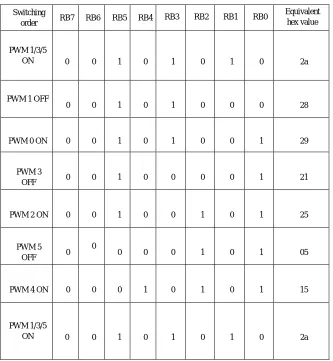
From the figure 4.1 switching action of the inverter switches can be done in the order below,
PWM 1/3/5 ON, PWM 1 OFF, PWM 0 ON, PWM 3 OFF, PWM 2 ON, PWM 5 OFF, PWM 4 ON, PWM 1/3/5 ON and cycle repeats
VI. RESULT AND DISCUSSION
1. For Forward direction
If the status of the switch connected to the port C is read to be high, the motor rotates in the forward direction. The corresponding switching actions are listed below. There should be a deadtime of 1μS between OFF and ON period of
any switch.
Switching
order RB7 RB6 RB5 RB4 RB3 RB2 RB1 RB0
Equivalent hex value
PWM 1/3/5
ON 0 0 1 0 1 0 1 0 2a
PWM 1 OFF
0 0 1 0 1 0 0 0 28
PWM 0 ON 0 0 1 0 1 0 0 1 29
PWM 3
OFF 0 0 1 0 0 0 0 1 21
PWM 2 ON 0 0 1 0 0 1 0 1 25
PWM 5
OFF 0
0
0 0 0 1 0 1 05
PWM 4 ON 0 0 0 1 0 1 0 1 15
PWM 1/3/5
ON 0 0 1 0 1 0 1 0 2a
Table 5.1: Switching sequence for forward Control
2. For Reverse direction
Switching
order RB7 RB6
RB 5
RB
4 RB3 RB2 RB1 RB0
Equivalent hex value
PWM 1/3/5
ON 0 0 1 0 1 0 1 0 2a
PWM 1 OFF
0 0 1 0 1 0 0 0 28
PWM 0 ON 0 0 1 0 1 0 0 1 29
PWM 3
OFF 0 0 0 0 1 0 0 1 09
PWM 2 ON 0 0 0 1 1 0 0 1 19
PWM 5
OFF 0
0
0 1 0 0 0 1 11
PWM 4 ON 0 0 0 1 0 1 0 1 15
PWM 1/3/5
ON 0 0 1 0 1 0 1 0 2a
Table 5.2: Switching sequence for reverse Control
OUTPUT WAVEFORMS:
Here the ADC value in accordance with the potentiometer variations is been taken into considerations to achieve the Variable speed of operation through pulse width modulation. The controller is programmed to give three sets of forward and reverse speeds depending on the ADC value. i.e. when ADC=0, when ADC<50, when 50<ADC<3FF. All the combinations of PWM waveforms obtained from the hardware circuit are recorded through a digital Cathode-Ray-Oscilloscope and are as shown below
FOR FORWARD DIRECTION
:
1. PWM1 and PWM0
a) At ADC=0 b) At ADC=27 c) At ADC=504
Fig. 6.1: PWM1 and PWM0 Waveforms
2. PWM3 and PWM2
a) At ADC=0 b) At ADC=27 c) At ADC=504
Fig. 6.2: PWM3 and PWM2 Waveforms
From the Fig. 6.2, note that width of each pulse in PWM3 and PWM2 is increased as ADC value is increased.
3. PWM5 and PWM4
a) At ADC=0 b) At ADC=27 c) At ADC=504
Fig. 6.3: PWM5 and PWM4 Waveforms
From the Fig. 6.3, note that width of each pulse in PWM5 and PWM4 is increased as ADC value is increased.
Therefore pulse width of all the PWMs will increase by increasing the ADC value. Hence the variable speed control of a PSC type of single phase induction motor in forward direction can be achieved by giving these pulses to the 3 phase inverter to have desired switching action.
FOR REVERSE DIRECTION:
i) At ADC=0
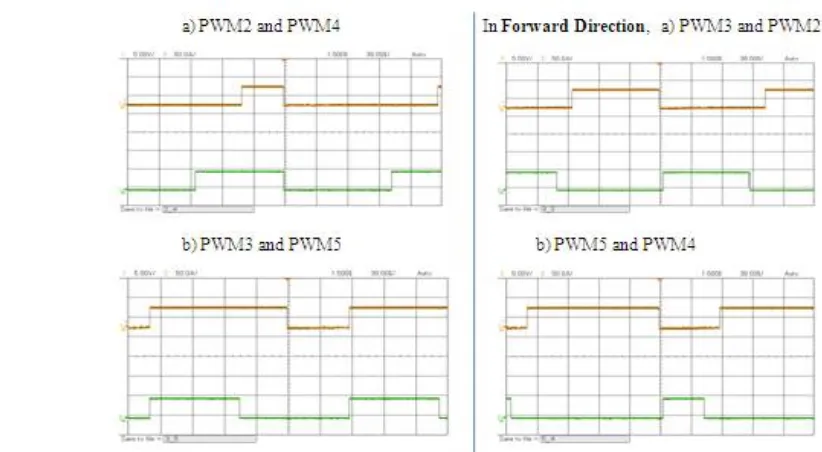
To achieve Reverse rotation of motor, the periods of switches 2 and 3 are interchanged with the periods of switches 4 and 5 respectively. i.e. 50% ON, 50% OFF period of PWM3 is interchanged by 75% ON, 25% OFF period of PWM5 and 50% OFF, 50% ON period of PWM2 is interchanged by 75% OFF, 25% ON period of PWM4 as shown in the figure 6.4.
ii) At ADC=27
Fig. 6.5: Comparison of PWM2 and PWM3 with PWM4 and PWM5 at ADC=27
As seen in the figure 6.5 and figure 6.6, the periods of switches 2 and 3 are interchanged with the periods of switches 4 and 5 respectively at ADC=27 and ADC=504. Width of each pulse is also modulated with change in ADC value.
iii) At ADC=504
From the waveforms, notice that the pulse width of all the PWMs will increase by increasing the ADC value and here the duty cycles of PWM2 and PWM3 are interchanged with the duty cycles of PWM4 and PWM5 respectively to have the reverse rotation. Hence the variable speed control of a PSC type of single phase induction motor in reverse direction can be achieved by giving these pulses to the 3 phase inverter to have desired switching action.
VII. CONCLUSION
The PIC16F72 is a popular low cost general purpose microcontroller from Microchip that can be used to implement the control algorithm. The PIC16F72 microcontroller-based control for PSC motor makes the system easy to implement and have control over the motor in two directions. Implementing the algorithm using a 3-phase inverter bridge gives flexibility and efficiency of control. Here the plus point is that, the motor can be rotated in two directions. So that it can be used in all the applications in which the operation in both directions is needed. Here Programming has been done to generate the PWMs required to control the three phase inverter and hence to control the PSC type of single phase induction motor. All the set of waveforms are provided in the Results section for both forward and reverse operations. Waveform clearly shows that the motor can be operated and controlled in both the directions for the variable speeds depending on the ADC value. ADC value can be varied by varying the potentiometer. Direction of rotation can be changed by the usage of switch.
REFERENCES
[1] Alfredo Mu˜noz-Garc´ıa, Thomas A. Lipo, Fellow, IEEE, and Donald W. Novotny, Fellow, IEEE “A New Induction Motor V/f Control Method Capable of High-Performance Regulation at Low Speeds”
[2] Atul M. Gajare1, Nitin R. “A Review on Speed Control Techniques of Single Phase Induction Motor” International Journal of Computer Technology and Electronics Engineering (IJCTEE) Volume 2, Issue 5, October 2012
[3] Christos Mademlis, Member, IEEE, Iordanis Kioskeridis, and Theodoros Theodoulidis, Associate Member, IEEE “Optimization of Single-Phase Induction Motors—Part I: Maximum Energy Efficiency Control”
[4] Deniz Yildirim and Murat Bilgic “PWM AC chopper control of Single phase induction motor for variable speed fan application” IEEE 2008 [5] Maurício Beltrão de Rossiter Corrêa, Member, IEEE, Cursino Brandão Jacobina, Senior Member, IEEE, Edison Roberto Cabral da Silva, Fellow, IEEE, and Antonio Marcus Nogueira Lima, Member, IEEE “Vector Control Strategies for Single-Phase Induction Motor Drive Systems”
[6] Miroslav Chomat, Member, IEEE, and Thomas A. Lipo, Fellow, IEEE “Adjustable-Speed Single-Phase IM Drive With Reduced Number of Switches”