c e-ISSN: 2348-6848, p- ISSN: 2348-795X Volume 2, Issue 12, December 2015
International Journal of Research (IJR)
Available at http://internationaljournalofresearch.orgCollaboration in Multicolor Computing Environments:
Framework and Security Issues
Anand Burjukadi
PG Student, Department of CSE, SV college of Engineering
Annapareddy V N Reddy
Assistant Professor Department of CSE, SV college of Engineering
ABSTRACT:
A proposed proxy-based multi-cloud computing framework allows dynamic, on the fly collaborations and resource sharing among cloud-based services, addressing trust, policy, and privacy issues without pre-established collaboration agreements or standardized interfaces. The recent surge in cloud computing arises from its ability to provide software, infrastructure, and platform services without requiring large investments or expenses to manage and operate them. Clouds typically involve service providers, infrastructure/resource providers, and service users (or clients). They include applications delivered as services, as well as the hardware and software systems providing these services.
1. INTRODUCTION
A proposed proxy-based multi-cloud computing framework allows dynamic, on the fly collaborations and resource sharing among cloud-based services, addressing trust, policy, and privacy issues without pre-established collaboration agreements or standardized interfaces. The recent surge in cloud computing arises from its ability to provide software, infrastructure, and platform services without requiring large investments or expenses to manage and operate them. Clouds typically involve service providers, infrastructure/resource providers, and service users (or clients). They include applications delivered as services, as well as the hardware and software systems providing these services. Cloud computing characteristics include a ubiquitous (network-based) access channel; resource pooling; multitenancy; automatic and elastic provisioning and release of computing capabilities; and metering of resource usage (typically on a pay-per-use basis). Virtualization of resources such as processors, network, memory, and storage ensures scalability and high availability of computing capabilities. Clouds can dynamically provision these virtual resources to hosted applications or to clients that use them to develop their own applications or to store data. Rapid provisioning and dynamic reconfiguration of resources help cope
c e-ISSN: 2348-6848, p- ISSN: 2348-795X Volume 2, Issue 12, December 2015
International Journal of Research (IJR)
Available at http://internationaljournalofresearch.orgmakes cloud service providers (CSPs) to propose new functionalities to clients at lower development costs. Examples of cloud mashups and technologies are IBM’s Mashup Center, Appirio Cloud Storage and Force.com for the Google App Engine. For example, cloudbased electronic medical record (EMR) management systems like [1] Practice Fusion, Verizon Health Information Exchange, Medscribbler, and GE Healthcare Centricity Advance are emerging. Cloud mashups want pre-established agreements among providers as well as the use of custom built, proprietary tools that combine services through low-level, tightly controlled and constraining integration techniques. This approach to building new collaborative services does not support agility, flexibility, and openness [2]. Realizing multicloud collaboration’s full potential will require implicit, transparent, universal, and on-the-fly interaction involving different services reach across multiple clouds that lack pre established agreements and proprietary collaboration tools. While cloud standardization will support collaboration, there are number of hurdles to its adoption. From a market perspective, it is doubtful that multiple CSPs will agree on an easy and standardized way to access services, as this would give clients total freedom in changing providers, leading to increased open and direct competition with other providers. Cloud-based computing also introduces new security concerns that affect collaboration across multi cloud applications they are, increase in the attack surface due to system complexity, loss of client’s control over resources and data due to asset migration, threats that target exposed interfaces due to data storage in public domains, and data privacy concerns due to multitenancy [13]. So there is need of developing multi cloud system which provides trust, security and safety for applications and data. Keeping all these drawbacks my work is to develop a generic cloud collaboration allows clients and cloud applications to simultaneously use services from and route data among multiple clouds. There are restrictions in the current cloud computing model prevent direct collaboration among applications hosted by different clouds.
COLLABORATION FRAMEWORK FOR
MULTICLOUD SYSTEMS:
Our proposed framework for generic cloud collaboration allows clients and cloud applications to simultaneously use services from and route data among multiple clouds. This framework supports universal and dynamic collaboration in a multicloud system. It lets clients simultaneously use services from multiple clouds without prior business agreements among cloud providers, and without adopting common standards and specifications.
Use of proxies for collaboration
c e-ISSN: 2348-6848, p- ISSN: 2348-795X Volume 2, Issue 12, December 2015
International Journal of Research (IJR)
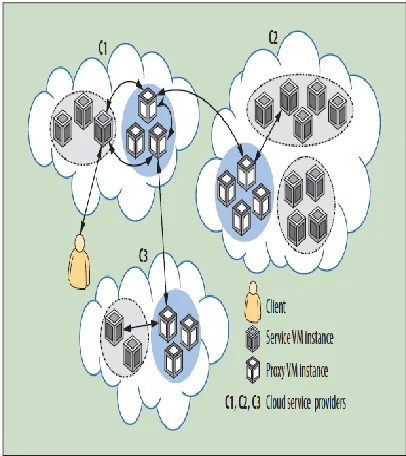
Available at http://internationaljournalofresearch.orgdifferent clouds. Also, CSPs typically package their service offerings with other resources and services. This results in a tight dependency of a service on the hosting CSP. Such a service delivery model limits a client’s ability to customize a service and use it in combination with service offerings from different CSPs. A technique that could overcome these restrictions uses a network of proxies. A proxy is an edge-node-hosted software instance that a client or a CSP can delegate to carry out operations on its behalf. Depending on the context, the system can regard a network of proxies as a collection of virtual software instances connected via a virtual network or a set of physical nodes connected via an underlying network infrastructure. The basic idea is to enable proxies that act on behalf of a subscribing client or a cloud to provide a diverse set of functionalities: cloud service interaction on behalf of a client, data processing using a rich set of operations, caching of intermediate results, and routing, among others. With these additional functionalities, proxies can act as mediators for collaboration among services on different clouds. Proxy deployment can be strategic—in close geographical proximity to the clouds, for example—to improve performance and facilitate execution of longlived applications without additional user intervention. As an example of proxy-facilitated collaboration between clouds, consider a case in which a client or CSP wishes to simultaneously use a collection of services that multiple clouds offer. First, the requesting entity chooses proxies to act on its behalf and to interact with cloud applications. A client or a CSP might employ multiple proxies to interact with multiple CSPs. It can select proxies based on, for example, latencies between proxies and clouds or workload conditions at various proxies. Once it chooses proxies, the client or CSP delegates the necessary service-specific privileges to the proxies to carry out the service request using the necessary security precautions. These proxies can further delegate to other proxies if necessary and initiate the service request. In some instances, clients or CSPs can assign special roles to one or more proxies in the network to coordinate the operations in a service request among the multiple delegate proxies. Following delegation, the requesting
entity need not further interact with the proxy network until the proxies complete the service request. During execution of a service request, proxies would interact with cloud-based applications, playing the role of the service subscriber(s). By independently requesting services from the clouds, and by routing data between each other in a manner transparent to cloud applications, proxies can facilitate collaboration without requiring prior agreements between the CSPs. Proxies can also perform operations to help overcome incompatibilities among services to allow data exchange between them.
Architectural overview
Clouds consist of multiple network-connected resource clusters such as server farms, data warehouses, and so on that host geographically distributed virtual machines and storage components that ensure scalability, reliability, and high availability. A multicloud system that employs proxies for collaboration consists of three architectural components: multiple cloud computing systems, networks of proxies, and clients (or service users). Such systems can use several possible strategies for placing proxies in the proxy network.
c e-ISSN: 2348-6848, p- ISSN: 2348-795X Volume 2, Issue 12, December 2015
International Journal of Research (IJR)
Available at http://internationaljournalofresearch.orgFigure 2.Proxy as a service. In this scenario, cloud service providers (CSPs) deploy proxies as an autonomous cloud system and offer it as a service to clients. (a) A client employs two proxies to interact with CSPs C1 and C2. (b) Alternatively, a client initiates a service request with C1, which then discovers the need for a service from C2. PSP: proxy service provider.
Figure 3.On-premises proxy. Clients deploy proxies within the infrastructure of their organization. (a) A client employs two proxies to interact with CSPs C1 and C2. (b) A client initiates a service request with C1, which then discovers the need for a service from C2. Hybrid proxy infrastructure
c e-ISSN: 2348-6848, p- ISSN: 2348-795X Volume 2, Issue 12, December 2015
International Journal of Research (IJR)
Available at http://internationaljournalofresearch.orgFor example, clients that must initiate a service request with two CSPs can employ on-premises proxies for collaboration. On the other hand, a cloud-based application that discovers it needs a service from another CSP to fulfill a client’s request can employ a CSP-maintained proxy. The proposed architectures illustrate the various options that are available for deploying proxies to support collaboration. Developing these architectures serves as the first step in building a proxy-based, collaborative, multicloud computing environment. A complete solution will entail several additional tasks. For example, an important task is a comprehensive study and evaluation of the proposed proxy-based architectures. Such an evaluation must cover each architecture’s use cases, and, if possible, merge the architectures into a universal proxy-based architecture for multicloud collaboration. Another important task is developing a full suite of protocols and mechanisms that proxies must implement to support all the functionalities necessary for acting as mediators among services from multiple clouds. For example, supporting collaboration scenarios that migrate a client-subscribed virtual machine from one cloud to another requires techniques for translation between various virtual machine packages and distribution formats possible variations under diverse practical use cases and scenarios for multicloud collaboration. Based on this study, researchers can refine the proposed architectures, develop new variations to support different scenarios and Implementation is an activity that brings the developed system into operational use and turning it over to the user. The changeover from the old to the new system can be arranged once the computer system is tested and approved. The most important phase in software life cycle is project implementation. The initial process of project is to connect the user with server with the help of port number activation. According to the port number activation we have to connect the process with the cloud. Here, the data owner and also the data user can be connected with each other to put the IP address into the block. Main server can communicate with all users in the cloud and receive all information send by the users and also receiving the details. In that situation
we provide the result of number of hosts, number of cloudlets and usage of particular virtual machines. These all information’s are displayed in our process. In download module the user has to know the file key to download the file. Again user has to login and give the file name to search. The download access is to enable the user and download the file. The downloaded file can be stored in any important drive in our system. The authorized user only can request the file and also access the file. If the owner enable the access rights to download the user has download the file easily. If the owner does not give the access rights to download the user can’t download the file. In upload module the owner has to add the files. To adding the file in the system the owner has to login his details first. The details are mail-id, password and his generated key. To upload the file the owner has to give the filename, keywords to identify the file, description about the file, permission access to read or write or both and file key. Then the owner has to choose the file and upload the file. The uploaded files are downloading by authorized users only. The unauthorized users do not download the files. The security can be maintained in this module.
CONCLUSION
It facilitates dynamic collaboration between clouds, in this proposed framework that uses proxies for collaboration between clouds. Here Proxies acts as a mediator between applications in multiple clouds that want to collaborate to share data. The proposed framework has the potential to overcome several restrictions in the current cloud computing model that can prevent dynamic collaboration among applications hosted by different cloud systems. Future research directions for the proposed framework include refining the proxy deployment scenarios and development of infrastructural and operational components of a multicloud system.
REFERENCES
c e-ISSN: 2348-6848, p- ISSN: 2348-795X Volume 2, Issue 12, December 2015
International Journal of Research (IJR)
Available at http://internationaljournalofresearch.org[2] B. Rochwerger et al., ―Reservoir—When One Cloud Is Not Enough,‖ Computer, Mar. 2011, pp. 44-51.
[3] S. Chandrasekhar et al., ―Efficient Proxy Signatures Based on Trapdoor Hash Functions,‖ IET Information Security, Dec. 2010, pp. 322-332
[4] M.P. Papazoglou and W. van den Heuvel, ―Blueprinting the Cloud,‖ IEEE Internet Computing, Nov./Dec 2011, pp. 74-79.
[5] FouedJrad, Jie Tao and AchimStreitSteinbuch Centre for Computing, Karlsruhe Institute of Technology, Karlsruhe, Germany {foued.jrad, jie.tao, achim.streit}@kit.edu.
[6] David Bernstein, Deepak Vij Huawei Technologies, USA Huawei Technologies, USA.
[7] D. Bernstein and D. Vij, ―Intercloud Security Considerations,‖ Proc. 2nd Int’l Conf. Cloud Computing (CloudCom 10), IEEE Press, 2010, pp. 537-544.
[8] GuilhermeSperb Machado, David Hausheer, Burkhard Stiller Communication Systems Group CSG, Department ofInformatics IFI, University of Zürich UZH Binzmühlestrasse 14, CH-8050 Zürich, Switzerland
[9] D. Bernstein, E. Ludvigson, K. Sankar, S. Diamond and M. Morrow, Blueprint for the InterCloud Protocols and Formats for Cloud Computing Interoperability, In Proceedings of the Fourth International Conference on Internet and Web Applications and Services, 2009.
[10] B. Farroha and D. Farroha Cyber security components for pervasive Enterprise Security Management and the virtualization aspects, Systems Conference, 2010 4th Annual IEEE, 2010.
[11] Rochwerger B, Breitgand D, Levy E, Galis A, Nagin K, Llorente IM, Montero RS, Wolfsthal Y, ElmrothE,Cáceres JA, Ben-Yehuda M, Emmerich W, Galán F. The RESERVOIR model and architecture for open federated cloud computing.IBM Journal of Research and Development2009;53(4):1–11.
[12] Kelly K. The Technium: A Cloudbook for the Cloud.
Available from:
http://www.kk.org/thetechnium/archives/2007/ 11/a_cloudbook_for.php [last accessed 1 June 2012].
[13] Amazon. Summary of the Amazon EC2 and Amazon RDS Service Disruption. Available from: http://aws.amazon. com/message/65648/ [last accessed 1 June 2012].
[14] Google AppEngine, http://code.google.com/appengine/.
[15] Bernstein, D., Vij, D.: Using XMPP as a transport in Intercloud Protocols In Proceedings of CloudComp 2010, the 2nd International Conference on Cloud Computing (2010).
[16] Bernstein, D.: The Intercloud: Cloud Interoperability at Internet Scale, In Proceedings of the 2009 NPC, pp. xiii (Keynote 2), Sixth IFIP International Conference on Network and Parallel Computing (2009).
[17] ―Xen hypervisor,‖ http://xen.org/, May 2012.
[18] S. Crosby, R. Doyle, M. Gering, M. Gionfriddo, S. Grarup, S. Hand,M. Hapner, D. Hiltgen, and et.al, ―Open Virtualization Format Specifi-cation,‖ vol. DSP0243 1.1.0, Jan 2010, http://dmtf.org/standards/ovf.
[19] A. Andrieux, K. Czajkowski, A. Dan, K. Keahey, H. Ludwig, T. Kakata,J. Pruyne, J. Rofrano, S. Tuecke, and M. Xu, ―Web Services Agreement Specification (WS-Agreement),‖ vol. GFD.192, October 2011, https://forge.ogf.org/sf/projects/graap-wg.
[20] B. Allcock, J. Bester, J. Bresnahan, A. L. Chervenak, I. Foster, C. Kesselman, S. Meder, V. Nefedova, D. Quesnal, S. Tuecke. ―Data Management and Transfer in High Performance Computational Grid Environments‖, Parallel Computing Journal, Vol. 28 (5), May 2002, pp. 749-771.
AnandBurjukadi m.techsv college of engg
moniabad