Revised: Block Cipher Based Hash Function Construction From
PGV
Duo Lei, Guozhu Feng , Li Chao , and RuiLin Li
Department of Science, National University of Defense Technology,Changsha, China
Abstract. Preneel, Govaerts, and Vandewalle[12] considered the 64 most basic ways to construct a hash function from a block cipher, and regarded 12 of these 64 schemes as secure. Black, Pogaway and Shrimpton[3] proved that, in black-box model, the 12 schemes that PGV singled out as secure really are secure and given tight upper and lower bounds on their collision resistance. And also they pointed out, by stepping outside of the Merkle-Damgard[5] approach to analysis, an additional 8 of the 64 schemes are just as collision resistant as the first group of schemes. In this paper we point out that the 12 compression functions that PGV singled out are free start collision resistant and others are not, the additional 8 compression functions are only fix start collision resistant as singled out by BRS, the hash functions based on those 20 schemes are fix start collision resistant, the upper bound of collision resistance and preimage resistant are given based on conditional probability of
P
Y X| = x( )
y
,| =
( )
Y K k
P
y
of compression function, not based on assumption of random oracle model, the bounds have more practical value than the bounds given by BRS. In view point of collision resistant, the best 4 schemes are not among the 12 schemes singled by PGV, and among the 8 schemes point out by BRS, and block cipher E itself is the best compression to build a collision resistant hash function. At the end of the paper, two recommend structure of block cipher based hash function are given, and a prove of their securities are also given.Key Words: Hash Function, Block Cipher, M-D Construction
1 Introduction
Most of hash functions iterate a compression function by Merkle-Damgaard structure with constant IV[10]. A well known approach for building hash function is the compression function out of a block cipher which have been discussed sine Rabin[13] given the first model of that kind of structure. As pointed out by BRS the block cipher approach has been less widely used for variety of reasons, and the emergence of the AES[6] has somewhat modified this landscape, especially recently the MD5 and SHA1 were attacked[1][2][16][17].
The topics of building hash function based on block cipher had been systematically analyzed in paper [12][15][9][3] and [7]. The PGV paper considered turning a block cipher
{0,1}
{0,1}
{0,1}
:
n×
n→
nE
into a hash function:
{0,1}
ni*×
{0,1}
n→
{0,1}
nH
using acompression function
F
:{0,1}
n×
{0,1}
n→
{0,1}
n derived from E. For v is a fixed n-bit constant, PGV considerd all 64 compression functions F of the formF m h
(
i,
i−1)
=
E b
a( )
⊕
c
,where1 1
, ,
∈
{
i,
i−,
i⊕
i−, }
a b c
m h
m
h
v
,defined the iterated hash ofF
asH m
(
t||
||
m IV
1,
)
=
h
t , 0h
=
IV
,h
i=
F m h
(
i,
i−1)
,i
∈
[1,
, ],|
t
m
i|
=
n
. Of the 64 such schemes, the authors of [12] regarded 12 as secure.schemes picked by PGV and the group-2 was the new founded 8 schemes. For the new founded schemes, the hash function H immune to collision attack within the Merkle-Damgard paradigm, the compression functions were not immune to collision attack. The proves of collision resistant of group-2 used the assumptions of E was a random oracle model and H with fix start model. They also provided both upper and lower bounds for each scheme.
This paper provide the complexity of finding a collision or preimage based on the assumption of known conditional probability of block cipher E. We analyze the 64 schemes with M-D structure, the 12 compression functions that PGV singled out are immune to free start collision resistant and additional 8 compression functions singled out by BRS are immune to fix start collision resistant. All the 20 schemes based hash function are fix start collision resistant, and fix start preimage resistant (where the preimage of 8 schemes singled out by BRS based hash function can be found by meet in middle attack, but the complexity is
2
n/ 2. On that condition we still call the hash is preimage resistant, for the complexity is same as birthday attack on collision).On considering of collision resistance, the best 4 schemes are not among the 12 schemes singled out by PGV and are among the 8 schemes singled out by BRS and the block cipher E is the best compression function, more precisely, we can tell the precise upper bound of preimage resistant and collision resistant of those 4 schemes, that of other 16 schemes are unpredictable and the block cipher E has much influence on the bounds. In this paper, we assume the padding is padding zero at end of the message, and the hash function is iterated by Merkle-Damgard paradigm.
2 Definition
2.1 Basic Definition
The notations of the probability it the paper is followed PhD paper of Christian Cachin[4].
Let
I
n{0,1}
n , the compression functionF I
:
× →
kI
nI
n ,y
=
F x
(
m,
x
h)
,x
h∈
I
n ,m k
x
∈
I
,y
∈
I
n , in hash iteration,x
h is chaining value. Let M-D hash construction:
k n nH I
⋅∗× →
I
I
,x
∈
I m
n,
∈
I
ki∗,
z
∈
I
n.1 1
( , )
(
||
||
, )
(
, (
, (
, )))
z
=
H m x
=
H m
∗m x
F m F
∗F m x
.Let
G I
:
× →
lI
nI
n ,z
=
G m x
( , )
,Ω
{( , , ) |
y m x m
∈
I x
l,
∈
I z
n,
∈
I
n}
,m
∈
I
l ,x
∈
I
n ,n
z
∈
I
,{( , , )}
z m x
G{( , , ) | ( , , )
z m x
z m x
∈ =
Ω
,
z
G m x
( , )}
,0 0
0 0
,
max#{( ,
, )}
GG z m
S
z m x
,0 0
0 0
,
max#{(
, ,
)}
GG z x
T
z m x
,0 0
max#{(
, , )}
GG z
R
z m x
A discrete random variable
X
is a mapping from the sample spaceΩ
to an alphabetχ
,X
assigns a value
x
∈
X
to each elementary event in theΩ
and the probability distribution ofX
is the function:
: ( )
: : [ ] [ ]
ω ω
χ
ω
∈Ω =
→ ℜ = =
∑
X
X x
P x P X x P
If the conditioning event involves another random variable Y defined on the same sample space, the conditional probability distribution of Y given that X takes on a value y is:
|
( , )
( )
( )
XY Y X x
X
P
x y
P
y
P x
==
whenever
P x
X( )
is positive .( , )
1,
( , )
( )
0,
( , )
g m x
y
g m x
y
y
g m x
χ
⎧
⎨
=
≠
⎩
the random variable Y’s distribution can be derived from X and M by:
( , ) ( , )
( )
( , )
( )
( )
( )
( )
n n t n n t
Y MX g m x M M g m x
x I m I x I m I
P y
P
m x
χ
y
P
m P
m
χ
y
⋅ ⋅
∈ ∈ ∈ ∈
∑ ∑
∑ ∑
we call the probability of
Y
is derived probability of M and X.Definition 1: (Random Oracles[3]). A fixed-size Random Oracle is a
function
f I
:
a→
I
b chosen uniformly at random from the set of all such functions.Definition 2: The maximum advantage of collision attack and preimage attack are defined as follows: 1. Pseudo Preimage Attack:
0
Pr ,
0 0
( )
max Pr[
;
:
{( , , )} ]
e F H H
H n
z
Adv
A
z
∈
I
ω
←
A
ω
∈
z m x
2. Fixed Start Preimage Attack:
0
FixP ,
0 0 0 0
( ) max Pr[ , ; F H : {( , , )} ]H
H n
z
Adv A z x ∈I
ω
←Aω
∈ z m x3. Pseudo Collision Attack:
0
,
0
( )
max Pr[ ,
: ,
,
{{( , , )} }]
Coll F H F
H
z
Adv
A
ω ω
′
←
A
ω ω
′
∈ Λ Λ ⊂
z m x
4. Fixed Start Collision Attack:
0
,
0 0 0
( )
max Pr[
, ,
: ,
,
{{( , ,
)} }]
FixC F H H
H n
z
Adv
A
x
∈
I
ω ω
′
←
A
ω ω
′
∈Λ Λ ⊂
z m x
.Definition3: [Black Box Model] function
g I
:
k t⋅× →
I
nI
ny
=
g m x
( , )
is a Black Box Model, if the probabilities of success of Game0 and Game1 are same, whereq
≤
2
n/ 2:Game0 (
A F y q
, ,
0,
) For i=1,…,t do:0
(
,
)
y i i
A
→
m x
A wins if exists i st
z
0=
G m x
(
i,
i)
Game1 (
A F y q
, ,
0,
)Q
← ∅
For i=1,…,t do:
0
(
, )
(
i,
i)
A y Q
→
m x
( (
i,
i),
i,
i)
Q
→ ∪
Q
G m x
m x
A wins if exists i st.
z
0=
G m x
(
i,
i)
3 The Security of Hash Function
Theorem 2 ( [8] ).For
y
=
F( x , x )
m h , andy
=
H( m, x )
, then:1. if
y
=
F( x , x )
m h is black box model then:Pr
( )
2 max{
,
}
2
2
e H H
H n k
S
T
Adv
q
=
q
;P
( )
2 max{
}
2
Fix H
H k
T
Adv
q
=
q
;( )
1
Coll H
Adv
q
=
;1
( )
max{2
, (
1)
}
2
2
FixC H H
H n k
S
T
Adv
q
≤
q
q q
−
−
.2. if, for any
0
h n
x
∈
I
,0 m h
y
=
F( x ,x )
is black box model then:P
( )
2 max{
}
2
Fix H
H k
T
Adv
q
=
q
;1
( )
max{2
, (
1)
}
2
2
FixC H H
H n k
S
T
Adv
q
≤
q
q q
−
−
.4 Collision Resistance of PGV Schemes
We assume block cipher
E I
:
n× →
I
nI
n,y
=
E x
k( )
is black box model, the security of 24 PGV schemes is summarized in tables 1 where we do not consider the constant valuev
. The functions are numbered in BRS[3],F I
i:
× →
nI
nI
n,H
i are M-D construction with::{0,1}
n{0,1}
n{0,1}
ni
H
⋅ ∗×
→
1
( , )
(
,
(
,
(
, )))
i i i i
z
=
H m x
F m F
∗F m x
Where
m
=
m
∗||
||
m
1,x
∈
I
n.The
F
1~
F
12 are the group one schemes, which are immune to free start collision resistance andF
13~
F
20 are the group two schemes which are not immune to free start collision resistance, immune to fix start collision resistance. In fact 24 schemes are driven from 12 compression function with different fix start and four of which are not immune to fix start collision resistance.4.1 Probability of Compression Function
Lemma 1. If
y
=
E x
k( )
is a random oracle model,x k
,
is uniformly distributed inI
n then1
E
T
=
andS
E=
1
.Theorem 3. Block cipher
y
=
E x
k( )
is a random oracle model,x
andk
are uniformly distributed inI
n, then fory
=
F x
i(
m,
x
h)
,1
i
F
S
=
, and1
i
F
T
=
,1
≤ ≤
i
24
.We give the prove of the most famous model 1
:
(
)
h
x m m
F y
=
E
x
⊕
x
.1 0 0 | | , | , ( , ) ( , ) ( , ) |
( )
(
)
(
(
)
)
=
(
)
(
,
(
))
1
(
)
( )
2
1
(
)
( )
2
h hm m m h h h
m
m m m h h h
m
m m h
m
m h h
Y X x
X m Y X x X x x m m
x
X m Y X x X x m x m
x
x u m F x x
n u x
x u m U X x n
u
P
y
P
x
P
y
E
x
x
P
x
P
y
x
u u
E
x
y
x
u
u
y
x
u P
u
χ
χ
χ
= = = = = ==
=
⊕
=
⊕
=
=
=
⊕
≤
=
⊕
=
∑
∑
∑∑
∑
And also| | , | ,
( )
(
)
(
(
))
=
(
)
(
(
))
1
2
m mh m m h h h
h
h m m h h h
h
Y X x
X h Y X x X x m x m
x
X h Y X x X x x m
x
n
P
y
P
x
P
y
x
E
x
P
x P
y
E
x
= = = = =
=
⊕
=
′ =
=
∑
∑
Other models can be proved in similar way.
Theorem 4.
∀
k
0, ( ,
y
=
E x k
0)
is a black box model, thenF
i,1
≤ ≤
i
12
are black box model.Proof. We give the prove of
F
1, others can be proved in similar way. 11
:
xh(
m)
m xh(
m)
mF y
=
E
x
⊕
x
⇔
E
−y
⊕
x
=
x
, for giveny
andx
m, if we can getx
h, that impliesfor given plaintext
x
m and cipher texty
⊕
x
m, we get the keyx
h with(
)
h
m x m
y
⊕
x
=
E
x
, sinceE
is a block cipher, the best way to findx
h is exhaustive search; for giveny
andx
h, if we can getx
m by direct computation means for giveny x
,
h, we can get the cipher textx
m⊕
y
and plaintextx
m directly, but the computation we can do isE
andE
−1, the condition is possible only whenE
is a linear function, for(
)
h
x m m
y
=
E
x
⊕
x
,E
is not a linear function, so the only way tofind the
x
m is exhaustive search, collision resistant can be proved in similar way.Theorem 5.
0
,
(
,
0)
h i m h
x
y
F x
x
∀
=
is black box model.Proof.
13
F
−
:∀
y
,x
=
E
k−1( )
y
, letx
mx
,x
hx
⊕
k
,
, then(
)
m
h m m
x x h
E
⊕x
⊕ ⊕
x
x
=
y
, but∀
y
and
0
h
x
, the way to findx
msatisfy0 m
(
)
h x m
x
E
⊕x
=
y
is exhaustive search, so0
13
(
m,
h)
y
=
F
x
x
is balck box model;
14
F
−
:∀
y
,x
=
E
k−1(
y
⊕
k
)
, letx
hx
⊕
k
,
x
mx
, then(
)
m
h m m
x x h
E
⊕x
⊕ ⊕
x
x
=
y
, buty
∀
and0
h
x
, we can’t findx
m satisfy0
0 m
(
)
h m m
x x h
E
⊕x
⊕
x
⊕
x
=
y
directly.15
F
−
:∀
y
,x
=
E
k−1(
y
⊕
k
)
, letx
hx
,
x
mk
, then( )
m h
x
E
x
=
y
, but∀
y
and0
can’t find
x
m satisfy0
(
)
m h
x
E
x
=
y
;16
F
−
:∀
y
,x
=
E
k−1( )
y
, letx
mk
⊕
x
,x
hx
,
thenE
xm⊕xh( )
x
h=
y
, but∀
y
andx
h0,we can’t find
x
m satisfy0
( )
h m hx x
E
⊕x
=
y
;17
F
−
:∀
y
,x
=
E
k−1(
y
⊕
k
)
, letx
hx
,
x
mk
⊕
x
,thenE
xm( )
x
h⊕
x
m=
y
, but∀
y
and0
h
x
, we can’t findx
m satisfy0
(
h)
m mx
E
x
⊕
x
=
y
;18
F
−
:∀
y
,x
=
E
k−1(
y
⊕
k
)
, letx
hx
,
x
mk
⊕
x
, thenE
xm⊕xh( )
x
h⊕
x
m⊕ =
x
hy
, buty
∀
and0
h
x
, we can’t findx
m satisfy0 0
0
(
h)
m hm h
x x
E
⊕x
⊕
x
⊕
x
=
y
;19
F
−
:∀
y
computesx
=
E
k−1( )
y
, letx
hx
⊕
k
,
x
mk
, thenE
xm(
x
m⊕
x
h)
=
y
, buty
∀
and0
h
x
, we can’t findx
m satisfy0
(
m h)
m
x
E
x
⊕
x
=
y
;20
F
−
:∀
y
computex
=
E
k−1(
y
⊕
k
)
, letx
hx
,
x
mk
, thenE
xm(
x
m⊕
x
h)
⊕
x
m=
y
, buty
∀
and0
h
x
, we can’t findx
m satisfy0
(
m h)
mm
x
E
x
⊕
x
⊕
x
=
y
;Theorem 6.
F
i,21
≤ ≤
i
24
are not fix start preimage resistant and fix start collision resistant. Proof. 21F
−
: 0,
hy x
∀
, let0
1
( )
h
m x
x
E
−y
then0
(
)
h m
x
E
x
=
y
;22
F
−
: 0,
hy x
∀
, let0 0
1
(
)
h
m x h
x
E
−⊕
y
x
then0 0
(
)
h m h
x
y
=
E
x
⊕
x
;23
F
−
: 0,
hy x
∀
, let0 0
1
( )
h
m x h
x
E
−y
⊕
x
then0
0
(
)
h m h
x
y
=
E
x
⊕
x
;23
F
−
: 0,
hy x
∀
, let0 0
0
1
(
)
h
m x h h
x
E
−⊕
y
x
⊕
x
then0 0
0
(
)
h m h h
x
E
x
⊕
x
⊕
x
=
y
.4.2Collision Resistance of Hash Function
Theorem 7. If block cipher
E
is a random oracle model, if the compression function is(
,
)
i m h
y
=
F x
x
,1
≤ ≤
i
20
,then the Hash functionH m IV
i( ,
)
, constant valueIV
∈
I
n is preimage resistance and collision resistant, the bound of collision resistance and preimage resistance are shown as bellow.−
ForH
i,1
≤ ≤
i
12
,2
( )
2
i FixP H nq
Adv
q
≤
,( )
(
1)
2
i
FixC
H n
q q
Adv
q
≤
−
.−
ForH
i,13
≤ ≤
i
20
,(
1)
( )
2
i FixP H nq q
Adv
q
≤
−
,( )
(
1)
2
i
FixC
H n
q q
Adv
q
≤
−
−
ForH
i,21
≤ ≤
i
24
,Proof. From Lemma 1, Theorem 2, Theorem 3 Theorem 4 and Theorem5 and Theorem6, we can get the conclusions directly.
Lemma 2. Let
E
is compression function, theny
=
E x
k(
⊕
k
)
,y
=
E x
k( )
⊕
k
,(
)
k
y
=
E x
⊕ ⊕
k
k
then|
1
( )
2
n Y K kP
=y
=
.Theorem 8. Let block cipher E I: n× →In In has no weakness then:
−
Fori
∈
{15,17,19, 20}
:( )
(
1)
2
i
i
F FixP
H n
T
Adv
q
≤
q q
−
,( )
(
1)
2
i
i
F FixC
H n
T
Adv
q
≤
q q
−
−
Fori
∈
{13,14,16,18}
:( )
max{ (
1)
, 2
}
2
2
i i
i
F H
FixP
H n n
T
S
Adv
q
≤
q q
−
q
,( )
max{ (
1)
, 2
}
2
2
i i
i
F H
FixC
H n n
T
S
Adv
q
≤
q q
−
q
.−
Fori
∈
{1, 2, 3, 4, 5, 6, 7,8}
:( )
max{2
, 2
}
2
2
i i
i
F H
FixP
H n n
T
S
Adv
q
≤
q
q
,( )
max{ (
1)
, 2
}
2
2
i i
i
F H
FixC
H n n
T
S
Adv
q
≤
q q
−
q
.5 Design of Secure Hash Function
From above discussion, we can make a conclusion that, if we can design a iterated hash function with
2
nH
S
=
− andT
H2
n−
=
, then the hash function is a idea model.Definition4: An iterated hash function structure is defined as
H
B1:
I
n ⋅ ∗× →
I
nI
n1
1
( || || , ) 1 0
( , ) ( )
B
H m m x
H m x E ∗ ⊕ ⊕ ⊕ h∗ h h ,
Where
x
∈
{0,1}
n,m
=
m
∗||
||
m
1,m
∈
{0,1}
n ⋅ ∗,(
1)
i
i m i
h
=
E
h
− ,h
0=
x
,z
=
H m x
( , )
, 1( , )
B
z
=
H
m x
.z
Fig.2 The design of
H
B1 Hash FunctionThe structure of
H
B1 is similar to the structure of 3c[19], but the attentions on the structure are different.Definition5. An iterated hash function structure is defined as
H
B2:
I
n ⋅ ∗× →
I
nI
n'
,
nz z
∈
I
,1
(
( ))
t
m m
z
=
E
E
x
,'
( , ),
(
,
)
(
)
h
m h x m
z
=
H m x y
=
F x
x
=
E
x
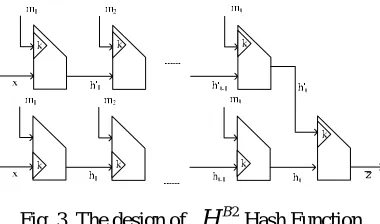
, 2( , )
( ')
B
z
z
Fig. 3. The design of
H
B2Hash FunctionTheorem 9. For
z
=
H
B1( , )
m x
,z
=
H
B2( , )
m x
, ifx
,k
andy
are independent from each other, andf m x
( , )
= ⊕ ⊕ ⊕
h
th
1h
0 is independent fromx
andm
, andy
=
F x
(
m,
x
h)
then:
1
1
B
H
S
=
,T
HB1=
T
E ,S
HB2=
1
, andT
HB2=
T
E.Theorem 10. For
z
=
H
B1( , )
m x
,z
=
H
B2( , )
m x
, ifx
,k
andy
are independent from each other, andf m x
( , )
= ⊕ ⊕ ⊕
h
th
1h
0 is independent fromx
andm
, andy
=
F x
(
m,
x
h)
then:1
( )
2
2
B
FixP E
H n
T
Adv
q
≤
q
, , 1( )
(
1)
2
B
FixC E
H n
T
Adv
q
≤
q q
−
2
( )
2
2
B
FixP E
H n
T
Adv
q
≤
q
, 2( )
(
1)
2
B
FixC E
H n
T
Adv
q
≤
q q
−
6 Conclusion
The theorem 7 needs block cipher is random oracle, or else (
x
andE x
k( )
) or (E x
k( )
andk
) is not independent, respectively. If block cipherE
is not assumed as a random oracle, then in13
≤ ≤
i
20
, theF
15,F
17F
19F
20 with properities of |( )
1
2
Y K k n
P
=y
=
,which means in group 2, thebest compression function is
F
15,F
17F
19F
20. And also theF
15 is the block cipherE
itself. In group 1, the possibility ofQ
i=
1
is very low, then the preimage resistant and collision resistant of these schemes are unpredictable, different block cipher may result in a totally different results, for in design of block cipher does not consider these properties and it is difficult to consider.i
F
y
x
hReferences
1. E.Biham and R.Chen. Near-Collisions of SHA-0 and SHA-1. In Selected Areas in Cryptography-SAC 2004.
2. E.Biham and R.Chen. Near-Collisions of SHA-0,In Advances in Cryptology CRYPTO'2004, LNCS 3152, pp290-305, 2004.
3. J.Black, P.Rogaway, and T.Shrimpton, "Black-box analysis of the block-cipher-based hash function constructions from PGV". In Advances in Cryptology -CRYPTO'02, volume 2442 of Lecture Notes in Computer Science. Springer-Verlag,2002.pp.320-335.
4. C.Chchin. Entropy Measures and Uncoditional Security in Cryptography, PHD thesis.
5. I.Damgºard. A design principle for hash functions. In G. Brassard, editor, Advances in CRYPTO' 89, LNCS 435, 1990.
6. J.Daemen and V.Rijmen: The Design of Rijndael: AES The Advanced Encryption Standard. Springer, 2002.
7. X.Lai and J.L.Massey: Hash functions based on block ciphers. In Advances in Cryptology
Eurocrypt'92, Lecture Notes in Computer Science, Vol. 658. Springer-Verlag, Berlin Hei-delberg New York (1993) 55-70.
8. D.Lei, The Security Proof of Iterated Hash Structure. http:\\eprint.iacr.org\2006\147.pdf
9. C. H. Meyer and S. M. Matyas. Cryptography: a New Dimension in Data Security.Wiley & Sons, 1982.
10. B.Preneel, V. Rijmen, A.Bosselaers: Recent Developments in the Design of Conventional Cryptographic Algorithms. In State of the Art and Evolution of Computer Security and Industrial Cryptography. Lecture Notes in Computer Science, Vol 1528. Springer-Verlag, Berlin Heidelberg New York(1998) 106-131.
11. B.Preneel: The State of Cryptographic Hash Functions. In Lectures on Data Security, Lecture Notes in Computer Science, Vol. 1561. Springer-Verlag, Berlin Hei-delberg New York (1999) 158-182.
12. B. Preneel, R. Govaerts, and J.Vandewalle, " Hash functions based on block ciphers,", In Advances in Cryptology -CRYPTO'93, Lecture Notes in Computer Science,pages 368-378. Springer-Verlag, 1994.
13. M. O. Rabin. Digitalized Signatures. In R. A. Demillo, D. P. Dopkin, A. K. Jones, and R. J. Lipton, editors, Foundations of Secure Computation, pages 155-166, New York, 1978. Academic Press.
28:656C715, 1949.
15. B. Van Rompay,Analysis and design of cryptographic hash functions, MAC algorithms and block cipher, K. U. Leuven, Juni 2004.
16. X.Wang, H.Yu, How to Break MD5 and Other Hash Functions, EUROCRYPT'2005, Springer-Verlag, LNCS 3494, pp19-35, 2005.
17. X. Wang, X. Lai, D.Feng and H.Yu., Cryptanalysis of the Hash Functions MD4
and RIPEMD, EUROCRYPT 2005, Springer-Verlag,LNCS 3494, pp1-18, 2005.