An Asymptotically Optimal Method for Converting
Bit Encryption to Multi-Bit Encryption
⋆Takahiro Matsuda and Goichiro Hanaoka
National Institute of Advanced Industrial Science and Technology (AIST), Japan
{t-matsuda,hanaoka-goichiro}@aist.go.jp
Abstract. Myers and Shelat (FOCS 2009) showed how to convert a chosen ciphertext secure (CCA secure) PKE scheme that can encrypt only 1-bit plaintexts into a CCA secure scheme that can encrypt arbitrarily long plaintexts (via the notion of key encapsulation mechanism (KEM) and hybrid encryp-tion), and subsequent works improved efficiency and simplicity. In terms of efficiency, the best known construction of a CCA secure KEM from a CCA secure 1-bit PKE scheme, has the public key size
Ω(k)· |pk|and the ciphertext sizeΩ(k2)· |c|, wherekis a security parameter, and|pk|and|c|denote the public key size and the ciphertext size of the underlying 1-bit scheme, respectively.
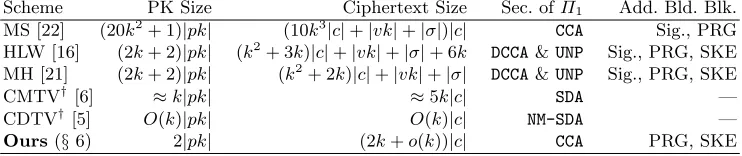
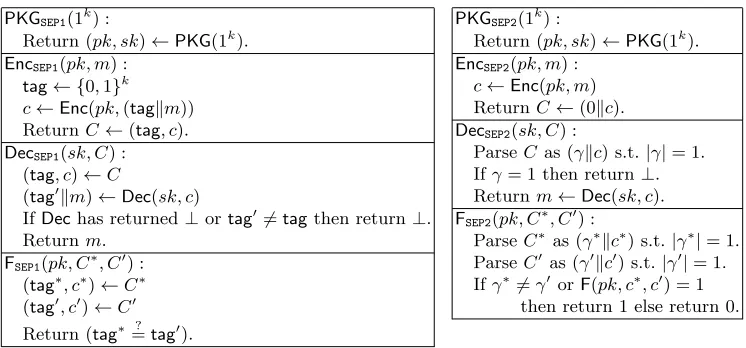
In this paper, we show a new CCA secure KEM based on a CCA secure 1-bit PKE scheme which achieves the public key size 2·|pk|and the ciphertext size (2k+o(k))·|c|. These sizes are asymptotically optimal in the sense that they are (except for a constant factor) the same as those of the simplest “bitwise-encrypt” construction (seen as a KEM by encrypting ak-bit random session-key) that works for the chosen plaintext attack and non-adaptive chosen ciphertext attack settings. We achieve our main result by developing several new techniques and results on the “double-layered” construction (which builds a KEM from an inner PKE/KEM and an outer PKE scheme) by Myers and Shelat and on the notion of detectable PKE/KEM by Hohenberger, Lewko, and Waters (EUROCRYPT 2012).
Keywords:public key encryption, key encapsulation mechanism, chosen ciphertext security, double-layered construction, detectable PKE and KEM.
⋆
Table of Contents
1 Introduction . . . 3
1.1 Background and Motivation . . . 3
1.2 Our Contributions . . . 4
1.3 Related Work . . . 6
1.4 Paper Organization . . . 7
2 Preliminaries . . . 8
2.1 Basic Notation . . . 8
2.2 (Detectable) Public Key Encryption . . . 8
2.3 (Detectable) Key Encapsulation Mechanism . . . 9
2.4 Non-malleable Codes . . . 10
3 New Security Notions for Detectable PKE and KEM . . . 11
3.1 “Weak” Non-malleability under DCCA and Its “Replayable” Variant . . . 12
3.2 Randomness-Inextractability . . . 12
3.3 Useful Facts . . . 13
4 Chosen Ciphertext Security of the Double-Layered Construction . . . 14
5 Concrete Instantiations of Building Blocks . . . 18
5.1 Bitwise-Encrypt Construction . . . 18
5.2 Encode-then-Bitwise-Encrypt Construction . . . 19
6 Full Description of Our 1-bit-to-Multi-bit Conversion . . . 21
7 Comparison . . . 22
8 On the Necessity of Two Key Pairs . . . 23
A Standard Cryptographic Primitives and a Basic Fact on Probability . . . 26
A.1 Symmetric Key Encryption . . . 26
A.2 Message Authentication Code . . . 26
A.3 Pseudorandom Generator . . . 27
A.4 Basic Fact on Probability . . . 27
B wNM-DCCA Security and Randomness-Inextractability for Detectable KEM . . . 27
C 2-bit-to-Multi-bit Conversion with a Single Key Pair . . . 28
D Proofs for Main Results . . . 30
D.1 Proof of Lemma 5: Non-triviality of Randomness-Inextractability . . . 30
D.2 Proof of Theorem 1: Our First Proof of CCASecurity ofΓDL. . . 32
D.3 Proof of Theorem 2: Our Second Proof of CCASecurity of ΓDL. . . 40
D.4 Proof of Theorem 3: Why DCCA Security, Unpredictability, and Randomness-Inextractability Are Not Enough . . . 49
D.5 Proof of Lemma 7: Randomness-Inextractability of ΠBEn . . . 51
D.6 Proof of Lemma 8: wRNM-DCCA Security ofΠEtBE . . . 52
D.7 Proof of Theorem 5: A CCA Attack on the “One-Key-Pair” ConstructionΓe′. . . 57
E Other Miscellaneous Proofs and Facts . . . 59
E.1 Proof of Lemma 2: Q ⊆ P. . . 59
1 Introduction
1.1 Background and Motivation
In this paper, we revisit the problem of how to construct a chosen ciphertext secure (CCA2, or just CCA) public key encryption (PKE) scheme that can encrypt plaintexts of arbitrary length from a CCA secure PKE scheme whose plaintext space is only 1-bit. (Hereafter, we call a PKE scheme whose plaintext space is {0,1}n an n-bit PKE scheme.) It is well-known that if we only consider
chosen plaintext attack (CPA) and non-adaptive chosen ciphertext attack (CCA1) settings, then the simple(st) “bitwise-encrypt” construction suffices, in which a plaintext is encrypted bit-by-bit (under the same public key) by a 1-bit PKE scheme, and the concatenation of all ciphertexts is regarded as a ciphertext of the construction. However, for the CCA setting, until recently, the simple question of how (and even whether) one can realize such a “1-bit-to-multi-bit” conversion had been left open.
This open problem was resolved affirmatively by Myers and Shelat [22]. They actually con-structed a CCA secure key encapsulation mechanism (KEM) which encrypts a random session-key, and can be used together with a CCA secure symmetric key encryption (SKE) scheme to achieve a full-fledged CCA secure PKE scheme via hybrid encryption [8]. One of the important steps of the approach by Myers and Shelat is to consider the “double-layered” construction of a KEM from an “inner” PKE scheme and an “outer” PKE scheme, where the inner ciphertext encrypts a plaintext (or a session-key if one wants to construct a KEM) and a randomness used for outer encryption, and the outer ciphertext encrypts the inner ciphertext using the randomness encrypted in the inner ciphertext. To decrypt a ciphertext, one first decrypts the outer ciphertext, and then the resulting inner ciphertext, to recover a plaintext and a randomness (for outer encryption), and the plaintext is output if the re-encryption of the inner ciphertext using the recovered randomness results in the outer ciphertext. Myers and Shelat showed that if the outer scheme that is built from a 1-bit scheme satisfies the security notion called “unquoted CCA” (UCCA) security (which is a weaker security notion than CCA security that can be considered only for a PKE scheme constructed using another PKE scheme as a building block), and the inner scheme satisfies “1-wise non-malleability against UCCA” (which has a similar flavor to 1-bounded CCA security [7]), the resulting construction achieves CCA security.
Despite the elegant ideas employed in [22, 16, 21], however, even in the best construction of [21] (in terms of efficiency), the public key size is Ω(k)· |pk| and the ciphertext size (when seen as a KEM) isΩ(k2)· |c|, wherekis a security parameter, and|pk|and |c|denote the public key size and the ciphertext size of a CCA secure 1-bit scheme, respectively. On the other hand, for constructing a CPA (resp. CCA1) secure KEM from a CPA (resp. CCA1) secure 1-bit scheme, one can use the above mentioned bitwise-encrypt construction in which one encrypts a k-bit random string and regards this as a session-key of a KEM. Note that the public key size of this KEM is just |pk|and the ciphertext size is k· |c|. Compared to this simplest and most straightforward method, in the CCA setting, the known constructions have the public key size and the ciphertext size that are at leastΩ(k) times larger.
Motivated by the above, in this paper we study the following question: How efficient can a
1-bit-to-multi-bit conversion for CCA security be?
1.2 Our Contributions
As our main result, we show a new 1-bit-to-multi-bit construction for the CCA setting, i.e., a construction of a CCA secure KEM based on a CCA secure 1-bit PKE scheme, with much better asymptotic efficiency than the existing constructions. Specifically, our construction achieves the public key size 2· |pk|, and the ciphertext size (2k+o(k))· |c|=O(k)· |c|, which are asymptotically optimal in the sense that these sizes are (except for a constant factor) the same as for the simple bitwise-encrypt construction for CPA and CCA1 security.
We achieve our main result by developing several new techniques and results on the double-layered construction of Myers and Shelat [22] and on the notion of detectable PKE/KEM by Hohenberger, Lewko, and Waters [16]. Our technical contributions in this paper lie in (1) coming up with appropriate security notions for detectable PKE/KEM so that we can conduct CCA security proofs for the double-layered construction using the language of detectable PKE/KEM (without addressing the details of how each of the inner and outer schemes is constructed) which we believe helps us understand our proposed construction (and more generally the double-layered approach itself) in a clearer manner, and (2) showing how one can realize the inner and outer schemes (satisfying the requirements of our security proofs) from a CCA secure 1-bit PKE scheme, so that the resulting CCA secure KEM achieves asymptotically optimal efficiency with respect to the bitwise-encrypt construction.
Below we explain more technical details of our results.
New Security Notions for Detectable PKE/KEM. In Section 3, we introduce new security notions for detectable PKE and detectable KEMs. Recall that DCCA security of [16] is defined like ordinary CCA security, except that in the security experiment, the decryption oracle is restricted according to the predicate F (which is a part of the syntax of detectable PKE/KEM): an adversary is not allowed to query a ciphertextcsuch thatF(c∗, c) = 1 wherec∗ is the challenge ciphertext. The first notion we introduce is a weak form ofnon-malleability [12, 3, 24] under DCCA that we simply name
We also introduce a new security notion for detectable PKE/KEM that we call randomness-inextractability. Recall that a DCCA secure detectable PKE scheme is meaningful only if it also satisfies another security notion that prevents the predicate F from outputting 1 for every input (which makes DCCA security equivalent to CPA security).Unpredictability [16] is one example of a security notion that prevents DCCA security from being trivial, which ensures that a ciphertext
c satisfying F(c∗, c) = 1 is hard to find without seeing c∗. Randomness-inextractability is another such security notion for detectable PKE: Informally, it requires that if an adversary is given a ciphertext c∗ (that encrypts a plaintext m of the adversary’s choice), it cannot come up with a pair of a (possibly different) plaintextm′ and randomnessr′ such thatF(c∗, c′) = 1, wherec′ is the encryption ofm′generated using the randomnessr′. We also show that randomness-inextractability and unpredictability do not imply each other, even if we combine one notion withwNM-DCCAsecurity. See Section 3 for the details.
New CCA Security Proofs for the Double-Layered Construction Based on Detectable PKE/KEM.
In Section 4, we show our main technical results: two new CCA security proofs for the double-layered construction of Myers and Shelat [22]. Our first security proof shows that if the inner KEM is a detectable KEM satisfying DCCA security and unpredictability, and the outer PKE scheme is a detectable PKE scheme satisfying wRNM-DCCA security and randomness-inextractability, then the KEM obtained from the double-layered construction is CCA secure. Our main result with asymptotically optimal efficiency is obtained from this security proof.
Our second security proof shows that if the inner KEM is wNM-DCCAsecure and unpredictable, and the outer PKE scheme is DCCA secure and randomness-inextractable, then the KEM obtained from the double-layered construction is CCA secure. Interestingly, this security proof can be seen as a generalization of Myers-Shelat’s original security proof of their construction [22].
Both of the security proofs have similar flavors to the security proofs of [16, 21]. Namely, DCCA security of the inner KEM guarantees that a session-key (hidden in the challenge ciphertext) is random as long as an adversary does not submit a “dangerous” decryption query (which are defined with respect to the predicate F from the inner detectable KEM), and we then upperbound the probability that the adversary comes up with such “dangerous” decryption queries to be negligible by the combination of the security properties of the outer PKE scheme and the inner KEM. However, unlike the previous works [16, 21] that use a “detectable” primitive only for the inner scheme, we employ a detectable primitive also for the outer scheme. Consequently, we have to deal with two types of “dangerous” decryption queries in the security proofs: an “inner-dangerous” query and an “outer-dangerous” query, which, as the names indicate, are related to the inner KEM and the outer PKE scheme, respectively. Our two security proofs differ in the treatment of the inner- and outer-dangerous queries, which lead to the difference between which of the inner KEM or the outer PKE scheme needs to be “non-malleable” under DCCA. In both of the proofs, randomness-inextractability of the outer PKE scheme is used to show that the adversary’s outer-dangerous queries do not help.
A Detectable PKE Scheme Satisfying wRNM-DCCA Security and Randomness-Inextractability from CCA Secure1-bit PKE. In Section 5, we show a construction of a detectable PKE scheme satisfying
wRNM-DCCAsecurity and randomness-inextractability, using a CCA secure 1-bit PKE scheme and a
non-malleable code [14] for “bitwise-tampering and bit-level permutations” [1, 2]. The idea of this construction is based on the recent result by Agrawal et al. [1] who showed how to transform a 1-bit commitment scheme secure against chosen commitment attacks (CCA) into a non-malleable string commitment scheme: We first encode a plaintext by a non-malleable code, and then do “bitwise-encryption” of the encoded value by a CCA secure 1-bit PKE scheme. (Due to its structure, we call this construction the “Encode-then-Bitwise-Encrypt” (EtBE) construction.) Our contribution regarding this construction is to clarify that the approach of [1] also works well for detectable PKE as we require.
Agrawal et al. [2] recently constructed a non-malleable code for the above mentioned class of functions with “optimal rate”, meaning that the ratio between the length n of a codeword and the length k of a message can be made arbitrarily close to 1 (i.e. n= k+o(k)). We employ this non-malleable code to achieve the asymptotic efficiency of our proposed KEM.
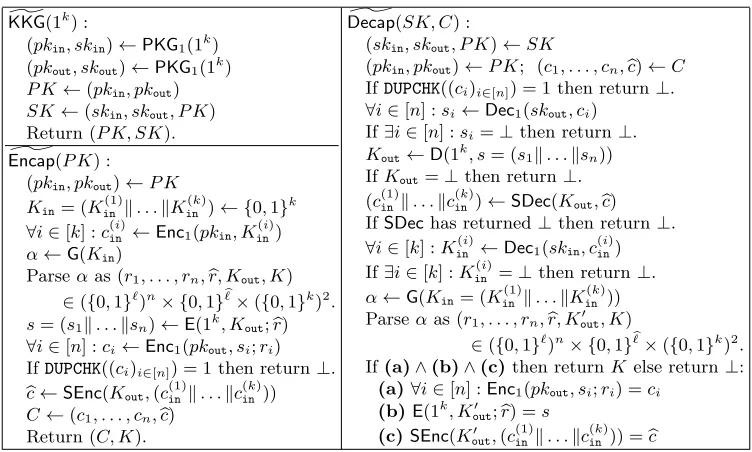
The Proposed1-Bit-to-Multi-Bit Conversion, and More. Our main result, i.e. a CCA secure KEM from a CCA secure 1-bit PKE scheme that achieves optimal asymptotic efficiency in terms of the public key and ciphertext sizes, is obtained by using the above mentioned detectable PKE scheme (together with some hybrid encryption techniques) as the outer PKE scheme, and using the bitwise-encrypt construction of a detectable KEM as the inner KEM, in the double-layered construction, via our first security proof. In Section 6, we show the full description of our construction. As noted above, our construction uses only two key pairs of the underlying 1-bit PKE scheme.
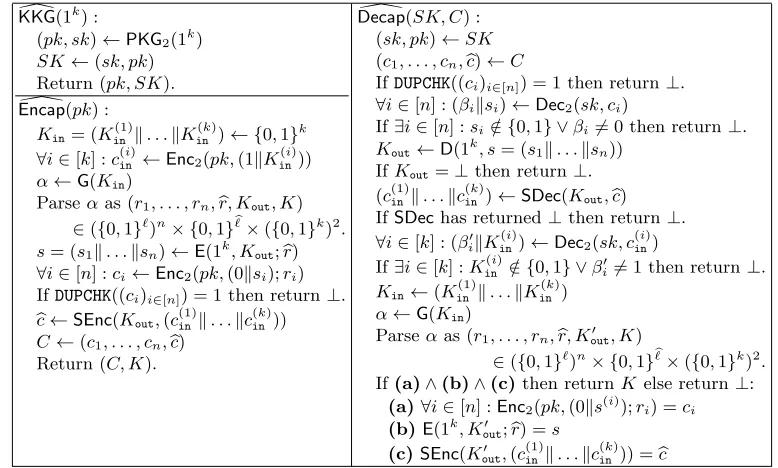
Interestingly, there (and in Appendix C), we also show that if a 2-bit PKE scheme can be used instead of a 1-bit PKE scheme, then one can construct a CCA secure KEM (with almost the same construction as our main construction) that uses only one key pair.
On the Necessity of Two Key Pairs. As mentioned above, our proposed KEM from a 1-bit PKE scheme uses two key pairs of the underlying CCA secure 1-bit PKE scheme. Given this, it is natural to ask if the number 2 of key pairs of the underlying 1-bit scheme is optimal for achieving 1-bit-to-multi-bit constructions for CCA security. Although we could not answer this question affirmatively or negatively, in Section 8, we show that the one-key variant of our proposed construction is vulnerable to a CCA attack. This negative result shows a necessity of different techniques and ideas than ours towards answering the question. It also contrasts strikingly with our 2-bit-to-multi-bit construction for CCA security that uses only one key pair of the underlying 2-2-bit-to-multi-bit scheme.
We leave it as an open problem to clarify whether one can achieve a 1-bit-to-multi-bit conversion using only one key pair of the underlying 1-bit scheme, or it is generally impossible.
1.3 Related Work
with randomness recovery property, where the decryption oracle in the security experiment returns not only the decryption result of a queried ciphertext but also a randomness that is consistent with the ciphertext, and (among other things) showed that the construction of [16] can be used to achieve a 1-bit-to-multi-bit conversion for enhanced CCA security. Most recently, Kitagawa et al. [18] showed that a simpler variant of the double-layered construction which does not have validity check by re-encryption in the decryption algorithm, can be used to extend the plaintext space of PKE satisfying key-dependent message (KDM) security against CCA with respect to projection functions (projection-KDM-CCA security).
Very recently, Coretti et al. [6] showed a 1-bit-to-multi-bit conversion for a PKE scheme. How-ever, the security notion considered in their construction is so-called “self-destruct” CCA security, which is defined like ordinary CCA security except that in the security experiment, once an adver-sary submits an invalid ciphertext (which does not decrypt to a valid plaintext) as a decryption query, the decryption oracle “self-destructs”, i.e. it will not answer to subsequent decryption queries. This security notion is strictly weaker than ordinary CCA security. Furthermore, in another recent work, Coretti et al. [5] considered non-malleability under self-destruct CCA, which is also strictly weaker than ordinary CCA security, and showed a 1-bit-to-multi-bit conversion for a PKE scheme satisfying this security notion. The 1-bit-to-multi-bit constructions of [6, 5] share the same idea with Agrawal et al.’s conversion (and hence with our “outer” PKE scheme): first encode a plaintext by a suitable non-malleable code, and then do bitwise encryption. The main differences between these works [6, 5] and our “double-layered” construction are: (1) Ours achieves ordinary (full) CCA security, while they achieve weaker security notions. (2) Our construction uses only two key pairs of the underlying 1-bit scheme, while the constructions in [6, 5] useO(k) key pairs, of the building block 1-bit scheme. (3) The requirements of the used non-malleable codes are all different: [6, 5] need stronger form of non-malleability called “continuous” non-malleability [15] (and its exten-sion), while we only need the original definition of non-malleability in [14] that captures “one-time” tampering.; The tampering functions with respect to which non-malleability is considered in [6, 5] are based on bit-wise tampering (extended to take into account continuous non-malleability), while ours requires additionally non-malleability against bit-level permutation (as in [2, 1]).
1.4 Paper Organization
The rest of this paper is organized as follows:
– Section 2 and Appendix A review the basic notation and definitions of the primitives.
– In Section 3, we introduce our new security notions for detectable PKE scheme, and also show several useful facts on them. (New security notions for a detectable KEM is given in Ap-pendix B.)
– In Section 4, we show our main technical results: two new security proofs for the “double-layered” construction. We also explain some evidence that justifies our reliance on non-malleability under DCCA.
– In Section 5, we show how to build a detectable PKE scheme satisfying our new security notions based on a CCA secure 1-bit PKE scheme and a non-malleable code.
– In Section 6, we provide the full description of our 1-bit-to-multi-bit conversion for CCA security. There (and in Appendix C), we also explain our 2-bit-to-multi-bit construction with a single key pair.
– Finally, in Section 8, we show that a variant of our 1-bit-to-multi-bit conversion, in which we only use one key pair of the underlying 1-bit scheme, is vulnerable to a CCA attack.
For theorems and lemmas, we only give proof sketches or intuitive explanations in the main body of the paper, and the formal proofs of them are given in Appendices D or E.
2 Preliminaries
In this section, we review the basic notation and the definitions of the cryptographic primitives. The definitions for standard primitives that are not reviewed in this section are given in Appendix A, which include symmetric key encryption (SKE), message authentication codes (MAC), and a pseu-dorandom generator (PRG).
2.1 Basic Notation
Ndenotes the set of all natural numbers. For n∈N, we define [n] :={1, . . . , n}. “x ←y” denotes thatxis chosen uniformly at random from yify is a finite set,xis output fromy ifyis a function or an algorithm, or y is assigned to x otherwise. If x and y are strings, then “|x|” denotes the
bit-length ofx, “x∥y” denotes the concatenationxand y, and “(x=? y)” is defined to be 1 ifx=y
and 0 otherwise. “(P)PTA” stands for a(probabilistic) polynomial time algorithm. For a finite setS, “|S|” denotes its size. IfAis a probabilistic algorithm then “y ← A(x;r)” denotes thatAcomputes
yas output by takingxas input and usingr as randomness. If furthermoreOis an algorithm, then “AO” denotes thatAhas oracle access toO. A functionϵ(·) :N→[0,1] is said to benegligible if for all positive polynomials p(k) and all sufficiently large k ∈N, we haveϵ(k) < 1/p(k). Throughout this paper, we use the character “k” to denote a security parameter.
2.2 (Detectable) Public Key Encryption
A public key encryption (PKE) scheme Π consists of the three PPTAs (PKG,Enc,Dec) with the following interface:
Key Generation: Encryption: Decryption:
(pk, sk)←PKG(1k) c←Enc(pk, m) m (or⊥)←Dec(sk, c)
whereDecis a deterministic algorithm, (pk, sk) is a public/secret key pair, and cis a ciphertext of a plaintext m under pk. We say that a PKE scheme satisfies correctness if for all k∈ N, all keys (pk, sk) output fromPKG(1k), and all plaintexts m, it holds that Dec(sk,Enc(pk, m)) =m.
Detectable PKE. In this paper, we use the notion ofdetectable PKE as defined in [16]. It is a PKE scheme that has a predicateFthat tests whether two ciphertextscandc′ are “related” in the sense that to decryptc, the information of the decryption result of c′ is useful (and hence, revealing the decryption result ofc′ is “dangerous”). This predicateF is used to define multiple security notions of the primitive, and hence we explicitly define it as a part of the syntax of the primitive (this approach is also taken in [16] and [21]).
ExptATK
Π,A(k) :
(pk, sk)←PKG(1k)
(m0, m1,st)← ADec(sk,1 ·)(pk)
b← {0,1}
c∗←Enc(pk, mb)
b′← ADec(sk,2 ·)(st, c∗) Return (b′=? b)
ExptATK
Γ,A(k) :
(pk, sk)←KKG(1k) (c∗, K1∗)←Encap(pk)
K0∗← K
b← {0,1}
b′← ADecap(sk,·)(pk, c∗, Kb∗) Return (b′=? b)
ExptUNP
Π,A(k) :
(pk, sk)←PKG(1k) (m, c)← ADec(sk,·)(pk)
c∗←Enc(pk, m) ReturnF(pk, c∗, c)
ExptUNP
Γ,A(k) :
(pk, sk)←KKG(1k)
c← ADecap(sk,·)(pk) (c∗, K∗)←Encap(pk) ReturnF(pk, c∗, c)
ExptF-NM
C,A(k) :
(f, m0, m1,st)← A1(1k)
b← {0,1}
s∗←E(1k, mb)
s′←f(s∗)
m′←D(1k, s′)
Ifm′∈ {m0, m1}thenm′←same
b′← A2(st, m′) Return (b′=? b)
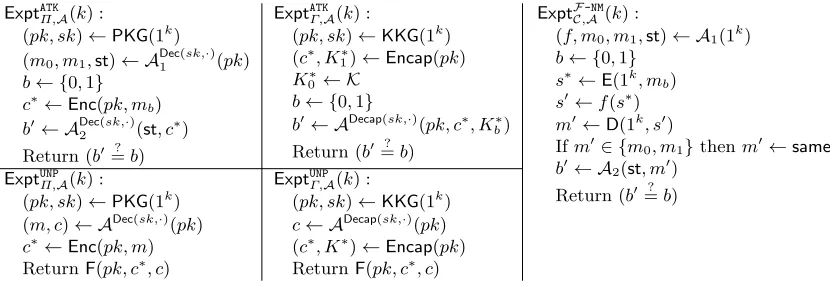
Fig. 1.The experiments for defining the security of detectable PKE (left-top/bottom), of detectable KEM (center-top/bottom), and of anF-non-malleable code (right). In theCCA(resp.DCCA) experiment for PKE,A2is not allowed to queryc∗(resp. ciphertextscsuch thatF(pk, c∗, c) = 1). The same restrictions apply toAin theCCA/DCCAexperiment for KEMs.
c, c′ as input, and outputs either 0 or 1. We require that for allk∈N, all public keys pkoutput by
PKG(1k), and all ciphertexts coutput by Enc(pk,·), we have F(pk, c, c) = 1. 1
Security Notions. Here we recallchosen ciphertext security (CCA security)for PKE, anddetectable CCA (DCCA) security and unpredictability for detectable PKE [16].
LetATK∈ {CCA,DCCA}. For a (detectable) PKE schemeΠand an adversaryA= (A1,A2),
con-sider theATKexperimentExptATK
Π,A(k) described in Fig. 1 (left-top). In the experiment, it is required
that|m0|=|m1|, andA2is not allowed to submit the “prohibited” queries to the decryption oracle:
IfATK=CCA, then the prohibited query isc∗, and ifATK=DCCA, then the prohibited queries are c
satisfyingF(pk, c∗, c) = 1. We say that a (detectable) PKE schemeΠ isATKsecure if for all PPTAs A,AdvATKΠ,A(k) := 2· |Pr[ExptATKΠ,A(k) = 1]−1/2|is negligible.
For a detectable PKE scheme Π (with predicate F) and an adversary A, consider the unpre-dictability experimentExptUNPΠ,A(k) described in Fig. 1 (left-bottom). We say that a detectable PKE schemeΠ is unpredictable if for all PPTAsA,AdvUNPΠ,A(k) := Pr[ExptUNPΠ,A(k) = 1] is negligible.
2.3 (Detectable) Key Encapsulation Mechanism
A key encapsulation mechanism (KEM) Γ consists of the three PPTAs (KKG,Encap,Decap) with the following interface:
Key Generation: Encapsulation: Decapsulation:
(pk, sk)←KKG(1k) (c, K)←Encap(pk) K (or ⊥)←Decap(sk, c)
whereDecapis a deterministic algorithm, (pk, sk) is a public/secret key pair that defines a session-key space K, andc is a ciphertext of a session-keyK ∈ K underpk. We say that a KEM satisfies
correctness if for all k∈ N, all keys (pk, sk) output from KKG(1k) and all ciphertext/session-key pairs (c, K) output fromEncap(pk), it holds thatDecap(sk, c) =K.
We also define a KEM-analogue of detectable PKE, which we call detectable KEM, as a KEM that has an efficiently computable predicate F whose interface is exactly the same as that of de-tectable PKE.
Security Notions. Here we review the definition of CCA security for a KEM, and the definitions of
DCCA security and unpredictability for a detectable KEM.
Let ATK ∈ {CCA,DCCA}. For a (detectable) KEM Γ and an adversary A, consider the ATK
experiment ExptATKΓ,A(k) described in Fig. 1 (center-top). In the experiment, A is not allowed to submit the “prohibited” queries that are defined in the same way as those for the PKE case. We say that a (detectable) KEMΓ isATKsecure if for all PPTAsA,AdvATK
Γ,A(k) := 2· |Pr[ExptATKΓ,A(k) =
1]−1/2|is negligible.
For a detectable KEM Γ (with predicateF) and an adversaryA, consider the unpredictability experiment ExptUNPΓ,A(k) described in Fig. 1 (center-bottom). We say that a detectable KEM Γ is
unpredictable if for all PPTAsA,AdvUNP
Γ,A(k) := Pr[ExptUNPΓ,A(k) = 1] is negligible.
2.4 Non-malleable Codes
Here, we recall the definition of non-malleable codes [14].
A code C with message lengthκ = κ(k) and codeword length n= n(k) (called also an (n, κ )-code) consists of the two PPTAs (E,D):E is the encoding algorithm that takes 1k and a message
m∈ {0,1}κ as input, and outputs a codeword c∈ {0,1}n.;D takes 1k andc as input, and outputs
m ∈ {0,1}κ or the special symbol ⊥ indicating that c is invalid. We require for all k ∈N and all
messagesm∈ {0,1}κ, it holds thatD(1k,E(1k, m)) =m.
Non-malleability. Non-malleability for codes, formalized by Dziembowski et al. [14], is defined with respect to a class of tampering functions F. Intuitively, non-malleability guarantees that if an encoding cof a message m is modified intoc′=f(c) by a function f ∈ F, then the decoded value
m′ of c′ is either the original messagem itself, or a completely unrelated message (or⊥). Here we recall the indistinguishability-based definition which is most convenient for us to work with, which is called the “alternative-non-malleability” in [13, Definition A.1]. It was shown in [13] that this definition is equivalent to the original simulation-based definition for codes whose message length
κ is superlogarithmic in k.
Let n, κ : N → N be positive polynomials of k such that n(k) ≥ κ(k). For an (n, κ)-code C = (E,D), a class of functions F ={Fk :{0,1}k → {0,1}k}k∈N, and an adversary A= (A1,A2),
consider theF-NMexperimentExptF-NM
C,A (k) described in Fig. 1 (right). In the experiment, “same” is
the special symbol indicating that the decoded messagem′ was eitherm0 orm1, and it is required
that f ∈ Fn and |m0|=|m1|=κ(k). We say that C is non-malleable with respect to the function
class F (F-non-malleable, for short) if for all PPTAs2 A, AdvF-NM
C,A (k) := 2· |Pr[ExptFC,-NMA (k) =
1]−1/2|is negligible. We also say that C is anF-non-malleable code.
Classes of Tampering Functions. In this paper, we consider the following classes of functions.
Composition of “Bitwise Tampering” and “Bit-Level Permutation” P [2, 1]: Let
set,reset,forward,toggle:{0,1} → {0,1}be the functions over a bit, defined byset(x) := 1,
2
reset(x) := 0, forward(x) := x, and toggle(x) := 1−x. We define FBIT := {set,reset, forward,toggle}.
LetP ={Pn}n∈Nbe the class of functions which first perform “bitwise tampering” to an input,
followed by a “bit-level permutation.” Namely, Pn is the set of all functions f : {0,1}n →
{0,1}n that can be described by using n bitwise-tampering functions f1, . . . , fn ∈ FBIT and a
permutation π : [n]→[n], as follows:
x= (x1∥. . .∥xn) f
7→(fπ−1(1)(xπ−1(1))∥ . . . ∥ fπ−1(n)(xπ−1(n))
) .
“Bit-Fixing” or “Quoting an Input without Duplicated Positions” Q: Let one : {0,1}n
→ {0,1} and zero :{0,1}n→ {0,1} be the constant functions that output 1 and 0 for any n
-bit inputs, respectively. Furthermore, forj ∈[n], let quotej :{0,1}n→ {0,1}be the “quoting” function that always outputs the j-th bit of its input.
LetQ={Qn}n∈N be the class of functions each of whose output bits is either a “fixed value” or
“quoting the input without duplicated positions.” More formally, Qn is the set of all functions
f :{0,1}n→ {0,1}nthat can be decomposed tonfunctionsf1, . . . , fn:{0,1}n→ {0,1}so that
f(x) = (f1(x)∥. . .∥fn(x)) for all x∈ {0,1}n, and furthermore it holds that for every i∈[n]:
fi ∈ {one,zero} ∪
(
{quotej}j∈[n]\{fj}j∈[i−1]
)
. (1)
Note that the above guarantees that there exist no indices i, i′, j ∈ [n] such that fi = fi′ =
quotej and i̸=i′. We call this condition the no duplicated quoting condition.
Agrawal et al. [2] showed the following elegant result, which is crucial for the efficiency of our proposed KEM:
Lemma 1. ([2]) There exists an explicit (n, k)-code such that (1) it is P-non-malleable, and (2) its “rate”, defined byk/n, asymptotically approaches to 1 ask increases (and hencen=k+o(k)).
Furthermore, the following is implicitly used by Agrawal et al. [1], and also is useful for our purpose. Although it is almost straightforward from the definitions ofP andQ, we show its formal proof in Appendix E.1 for self-containment.
Lemma 2. For all n ∈N, Qn ⊆ Pn. (This holds even if FBIT does not contain toggle.) Hence,
anyP-non-malleable code is also Q-non-malleable.
3 New Security Notions for Detectable PKE and KEM
In this section, we introduce new security notions for detectable PKE: wNM-DCCA security and
wRNM-DCCA security in Section 3.1, and randomness-inextractability in Section 3.2. We also show some useful facts regarding the new security notions in Section 3.3.
3.1 “Weak” Non-malleability under DCCA and Its “Replayable” Variant
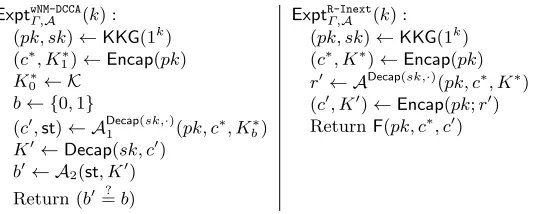
Here, we define a “weak” form of non-malleability against DCCA for detectable PKE, which we call wNM-DCCA security, that captures the intuition that a DCCA adversary who works in the DCCA
experiment cannot come up with a ciphertext that is “meaningfully related” to the challenge ci-phertext. Recall that the original definitions of non-malleability for PKE [12, 3, 24] ensure that an adversary cannot come up with even a vector of ciphertexts that are “meaningfully related” to the challenge ciphertext, while our notion here only requires that it cannot come up with only a single related ciphertext. Technically, following the formalizations in [3, 24, 22], we formalize wNM-DCCA
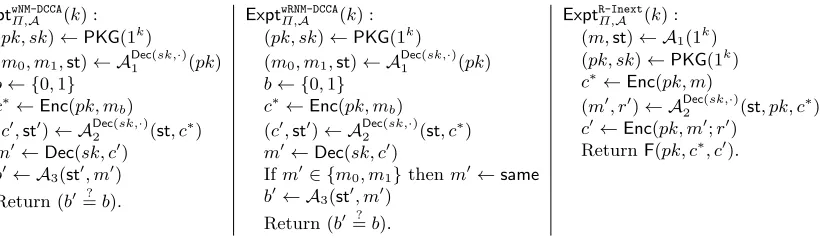
security by modifying the original DCCA experiment (in which originally the usage of the decryp-tion oracle is restricted according the predicate F of detectable PKE), so that at the end of the experiment an adversary is allowed to make a single “unrestricted” decryption query, regardless of F. Thus, it is like “1-bounded” CCA security [7], albeit an adversary has additionally access to theDCCA decryption oracle. Myers and Shelat [22] defined a security notion for PKE-to-PKE con-structions called “q-wise-non-malleability under UCCA.” Our definition of wNM-DCCA security is a detectable-PKE-analogue of their 1-wise-non-malleability.
We also define a weaker variant of wNM-DCCAsecurity, in the security experiment of which the final “unrestricted” decryption query (and only this query) is answered like a decryption query in the “replayable” CCA experiment [4], namely, if the decryption result is one of the challenge plaintexts that an adversary uses, then the adversary is only informed so and is not given the actual decryption result. Due to the lack of a better name, we call itwRNM-DCCA security (whereR
stands for “Replayable”).
Fomally, for a detectable PKE schemeΠ = (PKG,Enc,Dec,F) and an adversaryA= (A1,A2,A3),
we define thewNM-DCCAexperimentExptwNM-DCCAΠ,A (k) and thewRNM-DCCAexperimentExptwRNM-DCCAΠ,A (k) as described in Fig. 2 (left and center, respectively). In both of the experiments, it is required that |m0| = |m1|, and as in the DCCA experiment, A2 is not allowed to submit a decryption query c
satisfying F(pk, c∗, c) = 1 to the decryption oracle. The adversary’s final “unrestricted” decryption query is captured by the ciphertextc′ that is finally output byA2, and naturally it is required that c′ ̸=c∗.However, we allowc′ to be such thatF(pk, c∗, c′) = 1.In thewRNM-DCCAexperiment, “same” is the special symbol (which is distinguished from ⊥) that indicates thatDec(sk, c′)∈ {m0, m1}.
Definition 1. We say that a detectable PKE scheme Π is wNM-DCCA secure if for all PPTAs A,
AdvwNM-DCCA
Π,A (k) := 2· |Pr[ExptwNMΠ,A-DCCA(k) = 1]−1/2| is negligible. We define wRNM-DCCA security analogously.
3.2 Randomness-Inextractability
Here we introduce another security notion for detectable PKE that we callrandomness-inextractability. Roughly, this security notion ensures that given the challenge ciphertextc∗ (which is an encryption of a plaintext of an adversary’s choice), an adversary cannot come up with a pair (m′, r′) of a plain-text and a randomness such that F(pk, c∗,Enc(pk, m′;r′)) = 1. If the predicate F(pk, c∗, c′) tests
the equality (c∗ =? c′), then this notion exactly demands that the randomness used in c∗ cannot be recovered, and hence we use the name “randomness-inextractability” (although we allow more general predicates for F).
Formally, for a detectable PKE schemeΠ = (PKG,Enc,Dec,F) and an adversaryA= (A1,A2),
ExptwNM-DCCA
Π,A (k) : (pk, sk)←PKG(1k)
(m0, m1,st)← ADec(sk,·)1 (pk)
b← {0,1}
c∗←Enc(pk, mb)
(c′,st′)← ADec(sk,2 ·)(st, c∗)
m′←Dec(sk, c′)
b′← A3(st′, m′) Return (b′=? b).
ExptwRNM-DCCA
Π,A (k) : (pk, sk)←PKG(1k)
(m0, m1,st)← ADec(sk,·)1 (pk)
b← {0,1}
c∗←Enc(pk, mb)
(c′,st′)← ADec(sk,2 ·)(st, c∗)
m′←Dec(sk, c′)
Ifm′∈ {m0, m1}thenm′←same
b′← A3(st′, m′) Return (b′=? b).
ExptR-Inext
Π,A (k) : (m,st)← A1(1k) (pk, sk)←PKG(1k)
c∗←Enc(pk, m)
(m′, r′)← ADec(sk,2 ·)(st, pk, c∗)
c′←Enc(pk, m′;r′) ReturnF(pk, c∗, c′).
Fig. 2. Security experiments for wNM-DCCA security (left), wRNM-DCCA security (center), and randomness-inextractability (right). In the wNM/wRNM-CCA experiments, the decryption oracle for A2 has the same restriction as in theDCCAexperiment.
Definition 2. We say that a detectable PKE scheme Π satisfies randomness-inextractability if
for all PPTAs A, AdvRΠ,-InextA (k) := Pr[ExptRΠ,-InextA (k) = 1]is negligible.
Remark. We could have defined the randomness-inextractability experiment so that we let an adversary choose its challenge message m after given a public key pk. This makes the security stronger. However, we do not need this stronger variant for our results.
3.3 Useful Facts
Stretching a Session-Key. As in the case of ordinary KEMs, for a detectable KEM, session-keys can be stretched by using a PRG. More formally, letΓ = (KKG,Encap,Decap,F) be a detectable KEM whose session-key space is{0,1}k. Let G:{0,1}k→ {0,1}ℓ be a PRG withℓ=ℓ(k)> k, where for convenience we defineG(⊥) :=⊥. (The formal definition of a PRG can be found in Appendix A.3.) Then, consider the detectable KEMΓ′ = (KKG,Encap′,Decap′,F) whose session-key space is{0,1}ℓ, which is naturally constructed by combining Γ and G: Encap′(pk) runs (c, K) ← Encap(pk) and outputs a ciphertext/session key pair (c,G(K)).; We define Decap′(sk, c) := G(Decap(sk, c)). The following is straightforward, and thus its proof is omitted.
Lemma 3. If the detectable KEMΓ satisfies randomness-inextractability (resp. unpredictability), then so does the detectable KEM Γ′. Furthermore, if Γ is DCCA (resp. wNM-DCCA) secure and G is a PRG, then Γ′ is DCCA (resp. wNM-DCCA) secure.
Hybrid Encryption. For a detectable PKE scheme, a straightforward application of hybrid encryp-tion preserves w(R)NM-DCCA security and randomness-inextractability, when combined with a CCA
secure SKE scheme. Since a CCA secure SKE scheme with “zero” ciphertext overhead can be re-alized from a strong pseudorandom permutation [25] (which in turn can be rere-alized based on any one-way function), the ciphertext overhead of a detectable PKE scheme withw(R)NM-DCCAsecurity and randomness-inextractability, can be as small as the ciphertext size of the scheme for encrypting a random session-key (usually ak-bit string).
Formally, let Π= (PKG,Enc,Dec,F) be a detectable PKE scheme where the randomness space of Enc is {0,1}ℓ, and let E = (SEnc,SDec) be a deterministic SKE scheme (i.e. its encryption
PKGHYB(1k) :
(pk, sk)←PKG(1k). Return (pk, sk).
EncHYB(pk, m;R) :
ParseRas (r, K)∈ {0,1}ℓ× {0,1}k.
c←Enc(pk, K;r) b
c←SEnc(K, m) ReturnC←(c,bc).
DecHYB(sk, C) :
(c,bc)←C K←Dec(sk, c)
IfK=⊥then return⊥. Return m←SDec(K,bc).
FHYB(pk, C∗, C′) :
(c∗,bc∗)←C∗
(c′,bc′)←C′
ReturnF(pk, c∗, c′).
Fig. 3.Hybrid encryptionΠHYB for detectable PKE.
hybrid encryption, as in Fig. 3. (In the figure, we describe the randomness of EncHYB explicitly so
that it is convenient to consider its randomness-inextractability.) The randomness space of EncHYB
is {0,1}ℓ+k. Regarding the security of the hybrid encryption construction, the following lemma is
straightforward to see. However, since this hybrid encryption is used in the “outer” PKE scheme in our final construction to expand its plaintext space, we provide the formal proof in Appendix E.2 to make the paper self-contained.
Lemma 4. If the detectable PKE scheme Π is wNM-DCCA secure (resp. wRNM-DCCA secure) and
the SKE scheme E is CCA secure, then the detectable PKE scheme ΠHYB in Fig. 3 is wNM-DCCA
secure (resp.wRNM-DCCA secure). Furthermore, ifΠ satisfies randomness-inextractability (resp. un-predictability), then so does ΠHYB.
FromwRNM-DCCASecurity to wNM-DCCASecurity. Canetti, Krawczyk, and Nielsen [4] showed how to convert a “replayable”CCAsecure PKE scheme into an ordinary CCAsecure KEM, using a message authentication code (MAC), with almost no overhead. This method can be used for converting a wRNM-DCCA secure detectable PKE scheme into a wNM-DCCA secure detectable KEM. For self-containment, we review this transformation in Appendix E.3.
On the Non-triviality of Randomness-Inextractability. One might wonder whether there is an im-plication from randomness-inextractability to unpredictability and/or vice versa (especially in case if a detectable PKE scheme already satisfieswNM-DCCAsecurity). We show that this isnot the case, for both directions. Specifically, via artificial counterexamples, we can show the following lemma that shows the non-triviality of these notions, which we formally show in Appendix D.1.
Lemma 5. A detectable PKE scheme satisfying wNM-DCCA security and unpredictability
simulta-neously does not necessarily satisfy randomness-inextractability. Furthermore, a detectable PKE scheme satisfying wNM-DCCA security and randomness-inextractability simultaneously does not nec-essarily satisfy unpredictability.
4 Chosen Ciphertext Security of the Double-Layered Construction
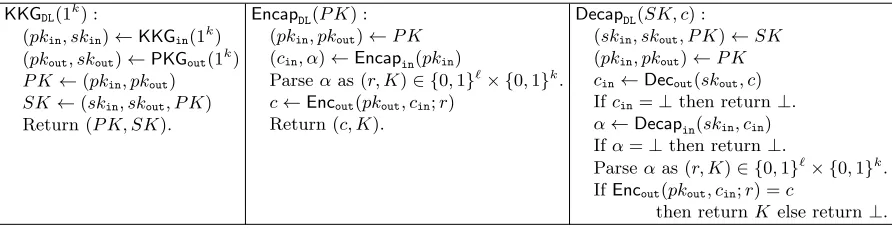
In this section, we show our main result: two new CCA security proofs for the “double-layered” constructionΓDL(of a KEM) constructed based on the “inner” detectable KEMΓinand the “outer” detectable PKE scheme Πout. We also show a partial evidence that we need to rely on
“non-malleability” that we defined in the previous section.
The Double-Layered Construction. LetΠout= (PKGout,Encout,Decout,Fout) be a detectable PKE
scheme. We assume the plaintext space ofΠoutto be{0,1}n(wheren=n(k) is determined below),
and the randomness space ofEncout to be{0,1}ℓ for some positive polynomialℓ=ℓ(k). LetΓin=
KKGDL(1k) :
(pkin, skin)←KKGin(1k)
(pkout, skout)←PKGout(1k)
P K ←(pkin, pkout)
SK←(skin, skout, P K)
Return (P K, SK).
EncapDL(P K) :
(pkin, pkout)←P K
(cin, α)←Encapin(pkin)
Parseαas (r, K)∈ {0,1}ℓ× {0,1}k.
c←Encout(pkout, cin;r)
Return (c, K).
DecapDL(SK, c) :
(skin, skout, P K)←SK
(pkin, pkout)←P K
cin←Decout(skout, c)
Ifcin=⊥then return⊥.
α←Decapin(skin, cin)
Ifα=⊥then return⊥.
Parseαas (r, K)∈ {0,1}ℓ× {0,1}k. IfEncout(pkout, cin;r) =c
then returnKelse return⊥. Fig. 4.The double-layered KEM constructionΓDLfrom a detectable PKE schemeΠout and a detectable KEMΓin.
the session-key space is {0,1}ℓ+k. Then we construct the “double-layered” KEM ΓDL = (KKGDL,
EncapDL,DecapDL) as in Fig. 4. For convenience, we occasionally callΓin theinner KEM and Πout
theouter PKE scheme.
Our First Security Proof. The CCAsecurity of ΓDL can be shown as follows.
Theorem 1. Assume that the “outer” PKE scheme Πout is a detectable PKE scheme satisfying
wRNM-DCCAsecurity and randomness-inextractability, and the “inner” KEMΓinis a detectable KEM
satisfying DCCA security and unpredictability. Then, the KEMΓDL in Fig. 4 is CCAsecure.
The formal proof is given in Appendix D.2. The structure of the proof is similar to the security proofs for the constructions by Hohenberger et al. [16] and by Matsuda and Hanaoka [21]. However, the details differ due to the difference in the construction and the used assumptions.
We explain the ideas for the proof of Theorem 1. (Here, the values with asterisk (*) represent those related to the challenge ciphertext c∗.) As the first step, note that since a session-key K of
ΓDL is part of a session-key α = (r∥K) of the DCCA secure inner KEMΓin, unless a CCAadversary Asubmits a decapsulation querycthat simultaneously satisfies (1)Decout(skout, c) =cin̸=⊥and
(2)Fin(pkin, c∗in, cin) = 1,Ahas no chance in distinguishing the real session-keyK1∗ from a random K0∗. Following [16, 21], we call this type of decapsulation query adangerous query. If the probability that Acomes up with a dangerous query is negligible, then we can finish the proof. Furthermore, observe that sinceΓin satisfies unpredictability, if we can ensure that the information of the inner
ciphertext c∗in is hidden from A’s view, then the probability that A comes up with a dangerous query is negligible.
To show that the probability that A comes up with a dangerous query in the original security game is negligibly close to that in the security game in which A’s view does not containc∗in at all (and hence we can invoke the unpredictability ofΓin), we rely on the security properties of the outer PKE schemeΠout to gradually change the security game forAso that in the final game,c∗ as well
as other values in A’s view contain no information on c∗in. Note that in the actual encapsulation algorithm EncapDL, the randomness r used for outer encryption is also a part of the session-key α
of the inner KEM. Thus, once we invoke the DCCA security of the inner KEMΓin (which we have
already done as the first step), not only the real session-keyK1∗ but also the randomnessr∗ used to generate the challenge ciphertext c∗ are made uniformly random values, which enables us to rely on the security properties of Πout from that point on.
Now, intuitively, theDCCA security (which is implied bywRNM-DCCAsecurity) ofΠout guarantees
that c∗in is hidden from A’s view as long as A only submits a decapsulation query c such that
such that Fout(pkout, c∗, c) = 1. As mentioned in Section 1.2, this is another type of “dangerous”
query, in the sense that the condition Fout(pkout, c∗, c) = 1 prevents us from relying on the DCCA
security of the outer PKE scheme Πout. To distinguish this from the above mentioned type of
dangerous queries with respect to the inner KEM, let us use the names “inner-dangerous queries” and “outer-dangerousqueries” which are associated with the inner KEM and the outer PKE scheme, respectively.
In the full proof, we will show that the randomness-inextractability of the outer PKE scheme allows us to reject decapsulation queries c satisfying Fout(pkout, c∗, c) = 1, without being noticed
byA. Intuitively, this is possible because in order forA to notice the difference between a security game in which a decapsulation querycwithFout(pkout, c∗, c) = 1 is not rejected and a security game
in which suchc is rejected,A has to come up with a “valid” query csatisfying Fout(pkout, c∗, c) =
1 and DecapDL(SK, c) ̸= ⊥. However, the latter condition implies Decout(skout, c) = cin ̸= ⊥,
Decapin(skin, cin) = (r∥K) ̸= ⊥, and Encout(pkout, cin;r) = c, among which the combination of
Fout(pkout, c∗, c) = 1 and Encout(pkout, cin;r) =cis exactly the condition of violating
randomness-inextractability, and thus such a valid query cmust be hard to find.
If we can safely reject an outer-dangerous query, one might wonder why we need non-malleability for the outer PKE scheme, and why ordinary DCCA security is not sufficient. The reason is that althoughDCCAsecurity ofΠoutintuitively ensures thatAcannot “see” the inner challenge ciphertext
c∗in, it does not preventAfrom coming up with an inner-dangerous decapsulation querycsuch that
Fout(pkout, c∗, c) = 1. From the viewpoint of the security proof, we may be able to come up with
a DCCA adversary (a reduction algorithm) for Πout that perfectly simulates the security game (in which queriescwithFout(pkout, c∗, c) = 1 are rejected) forA. However, suchDCCAadversary cannot
check ifA’s query satisfyingFout(pkout, c∗, c) = 1 is an inner-dangerous query due to the restriction
on the decryption oracle.
This is the place where the non-malleability of the outer PKE scheme comes into play. Note that an inner ciphertext is a “plaintext” of the outer PKE scheme, and the notion of “inner-dangerous queries” is a “meaningful relation” between c∗in and another inner ciphertext. There-fore, the wRNM-DCCA security of Πout ensures that A cannot come up with even a single inner-dangerous queryc, as long as Acan only observe the decapsulation results of queries c′ satisfying
Fout(pkout, c∗, c′) = 0. From the viewpoint of the security proof, if a reduction algorithm is a wRNM-DCCA adversary for Πout, it can check if A’s query c is inner-dangerous by its final “unre-stricted” decryption query, even if Fout(pkout, c∗, c) = 1 holds. This enables us to finally show that
the probability that A comes up with an inner-dangerous query in the original security game, is negligibly close to the probability that A does so in the game in whichA’s view does not contain the information on c∗in.
Hence, combining all the security properties of the building blocks leads to CCAsecurity. How-ever, the explanation so far hides some technical subtleties that arise due to the “replayable-CCA”-like nature ofwRNM-DCCA security, and the treatment of the cases whereA’s decapsulation query c
satisfiesDecout(skout, c) =c∗in, etc. For the details, see Appendix D.2.
Our Second Proof. We show an alternative security proof for the double-layered construction based on slightly different assumptions on the building blocks.
Theorem 2. Assume that the “outer” PKE scheme Πout is a detectable PKE scheme satisfying
The formal proof is given in Appendix D.3. Recall that Myers and Shelat’s original double-layered construction uses an “unquoted” CCA (UCCA) secure construction of a PKE scheme for the outer PKE scheme and a construction of a KEM which is “1-wise-non-malleable under UCCA” for the inner KEM, where UCCA security and its non-malleable variant are security notions considered for PKE-to-PKE constructions (i.e. constructions that use another PKE scheme as a building block). Recall also thatDCCA security is an abstraction of UCCA security [16], from a security notion for a PKE-to-PKE construction to that of a wider notion of detectable PKE. Analogously, our definition of wNM-DCCAsecurity can be seen as an abstraction of Myers and Shelat’s “1-wise non-malleability under UCCA”. Furthermore, we can easily see that the actual instantiations of the inner KEM and the outer PKE scheme used in the original Myers-Shelat construction [22], when respectively seen as a detectable KEM and a detectable PKE scheme, satisfy unpredictability and randomness-inextractability. Therefore, Theorem 2 can be seen as a generalization of Myers and Shelat’s result, stated using the language of detectable PKE/KEM.
The structure of the proof of Theorem 2 is similar to our first proof. However, there are several subtle but crucial differences. In particular, the definitions of “inner/outer-dangerous queries” are different from those used in the proof of Theorem 1, and correspondingly we consider a different ordering of the sequence of games for this proof. Furthermore, the role of the “non-malleability” in this proof and that of the proof of Theorem 1 are different. Informally speaking, in this proof, the
wNM-DCCAsecurity of the inner detectable KEMΓinis used to ensure that the probability that aCCA
adversary comes up with an outer-dangerous query is not noticeably different between the games in which we invoke (the indistinguishability property of) theDCCA security of the inner KEM. For the details, see Appendix D.3.
Can We Avoid w(R)NM-DCCA Security? Both of our security proofs for the CCA security of the double-layered construction require either the inner detectable KEM or the outer detectable PKE scheme to be “non-malleable” under DCCA.
Looking ahead, in the next section, we will see that the simplest “bitwise-encrypt” construc-tion based on CCA secure 1-bit PKE satisfies DCCA security, unpredictability, and randomness-inextractability. Thus, a natural question would be whether we can prove the CCAsecurity of the double-layered construction without using the non-malleability notions for both of the building blocks (and instead only requiring DCCA security). If such a security proof were possible, then one can use the bitwise-encrypt-based construction both for the inner KEM and the outer PKE scheme, and the resultingCCAsecure KEM would be fairly simple. (If we appropriately use the known tech-niques and results on hybrid encryption, then the key and ciphertext sizes of the resulting KEM could be made only twice as large as those of the bitwise-encrypt-based KEM construction that works for the CPAand non-adaptiveCCA(CCA1) settings.)
Unfortunately, however, we show that such a security proof is impossible, as there is a coun-terexample.
Theorem 3. Assume there exists a detectable PKE scheme which isDCCAsecure and unpredictable.
Then, there exist a detectable KEM Γin and a detectable PKE scheme Πout such that the follow-ing simultaneously hold: (1) Γin is DCCA secure and unpredictable. (2) Πout is DCCA secure and
randomness-inextractable. (3) The double-layered KEM ΓDL constructed using Γin as the inner
The formal proof is given in Appendix D.4. Our counterexample is based on an observation that the combination ofDCCA security, unpredictability, and randomness-inextractability, does not rule out a double-layered KEM with the following property: A ciphertextC is of the formC = (c1, c2) and
the corresponding session-key K is of the form K = (K1, K2), and furthermore it is “blockwise”
consistent, meaning that each pair (ci, Ki) is individually consistent as a ciphertext/session-key
pair of the double-layered construction. Thus, the decapsulation result of the “swapped” ciphertext
b
C= (c2, c1) is the “swapped” session-key Kb = (K2, K1). Such a KEM is clearly malleable, and its
one-wayness is broken by just a single decapsulation query. For the details, see Appendix D.4.
5 Concrete Instantiations of Building Blocks
In this section, we show how to construct a detectable PKE scheme, which we call “encode-then-bitwise-encrypt” (EtBE) construction, that uses a CCA secure 1-bit PKE scheme and a Q -non-malleable code as building blocks and simultaneously satisfieswRNM-DCCAsecurity and randomness-inextractability. Since it is much easier to understand it if we first review the simple “bitwise-encrypt” construction, we first review it in Section 5.1 together with its security properties, and then we show the EtBE construction in Section 5.2.
5.1 Bitwise-Encrypt Construction
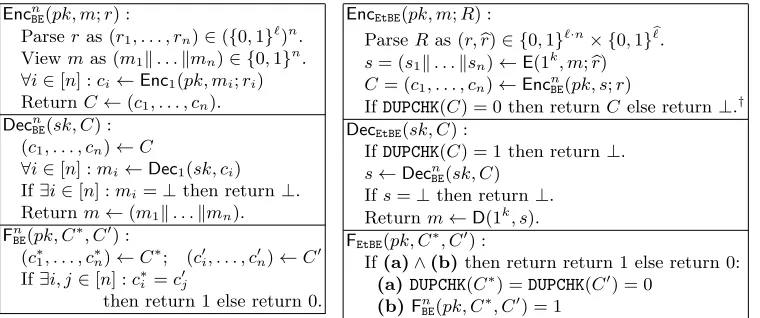
Here, we show that the simple “bitwise-encrypt” construction of a detectable PKE scheme based on a 1-bit PKE scheme, in which each bit of a plaintext is encrypted in a bit-by-bit fashion by the underlying 1-bit scheme, can be shown to satisfy randomness-inextractability, DCCA security, and unpredictability, if the underlying 1-bit PKE scheme is CCAsecure.
Let Π1 = (PKG1,Enc1,Dec1) be a 1-bit PKE scheme, and the randomness space of whose
encryption algorithm Enc1 is {0,1}ℓ (where ℓ = ℓ(k) is some positive polynomial). Then, for
a polynomial n = n(k) > 0, consider the “bitwise-encrypt” construction ΠBEn = (PKGnBE :=
PKG1,EncnBE,DecnBE,FnBE) of an n-bit detectable PKE scheme described in Fig. 5 (left). The key
generation algorithm PKGnBE is actually PKG1 itself, and we do not show it in the figure. The
ran-domness space of EncBE is {0,1}ℓ·n. In the figure, we make the randomness used by EncnBE explicit
so that it is convenient to consider its randomness-inextractability. The following result was shown by Hohenberger et al. [16]:
Lemma 6. ([16]) Let n =n(k) > 0 be a polynomial. If the 1-bit PKE scheme Π1 is CCA secure,
then the detectable PKE schemeΠBEn scheme satisfies DCCA security and unpredictability.
We show a similar statement regarding randomness-inextractability.
Lemma 7. Let n = n(k) > 0 be a polynomial. If the PKE scheme Π1 is CCA secure, then the
detectable PKE scheme ΠBEn satisfies randomness-inextractability.
The formal proof is given in Appendix D.5, and here we explain an intuition why the lemma is true, which is quite straightforward: Suppose an adversary A, given a public key pk and the challenge ciphertext C∗ = (c∗1, . . . , c∗n) and access to the decryption oracle, succeeds in outputting a plaintext m′ = (m′1∥. . .∥m′n) and a randomness r′ = (r1′, . . . , r′n) such that FnBE(pk, C∗, C′) = 1 with C′ = (c′1, . . . , c′n) = EncBEn (pk, m′;r′). Then, by definition, there must be a position i ∈ [n] such that c∗i = c′j holds for somej ∈[n], where c′a =Enc1(pk, m′a;ra′) for eacha ∈[n]. Note that
Encn
BE(pk, m;r) :
Parseras (r1, . . . , rn)∈({0,1}ℓ)n. Viewmas (m1∥. . .∥mn)∈ {0,1}n.
∀i∈[n] :ci←Enc1(pk, mi;ri) ReturnC←(c1, . . . , cn).
Decn
BE(sk, C) :
(c1, . . . , cn)←C
∀i∈[n] :mi←Dec1(sk, ci) If∃i∈[n] :mi=⊥then return⊥. Returnm←(m1∥. . .∥mn).
Fn
BE(pk, C∗, C′) :
(c∗1, . . . , c∗n)←C∗; (c′i, . . . , c′n)←C′ If∃i, j∈[n] :c∗i =c′j
then return 1 else return 0.
EncEtBE(pk, m;R) :
ParseRas (r,br)∈ {0,1}ℓ·n× {0,1}bℓ.
s= (s1∥. . .∥sn)←E(1k, m;br)
C= (c1, . . . , cn)←EncnBE(pk, s;r)
IfDUPCHK(C) = 0 then returnC else return⊥.†
DecEtBE(sk, C) :
IfDUPCHK(C) = 1 then return⊥.
s←DecnBE(sk, C)
Ifs=⊥then return⊥. Returnm←D(1k, s).
FEtBE(pk, C∗, C′) :
If(a)∧(b)then return return 1 else return 0: (a)DUPCHK(C∗) =DUPCHK(C′) = 0
(b)FnBE(pk, C∗, C′) = 1
Fig. 5. The “bitwise-encrypt” (n-bit) construction ΠBEn (left), and the “encode-then-bitwise-encrypt” (EtBE)
con-structionΠEtBE(right), both based on a 1-bit PKE schemeΠ1. The key generation algorithms forΠBEn andΠEtBE are
the key generation algorithmPKG1 of the underlying schemeΠ1.† Regarding the case in which EncEtBE returns⊥,
see the explanation in the text.
a randomness used for generating a ciphertext is a harder task than breaking indistinguishability. Thus, it is easy to construct another CCAadversary (a reduction algorithm)B forΠ1 that initially
guesses the position i such that c∗i = c′j holds with some j, embeds B’s challenge ciphertext into the i-th position of the challenge ciphertext for A, and has theCCA advantage at least 1/n times that ofA’s advantage in breaking randomness-inextractability.
5.2 Encode-then-Bitwise-Encrypt Construction
Here, we show the construction of detectable PKE that we call “Encode-then-Bitwise-Encrypt”
(EtBE), which simultaneously achieveswRNM-DCCA security and randomness-inextractability, based on the security properties of the bitwise-encrypt construction (which are in turn based on the underlying CCA secure 1-bit scheme) and a Q-non-malleable code. Our construction is actually a direct “PKE”-analogue of the transformation of a CCA secure 1-bit commitment scheme into a non-malleable string commitment scheme by Agrawal et al. [1]. We adapt their construction into the (detectable) PKE setting.
Let C = (E,D) be a code with message length k and codeword length n = n(k) ≥ k. Let
Π1 = (PKG1,Enc1,Dec1) be a 1-bit PKE scheme. Let ΠBEn = (PKG
n
BE = PKG1,Enc
n
BE,Dec
n
BE,FnBE)
be the bitwise-encrypt construction based on Π1. For convenience, we introduce the procedure
“DUPCHK(·)” which takes a ciphertext C = (c1, . . . , cn) of ΠBEn as input, and returns 1 if there
exist distinct i, j ∈ [n] such that ci = cj, and returns 0 otherwise. (That is, DUPCHK(C) checks a
duplication in the component ciphertexts (ci)i∈[n].)
UsingC,ΠBEn (andΠ1), andDUPCHK, the EtBE constructionΠEtBE = (PKGEtBE:=PKG1,EncEtBE,
DecEtBE,FEtBE) is constructed as in Fig. 5 (right). Like ΠBEn, the key generation algorithm PKGEtBE
isPKG1 itself, and we do not show it in the figure. The plaintext space of ΠEtBE is{0,1}k.
On the Correctness of ΠEtBE. Note that the encryption algorithm EncEtBE returns ⊥if it happens