Sandra Weintraub, PhD
Sureyya S. Dikmen, PhD
Robert K. Heaton, PhD
David S. Tulsky, PhD
Philip D. Zelazo, PhD
Patricia J. Bauer, PhD
Noelle E. Carlozzi, PhD
Jerry Slotkin, PhD
David Blitz, MA
Kathleen Wallner-Allen,
PhD
Nathan A. Fox, PhD
Jennifer L. Beaumont, MS
Dan Mungas, PhD
Cindy J. Nowinski, MD,
PhD
Jennifer Richler, PhD
Joanne A. Deocampo, PhD
Jacob E. Anderson, MA
Jennifer J. Manly, PhD
Beth Borosh, PhD
Richard Havlik, MD
Kevin Conway, PhD
Emmeline Edwards, PhD
Lisa Freund, PhD
Jonathan W. King, PhD
Claudia Moy, PhD
Ellen Witt, PhD
Richard C. Gershon, PhD
Correspondence to Dr. Weintraub:
Cognition assessment using the NIH
Toolbox
ABSTRACT
Cognition is 1 of 4 domains measured by the NIH Toolbox for the Assessment of Neurological and
Behavioral Function (NIH-TB), and complements modules testing motor function, sensation, and
emotion. On the basis of expert panels, the cognition subdomains identified as most important for
health, success in school and work, and independence in daily functioning were Executive Function,
Episodic Memory, Language, Processing Speed, Working Memory, and Attention. Seven measures
were designed to tap constructs within these subdomains. The instruments were validated in
English, in a sample of 476 participants ranging in age from 3 to 85 years, with representation from
both sexes, 3 racial/ethnic categories, and 3 levels of education. This report describes the
develop-ment of the Cognition Battery and presents results on test-retest reliability, age effects on
perfor-mance, and convergent and discriminant construct validity. The NIH-TB Cognition Battery is
intended to serve as a brief, convenient set of measures to supplement other outcome measures
in epidemiologic and longitudinal research and clinical trials. With a computerized format and
national standardization, this battery will provide a
“
common currency
”
among researchers for
com-parisons across a wide range of studies and populations.
Neurologyâ2013;80 (Suppl 3):S54–S64GLOSSARY
CAT5computer adaptive testing;CB5Cognition Battery;EF5executive function;NIH-TB5NIH Toolbox for the Assess-ment of Neurological and Behavioral Function;PS5processing speed;WM5working memory.
Cognition is 1 of the 4 domains of behavioral and neurologic health assessed in the NIH Toolbox
for the Assessment of Neurological and Behavioral Function (NIH-TB). All domain measures were
intended to be freely accessible, to be usable with individuals from 3 to 85 years of age, with each
domain battery not to exceed 30 minutes in duration. Expert surveys were conducted and panels of
research scientists and clinicians consulted in an iterative manner to rank cognitive subdomains in
order of their perceived importance for health. Information was requested from experts (N
5
102)
who reported sufficient familiarity with cognition to make recommendations for specific
subdo-mains of importance. The 2 top-ranked subdosubdo-mains were Executive Function (EF) (95%) and
Episodic Memory (93%), followed by Language (55%), Processing Speed (52%), and Attention
(50%). Many (57%) also listed a
“
Global Score
”
as important. Other cognitive subdomains were
excluded because of lower priority in the rankings, coupled with the stringent time constraints on
the length of the battery.
The rationale for specific cognitive constructs within subdomains and instrument selection was
based on a systematic review of the literature, including evidence of the known biological
associ-ations of each. The EF subdomain was deemed to include several distinct constructs, including
Switching/Set Shifting, Inhibitory Control and Attention, and Working Memory. Because of
the heavy weighting of EF by respondents,
these 3 constructs were considered separate
subdomains, with single instruments
address-ing each. Cognitive subdomains and specific
constructs selected for measurement follow.
EF, also called
“
cognitive control,
”
refers to
the top-down cognitive modulation of
goal-directed activity. Development of EF in
child-hood parallels the development of prefrontal,
anterior cingulate, and parietal cortex, and the
basal ganglia, as well as the growth of
connec-tions between these regions and others.
1EF
emerges in infancy
2and grows rapidly between
the ages of 2 and 5 years
3with more gradual
changes continuing into adolescence and early
adulthood. EF is very vulnerable to aging,
4and
comparisons across the lifespan yield an inverted
U-shaped pattern, with early age-related
im-provement followed by later age-related decline.
5Based on factor-analytic work, there is an
emerg-ing consensus that EF can be divided into 3
partially independent subcomponents: set
shift-ing, inhibitory control, and updating/working
memory.
6These distinctions are clearest in
middle childhood and beyond, and far less
distinct in children younger than age 6.
7There is also evidence that prefrontal
activa-tion during the performance of EF tasks
be-comes increasingly focal and differentiated in
the course of development.
8The set-shifting component of EF
con-sists of the ability to shift responses based
on rules or contingencies. It is measured in
the Cognition Battery by a paradigm
ini-tially developed for children, the NIH-TB
Dimensional Change Card Sort Test.
9This
aspect of EF is supported by a distributed
neuroanatomical network involving lateral
prefrontal, anterior cingulate, and inferior
parietal regions.
The ability to focus, sustain, and shift
atten-tion is a prerequisite for performing most
con-scious cognitive operations frequently tested
experimentally or clinically.
10The developmental
syndrome of attention deficit hyperactivity
disor-der has been associated with poor outcomes in
academic achievement and adult life adaptation,
including increased risk of accidents.
11Visual
spatial attention, critical at many developmental
time points and important for safety in a variety
of environments, is mediated by a well-studied,
distributed large-scale neuroanatomical network
composed of the frontal eye fields, the posterior
parietal cortex, and the anterior cingulate area
and their interconnections with one another
and with subcortical structures in the thalamus
and basal ganglia.
12,13A measure of visuospatial
inhibitory attention, the NIH-TB Flanker
Inhib-itory Control and Attention Test, was chosen for
the Cognition Battery.
Working memory (WM) refers to a
limited-capacity storage buffer that becomes overloaded
when the amount of information exceeds that
capacity. Conceptually, WM refers to the ability
to 1) process information across a series of tasks
and modalities, 2) hold the information in a
short-term buffer, 3) manipulate the
informa-tion, and 4) hold the products of that
manipu-lation in the same short-term buffer. Cortical
networks associated with spatial and nonspatial
WM include prefrontal and posterior parietal
re-gions.
14WM has been studied extensively across
the lifespan.
15,16Its integrity has been linked to
scholastic development
17and letter knowledge,
18and its impairment to reading disabilities.
19WM
improves significantly as children develop and
WM span is thought to double in capacity
between the ages of 5 and 10.
20WM is relatively
stable throughout adulthood. A reduction in
performance in older adults may be attributable
to a reduction in processing speed, rather than to
changes in WM per se.
21The test chosen to
measure this construct is the NIH-TB List
Sort-ing WorkSort-ing Memory Test.
Memory is composed of different systems of
information storage and retrieval. The memory
construct selected for the NIH-TB was episodic
memory, a system involved in storage of unique
events or experiences encoded in a time-specific
manner. Episodic memory is fragile, sensitive to
decay and interference and to both
“
normal
”
aging and many brain diseases. Episodic
mem-ory provides the building blocks for cognitive
growth during development and is the system
we rely on to update reality. Its absence, as in
the historic case of the patient H.M., results
in an existence in which there is only the
pre-sent.
22Episodic memory has a protracted
course of development, with pronounced
changes throughout the first 2 decades of
life.
23,24It is one of the first cognitive functions
susceptible to developmental disorders,
25brain
trauma, and neurodegenerative diseases such as
Alzheimer disease.
26The large-scale
neuroana-tomical network that supports episodic memory
in addition to the hippocampus includes the
hypothalamus, thalamus, medial temporal
re-gions, cingulate cortex, and prefrontal
cor-tex.
22,27The NIH-TB Picture Sequence
Memory Test is the measure of episodic
mem-ory in the Cognition Battery.
Language is a system of conventional symbols
for communication, linked to a large-scale
neuro-anatomical network in the left cerebral
hemi-sphere.
28Developmental disorders of language
and communication (e.g., autism, dyslexia) and
limited opportunities to acquire literacy have
a significant impact on academic achievement
and life adaptation. Language scores can predict
occupational attainment and performance.
29Many acquired conditions can impair language
in adulthood, including aphasia due to stroke
and neurodegenerative brain disease. After much
deliberation considering the various language
components that the NIH-TB could test, 2
mea-sures were designed: a single-word oral reading
test, the NIH-TB Oral Reading Recognition
Test, and a single-word vocabulary
comprehen-sion test, the NIH-TB Picture Vocabulary Test.
Reading was selected because it is a proxy for
a broad range of cognitive, educational, and
socioeconomic factors. The ability to pronounce
low-frequency words with irregular orthography
has been used as an estimate of overall
intelli-gence.
30Single-word reading recognition tasks
are strong predictors of health and cognitive
out-comes across the lifespan, and performance on
these tasks is also an estimate of the quality of
education, accounting for some of the
racial/eth-nic differences on neuropsychological test
per-formance seen in older adults.
31,32Vocabulary represents the lexical
compo-nent of language and is highly associated with
general measures of
“
crystallized
intelli-gence,
”
or
“
g
c,
”
33overall cognitive
function-ing, and success in school and work.
29,34Single-word auditory comprehension is a
fun-damental language skill that children learn
very early, even before they are able to speak.
Infants may have a repertoire of as many as 50
words they can understand before age 1.
35Syntactic proficiency is equally important
for development,
36,37but is more challenging
to measure and to translate across different
languages than single-word processing.
The final subdomain, Processing Speed
(PS), is defined as either the amount of time
it takes to process a set amount of information,
or the amount of information that can be
pro-cessed within a certain unit of time.
38Simple
PS tasks require a simple motor response to a
target stimulus. Measures of complex PS, in
contrast, require more concentration, as well
as some mental manipulation.
The greatest growth in PS is observed
rela-tively early and becomes more attenuated
dur-ing childhood and adolescence.
39Performance
declines in young adulthood and steadily as
people age.
40PS measures are among the most
sensitive indicators of cerebral dysfunction,
41and slowed PS has been demonstrated in
trau-matic brain injury, multiple sclerosis, Parkinson
disease, symptomatic HIV, chronic fatigue
syn-drome, dementia, and schizophrenia.
42Slowed
PS has been associated with changes in
neuro-transmitter activity (e.g., reduced cholinergic
function, reduced numbers of D2
dopamine
receptors, and altered glutamate activity), white
matter integrity, glucose metabolism, and nerve
conduction velocities (e.g., as measured by
evoked potentials, event-related potentials, and
EEG).
42For the Cognition Battery, the
NIH-TB Pattern Comparison Processing Speed Test
was chosen to measure PS.
The data reported in this article are derived
from the validation study of the Cognition
Bat-tery. Results are reported for test-retest
reliabil-ity, the effects of age on performance, and
convergent and discriminant construct validity.
More extensive details of test design and
admin-istration and scoring are available for the
pediat-ric portion of the sample (ages 3
–
15),
43and
similar details will be presented for the adult
sample (ages 20
–
85) in future publications.
METHODSAlthough the entire battery is computerized and includes automated scoring, it is necessary for an examiner to psent task instructions, monitor compliance, and ensure valid re-sults. For accessibility, all instructions are administered visually on the screen and also presented orally.
target (fish for children younger than 8, arrows for ages 8 and older) is flanked by similar stimuli on the left and right. The task is to indicate the direction of the central stimulus. On congruent trials, the flankers face the same direction as the target. On incon-gruent trials, they face the opposite direction. A scoring algorithm integrates accuracy, a suitable measure in early childhood, and reaction time, a more relevant measure of adult performance on this task, yielding scores from 0 to 10. There are 40 trials and the average time to complete the task is 4 minutes.
NIH-TB Dimensional Change Card Sort Test (Executive/ Shifting).The NIH-TB Dimensional Change Card Sort Test,9 orig-inally designed for children, was adapted for adults to assess the set-shifting component of EF. A target visual stimulus must be matched to 1 of 2 choice stimuli according to shape or color. Participants younger than 8 years receive a block of trials in which only 1 dimension is relevant and then a second block (switch) in which the other dimen-sion is critical. Those who succeed following the switch also receive a mixed block, in which color is relevant on the majority of trials with occasional, unpredictable shifts to shape. Participants 8 years and older receive only the mixed block. The relevant criterion word,“color”or
“shape,”appears on the screen and for young children is also delivered orally via the computer. Scoring is similar to that for the flanker task, with an algorithm that weights accuracy for children and reaction time for adults. A total of 40 trials require 4 minutes.
NIH-TB List Sorting Working Memory Test (Working Memory).This task is an adaptation of Mungas’List Sorting task from the Spanish and English Neuropsychological Assessment Scales.45,46A series of stimuli is presented on the computer screen visually (object) and orally (spoken name), 1 at a time. Participants are instructed to repeat the stimuli to the examiner in order of size, from smallest to largest. In 1 condition, all stimuli come from 1 cat-egory. In the second, stimuli are presented from 2 categories, follow-ing which the participant must report first all stimuli from 1 category, then from the other, in order of size within each. The number of items in each series increases from one trial to the next and the test is discontinued when 2 trials of the same length are failed. The proto-type task has been previously validated in an elderly sample.45,47The List Sorting task takes approximately 7 minutes to administer. Test scores consist of total items correct across all trials.
NIH-TB Picture Sequence Memory Test (Episodic Memory).
The NIH-TB Picture Sequence Memory Test is a new measure derived from imitation-based tasks (elicited and deferred imitation) used in research with infants and young children.48–50The original stimuli were 3-dimensional props used to produce action sequences that the infant or child imitates. For the NIH-TB, the stimuli are pictured objects and activities, thematically related but with no inherent order. For each trial, pictures appear in the center of the computer screen and then are moved 1 at a time into a fixed spatial order, as an audio file simultaneously describes the content of each (e.g.,“Plant the tomatoes”), until the entire sequence is displayed on the screen. Then the pictures return to the center of the screen in a random display and the participant must move them into the sequence demonstrated. The score is derived from the cumulative number of adjacent pairs of pictures remembered correctly over 3 learning trials. Based on pilot testing, level of task difficulty was adjusted for the various age groups. Thus, for ages 3 to 4 years, 6 pictures were administered; 5 to 6 years, 9 pictures; 8 years, 12 pictures; 9 to 60 years, 15 pictures; and 65 to 85 years, 9 pictures. Administration time is approximately 10 minutes.
NIH-TB Oral Reading Recognition Test (Language).This test measures the ability to pronounce single printed words and/or to recognize letters. An English item bank, controlled for frequency of word use, complexity of letter-sound relationships, and orthographic typicality, was developed with an initial set of item response theory
calibrations. Letters and other“prereading”items are included. Items are presented on the computer screen one by one and the participant is asked to read them aloud. Items are administered by computer adaptive testing (CAT) and participant responses are entered by the examiner. The CAT item bank in final form will contain approxi-mately 250 items, although only 30 to 40 will be presented, depend-ing on performance. Average administration time is 4 minutes.
NIH-TB Picture Vocabulary Test (Language). Single words are presented via an audio file, paired simultaneously with 4 screen images of objects, actions, and/or depictions of concepts. The task is to pick the picture that matches the spoken word. The test is CAT administered, which reduces the amount of time to identify performance level. The test does not require speaking and can be performed by individuals who are preliterate and illit-erate. Items were recalibrated and final parameter estimates were obtained after norming for optimal CAT administration. Total administration time is approximately 5 minutes.
NIH-TB Pattern Comparison Processing Speed Test (Pro-cessing Speed).This test is modeled after Salthouse’s Pattern Com-parison Task,51 an extensively researched assessment of choice reaction time, easily adapted for computerized administration. Par-ticipants are asked to identify whether 2 visual patterns are the“same” (“Yes”button) or“not the same”(“No”button). Children younger than 8 years indicate these choices with a“smiley”or“frowny”face button. Type, complexity, and number of stimuli are varied to ensure adequate variability of performance across the age spectrum from 3 to 85 years. The NIH-TB Pattern Comparison Processing Speed Test requires 3 minutes to administer and the score is the number of correct items (of a possible 130) completed in 90 seconds.
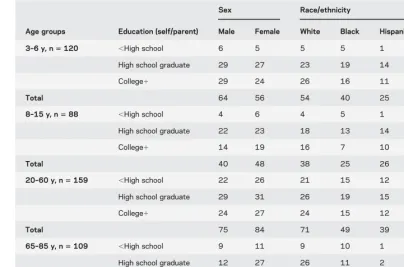
Subjects.The sample (N5476) was based on a stratification plan to include adequate numbers of individuals within age bands, level of education, and racial/ethnic backgrounds. A marketing research firm assisted in recruitment of community-dwelling individuals. Testing was completed at Northwestern University (Chicago) and 5 additional sites: Emory University (Atlanta), the University of Minnesota (Minneapolis), the University of Washington (Seat-tle), NorthShore University HealthSystem (Evanston, IL), and Kessler Foundation Research Center (West Orange, NJ). Eligible participants were 3 to 85 years of age living in the community. See table 1 for age, sex, race, and education strata. Not all ages were sampled in this study. Education levels in the table are defined as actual years of education completed by adult participants (ages 201 years) and highest parental education for children (ages 3–15 years). One-third of the sample was randomly selected to repeat testing 7 to 21 days later to assess test-retest reliability.
Analyses.This initial report includes results from analyses of test-retest reliability, associations of test scores with age, and convergent and discriminant construct validity. Age associations reflect the validity of the tests for measuring cognitive development during childhood and age-related cognitive decline during adulthood. Convergent and discriminant validity results provide evidence that the Cognition Battery is measuring the intended constructs.
attention, episodic memory, EF, and PS. Thus, in this age group, only convergent validity was measured between the Cognition Bat-tery measures and a measure of general cognitive ability (i.e.,“g”) obtained by averagingzscores of the Wechsler Preschool and Pri-mary Scale of Intelligence–3rd edition Block Design subtest52and the Peabody Picture Vocabulary Test–4th edition.53More detailed psychometric information on individual measures and on challenges related to testing for construct validity in very young children is detailed in Zelazo et al. (in press).9
RESULTS Test-retest reliability.
Test-retest reliability
was strong for the entire sample and separately for
children (ages 3
–
15 years) and adults (ages 20
–
85
years; table 3). Intraclass correlation coefficients for
the entire sample on the NIH Toolbox measures
ranged from 0.78 for the Picture Sequence Memory
Test to 0.99 on the Oral Reading Recognition Test,
with most other values falling above 0.90.
Age effects.
All cognitive abilities are expected to
improve during childhood, and most are expected
to show some age-related decline during adulthood,
with the exception of language skills and other
Table 1 Initial validation sample demographics (N5476)a
Age groups Education (self/parent)
Sex Race/ethnicity
Male Female White Black Hispanic/other/multiple
3–6 y, n5120 ,High school 6 5 5 5 1
High school graduate 29 27 23 19 14
College1 29 24 26 16 11
Total 64 56 54 40 25
8–15 y, n588 ,High school 4 6 4 5 1
High school graduate 22 23 18 13 14
College1 14 19 16 7 10
Total 40 48 38 25 26
20–60 y, n5159 ,High school 22 26 21 15 12
High school graduate 29 31 26 19 15
College1 24 27 24 15 12
Total 75 84 71 49 39
65–85 y, n5109 ,High school 9 11 9 10 1 High school graduate 12 27 26 11 2
College1 23 27 42 5 3
Total 44 65 77 26 6
aParental education was used for participants ages 3 to 15 years and participant education was used for adults (ages 201).
Table 2 Convergent and discriminant validity (“gold standard”) measures used for ages 8 to 85 years
NIH Toolbox measure Convergent validity measure Discriminant validity measure
Flanker (attention) WISC-IV/WAIS-IV Letter-Number Sequencing/Coding/Symbol Search averagea
PPVT-4
Flanker (EF) D-KEFS Inhibition PPVT-4
DCCS D-KEFS Inhibition PPVT-4
PSMT BVMT-R/RAVLT average PPVT-4
List Sorting WISC-IV/WAIS-IV Letter-Number Sequencinga/PASAT average PPVT-4 Pattern Comparison WISC-IV/WAIS-IV Coding/Symbol Search averagea PPVT-4
Vocabulary PPVT-4 BVMT-R/RAVLT average
Reading WRAT-4 BVMT-R/RAVLT average
Abbreviations: BVMT-R5Brief Visuospatial Memory Test–revised; DCCS5Dimensional Change Card Sort; D-KEFS5
Delis-Kaplan Executive Function System; EF 5executive function; PASAT 5 Paced Auditory Serial Addition Test; PPVT-45Peabody Picture Vocabulary Test–4th edition; PSMT = Picture Sequence Memory Test; RAVLT5Rey Auditory Verbal Learning Test; WAIS-IV5Wechsler Adult Intelligence Scale–4th edition; WISC-IV5Wechsler Intelligence Scale for Children–4th edition; WRAT-45Wide Range Achievement Test–4th edition.
aspects of
“
crystallized
”
intelligence. Therefore,
cor-relations between age and NIH-TB test performance
were conducted separately for children (ages 3
–
15
years) and adults (ages 20
–
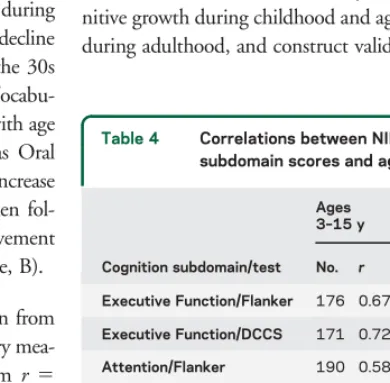
85 years). Table 4
presents these results.
All NIH-TB Cognition Battery measures showed
robust associations between test performance and age
in the child group (
r
5
0.58
–
0.87), where scores
improved with age. With the exception of the language
measures (Vocabulary and Reading,
r
5
0.15 and
2
0.02, respectively), age and test scores (
r
5 2
0.46
to
2
0.65) on the remaining NIH-TB Cognition
Bat-tery measures were negatively associated, with lower
scores at higher age levels. Thus, on the Picture
Sequence Memory Test, performance improved during
childhood and early adolescence, with gradual decline
in scores across adult age ranges beginning in the 30s
(figure, A). In contrast, the NIH-TB Picture
Vocabu-lary Test showed gradual, linear improvement with age
until the mid 50s and then stabilized, whereas Oral
Reading Recognition showed a much sharper increase
until early grade-school years (age 7
–
8) and then
fol-lowed the same pattern of more gradual improvement
and then stability in the older age groups (figure, B).
Convergent and discriminant validity.
In children from
3 to 6 years of age, all NIH-TB Cognition Battery
mea-sures were significantly correlated (ranging from
r
5
0.54 to
r
5
0.74) with our measure of general cognitive
ability (
“
g
”
), indicating that they are sensitive to a range
of different cognitive ability levels within this age cohort.
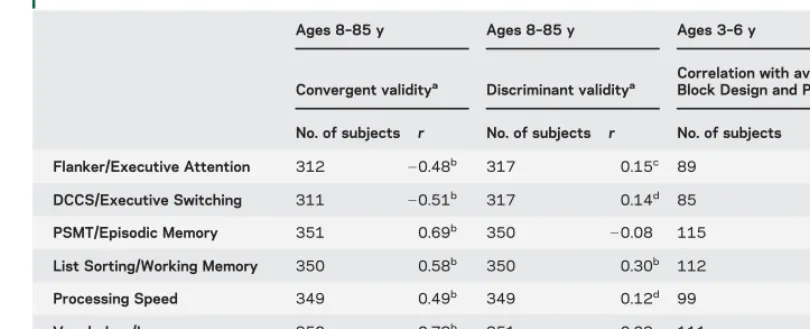
Table 5 shows results for convergent and discriminant
validity for ages 8 to 85 years. For all NIH-TB CB
instruments, correlations for convergent validity
meas-ures ranged from
r
5
0.48 to
r
5
0.93 (all
p
,
0.0001),
suggesting that the NIH-TB measures are tapping the
desired constructs. Correlations for discriminant validity
measures ranged from
r
5
0.05 to
r
5
0.30, indicating
lack of, or relatively weak, relationship with measures
that tap different constructs.
DISCUSSION
This article introduces the NIH
Tool-box Cognition Battery, a brief series of cognitive tests
for the purpose of supplementing measures in
epidemi-ologic and longitudinal studies to constitute a
“
com-mon currency
”
among researchers. The Cognition
Battery has 7 computerized instruments that measure
6 ability subdomains important for cognitive health
from the ages of 3 to 85 years. Data are presented for
208 normal children (age 3
–
15 years) and 268 normal
adults (age 20
–
85 years) on 3 important psychometric
characteristics: test-retest reliability, sensitivity to
cog-nitive growth during childhood and age-related decline
during adulthood, and construct validity.
Table 3 Test-retest reliability of instruments in the NIH-TB Cognition Battery
NIH-TB cognition subdomain/instrument
All Children aged 3–15 y Adults aged 20–85 y
No. ICC (95% CI) No. ICC (95% CI) No. ICC (95% CI)
Executive Function/Flanker 125 0.96 (0.94, 0.97) 52 0.95 (0.92, 0.97) 73 0.80 (0.70, 0.87) Executive Function/DCCS 123 0.94 (0.92, 0.96) 49 0.92 (0.86, 0.95) 74 0.88 (0.82, 0.92) Attention/Flanker 130 0.95 (0.93, 0.96) 57 0.95 (0.92, 0.97) 73 0.94 (0.91, 0.96) Episodic Memory/PSMT 155 0.78 (0.71, 0.83) 66 0.76 (0.64, 0.84) 89 0.77 (0.67, 0.84) Working Memory/List Sorting 155 0.89 (0.85, 0.92) 66 0.87 (0.80, 0.92) 89 0.77 (0.67, 0.84) Processing Speed/Pattern Comparison 148 0.82 (0.76, 0.87) 59 0.84 (0.75, 0.90) 89 0.72 (0.60, 0.81) Language/Vocabulary 155 0.94 (0.92, 0.96) 66 0.84 (0.75, 0.90) 89 0.81 (0.73, 0.87)
Language/Reading 154 0.99 (0.99, 0.99) 65 0.99 (0.98, 0.99) 89 0.91 (0.87, 0.94)
Abbreviations: CI5confidence interval; DCCS5Dimensional Change Card Sort; ICC5intraclass correlation coefficient; NIH-TB5NIH Toolbox for the Assessment of Neurological and Behavioral Function; PSMT = Picture Sequence Memory Test.
Table 4 Correlations between NIH-TB cognition subdomain scores and age
Cognition subdomain/test Ages 3–15 y
Ages 20–85 y
No. r No. ra
Executive Function/Flanker 176 0.67b 235 20.50b
Executive Function/DCCS 171 0.72b 236 20.53b Attention/Flanker 190 0.58b 237 20.54b
Episodic Memory 204 0.80b 266 20.65b Working Memory 201 0.79b 265 20.46b Processing Speed 189 0.77b 265 20.53b Language/Vocabulary 200 0.82b 265 0.15 Language/Reading 204 0.87b 266 20.02
Abbreviations: DCCS 5 Dimensional Change Card Sort; NIH-TB5NIH Toolbox for the Assessment of Neurological and Behavioral Function;r5Pearson correlation coefficient.
The subject sample for this study deliberately
emphasized representation of ethnic minorities (almost
50%) and the oldest and youngest groups (3
–
6 years
and 65
–
85 years; together, 48%) to ensure that the tests
would perform as needed in these important segments
of the population. Thus, the participants in this study
(or their parents, in the case of children) tended to be
rather highly educated, particularly in the youngest and
oldest groups (see table 1). A more representative
population-based sampling strategy was implemented
for the NIH-TB norming study.
Adequate test-retest reliability was considered
essen-tial for the NIH-TB Cognition Battery, particularly
because of its anticipated use in longitudinal studies.
The results suggest that test-retest reliability of all
NIH-TB measures is good to excellent across a large
age range. Composite scores, which have higher
reliabil-ity than individual test scores, are being developed to
Figure Episodic memory scores vs language scores across age
increase the potential for use of the battery in clinical
trials and other longitudinal research.
Evidence of test validity can take many forms, and
derives from both clinical and nonclinical subject
sam-ples. We presented the relationship of Cognition Battery
performance with age in cognitively normal children
and adults. The Reading and Vocabulary scores showed
the expected associations with age, growing through
adolescence and stabilizing in older adulthood. Not
sur-prisingly, Reading showed an especially steep
improve-ment from age 3 to the early school years, when both
formal and informal educational experiences ideally
pro-mote such development. The Language subdomain
tests, as expected, are experience-based and peaked
somewhat later than measures of other cognitive
subdo-mains, and then remained relatively stable even into the
ninth decade of life. The nonlanguage subdomain tests
in the battery, in contrast, conformed to the pattern
expected with cognitive ability measures in that they
peaked in early adulthood and then declined in later
adulthood at different rates, depending on the measure.
Another validity measure we included in this report
expresses how well the tests in the battery measure the
intended constructs (convergent validity) as opposed to
different cognitive constructs (discriminant validity).
The
“
gold standard
”
tests related to the Cognition
Bat-tery instruments in the expected ways for participants
across a wide age band (ages 8
–
85 years),
demonstrat-ing both convergent and discriminant validity.
Evalu-ating construct validity in young children (ages 3
–
6
years) was challenging because of the absence of specific
gold standard measures of targeted constructs
appropri-ate for these ages. (See Zelazo et al., in press,
54for
dis-cussion.) The lack of such measures may reflect the fact
that different subdomains of cognition become more
differentiated with experience and development.
55The
correlations between the NIH-TB measures and
gen-eral cognitive ability, our index of convergent validity in
young children (ages 3
–
6 years), were high (0.54
–
0.74), possibly supporting such a notion.
The NIH-TB Cognition Battery was designed as a
brief, diverse, accessible, and psychometrically sound
set of instruments that will be broadly applicable in
research studies of normal and abnormal groups across
a wide age range. The current results regarding age
ef-fects, test-retest reliability, and construct validity are
promising. The next phase of development established
normative standards for the NIH-TB measures using
a large, demographically diverse sample, including a
Spanish-language version of the measures. More detailed
information will also be available about associations of
test performances with various aspects of everyday
func-tioning (e.g., school performance in the child sample)
and relationships with additional demographic
charac-teristics (educational level/socioeconomic status, sex,
and ethnicity). The NIH-TB Cognition Battery was
not developed as a clinical measure to either screen for
cognitive impairment or to substitute for a full,
compe-tent neuropsychological evaluation. However, future
studies with clinical populations are expected to generate
another source of validation of the Cognition Battery as
a sound set of measures of a broad range of normal and
abnormal cognitive functioning, with implications for
brain health in large-scale research studies.
AUTHOR CONTRIBUTIONS
Sandra Weintraub: drafting/revising the manuscript, study concept or design, analysis or interpretation of data, acquisition of data. Sureyya Table 5 Convergent and discriminant validity of NIH-TB cognitive function battery measures
Ages 8–85 y Ages 8–85 y Ages 3–6 y
Convergent validitya Discriminant validitya
Correlation with average of WPPSI Block Design and PPVT-4zscores
No. of subjects r No. of subjects r No. of subjects r
Flanker/Executive Attention 312 20.48b 317 0.15c 89 0.70b DCCS/Executive Switching 311 20.51b 317 0.14d 85 0.74b PSMT/Episodic Memory 351 0.69b 350
20.08 115 0.59b
List Sorting/Working Memory 350 0.58b 350 0.30b 112 0.64b
Processing Speed 349 0.49b 349 0.12d 99 0.54b
Vocabulary/Language 350 0.78b 351 0.08 111 0.74b
Reading/Language 351 0.93b 351 0.19b 115 0.65b
Abbreviations: DCCS5Dimensional Change Card Sort; NIH-TB5NIH Toolbox for the Assessment of Neurological and Behavioral Function; PPVT-45Peabody Picture Vocabulary Test–4th edition; PSMT5Picture Sequence Memory Test;r5
Pearson correlation coefficient; WPPSI5Wechsler Preschool and Primary Scale of Intelligence–3rd edition.
aGold standard measures used to test convergent and discriminant validity for ages 8 to 85 y appear in table 2. bp,0.001.
Dikmen: drafting/revising the manuscript, study concept or design, anal-ysis or interpretation of data, statistical analanal-ysis, study supervision. Robert Heaton: drafting/revising the manuscript, study concept or design, anal-ysis or interpretation of data. David Tulsky: drafting/revising the manu-script, study concept or design, analysis or interpretation of data, acquisition of data, statistical analysis, study supervision. Philip Zelazo: drafting/revising the manuscript, study concept or design, analysis or interpretation of data. Patricia Bauer, Noelle Carlozzi, and Jerry Slotkin: drafting/revising the manuscript, study concept or design, analysis or interpretation of data, acquisition of data, study supervision. David Blitz: analysis or interpretation of data, statistical analysis, study supervision. Kathleen Wallner-Allen: drafting/revising the manuscript, study concept or design, analysis or interpretation of data. Nathan Fox: drafting/revising the manuscript, study concept or design, analysis or interpretation of data, study supervision. Jennifer Beaumont: analysis or interpretation of data, statistical analysis. Dan Mungas: drafting/revising the manu-script, study concept or design, analysis or interpretation of data, statisti-cal analysis. Cindy Nowinski: drafting/revising the manuscript, study concept or design, study supervision. Jennifer Richler: drafting/revising the manuscript, study concept or design, acquisition of data. Joanne Deo-campo and Jacob Anderson: study concept or design, analysis or interpre-tation of data, contribution of vital reagents/tools/patients, acquisition of data, statistical analysis, study supervision. Jennifer Manly: drafting/revis-ing the manuscript, acquisition of data. Beth Borosh: draftdrafting/revis-ing/revisdrafting/revis-ing the manuscript, study concept or design, analysis or interpretation of data, acquisition of data, study supervision. Richard Havlik: drafting/revising the manuscript, study concept or design, analysis or interpretation of data, acquisition of data. Kevin Conway: drafting/revising the manu-script, study concept or design, study supervision. Emmeline Edwards: drafting/revising the manuscript, study concept or design, analysis or interpretation of data, member of the NIH Project team managing the Tool Box Contract that produced data for this manuscript. Lisa Freund: study concept or design, study supervision, obtaining funding. Jonathan King and Claudia Moy: drafting/revising the manuscript. Ellen Witt: drafting/revising the manuscript, analysis or interpretation of data. Ri-chard Gershon: drafting/revising the manuscript, study concept or design, analysis or interpretation of data, acquisition of data, statistical analysis, study supervision, obtaining funding.
ACKNOWLEDGMENT
The authors thank Abigail Sivan and Edmond Bedjeti (Northwestern Uni-versity) for their valuable assistance in the validation phase of testing. The authors also acknowledge the following individuals for their helpful con-sultation during the development of the NIH Toolbox Cognition Battery: Jean Berko Gleason (Boston University), Rachel Byrne (Kessler Founda-tion), Gordon Chelune (University of Utah), Nancy Chiaravalotti (Kessler Foundation), Dean Delis (University of California, San Diego), Adele Dia-mond (University of British Columbia), Roberta Golinkoff (University of Delaware), Kathy Hirsh-Pasek (Temple University), Marilyn Jager Adams (Brown University), Joel Kramer (University of California, San Francisco), Joanie Machamer (University of Washington), Amanda O’Brien (Kessler Foundation), Timothy Salthouse (University of Virginia), Jerry Sweet (University of Chicago), Keith O. Yeates (Ohio State University), and Frank Zelkoe (Northwestern University).
STUDY FUNDING
This study is funded in whole or in part with Federal funds from the Blueprint for Neuroscience Research, NIH, under contract no. HHS-N-260-2006-00007-C.
DISCLOSURE
S. Weintraub is funded by NIH grants R01DC008552, P30AG013854, and the Ken and Ruth Davee Foundation, and conducts clinical neuro-psychological evaluations (35% effort) for which her academic-based practice clinic bills. S. Dikmen receives research grant funding from NIH R01 NS058302 and R01HD061400, NIDRR H133A080035, NIDRR H133G090022, and NIDRR, H133A980023, and DoD W81XWH-0802-0159. R. Heaton is funded by NIH grants P30MH062512, P50DA026306, P01DA012065, R01MH060720, R01MH073433, R01MH058076, R01MH078748, R01MH078737,
U01MH083506, R01MH083552, and R01MH081861. D. Tulsky is funded by NIH contracts H133B090024, H133N060022, H133G070138, B6237R, cooperative agreement U01AR057929, and grant R01HD054659. He has received consultant fees from the Institute for Rehabilitation and Research, Frazier Rehabilitation Institute/Jewish Hospital, Craig Hospital, and Casa Colina Centers for Rehabilitation. P. Zelazo serves on the editorial boards ofChild Development, Develop-ment and Psychopathology,Frontiers in Human Neuroscience,Cognitive Development, Emotion, and Developmental Cognitive Neuroscience, and
Monographs of the Society for Research in Child Development. He is a Senior Fellow of the Mind and Life Institute and President of the Jean Piaget Society. He receives research funding from the Canadian Institute for Health Research (grant 201963), NIDDK/NICHD (1699-662-6312), and the Baumann Foundation. P. Bauer is funded by NIH grant HD067359. N. Carlozzi is funded by NIH grant R03NS065194 and by contracts H133B090024, B6237R, and H133G070138; she previously received funding from NIH grant H133A070037-08A and a grant from the NJ Department of Health and Senior Services. J. Slotkin, D. Blitz, and K. Wallner-Allen report no disclosures. N. Fox is funded by NIH grants R37HD017899, MH074454, U01MH080759, R01MH091363, P50MH078105, and P01HD064653. He serves on the scientific board of the National Scientific Council for the Developing Child. J. Beaumont served as a consultant for NorthShore University HealthSystem, FACIT.org, and Georgia Gastroenterology Group PC. She received funding for travel as an invited speaker at the North American Neuroendocrine Tumor Symposium. D. Mungas is funded by research grants from the National Institute on Aging and a grant from the California Department of Public Health California Alzheimer’s Disease Centers program. C. Nowinski receives or has received research support from the NIH (contracts HHSN265200423601C, HHSN260200600007C, and HHSN267200700027C), the Department of Veteran’s Affairs, the Analysis Group, Novartis, and Teva Pharmaceuticals. She has also received honoraria for writing and updating an article for Med-link. J. Richler is funded by NIH/NCRR grant UL1RR025761. J. Deocampo and J. Anderson report no disclosures. J. Manly is funded by NIH grants R01AG028786 and R01AG037212; she previously received funding from NIH grant R01AG016206 and a grant from the Alzheimer’s Association (IIRG 05-14236). B. Borosh, R. Havlik, and K. Conway report no disclo-sures. E. Edwards is the Director of the Division of Extramural Research at NCCAM. Dr. Edwards declares that except for income received from her primary employer, no financial support or compensation has been received from any individual or corporate entity over the past 3 years for research or professional service and there are no personal financial holdings that could be perceived as constituting a potential conflict of interest. L. Freund reports no disclosures. J. King is the NIA Project Scientist for the NIH cooperative agreements U01AG014289, U01AG014276, U01AG14260, U01AG14282, and U01AG014263 (comprising the ACTIVE clinical trial). C. Moy and E. Witt report no disclosures. R. Gershon has received personal compensation for activities as a speaker and consultant with Sylvan Learning, Rockman, and the American Board of Podiatric Surgery. He has several grants awarded by NIH: N01-AG-6-0007, 1U5AR057943-01, HHSN260200600007, 1U01DK082342-01, AG-260-06-01, HD05469; NINDS: U01 NS 056 975 02; NHLBI K23: K23HL085766 NIA; 1RC2AG036498-01; NIDRR: H133B090024; OppNet: N01-AG-6-0007. Go to Neurology. org for full disclosures.
DISCLAIMER
The views and opinions expressed in this report are those of the authors and should not be construed to represent the views of NIH or any of the sponsoring organizations, agencies, or the U.S. government.
Received June 6, 2012. Accepted in final form November 15, 2012.
REFERENCES
2. Diamond A. Frontal lobe involvement in cognitive changes during the first year of life. In: Gibson KR, Petersen AC; Council SSR, editors. Brain Maturation and Cognitive Development: Comparative and Cross-cultural Perspectives. New York: De Gruyter; 1991:127–180.
3. Zelazo PD, Carlson SM, Kesek A. Development of execu-tive function in children. In: Nelson CA, Luciana M, edi-tors. Handbook of Developmental Cognitive Neuroscience, 2nd ed. Cambridge, MA: MIT Press; 2008:553–574. 4. Daniels K, Toth J, Jacoby L. The aging of executive
func-tions. In: Bialystok E, Craik FIM, editors. Lifespan Cogni-tion: Mechanisms of Change. New York: Oxford University Press; 2006:96–111.
5. Zelazo PD, Craik FI, Booth L. Executive function across the life span. Acta Psychol 2004;115:167–183.
6. Miyake A, Friedman NP, Emerson MJ, Witzki AH, Howerter A, Wager TD. The unity and diversity of execu-tive functions and their contributions to complex "Frontal Lobe" tasks: a latent variable analysis. Cogn Psychol 2000; 41:49–100.
7. Wiebe SA, Sheffield T, Nelson JM, Clark CAC, Chevalier N, Espy K. The structure of executive function in 3-year-olds. J Exp Child Psychol 2011;108:436–452.
8. Durston S, Davidson MC, Tottenham N, et al. A shift from diffuse to focal cortical activity with development. Dev Sci 2006;9:1–8.
9. Zelazo PD. The Dimensional Change Card Sort (DCCS): a method of assessing executive function in children. Nature Protocols 2006;1:297–301.
10. Weintraub S. Neuropsychological assessment of mental state. In: Mesulam MM, editor. Principles of Cognitive and Behavioral Neurology. New York: Oxford University Press; 2000:121–173.
11. Swensen A, Birnbaum HG, Ben Hamadi R, Greenberg P, Cremieux PY, Secnik K. Incidence and costs of accidents among attention-deficit/hyperactivity disorder patients. J Adolesc Health 2004;35:346.e341–346.e349. 12. Mesulam M. A cortical network for directed attention and
unilateral neglect. Ann Neurol 1981;10:309–325. 13. Posner MI, Petersen SE. The attention system of the
human brain. Annu Rev Neurosci 1990;13:25–42. 14. D’Esposito M, Aguirre GK, Zarahn E, Ballard D,
Shin RK, Lease J. Functional MRI studies of spatial and nonspatial working memory. Cogn Brain Res 1998;7:1–13.
15. Conlin JA, Gathercole SE, Adams JW. Children’s working memory: investigating performance limitations in complex span tasks. J Exp Child Psychol 2005;90:303–317. 16. Salthouse TA, Meinz EJ. Aging, inhibition, working
mem-ory, and speed. J Gerontol B Psychol Sci Soc Sci 1995;50: P297–P306.
17. Hitch GJ, Towse JN, Hutton U. What limits children’s working memory span? Theoretical accounts and applica-tions for scholastic development. J Exp Psychol Gen 2001; 130:184–198.
18. de Jong PF, Olson RK. Early predictors of letter knowl-edge. J Exp Child Psychol 2004;88:254–273.
19. de Jong PF. Working memory deficits of reading disabled children. J Exp Child Psychol 1998;70:75–96. 20. Riggs KJ, McTaggart J, Simpson A, Freeman RP. Changes
in the capacity of visual working memory in 5- to 10-year-olds. J Exp Child Psychol 2006;95:18–26.
21. Salthouse TA, Coon VE. Interpretation of differential def-icits: the case of aging and mental arithmetic. J Exp Psy-chol Learn Mem Cogn 1994;20:1172–1182.
22. Corkin S, Amaral DG, Gonzalez RG, Johnson KA, Hyman BT. H. M.’s medial temporal lobe lesion: findings from magnetic resonance imaging. J Neurosci 1997;17: 3964–3979.
23. Bauer PJ. Remembering the Times of Our Lives: Memory in Infancy and Beyond. Mahwah, NJ: Lawrence Erlbaum Associates; 2007.
24. Perner J, Ruffman T. Episodic memory and autonoetic con-sciousness: developmental evidence and a theory of child-hood amnesia. J Exp Child Psychol 1995;59:516–548. 25. Gadian DG, Aicardi J, Watkins KE, Porter DA, Mishkin M,
Vargha-Khadem F. Developmental amnesia associated with early hypoxic-ischaemic injury. Brain 2000;123(pt 3):499–507. 26. Albert MS. Cognitive and neurobiologic markers of early Alzheimer disease. Proc Natl Acad Sci USA 1996;93: 13547–13551.
27. Mitchell AS, Dalrymple-Alford JC. Lateral and anterior thalamic lesions impair independent memory systems. Learn Mem 2006;13:388–396.
28. Price CJ. The anatomy of language: contributions from functional neuroimaging. J Anat 2000;197(pt 3):335–359. 29. Schmidt FL, Hunter J. General mental ability in the world of work: occupational attainment and job performance. J Pers Soc Psychol 2004;86:162–173.
30. Grober E, Sliwinski M. Development and validation of a model for estimating premorbid verbal intelligence in the elderly. J Clin Exp Neuropsychol 1991;13:933–949. 31. Manly JJ, Byrd DA, Touradji P, Stern Y. Acculturation,
read-ing level, and neuropsychological test performance among Afri-can AmeriAfri-can elders. Appl Neuropsychol 2004;11:37–46. 32. Manly JJ, Jacobs DM, Sano M, et al. Effect of literacy on
neuropsychological test performance in nondemented, educa-tion-matched elders. J Int Neuropsychol Soc 1999;5:191–202. 33. Cattell RB. Intelligence: Its Structure, Growth and Action.
Amsterdam: Elsevier; 1987.
34. Kastner JW, May W, Hildman L. Relationship between language skills and academic achievement in first grade. Percept Mot Skills 2001;92:381–390.
35. Fenson L, Dale PS, Reznick JS, Bates E, Thal DJ, Pethick SJ. Variability in early communicative develop-ment. Monogr Soc Res Child Dev 1994;59:1–173. 36. Gleason JB, Ratner NB, editors. The Development of
Language, 7th ed. Boston: Pearson/Allyn & Bacon; 2009. 37. Hirsh-Pasek K, Golinkoff RM. The Origins of Grammar: Evidence from Early Language Comprehension. Cam-bridge, MA: M.I.T. Press; 1996.
38. Kalmar JH. Information processing speed in multiple scle-rosis: a primary deficit? In: DeLuca J, Kalmar JH, editors. Information Processing Speed in Clinical Populations. New York: Taylor & Francis; 2007:153–172.
39. Fry AF, Hale S. Relationships among processing speed, working memory and fluid intelligence in children. Biol Psychol 2000;54:1–34.
40. Salthouse TA. Aging and measures of processing speed. Biol Psychol 2000;54:35–54.
41. Hawkins KA. Indicators of brain dysfunction derived from graphic representations of the WAIS-III/WMS-III techni-cal manual clinitechni-cal samples data: a preliminary approach to clinical utility. Clin Neuropsychologist 1998;12:535–551. 42. DeLuca J, Kalmar JH. Information Processing Speed in
43. Zelazo PD, Bauer PJ, Editors. National Institutes of Health Toolbox—Cognitive Function Battery (NIH Toolbox CFB): Validation for Children Between 3 and 15 Years. Monogr Soc Res Child Dev (in press). 44. Rueda MR, Fan J, McCandliss BD, et al. Development of
attentional networks in childhood. Neuropsychologia 2004;42:1029–1040.
45. Mungas D, Reed BR, Tomaszewski Farias S, DeCarli C. Criterion-referenced validity of a neuropsychological test bat-tery: equivalent performance in elderly Hispanics and non-Hispanic Whites. J Int Neuropsychol Soc 2005;11:620–630. 46. Crane PK, Narasimhalu K, Gibbons LE, et al. Item response theory facilitated cocalibrating cognitive tests and reduced bias in estimated rates of decline. J Clin Epi-demiol 2008;61:1018–1027.e9.
47. Mungas D, Widaman KF, Reed BR, Tomaszewski Farias S. Measurement invariance of neuropsychological tests in diverse older persons. Neuropsychology 2011;25:260–269. 48. Bauer PJ. Long-term recall memory: behavioral and neuro-developmental changes in the first two years of life. Curr Dir Psychol Sci 2002;11:137–141.
49. Bauer PJ. Developments in declarative memory. Psychol Sci 2005;16:41–47.
50. Bauer PJ. Constructing a past in infancy: a neuro-devel-opmental account. Trends Cogn Sci 2006;10:175–181. 51. Salthouse TA, Babcock RL, Shaw RJ. Effects of adult age
on structural and operational capacities in working mem-ory. Psychol Aging 1991;6:118–127.
52. Wechsler D. WPPSI-III Wechsler Preschool Primary Scale of Intelligence, 3rd ed. San Antonio: Psychological Cor-poration; 2002.
53. Dunn LM, Dunn LM. Peabody Picture Vocabulary Test Fourth Edition (PPVT-IV). Bloomington, MN: NCS Pearson; 2007.
54. Zelazo PD, Anderson JE, Richler J, Wallner-Allen K, Beaumont JL, Weintraub S. NIH Toolbox cognitive func-tion battery (CFB): measuring executive funcfunc-tion and atten-tion. Monogr Soc Res Child Dev (in press).