Volume 4, No. 8, May-June 2013
International Journal of Advanced Research in Computer Science
RESEARCH PAPER
Available Online at www.ijarcs.info
ISSN No. 0976-5697
Search Engine Optimization of E-Commerce Website using Apache SOLR
Sanket Patil
School of Computer Science and Engineering, VIT University, Vellore, Tamilnadu, India
Rajeshkannan R
School of Computer Science and Engineering, VIT University, Vellore, Tamilnadu, India
Abstract:The Internet and the World Wide Web have bought significant changes in the emerging global economy. With the rapid development of Internet, electronic commerce has developed very sharply. Nowadays, most people use search engines more often for information and new websites. In one word, the search engines have become an indispensable part of Internet users. Search Engine Optimization, called SEO for short, is important to websites, which will improve the rank for search engines and get more page views. This paper puts forward various strategies which aims at search optimization such as site structure optimization, content optimization, minimal use of redirection statements etc. and represents the new approaches which makes use of SEO strategies. This new approaches are developed with the help of upcoming search technology like Apache SOLR. Moreover, it also provides the experimental analysis with several demanding e-commerce websites which indicates that the search engine optimization is achieved over them.
Keywords: e-commerce, SEO, Apache SOLR etc.
I. INTRODUCTION
Nowadays, the search engines have become an important part of Internet users. On the base of the search engine users rapidly growing and the ability of search engines is being raised continuously An important aspect of Search Engine Optimization is making the website easy for both users and search engine robots to understand[1,2].
Search engine optimization (SEO) is a well-defined and managed process which helps to increase the volume or improve quality of traffic to a web site from search engines. SEO activity helps to increase the amount of visitors to a Web site by ranking high in the search results of a search engine. The higher a Web site ranks in the results of a search, the greater the chance that that site will be visited by a user [6].
Search engine optimization is a method of optimizing a website so that it gains a high index ranking on the search engine [5].The optimization of website is necessary to achieve a successfulonline business. For every website owner it is necessary to know and understand the basics of SEO [4].Optimization of a website falls into two categories such as, On-site Optimization
Off-site Optimization
a. On-site optimization:
In this method, the optimization of web pages is done as per the requirements of the search engines. It is not a single process, but a series of different methods of optimization. The first step of this method is including keywords in the title tag. Making the description Meta tag a short snippet of the website is also important. The page is made light enough to load faster by using optimized images and graphics. The articles and
content text length should be between 300-500 words. The content of the website should be original and unique. The website should be easily navigable [6].
Altogether, on-site optimization is based on the process of making the website findable with plenty of relevant keywords. It also includes making a website easily accessible and user-friendly [4].
b. Off-site optimization:
Off-site optimization is the method in which backlinks are gained from other websites. People often think that getting thousands of backlinks from other websites is good enough. However, this is not true. Most of the people who are new to SEO manage to get hundreds of backlinks for a single page through link exchanges. Still they lack a good ranking [6].
Getting a huge number of backlinks is not enough. The backlinks should be gained from good and credible websites. These websites are referred to as authority sites. Authority websites are well-established and high earning. Getting one backlink from such a websites is worthier than hundred backlinks from other websites that are not much reputed [6].
Search engine optimization is a science. Its basic should be learned and understood to make a website optimized. This way a website can achieve a good ranking in Google and other search engines.
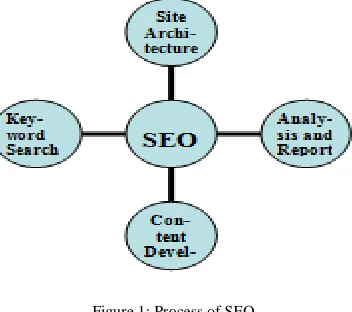
Figure 1: Process of SEO
Search Engine Optimization process [5] comprises of,
A. Keyword Search:
Keyword phrase research involves identifying a group of keyword phrases that will be used in optimization. This step is critical and requires a considerable amount of time to find a good set of phrases that offer a balanced combination of two important factors: high usage by searchers and relatively low competition within the search engines [5, 6].
B. Content Development:
First, a site loaded with high-quality content of interest to site users will give them a reason to stay and a reason to come back. After all, the reason they came to the site was to find information. Second, the added benefit of serving up exactly what the search engines want - content. Search engines will have more information to store about your business and products; that information will translate directly into the ranking they give your site for related keyword phrases. This step mainly deals with providing richer content to the site [5].
C. Site Architecture:
Efficient site structure plays a very important part of any SEO campaign and is something that should be always taken care and consideration when planning a new website. It is recommended that to choose simple-to-understand URLs that convey content information easily. To keep the site well-organized, try to create descriptive categories and file names for the documents on your website. At the same time it creates friendlier URLs for those that want to link to your content. Visitors may be intimidated by extremely long and cryptic URLs that contain few recognizable words. It deals with site structure which constitutes site navigation, URL structure, site layout etc. [5, 6].
D. Analysis and Report:
Analyze the existing website for SEO and generate the report so as to improve SEO for the site in future. Moreover, prepare SEO plan which contains the goals to be achieved for the website in terms of search engine optimization [5].
II. LITERATURE SURVEY
SEO improves the rank for search engines and get more
such as dynamic web pages, redirect web pages and similar or repeated pages and gives some tactics to improve them [1].Apache SOLR is the efficient upcoming search technology. It shows the how indexing approach gives the faster performance. It can be used for complex event processing purpose [2].Effective techniques and best practices are provided to position the sites web at the top results in search engines. It specially provides guidelines to improve SEO for flash websites [3].Website visibility is plays an important role for improving SEO. It provides various techniques to improve website visibility which in-turn improves SEO for any e-commerce website [4].
III. DIFFERENT STRATEGIES FOR SEO
Different metrics which enhances the search engine optimization such as site-structure optimization, content optimization, reduction of redirection etc. [6] which are given in detail as follows,
A. Site-Structure Optimization:
Website structure is an essential and interesting part of SEO. Website structure means design a website in a way that complies with SEO requirements, through which a website is finally promoted. The structural layout of website makes a big difference for the user. Site structure optimization is achieved based on some parameters like its URL structure, site map and file hierarchy [6].Different guidelines which aims at Site-structure optimization such as, Use words in URLs to make it more meaningful.
Use a simple directory structure that organizes website contents well and makes it easy for visitors to know where they are at on the website.
Make the website easier to navigate so that every page of the website is reachable in minimal steps by the visitors. Ensure more convenience for users by using ‘breadcrumb lists’ which allows visitors to quickly navigate back to a previous section or the root page.
B. Content Optimization:
It mainly offers Offer quality content and services. Content optimization can be defined as the optimization of the on-page content in correspondence with other factors like title tags, Meta tags, alt tags, web page URL, domain name and internal links [5].
Different guidelines [6] which aims at Content optimization such as, Use content that is well organized and well written, for example content that is stuffed with extra keywords.Anticipate differences in users understanding of website topics and offer unique, exclusive content accordingly.
Stay organized around the content which is always beneficial to organize website content so that visitors have a good sense of where one content topic begins and another ends. Breaking your content up into logical chunks or divisions helps users find the content they want faster.
Make use of suitable anchor text which makes it easy to convey the contents linked.Use more descriptive content to the website such as make use of images, animation to make it attractive for users
C. Reduction of redirection statements:
The homepage of e-commerce website, the most important web page, has a large amount of information and many external links, which search engines, attach great importance to, as well as product catalogue and merchandise pages. For the potential customer’s browsing information and search engine's capture, e-commerce website should allow unregistered users to visit these pages, namely do not put redirect statement at the beginning of them. In short, try to minimize use of redirect statements as much as possible in order to improve search process [1].
IV. NEW APPROACHES TO ACHIEVE SEO FOR
E-COMMERCE WEBSITE
Different new approaches which aim at Search Engine Optimization are implemented with the help of Apache SOLR search technology [7]. SOLR technology mainly follows indexing methodology i.e. it maintains indexes for each and every document which can be used for fast search and retrieval. Apache SOLR provides several features like distributed search, hit-highlighting, multiple language support, support for facet search, index replication, dynamic clustering, rich document handling etc. [7]. New approaches are given as follows,
A. Price Range Method B. Multi-faceted Browsing C. Auto-suggest by category D. Use of login-registration popup
A. Price Range Method:
Price range method provides accurate minimum and maximum prices for a group of products where the grouping can be done by category, sub-category or a facet. It will help shopper to search for products according to his/her budget. This method enhances the content optimization process which in turn helps for SEO.
E.g. In case of online shopping website, when customer is looking for a shirt, then he chooses the shirt then Brand facet displays the different brand name like “Allen Solly”, “Peter England”, “John Player” etc. along with the price range which helps to perform search according to his budget.
a. Process Involved:
Create dynamic field index on the price field so that price range can be displayed in any currency format.
Use stats component [8] of SOLR to extract price range in SOLR query response.
General format of SOLR Query used for price range method is given as follows,
q=parent&stats=true&stats.field=price_INR&stats.facet=fac et_value&rows=1
Pictorially, it is shown as below,
Figure 2: Price Range Method
B. Multiple Faceted Browsing:
In E-Commerce website, facet is the attribute of the product which is used to narrow down the search result [10]. Multi-Faceted Browsing is the extended feature of faceted browsing where searching is performed based on multiple facet selection. Customer can select multiple facets according to his choice and can directly jump onto relevant products which help to reduce the search time. Multi-faceted search follows content optimization process.
E.g. Customer wants to purchase a shirt then he will select different facets for it such as brand-name, size, color, pattern etc. and based on multiple facet selection, he can directly jump onto relevant products.
a. Process Involved:
Create the additional facets in database which are used for multi-faceted search.
Append the facet selected to the search URL which are used to the generate search query for multiple faceted search.
General format of SOLR Query used for multiple faceted browsing is given as follows,
facet=true&facet.limit=200&facet.sort=index&facet.field=fa cet_1&facet.field=facet_2&q=facet_1:("Value_1")ANDfacet _2:("Value_2")&spellcheck.collate=false&facet.mincount=1
&spellcheck=true&hl.requireFieldMatch=true.
Pictorially, it is shown as below,
C. Auto-Suggest by Category:
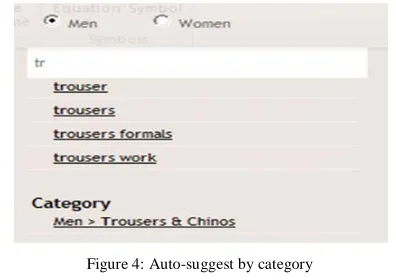
Auto-Suggest by Category are the extra facility provided to auto-suggest feature. Auto-Suggest feature performs the search according to the suggested- keywords. It retrieves the cached keywords as a search result. However, auto-suggest by category performs the search according to the category. By selecting a particular category, it will show relevant sub-categories coming under that category as a search result. Auto-Suggest by category follow content optimization process.
E.g. when customer enters the search term such as ‘tr’ into the search fields then it shows sub-category coming under that category like Men-> Trousers & Chinos.
a. Process Involved:
Create separate solr cores for categories so that separate indices will be created for solr instances.
Apply the solr query over selected category which makes use of terms component [9] of Apache SOLR.
General format of SOLR Query used for auto-suggest by category is given as follows,
terms.prefix=search_term&terms.limit=4&terms=true&term s.sort=count&terms.fl=spellCheck&qt=/term
Pictorially, it is shown as below,
Figure 4: Auto-suggest by category
D. Use of Login-Registration Popup:
Login-Registration Popup mainly performs login-registration process with the help of popups which keeps background contents of the website unchanged. Moreover, it carries out post login process over secured http channel i.e. https. This UI design approach reduces the time required for login-registration process as well as makes it more secure and efficient. By making use of popup for login-registration process, it minimizes the use of redirect statements which in turn helps for SEO.
a. Process Involved:
Create an iframe which handles login-registration popup response as well as performs cross domain communication.
Create javascript function which gets triggered on iframe load event. This function performs the following activities such as,
Checking the status of login-registration process.
After successful login-registration, sending response over secure http channel i.e. https (which changes URL to https domain).
Posting iframe response to parent page.
Figure 5: Overview of Login-Registration Popup
V. EXPERIMENTAL ANALYSIS
We have done the comparative study of our website i.e. TestStore with other demanding E-Commerce websites such as Jabong, Flipkart, Snapdeal, Myntra etc. In this analysis, time has been calculated for several queries like Q1, Q2 and Q3 etc. on E-Commerce website.
Notations used are as follows,
Q1: Clothing- Men - Shirts - Formal - Peter England - 39
Q2: Clothing- Men - Shirts - Casual- Allen Solly- 39 - Black, White
Q3: Clothing- Women - Dresses - Allen Solly - S, M – Blue
T1: Input time required to specify the search condition.
T2: Response time required to produce search result according to the search query.
T3: Overall time required to produce search result which is the addition of input time and response time for the search query.
Table 1: Comparison Table for SEO
Query Type Website
Q1 Q2 Q3
T1 T2 T3 T1 T2 T3 T1 T2 T3
Jabong 21 11 32 31 14 45 29 13 42
Flipkart 15 12 27 23 13 36 20 10 30
Snapdeal 25 10 35 31 11 42 33 12 45
Myntra 14 11 25 24 11 35 19 10 29
TestStore 10 12 22 18 15 33 15 11 26
Graphically it can be shown as follows,
It shows that TestStore which follows new approaches for SEO has more SEO compared to other websites like Jabong, Flipkart, Snapdeal and Myntra.
VI. CONCLUSION AND FUTURE WORK
In this paper, we presented new approaches like price range method, multi-faceted search and auto-suggest by category and use of popups for an E-Commerce website. Also, fast performance can be achieved with the help of Apache SOLR technology. With the help of comparative study with currently demanding E-Commerce websites, we can conclude that this several approach helps to improve Search Engine Optimization (SEO) for an E-Commerce Website.
Search Engine Optimization plays an important role for E-Commerce website in competitive world. In order to improve SEO, follow the strategies and make the different approaches since there is much room for improvement for any E-Commerce Website.
VII. ACKNOWLEDGMENT
The author sincerely thanks his family, as they are his strong support.
VIII. REFERENCES
[1]. Huanwei Wu, “Search Engine Optimization of E-Commerce Websites”, Huaihai Institute of Technology, China, IEEE, 2011
[2]. Roland Vecera, Szabolcs Rozsnyai and Heinz Roth,” Indexing and Search of Correlated Business Events”, IEEE, 2007
[3]. Luis Felipe Arias Aristizábal, Néstor Darío Duque Méndez,” SEO schema application for websites with an emphasis on optimizing pages developed in Flash”,IEEE,2012
[4]. John B. Killoran,” How to Use Search Engine Optimization Techniques to Increase Website Visibility”, IEEE, 2013
[5]. http://www.kaushalam.com/seo-process.html
[6]. Search Engine Optimization Starter Guide given by Google
[7]. http://www.ibm.com/developerworks/java/library/j-solr1/#basic
[8]. http://wiki.apache.org/solr/StatsComponent
[9]. http://wiki.apache.org/solr/TermsComponent