Human Immunodeficiency Virus Diagnostic Testing: 30 Years of
Evolution
Thomas S. Alexander
Summa Health, Department of Pathology and Laboratory Medicine, Akron, Ohio, USA, and Northeast Ohio Medical University, Rootstown, Ohio, USA
A concern during the early AIDS epidemic was the lack of a test to identify individuals who carried the virus. The first HIV anti-body test, developed in 1985, was designed to screen blood products, not to diagnose AIDS. The first-generation assays detected IgG antibody and became positive 6 to 12 weeks postinfection. False-positive results occurred; thus, a two-test algorithm was developed using a Western blot or immunofluorescence test as a confirmatory procedure. The second-generation HIV test added recombinant antigens, and the third-generation HIV tests included IgM detection, reducing the test-negative window to approx-imately 3 weeks postinfection. Fourth- and fifth-generation HIV assays added p24 antigen detection to the screening assay, re-ducing the test-negative window to 11 to 14 days. A new algorithm addressed the fourth-generation assay’s ability to detect both antibody and antigen and yet not differentiate between them. The fifth-generation HIV assay provides separate antigen and anti-body results and will require yet another algorithm. HIV infection may now be detected approximately 2 weeks postexposure, with a reduced number of false-positive results.
“
I
want to order the AIDS test on one of my patients.” So began a phone call I received in late 1985 from an oncologist. I ex-plained that the human T cell lymphotropic virus type III (HTLV III) (the term HIV had not been adopted at that time) antibody assay that had just been developed was not a test for AIDS but was actually a test designed to prevent virus transmission via blood or blood products. The assay had not been FDA approved as a diag-nostic test for AIDS (1). The oncologist went over my head to my department chairman in a futile attempt to have the “AIDS test” performed on his patient. Fast forward to 2016, and while we still do not have a specific AIDS test, diagnostic testing for HIV infec-tion has evolved during the past 30 years. HIV infecinfec-tion now may be readily detected by laboratory assays, but AIDS is the late stage of HIV infection and requires both clinical and laboratory param-eters for diagnosis (2). In this article, I provide a historical back-ground of HIV testing, concluding with a description of the cur-rent generation of HIV diagnostic assays and the curcur-rent testing algorithm.First-generation HIV antibody tests.Following the 1983 iso-lation and description of the virus associated with AIDS (3,4), diagnostic tests were developed using separate HTLV III (Abbot and Electronucleonics) and lymphadenopathy virus (LAV) (Ge-netic Systems) isolates. These enzyme-linked immunosorbent as-say (ELISA) and chemiluminescence methods used proteins iso-lated from virus-infected tissue cultures as antigenic targets. The assays detected IgG antibody to HIV-1 only. The tests were em-pirically sensitive but had an antibody-negative window of up to 12 weeks or more postinfection (5). The high sensitivity, while useful for protecting the blood supply, led to false-posi-tive results, especially when low-risk individuals were tested. False-positive results were associated with infections, autoim-mune disease, pregnancy, and unspecified conditions. Simi-larly to syphilis testing, a second level of testing was added to improve specificity. Two procedures were FDA cleared as con-firmatory tests for HIV-1 antibody only: the Western blot assay (6) and an HTLV III immunofluorescence assay (IFA) (7,8). Like the screening assays, each of these detected only IgG anti-HIV and had antibody-negative windows of 6 weeks or greater.
A testing algorithm where reactive specimens were repeated in duplicate was developed. If one or both of the duplicates were reactive, the confirming procedure was performed. Only spec-imens that were repeatedly reactive in the screening test and reactive by the confirmatory test had a final interpretation as positive. Positive predictive value of a reactive HIV screening test could be less than 50% in low-risk populations (9). Clearly, there was a need for better tests that could be used for the diagnosis of HIV infection.
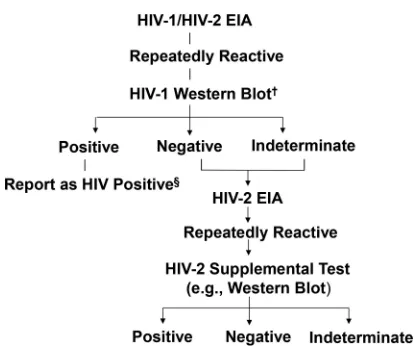
Second- and third-generation HIV tests.Second-generation HIV tests, developed in the late 1980s, improved the specificity and thus the positive predictive value of the screening procedures by adding recombinant antigens, specifically HIV-1 p24, to the antigen milieu. Often manufacturers added an HIV-2 protein and an HIV-1 group O protein to the antigen preparation in order to detect antibodies to those viruses. HIV-2 and HIV-1 group O viruses are found primarily in West Africa but have been reported worldwide (10). These second-generation assays reduced the an-tibody-negative window to 4 to 6 weeks postinfection. Since these assays could detect HIV-2 antibody in addition to HIV-1 anti-body, HIV-2 confirmatory testing was added to the algorithm (Fig. 1). The addition of IgM detection to the assay procedure resulted in the third-generation HIV test. While specific IgM de-tection had not been clinically useful, the IgG/IgM combination reduced the antibody-negative window to approximately 3 weeks postinfection (5). A p24 antigen detection ELISA, which detected the virus as early as 2 weeks postinfection, also could be per-formed. The overall testing algorithm remained the same,
how-Accepted manuscript posted online2 March 2016
CitationAlexander TS. 2016. Human immunodeficiency virus diagnostic testing: 30 years of evolution. Clin Vaccine Immunol 23:249 –253.
doi:10.1128/CVI.00053-16.
Editor:M. F. Pasetti
Address correspondence to [email protected].
Copyright © 2016, American Society for Microbiology. All Rights Reserved. CVINSIGHTS
on August 17, 2020 by guest
http://cvi.asm.org/
ever, and repeatedly reactive screening results still were confirmed by a Western blot assay or an IFA. Inclusion of an HIV-2 protein in the antigen mixture added another level of testing to specimens repeatedly reactive in the screening test yet negative by the con-firming procedure. Those specimens may have been positive for antibodies to HIV-2, which were not detected by the HIV-1 West-ern blot assay, or they may have been false positives. Thus, those specimens were then tested using an HIV-2-specific assay (Fig. 1). Quantitative and qualitative molecular assays could reduce the time from infection to detection even further; however, they were not cost-effective to be used for generalized screening. HIV PCR assays are recommended for neonatal diagnosis, however, as an-tibody assays may be positive in the neonate due to maternal IgG crossing the placenta (http://www.who.int/hiv/paediatric /EarlydiagnostictestingforHIVVer_Final_May07.pdf). In fact, the testing and HIV staging requirements for individuals⬍18 months of age differ from those recommended for adults (2).
Fourth-generation HIV tests.In the late 1990s, manufacturers developed HIV assays that combined antibody and antigen detec-tion. As before, these were ELISA and chemiluminescence-based procedures. These tests reduced the test-negative window to ap-proximately 2 weeks. While both antibody and antigen were de-tected in these procedures, the test gave only a single result and did not differentiate whether a positive result was due to the presence of the HIV-1 p24 antigen or due to the presence of antibody to HIV-1 or -2. While these tests had been used outside the United States for many years, the first fourth-generation procedure cleared by the FDA was the Abbot Architect method, which was approved in August 2010. Chavez et al. found that the Architect had a sensitivity of 99.94% and a repeat testing specificity of 99.5% in a cohort of 3,386 HIV-infected individuals, 7,551 uninfected subjects, and 58 patients with acute HIV infection (11). Bio-Rad’s fourth-generation GS ELISA was FDA cleared in 2011. The GS ELISA was evaluated on 9,150 specimens and showed 100% sen-sitivity and 99.9 to 100% specificity (10). Siemen’s ADVIA
fourth-generation assay, to be used on the Centaur instrument, was ap-proved in 2015. Siemen’s package insert shows an antibody sensitivity of 100%, an antigen sensitivity of 97.87%, and a speci-ficity of 99.69% (http://www.fda.gov/downloads/BiologicsBlood Vaccines/BloodBloodProducts/ApprovedProducts/Premarket ApprovalsPMAs/UCM450406.pdf).
When the fourth-generation HIV tests were adopted in the United States, a new testing algorithm was needed. Follow-up testing required both antigen and antibody detection. The Western blot assay, which has a 4- to 6-week antibody-negative window, may yield false negatives in patients with early infec-tion who could be identified with a fourth-generainfec-tion assay. Thus, the Western blot assay would be replaced by an HIV antibody differentiation assay. Initially, the CDC had proposed two separate fourth-generation testing algorithms: one for ar-eas of low risk for HIV infection and one for arar-eas of high risk. In 2014, however, a single algorithm was finalized (Fig. 2). The new algorithm followed the fourth-generation test with an HIV-1/2 differentiation procedure to determine whether the patient had antibodies to HIV-1 or HIV-2. Specimens that were repeatedly reactive by the fourth-generation assay and yet neg-ative by the HIV-1/2 differentiation procedure were to be tested using an HIV-1 RNA qualitative PCR assay to determine if HIV-1 was present, causing a positive antigen result on the fourth-generation screening test. The molecular assay ap-proved for this confirmation procedure is the Gen-Probe Ap-tima HIV-1 RNA assay. The current HIV viral load assays, while having improved sensitivity, have not been FDA ap-proved for diagnostic use and are thus not recommended for use in this algorithm (S. Michele Owen, personal communica-tion). Specimens that are negative by the molecular assay are considered to be false-positive screening results. The fourth-generation tests and algorithm have improved both sensitivity and specificity in detecting early HIV infection compared to those of the previous algorithm using the Western blot assay as the confirmatory procedure (12,13) (Fig. 3).
Summa Health System’s fourth-generation HIV testing ex-perience.Summa Akron City/St. Thomas Hospitals, located in Akron, OH, implemented the fourth-generation Abbott Archi-tect HIV assay in December 2010. Prior to implementing the fourth-generation assay, Summa had been performing
approx-FIG 1Centers for Disease Control/Food and Drug Administration algorithm for second-generation HIV tests (20). †, an immunofluorescence assay (IFA) for HIV-1 antibodies has recently been licensed by the Food and Drug Admin-istration and can be used instead of the Western blot assay. Positive and neg-ative IFA results should be interpreted in the same manner as similar results from Western blot tests. An indeterminate IFA result should first be tested by HIV-1 Western blot assay and then as indicated by the Western blot test re-sults. §, perform HIV-2 EIA only if there is an identified risk factor for HIV-2 infection.
FIG 2CDC algorithm for use with a fourth-generation HIV antibody/antigen screening test (21).
on August 17, 2020 by guest
http://cvi.asm.org/
imately 3,500 HIV screening tests per year. Approximately 20 specimens per year were repeatedly reactive, and 8 to 10 of those were confirmed as truly HIV positive, resulting in a pos-itive predictive value of 40 to 50% in a typical year during the time we performed the third-generation HIV ELISA. Through 25 January 2016, our volume for the fourth-generation assay has remained approximately 3,500 specimens per year. We had 79 repeatedly reactive specimens over the 5 years we have been performing that procedure. Fifty-six specimens were con-firmed by confirmatory testing as being positive for either an-tibody to HIV-1 (51 specimens) or viral nucleic acid (5 speci-mens). These values yield a positive predictive value of 70.8%. Thus, while our annual total positivity rate has dropped since we instituted the fourth-generation assay, our positive predic-tive value has increased, suggesting a reduced number of spec-imens being reported as false positive. We also detected five acute infections that may have been missed using the third-generation test and algorithm. Similar results for the Architect procedure were recently reported by Muthukumar et al. (14). Positive predictive values may be increased further by deter-mining a different cutoff value appropriate for the population to be tested (15).
Fifth-generation HIV tests.In 2015, the FDA approved the Bio-Rad BioPlex 2200 HIV Ag/Ab fifth-generation HIV screen-ing test multiplex analysis method as a diagnostic assay. This test, like the fourth-generation procedures, detects both HIV antibody and the HIV-1 p24 antigen but provides separate re-sults for each analyte. This assay will need a new algorithm, as
there is no need for a supplemental HIV-1/2 differentiation assay for antibody-positive specimens because the test also provides separate results for HIV-1 and HIV-2 antibody. Spec-imens reactive only for the p24 antigen do not need an antibody confirming procedure, and specimens reactive only for anti-body do not require an antigen confirmatory procedure. Sal-mona et al. evaluated the BioPlex fifth-generation assay and found 100% sensitivity and 99.5% specificity in a study of 1,505 patients (16). As of January 2016, the CDC has not published a fifth-generation testing algorithm.
Rapid HIV assays.The advent of HIV prophylactic treatments following an occupational blood or body fluid exposure, as well as a need to be able to provide HIV results to patients in a clinic or emergency room or during labor and delivery, set the stage for manufacturers to develop rapid HIV assays. These card-based as-says have gone through the same first through third generations as the main screening tests. Tests have been developed for whole blood, serum, and oral fluid. The OraQuick method is a third-generation HIV antibody assay which is FDA waived and has also been approved for home testing (http://www.fda.gov/Biologics BloodVaccines/BloodBloodProducts/ApprovedProducts /PremarketApprovalsPMAs/ucm311895.htm). Overall, the rapid tests perform well.
The first HIV-1/2 antibody differentiation assay, the Bio-Rad Multispot procedure that is used in the fourth-generation algo-rithm (Fig. 2), was initially developed as a third-generation rapid test. Bio-Rad will cease to market the Multispot assay during 2016 and is replacing it with another rapid procedure, the Geenius
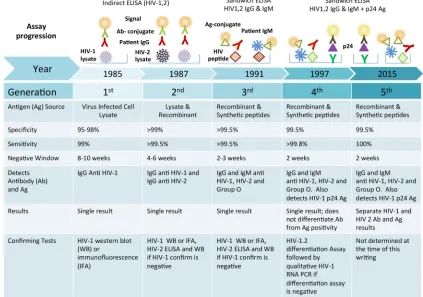
FIG 3Schematic representation of the 30-year evolution of HIV diagnostic assays.
on August 17, 2020 by guest
http://cvi.asm.org/
HIV-1/2 semiautomated HIV-1/2 differentiation assay. Although the Geenius is a “rapid” assay, it is approved to be used only as a supplemental assay in the fourth-generation algorithm, not as a screening procedure. The Geenius has been reported to have a sensitivity of 100% and a specificity of 96% (17).
Currently there is a 4.5-generation rapid test, the Alere Deter-mine HIV Ag-Ab Combo, which provides separate results for HIV antibody and antigen but does not differentiate HIV-1 antibody from HIV-2 antibody. Like the fifth-generation assay, this test would benefit from a different algorithm than has been developed for the fourth-generation tests. Faraoni et al. found this assay to have 100% specificity and positive predictive value with an overall sensitivity of 88.2% (18).
Social aspects of HIV testing.A complete discussion of the societal aspects of HIV testing is beyond the scope of this article; however, no discussion of the evolution of HIV testing can be complete without noting the social stigma originally associated with HIV infection and testing, the issue of mandatory versus voluntary testing, the legal restrictions concerning release of HIV testing-related information, and the eventual acceptance of HIV testing as part of routine medical practice. Most cases of AIDS were initially described in male homosexuals and intravenous drug users. Although heterosexual and blood product transmis-sion was also documented, just having an HIV test was often in-terpreted as an indication that the patient was a member of a high-risk group. Many states, including Ohio, where I practice, passed laws requiring specific informed consent for HIV testing, counseling before and after the test was performed, and limiting the disclosure of HIV test results. HIV test results were often not put into laboratory or hospital computer systems. Summa Health System, where I practice, did not put HIV results in the laboratory and hospital computer system until 2005. The CDC recom-mended, in 2006, that HIV testing become a routine procedure and that all adults be screened for the presence of HIV or antibody to HIV (19). This required amendments to many state laws. As of January 2016, 41 states have at least some law concerning HIV testing and/or counseling (http://www.cdc.gov/hiv/policies/law /states/index.html).
Conclusions.HIV testing has evolved from being used as a method to safeguard the blood supply to being offered as a routine diagnostic test. The major deficiencies of early HIV tests have largely been overcome with the advent of the fourth-and fifth-generation assays. The test-negative window from infection to detection has been reduced, positive predictive values have improved, and tests are available in a variety of formats. Testing algorithms need to be updated continually to be used appropriately with newer assays. HIV testing has pro-gressed to where infection can be detected approximately 2 weeks postexposure, with a reduced number of false-positive results compared to those seen with the early HIV assays (Fig. 3). Despite the improvements in HIV testing, the oncologist I mentioned above would not be satisfied. There remains no specific diagnostic test for AIDS.
ACKNOWLEDGMENTS
I thank Marcela Pasetti and Morgan Douglas for helpful discussions and assistance with figure preparation.
I have received speaker honoraria and travel assistance from Bio-Rad, Inc.
REFERENCES
1.Pear R.1985. AIDS blood test to be available in 2 to 6 weeks.http://www .nytimes.com/1985/03/03/us/aids-blood-test-to-be-available-in-2-to-6 -weeks.html. Accessed 26 January 2016.
2.Selik RM, Mokotoff ED, Branson B, Owen SM, Whitmore S, Hall HI. 2014. Revised surveillance case definition for HIV infection—
United States, 2014. MMWR Morb Recommend Rep 63(RR-03):
1–10.
3.Gallo RC, Sarin PS, Gelmann EP, Robert-Guroff M, Richardson E, Kalyanaraman VS, Mann D, Sidhu GD, Stahl RE, Zolla-Pazner S, Leibowitch J, Popovic M.1983. Isolation of human T-cell leukemia virus in acquired immune deficiency syndrome (AIDS). Science220:865– 867.
http://dx.doi.org/10.1126/science.6601823.
4.Barre-Sinoussi F, Chermann JC, Rey F, Nugeyre MT, Chamaret S, Gruest J, Dauguet C, Axler-Blin C, Vezinet-Brun F, Rouzioux C, Rozenbaum W, Montagnie L.1983. Isolation of a T-lymphotropic retrovirus from a patient at risk for acquired immune deficiency syndrome (AIDS). Science 220:868 – 871. http://dx.doi.org/10.1126 /science.6189183.
5.Chappel RJ, Wilson KM, Dax EM.2009. Immunoassays for the diagnosis of HIV: meeting future needs by enhancing the quality of testing. Future Microbiol4:963–982.http://dx.doi.org/10.2217/fmb.09.77.
6.Centers for Disease Control.1989. Interpretation and use of the Western blot assay for serodiagnosis of human immunodeficiency virus type 1 infections. MMWR Morb Mortal Wkly Rep38(Suppl 7):1–7.
7.Hedenskog M, Dewhurst S, Ludvigsen C, Sinangil F, Rodriguez L, Wu YT, Volsky DJ.1986. Testing for antibodies to AIDS associated retrovirus (HTLV-III/LAV) by indirect fixed cell immunofluorescence: specificity, sensitivity and applications. J Med Virol19:325–334.http://dx.doi.org/10 .1002/jmv.1890190405.
8.Imrie AA, Kehrer S, Smith GW, Penny R, Cooper DA.1986. Sero-immunology of AIDS retrovirus infection. I. Use of immunofluo-rescence assay to confirm sera with ELISA reactivity. Pathology18: 438 – 443.
9.Alexander TS, Lee J, Yen-Lieberman B.1999. Incidence of human im-munodeficiency virus antibody in a prenatal population at a community hospital. Clin Diagn Lab Immunol6:140 –141.
10. Bentsen C, McLaughlin L, Mitchell E, Ferrara C, Liska S, Myers R, Peel S, Swenson P, Gadelle S, Shriver MK.2011. Performance evaluation of the Bio-Rad Laboratories GS HIV combo Ag/Ab EIA, a 4thgeneration HIV
assay for the simultaneous detection of HIV p24 antigen and antibodies to HIV-1 (groups M and O) and HIV-2 in human serum or plasma. J Clin Virol52S:S57–S61.http://dx.doi.org/10.1016/j.jcv.2011.09.023. 11. Chavez P, Wesolowski L, Patel P, Delaney K, Owen SM.2011.
Evalu-ation of the performance of the Abbott Architect HIV Ag/Ab combo assay. J Clin Virol52S:S51–S55.http://dx.doi.org/10.1016/j.jcv.2011.09.010. 12. Geren K, Moore E, Tomlinson C, Hobohm D, Gardner A,
Reardon-Maynard D, Gay C, Hightow-Weidman LB, Pandori MB, Moss N, Westheimer E, Tsoi B, Branson BM, Peters PJ.2013. Detection of acute HIV infection in two evaluations of a new HIV diagnostic testing algo-rithm—United States, 2011-2013. MMWR Morb Mortal Wkly Rep62: 489 – 494.
13. Cardenas AM, Baughan E, Hodinka R.2013. Evaluation of the Bio-Rad Multispot HIV-1/HIV-2 rapid test as an alternative to Western blot for confirmation of HIV infection. J Clin Virol58S:e97– e103.http://dx.doi .org/10.1016/j.jcv.2013.08.021.
14. Muthukumar A, Alatoom A, Burns S, Ashmore J, Kim A, Emerson B, Bannister E, Ansari MQ.2015. Comparison of 4thgeneration HIV
antigen/antibody combination assay with 3rdgeneration HIV antibody
assays for the occurrence of false-positive and false-negative results. Lab Med 46:84 – 89. http://dx.doi.org/10.1309/LMM3X37NSWU CMVRS.
15. Kim S, Lee JH, Choi JY, Kim JM, Kim HS.2010. False-positive rate of a “fourth-generation” HIV antigen/antibody combination assay in an area of low HIV prevalence. Clin Vaccine Immunol17:1642–1644.http://dx .doi.org/10.1128/CVI.00258-10.
16. Salmona M, Delarue S, Delaugerre C, Simon F, Maylin S.2014. Clinical evaluation of BioPlex 2200 HIV Ag-Ab, an automated screening method providing discrete detection of HIV-1 p24 antigen, HIV-1 antibody, and HIV-2 antibody. J Clin Microbiol52:103–107.http://dx.doi.org/10.1128 /JCM.02460-13.
17. Malloch L, Kadivar K, Putz J, Levett PN, Tang J, Hatchette TF,
on August 17, 2020 by guest
http://cvi.asm.org/
khoda K, Ng D, Ho J, Kim J. 2013. Comparative evaluation of the Bio-Rad Geenius HIV-1/2 confirmatory assay and the Bio-Rad Multispot HIV-1/2 rapid test as an alternative differentiation assay for CLSI M53 algorithm-I. J Clin Virol58(Suppl 1):e85– e91.http://dx.doi.org/10.1016 /j.jcv.2013.08.008.
18. Faraoni S, Rochetti A, Gotta F, Ruggiero T, Orofino G, Bonoar S, Chisetti V.2013. Evaluation of a rapid antigen and antibody combination test in acute HIV infection. J Clin Virol57:84 – 87.http://dx.doi.org/10 .1016/j.jcv.2013.01.007.
19. Branson BM, Handsfield HH, Lampe MA, Janssen RA, Taylor AW, Lyss
SB, Clark JE.2006. Revised recommendations for HIV testing of adults, adolescents, and pregnant women in health-care settings. MMWR Rec-ommend Rep55(RR-17):1–17.
20. O’Brien TR, George JR, Epstein JS, Homberg SD, Schochetman G. 1992. Testing for antibodies to human immunodeficiency virus type 2 in the United States. MMWR Recommend Rep41(RR-12):1–9.
21. Centers for Disease Control and Prevention and Association of Public Health Laboratories.27 June 2014. Laboratory testing for the diagnosis of HIV infection: updated recommendations.http://stacks.cdc.gov/view/cdc /23447. Accessed 26 January 2016.