Volume 2010, Article ID 842879,10pages doi:10.1155/2010/842879
Research Article
Adaptive Parameter Identification Based on Morlet Wavelet and
Application in Gearbox Fault Feature Detection
Shibin Wang, Z. K. Zhu, Yingping He, and Weiguo Huang
School of Urban Rail Transportation, Soochow University, Suzhou 215006, China
Correspondence should be addressed to Z. K. Zhu,[email protected]
Received 26 July 2010; Accepted 22 October 2010
Academic Editor: T.-H. Li
Copyright © 2010 Shibin Wang et al. This is an open access article distributed under the Creative Commons Attribution License, which permits unrestricted use, distribution, and reproduction in any medium, provided the original work is properly cited.
Localized defects in rotating mechanical parts tend to result in impulse response in vibration signal, which contain important information about system dynamics being analyzed. Thus, parameter identification of impulse response provides a potential approach for localized fault diagnosis. A method combining the Morlet wavelet and correlation filtering, named Cyclic Morlet Wavelet Correlation Filtering (CMWCF), is proposed for identifying both parameters of impulse response and the cyclic period between adjacent impulses. Simulation study concerning cyclic impulse response signal with different SNR shows that CMWCF is effective in identifying the impulse response parameters and the cyclic period. Applications in parameter identification of gearbox vibration signal for localized fault diagnosis show that CMWCF is effective in identifying the parameters and thus provides a feature detection method for gearbox fault diagnosis.
1. Introduction
Rotating machines play an important role in many industrial applications, such as aircraft engines, automotive trans-mission systems, and wind power generation. Most of the machinery was operated by means of gears and other rotating parts, which may develop faults. The study of fault diagnosis of rotating machine by fault feature detection from vibration signals has thus attracted more and more attention over the past decade.
Gearbox, as an important mechanism for transmitting power or rotation, is widely used in industrial applications. The occurrence of impulse response in gearbox vibration signals usually means that there exist mechanical defects or faults. Most gear faults are due to gear damage, such as tooth wear, cracks, scoring, spalling, chipping, and pitting [1,2]. With such flaws existing on gears, progressive damage will occur and ultimately result in gear tooth breakage, which may cause significant economic loss. For gearbox fault diagnosis, therefore, it is very important to extract the information of impulse response from vibration signals.
So far, different techniques have been proposed to analyze the vibration signal for fault diagnosis, such as time-frequency/time-scale methods, empirical mode
EMD is an adaptive decomposition method proposed by Huang et al. [7], which in essence extracts the intrinsic oscillation of the signal being analyzed through their charac-teristic time scales (i.e., local properties of the signal itself) and decomposes the signal into a number of intrinsic mode functions (IMFs), with each IMF corresponding to a specific range of frequency components contained within the signal. Because it still has some shortcomings when it comes to calculating instantaneous frequency [8] or in some cases it may reveal plausible characteristics due to the mode mixing [9, 10], it is untenable in effective application in impulse detection and analysis.
Matching pursuit algorithm, a greedy algorithm that chooses a waveform that is the most adapted to approx-imate part of the signal at each iteration, is effective in analyzing impulse response signals; however, the excessive computational cost limits its engineering applications [11]. Correlation filtering, enlightened from matching pursuit, is used based on Laplace wavelet to identify the parameters of impulse response by calculating the maximal correlation value, which is employed by Freudinger et al. to identify the modal parameters of a flutter for aerodynamic and structural testing [12]. Similar efforts were made by Zi et al. for the identification of the natural frequency of a hydrogenerator shaft and the wear fault diagnosis of the intake valve of an internal combustion engine [13]. Qi et al. employed Laplace wavelet correlation filtering together with empirical mode decomposition to identify modal parameters [14]. An integrated approach, consisting of empirical mode decomposition, Laplace wavelet correlation filtering, and wavelet finite element model, proposed by Dong et al. for rotor crack detection, was effective in identifying the position and the depth of different cracks [15].
Laplace wavelet correlation filtering is effective in detect-ing a sdetect-ingle transient impulse response. However, localized defects in rotating mechanical parts tend to result in mul-tiple impulse responses, which are generally cyclic impulse responses. Considering that the waveform of Morlet wavelet is in shape similar to transient vibration caused by gearbox localized defects [16,17] and cyclostationarity matches the key feature of the gearbox vibration [18,19], Cyclic Morlet Wavelet Correlation Filtering (CMWCF) is thus proposed, which, based on correlation filtering, constructs the cyclic Morlet wavelet and identify both the impulse response parameters and the cyclic period for diagnosed gear fault.
The remainder of the paper is organized as follows. In Section 2, the basic theoretical background concerning CMWCF is introduced. Section 3 gives a simulation study and analysis to verify the proposed method.Section 4applies the method in gearbox transient feature detection by param-eter identification for fault diagnosis. Finally, conclusions are drawn inSection 5.
2. Adaptive Parameter Identification
Based on Morlet Wavelet
In this section, a method of adaptive parameter identification of Morlet wavelet based on correlation filtering is presented. Using correlation filtering, the parameters of Morlet wavelet
are firstly identified to detect the impulse response. Secondly, cyclic Morlet wavelet is constructed to detect the cyclic period between adjacent impulse responses. The proposed method is suitable for not only identifying the parameters of the impulse response but also detecting the cyclic period.
2.1. Morlet Wavelet and Parametric Representation. Morlet wavelet is one of the most popular nonorthogonal wavelets, defined in the time domain as a harmonic wave multiplied by a Gaussian time domain window:
ψMorlet(t)=exp
−β2t2
2
cos(πt). (1)
Morlet wavelet is a cosine signal that decays exponentially on both the left and the right sides. This feature makes it very similar to an impulse. It has been used for impulse isolation and mechanical fault diagnosis [16,17].
The parametric formulation of Morlet wavelet is
ψf,ζ,τ,t=ψγ(t)=e(−ζ/
√
1−ζ2)[2π f(t−τ)]2
cos2π f(t−τ), (2)
where the parameter vector γ = (f,ζ,τ) determines the wavelet properties. These parameters (f,ζ,τ) are denoted by frequency f ∈R+, damping ratioζ ∈[0, 1) ⊂R+and time
indexτ∈R, respectively.
The discrete parameters f,ζ, andτ belong to subsets of F,Z, andTC, respectively:
F=f1,f2,. . .,fm⊂R+,
Z=ζ1,ζ2,. . .,ζn⊂R+∩[0, 1),
TC=
τ1,τ2,. . .,τp ⊂R.
(3)
The discrete gridΓ=F×Z×TCis constructed, and the
set of the Morlet Wavelet, whose parameters are contained in subsets ofF,Z, andTC, is called thedictionaryshown as
follows:
Ψ=ψγ(t) :γ∈Γ =ψf,ζ,τ,t:f ∈F,ζ∈Z,τ ∈TC
, (4)
and each item in the dictionary is called anatom.
2.2. Correlation Filtering (CF). Correlation between two signals describes their similarity to each other or, in gen-eral term, their interrelationship. The degree of similarity between two real certain signals with limited energy,ψγ(t) and x(t), can be measured in terms of a correlation coefficient, defined as [20]
cx(t)ψγ(t)=
Cx(t)ψγ(t)
σx(t)σψγ(t) =
(x(t)−x)ψγ(t)−ψγdt
(x(t)−x)2dt ψγ(t)−ψγ
2
dt ,
(5)
where σx(t) and σψγ(t) are the standard deviations of the
Cx(t)ψγ(t) is the covariance of x(t) and ψγ(t). In practice,
the signalx(t) and the atomψγ(t) are sampled as discrete values; thus, the correlation coefficient is estimated from the sampled data as
cγ=
Nk=1(x(k)−x)
ψγ(k)−ψγ
N
k=1(x(k)−x)2
N
k=1
ψγ(k)−ψγ
2, (6)
whereNis the number of the data samples, andxandψγare the mean values ofx(k) andψγ(k), respectively. Because of the approximate zero mean property of the wavelet and the vibration signal, (6) can be described as
cγ=
Nk=1x(k)ψγ(k)
N
k=1x2(k)
N
k=1ψγ2(k)
, (7)
wherecγis a multidimensional matrix, which is determined byΓ=F×Z×TC. A correlation coefficientkγ(τ) is defined for
modal analysis to correlate frequency and damping at each time value. Peaks ofcγfor a givenτrelate the wavelet with the strongest correlation to the signal. Definekγ(τ) as the peak values ofcγat eachτ. So, the formulation ofkγ(τ) is
kγ(τ)= max
f∈F,ζ∈Zcγ=c{f,ζ,τ}, (8)
wheref andζare the characteristic parameters of the Morlet wavelet associated with the peak correlation. Define
kγ,max=max
τ∈TCkγ
(τ)= max
f∈F,ζ∈Z,τ∈TC
cγ=c{f,ζ,τ}, (9)
whereτis the time of the peak value ofcγin the whole time domain.
2.3. Cyclic Morlet Wavelet Correlation Filtering (CMWCF).
According to the characteristics of vibration signal and the identified Morlet wavelet ψγ(t) through CF, in order to determine the period, that is, time interval between two adjacent impulse responses, we can define the cyclic Morlet wavelet by introducing parameterTas
ϕλ(t)=
k
ψγ(t−kT)
= k
Ae(−ζ/√1−ζ2)[2π f(t−kT−τ)]2
cos2π f(t−kT−τ),
(10)
whereTis the time interval between two adjacent cyclic Mor-let waveMor-let atoms, namedcyclic period. Then, the parameter vectorλ =(f,ζ,τ,T) determines the cyclic Morlet wavelet properties.
According to the characteristics of cyclic impulse response, making use of the impulse response parameters which is obtained from CF, the cyclic Morlet wavelet is constructed to detect cyclic period. The set of the cyclic Morlet wavelet, whose parameter is contained in the subset
ofTT = {T1,T2,. . .,Tq} ⊂ R+, is also called the dictionary
shown as
Φ=ϕT(t) :T∈TT
=ϕf,ζ,τ,T,t:T∈TT , (11)
wheref, ζ, and τ are the parameters of impulse response obtained from CF. Then, a correlation function kT(T) is defined to quantify the correlation degree betweenϕT(t) and
x(t):
kT(T)=
Nk=1x(k)ϕT(k)
N
k=1x2(k)
N
k=1ϕ2T(k)
. (12)
Practically, kT(T) is a column vector, whose size is determined by subset ofTT. Define
kT,max=max
T∈TT
kT(T)=k{f,ζ,τ,T}, (13)
whereT, associated with the maximum ofkT, iscyclic period. Then, both the parameters of Morlet wavelet and the cyclic period between adjacent wavelet atoms are identified. These identified parameters are associated with the impulse responses. Finally, the procedure of the adaptive parameter identification scheme proposed is summarized as follows:
(i) establish Morlet wavelet dictionary;
(ii) find optimal Morlet wavelet using correlation filter-ing based on maximal correlation coefficient crite-rion;
(iii) construct cyclic Morlet wavelet given by (10) obtained in step 2;
(iv) find cyclic period using CMWCF based on maximal correlation coefficient criterion.
3. Simulation Signal Test
A simulation study is performed to illustrate the effect of the CMWCF method. Consider a simulative signal
x(t)=
k
ψγ(t−kT) +Ann(t)
= k
e(−ζ0/
√ 1−ζ2
0)[2π f0(t−kT0−τ0)]2cos2π f(t−kT
0−τ0)
+Ann(t),
(14)
where the frequency f0=5 Hz, the damping ratioζ0=0.01,
the time index τ0 = 1 s, and the cyclic period T0 = 2 s.
Obviously, x(t) is a real periodic cyclic impulse responses signal. The signaln(t) is white noise weight byAn=0.2, and the sampling frequency is 200 Hz in time range [0, 10].
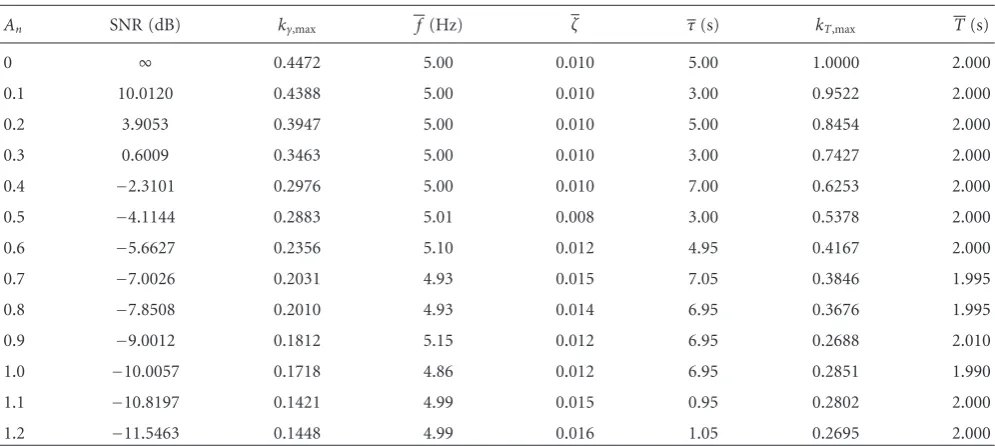
Table1: The results of CMWCF when increasing the noise amplitude.
An SNR (dB) kγ,max f(Hz) ζ τ(s) kT,max T(s)
0 ∞ 0.4472 5.00 0.010 5.00 1.0000 2.000
0.1 10.0120 0.4388 5.00 0.010 3.00 0.9522 2.000
0.2 3.9053 0.3947 5.00 0.010 5.00 0.8454 2.000
0.3 0.6009 0.3463 5.00 0.010 3.00 0.7427 2.000
0.4 −2.3101 0.2976 5.00 0.010 7.00 0.6253 2.000
0.5 −4.1144 0.2883 5.01 0.008 3.00 0.5378 2.000
0.6 −5.6627 0.2356 5.10 0.012 4.95 0.4167 2.000
0.7 −7.0026 0.2031 4.93 0.015 7.05 0.3846 1.995
0.8 −7.8508 0.2010 4.93 0.014 6.95 0.3676 1.995
0.9 −9.0012 0.1812 5.15 0.012 6.95 0.2688 2.010
1.0 −10.0057 0.1718 4.86 0.012 6.95 0.2851 1.990
1.1 −10.8197 0.1421 4.99 0.015 0.95 0.2802 2.000
1.2 −11.5463 0.1448 4.99 0.016 1.05 0.2695 2.000
Table2: Success rate for detecting the cyclic period.
An SNR (dB) Success rate An SNR (dB) Success rate
0.1 10.0120 100% 0.7 −7.0026 85%
0.2 3.9053 96% 0.8 −7.8508 78%
0.3 0.6009 90% 0.9 −9.0012 78%
0.4 −2.3101 95% 1.0 −10.0057 81%
0.5 −4.1144 81% 1.1 −10.8197 80%
0.6 −5.6627 92% 1.2 −11.5463 77%
F = {4.5 : 0.01 : 5.5}is a Matlab notation which denotes an array from 4.5 to 5.5 with step 0.01, andZ,TC, andTT
are similar toF. The parameter subset ofZis nonuniform to provide higher resolution at lower damping ratio values. The results obtained by the proposed method from the simulation signal are shown inFigure 1.
Figure 1(a) gives the waveform of the simulation sig-nal without noise and Figure 1(b) with noise. Figure 1(c) represents the correlation value kγ(τ), whose peak value kγ,max=0.3947 locates at one impulse. Figures1(d)and1(e)
indicate the modal information of frequency and damping ratio parameters revealed from the peak correlationkγ(τ) at each timeτ. We obtained frequency f =5 Hz and damping ratioζ =0.01 which are exactly equal to simulation values (f0 = 5 Hz,ζ0 = 0.01). Because of the multi-impulse the
time indexτ = 5 s is not equal toτ0 shown inFigure 1(c).
Using the results obtained by correlation filtering, the cyclic Morlet wavelet is constructed. Then, the correlation value kT(T), shown inFigure 1(f), is obtained by CMWCF, and
the cyclic periodT = 2 s associated withkT,max = 0.8454
is identified, which is also equal to the simulation value (T0 = 2 s). Figure 1(g) gives the comparison between the
reconstructed cyclic Morlet wavelet with the obtained results and the simulation signal. To see more clearly, we parallelly
move the curve of the reconstructed impulse response. The consistency between them can be obviously seen, so it can be drawn that the proposed method is effective in identifying the cyclic period between adjacent impulses.
In order to test the noise tolerance of the method, the simulation test with different noise amplitudesAnfrom (14) is investigated shown inTable 1, in which the resultsAn, SNR, kγ,max, f,ζ,τ,kT,max, andT are listed. SNR, the
signal-to-noise ratio, is used to weigh the signal-to-noise level and is defined as follows:
SNR=10×log P
S
PN
, (15)
wherePS is the energy of the useful information andPN is the energy of the noise.
It is clear that, with the increase of noise amplitude, the correlation values kγ,max andkT,max decreased steadily,
illustrating that the noise reduces the correlation between the simulation signal and Morlet wavelet. Meanwhile, the noise amplitude influences the frequency f, the damping rationζ, and the timeτforAn>0.4, but it has little influence on the cyclic period.Table 2 gives the success rate of detecting the cyclic period for randomized trial on 100 times.
4. Application in Gearbox Fault
Feature Detection
0 1 2 3 4 5 6 7 8 9 10
−1 0 1
Time (s)
A
(m
·
s
−
2)
(a)
0 1 2 3 4 5 6 7 8 9 10
−2 0 2
Time (s)
A
(m
·
s
−
2)
(b)
0 1 2 3 4 5 6 7 8 9 10
0 0.2 0.4
kγ
(
τ
)
Time (s)
(c)
0 1 2 3 4 5 6 7 8 9 10
4.5 5 5.5
f
(Hz)
Time (s)
(d)
0 1 2 3 4 5 6 7 8 9 10
0 0.01 0.02
ζ
Time (s)
(e)
0.5 1 1.5 2 2.5 3 3.5 4 4.5 5
0 0.5 1
kT
(
T
)
Time (s) T=2 s
(f)
0 1 2 3 4 5 6 7 8 9 10
−4
−2 0 2
Time (s)
A
(m
·
s
−
2)
(g)
Figure1: CMWCF of the simulation signal: (a) the simulation signal, (b) the simulation signal with noise, (c) the correlation value of CF, (d) frequency parameter f, (e) damping ratio parameterζ, (f) the correlation value of CMWCF, and (g) the comparison between the vibration signal and reconstructed signal.
For a gear transmission, the meshing frequency fm is calculated by
fm= (60nzi), (16)
wherezis the number of gear teeth,nis the rotating speed of the input shaft, andiis the transmission ratio. In the test,z=
24 27
32 28
26
32 25
18 13
42 Third
speed
Forth speed
First speed
Second speed
Reverse speed
Fifth speed Input
shaft
Counter shaft
Output shaft
(a) Structure of the gearbox
(b) Gearbox setup
Figure2: The automobile transmission gearbox.
Table3: Working parameters of the third speed gears.
The third speed gears Constant meshing gears
Driving gear Driven gear Driving gear Driven gear
Number of teeth 25 27 24 32
Rotating period (s) 0.05 0.054 0.04 0.03
Rotating frequency (Hz) 20 18.5 25 33.3
Meshing frequency (Hz) 500 640
frequency is 3 KHz. The working parameters are shown in Table 3.
The typical vibration signal caused by one driving gear teeth broken is shown inFigure 3(a). The time domain signal fails to demonstrate the characteristic feature of the gearbox vibration signal. Figure 3(b) expresses the corresponding frequency spectrum, from which it can be seen that the 500 Hz in frequency is the main components. Figure 3(c) gives the waveform of the correlation value kγ(τ) which is the result of correlation filtering, in which the maximal
correlation valuekγ,max =0.3370 is marked. The associated
parameters are f =268 Hz,ζ=0.0060, andτ=0.1780 s. In order to identify the cyclic period, the reconstructed Morlet wavelet is used to construct cyclic Morlet wavelet. The correlation coefficient kT between constructed cyclic Morlet wavelet and the vibration signal under different parameter period T is given in Figure 3(d), in which the maximal correlation value kT,max = 0.5711 is marked and
0 0.02 0.04 0.06 0.08 0.1 0.12 0.14 0.16 0.18 0.2
−20 0 20
Time (s)
A
(m
·
s
−
2)
(a)
0 500 1000 1500
0 500 1000
Frequency (Hz)
PSD
(m
2·
s
−
3)
(b)
Time (s)
0 0.02 0.04 0.06 0.08 0.1 0.12 0.14 0.16 0.18 0.2
0 0.2 0.4
kγ
(
τ
)
(c)
Time (s)
0.01 0.02 0.03 0.04 0.05 0.06 0.07 0.08 0.09 0.1
0 0.5
kT
(
T
) T=0.05 s
(d)
Time (s)
0 0.02 0.04 0.06 0.08 0.1 0.12 0.14 0.16 0.18 0.2
−40
−20 0 20
(e)
Figure3: The CMWCF application in gearbox vibration: (a) the gearbox vibration signal, (b) the spectrum of the gearbox vibration, (c) the correlation value of CF, (d) the correlation value of CMWCF, and (e) the comparison of the vibration signal and reconstructed signal.
original vibration signal is given in Figure 3(e), in which, to see more clearly, the curve of the reconstructed one is also parallelly moved. Obviously, as shown in Table 2, the identified cyclic period is consistent with the rotating period of the third speed driving gear. That is to say, the proposed method is effective in identifying the characteristic parameters.
To prove the tolerance of the proposed method,Figure 4 gives another signal whose length is different and the results
include kγ,max = 0.2877, f = 275 Hz, ζ = 0.0080, τ =
0.2310 s,kT,max=0.4327, andT =0.050 s. These identified
parameters are almost identical to the result ofFigure 3. Furthermore, in addition to illustrate the effectiveness of the proposed method, Figure 5 gives the vibration signal on normal condition, in which kγ,max = 0.1187
and kT,max = 0.1236 are represented and smaller than
0 0.05 0.1 0.15 0.2 0.25 0.3 Time (s)
−20 0 20
A
(m
·
s
−
2)
(a)
0 500 1000 1500
0 500
Frequency (Hz) 1500
PSD
(m
2·
s
−
3)
(b)
0 0.05 0.1 0.15 0.2 0.25 0.3
Time (s) 0
0.2 0.4
kγ
(
τ
)
(c)
Time (s)
0.01 0.02 0.03 0.04 0.05 0.06 0.07 0.08 0.09 0.1
0 kT
(
T
)
0.5
T=0.05 s
(d)
0 0.05 0.1 0.15 0.2 0.25 0.3
Time (s)
−20 0 20
(e)
Figure4: The CMWCF application in gearbox vibration: (a) the gearbox vibration signal, (b) the spectrum of the gearbox vibration, (c) the correlation value of CF, (d) the correlation value of CMWCF, and (e) the comparison of the vibration signal and reconstructed signal.
Though the impulse response was reconstructed and given inFigure 5(e), it can be clearly observed that the comparison with the original signal is unaccountable. So it can be drawn that there is no cyclic impulse response in the vibration
0 0.02 0.04 0.06 0.08 0.1 0.12 0.14 0.16 0.18 0.2
−20 0 20
Time (s)
A
(m
·
s
−
2)
(a)
0 500 1000 1500
0 1000
Frequency (Hz) 2000
PSD
(m
2·
s
−
3)
(b)
Time (s)
0 0.02 0.04 0.06 0.08 0.1 0.12 0.14 0.16 0.18 0.2
0 kγ
(
τ
)
0.05 0.1
(c)
Time (s)
0.01 0.02 0.03 0.04 0.05 0.06 0.07 0.08 0.09 0.1
0 kT
(
T
)
0.1 0.2
(d)
Time (s)
0 0.02 0.04 0.06 0.08 0.1 0.12 0.14 0.16 0.18 0.2
−40
−20 0 20
(e)
Figure5: The CMWCF application in gearbox vibration: (a) the gearbox vibration signal, (b) the spectrum of the gearbox vibration, (c) the correlation value of CF, (d) the correlation value of CMWCF, and (e) the comparison of the vibration signal and reconstructed signal.
5. Conclusions
The cyclic Morlet wavelet correlation filtering (CMWCF) method proposed represents an attempt in the direction of parameter identification and feature detection for fault diag-nosis. Both the parameters of the Morlet wavelet associated with the maximal correlation value and the cyclic period are effective in feature detection of the impulse response.
The simulation study demonstrates that the proposed method is effective in identifying parameters of impulse,
including frequency, damping ratio, and the time index, and is especially sensitive to the cyclic period. The gearbox application also demonstrates the fact that the method has the capability of parameter identification.
Acknowledgments
This research is supported partly by the Natural Science Foundation of China (no. 50905021) and the Natural Science Foundation of Jiangsu Province (no. BK2010225).
References
[1] Z. Feng, M. J. Zuo, and F. Chu, “Application of regularization dimension to gear damage assessment,” Mechanical Systems and Signal Processing, vol. 24, no. 4, pp. 1081–1098, 2010. [2] P. D. Samuel and D. J. Pines, “A review of vibration-based
techniques for helicopter transmission diagnostics,”Journal of Sound and Vibration, vol. 282, no. 1-2, pp. 475–508, 2005. [3] B. Leprettre and N. Martin, “Extraction of pertinent subsets
from time-frequency representations for detection and recog-nition purposes,”Signal Processing, vol. 82, no. 2, pp. 229–238, 2002.
[4] M. Bl¨odt, M. Chabert, J. Regnier, and J. Faucher, “Mechanical load fault detection in induction motors by stator current time-frequency analysis,”IEEE Transactions on Industry Appli-cations, vol. 42, no. 6, pp. 1454–1463, 2006.
[5] E. G. Strangas, S. Aviyente, and S. S. H. Zaidi, “Time-frequency analysis for efficient fault diagnosis and failure prognosis for interior permanent-magnet AC motors,”IEEE Transactions on Industrial Electronics, vol. 55, no. 12, pp. 4191– 4199, 2008.
[6] Z. K. Peng and F. L. Chu, “Application of the wavelet transform in machine condition monitoring and fault diagnostics: a review with bibliography,” Mechanical Systems and Signal Processing, vol. 18, no. 2, pp. 199–221, 2004.
[7] N. E. Huang, Z. Shen, S. R. Long et al., “The empirical mode decomposition and the Hubert spectrum for nonlinear and non-stationary time series analysis,”Proceedings of the Royal Society A, vol. 454, no. 1971, pp. 903–995, 1998.
[8] Y. Wang, Z. He, and Y. Zi, “Enhancement of signal denoising and multiple fault signatures detecting in rotating machinery using dual-tree complex wavelet transform,”Mechanical Sys-tems and Signal Processing, vol. 24, no. 1, pp. 119–137, 2010. [9] Q. Gao, C. Duan, H. Fan, and Q. Meng, “Rotating
machine fault diagnosis using empirical mode decomposi-tion,”Mechanical Systems and Signal Processing, vol. 22, no. 5, pp. 1072–1081, 2008.
[10] Y. Lei, Z. He, and Y. Zi, “Application of the EEMD method to rotor fault diagnosis of rotating machinery,”Mechanical Systems and Signal Processing, vol. 23, no. 4, pp. 1327–1338, 2009.
[11] S. G. Mallat and Z. Zhang, “Matching pursuits with time-frequency dictionaries,”IEEE Transactions on Signal Process-ing, vol. 41, no. 12, pp. 3397–3415, 1993.
[12] L. C. Freudinger, R. Lind, and M. J. Brenner, “Correlation filtering of modal dynamic using the Laplace wavelet,” in
Proceedings of the 16th International Modal Analysis Conference (IMAC ’98), vol. 2, pp. 868–877, Santa Barbara, Calif, USA, February 1998.
[13] Y. Zi, X. Chen, Z. He, and P. Chen, “Vibration based modal parameters identification and wear fault diagnosis using Laplace wavelet,”Key Engineering Materials, vol. 293-294, pp. 183–190, 2005.
[14] K. Qi, J. Xiang, Y. Zi, and Z. He, “High precision modal parameter identification based on Laplace wavelet correlation filtering,”Chinese Journal of Mechanical Engineering, vol. 43, no. 9, pp. 167–172, 2007.
[15] H. B. Dong, X. F. Chen, B. Li, K. Y. Qi, and Z. J. He, “Rotor crack detection based on high-precision modal parameter identification method and wavelet finite element model,”
Mechanical Systems and Signal Processing, vol. 23, no. 3, pp. 869–883, 2009.
[16] J. Lin and L. Qu, “Feature extraction based on morlet wavelet and its application for mechanical fault diagnosis,”Journal of Sound and Vibration, vol. 234, no. 1, pp. 135–148, 2000. [17] J. Lin and M. J. Zuo, “Gearbox fault diagnosis using adaptive
wavelet filter,”Mechanical Systems and Signal Processing, vol. 17, no. 6, pp. 1259–1269, 2003.
[18] Z. K. Zhu, Z. H. Feng, and F. R. Kong, “Cyclostationarity analysis for gearbox condition monitoring: approaches and effectiveness,”Mechanical Systems and Signal Processing, vol. 19, no. 3, pp. 467–482, 2005.
[19] A. Raad, J. Antoni, and M. Sidahmed, “Indicators of cyclo-stationarity: theory and application to gear fault monitoring,”
Mechanical Systems and Signal Processing, vol. 22, no. 3, pp. 574–587, 2008.