Building annotated resources for automatic text summarisation
Constantin Or˘asan
School of Humanities, Languages and Social Sciences University of Wolvehampton
Stafford Street, Wolverhampton, WV1 1SB United Kingdon
Abstract
Annotated corpora are necessary for automatic summarisation, but given how difficult is to produce them there are only few available. This paper presents an annotation tool which helps the human annotator to select the important units from a text. In addition to the tool, a new annotation scheme is proposed so that phenomena which such as presence of anaphoric expressions and redundancy can be marked. We argue that by annotating these phenomena the results of evaluation can be made more reliable.
1.
Introduction
Like in many other fields of computational linguistics corpora are very important for automatic summarisation. Unannotated they are used to extract linguistic characteristics of the texts to be summarised (e.g. presence of cue words and indicating phrases) (Paice, 1981; Salanger-Meyer, 1990; Or˘asan, 2001), or when annotated to train summarisation methods and to evaluate their results (Edmunson, 1969; Kupiec et al., 1995; Teufel and Moens, 1997). Being one of the newest fields in computational linguistics, automatic text summarisation still lacks resources (e.g. corpora or tools) and well established evaluation methodologies. The absence of annotated corpora for summarisation can be explained by the difficulty of the annotation task. Especially when the texts to be annotated are long, it is difficult to annotate without the help of an annotation tool. The tool presented in this paper offers a user-friendly annotation environment which tries to help the human annotator.
Annotation tools are very useful when the annotation scheme used is complicated. For example, the annotation of coreferential links cannot be done with high accuracy tool without a specially designed tool (Day et al., 1998; Or˘asan, 2000). Given that most of the annotation schemes used for summarisation mark only the most important units1 in a text, and eventually their importance, a special tool for the annotation is not fully justified. However, in this paper a more complex annotation scheme is proposed which can be applied easier with the help of a special annotation tool. In addition, the tool could prove particularly useful when long texts are annotated.
The structure of the paper is as follows: in section 2. we explain how corpora are used in summarisation. The existing methods for building corpora for summarisation are presented in section 3. A new annotation scheme for summarisation is proposed in section 4., and the tool which allows to apply this scheme is discussed in section 5.. Finally the tool is discussed and conclusions are drawn in section 6.
1In this paper, the term unit is used in a broad sense including
clauses, sentences and even whole paragraphs.
2.
How annotated corpora are used in
summarisation?
In summarisation, annotated corpora are mainly used to train machine learning algorithms (Kupiec et al., 1995; Teufel and Moens, 1997) and to evaluate summarisation methods (Edmunson, 1969). In addition to this, they can be used by linguists to investigate linguistic characteristics of sentences to be extracted for a summary and by students to learn how to produce summaries.
Whenever a annotated corpus is used to train machine learning algorithms a set of features is calculated for each unit in the text using algorithms specific to each summarisation method (e.g. presence of terms, length, position) and the information about the importance of the unit is taken from the corpus. In this case, the summarisation of a text means to classify each sentence as relevant for summary or not.
When an annotated corpus is used for evaluation, the list of units extracted from the text is compared with the list of units marked as important in the corpus. Given this comparison, the evaluation method cannot be directly applied to summarisation methods which produce abstracts and not extracts. The measures used for evaluation are taken from information retrieval:
P recision= T rue positives
T rue positives + F alse positives (1)
Recall= T rue positives
T rue positives + F alse negatives (2)
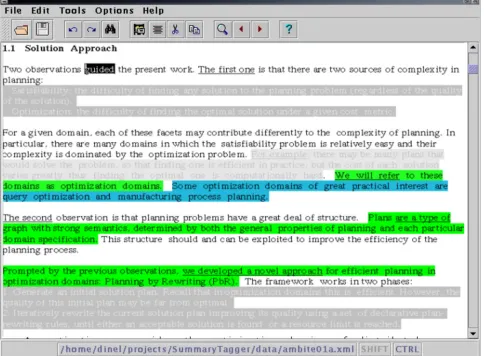
Figure 1: The annotation tool
annotator.2 In most of the cases the human annotators are field experts with little knowledge about annotation schemes and computers, or none. Therefore, the editor has to be designed in such a way that the humans provide the necessary information in a very simple way, using the mouse and the keyboard, and the task of saving the file in the appropriate format remains to be done by the tool. In some cases the annotation schemes have to follow different recommendations (e.g. TEI). The tool can be designed in such a way that it follows the recommendations and does not allow illegal constructions.
The annotation tool assists the human annotator in three ways: it identifies sentences which can be important and sentences which apparently do not contain any relevant information; it allows the human annotator to mark those sentences which cover the same information and the sentences which have referential expressions outside the sentence.
Figure 1 presents a screenshot of the tool. As can be seen some of the sentences are highlighted, whereas some of them are quite difficult to read. The highlighted
2
Actually, our annotation tool requires that the input text has the sentence boundaries marked and contains information about the part of speech for each word.
sentences are sentences which were identified as being important for the document. The sentences which are hardly readable are sentences which contain special formatting (e.g. lists) or indicating phrases. The indicating phrases are underlined in the text.
5.1. Deciding the importance of a unit
The annotation tool decides if a units could be important or not by using well known methods in automatic summarisation. All these methods rely on different parameters which can be adjusted at the running time by the human annotator. Depending on the type of text, the human annotator can decide to run one or more of these methods on the text, or he/she can decide to manually annotate the important units. At any point the annotator can see the list of units highlighted or hidden by the tool and override its decisions. In this section, the methods included in the annotation tool are presented. At present, all these methods included in the tool process sentences and not clauses. However, if the annotator wants to select a clause he/she can do it manually.
5.1.1. Important terms
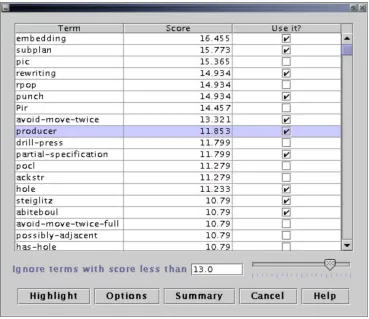
Figure 2: The form which allows to select the terms
6.
Discussion and conclusions
The proposed annotation tool tries to fill a gap in the summarisation field. Its main purpose is to speed up the annotation process through a user-friendly interface and by implementing several automatic ways to identify possible important/unimportant sentences. Given that none of the existing methods in automatic summarisation work with 100% accuracy, the human annotator can override the tool’s decisions. In addition to identifying the important/unimportant sentences in a text, we argued that for training and testing automatic extraction methods it is necessary to identify sentences which cover the same information and to indicate which sentences should be included in an extract to avoid dangling references.
One possible problem which can appear during the annotation process is that the human annotator trusts too much the tool and accepts all its decisions. This problem cannot be address through automatic means and the only solution is to check the quality of the annotation using cross validation techniques. The tool makes possible this cross-validation by allowing to compare different annotations of the same text and computing agreement scores.
The tool will not be used only for annotation. Given that all the actions of the human annotator are logged, it will be possible to investigate how humans decide if a sentence is important or not. Another important information which will be extracted from the logs will be the types of modules which are frequently used by the annotators. This will allow us to learn which methods are considered the best for
finding important/unimportant sentences. This information will be very useful for our project which plans to develop a tool for computer-aided summarisation because will show us which methods are considered reliable by humans and, therefore, should be included. Another information which will be stored in the logs will be the adjustment of the parameters and thresholds used by different methods. The best values (i.e. the once which make the human override the least of the tool’s decisions) will be determined for future use. It is very likely that these values are not common for all type of texts, therefore we hope to be able to use the tool as a way to assess how the text genre determines the kind of methods used and the values for its parameters.
7.
Acknowledgments
This research is part of the AHRB funded project for developing a computer-aided summarisation tool.
8.
References
David Day, John Aberdeen, Sasha Caskey, Lynette Hirschman, Patricia Robinson, and Marc Vilain. 1998. Alembic workbench corpus development tool. In
Proceedings of the First International Conference on Language Resource&Evaluation, pages 1021 – 1028,
May.
H. P. Edmunson. 1969. New methods in automatic extracting. Journal of the Association for Computing
Machinery, 16(2):264 – 285, April.
Hongyan Jing and Kathleen R. McKeown. 1999. The decomposition of human-written summary sentences. In Proceedings of the 22nd International Conference
on Research and Development in Information Retrieval (SIGIR’99), pages 129 – 136, University of Berkeley,
CA, August.
Julian Kupiec, Jan Pederson, and Francine Chen. 1995. A trainable document summarizer. In Proceedings of the
18th ACM/SIGIR Annual Conference on Research and Development in Information Retrieval, pages 68 – 73,
Seattle.
H. P. Luhn. 1958. The automatic creation of literature abstracts. IBM Journal of research and development, 2(2):159 – 165.
Daniel Marcu. 1997. From discourse structures to text summaries. In I. Mani and M. Maybury, editors,
Proceedings of the ACL/EACL ’97 Workshop on Intelligent Scalable Text Summarization, pages 82 – 88,
Madrid, Spain. ACL.
Daniel Marcu. 1999. The automatic construction of large-scale corpora for summarization research. In The 22nd
International ACM SIGIR Conference on Research and Development in Information Retrieval (SIGIR’99), pages
137–144, Berkeley, CA, August.
Constantin Or˘asan. 2000. CLinkA a coreferential links annotator. In Proceedings of LREC’2000, pages 491 – 496, Athens, Greece.
Constantin Or˘asan. 2001. Patterns in scientific abstracts. In Proceedings of Corpus Linguistics 2001 Conference, pages 433 – 443, Lancaster University, Lancaster, UK, March.
Chris D. Paice and G.D. Husk. 1987. Towards the automatic recognition of anaphoric features in english text: the impersonal pronoun it. Computer Speech and
Language, 2:109 – 132.
Chris D. Paice. 1981. The automatic generation of literature abstracts: an approach based on the identification of self-indicating phrases. In R. N. Oddy, C. J. Rijsbergen, and P. W. Williams, editors,
Information Retrieval Research, pages 172 – 191.
London: Butterworths.
F. Salanger-Meyer. 1990. Discoursal flaws in medical english abstracts: A genre analysis per research- and text-type. Text, 10(4):365 – 384.
Gerard Salton, James Allan, and Amit Singhal. 1996. Automatic text decomposition and structuring.
Information Procssing & Management, 32(2):127 –
138.
Simone Teufel and Marc Moens. 1997. Sentence extraction as a classification task. In Proceedings of the
ACL’97/EACL’97 workshop on Intelligent Scallable Text Summarization, pages 58 – 59, Madrid, Spain, July 11.
Benjamin K. Tsou, Hing-Lung Lin, and Tom B. Y. Lan. 1997. A comparative study of human efforts in textual summarization. In Proceedings of PACLING ’97, Meisei University, Tokyo, Japan, September 2 - 5.
Klaus Zechner. 1996. Fast generation of abstracts from general domain text corpora by extracting relevant sentences. In COLING - 96, The International Conference on Computational Linguistics, volume 1,