International Journal of Women’s Health
Effect of high parity on occurrence of some
fetal growth indices: a cohort study
Yahya M Al-Farsi1,2 Daniel R Brooks2 Martha M Werler2 Howard J Cabral2
Mohammed A Al-Shafaee1 Henk C Wallenburg3 1Department of Family Medicine and
Public Health, College of Medicine and Health Sciences, Sultan Qaboos University, Muscat, Sultanate of Oman;
2Department of Epidemiology, School
of Public Health, Boston University, Boston, MA, USA; 3Department of
Obstetrics and Gynecology, College of Medicine and Health Sciences, Sultan Qaboos University, Muscat, Sultanate of Oman
Correspondence: YM Al-Farsi Department of Family Medicine and Public Health, College of Medicine and Health Sciences, Sultan Qaboos University, PO Box 35, 123 Al-Khoudh, Sultanate of Oman
Tel +968 2414 1102 Fax +968- 2441 3300 Email [email protected]
Abstract: The objective of this retrospective cohort study was to explore the potential causal relation between parity and fetal growth indices, including low birth weight (LBW), macrosomia, and prematurity. The study was nested on a community trial in a city in Oman. The study analyzed 1939 pregnancies among 479 participants. Of these, 944 pregnancies (48.7%) were high parity ($5). Obtained newborns with outcomes of interest were as follows: 191 LBW, 34 macrosomic, and 69 premature. Associations were measured using multilevel logistic regression modeling. Compared to low parity (LP, defined as ,5), high parity was found to be associated with less risk of LBW (relative risk [RR] = 0.76; 95% confidence interval [CI]: 0.44–1.1) and prematurity (RR = 0.82; 95% CI: 0.54–1.27), but greater risk of macrosomia (RR = 1.8; 95% CI: 1.2–2.4). This study provides evidence that with increasing parity, risks of LBW and prematurity decrease, while risk of macrosomia increases.
Keywords: parity, fetal growth, low birth weight, macrosomia, prematurity, Oman
Introduction
Abnormal fetal growth is associated with multiple adverse outcomes for the mother and the newborn, such as perinatal morbidities, developmental disorders, and learn-ing disabilities.1 Abnormal fetal growth is usually assessed through multiple indices,
including low birth weight (LBW), small size relative to gestational age, macrosomia, and prematurity.
High parity (HP), defined as having $5 pregnancies of $20 weeks of gestation, is among various risk factors which have been hypothesized for fetal growth abnormalities.2 Although HP has been recognized to be a potential risk factor for
abnormal fetal growth, the exact etiological mechanism is not well understood. Studies investigating whether increasing parity has an adverse effect on fetal growth have yielded inconsistent results. Some studies have confirmed a negative effect evi-denced by LBW and prematurity,3–5 while others revealed no association or even an
increased frequency of macrosomia.6,7 This inconsistency has been attributed, among
other factors, to inadequate sampling of high parity women, especially in developed countries, as well as failure to adequately adjust for strong confounders.
HP is rarely seen in developed countries due to the widespread use of contraceptive measures and family planning. Nonetheless, it is still common in many developing countries, especially in the Arab world where a cultural preference for larger families is still prevalent.2 Oman, an Arab country characterized by an especially high birthrate,8
was accordingly selected as an ideal location for a new study that aims to investigate
Dove
press
O R I G I n A L R E S E A R C H open access to scientific and medical research
Open Access Full Text Article
International Journal of Women's Health downloaded from https://www.dovepress.com/ by 118.70.13.36 on 23-Aug-2020
For personal use only.
Number of times this article has been viewed
This article was published in the following Dove Press journal: International Journal of Women’s Health
the association between high parity and three fetal growth indices: LBW, prematurity, and macrosomia.
Materials and methods
This population-based retrospective cohort study was con-ducted from January 2006 to August 2006 in Bidbid, a city located about 30 kilometers west of Muscat, the capital of Oman. Bidbid was also the catchment population for an ongoing community trial entitled “Delaying the Development of Diabetes Mellitus Type 2 in Oman,” also known as the “AMAL study.” This community trial, which was conducted from 2004 through 2008, aimed to estimate the prevalence of prediabetes among adults in Bidbid and to apply appropriate interventions to prevent the occurrence of diabetes. The study was approved by the Medical Research and Ethics Committee at Sultan Qaboos University.
The target population for the present study consisted of 541 parous women who had previously enrolled in the AMAL study. Of those women, 532 consented to participate in our study, yielding a response rate of 98.3%. The enrolled women had a total of 1,939 singleton pregnancies during the duration of the study. Miscarriages, twin pregnancies, and pregnancies of less than 20 weeks of gestation were excluded.
Information about parity, LBW, and associated factors was obtained from Maternal Health Cards which recorded salient information for each pregnancy, such as sociodemo-graphic data, prepregnancy risk factors, obstetric and medical history, clinical findings at each antenatal visit, investigations, details of delivery, and postnatal findings.
Parity was defined both dichotomously (,5, $5) and by multiple categories (1, 2−3, 4−5, 6−7, 8−9, and $10). LBW was defined as ,2500 g. Individual pregnancies, rather than women, were the unit of analysis for this study, with the cumulative incidence of LBW reported per 100 pregnancies. Outcomes of interest were: (1) LBW (defined as ,2500 g). (2) macrosomia (defined as .4000 g), and (3) prematurity (defined as ,37 weeks of gestation).
Multilevel logistic regression (MLLR) analysis was used to assess the effect of parity on the aforementioned out-comes. Multilevel regression modeling was preferred over conventional regression due to its ability to adjust for the dependency that exists among same-woman pregnancies.9
Two series of MLLR were conducted in order to separately assess both dichotomous parity and categorical parity. Two sets of subanalyses were conducted within each series: a crude model and an adjusted model. In the crude model, parity was treated as the only predictor of occurrence of LBW. In the adjusted model, adjustment was made for the
following confounders: maternal age, educational status of mothers, family income, past history of LBW, and year of delivery. Similar crude and adjusted models were gener-ated for the other outcomes: prematurity and macrosomia. The same set of confounders was considered in all adjusted models. The trend of association between categorical parity and outcomes was tested using the Cochran–Armitage test for trend, and a cutoff value for statistical significance was taken at P, 0.05.
Chi-square analyses were used to evaluate the statistical significance of differences among proportions of categori-cal data. The nonparametric Fisher’s exact test (two-tailed) replaced the Chi-square test in cases of small sample size where the expected frequency was less than 5 in any of the cells in 2 × 2 tables. All statistical analyses were performed using SAS software (version 9.1; SAS Institute, Cary, NC).
Results
A total of 1939 pregnancies were enumerated of which 944 (48.7%) were HP and 995 (51.3%) were low parity (LP). Table 1 compares LP and HP pregnancies with respect to important baseline characteristics existing at the beginning of each pregnancy. Compared to LP pregnancies, HP pregnancies
Table 1 Sociodemographic and selected antenatal characteristics of pregnancies by parity status
LP pregnancies
(n = 995) HP pregnancies (n = 944)
Age (mean) 23.9 (3.5) 32.1 (5.7)
Gestational age (mean) 38.4 (0.6) 39.3 (0.7) Inter-pregnancy period
in months (mean)
31.0 (4.0) 27.0 (2.0)
BMI (average) 24.3 (1.4) 27.2 (1.9) Education
Illiterate 194 (19.5) 573 (60.7)
6th grade 342 (34.4) 280 (28.2)
9th grade 194 (19.5) 55 (5.8)
12th grade 171 (17.2) 24 (2.5)
College or beyond 94 (9.4) 12 (1.3) Monthly family income (in Omani Rials)
Low (,200) 415 (41.7) 240 (24.1) Middle (200 to 500) 442 (44.2) 531 (56.3) High-middle (500 to 1000) 104 (10.5) 146 (15.5) High (.1000) 34 (3.4) 27 (2.7) Year of delivery
Before 1990 112 (11.3) 122 (12.9) 1990 to 1999 541 (54.4) 573 (60.7) 2000 and later 342 (34.4) 249 (26.4)
History of LBW 26 (2.6) 23 (2.4)
History of gestational diabetes 64 (6.4) 152 (16.1)
Note: Figures in parentheses are percentages or standard deviations.
Abbreviations: LP, low parity; HP, high parity; BMI, body mass index; LBW, low birth weight.
Dovepress
Al-Farsi et al
International Journal of Women's Health downloaded from https://www.dovepress.com/ by 118.70.13.36 on 23-Aug-2020
Table 3 Adjusted risk ratios for fetal growth indices by parity status
Parity LBW RR (95% CI)
Macrosomia RR (95% CI)
Prematurity RR (95% CI) Dichotomous
LP (,5) 1.0 1.0 1.0
HP ($5) 0.76 (0.44–1.1) 1.8 (1.2–2.4) 0.82 (0.54–1.27) Categorical
1 1.91 (1.18–2.55) 0.2 (0.02–1.8) 1.47 (1.08–2.21)
2−3 1.0 1.0 1.0
4−5 0.56 (0.32–1.13) 1.4 (0.9–3.2) 0.93 (0.45–1.36) 6−7 0.75 (0.37–1.59) 1.5 (1.3–4.8) 0.79 (0.42–1.39) 8−9 0.82 (0.49–1.69) 1.3 (0.3–3.3) 0.69 (0.39–1.23)
$10 0.45 (0.22–1.27) 1.4 (0.2–3.5) 0.62 (0.31–2.10)
Note: The following factors were adjusted for in the adjusted regression models: age, education, family income, year of delivery, and past history of LBW.
Abbreviations: LBW, low birth weight; RR, relative risk; CI, 95% confidence
intervals; LP, low parity; HP, high parity.
were shown to be associated with the following maternal characteristics: older age, higher body mass index (BMI), illit-eracy, higher family income, and increased frequency of both LBW and gestational diabetes mellitus. Gestational duration did not vary significantly between LP and HP pregnancies.
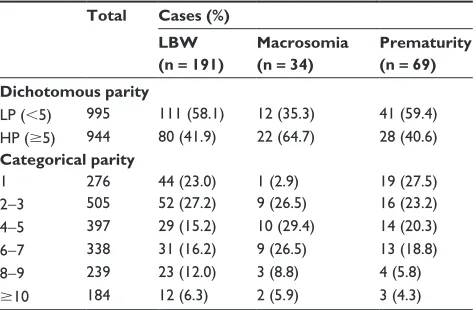
Table 2 shows the incidence of outcomes of interest for each category of parity. Frequencies of recorded newborns with disease outcomes of interest were as follows: 191 LBW, 69 prematurity, and 34 macrosomia. Fewer cases of LBW (80 vs 111) and prematurity (28 vs 41) were documented among HP pregnancies as compared to LP pregnancies. Thus, the incidence of LBW among HP pregnancies (8.5 per 100 pregnancies; 80/944) was lower than among LP pregnancies (11.1 per 100 pregnancies; 111/995). The difference in incidence risk of LBW was not statistically significant (P = 0.06). HP pregnancies also had a lower incidence of prematurity (3.0 per 100 pregnancies; 28/944) than LP pregnancies (4.1 per 100 pregnancies; 41/995), and the difference was not statistically significant (P = 0.26). More macrosomia cases occurred among HP pregnancies (22 vs 12), yielding a higher incidence of macrosomia among HP pregnancies (2.3 per 100 pregnancies; 22/944) than LP pregnancies (1.2 per 100 pregnancies; 12/995), but the dif-ference was not statistically significant (P= 0.61).
Table 3 shows the results of adjusted MLLR modeling. HP pregnancies exhibited a 24% reduction in the risk of LBW (relative risk [RR] = 0.76; 95% confidence interval [CI]: 0.44–1.1) and an 18% reduction in risk of prematurity (RR = 0.82; 95% CI: 0.54–1.27) relative to LP pregnancies. Nonetheless, these observed reductions in risks were not statistically significant. Additionally, the risk of having a macrosomic baby was higher among HP pregnancies (RR = 1.8; 95% CI: 1.2–2.4). Using parity of 2−3 as the reference category, the adjusted MLLR model revealed a
preventive dose-response relation between parity and the risk of both LBW and prematurity (trend, P= 0.04). The adjusted RR sequence also showed a correlation between increasing parity and elevated risk of macrosomia, but with a plateau trend rather than a dose-response relation (trend, P= 0.37).
Discussion
This retrospective population-based cohort study explored whether parity has an effect on the occurrence of LBW, prematurity, and macrosomia. The results showed that higher parity was positively associated with macrosomia and nega-tively associated with both LBW and prematurity.
Primiparity was found to be associated with an increased risk of LBW compared to multiparity. The increased risk of LBW among primiparous women may be explained by the lower average age of primiparous women, which is known to be associated with greater risk of both prematurity and pre-eclampsia; the latter also necessitating delivery before term.10,11
For multiparous pregnancies, higher parity was found to be associated with a decreased risk of LBW in a negative dose-response fashion. This finding may be explained by the asso-ciation between higher parity and maternal hyperglycemia, which tends to result in higher birth weight.12 Although the
overall trend suggested reduction in risk of LBW as parity increases, it is worth mentioning that the reduction in risk of LBW in each subcategory of parity was not statistically significant, and this might be attributed to statistical instability caused by a small category-specific sample size.
These results are in line with previous studies reporting that high parity is associated with a decreased risk of LBW and an increased risk of macrosomia.3,13–15 For example, a
Table 2 Fetal growth indices by parity status Total Cases (%)
LBW
(n = 191) Macrosomia (n = 34) Prematurity (n = 69) Dichotomous parity
LP (,5) 995 111 (58.1) 12 (35.3) 41 (59.4) HP ($5) 944 80 (41.9) 22 (64.7) 28 (40.6) Categorical parity
1 276 44 (23.0) 1 (2.9) 19 (27.5)
2−3 505 52 (27.2) 9 (26.5) 16 (23.2) 4−5 397 29 (15.2) 10 (29.4) 14 (20.3) 6−7 338 31 (16.2) 9 (26.5) 13 (18.8) 8−9 239 23 (12.0) 3 (8.8) 4 (5.8)
$10 184 12 (6.3) 2 (5.9) 3 (4.3)
Abbreviations: LBW, low birth weight; LP, low parity; HP, high parity.
Dovepress Effect of parity on fetal growth indices
International Journal of Women's Health downloaded from https://www.dovepress.com/ by 118.70.13.36 on 23-Aug-2020
prospective cohort study of 1098 pregnancies in Finland found a steady increase in average birth weight in correlation with higher parity.12
Other studies have found high parity to be associated with an increased risk of LBW;3–5 however, at least some of these results
have been attributed to placental complications such as atresia or abruption. Thus, their apparent disagreement with the present study’s results might be due to the absence of this factor. Oth-ers reporting conflicting results have postulated that observed elevations of the risk of LBW were caused by the additional domestic workload undertaken by women, along with each additional child.16 We do not reach a similar conclusion, despite
the fact that the majority of pregnancies included in the present study were among illiterate women from low- or middle-income families with extensive domestic responsibilities.
This study’s use of prospectively documented data among a population with an overall prevalence of HP is one of its strengths. This feature substantially increased the statisti-cal stability of the data notwithstanding the need to adjust for multiple confounders within smaller subcategories. A possible residual confounder is the nutritional status of the women, as sufficient information to adjust for this factor was not available.
With estimates as high as 27.6%, Oman has the second highest annual incidence proportion of HP pregnancies in the world (after the United Arab Emirates),2 as well as the
high-est reported incidence proportion of extreme parity ($10) in the world (11.3%).17
Several explanations have been proposed for these high figures, including limited use of contraceptive measures, cultural idealization of large family size, suboptimal female education, and shortcomings in the implementation of the national birth spacing policy.
Local attitudes towards – and limitations of – family planning are illustrated by a survey which estimated that the prevalence of contraceptive use among Omani women is only 12.7%, and only 64.3% of users believed contraceptives were desirable.18 Another survey of Omani high school students
reported that around 43% of boys and 20.8% of girls stated a preference to have six or more children in the future.19 This
indicates that widespread HP is likely to remain the status quo, even among younger, more educated generations. Given such high rates of HP in Oman, it is especially important for the local medical community to understand its potential health impacts in order to provide better health services for multiparous women and their children.
In conclusion, this study provides evidence that high parity is associated with a lower risk of LBW and prematurity
as well as a higher risk of macrosomia. These results could be usefully considered in designing effective national health policy programs aimed at improving the health of mothers and children in Oman and similar populations. These results can be used to address more targeted family planning programs at the local community level. For example, the observed increased risk of macrosomia can be used to educate women who are at risk of having macrosomic babies because of predisposing conditions such as diabetes mellitus.
These findings should not be interpreted in isolation from other potential consequences of high parity. Further studies are needed to explore, for example, the social and economic effects of larger nuclear family size on both mothers and their families.
Acknowledgments
The authors would like to thank Dr Kamlesh Bhargava, prin-cipal investigator of the AMAL Study, and the AMAL Study research team for their extensive logistical support, without which this work would not have been possible.
Disclosure
The authors declare no potential conflicts of interest.
References
1. Ashdown-Lambert JR. A review of low birth weight: predictors, precur-sors and morbidity outcomes. J R Soc Health. 2005;125(2):76–83. 2. Aliyu MH, Jolly PE, Ehiri JE, Salihu HM. High parity and adverse birth
outcomes: exploring the maze. Birth. 2005;32(1):45–59.
3. Aliyu MH, Salihu HM, Keith LG, Ehiri JE, Islam MA, Jolly PE. High parity and fetal morbidity outcomes. Obstet Gynecol. 2005;105(5 Pt 1): 1045–1051.
4. Ozumba BC, Igwegbe AO. The challenge of grandmultiparity in Nigerian obstetric practice. Int J Gynaecol Obstet. 1992;37:259–264. 5. Seidman DS, Armon Y, Roll D. Grand multiparity: an obstetric or
neonatal risk factor? Am J Obstet Gynecol. 1988;158:1034–1039. 6. Eidelman AI, Kamar R, Schimmel MS, Baron E. The grand multipara:
is she still at risk? Am J Obstet Gynecol. 1988;158:389–392. 7. Sipila P, von Wendt L, Hartikainen-Sorri AL. The grand multipara – still
an obstetrical challenge? Arch Gynecol Obstet. 1990;247:187–195. 8. Sultanate of Oman Ministry of National Economy. Human Development
Report 2003. Muscat, Oman: Ministry of National Economy; 2003. Available from http://www.moneoman.gov.om/book/hdr03/Final_en/ en/ind_1.pdf. Accessed May 6, 2012.
9. Diez Roux AV. The study of group-level factors in epidemiology: rethinking variables, study designs, and analytical approaches.
Epidemiol Rev. 2004;26:104–111.
10. Bánhidy F, Acs N, Puhó EH, Czeizel AE. Pregnancy complications and birth outcomes of pregnant women with urinary tract infections and related drug treatments. Scand J Infect Dis. 2007;39(5):390–397. 11. Martius JA, Steck T, Oehler MK, Wulf KH. Risk factors associated
with preterm (,37+0 weeks) and early preterm birth (,32+0 weeks): univariate and multivariate analysis of 106 345 singleton births from the 1994 statewide perinatal survey of Bavaria. Eur J Obstet Gynecol Reprod Biol. 1998;80(2):183–189.
12. Juntunen KS, Laara EM, Kauppila AJ. Grand multiparity and birth weight. Obstet Gynecol. 1997;90:495–499.
Dovepress
Al-Farsi et al
International Journal of Women's Health downloaded from https://www.dovepress.com/ by 118.70.13.36 on 23-Aug-2020
International Journal of Women’s Health
Publish your work in this journal
Submit your manuscript here: http://www.dovepress.com/international-journal-of-womens-health-journal The International Journal of Women’s Health is an international,
peer-reviewed open-access journal publishing original research, reports, reviews and commentaries on all aspects of women’s healthcare includ-ing gynecology, obstetrics, and breast cancer. Subject areas include: Chronic conditions (migraine headaches, arthritis, osteoporosis);
Endocrine and autoimmune syndromes; Sexual and reproductive health; Psychological and psychosocial conditions. The manuscript management system is completely online and includes a very quick and fair peer-review system. Visit http://www.dovepress.com/ testimonials.php to read real quotes from published authors. 13. Kumari AS, Badrinath P. Extreme grandmultiparity: is it an obstetric
risk factor? Eur J Obstet Gynecol Reprod Biol. 2002;101:22–25. 14. Toohey J, Keegan JR, Morgan M, et al. The dangerous multipara: Fact
or fiction? Am J Obstet Gynecol. 1995;172:683–686.
15. Hughes PF, Morrison J. Grand multiparity – not to be feared? An analysis of grand multiparous women receiving modern antenatal care.
Int J Gynaecol Obstet. 1994;44:21–31.
16. Schram ELR. The problem of the grand multipara. Am J Obstet Gynecol. 1954;67:253–262.
17. Ministry of Health. Sultanate of Oman. Annual Statistics Report 2007. Muscat, Oman: Ministry of Health; 2007. Available from: http://www. moh.gov.om. Accessed February 4, 2009.
18. Ministry of Health. Sultanate of Oman. National Survey on Knowledge, Attitude and Practice Towards Birth Spacing, 1994. Available from: http://www.moh.gov.om. Accessed February 15, 2009.
19. Ministry of Health. Sultanate of Oman. Towards better understand-ing of adolescents. KAP survey for secondary school children in public health and reproductive health by a self-administered questionnaire, 2001. Available from: http://www.moh.gov.om. Accessed February 15, 2009.
Dovepress
Dove
press
Effect of parity on fetal growth indices
International Journal of Women's Health downloaded from https://www.dovepress.com/ by 118.70.13.36 on 23-Aug-2020