Structured Compressive Sensing Aided Data
Detection for SM-OFDM
Dipali Vijaykar, Prof. S.B.Mule
M.E. Student, Department of Electronics and Telecommunication, SCOE, Pune, India
Assistant Professor, Department of Electronics and Telecommunication, SCOE, Pune, India
ABSTRACT
:
Spatial Modulation is the new technology that is used to increase the capacity of the MIMO (multi input multi output) OFDM (orthogonal frequency division multiplexing) system and reduces the complexity by utilizing the index transmit antennas as added means data transmission. In MIMO system Signal detection creates Compressive sensing problem. Based on compressive sensing principle, A novel detector is proposed to exploits the rare group sparsity of the signal that improve the accuracy of the nonzero element of localization. According to channel matrix decomposition the detector combines the CS algorithm and the iteration together to deal with performance deterioration that carried by inter carrier interference. Besides, theoretical analysis about the performance gain guaranteed by our detector is shown and the complexity is with the related works.Simulation results verify that the proposed detector have an apparent performance gain on the basis of throughput, SNR vs Bit Error Ratio (BER) and the no original samples vs Estimated samples.KEYWORDS: Spatial Modulation, MIMO (Multi Input Multi Output), Compressive Sensing (CS).
I
.
INTRODUCTIONIn wireless communication increasing the demand of high date rate for wide application of smart terminals. Multi Input Multi Output (MIMO) orthogonal frequency division multiplexing is the technology that uses multiple transmitter and receiver antenna to transfer more data at same time to achieve high data rate retrieve the data with minimum possible error. This is key technology for next generation wireless communication. MIMO is able to enhance the spectral efficiency by utilizing special multiplexing and special diversity. The main issue with massive MIMO is the complexity of the receiver increases as number of antennas increases due to Inter antenna interference is the challenging work to design with the low complexity.
Spatial modulation (SM) is the new technology to massive MIMO OFDM system is to reduce the complexity of the receiver. SM OFDM can effectively avoid inert antenna interference by activating only one antenna while transmitting per user. In SM a block of information is mapped into one information symbol and a corresponding antenna number. Antenna array pattern can be interrupted as spatial constellation diagram, the receiver estimates the symbol and active antenna no and de-maps the original information bits this helps in gain of data rate.
II. LITERATURE SURVEY
The increasing demand for higher data rates, better quality of service, fully mobile and connected wireless networks lead the researchers to seek new solutions beyond 4G wireless system. During the past few years, the data traffic (fixed and mobile) has increased exponentially because of the increasing number of devices like smart phones, laptops, tablets, and several other devices. In the future, the requirement for wireless data traffic will be much more than today [2], [3]. Mobile data traffic worldwide is anticipated to escalate to 15.9 Exabyte by the end of year 2018; this is about 6 times larger than that of year 2014. Along with the data traffic, the number of connected devices is projected to increase to 10.2 billion After more than 20 years of research and development, the achievable data rates of today’s cellular wireless communication network are several thousands of times faster compared to earlier 2G wireless systems. Even though there are a lot of benefits from wireless systems as compared to wired systems, however, there are a few major
challenges that exist. The major constraint in wireless systems is availability of limited frequency spectrum for an ever-increasing number of users and demand for data rate [4]. It is challenging to accommodate the ever-increasing users in the limited frequency band available. To resolve these challenges researchers came up with the scheme of frequency reuse which was not a simple task to do. There are numerous problems associated with frequency reuse. For instance, there will be a lot of interference when multiple users have to share the same spectrum. Another major difficulty in wireless
networks is fading such as multipath or frequency selective fading. In this regard, a Multiple Input Multiple Output (MIMO) antenna system emerged as a remedial technique to achieve better spatial diversity which makes the wireless systems more reliable. Moreover, with MIMO antenna system, multiple streams can be transmitted and thus, multiplexing gain can be achieved which significantly increases the capacity of wireless systems. MIMO systems have
been given major consideration in the previous decade and are being integrated into numerous new generation wireless standards (e.g., LTE-Advanced, 802.16m) [5].
Multiple-antenna techniques constitute a key technology for modern wireless communications, which trade-off superior error performance and higher data rates for increased system complexity and cost. Among the many transmission principles that exploit multiple-antenna at either the transmitter, the receiver, or both, Spatial Modulation (SM) is a novel and recently proposed multiple-antenna transmission technique that can offer, with a very low system complexity, improved data rates compared to Single-Input- Single-Output (SISO) systems, and robust error performance even in correlated channel environments. SM is an entirely new modulation concept that exploits the uniqueness and randomness properties of the wireless channel for communication. This is achieved by adopting a simple but effective coding mechanism that establishes a one-to-one mapping between blocks of information bits to be transmitted and the spatial positions of the transmit-antenna in the antenna-array.
III. METHODOLOGY
A. Spatial Modulation in OFDM
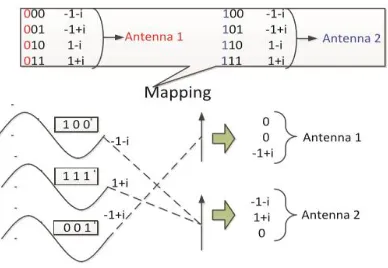
In SM-OFDM system mapping procedure is the basic concept, QPSK modulation technique is adopted and two antennas are provided in the system. Initial three bits to be transmitted each sub carrier. First bit is representing the index of the antenna,0 for antenna 1 and 1 for antenna 2. Other two bits are representing conventional QPSK.
B=
1 0 0 1 1 1 0 0 1
(1)
Fig 1. SM-OFDM Procedure
B. Orthogonal Frequency Division Multiplexing (OFDM)
OFDM is the multicarrier modulation system. Multiple sub-band and multi-subcarrier each subcarrier representing sub bands. The frequency selective fading can be converted into narrow band flat fading sub channel it avoids the inter channel interference. OFDM provides high data with low complexity.
C. Ensemble Detector
There are many detectors for SM-OFDM system but to recover the sparse signal CS based detector is suitable for better detection because of its low complexity. In existing model there are some detection problem in time domain due to this we established frequency domain signal to formulate the problem. The channel matrix in frequency domain between the −th receive antenna and the −th transmit antenna ∈ ℂ × ,
[1, ], ∈[1, ] , can be shown as
=
(1,1) ⋯ (1, )
⋮ ⋱ ⋮
( , 1) ⋯ ( , )
(2)
In HST systems, is the full matrix and off diagonal element can not be ignored due to large ICI resulting from high mobility. In massive MIMO system, received signal expressed as
= + (3)
Where denotes the received N Subcarriers −th antenna, represent the N subcarrier on the −th and is denoted as noise term. By solving (3), we get the modulated symbols for each transmit antenna then [ ⋯ ] .taking the index and value of , will demodulate according to the inverse process of SM-OFDM.
Inter cell interference is occur that reduced theperformance of system and the spectral efficiency by half. Our ensemble detector gets two signals that obtain from two adjacent antennas so the received signal is sum of the two cells. we get,
= + + (4)
taking consideration of the ICI we get the measurement decomposition same as single cell, = + (5) = ( ) + − ( ) +
according to the decomposition and the iteration process, we obtained
Algorithm:
Require:
Ensure:
Initialization: ←0 y←
while halting criterion false, do
1: {estimation of }
←0,
while halting criterion false, do
r← − ( ) c← ( )
Ω ← ∅
for n = 1: N
ℳ ← + 0∶( −1)
ℳ ← + 0∶( −1) +
Ω ← ℳ( | |ℳ ) Ω ← ℳ( | |ℳ
Ω= Ω ∪ Ω
end
← Ω ∪ ( )
←(( ( )) )
←0
←0
for n = 1: N ℳ ← + 0∶( −1)
(ℳ( {| |ℳ )}))←max{| |ℳ }
ℳ ← + 0∶( −1) +
(ℳ( {| |ℳ )}))←max{| |ℳ } end for
end while
2: {hard decision of
← ( ) 3: {calculation of }
←( − ( )) 4: {update of y}
← −
end while
IV. SIMULATION RESULT
Fig.2. SNR vs BER for = 2, = 2.
Another result shows the relationship between SNR vs throughput in Fig.3. it shows that through spatial modulation user can get maximum data rates Kbps.
Fig.3. SNR vs THROGHPUT
Fig.4. Original vs estimated data
V. CONCULSION
The low complexity detection algorithm for SM is proposed in this paper. A CS based strategy decomposed the channel matrix and improves the performance of the system. SM proves that it is an effective system for the better performance in low complexity along with compressing sensing is a method which makes signal reconstruction easier by reducing the signal processing load on detector.
REFRENCES
G. Skourletopoulos, C.X. Mavromoustakis, G.Mastorakis,J.M.Batalla, C. Dobre, S. Panagiotakis, and E. Pallis, “Towards mobile cloud computing in 5g mobile networks: Applications, big data services and future opportunities,” in Advances in Mobile Cloud Computing and Big Data in the 5G Era. Springer, 2017, pp. 43–62.
D. Ott, N. Himayat, and S. Talwar, “5g: Transforming the user wireless experience,” Towards 5G: Applications, Requirements and Candidate Technologies, pp. 34–51, 2017.
R. N. Clarke, “Expanding mobile wireless capacity: The challenges presented by technology and economics,” Telecommunications Policy, vol. 38, no. 8, pp. 693–708, 2014.
H. Q. Ngo, Massive MIMO: Fundamentals and system designs. Linkoping University Electronic Press, 2015, vol. 1642.
M. F. Duarte and Y. C. Eldar, “Structured compressed sensing: From theory to applications,” IEEE Trans. Signal Process., vol. 59, no. 9, pp. 4053– 4085, Sep. 2011.
Y. C. Eldar and G. Kutyniok, Compressed Sensing: Theory and Applications. Cambridge, U.K.: Cambridge Univ. Press, 2012.
J. A. Tropp and A. C. Gilbert, “Signal recovery from random measurements via orthogonal matching pursuit,” IEEE Trans. Inf. Theory, vol. 53, no. 12, pp. 4655–4666, Dec. 2007.
S. S. Chen, D. L. Donoho, and M. A. Saunders, “Atomic decomposition by basis pursuit,” SIAM J. Sci. Comput., vol. 20, no. 1, pp. 33–61, Aug. 1998.
D. Needell and J. A. Tropp, “CoSaMP: Iterative signal recovery from incomplete and inaccurate samples,” Appl. Comput. Harmonic Anal., vol. 26, no. 3, pp. 301–321, May 2009.
L. Xiao et al., “Efficient compressive sensing detectors for generalized spatial modulation systems,” IEEE Trans. Veh. Technol., vol. 66, no. 2, pp. 1284–1298, Feb. 2017.
Garcia-Rodriguez and C. Masouros, “Low-complexity compressive sensing detection for spatial modulation in large-scale multiple access channels,” IEEE Trans. Commun., vol. 63, no. 7, pp. 2565–2579, Jul. 2015.
C.-M. Yu et al., “Compressed sensing detector design for space shift keying in MIMO systems,” IEEE Commun. Lett., vol. 16, no. 10, pp. 1556– 1559, Oct. 2012.
Z. Gao, L. Dai, C. Qi, C. Yuen, and Z. Wang, “Near-optimal signal detector based on structured compressive sensing for massive SM-MIMO,” IEEE Trans. Veh. Technol., vol. 66, no. 2, pp. 1860–1865, Feb. 2017.
Z. Gao, L. Dai, Z. Wang, S. Chen, and L. Hanzo, “Compressive-sensingbased multiuser detector for the large-scale SM-MIMO uplink,” IEEE Trans. Veh. Technol., vol. 65, no. 10, pp. 8725–8730, Oct. 2016.