ISSN(Online): 2319-8753 ISSN (Print): 2347-6710
I
nternational
J
ournal of
I
nnovative
R
esearch in
S
cience,
E
ngineering and
T
echnology
(A High Impact Factor, Monthly, Peer Reviewed Journal) Visit: www.ijirset.com
Vol. 7, Issue 5, May 2018
A Cloud-Based RFID Parking Locater for
Smart Cities
Komal Mhokar, Priyanka Modak, Neha Prajapati, Shraddha Tupe
Dept. of Computer Engineering, RMD Sinhgad School of Engineering, Pune, India
ABSTRACT: Now a days , people are more often visit to the various public places like shopping malls, 5 star hotels,
multiplex cinema halls etc. Many people faces difficulties in finding the available parking slots. The system introduces a miniature model of vehicle parking that can direct and manage the no of vehicles that can be parked in given parking slot at any given time based on availability of parking space after doing the registration by user using android application on their smart phone.Addition to this user can login the system using biometric like fingerprint recognition.User can authorized by using RFID tag at parking location.Android application allows run time payment of money, if the time is exceeded then accordingly rates are being increased. The framework has pulled in expanding consideration from both academics and industrial communities which exhibits the effectiveness of framework design and implementation of vehicle parking system.
KEYWORDS: Smart parking, Traffic congestion, RFID,Slot al-location,Android application
I. INTRODUCTION
PARKING is an expensive process in terms of either money or the time and effort spent for the free spot”chasing.Parking spaces are found to be more than plenty in some places and very rare to nd in others.Valuing approaches had played an important role in the general parking accessibility for consider-able length of time .Here comes the important question: do we need to have more parking spaces or do we need better parking management. We believe it is the later and thus the motivation behind this work is about better parking management with fair and profitable pricing policies.
RFID inovation is an automized vehicle distinguishing proof framework that is helpful what’s more,requires no work force. Vehicles are recognized what’s more, parking area charges are gathered naturally by means of his framework.There has been a lot of lessening in exchange expenses and reduction in stock lack with the utilization of Radio Frequency Iden-tification (RFID) innovation in mechanization. The majority of the RFID systems incorporate an extensive variety of mechanization advancements. These advancements are RFID readers, RFID writers, RFID standardized tag scanners, RFID brilliant sensors and RFID controllers.In this study, a solution has been accommodated the issues experienced in parking area administration frameworks by means of RFID innovation.
The use of smart phones has been increasing in the last few years , which opened many possibilities to assist humans in every day life. To overcome the parking issue novel techniques such as smart phones can be used. For example to show parking availability and to guide drivers to free parking spots.
ISSN(Online): 2319-8753 ISSN (Print): 2347-6710
I
nternational
J
ournal of
I
nnovative
R
esearch in
S
cience,
E
ngineering and
T
echnology
(A High Impact Factor, Monthly, Peer Reviewed Journal) Visit: www.ijirset.com
Vol. 7, Issue 5, May 2018
payment of money. If time is exceeded then accordingly rates are being increased.The increase in broad band access on mobile devices brings up new possibilities such as displaying real-time parking data on mobile web maps like Google Maps .There has already been a lot of effort put in this topics to find possible solutions to solve the parking problem.The key goal of this work is the optimization of existing space by the use of modern technologies and by offering a less cost intensive solution.
II. SYSTEM ARCHITECTURE
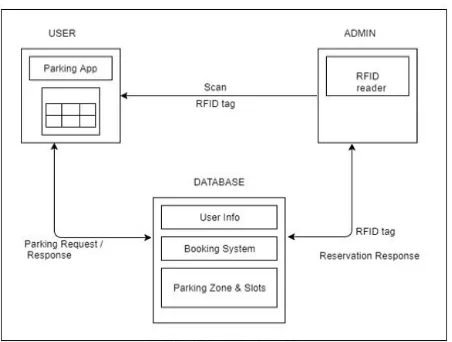
Fig. 1: System architecture System contains two main part
Web portal
User application
1) Web portal:-
-User will be authenticate by the admin with the help of RFID.
-All slots are managed with the help of admin.
2) User application:-
-User can register on the application.
ISSN(Online): 2319-8753 ISSN (Print): 2347-6710
I
nternational
J
ournal of
I
nnovative
R
esearch in
S
cience,
E
ngineering and
T
echnology
(A High Impact Factor, Monthly, Peer Reviewed Journal) Visit: www.ijirset.com
Vol. 7, Issue 5, May 2018
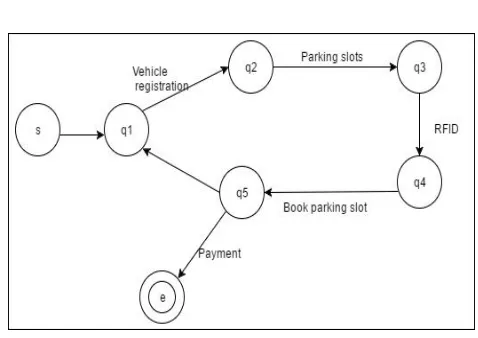
State diagram
Fig. 2: State Diagram
Explanation:
The q1 state vehicle Registration Details and User cre-dential for authenticating from the state s which is our initial state.
The q2 state is meant for Parking slots for Vehicle which is accept in state q1. The count stores in state q2 allocate the parking slots to user and send to state q3.
In q3 state,RFID for Parking Vehicle.
q4 state book the parking slot using android application. q5 State dummy payment by using cash or online. In this step i.e. q3, we use RFID code performance of
restructured result.
III. MINIMUM REQUIREMENT
A. Hardware Resources Required
RAM 8 GB
Hard Disk: 500 GB WiFi module
RFID Tag Aurdino
B. Software Resources Required
Platform:
1) Operating system: Windows 10
ISSN(Online): 2319-8753 ISSN (Print): 2347-6710
I
nternational
J
ournal of
I
nnovative
R
esearch in
S
cience,
E
ngineering and
T
echnology
(A High Impact Factor, Monthly, Peer Reviewed Journal) Visit: www.ijirset.com
Vol. 7, Issue 5, May 2018
3) Database proposed:-MySQL
4) software with version Jdk 7
Eclipse
Apache tomcat 8 Android SDK
IV. ALGORITHM OF SOFTWARE
V. LITERATURE REVIEW
”Smart Car Parking System”, by Sunil Dhakne1, et al. In this paper the mix of continuous reservations with share time reservations, powerfully performing framework choices (reservation time imperatives and evaluating) as per constant usage data, and offering the drivers the decision of picking different goals and reservation sort.
”Cruising for parking”, by Donald C. Shoup In this paper check stopping is an unreasonable sponsorship since it urges drivers to accomplish something that damages
ISSN(Online): 2319-8753 ISSN (Print): 2347-6710
I
nternational
J
ournal of
I
nnovative
R
esearch in
S
cience,
E
ngineering and
T
echnology
(A High Impact Factor, Monthly, Peer Reviewed Journal) Visit: www.ijirset.com
Vol. 7, Issue 5, May 2018
”Smart Parking System an Intelligent webApplication for Parking Search and Reservation”, by Govind Kamlesh Gupta et al. This system helps drives to find a optimal parking spot. Finding a spot for parking is based on a unique algorithm which is combination of KNN i.e. k nearest neighbor and avail-ability of parking slots. Special security feature is introduced which contains QR code mechanism to allow driver who has booking QR code.
”An Algorithm of Parking Planning for Shrewd Parking System”,by Xuejian Zhao et al.presented a novel strategy for stopping making arrangements for shrewd stopping sys-tem,transform stopping arranging into a sort of straight task issue by holding stopping questions in a line for some time. Build up another estimate calculation The experimental results on simulation clearly show our method is a feasible method which can give timely and efficient solutions for a real time smart parking system.
” Technical Solutions to Overcrowded Park and Ride Fa-cilities ”,by Kyriacos C. Mouskos et al. This paper is mainly focused on A prototype parking information and reservation system through the web and cell phone. It incorporates a stopping reservation calculation and arrangement strategy, an online stopping reservation framework and a mobile phone based stopping reservation and data system also This paper proposes an ensemble classification method together with a motion model in order to deal with the above issue. Exami-nations demonstrate that proposed strategy is fit for emulating GPS conduct on vehicle following.
we propose a savvy stopping framework consolidating WiFi and remote sensor organize. In this framework, geomagnetic sensors are utilized to distinguish the control of parking spots, and WiFi is utilized for route. A model framework has been produced.
”A savvy stopping framework utilizing WiFi and remote sensor In recent years, the demand of accurate positioning and navigation is increasing,especially in a complex indoor environment, such as underground mines, shopping malls,by Cheng Yuan;Li Fei et al.etc. We often need to obtain the location of terminal device and its holder.
”Relative location estimation of vehicles in parking man-agement system”,by T. Read et al. The primary requirement of content distribution is to efficiently deliver and share these multimedia-rich contents to the vehicles traversing the network.
”The investigation of Cyber-security experimentation: The prevent venture”, by T. Benzel et al.presents the DETER project,which creates DeterLab, an office gave to the experi-mentation and educating of digital security ideas.
”Park Here! a smart parking system based on smart phones embedded sensors and short range Communication Technolo-gies”, K. C. Chan and M. Martin, present solution targets common city environments, where no per-spot sensors are available, and there is no remote service allowing the reser-vation in-advance of a parking spot. For this scenario, we propose a new algorithm for the computerised detection of parking actions performed by the user, through the analysis of smart phone embedded sensors (accelerometer/gyroscope), and of the Bluetooth connectivity.
ISSN(Online): 2319-8753 ISSN (Print): 2347-6710
I
nternational
J
ournal of
I
nnovative
R
esearch in
S
cience,
E
ngineering and
T
echnology
(A High Impact Factor, Monthly, Peer Reviewed Journal) Visit: www.ijirset.com
Vol. 7, Issue 5, May 2018
VI. RESULT ANALYSIS
This system gives slot allocation method where we can book our own cheapest and shortest distant parking slot. It is one of the efficient way for solving parking problems, which over-comes the traffic congestion and provides automated billing process using the android application.
VII. CONCLUSION
Here , we conclude that using android application user can check the available also non available parking slots by registering and login to the application using biometric au-thentication like fingerprint recognition. Android application allow automatic billing process as soon as user booked the required parking slots. Authorized user can be authenticates by tapping the RFID tag at parking location.The cloud based vehicle parking locater with reservation framework builds the income for specialist organizations gives benefits separation to clients with various requirements, which eliminates traffic congestion pertaining for parking.
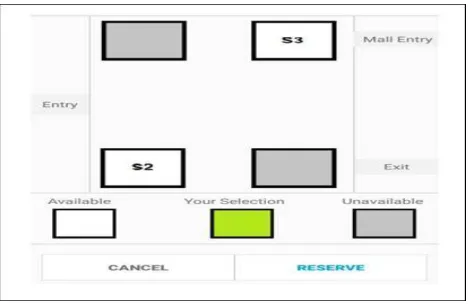
Fig. 3: Parking Reservation Slots
VIII. FUTURE SCOPE
The main purpose of this project is to reduce the traffic congestion that occurs in an around the urban areas which is caused by vehicle searching for parking.This work is addi-tionally extended as a completely computerised system using multilayer parking methods.Safety measures such as tracing the vehicle number so as to avoid theft and automatic billing process can also be design.We planed to expand the test on the real time environment where the user can the ”smart parking system ” in their hand-held devices.
Evaluate system using real-time data and greater number of resources and destinations.
Simulate different parking arrival scenarios in real life. Different algorithms and techniques can are used
ACKNOWLEDGMENT
ISSN(Online): 2319-8753 ISSN (Print): 2347-6710
I
nternational
J
ournal of
I
nnovative
R
esearch in
S
cience,
E
ngineering and
T
echnology
(A High Impact Factor, Monthly, Peer Reviewed Journal) Visit: www.ijirset.com
Vol. 7, Issue 5, May 2018
of this work. I would also like to express my appreciation and thanks to Ms.Vina M. Lomte, Head of Department, and Computer Engineering and to the Seminar Coordinator Prof. Parth Sagar. I would also like to express my appreciation and thanks to all my colleagues and family members who knowingly or unknowingly have assisted and encouraged me throughout my work.
REFERENCES
[1] iParkerA New Smart Car-Parking System Based on Dynamic Resource Allocation and Pricing Amir O. Kotb, Yao-Chun Shen, Xu Zhu, Senior
Member, IEEE, and Yi Huang, Senior Member, IEEE ,2016.
[2] H. Wang and W. He, A reservation-based smart parking system, in Proc. IEEE INFOCOM WKSHPS, Apr. 2011, pp. 690695.
[3] D. C. Shoup, Cruising for parking, Transp. Policy, vol. 13, no. 6, pp. 479486, Nov. 2006.
[4] The sharing at roadside: Vehicular content distribution using parked vehi-cles http://ieeexplore.ieee.org/stamp/stamp.jsptp=andarnumber=619
5670.
[5] ”Relative location estimation of vehicles in parking management sys-tem”,by T. Read;Mohammad Shaifur Rahman ; Youngil Park ; Ki-Doo
Kim, Feb. 2009.
T.”The science of Cyber-security experimentation: The deter project”, by Benzel et al,2011.
[6] ” Technical Solutions to Overcrowded Park and Ride Facilities ”,by Kyriacos C. Mouskos et al, 2013.
[7] Y. Geng and C. Cassandras, New smart parking system based on resource allocation and reservations, IEEE Trans. Intell. Transp. Syst., vol. 14,
no. 3, pp. 11291139, Sep. 2013.
[8] R. Ranjini and D. Manivannan, A comparative review on car park- ing technologies, Int. J. Eng. Technol., vol. 5, no. 2, pp. 17631767,Apr./May
2013.
[9] G. Revathi and V. Dhulipala, Smart parking systems and sensors: A survey, in Proc. ICCCA, Feb. 2012, pp. 15.
[10] A smart parking system using WiFi and wireless sensor network http://ieeexplore.ieee.org/stamp/stamp.jsptp=andarnumber=752 0924.
[11] The sharing at roadside: Vehicular content distribution using parked vehicles http://ieeexplore.ieee.org/stamp/stamp.jsptp=andarnumber=619
5670.
[12] ”Relative location estimation of vehicles in parking management sys-tem”,by T. Read;Mohammad Shaifur Rahman ; Youngil Park ; Ki-Doo
Kim, Feb. 2009.
T.”The science of Cyber-security experimentation: The deter project”, by Benzel et al,2011.
[13] ” Technical Solutions to Overcrowded Park and Ride Facilities ”,by Kyriacos C. Mouskos et al, 2013.
[14] Y. Ji, W. Guo, P. Blythe, D. Tang, and W. Wang, Understanding drivers perspective on parking guidance information, IET Intell. Transp. Syst.,
vol. 8, no. 4, pp. 398406, Jun. 2014.