R E S E A R C H
Open Access
A framework for service provisioning in virtual
sensor networks
Lambros Sarakis
1*, Theodore Zahariadis
1, Helen-Catherine Leligou
1and Mischa Dohler
2Abstract
The majority of research and development efforts in the area of Wireless Sensor Networks (WSNs) focus on WSN systems that are dedicated for a specific application. However, this trend is currently being replaced by resource-rich WSN deployments that are expected to provide capabilities in excess of any application’s requirements. In this regard, the concept of virtual sensor networking is an emerging approach that enables the decoupling of the physical sensor deployment from the applications running on top of it, allowing in this way the dynamic collaboration of a subset of sensor nodes and helping the proliferation of new services and applications beyond the scope of the original deployment. In this context, the article presents the architecture of a system for the realization of Virtual Sensor Networks (VSNs). The aim of the proposed architecture is to enable the realization of scalable, flexible, adaptive, energy-efficient, and trust-aware VSN platforms, focusing on the reduction of
deployment complexity and management cost, and on advanced interoperability mechanisms. The efforts have been put towards specifying a service provisioning architecture and mechanisms for advanced sensor and middleware design.
Keywords:wireless sensor network, virtualization, system architecture
1. Introduction
Over the last few years, we are witnessing an explosion of interest in research on Wireless Sensor Networks (WSNs) that are accompanied by a constantly increasing interest for physical WSN deployment and commercial exploitation of the services provided by these networks. In this regard, the majority of relevant research and development efforts have focused on WSN systems that are dedicated for a specific application. However, a trend is currently developing towards resource-rich WSN deployments that are expected to provide capabil-ities in excess of any application’s requirements.
In that sense, sensor-based applications/services will utilize sensors for purposes beyond the scope of the ori-ginal sensor design and deployment, creating in this way an instantiation of a Virtual Sensor Network (VSN) [1,2] to serve user-specific requests. Virtualization is the key enabler for decoupling the physical sensor deployment from the applications running on top, and is thus a
significant step towards the decoupling of ownerships in the Internet of Things. In rough analogy to virtualiza-tion in more “traditional”network infrastructures (both at the core and access network levels) [3], WSN virtuali-zation aims to accommodate multiple logical network instances over a single physical network infrastructure with the ultimate goal of (a) supporting applications with different requirements both in terms of nodes and communication functionalities and (b) utilizing in an efficient and cost-effective manner the available network resources.
With these goals in mind, one could think of several applications that can benefit from the virtualization of sensor network infrastructures. In the following, we dis-cuss two types of applications that correspond to what we consider to be the most significant use cases for VSNs. The first type involves geographically overlapped applications [1]. In this case, a WSN that is deployed to support an application can utilize communication resources offered by another WSN operating in the same area and being deployed to support a different application. The main benefit from the collaboration of the different WSNs, in this case, is the reduction of the * Correspondence: [email protected]
1
Technological Educational Institute of Chalkida, 34400 Psachna, Euboea, Greece
Full list of author information is available at the end of the article
number of sensors of each type without losing accuracy or degrading the required user functionality. With the smart usage of previously deployed networks, this approach contributes to cost savings and helps future evolvement and addition of new types of sensors with-out the need to deploy a full network from scratch.
The second VSN use case involves applications oper-ating over multi-purpose sensor networks. A common use of VSNs, in this case, could be the separation of nodes with multiple sensing elements in different (vir-tual) networks, each one being responsible to track a different sensing parameter. Using this approach, a bet-ter administration at node level and enhanced usability can be achieved with an increased number of different end-users gaining access and control in sensors’ infor-mation according to their needs.
Whilst mechanisms are in place to facilitate virtualiza-tion in the core network [3], major challenges remain in networks that connect embedded sensor devices to the Internet. On the one hand, these have to do with indivi-dual functionalities of a VSN system related, for exam-ple, to middleware, routing, security, trust, and energy awareness of protocols and mechanisms at various layers of the communication protocol stack. On the other hand, significant challenges arise as far as the develop-ment of a holistic approach to VSN is concerned, which should take into account not only individual enhance-ments related to the aforementioned functions, but also the need to federate resources across networks belong-ing to different administrative domains, as well as the need to support promising business models.
The challenges just presented are currently addressed by the VITRO project [4], the main objective of which is to achieve the realization of a scalable, flexible, adap-tive, energy-efficient, and trust-aware VSN platform, focusing on the reduction of deployment complexity and management cost, and on advanced interoperability. The VSN architecture that is proposed by VITRO is presented in this article.
The motivation behind the proposed architecture stems from the current trend to overcome the con-straints of application-specific WSNs and provide a fed-erated system that is more efficient, flexible, and adaptive in a wide sense. In this context, the goal of the system presented in this article is to support a number of advanced applications/services provided by VSNs. Each of these applications will have their own resource and service requirements, which must be fulfilled in order to ensure specific service level agreement require-ments. The abstraction introduced by the resource/ser-vice virtualization mechanisms will allow network operators to manage, modify, and utilize WSNs in a highly flexible and dynamic way. The flexibility gained through such an approach can be used to increase
sustainability (in terms of cost-effectiveness) of deployed network/node resources.
Given the heterogeneity of the deployed WSNs (in terms of platforms, operating systems–OSs, program-ming paradigms, addressing schemes, etc.), it is a tre-mendous challenge to make effective and seamless usage of such resources and services in an integrated VSN ser-vice platform. In this context, this study aims at describ-ing an integrated system architecture that extends the notion of a WSN towards the realization of large-scale, cross-organizational VSNs. What is introduced is a new paradigm in the design, deployment, and usage of WSNs, one in which the sensor network is not designed and deployed for one specific application, but for a vari-ety of applications. In this way, WSNs can in principle support many applications and, at the same time, a new application can count on a wide base of sensor networks already deployed.
The remainder of the article is organized as follows. Section 2 presents the related study on sensor networks virtualization, while Section 3 introduces the proposed VSN system architecture and discusses the principles behind its design. The architecture of the VSN gateway and the architecture of the sensor node are described in Section 4. The interfaces between the system compo-nents are presented in Section 5, while example interac-tions for service registration and negotiation, and session establishment are illustrated in Section 6. Finally, Section 7 concludes the article and presents future directions.
2. Related study
Virtualization gains increasingly more attention in com-puting and networking targeting more efficient resource utilization, lower cost, increased flexibility and manage-ability, and improved administration and interoperability among different computing devices. Aspects of virtuali-zation have been introduced in WSNs with the aim to give solutions to the constraints mentioned above and lead to a wider use of these networks and a faster reali-zation of the Internet of Things. Research efforts in sen-sor networks virtualization include (a) OS virtualization, (b) sensor virtualization, (c) network virtualization, (d) virtual machines, and (e) middleware layers, with the last being the predominant area of interest.
[7]. Platform virtualization with a node running distinct host and guest OS threads has been demonstrated by the TinyMOS implementation which can run a typical TinyOS program as a MANTIS thread [8].
Sensor virtualization is supported by inserting an abstraction layer between the application logic and the sensor driver with the aim to address issues like incom-pletea prioriknowledge of the area of operation, recali-bration of sensing equipment, changing conditions, etc. A component targeting sensor virtualization, which is programmable at runtime and is able to execute differ-ent adaptation schemes that may change during the application lifetime, is presented in [9]. Another area of research on virtual sensors is related to inference when physical sensors of the WSN do not work anymore. In this context, the study of [10] presents a method where virtual sensors infer approximation values using fuzzy logic rules with the assumption that physical quantities sensed by neighbor sensors are related.
Network virtualization in WSNs focuses on algorithms and protocol support for the formation, usage, adapta-tion, and maintenance of (possibly dynamically varying) subset of sensors collaborating on specific tasks and being organized as a VSN using resources of a shared physical infrastructure [1]. These nodes rely on those outside the subset to achieve connectivity and overcome the deployment and resource constraints. To make VSNs a reality, a number of mechanisms for VSN main-tenance (e.g., adding/deleting nodes, entering/leaving a VSN, and merging/splitting of VSNs) and membership maintenance (e.g., dynamic (re)assignment of sensor roles) must be developed. A mechanism for self-organi-zation of VSN members relying on a cluster tree-based scheme is presented in [11].
Virtual machines are widely used in high-end servers and PCs for various purposes such as platform indepen-dence and isolation. In sensor networks, however, the focus is on re-programmability, i.e., the capability of injecting new code into each node on site dynamically. Examples of stack-oriented virtual machines include Maté [12] and ASVM [13]. Their goal is to provide an application-specific virtual machine that delivers the needed flexibility to support a safe and efficient pro-gramming environment. By providing a limited number of instructions necessary for a specific application, Maté/ASVM can reduce the size of the assembly code to be transmitted to each node. Melete [14] extends Maté and supports multiple concurrent applications. VMStar [15] is another framework for building applica-tion-specific virtual machines and allows the dynamic update of the system software, such as the virtual machine itself, as well as the application code.
In the last few years, many varying middleware solu-tions for WSNs have been presented and their
architectures have been influenced by the progressive shift of application paradigms from targeting single sen-sor networks towards implementing the Internet of Things, where applications will operate over multiple interconnected networks on a global scale. Each middle-ware solution makes its own architectural design assumptions that are largely based on the application domain(s) it aims to support. Thus, each solution pro-vides different degree of support for features of virtuali-zation such as resource and service discovery, collaboration of heterogeneous nodes, interconnection of sensor sub-networks, and connectivity to external networks, ease of deployment and maintenance, concur-rent execution of multiple applications, scalability, adaptability, and reliability. Most of the current solu-tions try to facilitate high-level querying of sensor data, help to mask the distribution and heterogeneity in the sensor network, and address resource constraints by providing, for example, energy-aware routing and query processing.
In terms of their models for querying and data aggre-gation, their assumptions about the topology and other characteristics of the network, as well as the degree of support for the aforementioned aspects of VSNs, the proposed middleware frameworks can fit into one or more of the following categories:
•Database-inspired approaches, where the middle-ware configures the sensor network to behave as a database management system accepting and proces-sing database queries from the application layer. Examples of this type of middleware include Cougar [16], TinyDB [17], and Global Sensor Networks [18].
•Middleware making use of a distributed virtual shared space. Many approaches in this class are based on the tuple space shared memory model, which was notably used in Linda [19], or simply pro-vide a shared repository to enable global coordina-tion and execucoordina-tion of group algorithms. Solucoordina-tions belonging to this category include TinyLIME [20] and FACTS [21].
•Event-based approaches, which rely on publish/ subscribe mechanisms for sensor data delivery (e.g., Mires [22], PSWare [23]). In this case, the middle-ware architecture allows sensor nodes to advertise the types of sensor data they can provide, client applications to select from the advertised services, and sensor nodes to publish their data to clients in accordance with their subscriptions.
mechanisms. Example solutions of this type of mid-dleware include Impala [24], RUNES [25], and DARMA [26].
•Middleware with special support for heterogeneity and scalability. The formation of VSNs and the col-laboration of their heterogeneous smart nodes require middleware frameworks able to efficiently manage the underlying differentiation in terms of software and hardware resources and subsequently hide it from the applications. Scalability is also required as VSNs can be formed across multiple and heterogeneous WSNs possibly belonging to different administrative domains. Regarding single sensor net-works, some representative approaches in this cate-gory are TinyDB, Cougar, and Agilla [27]. Multiple sensor network management is a concept supported by jWebdust [28], Hourglass [29], and Global Sensor Networks. This concept proposes the notion of a VSN comprised of a number of discrete sensor net-works that can be managed as a single entity. Another project that enables the interconnection of multiple sensor networks is Sensor Web Enablement [30].
•Middleware with explicit support for mobile nodes. These nodes could have the role of a mobile sensor, of a“data mule” node enabling or assisting commu-nication across disconnected parts of the network or of a mobile sink node. TinyLIME is specifically designed to support mobile gateways and Impala is also designed to function in high mobility scenarios.
• Middleware supporting connection to larger net-works. Solutions in this category support the inter-connection of WSN “islands” that export their resources and services to external networks (e.g., TCP/IP) in order to be shared and exploited by monitoring and controlling entities. The Sensor Web Enablement framework provides such interface to the Internet. A common characteristic in this class of middleware is that it operates on (peer-to-peer) network overlays formed over the participating sen-sor networks, where each network is represented by an application-level gateway node (e.g., ShareSense [31], Hourglass, Global Sensor Networks).
Frameworks that support the interconnection of mul-tiple sensor networks and provide interfaces between such localized networks and external ones (e.g., the Internet) specify models and services that can be used for service provisioning in WSNs. A notable contribu-tion in this area comes from the SWE [32], which has specified standard models for (a) describing sensor sys-tems and processes associated with sensor observations (Sensor Model Language), and (b) encoding sensor observations and measurements (Observations &
Measurements). The project has, in addition, specified standard web service interfaces for collecting observa-tions and system information (Sensor Observaobserva-tions Ser-vice), requesting the execution of observations and sensor data acquisitions (Sensor Planning Service–SPS), publishing and subscribing to alerts produced by sensors (Sensor Alert Service–SAS), and delivering in an asyn-chronous manner messages and alerts from SAS and SPS (Web Notification Services). A service-oriented sen-sor Web architecture leveraging the SWE technologies is presented in [33].
Taking a more telecom operator-oriented approach to service provisioning in Machine-to-Machine (M2M) networks (which can be regarded as a generalization/ superset of sensor networks), ETSI recently completed the specification of the functional architecture for M2M communications [34]. This architecture relies on a service capability layer located at the network and gateway (or device) domains, which is responsible for functions like application enablement, secure transport session establishment, network communication selec-tion, network reachability and addressing, remote entity management, secure service bootstrap, etc. In contrast to SWE, the ETSI M2M architecture builds on the use of resources for the exchange of informa-tion between system components. The structure of the resources as well as API primitives has been specified and the information exchange follows a RESTful approach. In compliance with this approach, the com-munication between the gateway and the resource-con-strained devices takes place through the COAP protocol [35], which is currently under standardization in IETF.
3. System design principles and architecture
3.1. Design principles
A design choice for the presented VSN system is the selection of the Internet as the physical bearer between sensor platforms and the applications. The motivation for this choice is that VSN-compliant sensor networks can be considered as a huge network, whose core is the Internet, where VSN-compliant client applications run. At the periphery of this global network, there are the single WSNs used by those applications. In this new context, where sensors are deployed by some organiza-tions and then used by other organizaorganiza-tions and where virtualization may imply virtualization of services but may also have a more physical implication like virtuali-zation of node resources, two are the main drivers for the architectural design:
• Advanced sensor design which is able to support advanced features in several fields (energy saving, routing capability, middleware support, etc.).
• Middleware design to mediate between applica-tions and sensors. Considering that a sensor does no longer know the application that will use it, and an application does no longer know the sensors that it will use, major issues that the system architecture must address are (a) how a new application finds the sensors that it needs, (b) how it negotiates for the right to use those sensors with the organizations who deployed and administer them, and (c) how an application reacts to changes in the network. In other terms, the mechanisms for matching between the applications (user) and the resources (used) have to be specified.
The proposed system has tackled both these issues, by defining a new reference architecture for the sensors and an architecture for the middleware that binds together the sensors and the applications. On the other hand, with the aim of not leaving out the numerous cur-rent WSN deployments, we have considered a third dri-ver in the architecture design by including proprietary and legacy, non-VSN-compliant sensor networks. The VSN design, wherever possible, has avoided imposing specific characteristics or features to be mandatory implemented within the sensor node, and has instead allowed those to be implemented somewhere else on the Internet, provided that the accordance with a speci-fic interface is ensured. The motivation for this choice is to facilitate early adoption of VSN services among exist-ing WSNs that, with very limited investment, may implement adaptation servers for their WSNs, and open them to being used by VSN applications, favoring quick bootstrapping of the global VSN market.
3.2. General architecture
Prior to detailing the architecture of the VSN system, terms used extensively throughout the article are intro-duced:
•Virtual Sensor Network (VSN): A VSN is the seam-less grouping of WSNs also called Wireseam-less Sensor Islands.
•Wireless Sensor Island (WSI): A WSI is any group-ing of one or more legacy, proprietary, or VSN-aware sensor networks which are able to communi-cate, respectively, via a legacy, proprietary, or VSN-aware gateway node. A WSI is an autonomous administrative domain offering at least one service (autonomous sensors, which are uniquely addressa-ble from outside a WSI can be considered as a sim-plified WSI).
•VSN service: Defined as any combination of one or more operational and/or supporting services. As operational service, we define any sensing capability offered individually by a sensor node or collectively by a WSI. As supporting services, we define func-tions that support the provisioning of the opera-tional services. The supporting services may be offered by one or more WSIs or it may be hosted outside the WSI by external service providers. Many VSN services may be combined to offer new VSN services (as service mash-ups).
•Resource: A resource is defined as any physical or logical entity of a sensor node or of a WSI, which can be allocated, utilized, and released in order to realize a service. As such, resources may be consid-ered as service enablers.
contracts. In the latter case, guaranteed contracts and/or service level agreements may also be offered.
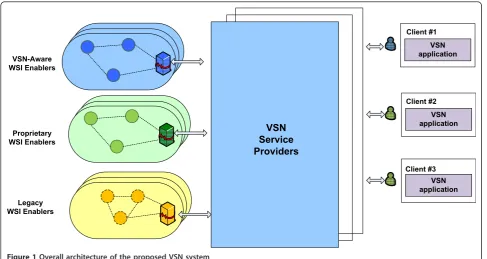
The VSN Service providers (VSPs) are the actors offering the VSN services to the Users. The main opera-tions of a VSP are to publish, negotiate, provision, and monitor the execution of services. A VSP may be a WSI Enabler itself, utilize open-access WSIs, or may have established permanent or negotiate on-demand service contracts with one or more WSI Enablers. The VSP may provide to the user the services of the WSI Enablers (acting in this case like a service reseller) but may also provide enhanced (or even customized) ser-vices composed from service parts provided by different WSI Enablers. In either case, semantically rich descrip-tions of the services can be used to facilitate service classification and searching. Depending on the business model, open access, restricted, or premium application services may be offered to different types of users.
The Users are the actors that negotiate and exploit the VSN services, potentially under a Service Level Agree-ment with the VSP. A user may have a permanent or on-demand service contract with one or more VSPs.
It is noted that the VSN business model is not con-strained to that depicted in Figure 1. In fact, the busi-ness model can support a fully cascading architecture (Figure 2), where a VSN application may utilize a hierar-chy of n tiers of VSN Service Providers along with external third-party Service Providers. Various VSN ser-vice providers may also establish permanent contracts, or negotiate them on demand, with WSI Enablers, or
other VSN service providers (in a collaborative fashion) or even with third-party service providers.
3.3. Service provisioning
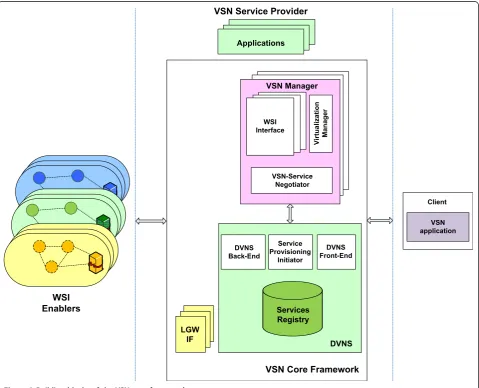
The proposed architecture for service provisioning is shown in Figure 3. Each VSN Service Provider offers a number of applications through a VSN Core framework that consists of one Dynamic Virtual Network Server (DVNS), a number of instanced VSN Managers and may also host some Legacy Gateway Interworking Func-tions (LGW IF). In brief, the DVNS is responsible for discovering/registering and publishing VSN services to the end users and initiate service provisioning. The VSN Manager is responsible for service negotiation, session establishment, and monitoring, while the LGW IF enables the interaction with legacy WSIs.
The core part of the DVNS is the Services Registry. This is a database where all the known/registered WSI Enablers and the VSN services, which are known to this VSN service provider, are listed and described. In addi-tion to the service name, ID, and descripaddi-tion, the Ser-vice Registry has knowledge of the WSI Enabler(s) that offer the services, their gateways, etc., and in particular knows which Gateway(s) is/are responsible for each ser-vice. The VSN services may be composed from several
“more elementary” services (hereafter called “abstract services”) according, for example, to some pre-defined composition rule. Abstract services are described through a number of inputs, outputs, and parameters. An example of such a service is one that passively Proprietary
WSI Enablers
VSN application Client #1
VSN application Client #2
VSN application Client #3 VSN
Service Providers VSN-Aware
WSI Enablers
Legacy WSI Enablers
collects measurements of sensing capabilities in a selec-tion of areas. For this service, the parameters may corre-spond to the set of desired sensing capabilities and areas of interest, the type of the data aggregation function
(minimum, maximum, average, etc), the QoS require-ments (e.g., tolerated time for a response, accepted per-centage of estimated error), the type of reporting pattern (periodic or one-shot) and associated
VSN application VSN Service
Provider (Tier 0)
VSN Service Provider
(Tier n)
….
Client
3rdParty
Service Providers WSI
Enablers
Figure 2The VSN cascading architecture.
VSN application
Client
WSI Enablers
DVNS
VSN Core Framework
Services Registry DVNS
Back-End
DVNS Front-End
LGW IF
VSN Service Provider
Applications
Service Provisioning
Initiator VSN Manager
VSN-Service Negotiator WSI Interface
Virtualization Manager
measurement thresholds, and the unit of measurement. The input in this service is the sensor observations and the outputs can be the raw and processed sensor data, as well as the history of the sensor data.
The additional DVNS components support the Ser-vices Registry functionality in the following manner. The DVNS Back-End component is responsible for updating the Services Registry on a periodic or on-demand basis. In particular, using crawling techniques the DVNS Back-End queries all the known/registered WSI Enablers in order to discover new services or remove services that are not offered any more. It may also enable colla-boration between DVNSs hosted by different service providers in case a contract is established. In addition, the WSI Enablers and/or the offered services may directly be registered to the Services Registry via the DVNS Back-End component. The main functionality of the DVNS Back-End is to register/discover new WSI Enablers, performing crawling of known/registered WSIs for new operational and supporting services and imple-menting ontology-based representations of services’ description. The discovered or registered VSN services are then published by the DVNS Front-End to the VSN end-users/subscribers. The DVNS Front-End is also used for querying and retrieving VSN services based on end-user criteria. The main functionality of the DVNS Front-End includes publishing of VSN services in a transparent way to the end-user applications, processing of user queries and translation to VSN services and interactive ontology navigation features.
As soon as a VSN service has been preliminary quali-fied by the end-user, the Service Provisioning Initiator component is invoked to authenticate the user and check the user permissions. Then, it initiates a VSN Manager instance. In more detail, the Service Provision-ing Initiator will contain a user database with the needed information in order to check user access rights and authentication privileges, get the user’s contracts service level agreements, obtain from the services regis-try all necessary information and initiate a VSN Man-ager instance.
The VSN Manager, responsible for service negotiation, session establishment, and monitoring, may also per-form service renegotiation and accounting/billing of the VSN services. It consists of the following subcompo-nents: the VSN Service Negotiator, the Virtualization Manager, and the WSI Interface. As it shown in Figure 3, the interface between the VSN Manager and the DVNS is implemented by the VSN Service Negotiator. This component receives from the DVNS (Service Provi-sioning Initiator) all necessary information in order to negotiate and establish a new VSN service. This infor-mation includes a list with the operational service(s) requested by the user, the WSI Enablers that offer such
operational service(s), the WSI entry points that are responsible for the relevant operational and supporting services, etc. The VSN Service Negotiator queries all WSI and gets up-to-date knowledge of the relevant operational and supporting services, along with the rele-vant WSI capacity to support a new instance of the operational service (i.e., the WSI available resources). Based on this information and additional non-functional information (e.g., user profile, access permissions, con-tracts, prices, etc.), the VSN Negotiator will negotiate with the user application the VSN service provisioning. In this phase, the user may refine his/her requirements and negotiate the VSN service establishment.
If the service negotiation is not successful, the session is closed and the VSN Manager instance is dissolved. Otherwise, the Virtualization Manager is invoked. At contract start-up, the Virtualization Manager communi-cates with the various known/registered WSIs and requests the allocation of the necessary resources. This module is also responsible for hiding from the end-user application the actual WSI sensor nodes and the real service(s) (which may run in multiple WSIs), and offer the VSN service in a transparent way, appearing as a single operational service of the VSN service provider. Each WSI Interface is a logical process that is responsi-ble for interfacing the WSI and hides any specificities of the WSI.
At run time, and based on the Contract Service Level Agreement, the Virtualization Manager may communi-cate with the WSIs that offer the requested operational services and check the session status/quality. Addition-ally, the WSI Interfaces may inform the Virtualization Manager if an error has been reported or trapped. In case of failure to meet the negotiated contract, the Vir-tualization Manager will communicate with the VSN Service Negotiator. The Negotiator will initially try to adopt countermeasures by negotiating with the WSI Enablers, a new session establishment. If anomalies can-not be compensated and the Service Level Agreement is broken, the Negotiator may try to re-negotiate with the end-user application or close the connection with an error message.
applications to the end-users, collaborating with VSN service providers or third-party service providers. These applications are customized to each VSN service provi-ders and form the Service Provider’s portfolio offering.
4. Wireless sensor islands
A WSI consists of at least one sensor node (normally a group of sensor nodes) and one gateway (acting as the WSI entry point). Collocation of their functionality is not excluded in case of autonomous addressable sensor nodes. If the gateway is mobile, IP radio access should be provided in a transparent way by the network infra-structure (see, e.g., [37]).
Within a VSN, the following three types of WSIs are considered (Figure 4):
•VSN-aware WSI: These are WSIs, which consist of VSN-aware Sensor Nodes (VaSN) and a VGW. It is assumed that within a VSN-aware WSI each node (sensor or gateway) is VSN-aware and has knowl-edge of the VSN service offerings. As it is shown in Figure 4, each VaSN may instantiate one or more virtual sensor nodes in the process of sharing its resources across multiple VSNs.
•Proprietary WSI: These are WSIs, which consist of Proprietary Sensor Nodes (PSNs) interconnected via a Proprietary Gateway. Due to the complexity that they might inherit, in order to guarantee intercon-nection with the VSN network architecture, we assume that the proprietary gateway offers a VSN-compliant interface, so it is considered as VGW.
• Legacy WSI: These are WSIs, which consist of Legacy Sensor Nodes (LSNs) interconnected via a Legacy Gateway (LGW). We assume that within a Legacy WSI, in order to offer interconnection with the VSN network architecture, an entity outside the WSI should offer a LGW IF. This interworking function should be offered either by the WSI Enabler or by a service provider. Alternatively, each VSN Service Provider should implement instantia-tions of VGW as interconnection funcinstantia-tions for LGW.
In the following, we focus on the VSN-aware WSI as we assume that the other WSI types may appear as VSN-aware WSI with limited functionality.
4.1. Gateway architecture
The VGW is the device in charge of bridging between one VSN-aware WSI and the VSN Service Provider. It handles the bridging in terms of“lower layer” communi-cation protocols (e.g., Medium Access Protocol, IPv4/ IPv6, routing protocol), and protocols for upper layers (e.g., middleware, application). The VGW manages the discovery of operational and supporting services, as well as available resources, within the WSI. If required, the VGW notifies VSN Service Provider(s) about the avail-able services and resources.
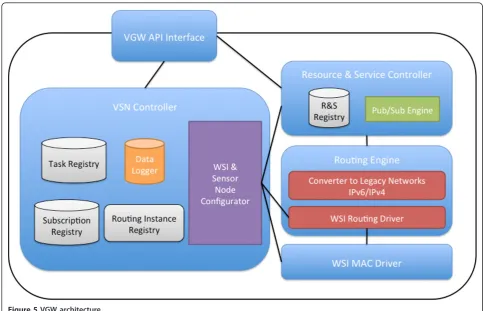
A functional view of the VGW is shown in Figure 5, and its main components are described next:
•VGW API Interface: this is an interface used by any external component to instantiate a VSN configura-tion within the WSI, retrieve the list of available resources/services, retrieve a history of data, or exe-cute an action onto a specific node.
•VSN controller: This module receives the instruc-tions to configure, within the WSI, all aspects related to the enforcement of VSNs for supporting VSN ser-vices. It maintains various registries including a reg-istry of the subscriptions per VSN to a set of operational and supporting services provided by the WSI, a registry of tasks that are deployable on the sensor nodes involved in the operation of a VSN, a data logger that maintains a history of the data pub-lished by nodes involved in an enforced VSN (e.g., measurements, alarms, etc.) and a registry of the routing instances configured in the WSI. The VSN controller embeds a component named WSI and Sensor Node Configurator to configure the function-ing of individual sensor nodes or networkfunction-ing proto-cols at the scale of the WSI. When receiving the configuration instructions to instantiate a VSN, this configuration component interacts with: the Routing Engine (e.g., an RPL driver, in order to run an
Proprietary WSI
VSN-Aware WSI Legacy WSI
VGW LGW
VaSN
PSN PSN
PSN
LSN
LSN
LSN VaSN
VGW
VaSN
additional instance of the RPL protocol [38]), the WSI MAC Driver module, in order to instantiate a specific MAC scheduling and the Resource and Ser-vice controller, in order to subscribe to specific pub-lishing services and manage the resources.
• Resource and Service Controller: This module negotiates with the VSN Service Provider and keeps a registry of all available operational and supporting services and the status of all WSI available resources. It uses a scalable publish/subscribe engine in order to handle published events and inform the VSN Manager about the subscribed services and the allo-cated resources status, as well as pushing actions to specific nodes.
•Routing Engine: it receives from the VSN controller the instructions to configure one or more routing instances (e.g., multiple RPL Destination-Oriented Directed Acyclic Graph instances), with one or many VSN applications per routing instance. This engine includes a WSI Routing Driver which is in charge of handling the operation of the WSI routing protocol (s), and handling for each protocol, the possibly mul-tiple instances of routing plane. In addition, the engine encompasses a routing converter which is in charge of converting received packets from the WSI
into the appropriate format to be sent over the legacy network.
4.2. Sensor node architecture
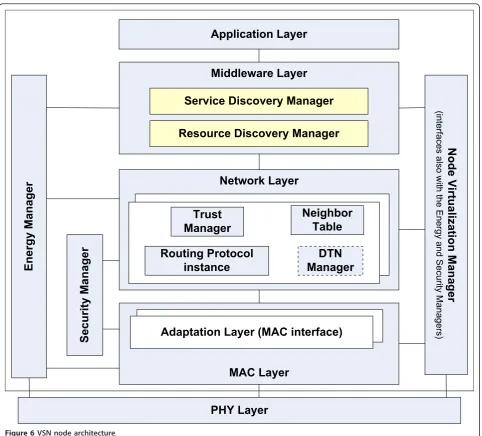
The functional architecture of a VSN sensor node is described in terms of its protocol stack as shown in Fig-ure 6. In this architectFig-ure, virtualization is realized through efficient management of (a) node’s services and resources and (b) functions at the network and MAC layers. Furthermore, the virtualization is done in a way that takes into account availability of security features and requirements for energy consumption.
NVM also maintains an association between the QoS requirements imposed on the delivery of the different services (e.g., in terms of reliability, delay, and trust) and maps different service and resource requests to different processes, routing instances, and configurable MAC pro-tocol parameters. Furthermore, it can enable the Delay-Tolerant Networking (DTN) Manager when the applica-tion serviced by a VSN is delay-tolerant. In addiapplica-tion, the NVM interacts with components at middleware layer to store/update the services offered by the sensor node in a dynamic way (e.g., after the completion of a reconfigura-tion query from VGW).
The role of the middleware layer is twofold: first, to pro-vide an abstracted and standard view of supported opera-tional services (in particular, separated from the
functioning of sensor hardware), and second to enable ser-vice and resource discovery management within a WSI. As such, the VSN middleware hides the hardware and software implementation details from the application layer and allows seamless data management between nodes. Additionally, it encompasses mechanisms to enable man-agement of the discovery of services and resources within the WSI and provides, through specific services, the cap-ability for re-purposing existing sensor network deploy-ments and creating VSNs, according to user needs. Regarding the middleware realization, we are currently elaborating on a solution based on the emerging CoAP application protocol [35] running on top of UDP.
In what regards the functions of the network layer, main focus is placed on the RPL routing protocol [38]
MAC Layer
Network Layer
Middleware Layer
Service Discovery Manager
Resource Discovery Manager
Application Layer
PHY Layer
Node
Virtualization
Manager
(interfaces
also
with
the
Energy
and
Security
Managers)
Energy
Manager
Adaptation Layer (MAC interface)
Trust
Manager
Routing Protocol
instance
Neighbor
Table
DTN
Manager
Security
Manager
as it represents a promising solution for supporting vir-tualization through the realization of multiple coexistent routing instances. Each one of these instances may have a Neighbor Table component, which will be maintained in this layer to facilitate the routing/forwarding process. In this respect, the selection of proper routing metrics to accommodate different and sometimes contradicting requirements set by different applications, in such a way that consistency, optimality, and loop-freeness routing requirements are met, is an open research topic that we are currently working on.
Tackling with security-related characteristics, the pro-posed routing solution will specify trust metrics that will be able to investigate and exclude malicious nodes from the traversed path to the destination node (VGW). The attacks that a trust management system can detect depend on the number and type of node behavior aspects that are monitored [39] and range from network up to application layer attacks (data inconsistency). Trading off hardware resource requirements for the rea-lization of the trust system and mitigation of the most probable attacks, the VSN trust system will be capable of detecting the black-hole, selective forwarding, denial of routing service, and selfish behavior attack. All these attacks lead to data loss which (when systematic) lead to loss of connectivity.
Furthermore, the trust-aware routing protocol will make use of possible security services offered by the Security Manager (e.g., encryption in the MAC or net-work layers) in order to select the optimal (QoS-based) path, according to the user request. Given that encryp-tion aims to ensure data confidentiality, privacy, data integrity and authenticity, and a variety of encryption schemes can be realized, different security levels can be defined. The encryption scheme implemented on a node and/or the offered security level can be used to decide whether the node can be included in a specific routing instance satisfying the application requirements. In this way, the availability of security features represents con-straints taken into account by the routing component during the creation of the routing tables. All informa-tion related to trust management will be stored and pro-cessed by a certain component, called Trust Manager. Through the discrimination between nodes supporting security services and through the implementation of a trust management system, the proposed VSN defends against network layer attacks and data confidentiality, integrity, and authentication attacks.
In case there is a lack of continuous network connec-tivity and the running applications can tolerate delays, the presented VSN approach may optionally make use of a DTN mechanism. This mechanism is handled by the DTN Manager, which closely collaborates with a specific routing protocol instance and takes care of
communication when a disconnection in the network cannot be repaired by the routing protocol’s mainte-nance mechanisms.
In the VSN case, DTN is used when a formerly con-nected WSI, becomes disconcon-nected for a long period of time, and therefore partitioned in a number of smaller WSIs. DTN basically relies on some nodes’mobility in order to deliver data among these WSIs and establish end-to-end communication. The DTN mechanism can be activated when the routing protocol (specifically, the component of the protocol that is responsible for neigh-bor discovery) detects disconnection in the network which cannot be repaired by the protocol’s mechanisms. Also, upon detection of the re-establishment of connec-tivity, the network layer can deactivate the DTN Manager.
According to the specific DTN protocol used, the DTN Manager can include functionalities, such as node addressing, buffering, queue management policies, metric calculations for probabilistic delivery rate, etc. These functionalities and buffers can be assumed as being internal to the DTN Manager, but some struc-tures can be shared with the routing protocol (for instance a neighbor discovery process and the neighbor table).
To support the concept of virtualization, different MAC layers may be instantiated in a wide variety of applications. Apart from the MAC layer responsibility to manage transmission of packets from the upper layers across the physical wireless channel to a neigh-boring node, an interface to Energy Manager is fore-seen in order for the MAC layer to manage issues related to RF energy (e.g., transmission power and sleep times). Multiple instantiations of the MAC Adap-tation Layer will act as an interface to upper layers (network layer) and cross-layer entities (Energy Man-ager and NVM) to tune MAC layer parameters (e.g., to instantiate different time/frequency scheduling pat-terns). In the proposed node architecture, the chal-lenge at MAC is to support different hardware owners and for each different applications. For example, in subsequent developments related to the emerging IEEE 802.15.4e, this is solved by having different super-frames with different duty cycles running in parallel. Other link layer technologies, such as IEEE 802.15.4-2003/2006, would need to handle such virtualization challenge sequentially and thus, not to be depleted quickly, need to be highly energy efficient.
prolong network lifetime, or even achieve load balancing.
5. Interfaces between system components
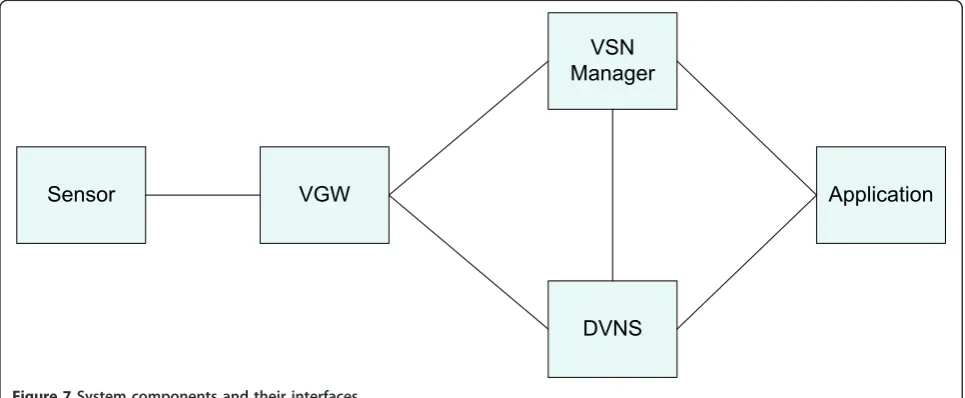
The interactions between the system components, namely the VSN application, the DVNS, the VSN Man-ager, the VGW, and the sensor node, are realized through the interfaces depicted in Figure 7. Prior to describing the main operations that are executed over these interfaces we briefly discuss the phases of the application’s lifetime in order to depict in a more clear way the interactions involved between components.
The lifetime of VSN applications is divided in three phases:
•Creation: During this phase, the user and the VSP negotiate and agree a “service contract”. In this phase, the user describes to the VSP a desired ser-vice, and the VSP proposes its possible implementa-tion based on the availability of VSN resources. This interactive cycle is repeated through successive adjustments of the description of the desired ser-vices, proceeding towards a more and more detailed qualification of the desired services and how it will be provided. At the end of this interactive negotia-tion, the user and the VSP agree on a detailed description of the application and of the conditions under which it is to be provided. When this agree-ment is reached, the creation phase is over and the service can begin.
•Execution: During this second phase, the VSN pro-vides the service requested, and the application con-sumes it. The execution of the service is taken care of by the network, automatically and transparently to the user. This phase can be very short (execution of a query and immediate return of the query result) or can
be long lasting; in any case, while the service is being executed the VSN Manager takes care of its execution.
•Termination: The end criteria for a service can be implicit in the service requested (this is the case, for instance, when the service is the execution of a sin-gle, immediate query), or the service can explicitly be terminated by the application (this typically hap-pens for long-lasting services). Termination condi-tions may also be agreed at service negotiation (e.g.,
“for one day”, or“until this predicate becomes true”).
5.1. Interface between application and DVNS
The DVNS is the first contact point between the applica-tions and the VSN system. The applicaapplica-tions may run either at the end-user’s machine or be hosted by the VSP. In either case, functions provided by this interface are used during the application initiation/creation and preli-minary service negotiation phase. The application uses the following functions which are provided by the DVNS:
•Authenticate_User: This is used at the beginning of the application creation phase in order for the user to request authentication.
•Browse_Services: the application uses this function repeatedly, to qualify in growing detail the desired service.
• Start_Negotiation: this is a request sent by the application in order to declare that it wishes to pro-ceed with negotiation for a specified service offered by the system.
5.2. Interface between DVNS and VSN manager
As soon as the nature of the service has been clarified and the user application has declared to the DVNS its intention to proceed with service negotiation, the DVNS
Sensor
VGW
VSN
Manager
DVNS
Application
spawns a new instance of the VSN Manager to handle the service negotiation and provisioning. This task is supported by the Create_Instance function of the DVNS-VSN Manager interface.
5.3. Interface between application and VSN manager This interface is used for service negotiation and initia-tion between the applicainitia-tion and the VSN Manager and for data delivery from the VSN Manager to the applica-tion. When the negotiation phase is complete, the user is aware of the current status of the requested services described as up-to-date operational services. The follow-ing functions are supported over this interface:
•Negotiate_Service: It is used by user/application to negotiate service provisioning with the VSP. This function is also used for service renegotiation in case changes to the service parameters are requested by the application (e.g., extension of the planned duration, modification of the geographical scope of the service, change of the data gathering rate, etc.). It is also used to terminate a service explicitly.
•Initiate_Service: This function is used by the Appli-cation after successful negotiation with the VSN Manager to denote intention for service execution.
•Retrieve_Service_Data: It is used by the application to ask for data in a synchronous manner (i.e., on a request/response basis) according to the specified service.
• Publish_Data: It is used by the VSN Manager to feed the application with the data that it has requested. This is particularly important for appli-cations whose primary purpose is data gathering. However, this function is also used for other types of applications because it is through the Publish_-Data function that the VSN Manager is able to communicate to the application relevant events like, for example, the inability to accomplish the required service.
5.4. Interface between DVNS and VGW
Using this interface, the DVNS retrieves the list of ser-vices offered by the WSI under the VGW’s control. In addition, this interface is used by the VGW to notify the DVNS of services updates and to allow for registration of a WSI with the DVNS. The following functions are provided by this interface:
• Publish_Services: When invoking it, the DVNS queries all known/registered VGWs for discovering new services, removing services not offered anymore
or updating changes in the services provided by WSIs.
•Update_Services: The DVNS provides this func-tion in order to allow a VGW to asynchronously update the list of WSI supplied services. The func-tion can be invoked on a periodic or on-demand basis.
•Update_WSI: This provides the capability for new WSIs accessible by the service provider to be regis-tered in the Services Registry (part of the DVNS) so that applications can access them.
5.5. Interface between VSN manager and VGW
This interface allows the VSN Manager to retrieve the current status of a WSI regarding its available services and resources and to request service initiation. It is also used by the VGW to update its status and provide requested data to the VSN Manager. The functions of this interface include the following:
•Update_Status: The VGW provides this function to allow the VSN Manager to get an up-to-date view of the available operational services and resources at the involved WSI. Based on the VGW response, the VSN Manager can provide to the application further feedback to be used in the negotiation phase (e.g., for service parameter reconfiguration).
•Initiate_WSI_Service: This function is used by the VSN Manager to communicate to the VGW requests for service initiation. Execution of this func-tion involves the enforcement of a VSN at the WSI level.
•Publish_WSI_Data: This function is used by the VGW to export data published by sensor nodes to the appropriate VSN Manager.
•Retrieve_Service_Data: It is used to support data retrieval from the VGW on a request/response fashion.
•Update_WSI_Status: This is used by the VGW to communicate to the VSN Manager changes in the status of the corresponding WSI supplied services and resources.
5.6. Interface between VGW and sensor node
communication models. The functions of this interface include the following:
• Get_Supported_Services. This function is used by the VGW to query the services supported by the sensor node.
• Get_Available_Resources: The function is used by the VGW to retrieve the list of resources provided by a sensor node.
•Retrieve_Service_Data: This is used by the VGW to trigger data collection from sensor nodes in a syn-chronous manner.
• Subscribe: The VGW uses this function to send requests for subscription to particular services of a sensor node. The requests can be sent in a unicast or broadcast fashion depending on the user query. The subscription request is expressed through a con-junction of constraints over attribute values, in a form of a tuple (attribute, operator, value).
•Rcv_reconfiguration: Reconfiguration of basic func-tionalities such as scheduling schemes or routing algorithms is handled through this function. Besides the basic reconfiguration of certain parameters deal-ing with the communication protocols (e.g., MAC duty cycle), this function also deals with the reconfi-guration of supporting services and resources (e.g., reconfiguration of the sampling rate for the sensed attribute).
• Get_Status: This is used by the VGW to get cur-rent information on usage associated to a service or to the consumption of resources. Resource informa-tion may include, among others, the number of instances that a sensor node participates in (either as a router or as a sensing device) or memory/proces-sor allocation.
•Rcv_notification. When the constraints of the sub-scription to a service are satisfied, the VGW receives, through this function, a notification from the sensor node. The notification is of the form (attribute, value).
• Notify_supported_services: Using this function a sensor node can proactively notify the VGW about its supported services.
•Notify_available_resources. This is used by a sensor node to communicate to the VGW, in a proactively manner, its available resources.
6. Service registration, service negotiation, and session establishment
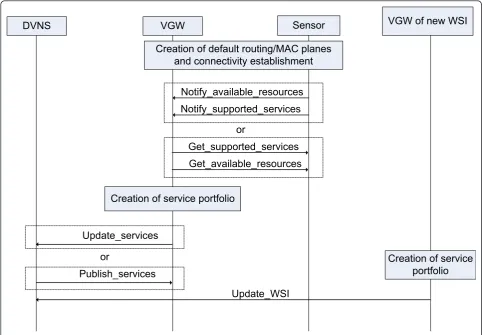
The registration of the services in the VSP involves two steps (Figure 8). In the first step, the services of all WSIs that have a service agreement with the VSP are discovered by their respective VGW. To accomplish
this, the VGW collects information related to services provided by all sensors comprising the WSI, as well as their available resources.
Prior to any service and resource discovery, a path between the VGW and every sensor node has to be established. To do this, the VGW configures the opera-tion of the MAC layer as well as the operaopera-tion of the routing protocol within the WSI, which deals with the creation of multiple instances of routing planes (e.g., several RPL Destination Oriented Directed Acyclic Graphs, with different metrics per RPL instance). By using theGet_supported_services and Get_available_re-sourcesfunctions, the VGW can collect (and periodically update) all services/resources available to the sensor nodes in order to support (new or existing) user queries. Another option consists in sensor nodes announcing proactively their provided services/resources to the VGW, using theNotify_supported_servicesand Notify_a-vailable_resourcesfunctions.
In the second step, the collected services and resources are sent to the DVNS by calling the Upda-te_WSI(in case of new WSIs) andUpdate_services func-tions, or can be browsed (possibly in a periodic fashion) by the DVNS via the Publish_servicesfunction. All dis-covered services are stored in the Services Registry mod-ule of the DVNS.
At the beginning of the application creation phase, and prior to service consumption, the user interacts with the DVNS to negotiate the provided service (Figure 9). The first operation is to qualify himself/herself, by using theAuthenticate_User function. After doing that, the user becomes aware of the available services by call-ing (possibly in a repeatable fashion) theBrowse_Services function. As soon as the desired service has been identi-fied, the user’s application notifies the DVNS of the intention to negotiate the implementation details of the service (QoS, guaranteed level of services, billing, fall-back policies, etc.) by sending the Start_Negotiation message. The service negotiation and the subsequent service delivery processes are handled by an instance of the VSN Manager, which is created for this purpose by the DVNS through the execution of theCreate_Instance function. To serve negotiation requests, the VSN Man-ager interacts with the involved VGWs, by calling the Update_Status function, to retrieve the list of available WSI services and resources. The VGW will, in turn, communicate with the sensor nodes, using the Get_Sta-tus function, to obtain an updated view of the available services and resources at the node level.
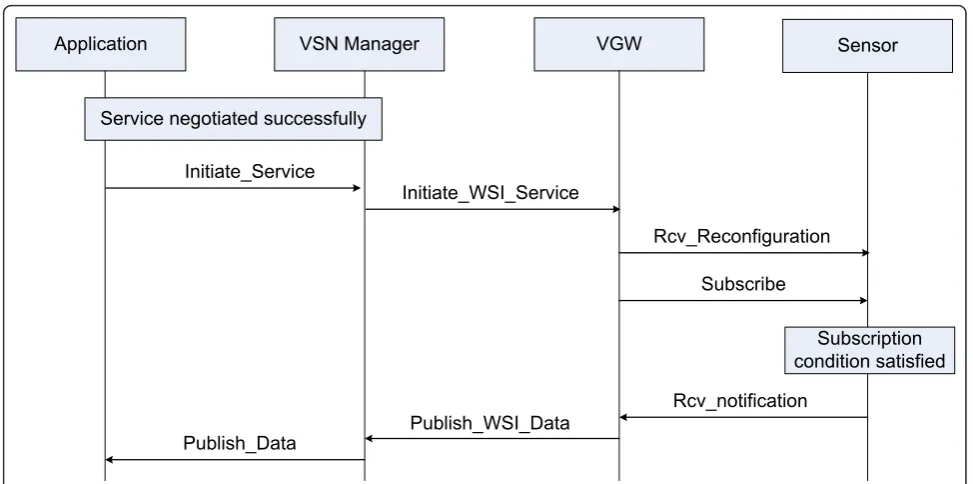
the provisioning of the service and contacts its(their) VGW(s) through theInitiate_WSI_Servicefunction call. This function is used to:
• Specify the number of nodes to be used for the provisioning of the service (e.g., exact, maximum or minimum number of nodes).
•Specify the operational services to be subscribed on the selected nodes.
•Specify the parameters that must be communicated to the WSI Routing Driver of the VGW.
The VGW uses the Rcv_Reconfiguration function to enforce/configure a VSN on the WSI and theSubcribe
DVNS VGW Sensor
Notify_available_resources Notify_supported_services Creation of default routing/MAC planes
and connectivity establishment
or
Get_supported_services Get_available_resources
Update_services
or
Publish_services
Update_WSI
VGW of new WSI
Creation of service portfolio
Creation of service portfolio
Figure 8Message sequence chart for service registration in the VSP.
Application DVNS VSN Manager VGW
Authenticate_User Browse_Services
Browse_Services...
Start_Negotiation
Create_Instance
Negotiate_Service Update_Status
Sensor
Get_Status
function to register itself as a recipient for data pro-duced by the sensor when the condition of the subscrip-tion is satisfied. These data are communicated back to the VGW through the Rcv_notification function. In order to export data published by sensor nodes towards the appropriate VSN Manager instance, the VGW uses the functionPublish_WSI_data.
Figure 10 illustrates the sequence of messages involved in sensor data delivery based on the publish/subscribe communication paradigm. For service execution on a request/response basis the Application sends a Retrie-ve_Service_Datarequest to the VSN Manager. In case cached data are available, the VSN Manager may return the requested data immediately; otherwise, the Retrie-ve_Service_Datais sent all the way to the sensor node.
7. Conclusions and future study
We have presented the system architecture of a VSN system that extends the concept of virtualization down to the sensor nodes while ensuring advanced perfor-mance and service exploitation. The global virtualization architecture is built around (a) software components that allow user applications to negotiate, execute, and monitor a service obtained by composing basic services provided by sensors, and (b) the architectural design of the physical aware sensor node and the VSN-aware gateway. The proposed architecture accommo-dates the flexibility and adaptability required to achieve an energy-efficient realization of VSNs mainly through the definition of both horizontal and vertical functional layers in the sensor node that allow for different
instantiations of the MAC and routing protocols to sup-port the concept of virtualization and provide efficient support to different VSN applications that may run on the node.
Currently, we have developed simulation models for the MAC and trusted routing components and complete software designs for all parts of the proposed VSN pro-visioning system. The simulation study has produced promising results regarding the capability of the pro-posed link and routing layer solutions to (a) support the virtualization concepts described in this article, and (b) accommodate applications with diverse communication requirements in terms of delay and trust. Future study will address the implementation of all system compo-nents, the development of testbeds that will federate resources from heterogeneous sensor network platforms, and the experimental evaluation of the proposed solutions.
Abbreviations
DTN: Delay-Tolerant Networking; DVNS: Dynamic Virtual Network Server; LGW IF: Legacy Gateway Interworking Functions; LGW: Legacy Gateway; LSN: Legacy Sensor Node; M2M: Machine-to-Machine; MAC: Medium Access Control; NVM: Node Virtualization Manager; OS: Operating System; PGW: Proprietary Gateway; PSN: Proprietary Sensor Node; QoS: Quality of Service; VaSN: VSN-aware Sensor Node; VGW: VSN Gateway; VSN: Virtual Sensor Network; VSP: VSN Service Provider; WSI: Wireless Sensor Island; WSN: Wireless Sensor Network.
Acknowledgements
This publication is based on work performed in the framework of the Project VITRO-257245, which is partially funded by the European Community. The authors would like to acknowledge the contributions to the VITRO Project of colleagues from Hellenic Aerospace Industry, Thales
Application VSN Manager VGW Sensor
Service negotiated successfully
Initiate_Service
Initiate_WSI_Service
Rcv_Reconfiguration
Subscribe
Rcv_notification Publish_WSI_Data
Publish_Data
Subscription condition satisfied
Communications SA, Telefonica Investigation Y Desarrollo SA, Centre Technologic de Telecomunicacions de Catalunya, Research Academic Computer Technology Institute, Technological Educational Institute of Chalkida, Zodianet SAS, Wlab SRL, and SELEX Sistemi Integrati S.P.A. Author details
1
Technological Educational Institute of Chalkida, 34400 Psachna, Euboea, Greece2Centre Tecnològic de Telecomunicacions de Catalunya (CTTC), Av. Carl Friedrich Gauss 7, 08860 Castelldefels, Barcelona, Spain
Competing interests
The authors declare that they have no competing interests.
Received: 1 October 2011 Accepted: 6 April 2012 Published: 6 April 2012
References
1. AP Jayasumana, Q Han, TH Illangasekare, Virtual sensor networks - a resource efficient approach for concurrent applications, inProceedings of the International Conference on Information Technology (ITNG‘07), Washington, DC, USA, pp. 111–115 (2007)
2. R Tynan, GMP O’Hare, MJ O’Grady, C Muldoon, Virtual sensor networks: an embedded agent approach, inProceedings of the International Symposium on Parallel and Distributed Processing with Applications (ISPA-08), Sydney, Australia, pp. 926–932 (Dec 2008)
3. NMMK Chowdhury, R Boutaba, A survey of network virtualization. Comput Netw.54(5), 862–876 (2010). doi:10.1016/j.comnet.2009.10.017
4. The VITRO project http://www.vitro-fp7.eu. Accessed 1 Feb 2012 5. P Levis, S Madden, J Polastre, R Szewczyk, K Whitehouse, A Woo, D Gay, J
Hill, M Welsh, E Brewer, D Culler, TinyOS: an operating system for sensor networks, inAmbient Intelligence, ed. by Weber W, Rabaey J, Aarts E (Springer, 2005), pp. 115–148
6. A Dunkels, B Gronvall, T Voigt, Contiki–a lightweight and flexible operating system for tiny networked sensors, inProceedings of the 29th Annual IEEE International Conference on Local Computer Networks (LCN‘04), Washington, DC, USA, pp. 455–462 (2004)
7. S Bhatti, J Carlson, H Dai, J Deng, J Rose, A Sheth, B Shucker, C Gruenwald, A Torgerson, R Han, MANTIS OS: an embedded multithreaded operating system for wireless micro sensor platforms. Mob Netw Appl.10(4), 563–579 (2005). doi:10.1007/s11036-005-1567-8
8. E Trumpler, R Han, A systematic framework for evolving TinyOS, in
Proceedings of the 3rd Workshop on Embedded Networked Sensors (EmNets 2006), Cambridge, MA, USA, pp. 61–65 (May 2006)
9. P Corsini, P Masci, A Vecchio, Configuration and tuning of sensor network applications through virtual sensors, inProceedings of the 4th Annual IEEE International Conference on Pervasive Computing and Communications Workshops (PERCOMW’06), Pisa, Italy, pp. 316–320 (13-17 March 2006) 10. L Caroprese, C Comito, D Talia, E Zumpano, A logic approach to virtual
sensor networks, inProceedings of the Fourteenth International Database Engineering & Applications Symposium (IDEAS‘10), Montreal, Quebec, Canada, pp. 149–156 (2010)
11. HMND Bandara, AP Jayasumana, TH Illangasekare, Cluster tree based self organization of virtual sensor networks, inProceedings of the IEEE Globecom Workshops, New Orleans, USA, pp. 1–6 (November 2008)
12. P Levis, D Culler, Maté: a tiny virtual machine for sensor networks, in
Proceedings of the 10th International Conference on Architectural Support for Programming Languages and Operating Systems (ASPLOS-X), San Jose, CA, USA, pp. 85–95 (October 2002)
13. P Levis, D Gay, D Culler, Active sensor networks, inProceedings of the 2nd USENIX/ACM Symposium on Networked Systems Design and Implementation (NSDI’05), Boston, MA, USA, pp. 343–356 (May 2005)
14. Y Yu, LJ Rittle, V Bhandari, JB Lebrun, Supporting concurrent applications in wireless sensor networks, inProceedings of the 4th International Conference on Embedded Networked Sensor Systems (SenSys’06), Boulder, Colorado, USA, pp. 139–152 (2006)
15. J Koshy, R Pandey, VMSTAR: synthesizing scalable runtime environments for sensor networks, inProceedings of the 3rd International Conference on Embedded Networked Sensor Systems (SenSys’05), San Diego, California, USA, pp. 243–254 (2005)
16. P Bonnet, JE Gehrke, P Seshadri, Towards sensor database systems, in2nd International Conference on Mobile Data Management (MDM) LNCS, vol. 1987. Springer, pp. 3–14 (2001)
17. S Madden, MJ Franklin, JM Hellerstein, W Hong, TinyDB: an acquisitional query processing system for sensor networks. ACM Trans Database Syst. 30(1), 122–173 (2005). doi:10.1145/1061318.1061322
18. K Aberer, M Hauswirth, A Salehi, The global sensor networks middleware for efficient and flexible deployment and interconnection of sensor networks. Technical Report, Ecole Polytechnique Federale de Lausanne (EPFL) (2006)
19. D Gelernter, Generative communication in Linda. ACM Comput Surv.7(1), 80–112 (1985)
20. C Curino, M Giani, M Giorgetta, A Giusti, AL Murphy, GP Picco, TinyLIME: bridging mobile and sensor networks through middleware, inProceedings of the 3rd IEEE International Conference on Pervasive Computing and Communications (PerCom 2005), Kauai, Hawaii, pp. 61–72 (March 2005) 21. K Terfloth, G Wittenburg, J Schiller, FACTS–a rule-based middleware
architecture for wireless sensor networks, inProceedings of the First International Conference on Communication System Software and Middleware (Comsware 2006), New Delhi, India, pp. 1–8 (January 2006)
22. E Souto, G Guimarães, G Vasconcelos, M Vieira, N Rosa, C Ferraz, J Kelner, Mires: a publish/subscribe middleware for sensor networks. Personal Ubiquit Comput.10(1), 37–44 (2006). doi:10.1007/s00779-005-0038-3
23. S Lai, J Cao, Y Zheng, PSWare: a publish/subscribe middleware supporting composite event in wireless sensor network, inProceedings of the IEEE International Conference on Pervasive Computing and Communications (PerCom 2009), Galveston, TX, USA, pp. 1–6 (March 2009)
24. T Liu, M Martonosi, Impala: a middleware system for managing autonomic, parallel sensor systems, inProceedings of the 9th ACM SIGPLAN symposium on Principles and Practice of Parallel Programming (PPoPP’03), San Diego, California, USA, pp. 107–118 (2003)
25. F Oldewurtel, J Riihijarvi, K Rerkrai, P Mahonen, The RUNES architecture for reconfigurable embedded and sensor networks, inProceedings of the Third International Conference on Sensor Technologies and Applications (SENSORCOMM’09), Athens, Greece, pp. 109–116 (June 2009)
26. PJD Cid, D Hughes, J Ueyama, S Michiels, W Joosen, DARMA: adaptable service and resource management for wireless sensor networks, in
Proceedings of the 4th International Workshop on Middleware Tools, Services and Run-Time Support for Sensor Networks (MidSens‘09), Urbana Champaign, Illinois, USA, pp. 1–6 (2009)
27. CL Fok, GC Roman, C Lu, Rapid development and flexible deployment of adaptive wireless sensor network applications, inProceedings of the 25th IEEE International Conference on Distributed Computing Systems (ICDCS’05), Columbus, OH, USA, pp. 653–662 (June 2005)
28. I Chatzigiannakis, G Mylonas, S Nikoletseas, jWebDust: a java-based generic application environment for wireless sensor networks, inProceedings of the 1st IEEE International Conference on Distributed Computing in Sensor Systems (DCOSS‘05), Marina del Rey, CA, USA, pp. 376–386 (2005)
29. J Shneidman, P Pietzuch, J Ledlie, M Roussopoulos, M Seltzer, M Welsh, Hourglass: an infrastructure for connecting sensor networks and applications. Technical Report, Harvard TR-21-04 (2004) 30. Botts M, Percivall G, Reed C, Davidson J (eds.), OGC sensor web
enablement: overview and high level architecture. White Paper Version 3 (Open Geospatial Consortium Inc., 2007)
31. A Antoniou, I Chatzigiannakis, A Kinalis, G Mylonas, S Nikoletseas, A Papageorgiou, A peer-to-peer environment for monitoring multiple wireless sensor networks, inProceedings of the 2nd ACM workshop on Performance monitoring and measurement of heterogeneous wireless and wired networks (PM2HW2N’07), Chania, Greece, pp. 132–135 (2007)
32. Botts M, Robin A, Davidson J, Simonis I (eds.), OGC sensor web enablement: architecture document. Discussion Paper Version 1 (Open Geospatial Consortium Inc., 2006)
33. X Chu, R Buyya, Service Oriented Sensor Web, inSensor Networks and Configuration: Fundamentals, Standards, Platforms, and Applications, ed. by Mahalik NP Springer-Verlag, Berlin Heidelberg, pp. 51–74 (2007) 34. ETSI TS 102 690 V1.1.1, Machine-to-Machine communications (M2M);
Functional architecture. (2011)
35. Z Shelby, K Hartke, C Bormann, B Frank, Constrained application protocol (CoAP). IETF Internet-Draft draft-ietf-core-coap-08, work in progress http:// tools.ietf.org/html/draft-ietf-core-coap-08 (2011)
Tselentis G, Galis A, Gavras A, Krco S, Lotz V, Simperl E, Stiller B, Zahariadis T (IOS Press, 2010), pp. 247–256
37. D Wisely, H Aghvami, S Gwyn, Th Zahariadis, J Manner, V Gazis, N Houssos, N Alonistioti, Transparent IP radio access for next generation mobile networks. IEEE Wirel Commun Mag.10(4), 26–35 (2003). doi:10.1109/ MWC.2003.1224976
38. Winter T, Thubert P (eds.), RPL: IPv6 Routing Protocol for Low power and Lossy Networks (IETF Internet-Draft draft-ietf-roll-rpl-19, work in progress, 2011) http://tools.ietf.org/html/draft-ietf-roll-rpl-19
39. Th Zahariadis, H Leligou, P Trakadas, S Voliotis, Trust management in wireless sensor networks. Eur Trans Telecommun.21(4), 386–395 (2010)
doi:10.1186/1687-1499-2012-135
Cite this article as:Sarakiset al.:A framework for service provisioning in
virtual sensor networks.EURASIP Journal on Wireless Communications and
Networking20122012:135.
Submit your manuscript to a
journal and benefi t from:
7Convenient online submission
7 Rigorous peer review
7Immediate publication on acceptance
7 Open access: articles freely available online
7High visibility within the fi eld
7 Retaining the copyright to your article