Article
Ethanol Vapor Sensor Based on a Microfiber with
Quantum- Dots Gel Coating
Siqi Hu 1, Guofeng Yan 2, *, Chunzhou Wu 1 and Sailing He 1
1 Centre for Optical and Electromagnetic Research, State Key Laboratory of Modern Optical
Instrumentation, Zhejiang Provincial Key Laboratory for Sensing Technologies, Zhejiang University, Hangzhou 310058, China;
2 Zhejiang Lab, Hangzhou 310000, China; * Correspondence: [email protected];
Abstract:
An ethanol vapor sensor based on a microfiber with quantum-dots (QDs) gel coating is
proposed and demonstrated. The QDs gel was made from UV glue as the gel matrix and the
CdSe/ZnS QDs with a concentration of 1mg/mL. The drawing and coating process were
conducted by using a simple and low-cost home-made system. The bending, ethanol sensing,
temperature response and time response tests were carried out, alternatively. The
experimental results show that the fabricated sensor has a high sensitivity of -3.3%/ppm, a
really low temperature cross-sensitivity of 0.17 ppm/℃ and a fast response time of 1.1s. The
robust structure with ease of fabrication and excellent sensing performance render it a
promising platform for real ethanol sensing application.
Keywords: optical fiber ethanol sensor; microfiber; quantum-dots gel;
1. Introduction
Ethanol concentration is an important parameter in many applications from biomedicine to safety, even in our daily life, for example alcohol test for the drivers. Various of ethanol sensors have been proposed and developed based on different sensing principles, such as electric gas sensors [1-2], SAW gas sensors [3] and optical fiber gas sensors [4-8]. Among them, optical fiber sensors attract more attentions these years, due to their unique advantages of immune to electromagnetic interference, high sensitivity and compact size. For example, it has been proposed and demonstrated that a single-mode silica fiber Bragg grating (FBG) coated with a poly (methyl methacrylate) (PMMA) thin layer exhibits good sensing properties in ethanol detection [4]. Similarly, optical fiber long period grating (LPG) with ZnO nanorod coating was also developed for ethanol vapor sensing [5]. Recently, an ethanol gas sensor based on a hybrid PMMA-silica microfiber coupler has been investigated and the experimental results show a linear sensitivity of 0.65 pm/ppm [6]. However, the demodulation scheme of these sensors is in the wavelength region, which always needs bulk equipment with high precise and high expense. The temperature-cross sensitivity is also a significant problem for such sensors. Especially, the FBG and microfiber coupler sensors, suffers really high temperature-cross sensitivity of 0.8%/℃[4] and -1450 ppm/℃[6], respectively. On the other hand, the principle of these sensors refer to electronic or structural changes that take place into the volume of the coating material [4, 5, 7] or sensing arm/film [6, 8]. Due to the diffusion law, longer penetration time is required for inducing significant refractive index changes. Thus the response time of such sensors varies from ~10 s [6] to several minutes [4, 5, 7, 8].
Compared to the wavelength demodulation system, photoluminescence (PL) detection system can realize high precise measurement with relatively low-cost equipment [9-16]. As one of the most important fluorescent materials, quantum dots (QDs) has outstanding optical luminescent properties compared to conventional organic dyes, including a broad range of absorption wavelengths, a
narrow emission spectrum, high quantum yield, robust signal intensity and high photochemical stability [17,18]. Especially, the QDs have high surface-to volume ratios and the surface-chemistry-dependent PL properties, they are highly sensitive to various target analytes, such as ions, humidity vapors and volatile gases. By different coating technology and in the form of thin films or monolayers, optical fiber sensors based on PL enhancement or quenching have been successfully developed and widely used for temperature [9-11], gas [13, 14] and chemical ions [15, 16] sensing applications. Since the PL intensity are directly correlated with the surface state of the QDs, these sensors always exhibit a fast time response [5]. For example, the 8-10 nm graphene quantum dots formed from multi-walled carbon nanotubes show a fast response of ~25 s to the ammonia gas [16]. The response time of a gas sensor based on PbS colloidal QDs on PET substrate can reduce to 4 s [2]. One-dimensional nanofibers with QD-dopant, has been demonstrated to be 1 –2 orders of magnitude faster than those of RH or ions sensors based on two-dimensional films or monolayers, with response time of ~90 ms [13]. However, the fabrication process of this kind of nanofiber sensors is relatively complicated and high cost.
In this contest, an ethanol vapor sensor based on a microfiber with QDs gel coating is proposed and demonstrated. UV glue was chosen as the gel matrix, which acted as the media for both hosting the QDs and making ethanol vapor permeate from the surroundings. A simple and low-cost coating system was home-made. A serious performance test was carried out for the fabricated samples, including bending, ethanol sensing, temperature response and time response test. Compared with other kinds of gas sensors, the proposed microfiber ethanol sensor with robust structure and ease of fabrication has a much higher sensitivity of -3.3%/ppm, a quite lower temperature cross-sensitivity of 0.17 ppm/℃ and a fast response time of 1.1s. It is believed that the proposed sensor could play a crucial role in the real ethanol sensing applications.
2. Sensor fabrication
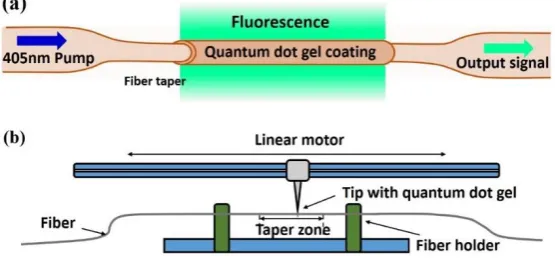
The schematic diagram of the proposed sensing structure is shown in Fig. 1(a). The micro-fiber was coated with a thin layer of CdSe/ZnS QDs gel as the sensing film. The QDs are pumped by the 405 nm laser. The fluorescence propagating along the microfiber is recorded. When the sensor is exposed to different concentrations of ethanol vapor, the QDs gel reaches a fast equilibrium with atmospheric ethanol vapor, resulting in the changes of the output fluorescence intensity.
Figure 1. (a) The schematic diagram of the RH sensor; (b) The schematic diagram of the home-made coating system.
The microfiber was made from a standard SMF (SMF-28, Corning) by using a conventional flame-heated taper-drawing technique. The overall taper region was about 20 mm and the diameter
of the microfiber was about 6 μm. The UV glue (NOA 61) based CdSe/ZnS QDs with a concentration
By controlling the moving speed and distance of the linear motor, a uniform and desired coating task can be realized. During our experiment, the coating velocity was set as 0.2 mm/s, and the coating region was about 20 mm. After the coating, the QD film was cured by way of UV exposure about 20 min.
Figure 2. (a) The photoluminescence and emission spectra of the QD-UV glue; (b) The dark-field image of the fabricated sensor under pump; the microscopy image of the fabricated sensor (c) only the right half was coated (d) totally coated.
3. Results
The schematic diagram of the test system was shown as Figure. 3. For spectral test, a 405 nm pump from a laser diode (LD) with a power of 30 mW was launched into the leading fiber as a pump source and the QD fluorescence spectrum was recorded by a micro-optical spectrum analyzer (mOSA, Ocean Optics STS-VIS) with a resolution of 0.53 nm. The dark-field of the fabricated sensor was first captured. As shown in Figure. 2(b), one can see that a uniform green emission light was excited along the coating region. The microscopy images of the typical fabricated sensor were also given in Figure. 2(c) and (d). In Figure. 2(c), the coated (right side and uncoated (left side) region are clearly distinguished, and the boundary is also clearly visible. The diameters of the coated and uncoated region were about 7.1 μm and 6.5 μm , which means the coating thickness was about 0.6
μm. Figure 2(d) presents the coated region, which shows a smooth coating surface. Overall, the
characterization of our fabricated sample confirms us a good coating process.
Figure 3. Schematic diagram of the test system.
3.1. Bending test
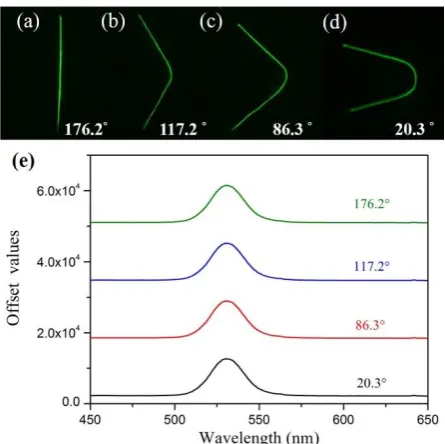
Considering the operation convenience and compact sensor size, in the subsequent sensing performance experiment, we fixed the sensor on a quart slide as a U-shape (as illustrated in Figure. 3). Thus, the bending test was carried out to investigate how the bending factor affects the
fluorescence spectrum. The fluorescence spectra under four different bending angles of176.2o, o
Figure 4. (a)-(d) The dark field images of the corresponding bended sensor. (e) The PL spectra corresponding to different bending angles.
3.2. Sensing performance
3.2.1. Ethanol vapor sensing
Since ethanol is volatile, the on-slide sensor was sealed in a culture dish at room temperature for alcohol vapor sensing. As shown in Figure. 3, the ethanol with a specific quantity was injected into the culture dish alternatively. For each test, the output fluorescence spectrum was recorded when the ethanol fully evaporated and the spectrum remained unchanged. Before next test, the vapor in the culture dish would be exhausted and the fluorescence spectrum will return to its original level. A series of tests were conducted, with ethanol vapor concentration from 0-30.6 ppm by a step of 1.7
ppm (corresponding to 0.5 μL ethanol liquid).
Figure 5. (a) The evolution of the fluorescence spectra of QDs versus different ethanol vapor concentration. (b) The normalized fluorescence intensity as a function of ethanol concentration.
3.2.2. Temperature response
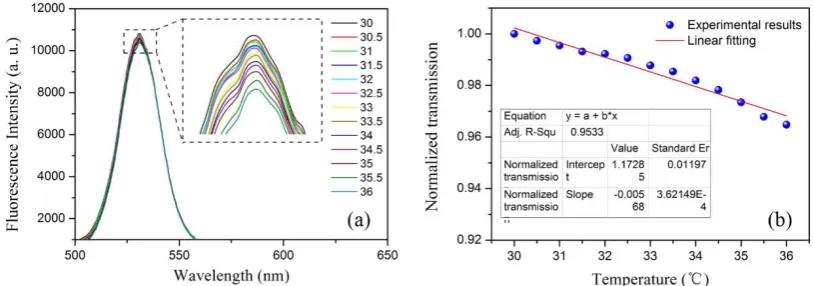
Since the temperature cross-sensitivity always affects the sensing performance, the temperature response of the sensor was also explored. The sensor was put into an oven and the temperature increased from 30℃to 36℃by a step of 0.5℃. The spectrum was recorded at each temperature when it got stable. Figure 5(a) presents the evolution of the QDs’ fluorescence spectra under different temperature. As the temperature increased, the fluorescence intensity decreased a bit. The normalized fluorescence intensity as a function of temperature was also given as Figure. 5(b). By linear fitting, the temperature sensitivity of the sensor was obtained as -0.57%/℃, which can lead to a cross-sensitivity of about 0.17 ppm/℃. Compared with the previous work [4-6], the temperature cross-sensitivity is extremely low. However, for high precision measurement, the temperature controlling should be considered during the real applications.
Figure 6. (a) The evolution of the QDs’ fluorescence spectra under different temperatures. (b) The
normalized fluorescence intensity as a function of temperature.
3.2.3. Time response
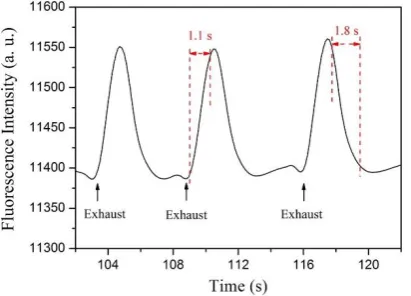
and recovery times are calculated at approximately 1.1 s and 1.8 s respectively, this represents the time it takes for the sensor to reach 95% and 15% of its final and original value, respectively.
Figure 7. Result of the time response test.
4. Conclusion
We have proposed the ethanol sensing structure based on the QDs gel-coating microfiber. A batch of samples were prepared by using a homemade drawing and coating system. The fabricated sensor was firstly bended to different angles and each fluorescence spectrum was recorded. The test results indicate that our fabricated sensor is very robust and bending-insensitive. Then, the ethanol sensing experiments were conducted, with ethanol vapor concentration from 0-30.6 ppm. The “yo
-yo” measurement results show that the proposed structure has very good repeatability with a linear
ethanol response of -3.3%/ppm. Temperature effect was also tested, and the experimental results indicated that the cross-sensitivity was quite low of about 0.17 ppm/℃, which can be ignored for normal ethanol vapor sensing applications. As a key performance, the time response was finally tested. Fast response time of 1.1s was obtained, which is much better than the previously reported work [4-8, 16]. It is believed that our proposed sensor with ease of fabrication and excellent sensing performance could play a crucial role in the real ethanol sensing applications.
Author Contributions: Guofeng Yan proposed the sensing structure of the ethanol vapor sensors and the construction of the measurement setup. Siqi Hu completed the experiment, analyzed the test results, cataloged references and prepared the manuscript. Chunzhou Wu built the homemade gel-coating system during the sample fabrication process. Guofeng Yan is the founder of the project, being responsible for evaluating the results of the tests, reviewing the reference list and editing the manuscript. Sailing He is the supervision of COER and supplied financial supports in daily operation.
Acknowledgments: This work is finance supported by National Natural Science Foundation of China Grant No. 61605170.
Conflicts of Interest: The authors declare no conflict of interest.
References
1. G. Neri, A. Bonavita, G. Micali, N. Donato, F.A. Deorsola, P. Mossino, I. Amato, B. De Benedetti, Ethanol sensors based on Pt-doped tin oxide nanopowders synthesised by gel-combustion, Sens. Actuators B. 2006, 117, 196-204.
2. Huan Liu, Min Li, Oleksandr Voznyy, Long Hu, Qiuyun Fu, Dongxiang Zhou, Zhe Xia, Edward H. Sargent, and Jiang Tang, Physically Flexible, Rapid‐Response Gas Sensor Based on Colloidal Quantum Dot Solids, Adv. Mater. 2014, 26, 2718-2724.
3. S. J. Ippolito, A. Ponzoni, K. Kalantar-Zadeh, W. Wlodarski, E. Comini, G. Faglia, G. Sberveglieri, Layered WO3/ZnO/360 LiTaO3 SAW gas sensor sensitive towards ethanol vapour and humidity, Sens. Actuators B. 2006, 117, 442-450.
5. Maria Konstantaki, Argyro Klini, Demetrios Anglos and Stavros Pissadakis, An ethanol vapor detection probe based on a ZnO nanorod coated optical fiber long period grating, Opt. Express 2012, 20, 8472-8484.
6. Dan-ran Li , Guang-xing Wu, Jin-hui Chen, Shao-cheng Yan, Zeng-yong Liu, Fei Xu , and Yan-qing Lu, Ethanol Gas Sensor Based on a Hybrid Polymethyl Methacrylate–Silica Microfiber Coupler, J. Light. Technol. 2018, 36, 2031-2036.
7. Dejun Liu, Rahul Kumar, Fangfang Wei, Wei Han, Arun Kumar Mallik, Jinhui Yuan, Shengpeng Wan, Xingdao He, Zhe Kang, Feng Li, Chongxiu Yu, Gerald Farrell, Yuliya Semenova, Qiang Wu, High sensitivity optical fiber sensors for simultaneous measurement of methanol and ethanol, Sens. Actuators B. 2018, 271, 1-8.
8. Hiroyuki Kudo, Masayuki Sawai, Yuki Suzuki, Xin Wang, Tomoko Gessei, Daishi Takahashi, Takahiro Arakawa, Kohji Mitsubayashi, Fiber-optic bio-sniffer (biochemical gas sensor) for high-selective monitoring of ethanol vapor using 335 nm UV-LED, Sens. Actuators B. 2010, 147, 676-680.
9. Glen W. Walker, Vikram C. Sundar, Christina M. Rudzinski, Aetna W. Wun, Moungi G. Bawendi et al. Quantum-dot optical temperature probes, Appl. Phys. Lett. 2003, 83, 3555-3557.
10. Beatriz Larrion, Miguel Hernaez, Francisco J. Arregui, Javier Goicoechea, Javier Bravo, and Ignacio R.
Matıas, Photonic Crystal Fiber Temperature Sensor Based on Quantum Dot Nanocoatings, J. Sens. 2009, 1687-7268.
11. Gonzaga de Bastida, Francisco J. Arregui, Javier Goicoechea, and Ignacio R. Matias, Quantum Dots-Based Optical Fiber Temperature Sensors Fabricated by Layer-by-Layer, IEEE Sens. J. 2006, 6, 1378-1379.
12. Sandeep Kalathimekkad, Jeroen Missinne, David Schaubroeck, Rajesh Mandamparambil, and Geert Van Steenberge, Alcohol Vapor Sensor Based on Fluorescent Dye-Doped Optical Waveguides, IEEE Sens. J. 2015, 15, 76-81.
13. Chao Meng, Yao Xiao, Pan Wang, Lei Zhang, Yanxin Liu, and Limin Tong , Quantum-Dot-Doped Polymer Nanofibers for Optical Sensing, Adv. Mater. 2011, 23, 3770-3774.
14. Wei Chen Fushan Li Poh Choon Ooi Yun Ye Tae Whan Kim Tailiang Guo, Room temperature pH-dependent ammonia gas sensors using graphene quantum dots, Sens. Actuators B. 2016, 222, 763-768. 15. Cheng-Shane Chu, Chih-Yung Chuang, Optical fiber sensor for dual sensing of dissolved oxygen and
Cu2+ ions based on PdTFPP/CdSe embedded in sol–gel matrix, Sens. Actuators B. 2015, 209, 94-99. 16. Minjuan Zhou, Jingjing Guo, Changxi Yang, Ratiometric fluorescence sensor for Fe3+ ions detection
based on quantum dot-doped hydrogel optical fiber, Sens. Actuators B. 2018, 264, 52-58.
17. L. E. Brus, Electron-electron and electron-hole interactions in small semiconductor crystallites: The size dependence of the lowest excited electronic state, J. Chem. Phys. 1984, 80, 4403-4409.