ROLE OF THE MANAGEMENT SCIENTIST IN SYSTEMIC PLANNING: AN ACTIONS-PROGRAMME MODEL FOR DECISION-MAKING IN COMPLEX SYSTEMS IN NIGERIA’S
PUBLIC SECTOR
UGOCHUKWU, MARIUS N., Ph.D (IN VIEW) Department of Management
Faculty of Business Administration Abia State University, Uturu
Abstract
While the term “systemic” implies an all-encompassing analysis of overall relationships within a unit or system, the term Management Science, or Operations Research (OR) today refers to the application of scientific methodology of several different disciplines to problems related to the functioning or operating of that unit (or system) – business, government, or institutional. The growth of OR activities in organizations has been rapid. Simultaneously, the scope of the problems addressed by Management Scientists (OR practitioners) has grown rapidly as well. The need is, however, everyday increasing for the methodological advances of OR in the analysis of (very) complex systems in the public sector in Nigeria. The OR specialists have neither replaced administrators nor managers (the decision-makers), nor have they taken over the decision-making responsibility. Their proper role is to help decision-makers make better decisions through a scientific approach to complex problem-solving situations. To highlight this role and, also to place OR in the proper focus within the framework of the systems-approach to dealing with problems in (very) complex situations within the polity, are the dual purposes of this paper.
INTRODUCTION
Operations Research (OR) and the more generic systems approach have throughout the world pioneered many important methodological advances in the analysis of very complex systems in the public and private sectors. These understanding have been achieved through the application of these methodologies. A greater cognizance of the interdependencies of complex systems, as well as the laws and operations that govern the behaviour of these systems, has evolved in recent years.
It is possible to construct models and simulations which describe these operations and to manipulate variable so as to optimize the objectives desired in the actual operations of complex public systems in Nigeria. There are no immutable laws governing the operations of complex systems (or, for
that matter, no immutable systems). Yet, the “constants” have been consistently fixed and the “laws” have
been empirically and intellectually accepted for a sufficient period of time. These are necessary and sufficient conditions to permit the description and subsequent manipulation of operational situations by those concerned with optimizing the operations of such systems for the more immediate future.
Since the “more immediate future” has meant only a few weeks or a few months ahead in time,
problems and uncertainties of longer time periods have not been critical. However, Operations Research and systems analysis have found increasing application in fields of study concerned with situations which will not actually occur until 10 or 20 years in the future (or even longer). It is the explicit function of these fields of study to recommend preparatory action. In order to approach a more optimal system, this action must be initiated between the present time and the more distant future at which time it is anticipated that the situation will actually occur or materialize.
THE DEVELOPMENT OF OPERATIONS RESEARCH AS A SCIENTIFIC METHOD
171
particular methodologies of their training, a synthesis takes place and new combinations of methodologies
emerge to “form-fit” the problem. Operations Research generates increasing demands for information necessary for problem-solving activities. The complications of communications these are given greater attention, and this leads to increased activity in investigation of information problems.
The emergence of Operations Research as a scientific approach to complex problem-solving situations can be traced in the development of its methods, concepts, and techniques. Operations Research is concerned with scientific methods as such and not with the field of any specific discipline. On the other hand, Operations Research is neither a method nor a technique. Rather it must be defined by a combination of the phenomena studied, the methods applied, and the techniques used in carrying out the problem analysis. As Russell Ackoff (1956:265) has observed: “Though it is true that all sciences have
certain aspects of method and technique in common, it is also true that each one has unique methodological characteristics which reflect the uniqueness of the subject-matter which it investigates. To the extent that a science develops methods and techniques well adapted to its special subject-mater, to a great extent that
science itself develops.”
THE PHASES OF AN OPERATIONS RESEARCH PROJECT
During the early stages of its development– until the mid-fifties– it was difficult to get a management scientist to describe a procedure for conducting an Operations Research project (Beer, 1968:231). A great variety of methods were being tried; some of these techniques had their origins in much earlier formulations, the application of which was not made possible until the advent of the high-speed computer.
At that time, each scientist’s version of the Operations Research Method would differ in some respects
(Ibid., 232).
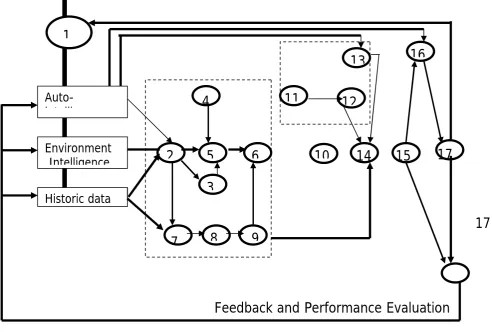
To a large extent, this still is true today. However, as more books are written on the subject of Operations Research and as more definitions of its methods are recorded, a good deal of commonality can be identified. Figure 1 is an attempt to summarize these common steps or phases of an Operations Research Project. Various writers have identified fewer or greater numbers of phases depending on how they have combined or broken down t he various steps of the process, but
17
1
Auto-intelligence
Environment
Intelligence
Historic data
Feedback and Performance Evaluation
4
2
5
6
3
7
8
9
11
12
13
16
10
14
15
Figure 1: Schematic Diagram of the Phases of an Operations Research
Project.
In this paper, we will delineate essentially five major phases to an Operations Research Project: (1) Problem Identification (step 1 in the diagram)
(ii) Formulation of the Client’s Problem (Steps 2 through 10)
(iii) Formulation of the Research Problem (Steps 11, 12 and 13)
(iv) Construction and Testing of a Model (Steps 14 through 17 in the diagram) and
(v) Solution Implementation and Performance Evaluation (step 18 plus the feedback cycle).
It is not implied that the steps enumerated in the diagram ever are conducted in this order, or that one step must be completed before another can begin. In many projects, for example, the complete
formulation of the client’s problem or the research problem (or both) may not be accomplished until the
project itself is virtually completed. There usually is a continuous interplay among these steps during the research; that is, there usually is considerable recycling of the results of each step through the preceding steps.
Phase 1: Problem Identification
In order for any organization to survive in the complex environment of modern-day society it is
necessary for it to have and maintain various “Screening devise.” These screening devices are designed to
alert the organization to the presence of a problem or set of problems. Frequently, when an organization’s
screening devices are not highly developed or sensitive to incremental changes in the environment, problems may reach crisis proportions before they are detected. However, the more successful organizations have developed highly sensitive devises which act as an early-warning system, identifying the approach of a problem to some threshold of tolerance, and thus alerting the organization to take action before the problem reaches a more critical stage.
Three basic “data files” lie at the foundation of aneffective screening process. One of these is an
“environmental intelligence system” which should be designed to keep the organization appraised of
conditions apparent in the broader environment within which it operates (i.e., the market place, client groups, constituencies, and so forth). Such information may come from regular reporting sources or through special studies; it may be consciously sought, or it may reach the organization through less formal channels (Wagner, 1969; 52).
A second element is the “auto-intelligence system,” which tells key decision-makers about the internal workings of the organization, its performance, and output, level of worker morale and efficiency, and so forth. Here again, this system may be formally structured, or it may rely primarily on informal
mechanisms such as the “grapevine,” gripe sessions,” and the infamous “suggestion box.” (Ibid).
The final element is the “historic data file.” This is the memory bank of the organization – the records of past performance; information pertaining to past problem situations and the steps taken in seeking solutions; fiscal accounts; and the myriad of other records that fill the files of a modern organization, whether in the private or in the public sector. These data can prove invaluable to an organization, providing that they are organized and maintained in such a way as to be readily accessible
and useable for “testing” the acceptability of the current situations confronting the organization.
PHASE II: FORMULATION OF THE CLIENT’S PROBLEM
It is useful to distinguish between the client’s (decision-makers) problem and the research problem, in framing an Operations Research Project, even though they are closely related. The latter is a transformation of the former, primarily involving the definition of a scientific basis for selecting a course
of action as a “solution.” (Ackoff, Op.Cit., 267).
The client’s problem seldom is given to the Operations Research team. Rather, it is extracted by
the team from reported symptoms and the analysis of the system involved. Formulation of the client’s
problem generally requires the following steps, the numbers corresponding to those in the diagram (figure 1):
1. Identification of the principal participants in the decision-making process, i.e., those in control of the operations under study and analysis of their decision-making procedures.
2. Identification of the principal participants in the decision-making process, i.e., those in control of the operations under study and analysis of their decision-making procedures.
3. Determination of constraints of the problem, i.e., the boundary conditions within which a solution must e found.
5. Determination of the decision-maker’s objectives. These falls into two classes: those to be obtained and those to be retained. The former relate to the goals to be achieved; the later provide inputs as to the restrictions on the problem.
6. Analysis of processes or operations involved; i.e., the processes which fall within the direct control of the organization and which may be modified in order to reach a problem solution. 7. Identification of other participants: those who carry out decisions outside the organization and
those who are affected by them, including “competition” or “adversaries.”
8. Determination of objectives of other participants which can affect responses to decisions in the area under study.
9. Determination of the alternative courses of action available to other participants, action which can affect the outcome in the area under study.
10. Determination of alternative courses of action available to the client or decision-makers. (Wagner, 1969:57).
It should be apparent from this listing of steps that in the process of formulating the client’s
problem, the Operations Research team must analyse the system under control and the organization and procedures by which it controlled.
Consequently, Operations Research increasingly has come to realize that the types of systems under study involve organized human behaviour (social systems) as well as physical objects and their behaviour (technical systems). More and more, specialists in Operations Research are turning their attention to the work of others in the area of organizational behaviour (socio-technical systems) and have begun work in this area themselves. (Thierauf, 1970: 7-11).
PHASE III: FORMULATION OF THE RESEARCH PROBLEM
In the most general terms, the objective of the Operations Research team is to determine which
alternative course of action is “most effective” (optimum) relative to the client’s set of pertinent objectives.
Consequently, in formulating the research problem, the measures of effectiveness to be used and the meaning of “most effective” must be defined. Wagner (1970:148) enumerated the steps involved as
follows:
11, Definition of the measure of efficiency to be used relative to each objective to be obtained (goals). 12. Selection of a common measure (standard) of efficiency and transformation of the measures
obtained into the common measure by either
(a) Finding an objective transformation (e.g.), finding the Naira value of the factors to be optimized and the associate constraints); or
(b) Finding a subjective transformation (e.g., determining the relative importance or utility of the objectives to the decision-maker -0 client0.
13. Definition of “most effective” – this in effect, defines a “best” or “optimum” solution.
In the early stages of the development of Operations Research methodology, the principal decision objectives were either the maximization of expected return or the minimization of maximum loss. In recent years, however, studies conducted in the field of decision theory have pointed up the need to develop other decision objectives, which in many practical situations must be used as the criteria of optimality and which are more appropriate than the two main strays or Operations Research.
PHASE IV: CONSTRUCTION AND TESTING OF A MODEL
Operation Research has reached a point in its development at which an OR model can be defined as a mathematical representation of the system under study. This representation takes the form
U = f (xi, yi),
Where
U = the utility objective to be attained;
Xi = the variables of the system that are subject to control; and
Yi = the variables that are not subject to control.
The restrictions on values of the variables generally are expressed in a supplementary set of equations and in equations.
During the historic development of Operations Research methods, certain processes or systems have been encountered repeatedly. The structure of these recurrent processes has been abstracted and analyzed, with the result that seven principal prototype OR models have been formulated:
(b) the allocation model;
c) the waiting-line or queuing model; (d) the routing model;
(e) the replacement or renewal model; (f) the information-collection model; and (g) the competitive or game-theory model.
Although these prototype models seldom can be applied in a specific situation without adjustment, they do provide a valuable point of departure. Recognition of recurrent processes also has led to abstraction and definition of these processes and the problems emerging from them. These are the tools with which Operations Research has filled its tool-bag.
Problems confronted in reality seldom involve only one of the recurrent processes, however. Therefore, the usual procedure for handling combined processes consistsof “solving” them in sequence.
Even with successive cyclic adjustments, however, many problems fail to reach a true optimum. Consequently, there is an ever increasing need to combine the abstracted processes and to construct models involving the interaction of several of the recurrent processes.
The next step in the model construction phase (step 15) involves the solution of the selected model
(or combination of models) so as to find the values of the “control variables” that minimize the system’s
effectiveness. This may involved the use of operational experiments and operational gaming. Under
certain circumstances, it may be possible to derive a “dual solution” to the model, which provides valuable
information as to the effect on the decision objective if certain of the problem constraints are relaxed. For example, if personnel resources provide a problem constraint, the dual solution may suggest the possible
increases in the system’s effectiveness if additional or improved personnel resources are made available. It must be recognized that a model is never more than a partial representation of reality. Despite its incompleteness, itis a good model if it can predict the effects of changes in the system on the system’s
overall effectiveness with acceptable accuracy. Therefore, the model and its solution must be tested (step 16) to determine its ability to predict changes in the system. Such tests may be retrospective, using data from the intelligence system, or may be prospective, usually undertaken on a small-scale or trial-run basis.
A solution derived from an OR model remains a solution only as long as the uncontrolled
variables retain their values (i.e., remain constants). The solution goes “out of control” when the value of
one or more of these variables has changed significantly. The significance of the change depend s on the amount by which the solution is made to deviate from the true optimum under changed conditions as well as the cost of changing the solution in operation.
For this reason, the final step (17) in the model phase of an Operations Research Project involves the development of controls for a given solution by
(a) defining a significant change for each variable and relationship which appears in the model; (b) Establishing a procedure for detecting the occurrence of such significant changes, thereby providing modifications in the screening device; and
(c) specifying how the solution should be modified if such changes occur. (Ackoff, op.cit., 289). This step is vital to the continuing operations of the organization, for without such guidelines and controls, a course of action may continued to be pursued long after it has ceased to be an appropriate solution to a problem.
PHASE V: SOLUTION IMPLEMENTATION AND PERFORMANCE EVALUATION
Proper implementation of a problem solution perhaps still is more of an art than a science. However, one of the more significant contributions of Operations Research Methodologies is the widening
recognition of the need to develop “decision-rules” –guidelines which can be turn over to the client and
carried out by operating personnel. As Ackott (Ibid.) has observed: “In many cases this means the team
must either translate elegant solutions into approximations that are easy to use or to sidestep the elegance and move directly to quick-and-dirty solutions. Operations Research is learning that an approximation that
is used may be a great deal better than an exact solution that is not.”
The development of decision-rules will permit the client more fully to appraise the effectiveness
recommended action-programmes. In the process of making this translation, various aspects of the situation that had not been taken into account may be found, requiring a recycling of the project or adjustments in the proposed solution.
OPERATIONS RESEARCH PROCEDURES IN SYSTEMIC PLANNING
In earlier times, technical innovation was achieved largely on an unorganized, accidental basis and usually without any concerted basic research. This was as true with respect to the innovation and design of complex systems as it was for the invention of particular consumer or other material items. It was a sort of natural growth, occurring at a slow, but steady, r ate over long periods of time. Since the Industrial Revolution, there has been an increasing concern with innovation. Especially since World War II, full appreciation of the importance of systems innovation, combined with the great increase in fundamental knowledge, have led to our present rate of change and innovation-from the lowest level of consumer products to major systems themselves.
Technical innovation has served as the catalyst of systems growth and development. The amount of catalyst has become so great, however, that there is need for concern about the general reaction resulting from rapid growth and cognitive overcrowding. An important step taken by operations Research in World War II was the recognition that operations of the future could be treated as a formal research problem and, therefore, could be studied through the applications of scientific methods. This advance, in turn, has led to a more orderly and development activities, innovation specific problems.
AN ACTIONS PROGRAMME MODEL FOR DECISION-MAKING (IN COMPLEX PUBLIC SYSTEMS)
What has been outlined to this point in procedural terms obviously will be extremely difficult to achieve in application to particularly complex public-sector systems. There are many inputs which first must be developed, as well as new techniques to enable a better quantification of the components of large complex systems. Another important methodological development is in the area of prediction. It is almost platitudinous to observe that planners project past trends into the future. But it must be recognized that there is often little reason to believe that these trends should or could continue.
The technical forecast provides the first and fundamental part of a rational basis for future planning. The forecast for any particular period is based on existing trends in their relation to the values and objectives chosen. It makes a prognosis of situations that may arise in a future period if trends continue. It may be argued that with skill and experience, such formal forecasts can be made with sufficient certainty to provide a far better basis for rational action than the present informal and almost random decision-making system.
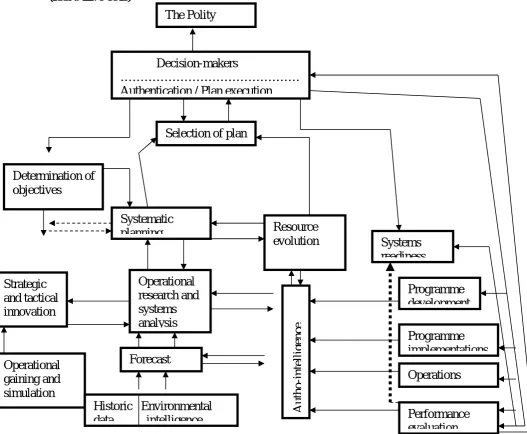
Three specific areas of information provide the data inputs for the formulation of a technical forecast: (1) auto-intelligence, which provides information about the particular system under study and the component elements of that system; (2) environmental intelligence, which provides information about the broader environment-the “out there”- of which the particular system is a part; and (3) historical data which brings together and analyzes the lessons of history (Wagner 1969:52). From intelligence studies in these three areas, it is possible to develop a probabilistic forecast (see figure 2). On these foundations, the forecast represents a weighed and balanced analysis rather than an intuitive impression of current trends and their possible effect on developments in the future.
In view of the predictions, the focus of the search is to determine possible new technical, tactical, and strategic courses of action that will enhance the overall performance of the system. Potential possibilities lie in the area of problem-solving innovations. There is no lack of general ideas for such solutions. The practical difficulty is in identifying and gaining support for proposals that will provide the most significant advances. But by applying the techniques of operations research and systems analysis, it is possible to identify and compare more completely the most promising alternatives. Wise and timely decisions on the acceptability of proposed innovations are of the utmost importance.
The forecast outlines the probable happenings in the continuance of hypothetical futures. Using operations research and systems analysis techniques, the possible directions to be taken can be identified in an attempt to suggest ways in which the real world can be manipulated to the competitive advantages of the system. Proposed innovations are directed toward providing specific ways and means of achieving successful manipulation.
task-force to select specific and feasible plans to meet identified objectives, taking into account many intangibles not susceptible to research at this stage of our action-programmes.
The basic problem of decision-makers in Nigeria today, whether in the public or private sectors, is
the need to achieve a balance in the programmes and choices made, with a view to ensuring a “systems readiness” in the short-, mid-, and long-range futures. This requires a posture of sufficient flexibility to meet a wide range of possible competitive actions.
The decision-maker requires all the assistance possible from advanced planning and problem-solving procedures that are now available. To date, however, too many decision-makers rely on intuitive methods those were sufficient in the past when the problems were comprehensible to a single human mind or a small board of advisers. They have not yet come to recognize that this approach is outmoded in truly complex situations and that the utilization of the available tools of analysis and synthesis must be combined with intuition developed through experience. It should be evident from this description of responsibilities that this planning task-force must include more than mere planning technicians. Implicit in this concept is the notion that planning is a principal responsibility of high-level administrative positions. Their participation in this task-force approach is vital to the success of the systematic planning process. By the same taken, a rapport and level of confidence must be developed whereby the decision-makers can accept the results of the analysis with the assurance that they are valid without having to question the analysis in detail.
The executive should have the benefits of all the sophisticated management and planning techniques when individual plans and sets of objectives covering proposed strategies, then, has the responsibility for the final decision determines whether a proposal is to be implemented. This implementation may require further programme development and specification before action-programmes can be put into operation. Finally, some mechanism of performance evaluation must be built into these action-programmes to provide further inputs into the auto-intelligence system for subsequent problem situations.
Strategic
and tactical
innovation
s
Operational
gaining and
simulation
Determination of
objectives
Forecast
That leads to
a new
Programme
implementations and performance evaluation
Stimulates
Operations Research and systems analysis
That gives
rise to
Decision
Leading to
Gives specific
That when tested by
Operational
The Polity
Decision-makers
………
Authentication / Plan execution
Selection of plan
Systems
readiness
Systematic
planning
Operational
research and
systems
analysis
Forecast
Historic Environmental
data intelligence
A
ut
ho
-i
nt
el
li
ge
nc
e
Resource
evolution
Programme
development
Programme
implementations
Operations
Performance
evaluation
Figure 2:
Actions programme Model for Decision-making in complex
Figure 3: The Decision-Making cycle.
CONCLUSIONS
The primary source of cohesiveness in complex systems is strategy, formulated via systemic planning. To be effective, however, strategy must be more than just a ringing statement of purpose, goal, or objectives. It must also provide guidance that will assist decision-makers in deciding how to proceed toward achieving the objectives. Furthermore, strategy should help to weld a complex system together by developing among the members of the decision-making team in the system both a shared belief in the efficacy of major action-programme and a shared commitment to execute these programmes successfully.
Operations research serves as the veritable handmaiden of decision-makers in the systematic planning for complex systems. Management scientists are expected by decision-makers (managers or administrators) to analyze managerial or administrative problems which involve the operations of systems, to gather essential data, to interpret those data, to build one or more models, to mix manipulate and experiment with those models, and finally, to make predictions and recommendations in all complex systems in the Nigerian public sector requires all the assistance possible from advanced planning and problem-solving procedures that are now available to the modern world. It is by these means that all tactical operational and strategic levels of management are bridged and effectiveness closely monitored.
The purpose of this paper has been thus to discuss how strategic planning in complex systems can be done in the public sector, in such a way that it will be more than simply a statement of purpose, fragmentarily contrived and implemented, but will have an active role in shaping decision-making in the polity, laying very great emphasis on the methodological advances of operations research.
REFERENCES
Daniel Alesch, “Government in Evolution: A Reat World Focus for State Planning: in Public
Administration Review, vol. 29 (May-June, 1978).
Hamdy A.T. (2003) “Operations Research, An Introduction. Thomson Press LTD. India.
H.M. Wagner, Principles of Management Science, with Applications to Executive Decisions (Englewood Cliffs, N.J.: Prentice-Hall, Inc., 1970)
H.M. Wagner, (1979) Principles of Operations Research (Englewood Cliffs, N.J.: Prentice-Hall Inc.,
Russel L. Ackoff, (1986) “The Development of Operation Research as a Science”, Operations Research, 4
(June, 1988).
S. Beer, Management Sciences: The Business use of Operations Research (Garden City, N.Y.: Doubleday & Company, Inc.,