Available online throug
ISSN 2229 – 5046
International Journal of Mathematical Archive- 8(9), Sept. – 2017 224
CONVECTIVE HEAT TRANSFER FLOW
OF A ROTATING NANOFLUID IN A VERTICAL CHANNEL WITH HEAT SOURCES
Dr. S. V. SUNEETHA*
Department of Mathematices, Rayalaseema University, Kurnoo, (A.P.), India.
(Received On: 02-08-17; Revised & Accepted On: 28-08-17)
ABSTRACT
T
he effect of heat sources on convective heat transfer flow of a nanofluid in a vertical channel. Analytical closed form solutions are obtained for both the momentum and the energy equations. Graphs are used to illustrate the significance of key parameters on the nanofluid velocity and temperature distributions.Keywords: Heat Sources, Nanofluid, Vertical channel, rotating fluid.
1. INTRODUCTION
Present days, researchers are more concentrating on enhancement of heat transfer. The low thermal conductivity of conventional heat transfer fluids, such as water, is considered a primary limitation in enhancing the heat transfer performance.Nanofluids are solid-liquid composite materials consisting of solid nanoparticles or nanofibers, with sizes typically on the order of 1–100 nm, suspended in a liquid. Nanofluids are characterized by an enrichment of a base fluid like water, toluene, ethylene glycol or oil with nanoparticles in variety of types like Metals, Oxides, Carbides, Carbon, Nitrides, etc. Today nanofluid are sought to have wide range of applications in medical application, biomedical industry, detergency, power generation in nuclear reactors and more specifically in any heat removal involved industrial applications. The ongoing research ever since then has extended to utilization of nanofluids in microelectronics, fuel cells, pharmaceutical processes, hybrid-powered engines, engine cooling, vehicle thermal management, domestic refrigerator, chillers, heat exchanger, nuclear reactor coolant, grinding, machining, space technology, Defense and ships, and boiler flue gas temperature reduction [Agarwal et al. (2011)]. Indisputably, the nanofluids are more stable and have acceptable viscosity and better wetting, spreading, and dispersion properties on a solid surface [Akbarinia et al. (2011), Nguyen et al. (2007)]. Several reviews [Ghadimi et al. (2011), Mahabudul et al. (2012)] on nanofluids with respect to thermal and rheological properties have been reported.
Thus, nanofluids have an ample collection of potential applications in electronics, pharmaceutical processes, hybrid-powered engines, automotive and nuclear applications where enhanced heat transfer or resourceful heat dissipation is required. In view of these, [Kiblinski et al. (2002)] suggested four possible explanations for the anomalous increase in the thermal conductivity of nanofluids. These are nanoparticles clustering, Brownian motion of the particles, molecular level layering of the liquid/particles interface and ballistic heat transfer in the nanoparticles. Despite a vast amount of literature on the flow of nanofluid model proposed by [Buongiorno (2006)], we are referring to a few recent studies [Alsaedi et al. (2012), Hajipour and Dekhordi (2012), Rana and Bhargava (2012)] in this article. However, we are following the nanofluid model proposed by [Tiwari and Das (2007)], which is being used by many current researchers [Hamad and Ferdows (2012), Hamad and Pop (2011), Norifiah et al. (2012)] on various flow fields.
The study of MHD flow and heat transfer due to the effect of a magnetic field in a rotating frame of reference has attracted the interest of many investigators in view of its applications in many industrial, astrophysical (dealing with the sunspot development, the solar cycle and the structure of a rotating magnetic stars), technological and engineering applications (MHD generators, ion propulsion, MHD pumps, etc.) and many other practical applications, such as in biomechanical problems (e.g., blood, flow in the pulmonary alveolar sheet). Many authors have studied the flow and heat transfer in a rotating system with various geometrical situations [Hickman (1957), Hide (1960), Mazumder (2012)]. [Hamad (2011)] investigated the effect of a transverse magnetic field on free convection flow of a nanofluid past a vertical semi-infinite flat plate. Recently, [Satya Narayana et al. (2013)] studied the Hall current and radiation absorption effects on MHD micropolar fluid in a rotating system. Some other related works can also be found in recent papers [Kameswaran et al. (2012), Kesavaiah et al. (2011), Rushi kumar and Sivaraj (2013), Srinivas et al. (2012)].
Corresponding Author: Dr. S. V. Suneetha*
The study of flow and heat transfer distinctiveness of a nanofluid past a vertical plate with thermal radiation in a rotating frame of reference.[Salem and Aziz (2008) have analyzed the effect of Hall currents and chemical reaction on the unsteady flow, heat and mass transfer laminar of a viscous, electrically conducting fluid over a continuously stretching surface in the presence of heat generation/absorption. Aziz (2010) has investigated the flow and heat transfer of a viscous fluid flow over a unsteady stretching surface with Hall effects. Sarojamma et al. (2015) have investigated the influence of Hall currents on cross diffusive convection in a MHD boundary layer flow on stretching sheet in porous medium with non-uniform heat source. Sarojamma et al. (2015) have discussed the effect of Hall currents on the flow induces by a stretching surface. Satyanarayana. et. al (2013) have analysed th efect of heat sources on convective heat transfer flow of a nanofluid pas a vertical plate in a rotating system .
In this paper we investigate the effect of Heat source on unsteady convective heat transfer flow of a rotating nanofluid in a vertical channel. Analytical closed form solutions are obtained for both the momentum and the energy equations. The velocity and temperature are analysed for different variations od parameters graphically. The skin friction and Nusselt number on the walls are evaluated numerically for different parmetric variations. It is found that an increase in nanoparticle concentration φ reduces the primary velocity, enhances the secondary and temperature in the flow region. The skin friction components reduce, the Nusselt number increases with increase in φ.
2. FORMULATION OF THE PROBLEM
We analyse the steady, three dimensional flow of a nanofluid consisting of a base fluid and small nanoparticles in a vertical parallel channel under the influence of a uniform magnetic field of strength Ho. The flow is assumed to be in the x-direction which is taken along the plane in an upward direction and z-axis is normal to the plate. Also it is
assumed that the whole system is rotating with a constant angular velocity vector
Ω
about the z-axis. Due to a semi-infinite plate surface assumption, the flow variables are functions of z and t only. Figure. 1 shows that the problem under consideration and the co-ordinate system.Figure-1: Schematic diagram of the problem :
The equations governing the flow and heat transfer of a nanofluids are Equation of Continuity
0
=
∂
∂
z
w
Equation of Momentum (1) 2
2 2 2
1
2
nf(
nf) (
) (
e o)
nf
u
u
w
v
g T
T
H u
z
ρ
µ
z
ρβ
∞σµ
∂
− Ω =
∂
+
−
−
∂
∂
(2) 22 2 2
1
2
nf(
e o)
nf
v
v
w
u
H
v
z
ρ
µ
z
σµ
∂
∂
+ Ω =
−
© 2017, IJMA. All Rights Reserved 226
Equation of Energy
2
2
(
)
(
)
H nf P nfQ
T
T
w
k
T
T
z
z
ρ
C
∞∂
=
∂
−
−
∂
∂
(4) where u,v are the velocity components along x,y directions respectively, T is the temperature of the fluid, thermal conductivity of the nanofluidk
nf ,(
ρβ
)
nf is thermal expansion coefficient of nanofluid, QH is the heat sourcecoefficient,
(
ρ
C
p nf)
heat capacitance Cp of the nanofluid,ρ
nf is effective density of the nanofluid density and g isgravity.
The boundary conditions are
1 2
(
)
0 ,
(
)
0,
(
)
,
(
)
u
L
v
L
T
L
T
T
L
T
± =
± =
− =
+ =
(5)The properties of the nanofluids are defined as follows
)
(
2
2
(
)
(
2
2
(
)
(
)
(
)
1
(
)
(
)
(
)
)(
1
(
)
(
)
1
(
)
(
)
1
/(
2.5s f f s s f f s f nf s f nf s P f P nf p s f nf nf p nf nf f nf
k
k
k
k
k
k
k
k
k
k
C
C
C
C
k
−
+
+
−
−
+
=
+
−
=
+
−
=
+
−
=
=
−
=
φ
φ
ρβ
φ
ρβ
φ
ρβ
ρ
φ
ρ
φ
ρ
φρ
ρ
φ
ρ
ρ
α
φ
µ
µ
(6)Table 1: Thermo-physical properties of water and nanoparticles
Physical properties Water Cu Al2O3
Cp (J/kg K)
ρ (kg/m3)
K (W/m K) β X 10-5 (1/K)
4179 997.1 0.613 21 385 8933 400 1.67 765 3970 40 0.85
We consider the solution of equation (1) as:
w= - w0 (7)
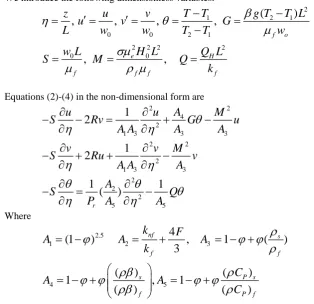
We introduce the following dimensionless variables:
2
1 2 1
0 0 2 1
2 2 2 2
0 0
(
)
,
,
,
,
,
,
f o e Hf f f f
T
T
g T
T L
z
u
v
u
v
G
L
w
w
T
T
w
w L
H L
Q L
S
M
Q
k
β
η
θ
µ
σµ
µ
ρ µ
−
−
′
′
=
=
=
=
=
−
=
=
=
(8)Equations (2)-(4) in the non-dimensional form are
2 2
4 2
1 3 3 3
1
2
A
u
u
M
S
Rv
G
u
A A
A
θ
A
η
η
∂
∂
−
−
=
+
−
∂
∂
(9)2 2
2
1 3 3
1
2
v
v
M
S
Ru
v
A A
A
η
η
∂
∂
−
+
+
−
∂
∂
(10)2 2 2 5 5
1
1
(
)
rA
S
Q
P
A
A
θ
θ
θ
η
η
∂
∂
−
=
−
∂
∂
(11) Where2.5
1 2 3
4 5
4
(1
)
,
1
(
)
3
(
)
(
)
1
,
1
(
)
(
)
nf s
f f
s P s
f P f
k
F
A
A
A
k
C
A
A
C
ρ
ϕ
ϕ ϕ
ρ
ρβ
ρ
ϕ ϕ
ϕ ϕ
ρβ
ρ
= −
=
+
= − +
= − +
= − +
The boundary conditions (2.5) reduce to
( 1)
0, ( 1)
0, ( 1)
0, ( 1)
1
u
± =
v
± =
θ
− =
θ
+ =
(12)In view of the fluid velocity in the component form:
( , )
( , )
( , )
V z t
=
u z t
+
iv z t
The equations (9) and (10) reduce to
2 2
4 2
1 3 3 2
1
2
A
V
V
M
S
iRV
G
V
A A
A
θ
A
η
η
∂
∂
−
−
=
+
−
∂
∂
(13)The boundary conditions (12) reduce to
( 1)
0
( 1)
0 , ( 1)
0 ,
V
± =
θ
− =
θ
+ =
(14)3. METHOD SOLUTION
Solving the equations (11) and (12) we get
9
5 3 6 3 14 1 1 15 1 1
1 1
1 1 1
1 1
( )
exp
(
(
)
(
)
exp((
) )
exp( (
) )
2
(
)
(
)
( )
exp(
)
( )
( )
(
)
(
)
b
V z
B Cosh m
B Sinh m
b
m
b
b
m
b
Cosh m
Sinh m
z
b
Sinh b
Cosh b
Cosh m
Sinh m
η
η
η
η
η
η
η
θ
η
=
−
+
+
−
+
−
+
=
−
+
The physical quantities of interest are skin friction and Nusselt number which are, respectively, defined as:
2 o f w f
U
C
ρ
τ
=
)
(
−
∞=
T
T
k
xq
Nu
w f w (15)Where
τ
w andq
w are the wall shear and the wall heat flux from the plate respectively, which are given by0 0
w nf w nf
z z
u
T
and
q
k
z
z
τ
µ
= =∂
∂
=
= −
∂
∂
In view of Equation (15) we obtain
18 3 19 3 20 1 1 21 1 1
1
22 3 23 3 20 1 1 21 1 1
1
1
( 1)
(
)
(
)
(
)
( (
))
1
( 1)
(
)
(
)
exp( (
))
( (
))
f
C
V
b Cosh m
b Sinh m
b Exp m
b
b Exp
m
b
A
V
b Cosh m
b Sinh m
b
m
b
b Exp
m
b
A
′
=
+ =
+
+
−
+
−
+
′
=
− ==
+
+
−
−
+
−
+
2( 1)
( 1)
nf
f
k
Nu
A
k
θ
′
θ
′
= −
± = −
±
( 1)
Nu
+ =
−
b
1exp(
−
b
1)(
Sinh b
( )
1+
Cosh b
( ))
1+
m
1exp(
−
b
1)(
Sinh b Tanh m
( )
1(
1)
+
Cosh b Coth m
( )
1(
1))
( 1)
Nu
− =
−
b
1exp( )(
b
1Sinh b
( )
1−
Cosh b
( ))
1+
m
1exp( )(
b
1−
Sinh b Tanh m
( )
1(
1)
+
Cosh b Coth m
( )
1(
1))
Where
2
5 2 5 1
1 1 2
2 2 1
(
Pr)
4
Pr
( )
,
,
2
2
(
)
A S
A Q
S
A
Cosh b
m
b
b
A
A
Sh m
+
=
=
=
1 1 3 1( )
,
(
)
m Ch b
b
Sh m
=
1 1 1( )
,
(
)
Sh b
B
Ch m
=
1 2 1( )
(
)
Ch b
B
Sh m
=
7 4
(
1 1)
5(
1 1),
© 2017, IJMA. All Rights Reserved 228
8 4
(
1 1)
b
=
b Sh m
−
b
−
b Sh m
5(
1+
b
1),
4 73
2
( )
,
(
)
Ch b
b
B
Ch m
−
=
4 84
2
( )
,
(
)
Sh b
b
B
Sh m
−
=
9 1 3
,
b
=
SA A
b
10=
M
2+
iRA A b
1 3,
11=
A A
1 4,
2
3 9 9
4
10,
m
= − ±
b
b
+
b
12 11
b
= −
b
11
( )
(
)
Sh b
Ch m
1 1( )
,
(
)
Ch b
Sh m
+
b
13=
b
111 1
( )
(
)
Sh b
Ch m
−
1 1( )
,
(
)
Ch b
Sh m
+
13 1214 2 15 2
1 1 3 1 1 10 1 1 3 1 1 10
,
,
(
)
(
)
(
)
(
)
b
b
b
b
m
b
m m
b
b
m
b
m m
b
b
=
=
−
+
−
−
+
−
+
−
16
( )((
9 14exp( (
1 1)
15exp(
1 1)),
b
=
Exp b
b
−
m
−
b
+
b
m
+
b
17
( )((
9 14exp((
1 1)
15exp( (
1 1)),
b
=
Exp b
b
m
−
b
+
b
−
m
+
b
18
(0.5
9 5 3) ,
6 19(
3 50.5
9 6),
20 14(
1 1)
(
1 1)
b
= −
b b
+
m b b
=
m b
−
b b
b
=
b
m
−
b Exp m
−
b
21 15
(
1 1)
( (
1 1)),
22(0.5
9 5 3 6)
(
3) exp(0.5 )
9b
= −
b
m
+
b Exp
−
m
+
b
b
= −
b b
+
m b Ch m
b
23
(0.5
9 6 3 5)
(
3) exp(0.5 )
9b
= −
b b
+
m b Sh m
b
16 17 5 3
(
)
,
(
)
b
b
B
Ch m
+
= −
16 176 3
(
)
,
(
)
b
b
B
Sh m
−
=
4. DISCUSSION OF THE NUMERICAL RESULTS
Figs.2a and 2b represent the primary and secondary velocity components with respect to Grashof number (G). It can be seen from the profiles that the primary velocity enhances while the secondary velocity reduces with increase in G.
Fig.3a represents the effect of magnetic field on the nanofluid velocity profile. It is found that the nanofluid velocity field enhances with increase of magnetic field parameter M along the surface. These effects are much significant near the surface of the plate. This shows that the fluid velocity is enhanced by increasing the magnetic field and confirms the fact that the application of the magnetic field to an electrically conducting fluid produces a drag like force which causes a enhancement in the fluid velocity. From Fig.3b,it is interesting to note that the effect of magnetic parameter on the secondary velocity is to enhance the magnitude of v. It is seen that the velocity rapidly increases attaining maximum at y=3 and then reduces to attain the prescribed value zero far away from the boundary.
Fig.4a represents the nanofluid velocity profiles for different values of rotational parameter R. This result displays that the nanofluid velocity reduces with an increase in R, as noted in reference [Hamad et al. (2011)]. Fig.4b depicts the variation of the secondary velocity with rotation parameter (R). It is observed from the profiles that the magnitude of v enhances with increase in R.
Fig.5a shows that the nanofluid velocity with suction parameter S . It can be seen from the profiles that the nanofluid primary velocity reduces for higher S which indicates that the suction stabilizes the boundary layer growth. The free convection effect is also apparent in this Figure. The effect of S on the nanofluid velocity is the reverse in the case of [Hamad et al. (2013)]. This is due to the dominate role of the radiation in the fluid field. Fig.5b depicts v with Suction parameter S. It is noticed that |v| enhances with increase in S. These results are clearly supported from the physical point of view. The variation of temperature with suction parameter S is exhibited in Fig.5c. It can be seen from the profiles that the temperature reduces with increase in S.
Figs.6a&&6b depict the behavior of the primary and secondary velocities with heat source parameter Q. It is found that the both components of velocities exhibit a increasing tendency with increase in the strength of the heat source. This is due to the fact that when heat is generated, the buoyancy forces increases which enhances the flow rate and there by gives rise to an enhancement in the velocity component profiles. An increase in the strength of the heat absorbing source ,the velocity components reduces as the heat is absorbed in the boundary layer. Fig.6c represents the temperature (T) with Heat source parameter Q. It is observed from the profiles that an increase in Q reduces the
temperature and hence the thickness of the thermal boundary layer reduces with increase in Q in Cuo-water nanofluids.
increase in the nanoparticle volume fraction enhances the temperature in the boundary layer. This is due to the fact that the thickness of the thermal boundary layer increases with increase in The variation of primary and secondary velocities with Prandtl number Pr is exhibited in Figs.8a&8b..It is found that the primary velocity component shows a depreciation while the secondary velocity experiences an increasing tendency with increasing the values of Prandtl number and hence the thickness of the boundary layer also reduces in Cuo-water nanofluids. Fig.9c shows the variation of temperature with Pr. It is found that an increase in Pr enhances the temperature in the thermal boundary layer Thus lesser the thermal diffusivity larger the temperature in the boundary layer.
Table.2 displays the behavior of local skin friction component τx and Nusselt number Nu at the plates η=±1. It is found
that an increase in the Hartmann number M reduces τx at η=-1 and increases it at η==1while an increase in the rotation
parameter R reduces τx at both the walls.. Also τx reduces with increase in the suction parameter S and the radiation
parameter F at η=±1. An increase in Q>0enhances τx at η=±1 and reduces with increase in Q<0 at both the walls. An
increase in the nanoparticle volume fraction φ reduces τx for Cu-water nanofluid. Lesser the thermal diffusivity smaller
the skin friction component at η=±1.
The local Nusselt number (Nu) at η=+1 is found to reduce with increase in S or Q or φ or Prandtl number Pr while at η=-1, it enhances with increase in Q >0 or S or φ or Pr and reduces with Q<0 in Cuo-water nanofluid.
Figure-2a: Variation of Primary velocity f with G M=0.5, R=0.2, Q=2, Pr=6.2, S=0.5
© 2017, IJMA. All Rights Reserved 230
Figure-3a: Variation of f with M, G=10, R=0.2, Q=2, Pr=6.2, S=0.5
Figure-3b: Variation of g with M, G=10, R=0.2, Q=25, Pr=6.2, S=0.5
Figure-4b: Variation of g with R, M=0.5, G=10, Q=2, Pr=6.2, S=0.5
Figure-5a: Variation of f with S, M=0.52, R=0.2, Q=2, Pr=6.2, G=10
© 2017, IJMA. All Rights Reserved 232
Figure-5c: Variation of Temperature (θ) with S, M=0.5, R=0.2, Q=2, Pr=6.2, G=10
Figure-6a: Variation of f with Q, G=10, M=0.5, R=0.2, S=0.5, φ=0.1, Pr=6.2
Figure-6c: Variation of θ with Q, M=0.5, R=0.2, G=10, Pr=6.2, S=0.5
Figure-7a: Variation of f’ with φ, M=0.5, R=0.2, Q=2, Pr=6.2, S=0.5
© 2017, IJMA. All Rights Reserved 234
Figure-7c: Variation of θ with φ, M=0.5, R=0.2, Q=2, Pr=6.2, S=0.5
Figure-8a: Variation of f with Pr, M=0.5, R=0.2, Q=2, Pr=6.2, S=0.5
Figure-8c: Variation of θ with Pr, M=0.5, R=0.2, Q=2, Pr=6.2, S=0.5
Table – 2: Skin friction (τ), Nusselt Number (Nu at η=±1
M R S Q φ Pr τx(+1) τx(-1) Nu(+1) Nu(-1)
0.5 0.2 0.5 2 0.05 6.2 -0.046486 0.67045 0.49466 0.51096 1 0.2 0.5 2 0.05 6.2 -0.056031 0.54662 --- --- 1.5 0.2 0.5 2 0.05 6.2 -0.069979 0.55612 --- --- 0.5 0.4 0.5 2 0.05 6.2 -0.042801 0.52575 --- --- 0.5 0.6 0.5 2 0.05 6.2 -0.040121 0.49046 --- --- 0.5 0.2 1.0 2 0.05 6.2 -0.038312 -0.06986 0.49359 0.51339 0.5 0.2 0.5 4 0.05 6.2 -0.170533 -0.64576 0.47524 0.51327 0.5 0.2 0.5 -2 0.05 6.2 -0.169884 0.65501 0.388766 0.45677 0.5 0.2 0.5 -4 0.05 6.2 -0.164556 0.66006 0.354843 0.43478 0.5 0.2 0.5 2 0.1 6.2 -0.013225 0.36442 0.48876 0.51017 0.5 0.2 0.5 2 0.3 6.2 -0.004228 0.12997 0.49676 0.51099 0.5 0.2 0.5 2 0.05 0.71 -0.043474 0.66589 0.49598 0.50555 0.5 0.2 0.5 2 0.05 1.71 -0.063464 0.67559 0.49375 0.50678
4. REFERENCES
1. Agarwal. S. Bhadauri, B.S. Siddheshwar, P.G (2011): Thermal instability of a nanofluid saturating rotatinganisotropic porous medium, STRPM, vol.2, pp:53–64
2. Akbarinia, A, Abdolzadeh, Laur. R (2011): Critical investigation of heat transfer enhancement using nanofluids in microchannels with slip and non-slip flow regimes,” Appl Therm Eng, vol.31, pp: 556–565.
3. Alsaedi. M, .Awais. T Hayat. (2012) Effect of heat generation/absorption on stagnation point flow of nanofluid over a surface with convective boundary conditions,” Comm. Nonlinear Sci. Number Simulation, vol.17, pp: 4210–4223.
4. Aziz. M. A. E (2010): Flow and heat transfer over an unsteady stretching surface with Hall effects, Meccanica, V.45,pp.97-109.
5. Buongiorno. J (2006): Convective transport in nanofluids,” ASME J Heat Tran vol.128, pp: 240–250, 6.Ghadimi. A, Saidur. R, Metselaar. H. S. C (2011): A review of nanofluid stability properties and charac-terization in stationary conditions, Int. J Heat Mass Tran. vol.54 (17-18), pp: 4051–4068.
6. Hajipour. M, A.M.Dekhordi. A. M (2012): Analysis of nanofluid heat transfer in parallel-plate vertical channels partially filled with porous medium, Int. J Therm. Sci., vol. 55, pp: 103–113.
7. Hamad M. A. A, Ferdows. M (2012): Similarity solutions to viscous flow and heat transfer of nanofluid over nonlinearly stretching sheet, Appl Math Mech Eng Ed, vol.33 (7), pp: 923–930.
8. Hamad M.A.A, Pop. I (2011) Unsteady MHD free convection flow past a vertical permeable flat plate in a rotating frame of reference with constant heat source in a nanofluid, Heat Mass Tran. vol.47, pp:1517–1524 9. Hamad. M.A.A (2011): Analytical solution of a natural convection flow of a nanofluid over a
linearlystretching sheet in the presence of magnetic field, Int. Comm. Heat Mass Tran, vol.38, pp: 487–492. 10. Hickman. K.C.D (1957): Centrifugal boiler compression still”, Ind Eng Chem, vol.49, pp: 786– 800.
© 2017, IJMA. All Rights Reserved 236
12. Kameswaran. P. K, Narayana. M, Sibanda. P, PVSN Murthy (2012): Hydromagnetic nanofluid flow due to a stretching or shrinking sheet with viscous dissipation and chemical reaction effects, Int. J Heat Mass Tran. vol.55pp:7587–7595.
13. Kesavaiah. D.Ch, Satya.Narayana. P.V, Venkataramana. S (2011): Effects of the chemical reaction and radiation absorption on an unsteady MHD convective heat and mass transfer flow past a semi-infinite vertical permeable moving plate embedded in a porous medium with heat source and suction, Int. J Appl. Math Mech. vol.7(1), pp:52–69,.
14. Kiblinski. P, Phillpot. S. R and Choi. S. U. S (2002): J.A.Eastman, “Mechanism of heat flow is suspensions of nanosized particles (nanofluids)”, Int. J Heat Mass Tran, vol.42, pp: 855–863.
15. Mahbubul. I. M,.Saidur. R and .Amalina. M. A (2012): Latest developments on the viscosity of nanofluids, Int. J Heat Mass Tran, vol.55 (4), pp: 874–885.
16. Mazumder. B. S (1991): An exact solution of oscillatory Couette flow in a rotating system” ASME J Appl Mech, vol.58 (4), pp:1104–1107.
17. Nguyen. C. T, Roy. G, Gauthier. C and Galanis. N (2007) Heat transfer enhancement using Al2O3–water nanofluid for an electronic liquid cooling system, Appl. Thermo Eng, vol.27, pp: 1501–1506.
18. Norifiah. B. Anuar and Ioan. P. I, Boundary layer flow over a moving surface in a nanofluid with suction or injection”, Acta Mech Sin, vol.28 (1), pp: 34–40.
19. Rana. P and Bhargava R Flow and heat transfer of a nanofluid over a nonlinearly stretching sheet”, Comm. Nonlinear Sci. Number Simulation, vol. 7, pp: 212–226.
20. Rushi Kumar. B and Sivaraj. R (2013): Heat and mass transfer in MHD visco-elastic fluid flow over a vertical cone and flat plate with variable viscosity, Int. J Heat Mass Tran, vol.56 (1–2), pp: 370– 379.
21. Salem. A. M, and Aziz. A.M.E (2008): Effect of Hall currents and chemical reaction on hydromagnetic flow of a stretching surface with internal heat generation/absotptio, Applied Mathematical odelling,V.32, pp.1236-1254
22. Sarojamma. G, Mahaboobjan. S and Nagendramma. V (2015): Influence of Hall currents on cross diffusive convection in a Mhd boundary layer flow on stretching sheet in porous medium with Heat generation, Int.Jour.Math.Archive, V.6(3), pp.227248.
23. Sarojamma. G., Mahaboobjan. S and .Sreelakshmi. K (2015): Effect of Hall current on the flow induced by a stretching surface, Int. Jour. Sci., and Innovative Math.Res, V.3 (3) pp.1139-1148.
24. Satyanarayana. P. V, Venkateswarlu. B. and Venkataramana. S (2013): Thermal radiation and heat source effects on a MHD Nanofluid past a vertical plate in a rotating system with porous medium, Heat transfer-Asian Research (J.Wiley), DOI:10.1002/htj.211001.
25. Satyanarayana. P. V,Venkateswarlu. B and Venkataramana. S (2013): Effects of Hall current and radiation absorption on MHD micropolar fluid in a rotating system, Ain-Shams Eng J
http://dx.doi.org/10.1016/j.asej.2013.02.002.
26. Srinivas. S, A.Subramanyam Reddy. A and Ramamohan. T. R (2012): A study on thermal-diffusion and diffusion-thermo effects in a two-dimensional viscous flow between slowly expanding or contracting walls with weak permeability, Int. J Heat Mass Tran. vol.55, pp: 3008–3020.
27. Tiwari. R. K and Das. M. K (2007): Heat transfer augmentation in a two-sided lid-driven differentially heated square cavity utilizing nanofluids”, Int. J Heat Mass Tran, vol.50:2002–2018.
28. Oztop. H. F and Abu-Nada. E (2008): Numerical study of natural convection in partially heated rectangular enclosures filled with nanofluids., Int. J. Heat and Fluid Flow., V.29, pp.1326-1336.
Source of support: Nil, Conflict of interest: None Declared.