Single Nucleotide Polymorphisms (SNPs) in Occupational Exposure Assessment
Rong Jiang
A dissertation submitted to the faculty of the University of North Carolina at Chapel Hill in partial fulfillment of the requirements for the degree of Doctor of Philosophy in the Department of Environmental Sciences and Engineering.
Chapel Hill 2010
Approved by,
Advisor: Leena A. Nylander-French Reader: Louise M. Ball
ii ABSTRACT
RONG JIANG: Single Nucleotide Polymorphisms (SNPs) in Occupational Exposure Assessment
(Under the direction of Leena A. Nylander-French)
iii
iv
ACKNOWLEDEMENTS
I would like to express my deepest gratitude to my advisor, Leena Nylander-French, for her support, encouragement, and guidance throughout the research. She introduced me to the field of exposure assessment, and she was always there to listen, to give advice, to ask me good questions to help me think through my problems. This dissertation would not have been possible without her continued support. I am deeply grateful to John E. French (Jef), who as my dissertation committee member helped me understand the fundamental of toxicology and genetics. Jef also introduce me to pathway network analysis, and help me better understand the genetic variation in a biological function context. I also would like to deeply thank Dr. Fei Zhou for her valuable suggestion and help in statistical methods in this research, and her patience in explaining the statistical genetics to me who initially had no idea about it. I wish to express my warm and sincere thanks to the rest of my dissertation committee: Louise Ball and Rebecca Fry for their valuable input and suggestions.
v
National Institute for Occupational Safety and Health for providing blood samples for this study.
Let me also say ‗thank you‘ to Jack Whaley, for helping me at any time and solving any unsolvable problems concerning Ph.D students. I am also grateful to those who involved in my project sampling and U.S. Air Force participants.
Special thanks to my parents Hucheng Jiang and Ruyu Zhang for giving me life in the first place and for unconditional support and encouragement to pursue my interests, even when the interests went beyond boundaries of language and geography.
Last, but not least I thank my husband Chunjin Lu, and my sons, Matthew and Kevin for their exceptional love and encouragement. I could not have completed my journey without them by my side.
vi
TABLE OF CONTENTS
List of Tables ... ix
List of Figures ...x
List of Abbreviations ... xi
Chapter 1. Background and significance ...1
1.1 Jet-propulsion fuel 8 (JP-8), its use and exposure ...1
1.2 Health effects ...3
1.3 Naphthalene as a marker of JP-8 exposure ...3
1.4 Individual genetic variations ...4
1.5 SNP association studies ...10
1.6 Biological function analysis ...13
1.7 Individual genetic variations in exposure assessment ...14
1.8 Study population and exposure assessment ...19
vii
Chapter 2. Paper I: Single Nucleotide Polymorphisms Associated with Skin
Naphthyl-Keratin Adduct Levels in Workers Exposed to Jet Fuel ...23
2.1 Abstract ...23
2.2 Introduction ...24
2.3 Methods ...27
2.4 Results ...37
2.5 Discussion ...48
2.6 Conclusions ...56
Chapter 3. Paper II: Single Nucleotide Polymorphisms Associated with Urinary Biomarker Levels in Workers Exposed to Jet Fuel ...58
3.1 Abstract ...58
3.2 Introduction ...59
3.3 Methods ...62
3.4 Results ...71
3.5 Discussion ...84
3.6 Conclusions ...90
Chapter 4. Discussion and conclusions ...92
4.1 Findings and significance ...93
viii
4.3 Scientific contributions and conclusions ...104
ix LIST OF TABLES
Table 2.1 Candidate genes (N = 35) and the number of SNPs (n = 498) tested for association with skin naphthyl-keratin adduct levels in fuel-cell maintenance workers using candidate-gene analysis. ... 35 Table 2.2 Regression analyses of the significant covariates for the skin
naphthyl-keratin adduct levels [ln(ng adduct/µg naphthyl-keratin)] in the U.S. Air Force personnel (n = 100) exposed to jet fuel. ... 38 Table 2.3 Regression models for skin naphthyl-keratin adduct levels measured in the
fuel-cell maintenance workers using genome-wide analysis. ... 42 Table 2.4 SNP variants and genes associated with the naphthyl-keratin adduct levels
and the other significant covariates affecting naphthalene exposure in the fuel-cell maintenance workers as identified by genome-wide analysis and multiple linear regression models... 43 Table 3.1 Candidate genes (N = 35) and the number of SNPs (N = 498) tested for
association with urinary biomarker levels in fuel-cell maintenance workers using candidate-gene analysis. ... 68 Table 3.2 Geometric means (GM) and geometric standard deviations (GSD) of urine
naphthol and naphthalene levels as well as dermal, breathing-zone, and end-exhaled breath naphthalene levels measured in the U.S. Air Force personnel exposed to jet fuel. 72
Table 3.3 Regression models for urine naphthol levels measured in the fuel-cell maintenance workers using genome-wide analysis. ... 76 Table 3.4 SNP variants and genes associated with urine naphthol levels in fuel-cell
x LIST OF FIGURES
Figure 1.1 Illustration of hybridization and image generation in Affymetrix Human GeneChip array (image courtesy of Affymetrix). ... 9 Figure 1.2 Major metabolic pathways of naphthalene [adapted from Waidyanatha et al.
(Waidyanatha et al. 2004)]. ... 16 Figure 2.1 Manhattan plots for the associations between the –log10P values of the skin
naphthyl-keratin adduct levels controlled for covariates for 184153 SNPs and the SNP physical chromosome location. ... 40 Figure 2.2 Predicted MetaCore™ network interactions from eleven polymorphic SNP
genetic markers associated with the skin naphthyl-keratin adduct levels measured in the fuel-cell maintenance workers. ... 44 Figure 2.3 Quantile-quantile plots of genome-wide association analysis of the observed
versus expected –log10P values. The results of observed association between the quantitative skin naphthyl-keratin adduct levels are plotted against the 184153 SNPs and the expected distribution of the –log10P under null hypothesis of no association (dash line 95% confidence level). ... 55 Figure 3.1 Quantile-quantile plots of genome-wide association analysis of the observed
versus expected –log10P values. The results of observed of association between the quantitative urine naphthol levels are plotted against 184846 SNPs and the expected distribution of the –log10P under null hypothesis of no association (dash line 95% confidence level). ... 72 Figure 3.2 Manhattan plots for the associations between the –log10P values of the urine
naphthol levels controlled for covariates for 184846 SNPs and the SNP physical chromosome location. ... 75 Figure 3.3 Predicted MetaCore™ network interactions from 14 polymorphic SNP
xi
LIST OF ABBREVIATIONS
CGA, candidate-gene analysis CYP, cytochrome P450 EGF, epidermal growth factor
ELISA, enzyme-linked immunosorbent assay GC-MS, gas chromatography-mass spectrometry GCOS, GeneChip® Operating System
GST, glutathione-S-transferase
GM, geometric mean
GSD, geometric standard deviation
GWA, genome-wide analysis
GWAS, genome-wide association study
JP-8, Jet propulsion fuel 8
KRT1, keratin 1
KRT10, keratin 10
KRT12, keratin 12
MAF, minor allele frequency
MAPK, mitogen-activated protein kinase MLRM, multiple linear regression model
1NAP, 1-naphthol
2NAP, 2-naphthol
xii 1NK1, 1-naphthyl-keratin-1
2NK1, 2-naphthyl-keratin-1 1NK10, 1-naphthyl-keratin-10 2NK10, 2-naphthyl-keratin-10 1NKA, 1-naphthyl-keratin adduct 2NKA, 2-naphthyl-keratin adduct NKA, naphthyl-keratin adduct
TNKA, total naphthyl-keratin adducts PCA, principal component analysis PAH, polyaromatic hydrocarbon PPE, personal protective equipment RA. all-trans-retinoic acid
CHAPTER 1. BACKGROUND AND SIGNIFICANCE
1.1 Jet-propulsion fuel 8 (JP-8), its use and exposure
JP-8, a kerosene-based fuel and distilled from crude oil, is a complex mixture of more than 228 aliphatic and aromatic hydrocarbons (Egeghy et al. 2003; IARC 1989; Irwin 1997). It is the predominant fuel used by U.S. military for aircrafts and land-based vehicles since 1992, and used by militaries of some North Atlantic Treaty Organization (NATO) countries since 1972 (ATSDR 1998; Carlton and Smith 2000; NRC 2003; Zeiger and Smith 1998). JP-8 has a higher flash point and a lower vapor pressure than the previous aviation fuel (JP-4), which makes it much safer to handle. Therefore, JP-8 has completely replaced JP-4 in the U.S. Air Force during the period of 1976-1996. JP-8 consists of approximately 81% aliphatic hydrocarbons (primarily C9 to C16) and 19% aromatic hydrocarbons, including benzene (<0.02%) and naphthalene (average of 0.18%) (ATSDR 1998; Carlton and Smith 2000; NRC 2003; Zeiger and Smith 1998). In the U.S., JP-8 is the battlefield fuel for all U.S. military operations and is expected to be in use well beyond the year 2025 (Henz 1998). The U.S. Department of Defense uses JP-8 at a rate of 3.5 billion gallons yearly and the U.S. Air Force is the largest consumer. The U.S. Department of Defense recognizes JP-8 as the single largest source of chemical exposure for its personnel (Carlton and Smith 2000).
2
cotton garments during work (to prevent the buildup of static electricity). In addition, the transition from the highly volatile JP-4 to JP-8 is believed to have contributed to the increased potential for dermal exposures (Ritchie 2001). In comparison to its predecessors JP-4 and JP-5, JP-8 has a relatively low vapor pressure. As a result, the potential for inhalation exposure to JP-8 is reduced, but dermal exposure is possibly increased (Lin et al. 2004). The National Research Council concluded that inhalation of JP-8 vapors does not present a carcinogenic risk but dermal exposure may present a risk for skin cancer and sensitization (NRC 2003).
Field studies of JP-8 use on military bases have identified sources of exposure as spills during transportation and storage of fuel, fueling, general maintenance and operation of aircrafts, cold engine starts, and performance testing (NRC 2003). JP-8 has been recognized as the major source of chemical exposure for fuel-cell maintenance workers. Fuel-tank maintenance entrees had higher exposure to JP-8 than non-entrees via both dermal (Chao et al. 2005) and inhalation routes (Rhodes et al. 2003). These persons enter aircraft fuel tanks to perform inspections and maintenance activities. They are exposed to residual fuel in the tanks and exposed to fuel released from reticulated polyurethane foam (Rhodes et al. 2003). The whole body dermal exposure level was significantly higher (P < 0.0001) in the entrant groups [8.34 ± 2.23 ln(ng/m2)] than non-entrant (attendants and runners) group [6.18 ± 1.35 ln(ng/m2)] (Chao et al. 2005).
3
personnel were observed to have a TWA exposure as high as 1304 mg/m3 and a STEL of 10,295 mg/m3 (Carlton and Smith 2000).
1.2 Health effects
In humans, major symptoms and health effects reported associated with JP-8 include mental fatigue, headache, and nausea (Smith et al. 1997), neurobehavioral changes (Smith et al. 1997; Zeiger and Smith 1998), neurocognitive changes (Tu et al. 2004), psychiatric disorders (Knave et al. 1976; Mindus et al. 1978; Struwe et al. 1983), posture balance problem (Smith et al. 1997), effects on reproductive (Reutman et al. 2002) and immune systems (Rhodes et al. 2003), skin irritation (Serdar et al. 2004; Serdar et al. 2003a), carcinogenesis (Brandt et al. 1999; Broddle et al. 1996; Parent et al. 2000; Siemiatycki et al. 1987) and hematopoiesis (Abraham 1996; O'Connor et al. 1999). Genotoxic changes (Lemasters et al. 1997), postural balance deficiencies (Kaufman 1998; Smith et al. 1997), hearing loss (Kaufman 1998), and female hormonal changes (Reutman et al. 2002) have been observed in the U.S. aircraft maintenance workers exposed to jet fuel. Health effects related to psychiatric symptoms, attention deficits, and sensory-motor effects among Swedish workers exposed to jet fuel have also been reported (Knave et al. 1979; Knave et al. 1978; Knave et al. 1976). Long-term skin contact with kerosene (the base mixture of JP-8) has been shown to increase the incidence of skin cancer in mice (NTP 1986).
1.3 Naphthalene as a marker of JP-8 exposure
4
breath (Carlton and Smith 2000; Egeghy et al. 2003; Pleil et al. 2000; Puhala 1997). Naphthalene is one of prevalent constituent of JP-8 and was one of the most readily absorbed components of JP-8 in rat skin (McDougal et al. 2000; McDougal and Robinson 2002). Therefore, naphthalene could be a good surrogate for JP-8 exposure via dermal exposure route. The use of naphthalene as a marker of dermal exposure to JP-8 has been investigated (Baynes et al. 2001; Chao et al. 2005; Chao et al. 2006; Chao and Nylander-French 2004; Kanikkannan et al. 2001a; Kanikkannan et al. 2001b; McDougal et al. 2000; McDougal and Robinson 2002; Riviere et al. 1999). Specific naphthyl-keratin adducts have been quantitated in the skin of workers exposed to JP-8 (Kang-Sickel et al. manuscript; Kang-Sickel et al. 2008; Kang-Sickel et al. 2010). Naphthalene (or its metabolites) is also commonly used as a marker for exposure in urine and blood samples (Chao et al. 2006; Serdar et al. 2004; Serdar et al. 2003a; Waidyanatha et al. 2004). The Occupational Safety and Health Administration (OSHA) has established an 8-h TWA permissible exposure level for naphthalene of 10 ppm (50 mg/m3) and a STEL of 15 ppm (79 mg/m3) (NTP 2000).
1.4 Individual genetic variations
1.4.1 Types of human genetic variations
5
(Cook and Scherer 2008). Humans ordinarily have two copies of each autosomal region, one per chromosome. This may vary for particular genetic regions due to deletion or duplication. Another type of genetic variation that goes beyond differences in DNA sequence is epigenetics. This type of variation arises from chemical tags that attach to DNA and affect how it gets read. The chemical tags, called epigenetic markings, act as switches that control how genes can be read (NIH 2010). Epigenetics is the study of inherited changes in phenotype or gene expression caused by mechanisms other than changes in the underlying DNA sequence.
1.4.2 Single nucleotide polymorphisms (SNPs)
6
SNPs may be changed (substitution), removed (deletions), or added (insertion) to a polynucleotide sequence. Insertion or deletion SNP (InDels) may shift translational frame (Vali et al. 2008; Vignal et al. 2002; Yue and Moult 2006). SNP may fall within the coding sequence of a gene, the non-coding region of a gene, or in the intergenic region between two genes. SNP within a coding sequence will not necessarily change the amino acid sequence of the protein that is produced, due to degeneracy of the genetic code. A SNP in which both forms lead to the same polypeptide sequence is termed synonymous (sometimes called a silent mutation) — if a different polypeptide sequence is produced that is nonsynonymous. A nonsynonymous change may either be missense or nonsense. A missense change results in a different amino acid while a nonsense change results in a premature stop codon. SNP that is not in protein-coding region may still have consequence for gene splicing, transcription factor binding, or the sequence of non-coding RNA.
1.4.3 SNP genotyping microarray
7
potential to hybridize to mismatched probes. This is addressed somewhat by using several redundant probes to interrogate each SNP. Probes are designed to have the SNP site in several different locations as well as containing mismatches to the SNP allele. By comparing the differential amount of hybridization of the target DNA to each of these redundant probes, it is possible to determine specific homozygous and heterozygous alleles (Rapley R. 2004). Although oligonucleotide microarrays have a comparatively lower specificity and sensitivity, the scale of SNPs that can be interrogated is a major benefit. The Affymetrix Human SNP 6.0 GeneChip performs a genome-wide assay that features ~1.8 million genetic markers, including more than 906,600 SNPs and more than 946,000 invariant probes for the detection of CNV (Affymetrix 2010).
In this study, we used Affymetrix Human GeneChip 250K StyI array to genotype SNPs for workers exposed to JP-8. Affymetrix 250K StyI array can be used to genotype ~238,000 SNPs genome-wide for each worker. Total genomic DNA (250 ng) is digested with StyI restriction enzyme and ligated to adaptors that recognize the cohesive four
base-pair (bp) overhangs. All fragments resulting from restriction enzyme digestion, regardless of
size, are substrates for adaptor ligation. A generic primer that recognizes the adaptor
sequence is used to amplify adaptor-ligated DNA fragments. PCR conditions have been
optimized to preferentially amplify fragments in the 200-to-1,100 bp size ranges. The
amplified DNA is then fragmented, labeled, and hybridized to a GeneChip Human Mapping
8
9
Figure 1.1 Illustration of hybridization and image generation in Affymetrix Human GeneChip array (image courtesy of Affymetrix).
10 1.5 SNP association studies
1.5.1 Candidate gene and genome-wide SNP association studies
11
1.5.2 Challenges in SNP association studies
12
between environment, individual genetic susceptibility, and the biological outcome (phenotype) in occupational exposure studies may, thus, provide a way to identify of gene-environment interactions as the exposure is more prevalent and assessed with greater accuracy in well-characterized samples than is usually a case in population or hospital-based case-control studies, which have been commonly conducted in genome-wide association studies to date (Vlaanderen et al. 2010).
1.5.3 Intermediate quantitative trait in SNP association analysis
13
required sample size to obtain sufficient statistical power (Potkin et al. 2009a; Potkin et al. 2009b). The systemic exposure levels (parent compound or metabolite levels of xenobiotics) may be used as intermediate quantitative traits when investigating association between dose-response relationship and individual susceptibility to disease to improve the resolution compared to only using binary disease outcomes.
1.6 Biological function analysis
1.6.1 SNP associated gene
SNP association analysis will identify the significant SNPs associated with quantitative traits among exposed subjects. Functional studies are needed to test whether associated SNPs alter the structure or functions of DNA, RNA, or proteins and affect the phenotypes. Functional SNPs might alter peptide sequences, transcription factor binding sites and exon splicing enhancer/suppressor sites. The biological relevance analysis of these SNPs will help us understand functional and regulatory status of associated sequences and genes, and make it biologically meaningful. The curated sequence identification, location, and functions can be established using NCBI Entrez Gene (http://www.ncbi.nlm.nih.gov/snp), Ensemble BioMart (http://www.biomart.org), and UCSC gene browser (http://genome.ucsc.edu/).
1.6.2 Gene network prediction and validation
14
whether the identified significant SNP associated genes interact with each other, but also can predict what pathways and function they work together in the response to xenobiotic exposure. While individual genetic effects are difficult to ascertain due to type I and type II errors, they can be collectively identified by combining nominally significant evidence of genetic association with current knowledge of biological pathways (Baranzini et al. 2009). GO is based on a library that consists of gene profiles that are associated with biological processes (Consortium 2001). Gene sets identified with SNP microarray experiments are tested for their association with a profile in the GO library (Khatri and Draghici 2005). In pathway analysis, not only the profile of genes associated with a specific biological process is tested, but also the functional interactions between genes in a profile (Draghici et al. 2007). Each new study will contribute to build a base of knowledge necessary for these types of analyses since there are large gaps still in knowledge of biological pathways (Vlaanderen et al. 2010). Genomatix TransFac can be used for identifying potential transcriptional factor binding sites for gene promoter sequences identified by the network interaction analysis. Ultimately, the relationship has to be functionally established by genetic and molecular analysis.
1.7 Individual genetic variations in exposure assessment
1.7.1 Individual genetic variations in response to xenobiotic exposure
15
variation observed in the levels of systemic exposure (i.e., urine and blood biomarkers) to xenobiotics and various stages of disease development (Christiani et al. 2008). The source of variation may be dependent upon SNPs, CNV, and hyper- or hypomethylation patterns in gene coding region or in their regulatory control sequences (locus-control regions, promoter, introns, etc.) that may affect expression (transcript and protein) and function critical to xenobiotic toxicokinetics and maintenance of homeostasis. These individual genetic differences may lead to differences in the levels of metabolites (e.g., urine, blood, or skin adducts), tissue distribution and elimination, as well as heritable differences in physiological function (blood pressure, heart rate, respiratory rate, etc.) that indirectly contribute to differences in associated health effects (resistance or susceptibility to disease). However, individual genetic variations are not accounted for in current exposure and risk assessment models, which may significantly affect or confound exposure and risk assessment. Our knowledge of individual differences in toxicokinetics of xenobiotic exposures, genetic mechanism of toxicity and associated health effects, and the impact of individual genetic variations in exposure assessment models is limited.
1.7.2 Individual genetic variations in JP-8 exposure
16
are biotransformation phase I enzymes, which catalyze the metabolism of PAHs in human cells. GSTs are biotransformation phase II enzymes, which can catalyze the conjugation of PAH diolepoxide metabolites with reduced glutathione (detoxification). The variations in these enzymes may lead to different levels of systemic exposure of naphthalene and other PAHs upon JP-8 exposure and, consequently, contribute to the development of occupational disease.
17
18
to JP-8. For example, genes involved in basal transcription and translations were upregulated in human epidermal keratinocytes, whereas genes related to DNA repair were mostly downregulated (Chou et al. 2006). Genes coded for growth factors, apoptosis, signal transduction, and adhesion were also altered (Chou et al. 2006).
1.7.3 Significance of investigation of individual genetic variations in exposure assessment
19
execution of investigations on the impact of individual genetic variations on the intermediate phenotypes. This research aims to call attention to the individual genetic variations that should not be ignored in exposure and risk assessment, as well as disease etiology.
1.8 Study population and exposure assessment
1.8.1 Study population
20
1.8.2 Exposure and biomarker measurements
In order to measure the exposure of JP-8, naphthalene was chosen as a marker for exposure. We collected skin tape-strip samples (dermal exposure and skin-keratin adduct monitoring), breathing-zone and breath samples (inhalation exposure), urine samples (urinary metabolites), and blood samples (for SNP genotyping) for this particular study.
21
samples were collected in the same way as the dermal tape-strip samples at one body site – volar arm. Four naphthyl- keratin adducts (naphthyl-keratin-1, 2-naphthyl-keratin-1, 1-naphthyl-keratin-10, and 2-naphthyl-keratin-10) were analyzed by enzyme-linked immunosorbent assay (ELISA) (Kang-Sickel et al. 2008; Kang-Sickel et al. 2010). The level of keratin protein collected by each tape-strip sample was measured to normalize the naphthyl-keratin adduct levels in the tape sample (Kang-Sickel et al. 2008; Kang-Sickel et al. 2010). The total naphthyl-keratin adduct level normalized by the keratin amount collected by each tape for each worker was calculated by summing each normalized level of the four adducts measured.
Dermal exposure to naphthalene was significantly different between the job tasks (P < 0.0001) and reflected the actual exposure scenarios in this study population (Chao et al. 2005). The fuel-tank maintenance personnel who performed fuel-tank entry tasks had higher exposure to naphthalene via both dermal and inhalation routes than those who did not enter the fuel tanks (Chao et al. 2005). Post-exposure levels of urinary 1- and 2-naphthols were significantly higher than pre-exposure levels (all P < 0.0001). Results showed that post-exposure urinary 2-naphthol levels were greater than post-post-exposure urinary 1-naphthol levels (P < 0.0001). The 2-naphthyl-keratin adduct levels were also observed to be significantly higher than 1-naphthyl-keratin adduct levels (P < 0.0001).
1.9 Study objectives and specific aims
22
environmental determinants, and (3) candidate gene association and/or genome-wide association scans determined by microarray genotyping of workers exposed to jet fuel JP-8. I hypothesized that individual genetic differences (SNPs) significantly contribute to the variation observed in the levels of systemic exposure (e.g., urine metabolites, skin keratin adducts) to naphthalene, a maker for exposure to JP-8. To achieve my goal and to test this hypothesis, I proposed the following specific aims:
1. Identify SNPs significantly associated with skin biomarkers (1-naphthyl-keratin, 2-naphthyl-keratin, and total naphthyl-keratin adducts) and urine biomarkers (1-naphthol, 2-naphthol, and total naphthols) among workers exposed to JP-8 using candidate-gene and genome-wide analyses (Chapter 2 & 3).
2. Investigate the influence and the relative contribution of the significant SNPs, personal exposure (dermal and inhalation) as well as individual (e.g., personal protection equipment, smoking status) and environmental (workplace) factors on the skin and urine biomarker levels using multiple linear regression models (Chapters 2 & 3).
3. Investigate the biological relevance of the SNP associated sequences and genes identified to significantly contribute to the skin and urine biomarker levels in aim 1 (Chapter 2 & 3).
CHAPTER 2. PAPER I: SINGLE NUCLEOTIDE POLYMORPHISMS ASSOCIATED WITH SKIN NAPHTHYL-KERATIN ADDUCT LEVELS IN
WORKERS EXPOSED TO JET FUEL
Rong Jiang, John E. French, Vandy I. Stober, Juei-Chuan C. Kang-Sickel, Yi-Chun E. Chao,
Mary Ann Butler, Fei Zou, and Leena A. Nylander-French (manuscript)
2.1 Abstract
24
method and strategy to investigate the role of individual genetic variation in the quantitative assessment of biomarker levels in a small well-characterized exposed worker population. These tools have the potential to provide biological plausibility to explain the relevance of the impact on the biomarker level, mechanistic insight into the etiology of exposure related disease, and to identify susceptible subpopulation with respect to exposure.
2.2 Introduction
25
mechanism of toxicity and associated health effects, and the potential value of including information on individual genetic variations in exposure assessment models is limited.
26
compound or metabolite levels of xenobiotics) may be used as intermediate quantitative traits when investigating association between dose-response relationship and individual susceptibility to toxicity and disease to improve the resolution compared to using only binary disease outcomes.
Current studies have shown that the interactions between genetic and environmental factors are critical to toxicity and disease risk (Christiani et al. 2008; Vineis et al. 2009; Vlaanderen et al. 2010). Therefore, research in this area should include investigation of the genetic basis of individual differences in biomarkers of exposure and susceptibility to the exposure of various environmental hazards. Thus, it is imperative that the sources of individual genetic variations are accounted for in future epidemiology and exposure assessment studies that utilize biomarkers of exposure and/or effect in order to reveal the exposure-disease relationships. Studies, which include individual genetic markers, e.g., SNPs as variance components, have the potential to provide mechanistic insight into toxicity and the etiology of disease. Inclusion of the individual genetic variations in exposure assessment models may further allow us to identify potential susceptible subpopulations with respect to workplace exposure, and provide useful input in setting exposure limits by taking into account individual variation that alter exposure classification and, thus, affects determination of susceptibility to adverse health effects in the occupational environment.
27
marker of jet fuel exposure) via both dermal (Chao et al. 2005) and inhalation routes (Egeghy et al. 2003; Serdar et al. 2004) than those who did not enter the fuel tanks. We have also demonstrated that skin naphthyl-keratin adducts (NKAs) can be used as biomarkers for naphthalene-containing jet fuel exposure (Kang-Sickel et al. 2008; Kang-Sickel et al. 2010). The goal of this study was to investigate the relative contribution of individual differences in SNPs as genetic markers associated with measured biomarker levels (i.e., NKAs) in workers exposed to jet fuel along with other personal and workplace factors. The biological relevance of relatively significant SNP associated genes was also investigated using pathway and network analysis to better understand the impact of individual genetic variations on the observed biomarker level.
2.3 Methods
2.3.1 Study Population
28
Questionnaires were collected after work shift to obtain the information on demographic factors, including job tasks, the use of personal protective equipment, smoking status, and other work related characteristics. Work diaries for each worker were also recorded during the survey, including detailed information on work tasks and task durations. Workers in this study included those who entered the plane‘s fuel cell and performed maintenance tasks including tank door, bolt, and/or foam removal, foam replacement, fuel tank cleaning, depuddling, repairs and inspections (referred to as entrants). Also included were attendants and runners who worked outside the fuel tank to assist entrants (e.g., foam removal) and other field workers who performed maintenance with occasional contact with JP-8.
2.3.2 Measurements of Dermal Exposure
29
conservatively assuming that no exposure to the other un-sampled regions occurred (Chao et al. 2005).
2.3.3 Skin Naphthyl-keratin Adduct Sampling and Analysis
Dermal tape-strip samples were collected from each worker in the same manner as for naphthalene exposure after the work shift [as described previously in Chao et al. (2005) and Kang-Sickel et al. (2008; 2010)]. Briefly, for each worker, dermal samples were collected from 3 – 5 exposed body regions and three sequential tapes were collected from each site. Four naphthyl-keratin adducts (NKA) were quantitated in the tape-strip samples [1-naphthyl-keratin-1 (1NK1), naphthyl-[1-naphthyl-keratin-1 (2NK1), 1-naphthyl-[1-naphthyl-keratin-10 (1NK10), and 2-naphthyl-keratin-10 (2NK10)] using enzyme-linked immunosorbent assay (Kang-Sickel et al. 2008; Kang-Sickel et al. 2010). The amount of keratin collected in each tape sample was determined to adjust the adduct level with the amount of keratin recovered from each tape-strip sample. The total 1NK- and 2NK-adduct levels were calculated by summing up the keratin-normalized 1NK1- and 1NK10-adduct levels and 2NK1- and 2NK10-adduct levels, respectively. The total naphthyl-keratin adduct (TNKA) level for each worker was calculated by summing the four keratin-normalized adduct levels.
2.3.4 Genotyping and Calling
30
NanoDrop (Thermo Fisher Scientific). Concentration of DNA and cleanup (desalting) for increased purity was carried out by vacuum centrifuge (Savant Instruments Inc., Holbrook, NY) or ethanol precipitation, respectively. Once the DNA was obtained at a concentration greater than 50 ng/µl with a purity of 1.8 or higher, a gel was run to verify that DNA was intact. DNA was processed as per the Affymetrix protocol for analysis using the GeneChip® Human Mapping 250k StyI SNP array set (Affymetrix, Santa Clara, CA) using a StyI digestion. In brief, 250 ng of DNA was digested using StyI restriction enzyme. An adaptor was ligated to the digested fragments and PCR performed using the added adapter sequences as primers. PCR products were cleaned and normalized prior to fragmentation and labeling with the fluorochrome. Arrays and samples were submitted to the UNC-CH Affymetrix Core for hybridization, washing, and reading of the array using the Affymetrix platform equipment to obtain individual SNP data.
Array images were acquired by scanning each array and raw DAT-image files were generated in GeneChip® Operating System (GCOS) software at UNC-CH Affymetrix Core. Each raw DAT image was processed by GCOS into CEL file, which was later run in Affymetrix Genotyping Console 3.0.1 using BRLMM algorithm to genotype ~238,000 SNPs for each worker. Each SNP genotype was generated as AA, AB, BB, or ―no call‖ if the confidence value was less than 0.5.
2.3.5 Data Cleaning
31
from the association test. The SNPs on X chromosome were excluded for simplification. After data cleaning, we obtained a set of 102 exposed workers with 184,153 SNPs for association tests with skin NKA levels. The average call rate was 98.1%.
2.3.6 Statistical Analyses
The descriptive statistics of the dermal exposure and the total skin NKA levels (1NKA, 2NKA, and TNKA) and comparison between total 1NKA and total 2NKA levels were performed using SAS 9.2 (SAS Institute, Cary, NC). Association analysis between SNP alleles and total 1NKA, 2NKA, and TNKA levels was performed using PLINK version 1.06. All skin NKA levels and the measured naphthalene dermal exposure levels were log-transformed to meet the normal distribution assumption. Additive effect was used for SNP allele dosage and coded as 0 = AA, 1 = AB, 2 = BB; in this way, the mean value of biomarker level increases with the variant allele frequency. SNP associations were investigated using candidate-gene and genome-wide approaches controlling for other important covariates. SNPs associated with each corresponding adduct level were selected as potential independent variables in the exposure assessment model containing other significant personal and workplace covariates in order to investigate the relative contribution of individual genetic variation to these adduct levels.
32
Yi0 pXip qCiqi q1
Q
p1
P
(1)where Yi represents the natural logarithm of the NKA level of the ith worker, Xip represents the pth natural logarithm of the dermal naphthalene level for the ith worker, Ciq represents the qth covariate value for the ith worker (i.e., personal and workplace factors), βp and γq represent the regression coefficient for pth dermal naphthalene level, and qth covariate, respectively, β0 is the intercept, and εi is the random error for the ith
worker.
The STEPWISE model selection was used in PROC REG to determine regression model 1 using dermal naphthalene level and other covariates as potential independent variables. Only naphthalene through dermal route of exposure can induce formation of NKAs in the skin (i.e., these adducts are route specific indicators of exposure; inhalation exposure will not contribute to the formation of these adducts). Possible collinearity problems were investigated using eigenvalue analyses and variance inflation factors. Possible outliers were examined using studentized residuals. Residual analysis was performed to check if the fitted models meet all assumptions.
SNP association analysis was performed controlling for the covariates determined in the previous step (model 1). PLINK allows for multiple covariates when testing for quantitative trait using linear models. The general form of the linear model in PLINK is given as follows:
Yi0gSi gpXi p qCi qi q1
Q
33
where Sig represented the gth tested SNP type for the ith worker as individual genetic data; and λg represented the coefficient for gth SNP. Everything else remained the same as in model 1. One SNP association was tested at a time controlling for covariates using model 2.
34
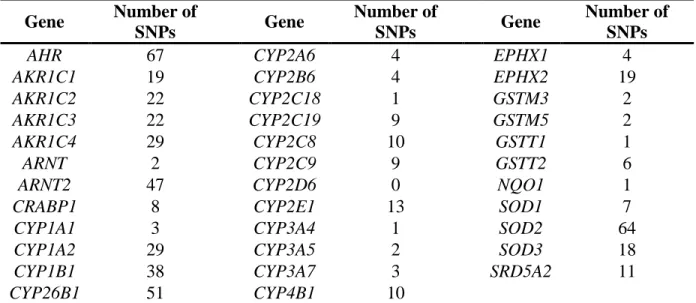
excluded by data cleaning procedure, 498 SNPs on the candidate genes selected were retained for candidate-gene analysis (CGA).
35
Table 2.1 Candidate genes (N = 35) and the number of SNPs (n = 498) tested for association with skin naphthyl-keratin adduct levels in fuel-cell maintenance workers using candidate-gene analysis.
Gene Number of
SNPs Gene
Number of
SNPs Gene
Number of SNPs
AHR 67 CYP2A6 4 EPHX1 4
AKR1C1 19 CYP2B6 4 EPHX2 19
AKR1C2 22 CYP2C18 1 GSTM3 2
AKR1C3 22 CYP2C19 9 GSTM5 2
AKR1C4 29 CYP2C8 10 GSTT1 1
ARNT 2 CYP2C9 9 GSTT2 6
ARNT2 47 CYP2D6 0 NQO1 1
CRABP1 8 CYP2E1 13 SOD1 7
CYP1A1 3 CYP3A4 1 SOD2 64
CYP1A2 29 CYP3A5 2 SOD3 18
CYP1B1 38 CYP3A7 3 SRD5A2 11
CYP26B1 51 CYP4B1 10
Note: The total number of SNPs is 537 in this table, because some SNPs are shared by more than one gene, only 498 independent SNPs were tested on 35 genes.
36
Yi 0 pXip qCiq gSigi g1
G
q1
Q
p1
P
(3)More than one SNP and significant covariates were selected as potential independent variables. STEPWISE selection was used in PROC REG to determine regression model 3 and model analysis was performed using the same methods as in model 1.
The relative contribution of each predictor in the final regression models were determined by the proportionate contribution that each predictor made to the regression model R2 using Pratt index, which is the product of its estimated standardized regression coefficient and the simple correlation between that predictor and the outcome variable (Chao et al. 2008; Pratt 1987). The relative contribution considered in this investigation is the dispersion importance, i.e., the proportion of the variance in outcome variable accounted for each predictor in the regression model.
2.3.7 Bioinformatic Analysis of Highly Associated SNPs and Network Interactions
37
were corroborated by further literature analysis of the predicted associations (formula available from MetaCore, GeneGo.com by request). Transcriptional factor binding sites (KLF6 and CREB1) on core promoter sequences of keratin 1 (KRT1) and keratin 10 (KRT10) target genes not identified in the peer-reviewed literature were predicted by Genomatix TransFac MatInspector (Cartharius et al. 2005) to confirm KLF6 and CREB1 transcription factor binding sites in the promoter region of epithelial KRT1 and KRT10. Briefly, the KLF6 and CREB1 transcription factor binding site sequence identified on keratin 12 (KRT12) (Chiambaretta et al. 2002; Wang et al. 2002) was used to weight and develop a training set to interrogate similarity matrices and to identify predicted binding sites. Ultimately, the significance of the candidate variant genes must be functionally established by further genetic and molecular analysis.
2.4 Results
2.4.1 Study Population and Exposure Measurements
After data cleaning, there were 184,153 SNPs and 102 workers available for association analyses. The workers included 94 males (92.2%) and 8 females (7.8%) of whom 89 were Caucasians (87.3%), 13 were non-Caucasians (African-American, Hispanic, or Asian; 12.7%), and 45 were smokers (44.1%). The average age of the workers was 24.6 ± 5.0 years and ranged from18 – 40 years.
The geometric mean (GM) and geometric standard deviation (GSD) of dermal
38
1.5, 2.1 ± 1.5, and 2.8 ± 1.5 pmole adduct/µg keratin, respectively. The GM for 1NKA level was significantly different (P < 0.0001) from that of 2NKA level. Covariates for dermal exposure, exposure time, age, ethnicity, and the task replacing foam, were significantly associated with 2NKA and TNKA levels (Table 2.2, all P < 0.094). However, smoking, but not ethnicity, was significantly associated with 1NKA level (Table 2.2, P < 0.086). CGA and GWA for significant SNPs were performed for 2NKA and TNKA levels by controlling for the significant covariates age, exposure time, dermal exposure, ethnicity, and the task replacing foam. In association analyses for 1NKA level, ethnicity was replaced with smoking status. Due to missing exposure time information for 2 subjects, 100 subjects were included in the CGA and GWA models.
Table 2.2 Regression analyses of the significant covariates for the skin naphthyl-keratin adduct levels [ln(ng adduct/µg keratin)] in the U.S. Air Force personnel (n = 100) exposed to jet fuel.
Adduct R2 Predictor Parameter Estimate Standard Error P-value
1NK 0.271 Intercept -0.416 0.285 0.147
Dermal exposure -0.033 0.019 0.083
Age -0.018 0.008 0.020
Exposure time 0.002 0.001 0.013
Replace foam 0.325 0.087 0.0003
Smoking 0.132 0.076 0.086
2NK 0.353 Intercept 0.633 0.239 0.010
Dermal exposure -0.052 0.016 0.001
Age -0.017 0.006 0.008
Exposure time 0.004 0.001 <0.0001
Replace foam 0.147 0.072 0.043
Ethnicity -0.173 0.094 0.068
TNK 0.354 Intercept 0.941 0.234 0.0001
Dermal exposure -0.047 0.015 0.003
Age -0.017 0.006 0.007
Exposure time 0.004 0.001 <0.0001
Replace foam 0.186 0.070 0.009
Ethnicity -0.155 0.092 0.094
39
2.4.2 Candidate-gene Analysis
Based on the corrected P-values at -level 0.1, one SNP (rs4852279, MAF = 0.451) related to CYP26B1 was significantly associated with 2NKA level (adjusted permutation P = 0.0449, Bonferroni P = 0.0515). No SNPs were observed to be significantly associated with 1NKA or TNKA level. This model, which included SNP rs4852279 (related to CYP26B1) and other five covariates significantly affecting 2NKA level, explained about 45% of the total variation in the observed 2NKA level (R2 = 0.450). As described by this model, the relative contribution of this SNP was 19%, which was greater than the individual contributions of dermal exposure itself, the task replacing foam, age, or ethnicity alone.
2.4.3 Genome-wide Analysis
40
41
42
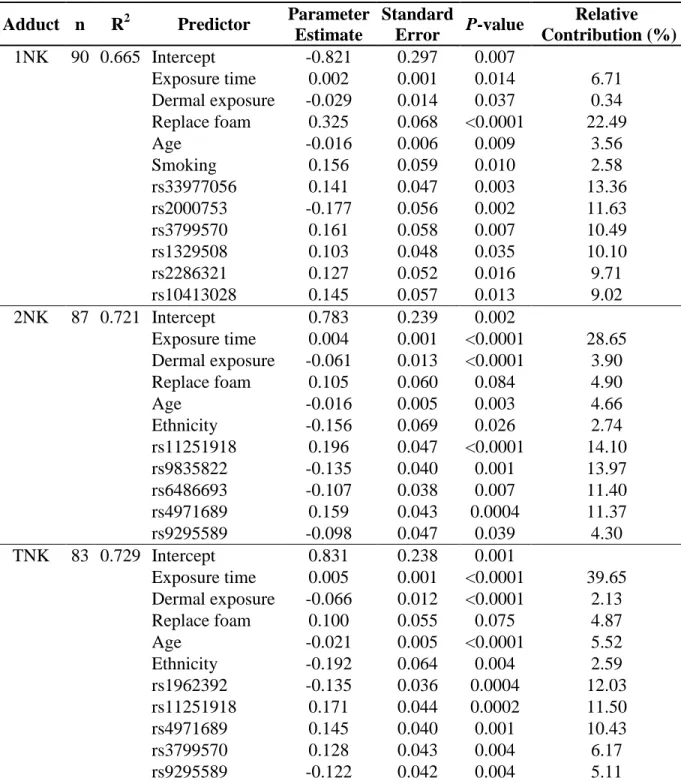
Table 2.3 Regression models for skin naphthyl-keratin adduct levels measured in the fuel-cell maintenance workers using genome-wide analysis.
Adduct n R2 Predictor Parameter Estimate
Standard
Error P-value
Relative Contribution (%) 1NK 90 0.665 Intercept -0.821 0.297 0.007
Exposure time 0.002 0.001 0.014 6.71
Dermal exposure -0.029 0.014 0.037 0.34 Replace foam 0.325 0.068 <0.0001 22.49
Age -0.016 0.006 0.009 3.56
Smoking 0.156 0.059 0.010 2.58
rs33977056 0.141 0.047 0.003 13.36
rs2000753 -0.177 0.056 0.002 11.63
rs3799570 0.161 0.058 0.007 10.49
rs1329508 0.103 0.048 0.035 10.10
rs2286321 0.127 0.052 0.016 9.71
rs10413028 0.145 0.057 0.013 9.02
2NK 87 0.721 Intercept 0.783 0.239 0.002
Exposure time 0.004 0.001 <0.0001 28.65 Dermal exposure -0.061 0.013 <0.0001 3.90
Replace foam 0.105 0.060 0.084 4.90
Age -0.016 0.005 0.003 4.66
Ethnicity -0.156 0.069 0.026 2.74
rs11251918 0.196 0.047 <0.0001 14.10
rs9835822 -0.135 0.040 0.001 13.97
rs6486693 -0.107 0.038 0.007 11.40
rs4971689 0.159 0.043 0.0004 11.37
rs9295589 -0.098 0.047 0.039 4.30
TNK 83 0.729 Intercept 0.831 0.238 0.001
Exposure time 0.005 0.001 <0.0001 39.65 Dermal exposure -0.066 0.012 <0.0001 2.13
Replace foam 0.100 0.055 0.075 4.87
Age -0.021 0.005 <0.0001 5.52
Ethnicity -0.192 0.064 0.004 2.59
rs1962392 -0.135 0.036 0.0004 12.03
rs11251918 0.171 0.044 0.0002 11.50
rs4971689 0.145 0.040 0.001 10.43
rs3799570 0.128 0.043 0.004 6.17
rs9295589 -0.122 0.042 0.004 5.11
43
2.4.4 Bioinformatics
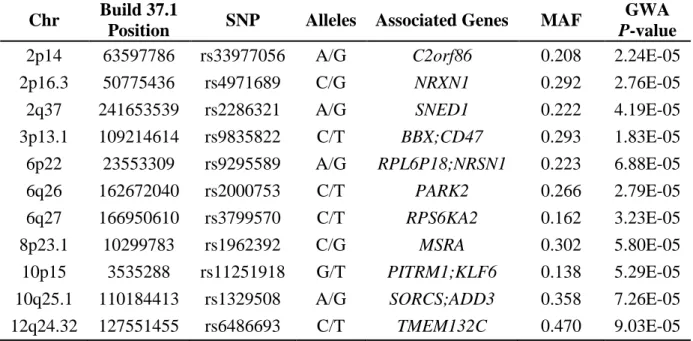
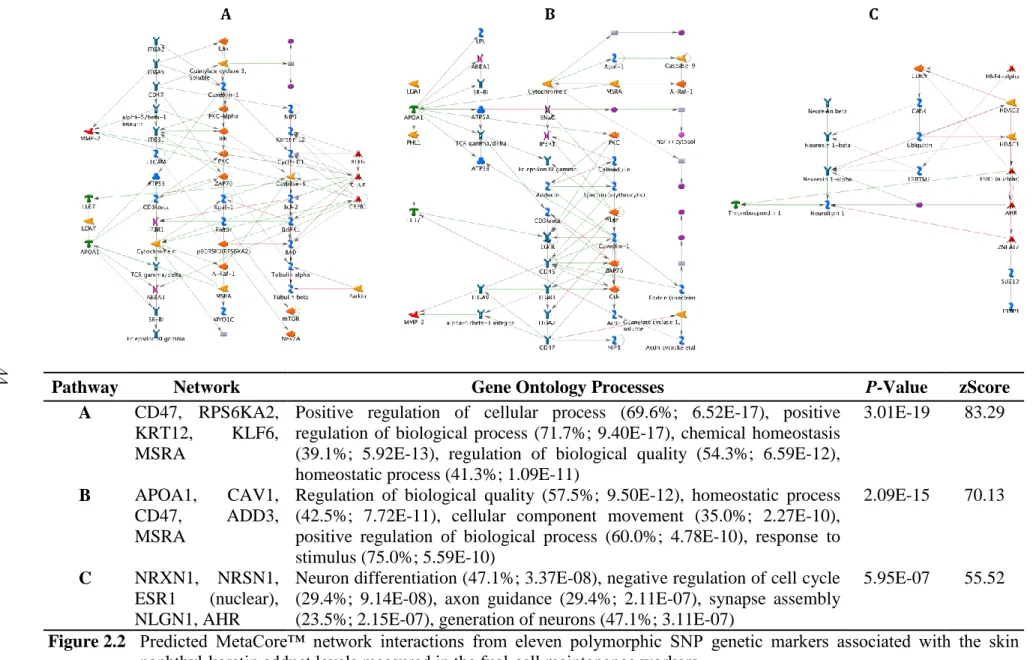
Eleven SNPs (Table 2.4) were identified by GWA and MLRM analyses and associated with skin NKA levels measured in the fuel-cell maintenance workers. Eight of these highly associated SNPs were within or proximate to their most likely associated cis-related genes (ADD3, CD47, RPS6KA2, KLF6, PARK2, MSRA, NRSN1, and NRXN1) that possibly interact through 3 networks predicted (Figure 2.2) by observed interactions as presented in the curated literature (Metacore, GeneGo.com).
Table 2.4 SNP variants and genes associated with the naphthyl-keratin adduct levels and the other significant covariates affecting naphthalene exposure in the fuel-cell maintenance workers as identified by genome-wide analysis and multiple linear regression models.
Chr Build 37.1
Position SNP Alleles Associated Genes MAF
GWA
P-value
2p14 63597786 rs33977056 A/G C2orf86 0.208 2.24E-05
2p16.3 50775436 rs4971689 C/G NRXN1 0.292 2.76E-05
2q37 241653539 rs2286321 A/G SNED1 0.222 4.19E-05
3p13.1 109214614 rs9835822 C/T BBX;CD47 0.293 1.83E-05
6p22 23553309 rs9295589 A/G RPL6P18;NRSN1 0.223 6.88E-05
6q26 162672040 rs2000753 C/T PARK2 0.266 2.79E-05
6q27 166950610 rs3799570 C/T RPS6KA2 0.162 3.23E-05
8p23.1 10299783 rs1962392 C/G MSRA 0.302 5.80E-05
Pathway Network Gene Ontology Processes P-Value zScore A CD47, RPS6KA2,
KRT12, KLF6, MSRA
Positive regulation of cellular process (69.6%; 6.52E-17), positive regulation of biological process (71.7%; 9.40E-17), chemical homeostasis (39.1%; 5.92E-13), regulation of biological quality (54.3%; 6.59E-12), homeostatic process (41.3%; 1.09E-11)
3.01E-19 83.29
B APOA1, CAV1,
CD47, ADD3,
MSRA
Regulation of biological quality (57.5%; 9.50E-12), homeostatic process (42.5%; 7.72E-11), cellular component movement (35.0%; 2.27E-10), positive regulation of biological process (60.0%; 4.78E-10), response to stimulus (75.0%; 5.59E-10)
2.09E-15 70.13
C NRXN1, NRSN1,
ESR1 (nuclear), NLGN1, AHR
Neuron differentiation (47.1%; 3.37E-08), negative regulation of cell cycle (29.4%; 9.14E-08), axon guidance (29.4%; 2.11E-07), synapse assembly (23.5%; 2.15E-07), generation of neurons (47.1%; 3.11E-07)
5.95E-07 55.52
Figure 2.2 Predicted MetaCore™ network interactions from eleven polymorphic SNP genetic markers associated with the skin naphthyl-keratin adduct levels measured in the fuel-cell maintenance workers.
45
46
been associated by epidemiologic genome-wide association studies (GWAS) with a number of diseases (Liu et al. 2010; Spinola et al. 2007). MSRA, a cytosolic methionine-S-sulfoxide reductase, carries out the enzymatic reduction of methionine sulfoxide to methionine and MSRA genes are differentially expressed in human skin (Taungjaruwinai et al. 2009). This
enzyme functions are to repair of oxidative damage to proteins and to restore biological activity. RA regulates MSRA expression via two promoters and three transcript variants encoding different isoforms have been observed that may alter function or tissue specificity (Pascual et al. 2009).
47
component of high-density lipoprotein (HDL) in plasma. This protein promotes cholesterol efflux from tissues to the liver and intestine for excretion. Two cysteine disulfide bonds are required for ABCA1 transport of APOA1 and are thus potential sites of adduction (Hozoji et al. 2009). CAV1 encodes a scaffolding protein, which is the main component of the caveolae plasma membranes found in most cell types. This protein links integrin subunits to the tyrosine kinase FYN, an initiating step in coupling integrins to the RAS-ERK pathway and promoting cell cycle progression (Wary et al. 1998).
48
insulators or they may provide targets for adduction due to their cysteine rich protein structure. In the skin, we can speculate that tissue specific relaxation of expression might have an effect on membrane transport and/or epidermal keratinocyte differentiation.
The other three SNPs in or proximate to genes (SNED1, TMEM132C, and C2orf86,), although significant SNP associated genes in the GWA, either has no known relevant function to skin or appear to be structural proteins integral to cell or basement membranes. Both NRXN1 and SNED1 appear to be independent of any known cellular functions in the skin. However, the proteins might represent targets for adduction due to the number of cysteine residue targets. SNED1 is involved in the regulation of cell-matrix adhesion and calcium ion binding (Strausberg et al. 2002). TMEM132C is a structural transmembrane protein, found in undifferentiated neuronal progenitor cells, whose expression is also controlled by the REST transcription factor (Rock et al. 2007) and it is thought that it may act as a master negative regulator of neurogenesis. C2orf86 has no known function reported in the scientific literature at this time (Katayama et al. 2005)
2.5 Discussion
49
an increased power to detect quantitative associations in well-defined exposed populations compared to using a binary case-control outcome (i.e., disease) with less well-defined covariates.
Previously, we demonstrated that human skin expresses xenobiotic metabolism enzymes and that naphthyl-keratin adducts are formed in response to naphthalene exposure that can be quantitatively measured in the exposed skin of workers and used as biomarkers of dermal exposure to jet fuel (Sickel et al. manuscript; Sickel et al. 2008; Kang-Sickel et al. 2010). Further, we examined the effects of four a priori selected metabolic genotypes (CYP2E1, GSTM1, GSTT1, and NQO1) on the measured TNKA levels in the skin and on the urine biomarker levels using linear regression modeling (Kang-Sickel et al. manuscript). We observed that the TNKA level, post-exposure breath naphthalene level, as well as the presence of GSTT1-plus (++/+-) and CYP2E1*6 wild-type (DD at the DraI restriction site of intron 6) significantly influenced urine naphthalene levels. However, we also observed that the effect sizes of the personal and environmental factors, such as exposure duration and dermal naphthalene level, might outweigh the effect associated with these metabolic genotypes. These results demonstrate the complexity and difficulty to investigate the role of individual variability and susceptibility factors along with quantitative exposure measurements to understand on the potential health effects of environmental hazards.
50
contribution of this SNP genetic marker to skin NKA level may be related to CYP26B1 function in the control of all-trans-retinoic acid (RA). CYP26B1 gene encodes an enzyme involved in the inactivation of RA to hydroxylated forms, such as 4-oxo-, 4-OH-, and 18-OH-RA. RA is a regulator of epidermal proliferation and differentiation. RA also induces keratinocyte proliferation and, thus, epidermal hyperplasia (Giltaire et al. 2009). RA is the only recognized substrate of CYP26B1 detected in human skin, mainly in the epidermal basal layer (Ray et al. 1997). RA has shown to inhibit mRNA and protein expression of KRT10 in autocrine high-cell density cultures of epidermal keratinocytes in vitro (Poumay et al. 1999). The variations in CYP26B1 expression may result in different levels of RA in the skin leading to differences in KRT10 protein through keratin expression and, thus, impact the skin NKA levels observed in this study.
51
SNP probe array such as Affymetrix Genome-wide Human Array 6.0 (genotyping more than 906,000 SNPs) could be used in future studies. In addition, imputation could be applied to provide a route to testing additional SNPs without further genotyping. SNPs can be imputed with considerable reliability from the HapMap panel (Collins 2009). Imputation has the potential to improve the fine mapping resolution in candidate regions.
52
their joint actions are likely to have a significant risk effects. The predicted pathway and networks show that the identified SNP associated genes are not independent but may interact with each other and that they can work collectively through meaningful biological processes to contribute to the skin NKA levels in exposed workers. The significant SNP variants identified in this study are highly associated with the regulation of cellular processes and homeostasis and may also provide targets for adduction by naphthalene electrophilic metabolites. These identified genetic associations need to be replicated and their biological functions must be validated. Thus, this discovery study has generated new information on the potential biological functions of genetic factors affecting biomarker levels in the JP-8 exposed workers.
53
both skin NKAs, and the use of MLRMs including 10 SNPs with the lowest P-values provided one way to construct a final exposure model and investigate the contributions of multiple SNPs to biomarker levels. The pathway and network analyses of multiple SNPs associated genes in the final models provide one way to identify biological processes that may be critical to determine the observed biomarker levels among exposed workers, without missing important pathways due to stringent threshold.
54
have significant size effects include heritable variation in traits that may not be associated with exposure to xenobiotics. For example, heritable differences in blood pressure (essential hypertension) and respiratory rate and capacity may strongly influence the absorption, distribution, and clearance of metabolites (biomarkers) and may even be greater than the effects of metabolism. This may especially be the case for tissues with limited phase 1 and 2 metabolism, like the skin where metabolism may be restricted to the suprabasal cell layer of the epidermis.
55
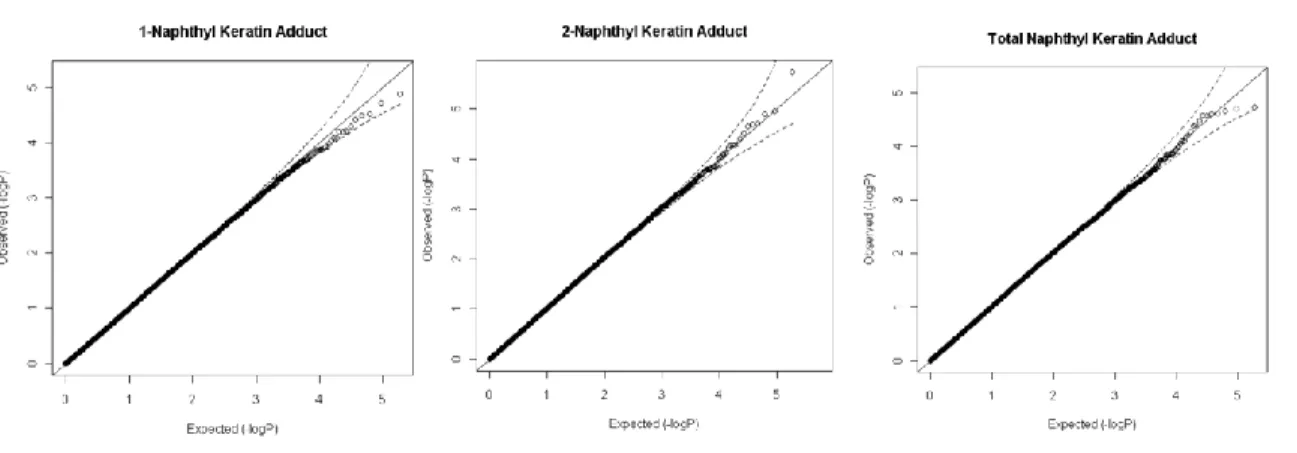
Figure 2.3 Quantile-quantile plots of genome-wide association analysis of the observed versus expected –log10P values. The results of observed association between the quantitative skin naphthyl-keratin adduct levels are plotted against the 184153 SNPs and the expected distribution of the –log10P under null hypothesis of no association (dash line 95% confidence level).
Our sample size was small compared with a typical GWAS case-control study aimed to map disease marker. The small effect size of complex diseases requires larger sample size to get enough statistical power. However, our study population is well defined in that specific quantitative environment characteristics were measured (such as dermal and inhalation exposure data) and the exposure was prevalent and assessed with a great accuracy. Furthermore, intermediate quantitative traits were used instead of binary disease status, which is more objective (less misclassification), more informative, and can increase statistical power several fold (Potkin et al. 2009b). Nevertheless, large sample size would provide more power with well-defined and quantitative traits.
56
selecting false positives by further testing groups of highly associated candidate genes by testing for gene-gene interactions in the curated literature. Three predicted networks were obtained that suggest these SNP variants are highly associated with regulation of cellular processes and homeostasis and that may provide targets for adduction by naphthalene electrophilic metabolites. The biological functions of SNP associated genes must be validated by genetic and molecular analysis. For example, the relationship between KLF6 and KRT1/KRT10 can be tested using miRNA knockdown of KLF6 in human skin tissue constructs and the exposure to relevant exposure levels to naphthalene. Also, a potential strategy is a two-stage design and independent replication of samples to confirm study findings (Collins 2009). Two-stage design and replication of the initial findings in follow-up studies can reduce the false-positive results and artifacts of the technique if a different analytical technique is applied in a second matched set of well-characteristic samples. However, replication is not easily achievable in that the populations are exposed to very different levels (i.e., not many other populations with similar levels of environmental exposure) (Vineis et al. 2009). To conclude, this study should be regarded as a discovery study that can generate new hypotheses on the biological functions of potential genetic factors affecting biomarker levels. Ultimately, only independent replication of these studies with increased sample size and/or functional validation of the candidate gene allelic variants will provide proof.
2.6 Conclusions
57
CHAPTER 3. PAPER II: SINGLE NUCLEOTIDE POLYMORPHISMS
ASSOCIATED WITH URINARY BIOMARKER LEVELS IN WORKERS EXPOSED TO JET FUEL
Rong Jiang, John E. French, Vandy I. Stober, Mary Ann Butler, Fei Zou, Yi-Chun E. Chao,
Stephen M. Rappaport, Berrin Serdar, Peter Egeghy, and Leena A. Nylander-French (manuscript)
3.1 Abstract
59
thyroid hormone metabolism, which may be associated in homeostatic mechanisms affecting the mass movement of naphthalene metabolites into the cells of tissues. We report here a method and strategy to investigate the role of individual genetic variation in the quantitative assessment of urine biomarker levels in a small well-characterized exposed worker population. These tools have the potential to provide biological plausibility to explain the relevance of their impact on the biomarker level, mechanistic insight into the etiology of exposure related disease, and to identify susceptible subpopulation with respect to exposure..
3.2 Introduction
60
individual genetic differences as a potential modifier in exposure assessment models of small well-characterized populations.
Single nucleotide polymorphisms (SNPs) are the commonest and simplest form of human genetic variations, and new dense genotyping and sequencing methods along the allelic frequency of SNPs makes it possible to identify SNPs highly associated with quantitative biological phenotypes. SNP association test can be performed to discover genetic variants that may give rise to a variation in a phenotype under investigation. We postulate that it will be more informative to map intermediate steps associated with the disease processes (i.e., intermediate phenotypes), rather than use the binary case/control disease status with genetic marker loci (Chen et al. 2008; Emilsson et al. 2008; Keller et al. 2008; Kim and Xing 2009; Kim et al. 2006). The intermediate quantitative traits are more directly influenced by the genetic variations and thus provide detailed insight to the relationship between genetic variations and toxicity and/or disease phenotype. Furthermore, the use of binary outcome decreases the resolution of the association substantially since large variability in outcome is not captured using dichotomous case-control variables, especially in an exposure assessment study. A systemic exposure level (e.g., urine metabolite level) may be used as an intermediate quantitative trait when investigating association between biomarker level and individual susceptibility to toxicity and/or disease to improve the resolution compared to only using binary disease outcomes.
61
in worker with c1/c1 genotype of CYP2E1 than those with c1/c2 or c2/c2 genotype. The levels of 2-naphthol were also higher in GSTM1 null workers than in GSTM1 positive workers. CYP1A1*2 allele has been considered as a risk marker for PAH-related cancers associated with occupational exposure due to its greater capacity to activate PAHs (Lee et al. 2001; Nerurkar et al. 2000). Mixed-function oxygenases have been shown to be expressed in the liver during the metabolism of PAH: CYP1A1 (Kim et al. 2004; Lee et al. 2001), CYP1A2 (Castorena-Torres et al. 2005; Kim et al. 2004), CYP1B1 (Kim et al. 2004), CYP2E1 (Farin et al. 1995; Nan et al. 2001), CYP3A5 (Gabbani et al. 1999; Piipari et al. 2000). Conjugating enzymes, such as GSTM1, are also highly expressed in this tissue (Gabbani et al. 1999; Godschalk et al. 2001; Lee et al. 2001; Nan et al. 2001). The expression of various genes related to antioxidant responses and detoxification, including those for glutathione-S-transferase (GST) and cytochrome P450 (CYP) proteins, were upregulated after exposure to JP-8 (Espinoza et al. 2005). The functional status of these enzymes and their relative contribution to the metabolites may be critical to the understanding of individual variations in responses to jet fuel exposure. In addition to these metabolic enzymes, other gene expressions in regulatory regions are altered after exposure of jet fuel. For example, genes involved in basal transcription and translations were upregulated in human epidermal keratinocytes, whereas genes related to DNA repair were mostly downregulated (Chou et al. 2006). Genes coded for growth factors, apoptosis, signal transduction, and adhesion were also altered (Chou et al. 2006).
62
using an association study tandem with multiple linear regression modeling (Jiang et al. manuscript). We also provided evidence that individual genetic differences and the impact of personal and workplace factors on the measured biomarker levels should not be ignored when investigating factors (personal and environmental) that may affect the outcome in epidemiology studies (Jiang et al. manuscript). Here, our goal was to investigate the relative contribution of individual genetic differences associated with urine biomarker levels (i.e., systemic exposure biomarkers) in this same worker population in order to account for the contribution of both dermal and inhalation exposure routes.
3.3 Methods
3.3.1 Study population
Exposure data was available from the assessment of dermal and inhalation exposures to jet propulsion fuel 8 (JP-8) in the personnel at six U.S. Air Force (USAF) bases in the continental United States (Chao et al. 2005; Chao et al. 2006; Egeghy et al. 2003). Workers who routinely worked or were exposed to JP-8 were recruited with informed consent from active duty USAF personnel. Approval for human subject use was obtained from the institutional review board for the USAF and for each of the participating investigators, and the study complied with all applicable U.S. requirements and regulations.


![Table 2.2 Regression analyses of the significant covariates for the skin naphthyl-keratin adduct levels [ln(ng adduct/µg keratin)] in the U.S](https://thumb-us.123doks.com/thumbv2/123dok_us/8282367.2193382/50.918.121.821.616.1050/table-regression-analyses-significant-covariates-naphthyl-keratin-keratin.webp)