PREDICTING MAXIMUM OXYGEN UPTAKE (VO2max) USING A DYNAMICAL SYSTEMS MODEL IN ACUTE LEUKEMIA PATIENTS
Erin McMullen
A thesis defense submitted to the faculty of the University of North Carolina at Chapel Hill in partial fulfillment of the requirements for the degree of Masters of Arts in the Department of
Exercise and Sport Science (Exercise Physiology).
Chapel Hill 2016
Approved By: Claudio Battaglini
Edgar Shields Ashley Leak Bryant
ABSTRACT
ERIN MCMULLEN: Predicting maximum oxygen uptake (VO2max) using a dynamical systems model in acute myeloid leukemia patients.
(Under the direction of Claudio Battaglini)
PURPOSE: To determine if a dynamical systems model can estimate VO2max using data from a CPET on a cycle ergometer in acute leukemia patients prior to treatment. METHODS: Seventeen patients performed a CPET. The VO2peak obtained during the CPET and predicted values from the dynamical systems model were compared using paired samples t-tests. RESULTS:
TABLE OF CONTENTS
LIST OF TABLES ...vii
CHAPTER ONE: INTRODUCTION ...1
Background ...1
Statement of Purpose ...6
Research Question ...6
Hypothesis...6
Definition of Terms ...7
Assumptions ...8
Limitations ...8
Delimitations ...8
Significance ...8
CHAPTER TWO: REVIEW OF LITERATURE ...10
Cardiopulmonary Exercise Testing ...10
Prognostic Value Of VO2 ...11
Current Issues with Cardiopulmonary Testing ...13
Non-exercise VO2 Prediction Equations ...14
Dynamical systems Mathematical Prediction Models ...15
CHAPTER THREE: METHODS ...17
Instrumentation ...18
Research Design ...19
General Procedures ...20
Cardiopulmonary Exercise Test ...20
Oxygen Uptake Data ...20
Dynamical systems Prediction Model ...21
Statistical Analysis and Design ...22
CHAPTER FOUR: RESULTS ...23
Overview ...24
Subjects ...24
Hypotheses ...25
Exploratory Analyses ...26
CHAPTER FIVE: DISCUSSION ...28
Overview ...28
Dynamical systems Prediction Model ...32
Non-exercise Estimation Equation ...33
Comparison Between Dynamical Systems Model and Non-exercise estimation equation ...34
Exploratory Analyses ...35
Limitations ...38
Conclusion ...38
Recommendations for Future Research ...39
APPENDIX I: DYNAMICAL SYSTEM TIME SERIES PLOT 1 ...41
LIST OF TABLES
CHAPTER I INTRODUCTION
Acute myeloid leukemia (AML) is a hematological cancer that results in the bone marrow producing abnormal red blood cells, white blood cells, or platelets (NCI, 2015). AML most commonly occurs in men over the age of 60, with a history of smoking, and a previous history of chemotherapy or radiation treatment (ACS, 2016). It is estimated that there will be over 60,140 incident cases of leukemia in the United States in 2016, of which 19,950 are expected to be AML. In 2014, U.S. cancer surveillance data showed that nearly half of the 24,400 reported leukemia mortalities were in patients with AML (ACS, 2016).
The most common initial phase of treatment for AML patients is inpatient induction chemotherapy. The objective of induction chemotherapy is to eliminate all cancerous cells from the blood and bone marrow. Patients are generally admitted to the hospital to receive intravenous chemotherapy for a week, followed by an extended
To date, there have only been a few studies that have explored the efficacy of exercise as a treatment modality to lessen the burden of treatment and mitigate the impact of the negative side effects to improve patient outcomes, functionality, and quality of life in this cancer population. Four prominent studies of exercise interventions have found consistent evidence of improved outcomes in AML patients. The first recorded exercise intervention in an AML patient population was an exercise program of five days of walking in one week (Chang, 2008) and found reduced fatigue, anxiety, depression, and improved walking distance (2008). In 2009, Battaglini et al. conducted an exercise
intervention consisting of aerobic and resistance training twice daily, three days a week in 10 patients with acute leukemia. Aerobic exercise was conducted at 60% heart rate
reserve (HRR).The authors reported reduced fatigue, depression, and increased
According to the American Heart Association, cardiopulmonary functional
capacity reflects an individual’s ability to perform tasks of daily living as well as quantify exercise tolerance and is usually expressed as maximal oxygen uptake (VO2max) (Arena, 2007). The gold standard way to assess cardiopulmonary function capacity is through a cardiopulmonary exercise testing (CPET) with indirect calorimetry. However, this type of testing requires expensive and specialized equipment, and trained personnel. Therefore, the assessment of cardiopulmonary function capacity is not always available in many different clinical settings, making it very difficult for clinicians, exercise specialists, and other health care professionals to benefit from using the results of such test for the initial assessment, prescription of exercise, and most recently, as a prognostic tool for post-treatment complications and mortality in certain cancer populations (Jones et al. 2010, Wood et al, 2013).
An alternative method that can be used for the assessment of VO2max is to perform submaximal CPET and use the results of these types of tests to estimate VO2max. These types of tests are usually based on heart rate response and its relationship to different exercise intensities. By plotting the heart rate response during the final two stages of a submaximal test, and extrapolating the results using linear mathematical equations, one can estimate VO2max. However, this relies on the assumption that HR will respond linearly to different increments of exercise intensity. Another assumption is that
Grant (1995) found that submaximal CPETs using a cycle ergometer under-predicted VO2peak by 7.8 mL/kg/min. This estimate is not only outside the accepted standard error of measurement of 2 mL/kg/min, but clinically significant when
considering using the results of such tests for the precise assessment of cardiorespiratory function or to use the results of such tests for the prescription of aerobic exercise.
While it is important to avoid overexertion within clinical populations that are sick or recovering from treatments, such as patients with hematological cancer, it is critical to conduct training at a level sufficient to elicit the response necessary to induce positive adaptations. This presents the need for a method to predict VO2max with the precision of a max test, but with the limited effort of submaximal testing, so it can be available to clinicians, researchers, exercise physiologists and health care providers using aerobic exercise to improve the health and functionality, and use the results of such tests to inform better treatment practices.
Previous prediction models have tried to predict VO2max using skinfolds and body mass index (BMI) instead of exercise testing (Jackson, 1990). The standard of error of these types of models are usually around 5.3 mL/kg/min with skinfolds and 5.6
mL/kg/min, with BMI. This was determined to be appropriate for 95% of the adult population, but is remains too variable for use in a clinical population.
In 2008, Stirling et al. developed a dynamical systems mathematical model to predict maximum VO2max. The theory behind this type of model is that the
cardiorespiratory system is always working to reach equilibrium between demand and cardiac output. There is an absolute minimum heart rate for each individual and a
and a transient value that changes as a function of demands placed on the system (exercise). Mazzoleni, Battaglini, and Mann in 2015 (paper in review) further adapted this model to define demand as a function of power (Watts) and cadence pedaling on a cycle ergometer. In order to predict VO2max, participants perform a submaximal exercise test and the subsequent values are entered into the model. The model calculates
individual parameters that account for and are dependent on the values from the test. A genetic algorithm generates hundred of possible parameters and is run to determine the parameters that best fit the model. Through the application of the algorithm, the
parameters are individualized to the person’s performance during testing, and therefore removing the need for any physiological variables such as age, sex, and body mass as well as assumptions that all individuals respond the same physiologically to exercise such as heart rate and oxygen uptake responses. This initial approach tested in healthy young individuals using a cycle ergometer, showed promise, since it would estimate VO2max with a level of precision much superior to currently submaximal CPETs and extremely accurately when compared to gold standard CPET.
Based on the preliminary results of Mazzoleni, Battaglini, and Mann (2015), math model prediction using dynamical systems, exploring this testing concept in a clinical population such as patients with hematological cancers, where physiological changes due to disease and treatment are constantly occurring, may provide insight on the true
Statement of purpose:
The purpose of this study was to determine if a dynamical systems model can accurately estimate VO2max using data obtained during a maximal cardiopulmonary exercise test (CPET) performed on a cycle ergometer in acute myeloid leukemia patients prior to receiving induction chemotherapy treatment.
Research Questions:
R1: Can a dynamical systems model accurately predict VO2max in acute myeloid leukemia patients using all of the data obtained from a CPET prior to beginning chemotherapy treatment?
R2: Can a non-exercise prediction equation accurately estimate VO2max in acute myeloid leukemia patients using anthropometric data, body fat percentage or BMI?
R3: Can a dynamical systems model more accurately predict VO2maxk in acute myeloid leukemia patients data obtained from a CPET performed on a cycle ergometer than a non-exercise prediction equation?
Research Hypotheses:
H2: There will be no significant difference in difference between the non-exercise equation predicted VO2max using anthropometric data (percent body fat or BMI) from baseline testing and VO2peak values attained during a CPET performed on a cycle ergometer.
H3: There will be no significant difference between VO2max values between the dynamical systems model estimation using all data from a CPET test and the VO2max value estimated using a non-exercise estimation equation using percent body fat or BMI.
List of Abbreviations and Definition of Terms:
Acute myeloid leukemia (AML): A type of leukemia that affects the bone marrow and causes the production of abnormal red blood cells, white blood cells, or platelets (NCI, 2005).
Cardiopulmonary exercise test (CPET): Incremental or graded exercise test using indirect calorimetry to determine maximal oxygen consumption (VO2max).
Maximal oxygen consumption (VO2max): The body’s maximal ability to intake and utilize oxygen, and remove waste products during exercise.
VO2 peak: The highest oxygen uptake (VO2) achieved by a patient during a CPET. For this study, the 3 highest values of oxygen uptake during the last stage of the CPET will be averaged to derived the maximal oxygen uptake value achieved during the tests and will be used for comparison with the math prediction model.
Assumptions:
1. All patients followed pre-assessment guidelines prior to CPET. 2. All patients gave maximal effort during CPET.
3. The dynamical systems model determines the best set of individual parameters. Limitations:
1. Relatively small sample size.
2. Generalizability to other clinical populations as well as general population. Delimitations:
1. Patients over the age of 21.
2. Recently diagnosed with acute myelogenous or acute lymphocytic leukemia, but not yet receiving induction chemotherapy.
3. Approved by oncologist to participate in CPET.
4. No pre-existing condition or comorbidity that would increase the risk of performing CPET.
Significance of the study:
This model could be instrumental in prescribing more appropriate training
intensities for exercise interventions in AML patients without having patients to undergo a maximal cardiopulmonary exercise test. The dynamical systems model allows for individualization of results, without needing to account for individual physiological differences because these differences manifest in their transient VO2 responses at various power outputs and cadences during a CPET that are capture and incorporated in the prediction model. The individualization of the prediction provides more accurate
accurately prescribe exercise intensity for aerobic training programs. Within AML
CHAPTER II
REVIEW OF LITERATURE
Cardiopulmonary Exercise Testing
Maximal oxygen consumption (VO2max) is considered the best way to measure the capacity of the cardiovascular and pulmonary systems and assess aerobic capacity as well as physical fitness (Brooks, Fahey, Baldwin, 2005). The current gold standard method for measuring VO2max is a cardiopulmonary exercise test (CPET). In 2003, the American Thoracic Society and American College of Chest Physicians released a joint statement on the use of cardiopulmonary exercise testing including indications for use,
implementation, interpretation and clinical application. The purpose of this statement was to standardize measurements and provide guidelines for testing, as well as the
interpretation of results. The American Heart Association also released a statement on conducting exercise testing that provides guidelines for certain clinical populations and focuses on the diagnostic and prognostic purposes of conducting a CPET (2007). These statements attempt to standardize measurements due to the variation amongst exercise tests including mode of exercise used protocol.
and performed under standard experimental conditions. In order to determine that an individual has achieved their maximum capacity, they must meet at least three of the following criteria: a high rate of perceived exertion, a respiratory exchange ratio exceeding 1.1, a blood lactate level greater than 8 mmoles, a plateau of VO2 even with increasing workloads, or a heart rate within 10 beats per minute of the age-predicated maximum heart rate (Powers, 2012). If the criteria for reaching VO2max have not been met, then the highest attained VO2 is considered the VO2peak.
Prognostic Value of VO2
Kavanagh, Mertens, and Hamm (2002) examined the predictive efficacy of exercise capacity measured directly by VO2peak in men participating in cardiac
In 2008, Jones et al. performed a systematic review of cardiorespiratory exercise testing in clinical oncology, according to the guidelines set forth in the ATS/ACCP statement. Of 852 potential citations, 90 were included in the review. Most of the reviewed studies involved operable disease, where testing was performed prior to surgery, and the majority of patients were women. In studies involving interventions, they were generally conducted during or after treatment. The authors concluded that in general, CPET was not optimum for these populations and data reporting standards did not comply with national guidelines. Suggestions for further research include
standardizing guidelines for exercise testing for patients with cancer.
In 2010, Jones et al. performed a prospective multisite study to assess the potential prognostic benefits of VO2peak in 398 non-small cell lung cancer (NSCLC) patients. The authors adjusted their results for age, sex, and all-cause mortality, and found that VO2peak was a strong predictor of survival. The underlying physiological mechanisms are unclear, but the authors suggest a possible explanation is an inverse relationship between cardiovascular performance and cardiovascular disease, as well as muscle atrophy and muscular endurance. The results of this study suggest that VO2peak can be a predictor of mortality, and improvement in VO2 should be a goal to improve post-treatment outcomes. In a subsequent study in the same population, Jones examined the prognostic value of functional capacity and exercise in NSCLC patients (2012a). Patients performed a six-minute walk test and completed a questionnaire about their exercise habits. Functional capacity was found to be an independent predictor of all-cause
research into the efficacy of implementing exercise training to improve functional capacity.
Jones et al. also assessed VO2peak in four cohorts of breast cancer survivors: before treatment, during treatment, after adjuvant therapy for non-metastatic disease, and during treatment for metastatic disease (2012b). The authors’ previous conclusions were
supported by the results seen in this cancer population. They observed that women had significantly impaired cardiovascular function across all groups compared to healthy aged matched sedentary women. One third of the study population had a VO2max below the capacity required for functional independence (15.4 ml/kg/min). They also concluded that VO2peak might be a predictor of survivorship in metastatic disease, as patients with a VO2peak greater than or equal to 15.4 mL/kg/min had a higher probability of survival compared to patients with VO2peak less than 15.4 mL/kg/min
Current Issues with Cardiopulmonary Testing
In addition to the inherent limitations of maximal testing within specific clinical populations, it can also be resource-prohibitive due to the need for specialized equipment, trained personnel, and considerable time and space. Submaximal testing can be
conducted to reduce these constraints, but results in a loss of precision. Thus, there is a need for increased precision of maximal predictions derived from submaximal testing. In an attempt to address this lack of precision, Montoye et al. developed a multiple linear regression model to predict VO2max using output from submaximal testing as predictor variables (1986). They utilized a submaximal cycle ergometer test, a graded maximal treadmill test, and nonexercise data in their model. The authors determined that perceived functional ability (PFA) was the most statistically significant predictor of VO2max. They also found that their model was statistically more accurate than the YMCA bike protocol for the estimation of VO2max. Montoye et al.’s model accurately predicted VO2max, and was more precise when non-exercise variables were included.
Non-exercise VO2 Prediction Equations
In a subsequent study using data from the HUNT study, Nes et al. (2014) used previously established model to predict all-cause mortality among cardiovascular disease patients. They found that cardiorespiratory fitness was inversely related to mortality amongst men and women at baseline, after adjusting for potential confounders. These findings support the predictive nature of the model and its application for healthy or at-risk populations.
Dynamical systems Mathematical Prediction Models
In 2008, Stirling developed a non-exercise mathematical based prediction model. Stirling’s is a dynamical model of heart rate kinetics for predicting heart rate response to exercise. The model gives physiological information about the subject based on oxygen uptake and heart rate response as a function of time and intensity at all exercise
intensities based on physiological principals. One potential limitation of this study is that it does not account for individual variability in heart rate response to exercise by only examining constant intensities.
CHAPTER III METHODOLOGY
Population
The study population included seventeen patients recently diagnosed with acute
myelogenous or acute lymphocytic leukemia, who had participated in the Exercise and Quality of Life in Leukemia/Lymphoma Patients (EQUAL) phase II study. Patients included men and women between 28 and 69 years old. Eligible patients were admitted for induction chemotherapy treatment within 3 days of beginning treatment. Patients were informed of the EQUAL phase II study by their oncologists and approved to participate before being contacted by a research team member. Upon receiving further information regarding the study and agreeing to participate, patients signed an informed consent approved by the Lineberger Comprehensive Cancer Center Protocol Review Committee (LCCC 1234) and the University of North Carolina Institutional Review Board (IRB).
The inclusionary criteria for the EQUAL phase II study included: (1) at least 21 years old, (2) recently diagnosed with acute leukemia, (3) approved by an oncologist to participate in cardiopulmonary exercise testing (CPET), and (4) able to read and understand English.
Exclusionary criteria included any pre-existing conditions that would increase the risk involved of performing CPET such as: cardiovascular disease, respiratory disease, musculoskeletal disorders and disease, and/or altered mental or psychological state that could affect
determined by reviewing the patient’s medical history questionnaire and consulting with the patient’s oncologist.
The medical history questionnaire completed by patients prior to participation included a general medical history, as well as a detailed cancer history including previous and planned treatment. Prior to participating in the CPET, patients underwent a complete physical examination including a resting ECG and a Multigated Acquisition Scan (MUGA) to assess cardiovascular function.
Instrumentation
Maximum oxygen uptake (VO2max) and for those patients who weren’t able to achieve VO2max (VO2peak) and MHR achieved during the CPET will be used in this study from the initial cardiopulmonary test administered to these patients enrolled in the EQUAL phase II trial. CPET tests were performed using a cycle ergometer (Monark 874E, Goteborg, Sweden). Heart rate was measured using a Polar heart rate monitor (Polar Electro Inc., Lake Success, NY) and was recorded every 10 seconds. Blood pressure was assessed by auscultation using a
Research Design
This study used data from the EQUAL phase II trial (IRB # 13-1082), a pilot randomized clinical trial designed to test the effects of exercise on the alleviation of multiple treatment related side-effects commonly developed in acute leukemia patients undergoing cancer
treatments, including fatigue, loss of body mass with significant loss of muscle mass, depression, anxiety; which are common side-effects observed in this cancer population during induction phase of treatment along with other side-effects that occurs in a more patient specific basis . These side effects are known to significantly reduce the quality of life of this cancer population. All patients enrolled in the EQUAL phase II trial, underwent a CPET test prior to beginning chemotherapy treatment. The heart rate (HR) and oxygen uptake data obtained during the CPET were used to devise an estimation of maximum VO2 using mathematical modeling (dynamical systems) and compared to the maximum values obtained from the CPET for oxygen uptake. General Procedures
Upon being determined eligible for the study and cleared by an oncologist to participate, the EQUAL phase II study, the study procedures were explained in full to all patients, and if interested in participating in the study, patients were asked to sign an informed consent form. The study protocol included a number of baseline physical, functional, and psychosocial
assessments, however, only data obtained from CPET (Oxygen uptake and HRs collected during the test) will be used for the current study. Patients enrolled in the EQUAL phase II study were randomized into a standard treatment control group, and an intervention group. However,
Cardiopulmonary Exercise Test (CPET)
Before beginning the CPET, patients were fitted with a facemask to collect respiratory exchange gases. Patients were also familiarized with the cycle protocol and the stationary cycle ergometer; and the seat was adjusted at approximately 120° of extension between the thigh and the lower leg. The protocol used was previously shown to be appropriate for determining cardiopulmonary capacity in cancer patients (Jones et al, 2009). Prior to beginning the test, resting VO2 measurements were taken for two minutes while the participant was seated on the bike. This was followed by a two minute warm up, a period where patients pedaled at a cadence of 50 revolutions per minute (RPM) with a resistance of zero Watts (W). The cadence of 50 rpm was held constant for the duration of the CPET. Following the warm up, the initial workload was set at 25 Watts. The workload increased every minute by 5 to 20 W depending on the patient response during the warm up phase of the test, until volitional fatigue was reached at the end of the test. The criteria for test termination included: volitional fatigue, respiratory exchange ratio (RER) exceeding 1.10, or limitation by physical symptoms. The test was immediately terminated if the patient experienced chest pain, dizziness, nausea, if there were ischemic changes on the ECG, BP response was abnormal, or arterial oxygen saturation was 85% or less. Throughout the test, HR, BP and VO2 were measured, with RPE taken at the end of every stage and at the end of the test. Maximum oxygen uptake was determined by averaging the three highest values of oxygen uptake during the last minute of the test. Patients completed a cool down period of 10 W resistance at their own pace until their HR dropped below 120 bpm.
Oxygen Uptake Data
responses from the first two stages of the test will also be used for the prediction of maximum oxygen uptake using system dynamics and will be compared to the maximal oxygen uptake achieved by subjects during the CPET.
Dynamical systems Prediction Model
The mathematical model used for this study builds upon the work of Stirling and
Zakynthinaki (2008), who used dynamical systems theory and physiological insight to construct a model for predicting oxygen uptake and heart rate responses of individuals based on system equilibrium. Their model is able to account for the nonlinear nature of oxygen uptake response across a range of constant exercise intensities, but does lacks the ability to predict across transient exercise intensities. The current model by Mazzoleni, Battaglini, and Mann (2015), expands on their model by developing a state equation for oxygen uptake demand and the addition of a multi-variable exercise intensity function. This model demonstrates that oxygen uptake is more accurately predicted by a combination of power output and cadence. Due to the nonlinear nature of this problem, a heuristic algorithm was developed for the parameter
estimation. The parameter estimation algorithm was verified using synthetic data and then applied to oxygen data collected from laboratory cycling test performed on several healthy, regularly exercising adults. The resulting model predictions of the oxygen uptake responses showed good agreement with the experimental data (R2 = 0.92 ± 0.04). Additionally, the
the algorithm to estimate maximal oxygen uptake with a high degree of accuracy when transient effects in the oxygen uptake response are observed.
Statistical Analysis
All statistical analysis were performed using SPSS software (IBM, Durham, NC) and an alpha level was set a priori at p < .05.
Descriptive statistics, means and standard deviations, were calculated for maximum oxygen uptake achieved during the CPET and for the mathematically predicted value derived from system dynamics and the non-exercise prediction equation using BMI and body fat percentage. Maximum oxygen uptake attained from the CPET was compared to the predicted values from the dynamical systems model and the non-exercise prediction model using dependent samples t-test.
CHAPTER IV RESULTS
Overview
The purpose of this study was to determine if a dynamical systems model can accurately estimate VO2max from data obtained during a maximal cardiopulmonary exercise test (CPET) performed on a cycle ergometer in acute myeloid leukemia patients prior to receiving induction chemotherapy treatment. Due to patients not truly reaching their maximum oxygen uptake during the CPET test based on recommended criteria for attainment of maximum oxygen uptake
Subjects
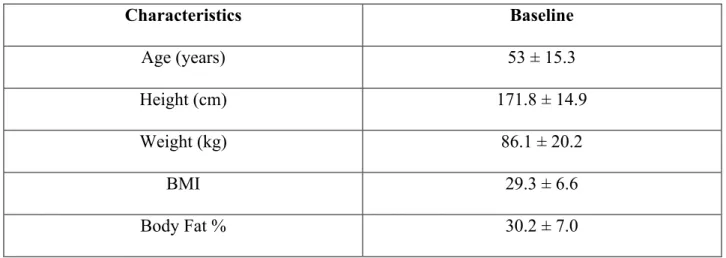
Seventeen subjects were recruited from the EQUAL phase II clinical trial at UNC Lineberger Comprehensive Cancer Center and completed the baseline assessment including a CPET to assess cardiopulmonary function. All seventeen patients were included in the data analysis. One patient was missing body fat percentage calculation; therefore, a mean substitution was imputed for this missing value and used for the calculation of the estimated VO2max using the non-exercise equation. Patient characteristics are presented in Table 1.
Table 1: Anthropometric Characteristics of Patients, N=17 (mean ± SD)
Characteristics Baseline
Age (years) 53 ± 15.3
Height (cm) 171.8 ± 14.9
Weight (kg) 86.1 ± 20.2
BMI 29.3 ± 6.6
Body Fat % 30.2 ± 7.0
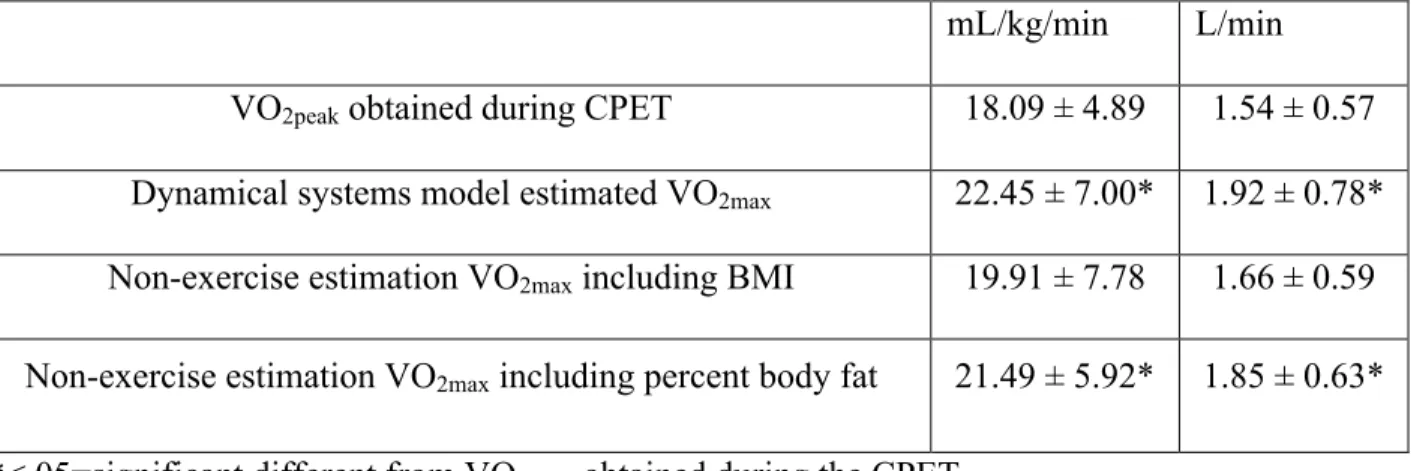
Paired samples t-tests were used to compare the dynamical systems model estimated VO2max and non-exercise estimated VO2max to maximum oxygen uptake obtained during the CPET.
Table 2: Descriptive Statistics for maximum oxygen uptake obtained during the CPET,
Dynamical systems model, and non-exercise estimation equations (mean ± SD)
mL/kg/min L/min VO2peak obtained during CPET 18.09 ± 4.89 1.54 ± 0.57 Dynamical systems model estimated VO2max 22.45 ± 7.00* 1.92 ± 0.78* Non-exercise estimation VO2max including BMI 19.91 ± 7.78 1.66 ± 0.59 Non-exercise estimation VO2max including percent body fat 21.49 ± 5.92* 1.85 ± 0.63* *<.05=significant different from VO2peak obtained during the CPET.
Hypotheses
Hypothesis 1, there will be no significant difference between the dynamical systems model VO2max estimation using all data from a CPET test and the VOpeak value attained during a CPET performed on a cycle ergometer. A significant difference (p < .001) was found between VO2peak attained during the CPET and dynamical systems model predicted VO2max.
Hypothesis 2, that there will be no significant difference between the non-exercise equation predicted VO2max using anthropometric data (percent body fat or BMI) from baseline testing and VO2peak values attained during a CPET performed on a cycle ergometer. A significant difference (p < .005) was found between VO2peak attained during a CPET performed on a cycle ergometer and the non-exercise equation using percent body fat predicted VO2max . There was no significant difference between VO2peak attained during a CPET performed on a cycle ergometer and the non-exercise equation using BMI predicted VO2max .
significant difference between dynamical systems model predicted VO2max and estimated VO2max using percent body fat or BMI.
Exploratory Analysis
Exploratory analyses were conducted to capture the inter-variability between subjects that was not captured when analyzing the data using absolute values. The VO2max values attained from the dynamical systems model and the non-exercise estimation equations were compared to the maximum oxygen uptake attained during the CPET data for each subject and expressed as percent difference from the “gold standard” CPET attained value. These values are listed in Table 3 as ml/kg/min ± percent change from the VO2peak.
Table 3. VO2 Prediction Values as Percent Error
Subject CPET VO2peak
Model Predicted VO2max ± % Δ
Equation Estimated VO2max BMI ± % Δ
Equation Estimated VO2max Body Fat ± % Δ
1 19.25 19.68 (+2.23%) 21.46 (+11.51%) 26.78 (+39.10%)
2 18.41 24.92 (+35.37%) 25.95 (+40.93%) 28.08 (+52.50%)
3 22.60 23.11 (+2.26%) 8.00 (-64.61%) 13.08 (-42.11%)
4 25.11 32.36 (+28.89%) 11.91 (-52.59% 19.66 (-21.69%)
5 16.33 16.40 (+0.42%) 13.59 (-16.84%) 23.84 (+45.95%)
6 22.83 25.08 (+9.86%) 29.25 (+28.14%) 32.91 (+44.18%)
7 11.62 20.62 (+77.55%) 12.97 (+11.64 %) 17.25 (+48.50%)
8 15.39 18.21 (+18.30%) 21.01 (+36.50%) 20.78 (+35.04%)
9 22.49 35.62 (+58.39%) 15.53 (-30.95%) 14.70 (-34.63%)
10 14.43 14.49 (+0.42%) 14.38 (-0.37%) 13.01 (-9.87%)
11 21.29 22.67 (+6.51%) 21.93 (+3.00%) 22.65 (+6.37%)
12 12.95 22.76 (+75.72%) 21.00 (+62.13%) 21.48 (+65.79%)
13 18.01 29.33 (+62.83%) 23.07 (+28.11%) 18.50 (+2.73%)
14 24.18 30.90 (+27.75%) 39.59 (+63.72%) 29.15 (+20.54%)
15 6.68 7.45 (+11.59%) 11.68 (+74.90%) 14.95 (123.79%)
CHAPTER V DISCUSSION
Acute myeloid leukemia is a hematological cancer that results in the formation of abnormal red and white blood cells and platelets from the bone marrow and occurs in over 54,000 new patients each year (ACS, 2014). The initial stage of treatment includes inpatient induction chemotherapy for a week, followed by several weeks of inpatient recovery. During this time, patients are extremely susceptible to infections, bleeding, and bruising in addition to
numerous of other negative physical and psychological symptoms associated with their chemotherapy treatment and reduced physical activity, including cachexia, fatigue, anxiety, depression, and sleep disturbances within many others.
Currently, there have been four studies that have examined the efficacy of exercise interventions in this population with the goal of mitigating the symptom burden, improving patient outcomes such as functionality and quality of life. All four studies found that exercise with this population is not only safe but also feasible and efficacious in alleviating the common physical and psychological decline experience by the majority of patients. The first ever program in this population reported reduced fatigue, anxiety, depression and improved walking distance in response to walking five days per week (Chang, 2008). An exercise intervention consisting of aerobic and resistance training twice daily, three days a week reported reduced fatigue,
of a progressive training program individualized to each patient comprising of flexibility, aerobic, and resistance training four to five days a week, observed reduced fatigue and anxiety, as well as improved aerobic fitness and physical functionality (Alibhai, 2012).
While all studies to date have demonstrated the desired positive outcomes, the exercise interventions varied drastically from study to study in terms of exercise prescription and exercise modality. Due this heterogeneous body of literature examining the effects of exercise in
leukemia patients, if is not possible at this time to make precise recommendations regarding the best and most efficacious prescription of exercise to maximize the benefits of exercise to this cancer population. Exercise interventions must be prescribed in a way that will maximize the physiological and psychological benefits without overtaxing the body and placing an undue burden on the patient. In order to properly prescribe an exercise program for an individual patient, there must be a standardized and objective method for assessing a patient’s current physical fitness and prescribing exercise in relation to this measurement.
An individual’s cardiopulmonary functional capacity expressed as maximum oxygen uptake (VO2max) is an individual’s ability to uptake and utilize oxygen during exercise and reflects an individual’s ability to perform tasks of daily living as well as tolerate exercise (Arena, 2007). Cardiopulmonary functional capacity is considered among exercise physiologists as the single best measurement of overall fitness of an individual. Once an individual’s VO2max is known, exercise can be prescribed as a percentage of this number, typically in terms of a
corresponding heart rate due to the nature of the relationship between heart rate and VO2. Some studies have shown that VO2 is an independent predictor of mortality in different cancer
The gold standard method of measuring VO2 is through a cardiopulmonary exercise test (CPET) using indirect calorimetry. However, these tests require expensive and specialized equipment and personnel and may not be feasible or practical in all settings. An alternative to this, is to perform a submaximal exercise test and use the results to estimate VO2max. This method utilizes the relationship between heart rate and various exercise intensities, however, it is
dependent on the assumption that an individual’s heart rate will respond linearly to incremental exercise, and that mechanical efficiency is similar among different individuals. These
submaximal predictions require an individual to achieve steady state in two stages during the exercise test, and due to the assumptions mentioned above, significant error of estimation is known to occur in different populations. In cancer patients such as those being treated for leukemia, the accuracy of submaximal tests are may be even more pronounced. In leukemia patients, due to the negative effects of the disease and treatment on the patient’s physiology, the patients’ exercise response most likely will violate submaximal testing assumption of estimation, leading to even more error of estimation. Non-exercise VO2 prediction models have also been developed using skinfolds and BMI, with a standard error of 5.3 and 5.6 mL/kg/min respectively when compared to the gold standard CPET (Jackson, 1990). While this method would be
acceptable for certain healthy adult populations, its use in clinical populations such as cancer has been very little evaluated if evaluated at all.
to date the precision of these methods to be used as alternative to gold standard CPET in Leukemia patients.
Stirling (2005, 2008) developed a dynamical systems model of the heart rate and oxygen uptake responses to exercise. However, this model was limited in its application because it was only able to predict hear rate and oxygen uptake responses at constant exercise intensities. Mazzoleni and colleagues (2016) expanded upon this model and incorporated a demand function to capture the dynamics of the system at non-steady state and transient exercise intensities. They were also able to utilize this model to make predictions for the maximum heart rate and maximal oxygen uptake values of an individual. For the case of cycling, an individual performs a
cardiopulmonary exercise test on a cycle ergometer in the lab and the subsequent values for heart rate, oxygen uptake, power, and cadence are entered into the model as time series variables, and the dynamical systems model then uses a heuristic algorithm to determine individual parameters that best fit the model and predict maximum heart rate and maximal oxygen uptake. The
The primary purpose of this study was to determine if a dynamical systems model can accurately estimate maximum oxygen uptake from data obtained during a maximal CPET performed on a cycle ergometer in acute myeloid leukemia patients. The secondary purpose was to compare maximum oxygen uptake attained during the CPET, to a non-exercise estimation equation using BMI and body fat percentage. The tertiary purpose was to evaluate if the dynamical system model predicted maximum oxygen uptake was significantly different to the non-exercise estimation equation using BMI or body fat percentage.
Dynamical Systems Model
during the final minute of the test were averaged to determine VO2peak. Therefore, the VO2 value achieved by most patients in this study is not believed to be their true physiological max that they could achieve, thus the dynamical system model over-predicting VO2max. The dynamical systems model represents VO2 as the change in oxygen uptake kinematics in response to the demands placed on the system that disturb the equilibria of the heart rate and VO2. The system has minimum and maximum values, as well as the sub-maximal demand that is a function of exercise intensity. The model is able to recognize that those sub-maximal values experimentally obtained are not the maximal values of the system in the case that a test is terminated early, thus the model over-predicting in some cases (Stirling 2005, Mazzeloni 2016).
Non-Exercise Estimation Equations
The most commonly accepted and widely used equations for predicting VO2max were validated using young, healthy populations and developed for use during steady state exercise. In 2003, Peterson and colleagues examined the efficacy of two of the most commonly used
utilized a modified maximal test, and the Allied Dunbar National Fitness Survey (n=1706), utilized a submaximal test, the non-exercise equations applied to the three populations included age, gender, resting heart rate, and physical activity measurement. The NASA model was most accurate, due to the use of the gold standard VO2max exercise test, but all the estimations were valid in all three populations; NASA r=0.81, ACLS r2=0.77, and ADNF r2=0.76. (Jurca, 2005).
The current study uses a non-exercise equations use age, gender, physical activity, and anthropometric data to predict VO2 developed by Jackson and Blair (1990). When compared to the VO2peak attained by patients during the CPET, there was no significant difference (p<.05) when using BMI as a variable in the equation. However, when using body fat percentage as a variable it was significantly higher. As a general trend, both equations overestimated VO2 with the exception of a few patients, with the body fat estimation being the highest. Body mass index is a ratio of height to weight, whereas, body fat percentage is a measure of body composition between fat and fat free mass and therefore correlated to physical fitness. Most of these patients experience a loss of body mass as a result of their disease, and changes in body fat percentage may not accurately represent the normal physiology parameter used to develop such equations. The BMI equation may be more appropriate in this population because it is more standardized to exclude individual physiology. These equations have not previously been validated in this population, but may be a viable alternative if other methods for assessing VO2 are not available. If utilized, BMI should be used as a predictor.
Comparison Between Dynamical Systems Model and Non-exercise Equations
This could also be attributed to the individual variability that was not captured by the paired samples t-tests and will be discussed further in exploratory analysis. The dynamical systems model consistently over-predicted, to what would be assumed to be the true physiological VO2max, whereas the estimation equations over- and under- predicted with large fluctuations between individuals. In this population, non-exercise or mathematical predictions may be better indicators of cardiorespiratory fitness due to their inability to perform maximal cardiorespiratory tests. In the current study, it appears that the dynamical systems model overestimates, it may be more accurate that the CPET obtained value misrepresents their true maximal VO2 value. The underlying assumption is that the obtained value is their physiological max is violated in this population due to their disease processes and poor physical fitness. The non-exercise equations are more accurate in this population because they account for low physical activity level, age, and body mass index. These patients have very low physical activity levels, are older adults, and have a BMI of (29.3 ± 6.6).
Exploratory Analysis
Due to the individualized nature of the dynamical systems model, exploratory analyses were conducted to capture the inter-variability that was not reflected in the statistical tests ran. The variance between patients and within the sample was not equal, therefore means do not capture the individual differences for each prediction method. For example the dynamical
pose a tremendous burden on the patients ability to perform at their best allowing for
achievement of maximum oxygen uptake . Examples of time series plots are listed below, in the appendices I and II.
Table 3 presents the percent change between VO2peak attained and predicted VO2max using the dynamical systems model and non-exercise equations including either BMI or percentage body fat. This demonstrates the potential predictive capability of the model in scenarios where a patient’s physical limitations to the test are believed to hinder the attainment of a true
representation of their cardiorespiratory capacity. Factors such as reduced muscular endurance and strength, lower hemoglobin levels, disease related physical impairments, psychological stress, lack of motivation or energy due to cancer-related fatigue, and unfamiliarity with exercise testing on a cycle ergometer can all contribute to the attainment of lower VO2max during a CPET. The non-exercise estimation equations are designed to assist in the estimation of the patient’s cardiopulmonary capacity in scenarios where patients are either unable to perform a CPET, had a percent error of 15.20% ± 39.33 when including BMI, and 26.21% ± 40.75 when including body fat percentage. Table 3 shows how these prediction equations are inconsistent in the direction of error between individuals, while both tending to significantly overestimate with large standard deviations. The reason for these discrepancies between individuals may be due to the tremendous heterogeneity between individuals including different age groups, size, and varied body
compositions.
minute of their age predicted maximum, and a rate of perceived exertion greater than 17, with one patient reaching a plateau in VO2 with increasing workloads. Four of the patients within this subgroup cited leg fatigue as their reason for terminating the test. The comorbidities of this group include four patients with arthritis, two with anxiety and depression, one with diabetes, one with COPD. The average age of this subset was 50, BMI of 30.6, and body fat percentage was 29.5. The average test duration was 6.63 minutes with a range of 5-11.36 minutes
A second subset of the patients with the highest percent error between dynamical systems model predicted VO2max and CPET obtained VO2peak consisted of four patients with error of +58%-77%. There were two men and women with the average age of 56, BMI of 29.7, and body fat percentage of 34.9. None of these patients achieved a maximum heart rate within 10 beats per minute of their age predicted max, two had a final RPE of 18, all cited leg fatigue as their reason for terminating the test. The average duration of the test was 5.145 minutes with a range of 2.23-7.5 minutes. The outlier of this subset and the entire population was a 28-year-old male with a BMI of 43.4 and a body fat percentage of 45.6. This patient and one other in this subset had arthritis, two had hypertension.
Limitations
Potential limitations for the current study include sample size and generalizability of study results. The exclusion criteria for the EQUAL phase II trial, limited the recruitment of patients who did not have any contra-indication to participate in maximal exercise testing or regular exercise of moderate intensity. Therefore, only patients without any physical limitations besides the potentially altered physiology due to leukemia and treatments participated in the study. However, these results are an important first step in testing the capabilities of the dynamical systems model and further research is needed to continue to explore the accuracy capacity and usability of such model in the oncology setting. Another limitation of the current study is the use of retrospective data, where control over the protocol and variation in the testing parameters could not be manipulated to increase the ability of the dynamical systems model to produce different levels of estimation. For example, if cadence could be altered during testing promoting more pronounced alterations on the physiological response of the patients HR and oxygen uptake during testing, the dynamical systems model could potentially increase its estimation accuracy.
Conclusion
prescription may prove to be an important factor in providing prescriptions that can be more efficacious in promoting most benefits. Based on the results of this preliminary study, the use of a dynamical systems model and/or a non-exercise estimation equation that uses BMI may provide a better overall assessment of the cardiopulmonary capacity of leukemia patients, that is not limited to the physical inability or test specifics that can produce erroneous evaluation of the current cardiorespiratory capacity to be used in the context of an exercise prescription. However, further research must be conducted so better methods for the assessment of cardiorespiratory function can be developed to account for specific physiological alterations in clinical population, that can be captured by the test for a better and more precise assessment be achieved. In
conclusion, since transient changes captured in VO2 in response to the demands placed on the equilibria of the dynamical system, the system is not subject to the same physiological
limitations of CPET, potentially providing a more precise VO2max determination. However, this is just speculation at this time since this is just the first study to attempt to investigate the
dynamical systems model VO2max predictability in leukemia patients and more research is needed to confirm or refute this possibility.
Recommendations for Future Research
data from these CPETs (Mazzoleni et al 2016). The same dynamical systems model may be used for the estimation of VO2max using data from a submaximal effort independent of how different the responses differ between individuals. Using data from a submaximal effort could potentially solve the issue of having to conduct a CPET with indirect calorimetry making it usable in many different setting where such equipment and testing specifics are not possible. Due to the
Appendix I
Appendix II
Appendix III
REFERENCES
Alibhai, S. M. H., O’Neill, S., Fisher-Schlombs, K., Breunis, H., Brandwein, J. M., Timilshina, N., … Culos-Reed, S. N. (2012). A clinical trial of supervised exercise for adult inpatients with acute myeloid leukemia (AML) undergoing induction chemotherapy. Leukemia Research, 36(10), 1255–1261. doi:10.1016/j.leukres.2012.05.016
American Cancer Society. (2016). Leukemia-Acute Myeloid (Myelogenous). Retrieved from http:/ www.cancer.org/cancer/leukemia-acutemyeloidaml/detailedguide/leukemia-acute-myeloid-myelogenous-key-statistics
American College of Sports Medicine (Ed.). (2013). Guidelines for exercise testing and prescription (9th ed.). Philadelphia: Lippincott, Wilkins, and Williams.
Arena R, Myers J, Williams MA, et. al. Assessment of functional capacity in clinical and research settings: a scientific statement from the American Heart Association Committee on Exercise, Rehabilitation, and Prevention of the Council on Clinical Cardiology and the Council on Cardiovascular Nursing. Circulation 2007;116:329-343. ATS/ACCP. Statement on cardiopulmonary exercise testing. Am J Respir Crit Care Med
2003;167:211-277.
Battaglini CL, Hackney AC, Garcia R, Groff D, Evans E, Shea T. (2009). The effects of an exercise program in leukemia patients. Integr Cancer Ther. 2009 un;8(2):130-8., 8(2), 130-8. Bryant, A.L., Walton, A.M., Shaw-Kokot, J., Mayer, D., & Reeve, B.B. (2015). Symptoms and
Quality of Life in Adult Survivors of Acute Leukemia: A Systematic Review. Oncology Nursing Forum, 42(2), E91-E101.
Cardinal, B. J. (1996). Predicting cardiorespiratory fitness without exercise testing in epidemiologic studies: a concurrent validity study. Journal of Epidemiology / Japan Epidemiological Association, 6(1), 31–35.
Chang PH, Lai YH, Shun SC, Lin LY, Chen ML, Yang Y, Tsai JC, Huang GS, Cheng SY. (2008). Effects of a walking intervention on fatigue-related experiences of hospitalized acute myelogenous leukemiapatients undergoing chemotherapy: A randomized controlled trial. J Pain Symptom Manage, 35(5), 524-34.
Grant, S., Corbett, K., Amjad, A. M., Wilson, J., & Aitchison, T. (1995). A comparison of methods of predicting maximum oxygen uptake. Br J Sports Med, 29, 147–152. doi:doi:10.1136/bjsm.29.3.147
Jarden, M. (2016). The emerging role of exercise and health counseling in patients with acute leukemia undergoing chemotherapy during outpatient management. Leukemia
Research, 37(2), 155–161. doi:10.1016/j.leukres.2012.09.001
Jones LW, Courneya KS, Mackey JR, Muss HB, Pituskin EN, Scott JM et al. Cardio pulmonary function and age-related decline across the Breast Cancer Survivorship Continuum. J Clin Oncol 2012; 30: 2530–2537.
Jones LW, Eves ND, Haykowsky M, et. al. Cardiorespiratory exercise testing in clinical oncology research: systematic review and practice recommendations. Lancet Oncology 2008;9(8):757-65.
Jones LW, Hornsby WE, Goetzinger A, Forbes LM, Sherrard EL, Quist M et al. Prognostic significance of functional capacity and exercise behavior in patients with metastatic non small cell lung cancer. Lung Cancer 2012; 76: 248-252.
Jones LW, Watson D, Herndon 2nd JE, Eves ND, Haithcock BE, Loewen G et al. Peak oxygen consumption and long-term all-cause mortality in nonsmall cell lung cancer. Cancer 2010; 116: 4825-4832.
Jurca, R., Jackson, A. S., LaMonte, M. J., Morrow Jr., J. R., Blair, S. N., Wareham, N. J., … Laukkanen, R. (2016). Assessing Cardiorespiratory Fitness Without Performing Exercise Testing. American Journal of Preventive Medicine, 29(3), 185–193.
http://doi.org/10.1016/j.amepre.2005.06.00410; 116: 4825–4832.
Kavanagh T, Mertens DJ, Hamm LF, et al. Prediction of long-term prognosis in 12,169 men referred for cardiac rehabilitation. Circulation. 2002;106:666-671.
Klepin, H. D., Danhauer, S. C., Tooze, J. A., Stott, K., Daley, K., Vishnevsky, T., … Mihalko, S. L. (2011). Exercise for older adult inpatients with acute myelogenous leukemia: A pilot study. Journal of Geriatric Oncology, 2(1),11–17.
Mazzoleni MJ, Battaglini CL, Mann BP, 2015, “A predictive heart rate model for changes in exercise intensity during cycling,” Medicine & Science in Sports & Exercise, Vol. 47, No. 5S, p. 121.
Mazzoleni MJ, Battaglini CL, Mann BP, 2015, “Modeling heart rate dynamics in response to changes in exercise intensity,” Proceedings of the ASME 2015 International Design Engineering Technical Conferences & Computers and Information in Engineering Conference, Boston, MA, August 2-5, Paper No. DETC2015 -- 47587 (In Press).
Mazzoleni MJ, Battaglini CL, Martin KJ, Coffman EM, Mann BP, 2016, “Modeling and predicting oxygen uptake dynamics in response to transient exercise intensities during cycling,” Medicine & Science in Sports & Exercise (Under Review).
Montoye HJ, Ayen T, and Washburn RA. The estimation of VO2max from maximal and submaximal measurements in males, age 10-39. Res Q Exerc Sport 1986;57(3):250-253. Myers J, Prakash M, Froelicher V, Do D, Partington S, Atwood JE. Exercise capacity and
mortality among men referred for exercise testing. N Engl J Med. 2002;346:793 801. National Cancer Institute: PDQ® Adult Acute Myeloid Leukemia Treatment.Bethesda, MD:
National Cancer Institute. Date last modified <03/16/2015>. Available
at:http://cancer.gov/cancertopics/pdq/treatment/adultAML/Patient.
Nes BM, Janszky I, Vatten LJ, et. al. Estimating VO2peak from a nonexercise prediction model: the HUNT Study, Norway. Med Sci Sports Exerc 2011;43(11):2024-30.
Nes BM, Vatten LJ, Nauman J, et. al. A simple nonexercise model of cardiorespiratory fitness predicts long-term mortality. Med Sci Sports Exerc 2014;46(6):1159-65.
Palange P, Ward SA, Carlsen KH, et. al. Recommendations on the use of exercise testing in clinical practice. Eur Respir J 2007;185-209.
Peterson, M. J., Pieper, C. F., & Morey, M. C. (2003). Accuracy of VO2 max prediction equations in older adults. Medicine & science in sports & exercise,35(1), 145-149. Siegel, R., Ma, J., Zou, Z. and Jemal, A. (2014), Cancer statistics, 2014. CA: A Cancer Journal
for Clinicians, 64: 9–29. doi: 10.3322/caac.21208
Stirling JR, Zakynthinaki MS, Saltin B, 2005, “A model of oxygen uptake kinetics in response to exercise: Including a means of calculating oxygen demand/deficit/debt,” Bulletin of Mathematical Biology, Vol. 67, pp. 989-1015.
Stirling JR, Zakynthinaki MS, Refoyo I, Sampedro J, 2008, A Model of Heart Rate
Kinetics in Response to Exercise," J Nonlinear Math Phys V. 15, No. 3, pp. 426-436. Wood, WA, Deal AM, Reeve BB, et. al. Cardiopulmonary fitness in patients undergoing
hematopoietic SCT: a pilot study. Bone Marrow Transplant 2013;48(10):1342-1349. Zimmermann, C., Yuen, D., Mischitelle, A., Minden, M. D., Brandwein, J. M., Schimmer, A., …
Rodin, G. (2013). Symptom burden and supportive care in patients with acute leukemia. Leukemia Research, 37(7), 10.1016/j.leukres.2013.02.009.