Mary K. Higgins Neyland
A dissertation submitted to the faculty at the University of North Carolina at Chapel Hill in partial fulfillment of the requirements for the degree of Doctor of Philosophy in the Department
of Psychology and Neuroscience (Clinical Psychology).
Chapel Hill 2015
Approved by:
ii © 2015
iii ABSTRACT
Mary K. Higgins Neyland: Culturally-Specific Factors Associated with Eating Disorder Pathology, Treatment, and Identification among Latinas
(Under the direction of Anna M. Bardone-Cone)
iv
TABLE OF CONTENTS
LIST OF TABLES ... viii
LIST OF FIGURES ... ix
CHAPTER 1: BACKGROUND INFORMATION ...1
Culturally-specific factors associated with eating pathology ...2
Individual factors ...4
Acculturation...4
Acculturative stress ...5
Family factors ...7
Family functioning ...7
Environmental factors ...8
Discrimination...8
Culturally-specific factors hypothesized to be associated with treatment utilization ...9
Acculturation...10
Stigma and shame related to eating disorders ...11
Clinician bias ...11
Cost of services ...11
Language barriers...12
Mechanistic models involving binge eating, disordered eating, body dissatisfaction, and culturally-specific factors ...12 Factors that may differentiate those who endorsed having an
v
meeting full diagnostic criteria for an eating disorder ...21
The current study ...24
CHAPTER 2: METHOD ...26
Participants and procedure ...26
Measures ...28
Measures for determining lifetime and current eating disorder diagnosis ...28
Measures of treatment experiences, their perceived helpfulness, and factors (including culturally relevant ones) associated with treatment experiences ...29
Measures to test mechanistic models involving binge eating, disordered eating, body dissatisfaction, and culturally-specific factors ...32
Model 1: Escape theory models ...32
Acculturative stress ...32
Family functioning ...32
Discriminatory stress ...33
Negative affect ...34
Binge eating ...35
Model 2: Sociocultural models ...35
Acculturation...35
Acculturative stress ...35
Thin-ideal internalization ...36
Disordered eating ...36
Weight/shape concern ...36 Measures to compare factors that may differentiate those
vi
did not, despite both groups meeting full diagnostic
criteria for an eating disorder ...37
Body mass index ...37
Severity of eating pathology ...37
Mental health treatment stigma tolerance ...38
CHAPTER 3: RESULTS ...38
Descriptive statistics related to eating disorder diagnoses ...38
Aim 1: To gather quantitative data on treatment experiences, their perceived helpfulness, and factors (including culturally relevant ones) associated with treatment experiences ...39
Aim 2: To test mechanistic models involving binge eating, disordered eating, body dissatisfaction, and culturally-specific factors ...42
Model 1: Escape theory models ...42
Correlations ...43
Mediation models...43
Model 2: Sociocultural models ...45
Correlations ...45
Disordered eating mediation models ...46
Body dissatisfaction mediation models ...47
Exploratory aim: To identify factors that may differentiate those who endorsed having an eating disorder versus those who did not, despite both groups meeting full diagnostic criteria for an eating disorder ...48
Body mass index analysis ...49
Severity of eating pathology analysis ...49
Mental health treatment stigma tolerance analysis ...50
vii
their perceived helpfulness, and factors (including culturally
relevant ones) associated with treatment experiences ...51
Aim 2: To test mechanistic models involving binge eating, disordered eating, body dissatisfaction, and culturally-specific factors ...54
Model 1: Escape theory models ...54
Model 2: Sociocultural models ...55
Exploratory Aim: To identify factors that may differentiate those who endorsed having an eating disorder versus those who did not, despite both groups meeting full diagnostic criteria for an eating disorder ...57
Strengths and limitations ...58
Future directions ...59
Clinical implications ...61
Conclusion ...62
APPENDIX 1: TABLE 1 ...63
APPENDIX 2: TABLE 2 ...64
APPENDIX 3: TABLE 3 ...65
APPENDIX 4: TABLE 4 ...66
APPENDIX 5: TABLE 5 ...67
APPENDIX 6: TABLE 6 ...68
APPENDIX 7: FIGURE 4 ...69
APPENDIX 8: FIGURE 5 ...70
viii
LIST OF TABLES Table 1 – Percentiles endorsing different eating disorder treatment
experiences and mean helpfulness of these types of eating
disorder treatments ...63 Table 2 - Average influence of barriers on seeking or receiving
treatment and results from the Bonferroni tests for pair-wise
comparison ...64 Table 3 - Means, standard deviations, and correlations among treatment
experiences and culturally-specific factors for participants who
endorsed having had an eating disorder ...65 Table 4 - Means, standard deviations, and correlations among construct
for model 1: Escape theory models ...66 Table 5 - Means, standard deviations, and correlations among constructs
for model 2: Sociocultural models ...67 Table 6 - Chi-square analysis with the presence/absence of meeting
lifetime diagnostic criteria for anorexia nervosa or bulimia
ix
LIST OF FIGURES Figure 1 - Factors, with a focus on culturally-specific factors, which
may be associated with eating pathology for Latinas at the individual, family, and environmental levels, adapted from
Reyes-Rodríguez et al., 2013 ...3 Figure 2 - Proposed mediation models testing the escape theory of
binge eating using acculturative stress, family disconnection,
discriminatory stress, and negative affect ...13 Figure 3 - Proposed sociocultural mediation models testing acculturation
and acculturative stress as independent variables, thin-ideal internalization as a mediator, and disordered eating and
weight/shape concern as dependent variables ...17 Figure 4 – Mediation models testing the escape theory of binge eating
using acculturative stress, family disconnection, discriminatory
stress, and negative affect ...69 Figure 5 - Sociocultural mediation models testing acculturation and
acculturative stress as independent variables, thin-ideal internalization as a mediator, and disordered eating and
1
CHAPTER 1: BACKGROUND INFORMATION
The relative lack of studies investigating eating pathology and treatment experiences among Latinas is particularly troubling in light of evidence that bulimia nervosa is more prevalent among Latinas compared to non-Latino Caucasians (Marques et al., 2011)1. Furthermore, there were no differences in 12-month or lifetime anorexia nervosa and binge eating disorder prevalence when comparing Latinos and non-Latino Caucasians (Marques et al., 2011). Additional studies support similar prevalence of eating disorders amongst Latinos
compared to Caucasians (Cachelin, Veisel, Barzegarnazari, & Striegel-Moore, 2000; Franko et al., 2012). Given these findings, one thing is evident: Latinas do suffer from eating disorders, and they have been largely overlooked in eating disorder research.
Furthermore, of those Latinas who suffer from eating disorders, evidence suggests that our current treatments and the health care system may not meet their needs. Latinos report experiencing stigma related to utilizing mental health services, as well as a distrust of health care providers, and fears of experiencing racism and cultural miscommunications (Pomales &
Williams, 1989; Rastogi, Massey-Hastings, & Wieling, 2012). These findings point to a need to uncover relevant cultural factors that could be targeted to increase treatment efficacy for Latinas. These findings also underscore the importance of connecting Latinas with services that have proven efficacy in this population.
2
Due to the fact that Latinos may experience eating disorders at similar or elevated rates relative to Caucasians, that the experience of eating disorder treatment and the efficacy of our traditional eating disorder treatments is largely unknown in Latinos, and that there is lack of research investigating pathways to disordered eating in this population, research needs to be done to 1) gather quantitative data on treatment experiences, their perceived helpfulness, and factors (including culturally relevant ones) associated with treatment experiences; and 2) test
mechanistic models involving binge eating, disordered eating, body dissatisfaction, and
culturally-specific factors. We also compared those who reported a history of an eating disorder to those who denied a history of an eating disorder, despite both groups meeting full diagnostic criteria, on a number of factors including eating disorder severity and mental health treatment stigma tolerance.
Thus, the primary purpose of this study is to investigate treatment experiences and pathways to disordered eating among Latinas living in the United States of America (U.S.) who have had a history of binge eating disorder and/or bulimia nervosa. We are especially interested in culturally-specific factors that may be uniquely related to eating pathology and treatment for these women. By culturally-specific factors we are referring to factors that may play a unique role in eating pathology for Latinas—either positively by aiding in eventual recovery or
negatively by maintaining the eating disorder or leading to relapse. By targeting these culturally-specific factors during treatment, there is the potential to increase recovery rates and reduce relapse for Latinas who suffer from eating disorders.
Culturally-Specific Factors Associated with Eating Pathology
3
adapted from Reyes-Rodríguez, Ramírez, Davis, Patrice, & Bulik, 2013). We will elaborate on a subset of these below as a way of providing a sense of the constructs that researchers interested in examining eating disorders and disordered eating in Latina populations may want to consider. We will revisit these constructs when discussing our specific aims. Our culturally-specific factors were assembled based on the literature related to risk factors, treatment, and presentation of eating disorder symptoms among Latinas and are not exhaustive.
Figure 1. Factors, with a focus on culturally-specific factors, which may be associated with eating pathology for Latinas at the individual, family, and environmental levels, adapted from Reyes-Rodríguez et al., 2013.
Before proceeding with a discussion of culturally-specific factors that may be associated with treatment and eating pathology, we would like to acknowledge that in broadly defining Latinas, much inter-group variance is lost; for instance, referring to “Latinas” does not capture all of the experiences of Mexican-Americans, Bolivian-Americans, or Ecuadorian-Americans.
Individual
Acculturation Acculturative stress Ethnic identity Religiosity
Treatment experience Family
Messages from family about body/eating habits
Family functioning Eating disorder stigma Mental health stigma Environment
Discrimination/racism Support from
racial/ethnic minority community
o religious community o knowledge/stigma
4
However, by referring to this ethnicity, we are capitalizing on the broad characteristics, values, worldviews, and experiences Latinas may share, along with common physical characteristics (Okazaki & Sue, 1995). Thus, it is important to keep the culturally-specific factors discussed below in mind when working with Latina clients, but to also acknowledge that not all factors will be personally relevant to all clients.
Individual factors. There are a variety of factors especially relevant to the Latina individual
suffering from an eating disorder that could impact risk, maintenance, and treatment of her eating disorder. We discuss these factors below.
Acculturation. The process of aligning with a new culture is known as acculturation and is marked by psychosocial change occurring when an individual acquires cultural values, language, and norms of the dominant society. Current acculturation theory characterizes this process as occurring along two dimensions: the degree to which the individual maintains cultural beliefs and practices of his/her country of origin, and the degree to which the individual adopts similar aspects of the new dominant culture (Ayala, Mickens, Galindo, & Elder, 2007). To the extent that eating disorders can be thought of as “culture-bound” within the U.S., it makes sense that the more a person aligns and identifies with U.S. culture (which centers on the thin-ideal), the more at risk she may be for developing body dissatisfaction and eating disorders (Ayala et al., 2007). Since previous studies have found that undergraduate Latinas endorse larger body shape ideals for their ethnic group when compared to Caucasian undergraduates (e.g. Gordon, Castro,
Sitnikov, & Holm-Denoma, 2010), it follows conceptually that Latinas who adhere more closely to their culture of origin may be operating under larger body expectations than those who
5
more acculturated Latinas may instead strive for very thin physical Caucasian ideals that might be unrealistic given their physical characteristics or body proportions (Kempa & Thomas, 2000).
Supporting this theory, level of acculturation has been associated with eating disorder symptoms among Latinas (Alegria et al., 2007; Cachelin, Phinney, Schug, & Striegel-Moore, 2006). Indeed, Latina women who had eating disorders were more likely to only speak English and to have parents born in the U.S. (i.e., more acculturated) than a matched non-eating
disordered control group, supporting the association between acculturation and disordered eating in a clinical sample (Cachelin et al., 2000). Furthermore, level of acculturation was found to be associated with partial syndrome eating disorders among Latinos, with those who were more acculturated being more likely to be diagnosed compared to those who were less acculturated (Gowen, Hayward, Killen, Robinson, & Taylor, 1999).
Thus, lower levels of acculturation may be a buffer against eating disorder symptoms— those who are able to separate themselves from Western culture, which places a large emphasis on the thin-ideal, may also be able to distinguish themselves from the White, majority women they see in the media. In contrast, high levels of acculturation appear to connote risk. Thus, Latinas who are highly acculturated and suffering from an eating disorder may be striving for the thin-ideal and may be more resistant to eating disorder recovery as a result.
Acculturative stress. Instead of level of acculturation affecting eating disorder pathology, some researchers postulate that acculturative stress serves as a more potent risk factor for eating disorders (Gordon et al., 2010; Reddy & Crowther, 2007). Acculturative stress is defined as the stress and reduction in health status that one experiences while undergoing the process of
6
emergence of eating disorders (Smolak & Striegel-Moore, 2001) and has been linked to a number of unhealthy psychological outcomes among Latinas, including bulimic symptoms (Perez, Voelz, Pettit, & Joiner, 2002) and drive for thinness (Gordon et al., 2010).
Among a sample of African Americans and Latinas, body dissatisfaction interacted with acculturative stress to identify women with the highest levels of bulimic symptomatology (Perez et al., 2002). Thus, it appears that minority women with body dissatisfaction may engage in bulimic behaviors if they are also experiencing acculturative stress. When investigating acculturative stress among African Americans, Asian Americans, and Latinas, acculturative stress was significantly associated with bulimic symptoms when controlling for general life stress, highlighting the impact of acculturative stress in the manifestation of bulimic symptoms over and above general stress (Kroon Van Diest, Tartakovsky, Stachon, Pettit, & Perez, 2013). Acculturative stress could act on eating pathology in two ways: women may restrict in order to achieve some control, or they may binge eat as an escape from the overwhelming stress of acculturation.
As stated previously, acculturative stress may be a more potent factor in eating disorder symptoms than acculturation. To support this point, higher levels of acculturative stress were associated with a higher drive for thinness among Latinas; however, level of acculturation was not similarly associated with this construct (Gordon et al., 2010). This finding provides evidence that it is the stress of acculturating, rather than acculturation itself, which may be detrimental. Thus, women who experience a high degree of acculturative stress may be coping with this stress in maladaptive ways (e.g., eating pathology). It follows that for these women, targeting
7
Family factors. Family factors are not unique to Latinas; however, due to the strong emphasis
that Latinas place on family relationships, we argue that they are potent factors in both eating disorder risk and resilience and should be included in a discussion of eating disorder pathology among Latinas. Indeed, a strong extended family network has been observed among Latinos (Kempa & Thomas, 2000; Steidel & Contreras, 2003). Latinos embrace familism, which is considered a core value that encompasses upholding the honor of one’s name, interdependence, support, and submissiveness in regards to family (Steidel & Contreras, 2003). These traditions of strong family support could bolster Latinas in treatment and recovery, and may dovetail nicely with Family-Based Treatment, found to be significantly more effective than individual therapy in treating anorexia nervosa and bulimia nervosa in adolescents (Couturier, Kimber, & Szatmari, 2013). Although family support may enhance treatment and recovery, there are also aspects of family that may increase risk for an eating disorder and serve as maintenance factors for eating pathology.
Family functioning. Although strong family connections are likely protective against eating pathology for Latinas, research suggests that family disconnection is a risk factor. Regarding adolescent Latinas, the relationship between family connectivity and bulimic symptomatology was mediated by dysphoria; thus, feeling disconnected from family led to depressed mood and suicidal ideation, which then led to bulimic behaviors (Hodson, Newcomb, Locke, & Goodyear, 2006).
8
Garbanati, 2003). Family disconnection is problematic in relation to eating disorders because it could serve to maintain eating pathology or facilitate relapse; if one is treated for an eating disorder but is still exposed to a hostile or conflictual family environment, she may be more likely to maintain (or revert back to) eating disorder behaviors for emotion regulation. Environmental factors. There are factors related to one’s broader environment that could
increase the amount of stress to which a Latina with an eating disorder is exposed. We will focus on discrimination related to ethnicity, elaborated on below.
Discrimination. The stress and trauma related to discrimination serve as maintenance factors in eating disorders among racial/ethnic minorities (e.g., African Americans; Harrington, Crowther, Payne Henrickson, & Mickelson, 2006). The escape theory of binge eating (Heatherton & Baumeister, 1991) could explain the relationship between discrimination and eating pathology. Escape theory states that people engage in binge eating as a means of lowering their
self-awareness related to the pressures, threats, long-range concerns and lasting consequences of their experiences. These pressures typically arise from standards that are set forth by the self or by a salient reference group and are demanding of the individual. Thus, discrimination by the reference group (i.e., majority culture) could remind the minority member of the ways in which she does not comply with Caucasian majority culture and standards (e.g., through skin tone, body type, language). In response to these stressors and perceived shortcomings, the minority member may seek to reduce her self-awareness of the experience and her deviation from the majority, and engage in binge eating as a result. Binge eating is then maintained through negative
9
Discrimination leads to negative affect among Latinos. An ecological momentary assessment study found that Latinos experienced depression the day following a discriminatory event (Torres & Ong, 2010). As depression has been found to precede disordered eating in both subclinical (Dennard & Richards, 2013) and clinical populations (Deep, Nagy, Weltzin, Rao, & Kaye, 1995), the relationship between discrimination and depression is important to keep in mind: perhaps discrimination leads to depression which then leads to eating pathology via escape theory. Eating pathology may then be maintained through negative reinforcement. Although research supports the link between binge eating and discrimination among a sample of African American women (Harrington et al., 2006), these constructs have not been investigated among Latinas. Further supporting the link between discrimination and eating pathology among racial/ethnic minorities, focus group data suggested that eating pathology for racial/ethnic minority women has “little or nothing to do with vanity or obsession with appearance. In fact, eating problems begin as survival strategies—as sensible acts of self-preservation, in response to myriad injustices including racism” (Thompson, 1996; p. 106); from this perspective, eating disorders may begin as coping strategies in response to external stressors (e.g., racism and discrimination). If racism and discrimination are indeed maintenance factors for eating pathology, exposure to these experiences would impede eventual recovery.
Culturally-Specific Factors Hypothesized to be Associated with Treatment Utilization
10
(Kearney, Draper, & Barón, 2005). In regards to eating disorders specifically, one study found that between 67%-83% of racial/ethnic minorities with a diagnosed eating disorder do not seek treatment (Hart, Granillo, Jorm, & Paxton, 2011). This is contrasted with another study in which 24.2% of Caucasian participants with a diagnosed eating disorder did not seek treatment
(Marques et al., 2011). There are a variety of factors related to the individual, mental health care providers, and the mental health care system that influence whether Latinas suffering from an eating disorder seek or receive treatment. These factors may affect eventual recovery, especially in light of the low incidence of spontaneous remission from an eating disorder (Mills, Polivy, McFarlane, & Crosby, 2012). We expound on these factors below.
Acculturation. Research consistently identifies acculturation as a factor that determines whether
Latinos seek treatment: less acculturated Latinas (measured by being bilingual, foreign-born, and having foreign-born parents) who were diagnosed with eating disorders via the Eating Disorder Examination were less likely to seek and receive treatment for their eating disorder symptoms in the past year, when compared to those who were more acculturated (Cachelin et al., 2000). Acculturation may be linked to an unwillingness to seek mental health care: those who are less acculturated are more likely to be distrustful of health care providers, have a preference for counselors of the same ethnicity, and be less likely to see the utility in mental health care (Coleman, Wampold, & Casali, 1995; Obasi, & Leong, 2009; Pomales & Williams, 1989). As such, those who are less acculturated may suffer from eating disorders less, but of those who do suffer from eating disorders, less acculturated women may be less likely to seek treatment and thus less likely to recover.
Stigma and shame related to eating disorders. Stigma and shame from family members
11
shame to oneself or one’s family or “losing face” (characteristics of Latin cultures) could deter Latinas from seeking treatment for an eating disorder (Cachelin, Rebeck, Veisel, & Striegel-Moore, 2001; Steidel & Contreras, 2003). Indeed, feelings of shame and fear of discrimination were among the top reasons a sample of ethnically diverse women gave as barriers to treatment (Cachelin et al., 2001). If Latinas do not seek treatment due to stigma and/or shame, they may be less likely to recover from their eating disorder.
Clinician bias. Eating disorders are less likely to be detected in Latinas. For example, among an
ethnically and racially diverse sample with eating concerns, Latinas were less likely to be referred for further evaluation when compared to Caucasians; this effect was found even after controlling for severity of eating disorder symptoms, cognitive symptoms, behavioral symptoms, distress and impairment, and BMI (Becker, Franko, Speck, & Herzog, 2003). Additionally, Latinas who reported eating and weight concerns were significantly less likely to be asked about eating pathology by a doctor. These findings indicate that clinician bias can cause a disparity in access to treatment among Latinas with eating disorders (Becker et al., 2003).
Cost of services. Aside from clinician bias, there also may be financial aspects that play a role in
whether or not Latinas receive treatment for an eating disorder (U.S. Department of Health and Human Services, 2001). Although not a culturally-specific factor, Latino youth hospitalized with an eating disorder were less likely to have private insurance (Calderon, Vander Stoep, Collett, Garrison, & Toth, 2007). Additionally, the top reported reason women in a racially and
12
Language barriers. Language barriers may also impede access to treatment. Among Latinas
who are suffering from an eating disorder, not being able to speak or read English well could limit the amount of information they receive about health care services. Additionally, working with a health care provider who is not bilingual may prove to be embarrassing or complicated when interpreters are utilized; interpreters at times may translate symptoms incorrectly or add in their own advice, along with that of the provider (Reyes-Rodríguez et al., 2013). For many clients for whom English is not their primary language, engaging in therapeutic treatment in English could be very difficult, especially if the client feels as though she is not able to fully express her thoughts and feelings (Reyes-Rodríguez et al., 2013). Thus, language barriers may dissuade one from seeking or remaining in treatment.
Mechanistic Models Involving Binge Eating, Disordered Eating, Body Dissatisfaction, and Culturally-Specific Factors
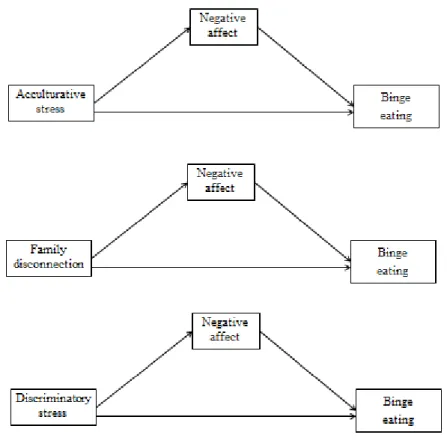
One of our primary aims focuses on testing mechanistic models involving binge eating, disordered eating, body dissatisfaction and culturally-specific factors; we elaborate here on the specific models to be tested, providing the theory behind the proposed pathways. The first model (see Figure 2) reflects components of the escape theory of binge eating (Heatherton &
Baumeister, 1991). According to escape theory, those who engage in binge eating (either in the context of bulimia nervosa or binge eating disorder) tend to have unrealistically high
13
them “zone out” and escape from negative feelings, albeit temporarily (Blackburn, Johnston, Blampied, Popp, & Kallen, 2006; Heatherton & Baumeister, 1991). Thus, according to this theory, negative affect is proximal to binge eating. We plan to take a step back from escape theory to suggest some culturally-specific factors that might act as ego-threatening stressors that generate negative affect and thus explain how escape theory may apply to Latinas within a cultural context.
Figure 2. Proposed mediation models testing the escape theory of binge eating using acculturative stress, family disconnection, discriminatory stress, and negative affect.
14
negative reaction caused by these stressful experiences, one may seek to reduce her
self-awareness of the experiences. This desire may motivate binge eating. We chose the independent variables of acculturative stress (individual level), family disconnection (family level), and discriminatory stress (environmental level). We tested these independent variables in separate mediation models in order to investigate total, direct, and indirect effects on binge eating and to examine which culturally relevant stressors may fit in an escape theory model.
We chose acculturative stress from the individual factors because experiencing high levels of acculturative stress would likely cause women to feel inadequate. This idea is
reinforced by previous links between higher acculturative stress and lower self-esteem among Latinos (Zamboanga, Schwartz, Jarvis, & Van Tyne, 2009). It is unsurprising that numerous studies have found acculturative stress to be related to depression severity (e.g., Crockett et al., 2007; Driscoll & Torres, 2013; Torres, 2010), reinforcing the connection between experiencing acculturative stress and subsequent negative affect. Evidence supports a positive relationship between acculturative stress and bulimic symptomatology (Kroon Van Diest et al., 2013; Perez et al., 2002), suggesting the likelihood that there is a direct relationship between acculturative stress and binge eating within this mediation model.
15
two years, Latinos with high parental conflict consistently reported lower self-esteem than those with low conflict (Smokowski, Rose, & Bacallao, 2010). Furthermore, feeling disconnected from one’s family led to depressed mood and suicidal ideation among Latinas (Hodson et al., 2006)— this again supports the inclusion of family disconnection in the model. Latinas who experience family disconnection may, as a consequence, feel depressed, and as a result, engage in binge eating to escape self-awareness of their negative affect. While no research to date has examined links between family disconnection and binge eating in Latina samples, research in other racial/ethnic groups supports such a pathway. For instance, family discord, frequent separations from parents, high parental demands, and a parental style categorized by low affection and high control served as risk factors for binge eating disorder among a sample of Caucasian and African American women (Striegel-Moore et al., 2005).
16
discrimination had lower self-esteem and a significantly slower growth in self-esteem over time (Zeiders, Umaña-Taylor, & Derlan, 2013). Furthermore, discrimination leads to negative affect among Latinos (Torres & Ong, 2010): an ecological momentary assessment study found that Latinos experienced depression the day following a discriminatory event (Torres & Ong, 2010), further supporting the role of discriminatory stress in a model of escape theory. Although there are no studies looking at the direct relationship between discriminatory stress and binge eating among Latinas, discriminatory stress was significantly related to binge eating symptomatology among a sample of African American women (Harrington et al., 2006).
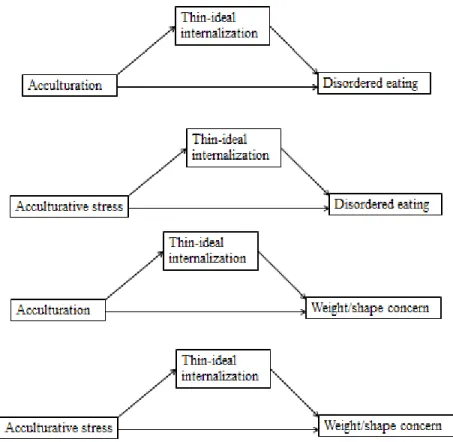
The second set of models draws from the sociocultural models of eating disorders (see Figure 3). Sociocultural models of eating disorders (e.g., Dual Pathway Model - Stice, 1994; Stice, Nemeroff, & Shaw, 1996; Tripartite Influence Model - Thompson, Heinberg, Altabe, & Tantleff-Dunn, 1999) are among the most widely tested and validated models describing the development of body dissatisfaction and eating disorders among people in the U.S. These models posit that eating disorders are culture-bound (Smolak & Striegel-Moore, 2001), and that women receive outside pressure (from the media, peers, and family) to be thin; this pressure then causes women to internalize the thin ideal for themselves (Thompson & Stice, 2001). Internalizing the thin-ideal (e.g., “I want to be thin”) can lead them to realize that they do not meet the
17
Figure 3. Proposed sociocultural mediation models testing acculturation and acculturative stress as independent variables, thin-ideal internalization as a mediator, and disordered eating and weight/shape concern as dependent variables.
18
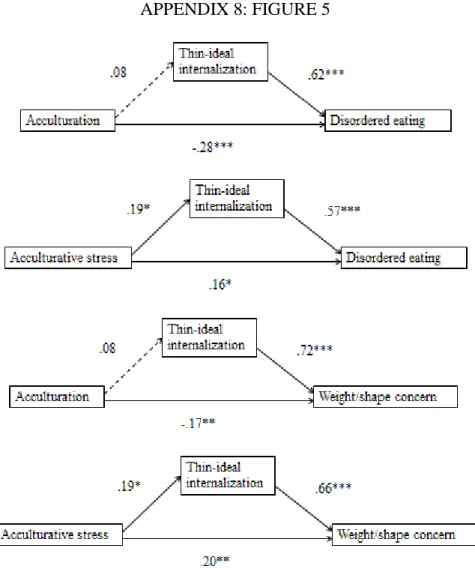
We will be testing two different independent variables that we suspect are associated with disordered eating and weight/shape concern via thin-ideal internalization: acculturation and acculturative stress. We are interested in these independent variables due to previous empirical support for their inclusion in sociocultural models of eating disorders among Latinas (e.g., Menon & Harter, 2012; Poloskov & Tracey, 2013). We are also interested in examining both acculturation and acculturative stress given inconsistent findings regarding which construct is more potent in predicting disordered eating and body dissatisfaction (Gordon et al., 2010; Reddy & Crowther, 2007). We will examine total, direct, and indirect effects, as well as total variance accounted for in the respective dependent variables (i.e., disordered eating, body dissatisfaction) in order to identify the effectiveness of each independent variable as a culturally-specific risk factor for Latinas. In total, we will test four models: acculturation in the thin-ideal internalization/disordered eating and thin-ideal internalization/body dissatisfaction mediation models and acculturative stress in the thin-ideal internalization/disordered eating and thin-ideal internalization/body dissatisfaction mediation models.
19
The first independent variable we propose testing is acculturation. Since undergraduate Latinas endorse larger body shape ideals when compared to Caucasian undergraduates (e.g. Gordon et al., 2010), it follows conceptually that Latinas who adhere more closely to their culture of origin may be operating under larger body expectations than those who affiliate more with Caucasian majority culture. These less acculturated women could therefore be at a lower risk of engaging in disordered eating practices, while more acculturated Latinas may instead strive for very thin physical Caucasian ideals as they adopt U.S. conceptions of beauty and thinness (Alegria et al., 2007; Chamorro & Flores-Ortiz, 2000). We believe that higher
acculturation leads to more thin-ideal internalization; this hypothesis is supported by prior work (Poloskov & Tracey, 2013), as well as the fact that Mexican Americans who are more
acculturated to U.S. culture prefer thinner body types (Cachelin, Monreal, & Juarez, 2006; Olvera, Suminski, & Power, 2005).
Previous work additionally supports the direct relationships between acculturation and disordered eating and acculturation and body dissatisfaction among Latinas. Higher acculturation is associated with more disordered eating (Alegria et al., 2007; Cachelin et al., 2006; Chamorro & Flores-Ortiz, 2000; Gowen et al., 1999) as well as more body dissatisfaction (Lopez, Blix, & Blix, 1995; Pepper & Ruiz, 2007; Poloskov & Tracey, 2013).
The second independent variable we propose testing is acculturative stress. As mentioned previously, acculturative stress is conceptualized as the clash between one’s traditional culture and the majority culture. Thin-ideal internalization mediated the relationship between
20
Acculturative stress has been implicated in the emergence of eating disorders (Smolak & Striegel-Moore, 2001) and has been linked to a number of unhealthy psychological outcomes, including bulimic symptoms (Perez et al., 2002). Interestingly, higher acculturative stress was associated with drive for thinness among Latinas, while acculturation was not; the authors conceptualized this as “maladaptive coping strategies that are used in an attempt to fit into the mainstream through attainment of the thin ideal” (Gordon et al., 2010, p. 141). While there is evidence that acculturative stress is directly associated with disordered eating among Latinas (Gordon et al., 2010; Kroon Van Diest, Tartakovsky, Stachon, Pettit, & Perez, 2014; Perez et al., 2002), previous work has not found a significant link between acculturative stress and body dissatisfaction. However, among a sample of African Americans and Latinas, body
dissatisfaction interacted with acculturative stress to identify women with the highest levels of bulimic symptomatology (Perez et al., 2002), indicating the interrelatedness of these variables.
21
Factors that may Differentiate Those who Endorsed Having an Eating Disorder Versus Those who did not, Despite Both Groups Meeting Full Diagnostic Criteria for an Eating Disorder
In analyzing the characteristics of our sample, two subgroups emerged: those who endorsed having had a history of an eating disorder and who met full diagnostic criteria for an eating disorder and those who endorsed never having had a history of an eating disorder but met full criteria for an eating disorder either in the present or in the past. Due to these two distinct subgroups, we investigated whether they differed on important characteristics.
As mentioned above, previous studies have examined the stigma related to and lack of knowledge about eating disorders among the Latin community (Reyes-Rodríguez et al., 2013). This unfamiliarity and isolation in believing that one is the only Latina in the U.S. with an eating disorder could lead an individual to fear seeking treatment because she may be seen as especially aberrant. Relatedly, a fear of being labeled was present in an ethnically and racially diverse sample and prevented treatment seeking (Cachelin et al., 2001). Similar factors may also contribute to some Latina women not identifying as having an eating disorder despite meeting criteria. We focused on comparing those who did identify as having had an eating disorder with those who did not (despite all having met criteria for an eating disorder at some point) on: body mass index (BMI), severity of eating disorder symptoms and diagnosis type, and mental health treatment stigma tolerance.
22
Bulik, & Bardone-Cone, 2013; U.S. News & World Report, 2010) and undergraduates have clearer information and perceptions about anorexia nervosa and the compensatory behavioral component of bulimia nervosa than other eating disorders (Chiodo, Stanley, & Harvey, 1984; Gratwick-Sarll et al., 2013). It is less clear that an eating disorder not otherwise specified diagnosis or presentations primarily characterized by binge eating (i.e., binge eating disorder) would be as often identified as eating disorders. Thus, being lower weight for height may align more closely with the picture most individuals have of an eating disorder and contribute to identifying as having such a history.
We also investigated differences in severity of eating disorder symptoms, operationalized as frequency of engaging in binge eating and compensatory behaviors, and EAT-26 scores. We hypothesized that those who endorsed having had an eating disorder would engage in more frequent compensatory behaviors and have higher EAT-26 scores. As mentioned above, bulimia nervosa and anorexia nervosa are the typical eating disorders the lay population thinks of when they think of eating disorders (U.S. News & World Report, 2010). Furthermore, when asked about bulimia nervosa, college students described the behavioral aspects (e.g., purging – Chiodo et al., 1984). Thus, it may be that those who are engaging in high levels of compensatory
23
We do not hypothesize differences in terms of binge eating frequency because previous research suggests that binge eating may be more normative in Latin cultures (Shea, Cachelin, Uribe, Striegel, Thompson, & Wilson, 2012). Furthermore, before more studies began
investigating the phenomenon of binge eating among Latinos, there was not a word for binge eating in any dialect of Spanish. Thus, awareness of binge eating disorder as a distinct eating disorder (or even binge eating as a disordered eating behavior) is likely low in this population, and we do not expect there to be any differences in binge eating frequency between those who endorsed having an eating disorder and those who did not endorse having an eating disorder.
In terms of eating disorder diagnosis type, we expect that those who endorsed having had an eating disorder will more likely meet diagnostic criteria for past or current anorexia nervosa or bulimia nervosa, while those who did not endorse having had an eating disorder will more likely meet diagnostic criteria for binge eating disorder or eating disorder not otherwise specified.
Lastly, we will compare the two groups on mental health treatment stigma tolerance. We believe it is especially important to investigate this construct, given the high degree of stigma associated with eating disorders and mental health concerns that contribute to Latinos
downplaying or ignoring disordered eating symptoms. Fear of bringing shame to oneself or one’s family or “losing face” (characteristics of Latin cultures) could deter Latinas from seeking
24
This aspect of the study will elucidate the discrepancy between those who admit (and may ultimately seek treatment for) their eating disorder and those who deny an eating disorder history. It is especially important to understand factors that discourage treatment utilization given the fact that the majority of Latinos do not seek eating disorder treatment (Hart et al., 2011), and that they have less availability, accessibility, and utilization of mental health care services when compared to Caucasians (U.S. Department of Health and Human Services, 2001).
The Current Study
25
26
CHAPTER 2: METHOD
Participants and Procedure
Participants included 78 Latinas who had a history of binge eating disorder and/or bulimia nervosa, as well as 41 Latinas who never had a history of any eating disorder, for a total of 119 participants. Only participants aged 18-25 were recruited for inclusion in this study. All participants identified their ethnicity as Hispanic/Latino. In terms of race, the majority of participants (67.2%) identified as White, 5.9% identified as “Other,” 5.0% as multiple races, 2.5% as Asian or Asian American, 1.7% as American Indian or Alaska Native, and .8% as Black. 16.8% did not report on their race. Participants with a history of an eating disorder had a mean age of 20.40 years (SD = 1.92); non-eating disorder control participants (hereafter referred to as “controls”) had a mean age of 19.59 years (SD = 1.55). Based on self-reported current height and weight, mean BMI for participants with a history of an eating disorder was 25.27 kg/m2 (SD = 6.25 kg/m2). Control participants had a mean BMI of 24.28 kg/m2 (SD = 4.66 kg/m2). Highest parental education was used as a proxy for socioeconomic status. On average, the highest
education attained by parents of those with a history of an eating disorder was 13.08 years (SD = 3.51); for controls, the mean for the highest education attained by parents was 13.27 years (SD = 3.24). Participants with a history of an eating disorder were significantly older than control participants, t(117) = -2.33, p = .021, but the groups did not differ on BMI, t(113) = -.89, p = .376, or highest parental education, t(117) = .44, p = .662.
27
colleges and universities were contacted and asked to forward information about our survey to their members. In total, we emailed organizations within the 11 states/districts (Arizona, North Carolina, Virginia, the District of Columbia, New Mexico, Florida, California, Texas, Colorado, New Jersey, and New York) that have the highest number of Latinos (U.S. Census Bureau, 2014). Organizations in these states (N = 16,024) were emailed and asked to share the survey with their members. Our study was also publicized through website postings on eating disorder-related organizations (e.g., Binge Eating Disorder Association). Furthermore, we posted flyers around college campuses and in community clinics with information on how to access the survey. Lastly, we recruited participants via the University of North Carolina’s participant pool from introductory psychology classes. Participants who were not part of the University of North Carolina’s participant pool received a $10 Amazon gift card in return for their participation in an online survey lasting 45-60 minutes. Participants who were recruited via participant pool
received one psychology course credit-hour for their participation. After completing the survey, all participants were sent a debriefing statement about the study. All aspects of this study were approved by the university’s institutional review board.
28
We validated diagnostic history with a phone interview in which 10% (i.e., 8 participants) of the sample who met criteria for binge eating disorder or bulimia nervosa per the survey was randomly chosen and called. These participants were interviewed with the eating disorder module of the Structured Clinical Interview for DSM-IV. Participants who completed this 30-minute phone interview were entered into a drawing to win one of four $50 cash prizes. Results of the phone interviews revealed that all participants but one qualified as having had a history of an eating disorder with binge eating components (i.e., anorexia nervosa – binge/purge subtype, bulimia nervosa, binge eating disorder). The one participant who did not meet diagnostic criteria for an eating disorder reported eating objectively large amounts of food within a two hour period and experiencing extreme guilt, but not loss of control.
Measures
Measure for determining lifetime and current eating disorder diagnosis.
The Eating Disorder Diagnostic Scale (EDDS; Stice, Telch, & Rizvi, 2000) was
administered to determine lifetime and current eating disorder diagnoses (bulimia nervosa, binge eating disorder, anorexia nervosa, and eating disorder not otherwise specified). The EDDS is a 22-item survey that was developed to be a brief self-report diagnostic interview for anorexia nervosa, bulimia nervosa, and binge eating disorder using DSM-IV criteria. Although the EDDS was developed only to determine current eating disorder diagnosis, we modified the survey to assess lifetime eating disorder diagnosis as well. Acceptable internal consistency (α =.89) and test-retest reliability (r = .87) have been found (Stice et al., 2000). Furthermore, the EDDS has demonstrated criterion validity through its high agreement between interviewer diagnosis and EDDS diagnosis for each disorder (mean k = .83), and has been validated among
29
made determinations of eating disorder history using DSM-5 criteria, despite the fact that the EDDS was developed using DSM-IV criteria. We decided to use DSM-5 criteria to reflect current eating disorder diagnoses. Furthermore, changes in diagnoses from DSM-IV to DSM-5 primarily involve difference in frequencies of binge eating episodes and compensatory
behaviors, and lack of amenorrhea. As we did not need to change the EDDS to use DSM-5 criteria, we thought that using the new diagnostic criteria would be more meaningful and applicable to current diagnoses.
Measures of treatment experiences, their perceived helpfulness, and factors (including culturally relevant ones) associated with treatment experiences.
Information related to treatment experiences was gathered via a set of questions created by the authors. Participants were asked to report whether they had ever seen the following health care professionals for an eating disorder: physician, psychologist/therapist for individual therapy, psychologist/therapist for family or couples therapy, psychologist/therapist for group therapy, nutritionist/dietician, psychiatrist, other (i.e., “other health care professional or other non-family person you sought help from for an eating disorder”), or “I have not seen any health care
professional for an eating disorder.” If “other” was endorsed, participants were asked to enter the person’s profession/title. If “yes” was endorsed for any of these professionals, participants were asked to report the degree of helpfulness of the treatment experience, rated on a scale from 1 = not at all helpful to 5 = extremely helpful.
30
1 = not at all helpful to 5 = extremely helpful. Participants were asked to describe any other treatment for an eating disorder, whether or not it was led by a health care professional. The same question (i.e., helpfulness) was asked of participant-generated treatments.
Treatment correlates proposed in the introduction were measured with the Stephenson Multigroup Acculturation Scale (Stephenson, 2000), questions created by the authors, and the Stigma Tolerance subscale of the Attitudes toward Seeking Professional Psychological Help (ATSPPH; Fischer & Turner, 1970).
31
To assess barriers related to treatment, participants were asked the question: “How much of a barrier was ___ to seeking or receiving treatment for your eating disorder?” and were then given the following options: stigma related to eating disorders, shame related to eating disorders, stigma related to mental health treatment, shame related to mental health treatment, lack of referral for treatment, not knowing where to get treatment, cost of services, language barriers, lack of health insurance. Participants were asked to report how much of a barrier each option was to seeking or receiving treatment (rated on a scale from 1 = no barrier to 5 = large barrier).
In order to distinguish stigma and shame, we defined stigma for the participants as “a label that sets a person apart from others and links the labeled person to undesirable
characteristics” and shame for the participants as “a negative emotion that occurs when a person experiences failure in relation to personal or social standards, feels responsible for this failure, and believes that the failure reflects self-inadequacy” (Fortenberry et al., 2002, p. 378).
32
Measures to test mechanistic models involving binge eating, disordered eating, body dissatisfaction, and culturally-specific factors.
Model 1: Escape theory models.
Acculturative stress. Acculturative stress was assessed with the short version of the Social, Attitudinal, Familial, Environmental measure (SAFE; Mena, Padilla, & Maldonado, 1987; Padilla, Wagatsuma, & Lindholm, 1985). The SAFE is a 24-item questionnaire that assesses acculturative stress in social, attitudinal, familial, and environmental domains (e.g., “People look down upon me if I practice customs of my culture,” “In looking for a good job, I sometimes feel that my ethnicity is a limitation”). Items are scored on a 5-point scale (1= not stressful; 5 = extrememly stressful); participants are additionally given the option of endorsing “0” if an item is
not applicable to them. Possible scores range from 0 to 120, with higher scores indicating higher acculturative stress. The SAFE has acceptable internal consistency among a sample of Latinas (α = .91; Kroon Van Diest et al., 2013), as well as demonstrated predictive validity for depression and anxiety among Latinas (Kiang, Grzywacz, Marin, Arcury, & Quandt, 2010). In the current study, coefficient alpha was .91.
Family functioning. Family functioning was assessed with six questions from the general functioning scale of the Family Assessment Device (Epstein, Baldwin, & Bishop, 1983; Miller, Epstein, Bishop, & Keitner, 1985). Participants were asked: “How strongly do you agree with the following statements? For these questions, think about your family in general (including your parents and your brothers and sisters) (1) Family members are accepted for who they are; (2) Making decisions is a problem for the family; (3) We don't get along well together; (4) We can express feelings to each other; (5) Planning family activities is difficult because we
33
a 4-point scale (1 = strongly disagree; 4 = strongly agree) with responses recoded as need be so that higher scores reflect higher family functioning.
The general functioning scale of the Family Assessment Device has shown high validity (r = .92) and test-retest reliability (r = .71; Epstein et al., 1983) among samples of
racially/ethnically diverse participants. Furthermore, these six questions measuring family
functioning have been used in prior work and have shown acceptable internal consistency among a racially/ethnically diverse adolescent sample (α = .70; Berge, Wall, Larson, Loth, & Neumark-Sztainer, 2013). In the current study, coefficient alpha was .78.
Discriminatory stress. Discriminatory stress was assessed with the appraised racist events scale of the Schedule of Racist Events (SRE; Landrine & Klonoff, 1996). The SRE is an 18-item, multi-part measure that assesses lifetime and past year frequency of racist discrimination, as well as the extent to which these events were stressful. Before completing this questionnaire,
participants completed an open-ended question regarding their race/ethnicity. Their response was then piped into the SRE items via survey software so that each item reflected the participants’ reported race/ethnicity in order to make the questions more salient. Of note, all participants (with the exception of two, who reported “white” but indicated that they were Latina elsewhere) wrote in some variant of Latina. Questions regarding exposure to racist events on the SRE are scored on a 6-point scale (1 = never; 2 = once in a while (less than 10% of the time); 3 = sometimes (10%–25% of the time); 4 = a lot (26%–49% of the time); 5 = most of the time (50%–70% of the time); 6 = almost all of the time (more than 70% of the time). Questions regarding stress
34
to somebody else?”) with three questions assessing frequency and stress (i.e., “How many times in the past year?” “How many times in your entire life?” “How stressful was this for you?”). Total scores are created by summing past year frequency of racist events to receive the Recent Racist Events score, summing entire lifetime frequency of racist events to receive the Lifetime Racist Events score, and summing scores on how stressful each type of event was to receive the Appraised Racist Events score, with higher scores indicating more exposure to racist events and more stress associated with these events.
Although this questionnaire was originally developed to assess exposure and stress related to racist events among African Americans, it has demonstrated acceptable internal consistency among a racially/ethnically diverse community sample of African American, Asian American, Latina, and Caucasian women (all alpha coefficients across racial groups = .87 - .91; Ro & Choi, 2009). Furthermore, it has demonstrated construct validity through significant correlations between SRE subscale scores and psychological distress among undergraduate Latinas (Huynh, Devos, & Dunbar, 2012). In the current study, coefficient alpha for appraised racist events was .95. We chose to use the appraised racist events scale in analyses over the other two scales (i.e., past year racist events, lifetime racist events) because it is more relevant to escape theory (Heatherton & Baumeister, 1991). The appraised racist events scale reflects the stress that one feels in response to a racist event, which would then (according to escape theory) lead to binge eating as a form of emotion regulation.
35
to report how often over the past week they have experienced various symptoms (1 = rarely or none of the time (less than one day); 2 = some or a little of the time (1-2 days); 3 = occasionally or a moderate amount of time (3-4 days); 4 = most or all of the time (5-7 days)). Four items related to positive affect are reverse-scored and a total composite score is derived by summing the item responses so that higher scores reflect more depressive symptoms. When comparing groups of Black, White, Asian/Indian, and Latino youth, the CES-D met some of the criteria for strong measurement invariance, indicating that it is an acceptable screening measure for
depression among Latinos (Skriner & Chu, 2014). In this study, coefficient alpha was .92. Binge eating. Binge eating was assessed using the Eating Disorder Examination Questionnaire (EDE-Q; Fairburn & Beglin, 1994). Participants were asked the number of times in the past 28 days they ate ‘‘what other people would regard as an unusually large amount of food’’ and then asked how many of these episodes of overeating were accompanied by a sense of ‘‘loss of control.’’ This combination of an objectively large amount of food and a loss of control represents binge eating.
Model 2: Sociocultural models.
Acculturation. Acculturation was assessed with the dominant society immersion scale of the Stephenson Multigroup Acculturation Scale (SMAS; Stephenson, 2000), described earlier as part of the measures of culturally relevant factors associated with treatment experiences.
Acculturative stress. Acculturative stress was assessed with the short version of the Social, Attitudinal, Familial, Environmental measure (SAFE; Mena et al., 1987; Padilla et al., 1985), described earlier as part of the measures for Model 1.
36
4 (SATAQ-4; Schaefer et al., 2014). The Internalization: Thin/Low Body Fat subscale of the SATAQ-4 is composed of five items that measure thin-ideal internalization (e.g., “I want my body to look very thin.”). Items are scored on a 5-point scale (1 = definitely disagree; 5 = definitely agree) with higher scores reflecting more internalization of the thin-ideal. When looking at an earlier version of the SATAQ, the thin-ideal internalization subscale demonstrated acceptable internal consistency among Latina undergraduates (α = .89; Cashel, Cunningham, Landeros, Cokley, & Muhammad, 2003). In this study, coefficient alpha was .85.
Disordered eating. Disordered eating was assessed with the Eating Attitudes Test-26 (EAT-26; Garner et al., 1982). The EAT-26 is a 26-item self-report questionnaire that measures the degree to which participants engage in a variety of disordered eating behaviors and attitudes (e.g., “I am terrified about being overweight,” “I avoid eating when I am hungry”). Items are rated on a 6-point scale (1 = never, 6 = always), with higher scores reflecting greater eating pathology. Items endorsed as 1, 2, or 3 are scored as “0,” while items marked as 4, 5, or 6 are scored as “1,” “2,” or “3,” respectively. The EAT-26 has been shown to be reliable among college women (α =.92; Moradi, Dirks, & Matteson, 2005). As an indicator of this measure’s validity, studies have found the EAT-26 to be effective as a screening measure, with a cutoff score of 20 indicating a
probable eating disorder among a sample of men and women aged 16-35 (King, 1989; 1991). In the current study, coefficient alpha was .92.
Weight/shape concern. Weight/shape concern was assessed using the Eating Disorder
37
Studies have shown high levels of agreement between earlier versions of the EDE-Q and the EDE across various populations (Fairburn & Beglin, 1994; Mond, Hay, Rodgers, Owen, & Beumont, 2004). The EDE-Q includes subscales of Weight Concern and Shape Concern which are combined in this study, given evidence that these two subscales loaded on the same factor in a study investigating the factor structure of the EDE-Q (Peterson et al., 2007). Acceptable internal consistency (.89 and .93) and test-retest reliability (.92 and .94) have been found for the subscales of Weight Concern and Shape Concern of an earlier version of this measure,
respectively (Luce & Crowther, 1999). In the current study, coefficient alpha for the combined Weight Concern and Shape Concern subscales was .96.
Measures to compare factors that may differentiate those who endorsed having an eating disorder versus those who did not, despite both groups meeting full diagnostic criteria for an eating disorder.
Body mass index. Participants’ self-reported weight and height were used to compute BMI. Severity of eating pathology. Severity of eating pathology was measured with the
aforementioned Eating Attitudes Test-26 (EAT-26; Garner et al., 1982) and binge eating frequency from the Eating Disorder Examination Questionnaire (EDE-Q; Fairburn & Beglin, 1994). Frequency of compensatory behaviors was also measured using the EDE-Q. Participants were asked the number of times in the past 28 days they had vomited, taken laxatives or
diuretics, and exercised in a hard, driven, or compulsive way as a means of controlling their shape or weight. Responses for all items were summed into a total score representing the minimum number of occasions participants engaged in compensatory behaviors.
38
CHAPTER 3: RESULTS
Descriptive Statistics Related to Eating Disorder Diagnoses
Based on the EDDS, participants were given the following possible DSM-5 diagnoses both in the past and in the present: bulimia nervosa, binge eating disorder, anorexia nervosa, or eating disorder not otherwise specified. Eating disorder not otherwise specified included participants who had a subthreshold diagnosis of bulimia nervosa, binge eating disorder, or anorexia nervosa or a full diagnosis of purging disorder (defined as engaging in a purging behavior – vomiting, laxative use, diuretic use – at least one time per week while not at an anorexic weight and not engaging in any binge eating). In order to diagnose a past instance of anorexia nervosa, we relied on BMI data (BMI < 18.5 kg/m2) derived from participants’ self-report of lowest weight and height at that weight, and the absence of at least three consecutive menstrual cycles. We did not collect data from these participants about the psychological factors occurring concurrently with this lowest weight that would be associated with anorexia nervosa (i.e., intense fear of gaining weight or becoming fat even though underweight, disturbance in the way in which one’s body weight or shape is experienced). We diagnosed bulimia nervosa and binge eating disorder according to the required DSM-5 criteria in terms of frequencies of behaviors (at least one time per week engaging in binge eating and – in the case of bulimia nervosa – one time per week engaging in a compensatory behavior) and overvaluation of
39
for eating disorder not otherwise specified (e.g., purging disorder, subthreshold bulimia nervosa or binge eating disorder). Of those participants with an eating disorder history who did not have any current eating disorder diagnosis (n = 6), only one did not engage in any eating disorder behaviors over the past three months (e.g., reported zero frequencies of binge eating and compensatory behaviors). Thus, this sample of 78 Latinas was overwhelmingly a sample with current eating disorders rather than only past eating disorders.
Aim 1: To Gather Quantitative Data on Treatment Experiences, Their Perceived
Helpfulness, and Factors (Including Culturally Relevant Ones) Associated With Treatment Experiences
The data provided regarding treatments were examined in several ways. For example, we used descriptive statistics to identify the types and number of treatments for eating disorders used as well as their perceived helpfulness. We also re-coded the data regarding barriers to seeking or receiving treatment (e.g., stigma related to eating disorders, lack of referral for treatment) so that the independent variable was type of barrier (i.e., numbers 1 – 9 to represent the nine barriers) and the dependent variable was average barrier to treatment score. We then conducted a one-way ANOVA, which allowed us to compare all nine barriers against one another and to see which barriers were rated as the most influential on treatment seeking.
We also examined potential correlates of treatment experiences using established measures of culturally-specific factors (i.e., Stephenson Multigroup Acculturation Scale; Stephenson, 2000; Stigma Tolerance subscale; Fischer & Turner, 1970). We performed
correlations between the culturally-specific factors (i.e., acculturation, mental health stigma) and the treatment experiences variables of total number of treatments and average perceived
40
All of these analyses were run using the subsample who identified a history of an eating disorder at the start of the survey. Participants were only asked questions regarding treatment experiences if they reported having had an eating disorder. Although 78 women met criteria for lifetime or current bulimia nervosa or binge eating disorder, only 44 participants identified as having had an eating disorder. Of these 44, only 43 participants provided treatment data due to one participant dropping out of the survey before getting to the treatment questions. Of
additional note, three of the participants who self-identified as having had an eating disorder and who responded to the questions related to treatment experiences did not meet diagnostic criteria for an eating disorder history, but were still included in these analyses. These women had some eating disorder behaviors (e.g., eating disorder thoughts, binge eating, excessive exercise, fasting) but they were not severe or frequent enough to warrant an eating disorder diagnosis.
Of the 43 participants who answered questions related to treatment experiences, 15 (34.88%) reported that they did not receive any treatment for their eating disorder. Of those who sought treatment (n = 28, 65.12%), participants sought on average 4.00 different treatment experiences (SD = 2.83). As is evidenced in Table 1, the most frequently seen healthcare professionals among those who sought treatment for an eating disorder were
psychologist/therapist for individual therapy and nutritionist/dietician (ns = 19, 67.86%). The most frequented intensive treatment was intensive outpatient program (n =7, 25.00%).
41
most helpful (M = 4.25, SD = 1.17). A one-way ANOVA conducted with treatment type as the independent variable and average treatment helpfulness as the dependent variable revealed that treatment helpfulness significantly differed as a function of treatment type, F(11, 100) = 2.14, p = .024, partial η2 = .19. This significant effect was followed up with Tukey HSD tests for pair-wise comparisons. Although no pair-pair-wise comparisons were significant, “other” treatment (M = 4.80, SD = .45) was marginally significantly more helpful than physicians (M = 2.75, SD = 1.34; p = .082).
In terms of barriers to seeking or receiving treatment, participants endorsed cost of treatment as the most influential barrier (M = 3.40, SD = 1.45), while language barriers were endorsed as the least influential (M = 1.29, SD = .77). Given the primary recruitment strategy of recruiting from 2- and 4-year colleges, it is likely that we did not have a sample that was faced with many language concerns. The next lowest barrier after language was lack of health
insurance (M = 2.36, SD = 1.59). One one-way ANOVA was conducted with barrier type as the independent variable and the average barrier’s influence on seeking or receiving treatment as the dependent variable. The results of the one-way ANOVA were significant, F(8, 365) = 10.91, p < .001, partial η2 = .19; this significant effect was followed up with Bonferroni tests for pair-wise comparisons (see Table 2). The pattern of results revealed that language barriers, lack of health insurance, and lack of referral were significantly the least influential barriers to seeking or
receiving treatment, while eating disorder shame, and cost of treatment were the most influential. Finally, we performed correlations between the culturally-specific factors (i.e.,
42
and dominant society immersion, such that those who were more immersed in White majority culture found their eating disorder treatment to be more helpful on average (r = .43; p = .022; see Table 3). No other relationships between the culturally-specific factors and treatment experiences variables were significant.
Aim 2: To Test Mechanistic Models Involving Binge Eating, Disordered Eating, Body Dissatisfaction, and Culturally-Specific Factors
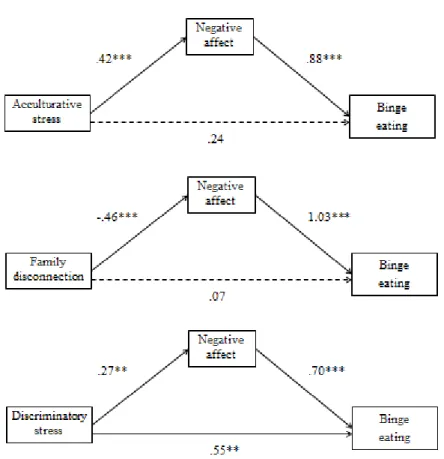
Model 1: Escape theory models. We first examined descriptive statistics of bivariate
correlations and then tested the mediation models. An evaluation of assumptions for parametric data revealed a skewed distribution for binge eating. Since this is a count variable, Poisson regressions were used with robust standard errors via restricted maximum likelihood as
recommended by Cameron and Trivedi (2009). In order to have a more nuanced understanding of the relationships between the variables, we examined the total, direct, and indirect effects of each mediated relationship in order to determine whether mediation took place. We estimated indirect effects with the procedure outlined by Preacher and Hayes (2004). The Preacher and Hayes (2004) method, unlike the Baron and Kenny (1986) method, does not require a significant direct effect between X and Y in order to test indirect effects. Pathways are determined to be mediated when a significant indirect effect estimate is obtained. Of note, we are unable to interpret indirect effects in the normal way due to our use of a count variable (i.e., binge eating) as the dependent variable. The indirect effects presented are with respect to the log rate of the count variable instead of standard regression coefficients. Mplus Version 7.0 (Muthén & Muthén, 2007) was used to run these analyses.