Amanda C. Stevens. Career Placement Services for Master’s Students at UNC SILS in the Context of the Competitive Landscape: an Exploratory Study of Services Offered at Highly Ranked ALA Accredited iSchools. A Master’s Paper for the M.S. in I.S degree. April, 2010. 47 pages. Advisor: Susan Rathbun-Grubb
This study aims to examine the current state of career placement services for master’s students at the School of Information and Library Science at the University of North Carolina at Chapel Hill (UNC SILS) and compare them to services offered at other highly ranked American Library Association accredited iSchools. Possible correlation of career placement services with average starting salary, percentage of recent graduates reporting employment, and school ranking are explored. The study finds that career placement services at UNC SILS lag behind those offered at most other similar programs. Ways to enhance UNC SILS' placement services are examined, implications for the school are highlighted, and recommendations are made for future action.
Headings:
Education for Librarianship – Evaluation. Information Scientists – Careers.
Librarians – Careers.
Library Schools – Placement Service.
STUDY OF SERVICES OFFERED AT HIGHLY RANKED ALA ACCREDITED ISCHOOLS
by
Amanda C. Stevens
A Master’s paper submitted to the faculty of the School of Information and Library Science of the University of North Carolina at Chapel Hill
in partial fulfillment of the requirements for the degree of Master of Science in
Information Science.
Chapel Hill, North Carolina April 2010
Approved by
Introduction
Post-graduation employment for students completing master’s degrees at the School of Information and Library Science at the University of North Carolina at Chapel Hill (UNC SILS) is an issue of great importance to students. An examination of
announcements sent to the UNC SILS student listserv over the past calendar year revealed that all six student organizations run by master’s students held at least one career-related event. In total, ten student-organized career-related events were held, including networking events, resume review sessions, alumni and professional panels, and brown bag lunches with professionals. The SILS Student Survey administered by the Information & Library Science Student Association (ILSSA) in December 2009 revealed that only 22% of the 153 students who responded believed that UNC SILS offers
Figure 1: UNC SILS student comments about career placement services at the school.
• “I think SILS needs to do a better job of helping us prepare for finding
jobs/choosing specializations.”
• “It would be more effective if SILS emphasizes on [sic] what jobs an IS
professionals [sic] can get.”
• “I said that I agreed that SILS provided good career counseling/support and
mentoring. One thing I might add is that students must seek these
opportunities out for themselves and actively seek mentors and career advice. I believe the opportunities are there, they are just not advertised. The student must be proactive.”
• “I wish there were an even closer link between jobs and coursework. It would
be interesting to find out the number of SILS students [who] have jobs locally in the field or related fields.”
ILSSA has also solicited the opinions of the student body specifically about career services at UNC SILS via a survey this month (April 2010). One hundred and seventy one students responded to the survey, 81% of them current master’s students.
resources available at other LIS programs. Tools provided by the University of Texas at Austin were mentioned repeatedly by multiple students, and those at Drexel University and Simmons College were also referenced.
This study aims to examine the current state of services available to master’s students at UNC SILS to help them search for and obtain post-graduation employment and compare those services to career placement services available to master’s students at other similar highly ranked, ALA accredited iSchools. In addition, existing data and resources will be utilized to explore how career placement services may affect students' job searches and post-graduation employment. The role of career placement services with regard to UNC SILS as a whole will also be investigated, including how career placement services may work in conjunction with other services and aspects of
administration, including admissions and recruitment, curriculum evaluation, fundraising, and strategic planning. Finally, recommendations for ways in which career placement services at UNC SILS could be enhanced will be proposed.
Literature Review
methodology by which U.S. News and World Report determines its rankings is as follows:
“The rankings are based solely on the results of a fall 2008 survey sent to the dean of each program, the program director, and a senior faculty member in each program. The questionnaires asked individuals to rate the academic quality of programs at each
institution as outstanding (5), strong (4), good (3), adequate (2), or marginal (1).
Individuals who were unfamiliar with a particular school's programs were asked to select "don't know." Scores for each school were totaled and divided by the number of
respondents who rated that school. The response rate was 56 percent,” (U.S. News and World Report, 2010a).
On the basis of this methodology, the validity of the rankings is questionable, but because they provide a way to compare the reputation and relative quality of programs and
because reputation is an important factor in students’ choices of an LIS graduate program (Barry-Rodriguez, 1999), they are included in the current research.
Aside from being ranked in the top ten LIS programs by U.S. News and World Report, the schools studied all have programs accredited by the ALA, which means that their missions, curricula, and administration are somewhat similar. In addition, they are all members of the iSchools caucus. The iSchools organization was formally
“iSchools promote an interdisciplinary approach to understanding the opportunities and challenges of information management, with a core
commitment to concepts like universal access and user-centered organization of information. The field is concerned broadly with questions of design and
preservation across information spaces, from digital and virtual spaces like online communities, the World Wide Web, and databases to physical spaces such as libraries, museums, collections, and other repositories.
Degree programs at iSchools include course offerings in areas such as information architecture, design, policy, and economics; knowledge management, user
experience design, and usability; preservation and conservation; librarianship and library administration; the sociology of information; and human-computer
interaction and computer science.”
In a 2009 article, Olson and Grudin suggest that the iSchools organization was formed to encourage an interdisciplinary approach that supports “meaningful syntheses” of insights from scholars in multiple fields who believe that “…information, technology, and people interact and [are] of roughly equal significance,” (Olson & Grudin, 2009, p. 17). Fifteen of the 27 current iSchools members have ALA accreditation, but only 15 of 57 programs with ALA accreditation are iSchools members. Thus iSchools membership represents an aspect of institutional identity beyond ALA accreditation that must be taken into account when seeking programs similar to UNC SILS.
A major source of data for this study is Library Journal’s Placements and Salaries Survey, which has been undertaken annually for decades (Weech & Konieczny, 2007). Response to the survey is voluntary and comes mostly from individual graduates of LIS programs, but also from the schools themselves. It appears that the most recent published survey from 2008 garnered a participation rate of approximately one third of all LIS graduates for that year (Maatta, 2009). However, it is difficult to determine whether the number of total LIS graduates given by Library Journal represents all graduates from all LIS programs in the United States in 2008 or whether it represents the total number of graduates of LIS programs participating in the survey. This problem is highlighted by Weech and Konieczny in their 2007 article on alternative careers for LIS graduates, in which they compare the Library Journal data to data collected by the Association for Library and Information Science Education (ALISE) (Weech & Konieczny, 2007). While they note “significant problems with being able to generalize from the Library Journal survey data,” largely due to the low response rate, they acknowledge that it is the
best data available (Weech & Konieczny, 2007). The Library Journal data is very useful for the current study as well, since it collects information about salaries and placements of recent graduates by school and over time, allowing for exploration of trends and comparisons between institutions.
five North Carolina LIS university-based programs, including current employment types, salaries, and graduate career satisfaction. Like the Library Journal data, the WILIS data is not generalizable because of its geographic specificity and the low response rate (38.8% of recent graduates surveyed responded), but it provides information about the experience of a large number of recent graduates, including some from UNC SILS.
In addition, the WILIS 2 project, which is a “study aimed at developing a career-tracking and program evaluation system that can potentially be used by all library and information science (LIS) programs,” has produced results that are very relevant to the current research (Marshall et al., 2009). Analysis of a subset of the data collected for WILIS 2 based on respondents who graduated with a master’s degree in information science from one of two North Carolina LIS programs, including UNC SILS, between 1988 and 2007 revealed that graduates are working in a wide variety of environments, that 34% got their current job through informal networking, and 30% got their job through direct recruitment. While 75% rated the overall experience at their program as good or excellent, 29% responded that the opportunity for mentoring from alumni is poor or needs improvement, and 26% said that opportunities for networking are poor or need improvement (Rathbun-Grubb, 2009). Some graduates commented specifically about placement concerns:
• “I was extremely disappointed in the lack of assistance from my program in helping
me to find an internship or a job.”
• “I wish my program would have been active in finding graduates employment upon
It is interesting to note that while ALISE publishes an annual statistical report including information on faculty, students, curricula, and continuing education in LIS programs in the United States and Canada, it does not collect any information about placement of graduates. Because ALISE data are collected in the process of American Library Association (ALA) accreditation for LIS programs, the response rate is very high. Incorporating questions about graduate placement into this data collection process would yield information of much higher quality than what is available from Library Journal or WILIS and which could be explored to illuminate LIS education issues such as
curriculum, recruitment, or retention. Although this data is not available for use in the current study, perhaps ALA and ALISE will consider collecting it in the future. In addition, the WILIS 2 project attempts to fill this gap (Marshall et al., 2009). WILIS 2 has involved a survey of heads of LIS programs to determine current data collection practices surrounding alumni and to explore what kind of questions should be included in a systematic alumni survey for widespread use by LIS programs.
In several cases, individual LIS schools have collected data about their students and graduates. Syracuse University’s Center for Career Services does not collect information about graduate students, but they have compiled a report about 2008 graduates from their bachelors in information management and technology degree program (Syracuse University Center for Career Services, 2008). Of 62 students
indicated that they used on-campus recruiting or referral, 23% had a previous position or internship, 15% used a personal contact or networking, 11.5% attended a career fair (the survey does not specify what career fair, but Syracuse’s iSchool has its own career fair), 11.5% applied directly to an organization, and one student reported using another
method. Employment details indicate that graduates found jobs in 10 states and a variety of types of organizations. The report also indicates that the School of Information
Studies had the highest percentage (78%) of students reporting having obtained a position prior to graduation than any other school or college at the university. The authors
attribute this high success rate to the large number of students receiving positions through on-campus recruiting or internships. This survey applies to undergraduate students rather than master’s students, but the resulting data is relevant because it is pertinent to iSchool graduates and provides information about how they found their positions. In the context of the current study, it is interesting to note that more students reported using on-campus recruiting or referral to obtain positions than any other method.
In 2004, the Africa Regional Centre for Information Science (ARCIS) at the University of Ibadan in Nigeria collected data on the graduates of its Master of Information Science degree program from its alumni database (Tiamiyu & Aiyepeku, 2004). The published article focuses on where alumni of the program were employed (many in banks, information and communication technologies, oil and gas industries, and universities, though other types of organizations were also represented), but contains no information about how alumni obtained these positions. The information from this article is largely irrelevant to the current study because of its specific geographical and
The School of Information Career Development Office at the University of Michigan surveys its Master of Science in Information graduates annually to determine their post-graduation plans. These reports are available online through the school’s website dating back to 2001. The most recently published survey, which profiles 2008 graduates, boasts a 76% response rate and contains information about graduates’ salaries, organizations, geographic locations, job search methods, length of job search, and job satisfaction (University of Michigan School of Information Career Development Office, 2008). While the information is specific to graduates of Michigan’s iSchool, it is interesting in the context of the current study to illuminate the outcomes of dedicated career placement services within an iSchool. This report will be discussed further in conjunction with the profile of Michigan’s Career Development Office in the Results section of this paper.
The Career Services Office at the School of Information at the University of Texas at Austin also surveys its graduates yearly. The most recent available report is about 2007 graduates and includes information about length of job search, career field, salary, and geographic location (University of Texas at Austin School of Information Career Services Office, 2008). Only 30 of 116 graduates responded (25.9%), so this data is less useful in illustrating the outcomes of a dedicated career services office within an iSchool, but it is important to note that the iSchool at Texas is collecting, analyzing, and publishing placement data about its graduates.
2005, Conners & McCarthy, 2007, and Simpson, 2005) and the advice and responses published by LIS educators and professionals (see Fialkoff, 2007, Berry, 2009b, and Casey & Stephens, 2008). It is interesting to note that of the above examples, the only student to have explicitly made use of career placement services offered by her school was Kristin Centanni, an Indiana University LIS student who was profiled as a job search success story in the Library Journal Placement and Salaries Survey issue from 2009 (Berry, 2009a). On the other hand, several graduates discuss being led to believe by their schools or others that there were lots of jobs available, and then being surprised by the difficulty of their employment searches (Simpson, 2005, Orbanus, 2007, and Bruno, 2009). Holt and Strock performed a study using a review of the literature, a survey, and anecdotal evidence to make an argument that it is extraordinarily difficult for new LIS graduates to find entry-level library jobs (Holt & Strock, 2005). In 2007, two other recent graduates questioned the validity of Holt and Strock’s findings and recommended further inquiry (Conners & McCarthy, 2007). All of these articles suggest that recent graduates are concerned about their ability to find employment and are interested in discovering ways in which their difficulties might be ameliorated.
In response to students’ complaints, Francine Fialkoff, the editor of Library Journal, called for more LIS programs to participate in the annual Placements and
including students and recent graduates in LIS curriculum planning (Berry, 2009b). Casey and Stephens offered tips for new graduates to find jobs that suit them, but their advice does not include anything intended to help graduates be more successful in their job searches (Casey & Stephens, 2008).
This extended dialogue in LIS literature regarding the difficulties of new graduates in finding employment indicates a clear need for further studies about career placement services in LIS programs. The current research aims to supplement the existing work by providing specific information about what kinds of services are available at highly ranked ALA accredited iSchools.
A final type of information relevant to the current study is general best practices for career placement services in higher education. Amanda Nell documents the process of implementing a career placement service for liberal arts undergraduates at the University of Missouri in 2002 and provides valuable information about strategic planning, assessing the current environment, and getting stakeholder input (Nell, 2003). She makes an
interesting point about the challenges of providing career services for liberal arts students which may also apply to students in LIS programs:
“One of the advantages of a liberal education is the ability of its graduates to perform well in an employment setting, having acquired skills in communication, teamwork, and critical thinking. Liberal arts graduates have as many career options as they have marketable skills which can make career planning and job searching a difficult task. Without a pre-professional degree, many Arts and Science students have to create their own career focus because their academic degree and acquired skills can be used in a variety of industries and positions.”
solutions to this problem, she does suggest that post-graduation plans are “a long-term process that takes time to develop and refine,” which indicates that students should be encouraged to make use of career placement services early in their academic careers. While this study applies to liberal arts undergraduates rather than LIS graduate students, it is likely that LIS programs looking to enhance or implement their career placement services could learn from the experience of the University of Missouri.
The National Association of Colleges and Employers (NACE) provides a wealth of resources about career placement services, including a number of case studies providing best practices for implementation, marketing, and evaluation of career placement services programs (NACE, 2010). Again, this information is intended for the use of those serving an undergraduate population, but many of the findings may also apply to LIS graduate programs. One such case study describes Old Dominion University’s Cyber Career Center, which won an award in 2007 for focusing on pushing career services out via the internet to students who live off campus and those engaged in distance learning
in LIS graduate programs.
Methodology
The foundation of the current research is a content analysis of the career sections of websites of highly ranked ALA accredited iSchools, i.e., those within the top ten Library and Information Studies schools according to U.S. News and World Report. These schools were chosen because of their similarity to UNC SILS to form a basis of comparison between UNC SILS and competing programs. ALA accreditation unites the curricula of the included schools to some degree, and being members of the iSchools caucus indicates that the included schools have some similar goals for the direction of their programs. Being highly ranked by U.S. News and World Report suggests that the quality of education at these schools is similar. The eleven iSchools studied include Drexel University, the University of Illinois at Champaign-Urbana, Indiana University at Bloomington, the University of Maryland College Park, the University of Michigan, the University of North Carolina at Chapel Hill, the University of Pittsburgh, Rutgers (the State University of New Jersey), Syracuse University, the University of Texas at Austin, and the University of Washington.
Data collected about each school includes whether or not the school has dedicated career services (meaning that there is at least one faculty or staff member within the iSchool whose main responsibility is administering career placement services), and what career placement services were offered within the iSchool as of April 2010. This
Education Statistical Report. The resulting set of data allows for comparison between schools on the basis of a number of different factors including ranking, school size, average starting salary, percentage of graduates reporting employment, and career placement services offered.
Results
Career Placement Services at UNC SILS
Currently, the career placement services offered by UNC SILS are all web-based. A jobs listserv is maintained by administrative staff, and postings are contributed by faculty, students, staff, alumni, and others connected with the school. Three months’ worth of past postings are also archived on the UNC SILS website (UNC SILS, 2010). Over the past three months, there have been 121 postings, and since September 2008, there have been approximately 460 postings. Preliminary results from ILSSA’s Career Services Survey suggest that a number of students have noticed that positions are often posted late to the listserv, resulting in opportunities having already passed before students have a chance to apply (ILSSA, 2010b). The Careers section of the UNC SILS website also provides links to 36 external job listing sites. Unfortunately, ten of those links are dead, and one is a duplicate. The website also contains a link to UNC’s University Career Services website, a dead link to a salary calculator, a dead link to Money
them to submit job postings to the listserv via an email link, provides contact information for a representative at UNC’s University Career Services and a member of the UNC SILS administrative staff, and offers an opportunity to be involved in mentoring students by contacting a representative of the UNC SILS Alumni Association.
Aside from the mentoring service, which is a collaboration between ILSSA and the UNC SILS Alumni Association, there have been a number of other career-related events that have taken place at UNC SILS over the past year that were not initiated by the school, but by student organizations. The following figures show the number of career-related events relative to the total number of events sponsored by each group, and a brief description of the career-related events sponsored by student groups.
Figure 2: Career-related events and total events sponsored by student groups at UNC SILS, April 2009-April 2010
While UNC SILS graduates have submitted some data to Library Journal’s annual survey regarding their salaries and placements, participation has been inconsistent at best. During some years, no UNC SILS graduates submitted information, and in 2008 (the most recent year for which data is available), only 26 students responded to the survey. UNC SILS has not made internal collection of such data a priority. Graduating students are asked (but not required) to complete an online exit survey before they leave UNC SILS. Figure 4 shows career-related questions from the Spring 2010 SILS Exit Survey.
Figure 4: Career-related questions from UNC SILS’ Spring 2010 Exit Survey AMLISS (Art & Museum Library & Information Student Society)
• Art Librarianship Brown Bag Lunch
ASIS&T (American Society for Information Science & Technology student chapter)
• Life After SILS Alumni Panel with the UNC SILS Alumni Association
• Careers in the Corporate World Brown Bag Lunch
• Local Tech Entrepreneur Panel with the North Carolina chapter of ASIS&T
ILSSA (Information & Library Science Student Association)
• Speed Networking with UNC SILS Alumni Association
SCALA (Student Chapter of the American Library Association)
• Careers in Federal Libraries
• Academic Reference Panel
• Resume Session and Panel with the North Carolina Library Association
SCOSAA (Student Chapter of the Society of American Archivists)
• Job Workshop with the Society of North Carolina Archivists
SLA (student chapter of the Special Libraries Association)
Perhaps more interesting than what is asked on UNC SILS’ exit survey is what is not asked. Specific information about post-graduation employment, such as organization,
geographic location, salary, or position title, is not solicited. There are no questions about how long it took students to find this position, nor about the methods they used to find and obtain it. While there are several questions relating to students’ satisfaction with career placement services available at UNC SILS, there are no questions about whether or how students have made use of existing services. Participating in an ongoing project such as WILIS 2 would provide a formalized approach to collecting richer information about recent graduates. In addition, surveying alumni about post-graduation
employment separately from the exit survey six months or a year after graduation might
• “Do you have a job lined up immediately after graduation?” (possible
answers are Yes or No)
• “How prepared do you feel as you launch your career?” (students can
choose from a five point scale ranging from Not at All Prepared to Extremely Prepared)
• “What additional preparation would be beneficial?” (open answer)
• Students are given the opportunity to rate SILS’ “Assistance and advice in
result in the collection of more information from students who do not find jobs until after leaving the program.
Career Placement Services at Highly Ranked ALA Accredited iSchools
Figure 5: Career placement services offered by studied iSchools1
D IL IN MD MI NC P R S TX WA
Alumni Mentoring/Network x x
Career Counseling x x x x
Career Guides x
Career Fair x x x x
Employer Services x x x x x x x
Faculty Mentoring x
Internal Jobs Listserv or Website x x x x x x x * x x
Interview Coaching x x x
Job Search Assistance x x
Links to External Job Postings x x x x x x x x x x x
Other Online Resources x x x x x x x x
Professional Mentoring x
Recruitment Events x x x
Reference Files/Credential Service x x x
Research on Employers x x
Resume/Cover Letter Assistance x x x x x
Salary Negotiation Assistance x
Services Available to Alumni x x
Workshops/Seminars x x x x
(* = Syracuse’s website indicates that they have provided this service in the past and intend to provide it again, but they do not appear to be providing it currently.)
1
In Figure 5, Alumni Mentoring/Network refers to any service through which students can connect with alumni for career-related purposes. Career Guides provide advice to students about how to prepare for work in a particular field. Employer Services refers to any invitation extended to employers to participate in students’ career planning process (through posting jobs, internships, mentoring, etc.). Other Online Resources include career planning materials for students that are not job postings (e.g. cost of living calculators, resume tips, etc.). Reference Files/Credential Service provides students with an opportunity to collect documentation such as letters of recommendation or portfolios and store them with the iSchool for distribution to multiple potential employers.
Research on Employers includes specialized information gathering about a potential employer or employers. Services Available to Alumni means that the career placement services provided by the iSchool are available not only to current students but also to graduates of the LIS program.
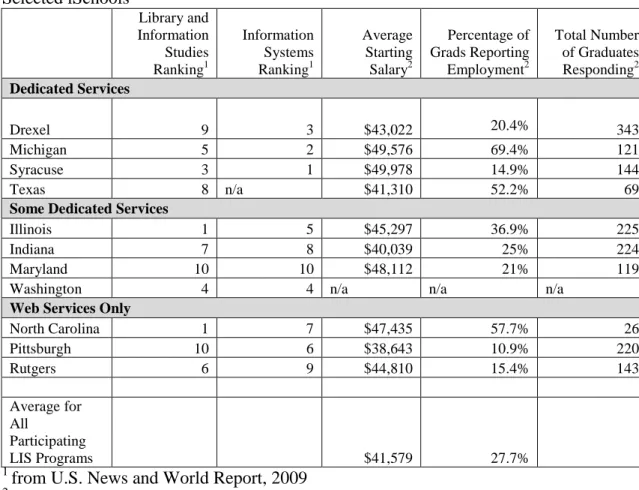
Figure 6 presents the average starting salaries and reported employment rates for selected iSchools. Rankings for Information Systems are included in Figure 6 because all of the studied iSchools except Texas were also ranked in this category, which is a
Figure 6: Rankings, Average Starting Salaries, and Reported Employment Rates for Selected iSchools Library and Information Studies Ranking1 Information Systems Ranking1 Average Starting Salary2 Percentage of Grads Reporting Employment2 Total Number of Graduates Responding2 Dedicated Services
Drexel 9 3 $43,022 20.4% 343
Michigan 5 2 $49,576 69.4% 121
Syracuse 3 1 $49,978 14.9% 144
Texas 8 n/a $41,310 52.2% 69
Some Dedicated Services
Illinois 1 5 $45,297 36.9% 225
Indiana 7 8 $40,039 25% 224
Maryland 10 10 $48,112 21% 119
Washington 4 4 n/a n/a n/a
Web Services Only
North Carolina 1 7 $47,435 57.7% 26
Pittsburgh 10 6 $38,643 10.9% 220
Rutgers 6 9 $44,810 15.4% 143
Average for All
Participating
LIS Programs $41,579 27.7%
1
from U.S. News and World Report, 2009 2
from Library Journal’s Placement and Salaries Survey, 2009
Figure 7 presents three line charts showing average starting salaries for graduates of the studied schools from 2003 to 2008 as reported in Library Journal’s annual
Profiles of Exemplary Career Placement Services
Figure 8: University of Michigan School of Information’s careers website, April 2010
Of all the schools studied, the University of Michigan School of Information (SI) offers the most comprehensive career placement services to its students. Coincidentally, it is interesting to note that over the past five years, Michigan SI graduates have
service, resume and cover letter assistance, salary negotiation assistance, and workshops and seminars. The only services Michigan SI does not formally offer that are offered by other schools studied are faculty mentoring and professional mentoring. Michigan also does a good job of collecting post-graduation employment data from its alumni, which is analyzed and compiled into a yearly report. Figure 9 displays selected quotations from Michigan SI’s promotional multimedia viewbook.
Figure 9: Quotations from the University of Michigan’s School of Information’s Multimedia Viewbook
• “We work with students from before they’re here, throughout their entire
time at SI, and beyond, for a lifetime.”
• “Within four to six months of graduation, we have found that virtually all
the graduates are in professional positions.”
• “Over the past probably two years, we’ve seen our on campus recruitment
Figure 10: Careers website of the iSchool at the University of Texas at Austin, April 2010
Discussion
Overall, the results indicate that in spite of a demonstrated student interest in job placement, career placement services offered at UNC SILS lag behind those offered at most other highly ranked ALA accredited iSchools. Although correlations between services offered and average starting salaries or employment rates for students could not be discovered using the data currently available, the state of career placement services could affect UNC SILS in other ways.
Potential Impact on Admissions and Recruitment at UNC SILS
In a 1999 survey of UNC SILS students, Heidi Barry-Rodriguez discovered that the top three factors influencing students’ choice of UNC SILS over other LIS graduate programs were SILS reputation, UNC-CH reputation, and job placement
(Barry-Rodriguez, 1999). Job placement was more important to students than either cost or geographical factors, and 75.3% of the 93 students responding to the survey indicated that it was either “Important” or “Critically Important.” Barry-Rodriguez also discovered that 70.7% of respondents would have liked to receive job placement information on recent graduates when making the decision whether or not to attend UNC SILS. More students indicated that they would have liked job placement information than any other type of additional information. In addition, she found that even in 1999, when in general the internet was used less than it is today, more students were getting information about UNC SILS from the website than from any other source. Her ultimate recommendations were as follows:
attend SILS is to make available job placement information on recent graduates…From respondents’ answers to the survey, it is clear that they want reassurance that they will find interesting (and lucrative) employment once they graduate, and would like to see the diversity of positions held by recent graduates. Based on respondents’ actions and perceptions as indicated in this research study, this would be the single most important area of information for prospective students, and it is the one area in which there is currently an information gap. Job placement information should also be included on SILS’ Web site, as the Web site was used by the majority of respondents in this study to gain SILS program information.”
Impact on Fundraising
The provision of career placement services such as alumni and professional mentoring presents an opportunity for building relationships with alumni and organizations that could be leveraged to increase donations. A comprehensive
examination of existing research on fundraising in higher education found that emotional attachment to the school and participation in alumni events were among the best
predictors of alumni giving (Brittingham & Pezzullo, 1990). Columbia University has had great success in increasing alumni donations by providing opportunities for
engagement, including a mentoring program (Strout, 2006). The Brittingham & Pezzullo (1990) study indicates that corporations have a vested interest in the products of higher education (graduates and research) and are willing to donate in support of the creation of products that are relevant to them. The authors suggest that educational institutions “be aware of their own current and potential ties with a particular business through placement services, alumni employees, and – particularly in the case of local corporations – student internships and faculty consulting.” Rathbun-Grubb (2009) also discusses the potential of alumni in relation to the results of the WILIS project: “For some programs, alumni may be an untapped resource, and regular communication with those who are interested opens up potential partnerships with them, their associates, and their employers.
produce well-prepared graduates could engage alumni and employers and make them more likely to consider donating to the school when asked.
Impact on Curriculum Evaluation and Planning
While the provision of career placement services to students at UNC SILS might not seem to have any ostensible connection to curriculum, related activities such as data collection about students’ post-graduation employment and direct contact and extended relationships with employers could provide valuable information for curriculum
evaluation and planning. “Frameworks for evaluating LIS education by analyzing relationships between curricula and professional activities” were on the agenda of the 2009 ALISE conference (Burek Pierce, 2009, p.24), and ALISE’s KALIPER study of LIS curricula from 1998-2000 determined that “demands of students, employers,
graduates, and professional associations for graduate competencies” are factors affecting curricular change (KALIPER Advisory Committee, Association for Library and
Information Science Education, 2000, p. 8). Information obtained from graduates and employers through career placement services related functions could form a basis for evaluating whether the skills being taught at UNC SILS are being used in the profession and whether there are skills that employers seek that are not being taught at UNC SILS.
If more comprehensive career placement services were provided at UNC SILS, it is likely that the placement program director would be soliciting specific information from recent graduates regarding their post-graduation employment, including information about employing organizations, job duties, whether graduates felt that UNC SILS
prepare them for their jobs. In addition, it is probable that the program director would form lasting relationships with employers on the basis of interactions such as planning recruitment events or facilitating professional mentoring of students. These relationships could be leveraged to seek employers’ opinions on the preparedness of UNC SILS graduates for positions at their organizations. The resulting information from these two career placement services related avenues could be combined with other data sources, such as the opinions of faculty and current students and curricula from other LIS programs, to evaluate the effectiveness of UNC SILS’ curriculum and suggest ways to improve it.
Alignment with ALA Accreditation Requirements, iSchools Membership,
and Strategic Plan
There are a number of ways in which enhanced career placement services can contribute to the overall progress of UNC SILS as a highly ranked, ALA accredited iSchool. There are two points within the ALA Standards for Accreditation of Master’s Programs in Library & Information Studies that refer specifically to placement services. One dictates that “students have access to continuing opportunities for guidance,
curriculum evaluation and the evaluation of student achievement, which would also be supported by functions related to enhanced career placement services. ALA requires that the curriculum be “continually reviewed and receptive to innovation…Evaluation of the curriculum includes assessment of students’ achievements and their subsequent
accomplishments.” In addition, ALA also mandates that “The school applies the results of evaluation of student achievement to program development.” The data collected about students’ post-graduation employment that would be carried out by a career placement program director to assess the impact of career services could also be used to support ALA’s required curriculum evaluation and program development.
Career placement services can also supplement UNC SILS’ ability to maximize its identity as an iSchool. In a 2009 editorial in the Journal of Academic Librarianship, Danny Wallace states, “It is clear that a major motivation for the iSchools has to do with branding, with providing a new identity that places members in an improved position to explain their missions to university administrators and other constituents, to attract students, and to garner fiscal support,” (Wallace, 2009, p. 406). The new and diverse connections that could be formed with external organizations through enhanced career placement services would be integral to supporting a new identity based on
interdisciplinarity. In addition, showing that graduates are successful in their searches for post-graduation employment and are involved in a multitude of different information roles could contribute not only to UNC SILS’ identity as an iSchool but also to the success of the burgeoning iSchools movement on the whole.
Values is Collaboration and Community. The strategic plan states, “With others in a multiplicity of organizational relationships, structures, partnerships, and cooperative pursuits we will reach beyond the familiar to explore the new. We will see to it that we make places for students to also be active participants in these collaborations, such that they will not only observe, but also experience and try out various roles in different types of collaborative enterprises,” (UNC SILS, 2007). Enhanced career placement services could contribute to this principle by forming relationships with external organizations to help students find employment. These new relationships could provide more potential field experiences for students, possible research partnerships between UNC SILS and employers, or avenues of funding for new ventures.
UNC SILS also intends to make an effort to retain its top ranking among LIS programs. The strategic plan cites the 2006 final report of ALA’s accreditation review panel, which suggests that the school, “strengthen its planning and assessment
processes… [and] add much-needed support staff and more faculty in a balanced fashion.” Hiring a support staff member to lead career placement services would allow responsibilities such as maintaining the career section of the UNC SILS website, coordinating the field experience program, and maintaining the jobs listserv to be
transferred away from faculty and staff who may currently be overburdened. In addition, data collected to support career services evaluation could also contribute to strengthening UNC SILS’ overall planning and assessment processes.
projects with Computer Science, our Business and Financial communities, and Health Sciences communities.” The connections formed with external organizations in support of student placement could be leveraged to form partnerships with employers and help determine the direction of UNC SILS’ contributions in these new fields. Additionally, since it is likely that some of these new relationships will be initiated by students, exploiting the new contacts is a way of indirectly including student interests in UNC SILS planning and administration.
Under the goal of Programmatic Development, UNC SILS states, “We will prepare information and knowledge professionals for a broad range of present and future
positions in information and library science. These will include both traditional library science positions as well as new and developing careers in the information sector.” Especially in the case of new and developing careers outside of UNC SILS’ traditional area of expertise, students will need to be educated on what opportunities are available to them, what skills they should hone, and how they should market those skills. As this information is likely to lie largely outside of the formal curriculum, it will be very important for UNC SILS to provide it to students through enhanced career placement services.
post-graduation employment of UNC SILS students and showing that robust career placement services are offered to current students could be highly effective in helping to influence prospective students to choose to attend UNC SILS instead of another LIS program. In addition, if UNC SILS begins to graduate twice as many students each year, in order to maintain its excellent reputation, the school will need to make sure that most or all of these students are employed and satisfied after graduating the program.
Conclusion
The results of the current study clearly indicate that UNC SILS lags behind similar programs in terms of offering career placement services to its students. While it was not found that the provision of career placement services is correlated with
graduates’ average starting salary, percentage of recent graduates employed, or the school’s ranking by U.S. News and World Report, many other ways in which career placement services may impact UNC SILS were also explored. In order to provide maximum benefit to UNC SILS students and to the school as a whole, it is recommended that the school take action to enhance the career placement services it offers. At a
section of the school’s website and continuing a relationship with University Career Services are neither the specific responsibility nor priority of a particular faculty or staff member, it is likely that these tasks will fall by the wayside and UNC SILS will revert to its current state in terms of career placement services.
If financial resources are available, there is a great opportunity for UNC SILS to benefit from the hiring of a full time permanent support staff member to administer a career placement services program. Such a person would enhance the value of career placement services by creating institutional memory of effective techniques and forming lasting, sustainable relationships with outside organizations. These benefits would be lost if career placement services responsibilities were assigned across multiple faculty or staff members or assigned to student assistants. If such a staff member were to be hired, he or she could begin to improve career placement services offerings as follows:
• Update and enhance career information available to students on the
school’s website
• Involve University Career Services in placement efforts at UNC SILS and
encourage students to make use of available resources
• Collect data about students’ post-graduation employment, analyze this
data for trends, and share the data internally as well as with current and prospective students through the website
• Encourage participation in the annual Library Journal Placements and
Salaries survey and career and placement related studies like WILIS 2
• Evaluate and formalize field experience procedures and begin collecting
• Reach out to student and alumni employers and encourage them to
participate in new ways (recruitment events, curriculum evaluation processes, mentoring, research partnerships, financial partnerships, etc.)
• Work with student and alumni organizations to shore up the existing
mentoring program and use these connections to implement networking resources for students
• Begin providing live career placement services for students, such as career
counseling, resume and cover letter assistance, interview coaching, a career fair and/or on campus recruiting events, etc.
• Create new connections with organizations at which students and
graduates have not previously been placed.
• Continually refer to career services programs at other highly ranked LIS
programs to assess UNC SILS’ competitiveness and search for new ideas to implement, and consider examining superior career services programs at non-LIS schools as well.
• Continually analyze data collected from recent graduates to look for
opportunities for improving services and evaluate the success of current offerings.
• Review the literature of LIS, higher education, and career placement to
stay abreast of developments.
The conclusions of this study apply specifically to highly ranked ALA accredited iSchools and may not be generalizable to other LIS programs or schools teaching subjects other than LIS. Data was gathered about career placement services offered by the studied schools from their websites only, so it is possible that these schools offer other services that are not publicized online. The data from the annual Library Journal Placement and Salaries survey, upon which much of the analysis in this study was based, is inconsistent, and as such, further study is recommended to corroborate the results of this research.
Opportunities for Future Research
Perhaps the most useful contribution to further insight in this area would be the collection of reliable large-scale data on the employment and satisfaction of recent graduates of LIS programs. This data could be used to explore connections between career placement services and outcomes for graduates, in addition to correlations between other possible contributing factors and graduate placements. It would then be possible to demonstrate the value of career placement services and present a picture of what effective career placement services look like for LIS programs. Additional research could also be performed on whether or not the availability of career placement services or
References
American Library Association. (2008). Standards for Accreditation of Master's Programs in Library & Information Studies. Chicago, IL: American Library Association. Barry-Rodriguez, H. J. (1999). Factors That Influence Students in Their Choice of a
Graduate Library and Information Science Program: Implications for
Recruitment. Unpublished Master's Paper, The University of North Carolina at Chapel Hill.
Berry, J. N. (2009a). The LIS Placement Gap. Library Journal (1976), 134(12), 10. Berry, J.N. (2009b). Change Agent: Kristin Centanni Class of 2008. Library Journal
(1976), 134(17), 25.
Bonnici, L. J., Subramaniam, M. M., & Burnett, K. (2009). Everything Old is New Again: The Evolution of Library and Information Science Education from LIS to iField. Journal of Education for Library and Information Science, 50(4), 263- 274.
Brittingham, B.E. & Pezzullo, T. R. (1990). The Campus Green: Fund Raising in Higher Education. Association for the Study of Higher Education Higher Education Report 1. Washington, D.C.: Educational Resources Information Center.
Bruno, T. (2009). It Isn't Just Me: A Story of Four Recent Library Science Graduates on the Prowl for their First Librarian Job. Indiana Libraries, 28(2), 20-2.
Burek Pierce, J. (2009). LIS Educators Reflect on Past and Present Trends. American Libraries, 40(3), 24.
Casey, M. & Stephens, M. (2008). How To Find the Right Fit. Library Journal (1976), 133(11), 28.
Conners, D. & McCarthy, L. (2007). The Jobs Can Be Found. Library Journal (1976), 132(14), 44-5.
Drexel University iSchool (2010). The iSchool at Drexel University. Retrieved 27 Apr, 2010, from
Holt, R. & Strock, A. L. (2005). The Entry-Level Gap. Library Journal (1976), 130(8), 36-8.
Indiana University Bloomington School of Library and Information Science. (2010). Careers. Retrieved 27 Apr, 2010, from Information & Library Science Students Association. (2010a). SILS Student Survey,
2008-2009. Unpublished survey results, The University of North Carolina at Chapel Hill.
Information & Library Science Students Association. (2010b). SILS Career Services Survey, 2010. Unpublished survey results, The University of North Carolina at Chapel Hill.
iSchools. (2010). About the iSchools. Retrieved 27 Apr, 2010, from
KALIPER Advisory Committee, Association for Library and Information Science Education. (2000). Educating Library and Information Science Professionals for a New Century: The KALIPER Report Executive Summary. Reston, Virginia: Association for Library and Information Science Education.
Maatta, S. (2009). Jobs & Pay Take a Hit. Library Journal (1976), 134(17), 21-9. Maatta, S. (2008). Jobs and Pay Both Up. Library Journal (1976), 133(17), 30-8. Maatta, S. (2007). What's an MLIS Worth? Library Journal (1976), 132(17), 30-8. Maata, S. (2006). Starting Pay Breaks $40K. Library Journal (1976), 131(17), 28-36. Maata, S. (2005). Closing the Gap. Library Journal (1976), 130(17), 26-33.
Maata, S. (2004). Jobs! (Eventually). Library Journal (1976), 129(17), 28-35.
Marshall, J. G., Marshall, V. W., Craft Morgan, J., Barreau, D., Moran, B., Solomon, P., Rathbun-Grubb, S., and Thompson, C.A. (2009). Where Will They Be in the Future? Implementing a Model for Ongoing Career Tracking of Library and Information Science Graduates. Library Trends, 58(2), 301-315.
National Association of Colleges & Employers. (2010). NACE - Knowledge Center – Best Practices > > Career services. Retrieved 27 Apr, 2010, from
Nell, A. E. (2003). The Good, the Bad, and the Ugly: Developing Placement
Services for Liberal Arts Undergraduates. Journal of Career Development, 29(3), 183-194.
Olson, G. M. & Grudin, J. (2009). The Information School Phenomenon. Interactions, 16(2), 15-9.
Orbanus, C. (2007). Where Are All the Jobs? Library Journal (1976), 132(11), 46. Rathbun-Grubb, S. (2009). What happens to iSchool graduates? Using career data to
support iSchool engagement initiatives. Poster session presented at the iConference 2009, University of Illinois at Champaign-Urbana.
Rutgers University School of Communication and Information. (2010). SC&I, Rutgers University - Current Students Home. Retrieved 27 Apr, 2010, from
Simpson, E. (2005). The Quest. Library Journal (1976), 130(17), 36-8.
Strout, E. (2006). If Alumni Associations Give, Will Colleges Receive? The Chronicle of Higher Education, 53(8), A36-8.
Syracuse University Center for Career Services. (2008). Class of 2008 Placement Report.
Syracuse University iSchool. (2010). Career Overview - iSchool - Syracuse University. Retrieved 27 Apr, 2010, from
Tiamiyu, M. A. & Aiyepeku, W. O. (2004). Carving a Market Niche for ARCIS Graduates: The First Scorecard. African Journal of Library, Archives & Information Science, 14(2), 81-92.
University of Illinois at Champaign-Urbana Graduate School of Library and Information Science. (2010). Careers | www.lis.illinois.edu. Retrieved 27 Apr, 2010, from
University of Maryland College of Information Studies. (2010). Careers - iSchool @ UMD. Retrieved 27 Apr, 2010, from
University of Michigan School of Information. (2010). SI Career Development: Student/Alumni Services. Retrieved 27 Apr, 2010, from
University of Michigan School of Information Career Development Office. (2008). 2008 Employment Report.
University of North Carolina at Chapel Hill School of Information and Library Science. (2010). UNC SILS >> Careers. Retrieved 27 Apr, 2010, from
University of North Carolina at Chapel Hill School of Information and Library Science. (2007). SILS for the 21st Century: An Uncompromising Advocacy for
Knowledge. The Strategic Plan for the School of Information and Library Science.
University of Pittsburgh School of Information Sciences. (2010). Career Resources | School of Information Sciences | University of Pittsburgh. Retrieved 27 Apr, 2010, fr
University of Texas at Austin School of Information. (2010). UT School of Information – Career Services Office. Retrieved 27 Apr, 2010, from
University of Texas at Austin School of Information Career Services Office. (2008). Salary Survey of 2007 Graduates.
University of Washington Information School. (2010). Career Resources - Student Services - Information School | University of Washington. Retrieved 27 Apr, 2010, from
U.S. News and World Report. (2010a). The Library and Information Studies Rankings Methodology - US News and World Report. Retrieved 27 Apr, 2010, from
U.S. News and World Report. (2010b). Rankings - Library and Information Studies – Graduate Schools - Education - US News and World Report. Retrieved 27 Apr, 2010, from
Wallace, D. P. (2009). Guest Editorial: The iSchools, Education for Librarianship, and the Voice of Doom and Gloom. The Journal of Academic Librarianship, 35(5), 405-9.
Weech, T. L. & Konieczny, A. M. (2007). Alternative careers for graduates of LIS schools: The North American perspective - an analysis of the literature. Journal of Librarianship and Information Science (Folkestone, England), 39(2), 67-78.