236
Effects of Application Type on the Choice of Interaction
Modality in IVR Systems
Tembalethu Jama Ndwe
Department of Computer Science Centre of Excellence in DistributedMultimedia Rhodes University Grahamstown, 6140 +27 46 603 8291
[email protected]
Etienne Barnard
Multilingual Speech TechnologyGroup North-West University P.O. Box 1174 Vanderbijlpark, 1900 +27 16 910 3111
[email protected]
Mqhele E. Dlodlo
Department of Electrical EngineeringCommunications Research Group University of Cape Town
Rondebosch, 7701 +27 21 650 3441
[email protected]
ABSTRACT
This paper addresses the feasibility of using the telephone as a tool for information access in the technology challenged and illiterate communities of Southern Africa. We did two case studies of disparate Interactive Voice Response (IVR) systems, i.e., OpenPhone system being a disagreeable health information system for information on a stigmatized illness issue and Beautiful Game Results (BGR) system being a pleasurable application for soccer fans to access the results of recently played soccer games. The research compared the users’ choice of interaction modality between DTMF and speech-enabled IVR modalities. The targeted users were oral users of Southern Africa with diverse literacy levels ranging from functionally illiterate to literate adults but who are nevertheless numerically literate. We found that the type of application presented to the users instigated their choice between DTMF and the speech-enabled IVR modalities.
Categories and Subject Descriptors
H.5.2 User Interfaces: Voice I/O User Interfaces; H.5.2 User Interfaces: Evaluation; H.1.2 User/Machine Systems: Human Factors
General Terms
Measurement, Performance, Design, Experimentation, Human Factors.
Keywords
IVR system, voice user interface, DTMF, ASR, ICT for development, low-literacy users, soccer.
1.
INTRODUCTION
In the present information age, access to information and communication is one of the most important needs in any population group and this holds true even in developing
countries where citizens need access to the information that is relevant and important to their needs in order to uplift their living standards and promote development through connectivity and information sharing [14].
Generally, in the developing world it is difficult for most people to access information because the tools and the technologies used to access information such as multipurpose computers and the internet are prohibitively expensive and require training prior to operating such tools and using such technologies [15]. This restrains those who are either poor, illiterate, or without any computer skills from accessing information and these people are unfortunately the majority of the people living in the developing regions of the world. Inability to access information and participate in the present global information economy has the capacity to bring about and promote new forms of social injustices through social exclusion and marginalization of those who do not have access to information.
An alternative means to access information is through the use of technologies that are readily available and are familiar to the people in the developing world. The telephone is an instrument that people in the developing world are accustomed to and have used at some time. The number of cellular phones is growing rapidly in the developing regions such as the developing countries of Africa and, in fact, the cell phone penetration is growing faster in Africa than everywhere else in the world [10]; [3]. There is no prior training necessary for the majority of people in order to make a telephone call. The growth of cellular communications is even more important to consider within the realm of the region of Africa where a strong oral tradition exists amongst a large low literacy population [2].
This paper presents research into the usability of telephonic voice access as a feasible means to extend the capabilities of ICT to include those who do not have the tools and/or the know how to access information using the contemporary tools such as multipurpose computers and the internet. The paper specifically looks at the relationship between the application types in correlation with interaction modality of choice by the targeted users. This study compares DTMF (dual tone multi frequency) and ASR (automatic speech recognition) input modalities in the setting of two different applications. The first application involves accessing information about HIV/AIDS illness that is pandemic in the region of Southern Africa and has brought about much damaging consequences in all walks of life and either infects or affects everybody in the region. The second study is in strong contrast to the first as it a passionate and fun
Permission to make digital or hard copies of all or part of this work for personal or classroom use is granted without fee provided that copies are not made or distributed for profit or commercial advantage and that copies bear this notice and the full citation on the first page. Copyrights for components of this work owned by others than ACM must be honored. Abstracting with credit is permitted. To copy otherwise, to republish, to post on servers or to redistribute to lists, requires prior specific permission and/or a fee.
SAICSIT '12, October 01 - 03 2012, Pretoria, South Africa Copyright 2012 ACM 978-1-4503-1308-7/12/10…$15.00.
237 application that allows soccer fans to access soccer results of recently played games. Soccer is the favorite sport in the region and its status as the favorite sport has recently been enhanced by the World Cup 2010 soccer games which were held in 2010 in the region. The case studies were conducted in 2008 for the OpenPhone and 2010 for the BGR system. The researchers are not aware of any published research studies that compare the two modalities in the milieu of two conflicting settings within the region of Southern Africa. Although the experiments were conducted in Southern Africa, the researchers believe that the findings can be generalized and are applicable in other developing regions.
2.
PREVIOUS STUDIES
There have been other studies of IVR systems whereby the users were required to compare the speech-enabled and the DTMF modalities. In contrast to this research study, the majority of those studies have been done in developed countries, with users who are generally literate, for example, professionals or college students [6]; [8]; [12]. The intended users in this study are different from the user populations in aforementioned studies as the culture and the given users’ mental models are different from that of those in other studies that were carried out in the Global North (developed countries of the world). The geographical location of the other studies is also important due to the fact that this study is conducted in Africa, where oral rather than literary orientation prevails. It is a place [Africa] where news travels from person to person by spoken word [1]. This is an important differentiation as orality affects various aspects that are of importance in the interaction between the intended users and the proposed technology including how people think, communicate, and learn [23]. The results from the previous studies conducted in the Global North have shown various outcomes with the preference of DTMF input for linear task completion and speech-enabled input for non-linear tasks [26]. Other studies, conducted by Harris Interactive and commissioned by Nuance, have shown that speech-enabled IVR systems are preferred by users over the DTMF system signifying ease-of-use, convenience, and accessibility as the key benefits in using the speech-enabled system [27]. Delogu et al. [6] found preference of DTMF over speech-enabled input in a system that is designed for an isolated word interface. Both case study applications in this research use isolated word input and the tasks that are to be completed by the users are all linear tasks but this study is carried in a different context of the Global South (developing countries) within a setting of two different case studies that are contain contrasting subject matters.
There have been other studies within oral communities in developing countries for designing information access via speech technology but with differing cultural and user contexts, and also differing geographical locations from this study. Sherwani et al. [22] investigated the design of a speech-based access to health information by low-literate users and [24] established the preference of speech-enabled input compared to DTMF in a healthcare system that was intended for low literacy users in Pakistan. However, the abovementioned studies inevitably involved limited user populations and task domains – for example, it did not involve stigmatized and privacy issues (the healthcare system was aimed at neonatal healthcare). Also, the aforementioned studies in the developing world did not involve a pleasurable application that is aimed at entertainment for people in developing countries.
In the Avaaj Otalo (AO) IVR application for agricultural information access that was intended for farmers in rural India, [17] did a comparison between DTMF and speech-enabled modality and found user preference of DTMF over speech-enabled modality but that study focused on a longer term user experience as their experiment was conducted over a seven month period unlike this current study which focuses on the users’ first encounter with the voice user interface. The OpenPhone case study was utilized in [21] and in [15] and a preference for DTMF over speech-enabled input was established.
3.
USABILITY STUDIES
For the OpenPhone system, the researchers resolved that the imperfections and limitations of automatic speech recognition (ASR) technology would obscure the comparison of the two systems since the user utterances would not be guaranteed to be correctly recognized by the system. This would compromise the accuracy and integrity of the experimentation. For this reason, a wizard-of-oz (WOZ) prototype was used instead of a fully functional speech-enabled system. In the WOZ prototype, the speech recognition errors were evaded since a human being recognized the user utterances instead of a true ASR engine. The wizard, who is obscure to the user, listens to the user commands and responds by selecting the appropriate responses to be played by the system in the same way that a fully functional system would respond. The user is not aware that it is the wizard who is controlling the outputs that the user hears as the user thinks that they are interacting with the system directly without human intervention.
In contrast to the OpenPhone WOZ system, the BGR system uses a fully functional ASR system in which the users use verbal commands to interact and control the system which are automatically recognized by the system. These verbal commands are chosen from a given list in the system’s menu. The BGR is a high-fidelity prototype that is connected to the Public Switched Telephone Network (PSTN) so that users can call from anywhere in the world.
In both applications, the DTMF modality allows the use of the telephone keypad as the sole input device and the modality utilizes a menu dialogue strategy. The DTMF system output presents a menu that instructs the user to press a particular number on the phone keypad that corresponds to a particular effect. For example:
System: To learn about hygiene and cleanliness press 2, to learn about nutrition press 3.
The user then reacts by pressing whichever number that corresponds to the task that they want to carry out.
The tests were done from 21 April through 25 April 2008 for OpenPhone in Botswana and 1 December through 11 December 2010 for the BGR in the Republic of South Africa. The researchers emphasized that they were not testing the participants but rather how the systems perform for the intended users and if the test participants got any of requested tasks incorrect, then that would simply imply that something needs to be changed on the relevant system. This was explained in order to ensure that the users would not interpret the tasks as a test of their abilities or inabilities to use the systems but to determine how the systems could be improved, and consequently the researchers viewed an incorrect task to be as good as a correct one. All communications were conducted in the indigenous language of the test participants which was Setswana for the OpenPhone and the various languages of the indigenous
238 African people of South Africa for the BGR system. For the OpenPhone application, a demonstration video that illustrated how an IVR system works within the context of health information access was shown to each participant before they could engage in the tasks. As the intended users were not acquainted to the use of an IVR system, the purpose of the video was to demonstrate the abilities of such a system in a visual manner, and to build an expectation from the caregivers of what to anticipate out of the experience with the system. Demonstration videos have been found beneficial in clarifying the use of interactive information access services particularly for low-literacy users as in the case of the OpenPhone case study [13]; [22].
There was no need for a demonstration or extensive explanation for the BGR application because the participants were accustomed with the use of IVR systems for information access. During a preliminary requirements solicitation activity, it was established that the BGR users had previously used some form of IVR system, most commonly for refilling prepaid airtime on cell phone accounts and interacting with the customer service of their cell phone service provider. The BGR participants were briefed on the purpose of the study and the tasks they were being requested to perform. The participants were also informed about the operation of the system – e.g., that the information on the system was indexed by the different days that games are played, and therefore, the information was to be primarily accessed according to the day that a specific match was played. Since the BGR was a live application that was accessible over the PSTN, it was possible for remote participants to participate in the experiment unlike OpenPhone which was only tested within a laboratory environment. All the prototypes were instrumented to log participants’ interaction activities including task navigation paths, task completion times, timeouts, barge-in activities, and others. It is important to note that in this paper only the qualitative subjective results of the participants are used and not the quantitative objective results because the participants’ choice of modality is independent of the objective measures of efficiency and effectiveness such as task completion times and success rates and the researchers have chosen to focus on the subjective issues for now. The facial expressions and gestures of participants that were tested in the vicinity of the researchers were observed and noted, i.e., all the OpenPhone participants and those BGR participants that were tested in the presence of the researchers.
3.1
Experimental Design
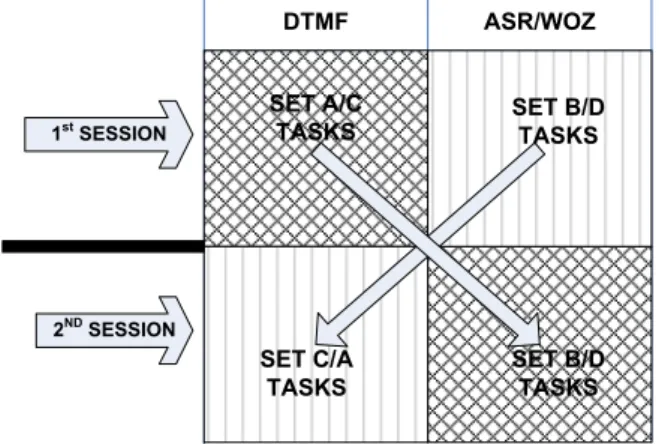
For both applications there were two test stations (two PSTN communication lines in BGR) for the experiments, one for the DTMF modality session and the other for the speech-enabled ASR/WOZ modality session. The participants were asked to participate in both the DTMF and ASR/WOZ modalities. In total there were four sets of tasks (A,B,C, and D) that could be done by the participants and out of the four each participant was required to do only two sets, one in the DTMF mode and the other in the speech-enabled ASR/WOZ mode. Each set had two tasks within it (task 1 and task 2) and all the sets were different from each other in terms of the combination of tasks that were performed. This made a total of four tasks that were performed by each participant (two tasks in each set of two sets). The first set was performed during the first session and the second set was done in the second session. Half of the participants were asked to start with DTMF as their 1st session and the other half were asked to start with ASR/WOZ as their 1st session.
In order to distribute the task set execution evenly amongst the participants, the task sets were executed in a rotating manner.
For example, the first participant did the 1st session in DTMF using set. A tasks and the same participant was then asked to do the 2nd session in ASR/WOZ using set B tasks. The second participant was asked to do 1st session in ASR /WOZ using set B tasks and the same participant was asked to do 2nd session in DTMF using set C tasks. The third participant was asked to do 1st session in DTMF using set C tasks and the same participant was then asked to do the 2nd session in ASR/WOZ using set D tasks. The fourth participant was asked to do 1st session in ASR/WOZ using set D tasks and the same participant was then asked to do 2nd session in DTMF using set A tasks. The fifth participant followed the same procedure as the first participant, and the sixth followed the same procedure as the second, the seventh as the third and the rotation carried on in that manner. All the tasks were independent of each other in the sense that no task depended on the accomplishment of any other task. Figure 1 is a graphical representation of the task execution described above. ASR/WOZ DTMF SET B/D TASKS SET A/C TASKS SET C/A
TASKS SET B/DTASKS
1st SESSION
2ND SESSION
Figure 1: Graphical presentation of planned task execution
The above experimental procedure of half-and-half crisscrossing of task execution combined with the rotation of set tasks was done in order to make sure that:
• The same number of tasks was performed for each of the modalities.
• Half of the participants started with DTMF modality and the other half started with the ASR/WOZ modality. • There was an even distribution of tasks performed between
the 4 possible task sets.
In each set, the first of the two tasks was designed to be easier than the second task and the participants started with the easier task and then progressed to the slightly more difficult task. The 2nd tasks were more challenging and engaging in the sense that they needed the participants to pay more attention and have more patience as the task performance required the participants to access information that was mentioned later in the system dialogue and deeper in the dialogue structure.
In-between the sessions, questions about the participants’ experiences on the 1st session were asked and questions about comparing the two modalities were not asked since they had interacted with only one modality by that time. After completing both sessions, participants were asked a few demographic questions which requested their age, level of education, home language, and others. They were also asked for their subjective evaluation of the systems and their choice of interaction modality between the DTMF and the speech-enabled ASR/WOZ modalities.
239 For both case studies the tests did not always go according to the plan as demonstrated in Figure 1 mainly due to some technical errors in the prototypes. This reduced the initial number of recruited participants on both systems. Out of the 33 OpenPhone participants, only 22 participants experienced both prototypes (both modalities) and only those participants’ results are employed for the direct contrast between the two prototypes. The OpenPhone participants were all indigenous Botswana people and spoke the only indigenous language of Botswana, i.e., Setswana, and they were recruited from the pool of clients, who are mostly women, at the clinic where they usually obtain medication and consulting services for the illness.
For the BGR system there were 27 participants and these are the participants who are used in the comparison of the two modalities as they performed tasks in both prototypes. There were nine BGR participants who performed their tasks in the presence of the researchers and 18 performed their tasks remotely. The participants covered speakers of all the nine indigenous languages of South Africa and came from all the nine provinces of the country. It was important for some of the BGR participants to execute their tasks remotely as the application needed to cover participants from both urban and rural areas in all nine provinces of South Africa.
4.
EXPERIMENTAL RESULTS
As stated earlier, this paper uses subjective results more dependable than objective results given the exploratory nature of the experiments, i.e., to establish the users’ modality of choice. Human experience is generally subjective [11], and in this paper we are only concerned with the participants’ modality of choice which is a subjective issue. Hone and Graham [9] concurs with the significance of users’ subjective measures to speech interfaces by stating that subjective reactions may well be a more important predictor of real world success. Shackel [20] also regards user satisfaction or users’ subjective attitude towards the system as the most important aspect of usability, and objective measures of system behavior may not suffice in predicting system acceptability [25].
In OpenPhone, the DTMF modality was preferred significantly over the WOZ modality notwithstanding the fact that the two modalities did not differ significantly in the overall success rates achieved. The researchers had imagined that, due to the intended users’ oral tradition, the speech-enabled WOZ system would be preferred by a large margin since the participants use their local language to interact with it. The researchers had believed that the single modality of interaction of the speech recognition substitute system (WOZ) would be preferable because information is exchanged to and from the system using only speech. With the DTMF system users employ two modalities of interaction with the system, i.e., listening to speech and pressing buttons. It was interesting to observe that even people who experienced more success with the WOZ system still chose the DTMF as their preferred modality of interaction. In BGR the overall success rate across all education level groups was not significantly different but the users preferred the ASR with an even greater extent than the users who preferred DTMF in the OpenPhone. In BGR, the researchers had learnt not to have any preconceived ideas about the users’ preferences as they were surprised enough from the OpenPhone experiences. It must be remembered that the underlying common factor in the users and usage of the two case studies is that they are for orally grounded people, even though there are differences in their cultures, levels of education, and nature of the content in the systems (OpenPhone
being a health-related application, and BGR being a fun application).
5.
ANALYSES
The participants preferred the DTMF modality in the OpenPhone and preferred ASR in the BGR. In finding out why this occurred there is a need to look at how the two modalities differ in their modus operandi in view of the participants’ socio-cultural ideals and traditions, as discussed next:
In operation, the DTMF modality necessitates the user to interact by pressing buttons on the phone. The interaction is muted to a nearby person and therefore, except for the user, no other person would be able to comprehend the content and the context of the interaction between the user and the system. Conversely, in the WOZ and ASR interactions, the modality necessitates the user to respond and interact by using their voice as in a normal conversation with another human being. This means that a close by person would be able to overhear the content of the interaction, whether unintentionally or otherwise. Other people who have used the same system would certainly know both the content and the context of the interaction as well. Within the culture of the indigenous people of Botswana, speaking out loudly on matters that are affiliated with sex is an inappropriate practice. It is well known that HIV/AIDS is an illness that is mostly spread through sex, and therefore speaking out loud about HIV/AIDS is not common unless it is through educational media such as lectures, television, radio, newspapers, etc. The stigma about HIV/AIDS is a complex situation that is interlinked with other stigmas including ethnicity, religion, gender and others [18]; [4]. Stigma is considered as one of the main impediments in controlling the disease. Being an HIV infected woman, within the socio-cultural ideals of the targeted users bears even more stigmatization, suffering in silence and shame [7]. The targeted users’ socio-cultural ideals in combination with the lack of seclusion in the modus operandi of the WOZ modality support the postulation that the caregivers’ choice of the DTMF modality is based on the privacy of the modality when compared to its counterpart. The researchers view the privacy issue as the most compelling reason behind the users’ choice. An inherent problem with the stigma of HIV/AIDS is that the users would largely not say that the stigma is the reason for their choice of interaction modality. This is partly because from the lectures that they attend and from the media of radio and television the effects and negative consequences of stigma have been addressed over and over, and caregivers know very well that they are not supposed to yield to stigma. Nevertheless, the HIV/AIDS stigma continues to be a problem in their communities and by nature of stigma, as it is something no one wants to talk about or be associated with, it discourages the caregivers in revealing stigma as an influence to their choice of interaction modality. In all the 22 participants who performed both modalities and were asked to compare the 2 modalities, only one participant mentioned that they prefer the DTMF because of its confidentiality, stating that in the WOZ system other people can hear what the user says. Interestingly, this particular user got both her DTMF tasks incorrect and got both her WOZ tasks correct and still chose DTMF as her modality of choice.
In contrast to the OpenPhone system’s access to a stigmatized issue, the BGR provides access to an issue that is not only free of stigma but something that has a culture of being publicly debated and spoken about loudly in public places, private
240 homes, work, and generally everywhere. It is a normal practice to find soccer fans gathered at work, in public places or over a phone call and debating issues about recent games and such conversations are typically accompanied with exuberance and loud speaking and laughter of fans teasing the supporters of teams that recently lost a game. Soccer fans love to speak out loudly about their favorite teams and this camaraderie is a way of making friends because soccer fans find it easy to start a chat with a stranger based on soccer. This loud and exuberant expression of love for soccer is part of South African soccer culture and it is compatible with the oral tradition of the indigenous people of the country as it promotes expression of opinions and chatting freely on a subject that is well-known and loved by the soccer fans. The exuberance of speaking loudly on soccer issues was evidenced on the BGR whereby participants were speaking loud and fast as they gave commands to the system, something they were not requested to do, as they were only requested to speak clearly. This was in direct contrast to the reserved, monotonous and slow style of interaction that was experienced with the OpenPhone participants. According to studies that were conducted in human emotional sensitivity, loud and fast voice was found to correlate to happiness, joy and confidence whilst a low and slow voice was linked to boredom, grief and sadness [19]; [5]. The researchers believe that the reason for the overwhelming choice of the ASR in BGR is because it allows the users to interact with the system in the same manner that they normally address soccer issues which is, simply, loud. Everything about the game in the region is loud; from the vociferous vuvuzela, a plastic horn played in and outside soccer matches that produces a loud monotone note, to the colorful apparel worn by the spectators, inside and outside the stadia. Likewise, the choice of the DTMF system in OpenPhone was due to fact that DTMF allows the users to exercise confidentiality in an interaction with a stigmatized subject matter within a society that imposes even more stigmatization towards infected women as they are looked upon more negatively than infected males.
6.
SHORTCOMINGS OF THE STUDY
In the OpenPhone system, when users were lost in the WOZ navigation or confused on what to do, the users had a tendency to keep quiet and then the system would time out, which resulted in more timeouts when compared to the DTMF. It could have been that the users were silent because they did not want to seem inadequate or foolish in performing their tasks (as they knew that the researchers were listening to them). The researchers tried to be indifferent towards the participants during the tests so as to influence them as little as possible but it cannot be ignored that they were present. On the other hand, users tended to try more options and persevered more with the DTMF and this could have been caused by the confidentiality of the interaction in the DTMF modality as the users might have assumed that the researchers were not aware of which buttons they were pressing (therefore were convinced that it was more confidential to make mistakes in DTMF than being overheard in the WOZ system).
The OpenPhone study might have produced different results if the users were to be asked to conduct the WOZ experiment in privacy, so that the unpleasant effect of speaking aloud about a stigmatized subject is minimal. It is important to note that the confidentiality addressed in the above paragraph is different from the privacy addressed in this paragraph and the two are not to be confused. The confidentiality mentioned above is a perceived privacy in providing input in the DTMF modality whereby the users assume that the researchers are not aware of
what numbers they have pressed and therefore feel more relaxed in attempting different options in DTMF than uttering spoken words in WOZ which are easily overheard by the researchers; this confidentiality has nothing to do with stigma. The other privacy effect is directly related to the stigmatized subject of HIV/AIDS and it is concerned with users being able to interact with the system in isolation in order to observe if this has any effects in their ability to interact with the system about a stigmatized subject. The common and underlying influence in both types of privacy is the effect of the presence of the researchers, which is meaningful in oral cultures especially in lower literate users. Sherwani et al. [23] concurs with the proposal of researchers’ influence on oral participants by stating that:
The experimenter always has a higher socio-economic status than the participant and is usually foreign to the local community, leading to feelings of intimidation and “performance anxiety” [23].
The researchers believe that this “performance anxiety” becomes less intense in applications that are for fun and cheerful as the anxiety was not evident in BGR participants, although this could have been due to the BGR users’ confidence in using IVR systems as opposed to the OpenPhone users. In the BGR system, this researcher-participant relationship was positively stimulated by the researchers’ general knowledge of the beautiful game’s current events in both local and international soccer scenes. This greatly improved the interactions with the BGR participants as it was easy for the researchers to ‘break the ice’ and start a comfortable conversation with the participants. The researchers believe that it would have been, otherwise, difficult to overcome the reservations that people tend to have when conversing with strangers especially in the context of participating in a usability test. This resulted in a researcher-participant relationship with minimal “performance anxiety”. There is a need to explore the effects of researcher-participant relationship in oral user studies and the correlation of such a relationship to the type of content provided by the system. The researchers’ ability to speak in the language of the participants also improves the researcher-participant relationship.
7.
CONCLUSIONS
OpenPhone users viewed the technology as something that would improve their ability to deal with the illness at any time of the day and from their homesteads instead of having to travel to the clinic in order to get help. The BGR users regarded their system as a helpful means that gives them results of recently played games whilst travelling or at work without having to wait for sports news on the television or the radio. The intended users’ response in both case studies is the buy-in that was aspired by the research team in order to be able to continue with further development of the technologies. The researchers consider the present first iterations of the developments to be a success as they have gathered information that will improve the next iterations and having obtained a positive affirmation from the most valuable entity in user centered design, i.e., the intended users.
In the comparison between the two modes of DTMF and ASR in IVR systems, it cannot be conclusively established that oral users prefer one over the other and this research has established that the type of content in the interaction have repercussions on the users’ preferences. Confidential matters that are associated with stigmatized issues within certain socio-cultural norms in oral communities are better handled with the mute DTMF
241 modality [15], whereas outspoken issues that are freely discussed with exuberant attitudes are preferably handled with the ASR modality. This finding contextualizes studies that have been previously conducted which suggest that DTMF is preferred by low-literacy users [16]; [21], and also qualifies another study that suggests the preference of ASR [24]. This research advocates that the type of content in the system has a bearing on the users’ choice of technology.
8.
ACKNOWLEDGMENTS
The authors would like to acknowledge the assistance from the Rhodes University Centre of Excellence in Distributed Multimedia, Human Language Technologies Group at the Meraka Institute, CSIR and Communications Research Group of the University of Cape Town.
9.
REFERENCES
[1] An analysis of African oral traditions. 2010. [Online] Available: http://www.helium.com/items/1008065-an-analysis-of-african-oral-traditions [Accessed 22 November 2010].
[2] Barnard, E., Cloete, J.L., Coetzee, L., and Patel, H. 2003. Towards effective telephone-based delivery of government services. 9th International Winelands Conference, Stellenbosch, 2003.
[3] Brown, I., Cajee, Z., Davies, D., and Stroebel, S. 2003. Cell phone banking: Predictors of adoption in South Africa—An exploratory study, International Journal of Information Management 23 (5) (2003), pp. 381– 394.Tavel, P. 2007 Modeling and Simulation Design. AK Peters Ltd.
[4] Chesney, M.A., Smith, A.W., Critical Delays in HIV Testing and Care: The Potential Role of Stigma, American Behavioural Scientist, Vol. 42, No. 7, 1162-1174 (1999). [5] Davitz, J. R. 1964. The communication of emotional
meaning. New York: McGraw-Hill.
[6] Delogu, C., Di Carlo, A., Rotundi, P., and Sartori, D. 1998. A comparison between DTMF and ASR IVR services through objective and subjective evaluation. In Proceedings of IVTTA’98 (Sydney, Australia, November 30–December 4, 1998), pp. 145–150.
[7] Duffy, L., Suffering, shame, and silence: The stigma of HIV/AIDS. Journal of the Association of Nurses in AIDS care, Volume 16, Issue 1, January 2005, pp. 13 – 20. [8] Foster, J.C., McInnes, F.R., Jack, M.A., Love, S., Dutton,
R.T., Nairn, I.A., and White, L.S. 1998. An experimental evaluation of preferences for data entry method in automated telephone services. In Behaviour & Information Technology, Volume 17, Issue 2, pp. 82-92.
[9] Hone, K. S. and Graham, R. 2001. Subjective assessment of speech-system interface usability. In EUROSPEECH-2001, pp. 2083-2086.
[10] [ITU] International Telecommunications Union. 2006. World Telecommunication Development Report 2006. Mobile Cellular. Executive Summary. Geneva, Switzerland.
[11] Isomursu, M. 2008. In IFIP International Federation for Information Processing, Volume 272, Human-Computer Interaction Symposium, Peter Forbig, Fabio Paterno, Annelise Mark Pejtersen; (Boston: Springer), pp. 47-52.
[12] Karis, D. 1997. Speech recognition systems: Performance, preference, and design. In Proceedings of 16th International Symposium on Human Factors in Telecommunications, May 12–16, 1997, Oslo, Norway, pp. 65–72.
[13] Medhi, I. and Toyama, K. 2007. Full-Context Videos for First-Time, Non-Literate PC Users. In IEEE/ACM International Conference on Information and Communication Technologies and Development, Bangalore, India.
[14] Ndwe, T.J., Dlodlo, M.E., Mashao, D.J. 2007. Usability engineering of an interactive voice response system in a diverse-cultured and multilingual setting. International Conference on Systems, Computing Sciences and Software Engineering (SCSS 2007). 3-12 December 2007, pp. 554-559.
[15] Ndwe, T.J., Dlodlo, M.E., Nichols, J.W, 2010. Comparison of Touch and Speech-enabled IVR System in Low Literacy Users. IEEE International Conference on User Science and Engineering (i-USEr 2010). Shah Alam, Malaysia, 13-15 December 2010, pp. 264-269.
[16] Patel, N., Agarwal, S., Rajput, N., Nanavati, A., Dave, P. and Parikh, T.S. 2009. A Comparative Study of Speech and Dialed Input Voice Interfaces in Rural India. In Proceedings of CHI 2009, pp. 51-54.
[17] Patel, N., Chittamuru, D., Jain, A., Dave, P., and Parikh, T.S. 2010. Avaaj Otalo — A Field Study of an Interactive Voice Forum for Small Farmers in Rural India. In Proceedings of CHI 2010.
[18] Reidpath, D. D. and Chan, K. Y. AIDS Care, Volume 17, Number 4, May 2005 , pp. 425-432(8).
[19] Scherer, K.R. 1979. Nonlinguistic vocal indicators of emotion and psychopathology. In Emotions in Personality and Psychopathology, C.E. Izard, (ed.), Plenum, New York, pp. 495–529.
[20] Shackel, B. 1991. Usability—context, framework, definition, design and evaluation. In Human Factors for Informatics Usability, B. Shackel and S. J. Richardson, Eds. Cambridge University Press, New York, NY, pp. 21-37.
[21] Sharma, A., Plauché, M., and Barnard, E. 2009. HIV Health Information Access Using Spoken Dialogue Systems: Touchtone vs. Speech. In IEEE International Conference on Information and Communications Technologies and Development '09 (ICTD 09), Doha, Qatar, pp 95-107, April 2009.
[22] Sherwani, J., Ali, N., Mirza, S., Fatma, A., Memom, Y., Karim, M., Tongia, R., and Rosenfeld, R. 2007. HealthLine: Speech-based access to health information by low-literate users. In IEEE/ACM InternationalConference on Information and Communication Technologies and Development, Bangalore, India.
[23] Sherwani, J., Ali, N., Rosé, C., and Rosenfeld, R. 2009. Orality-Grounded HCID: Understanding the Oral User. Information Technologies & International Development, 5(4), pp. 37-49.
[24] Sherwani, J., Palijo, S., Mirza, S., Ahmed, T., Ali, N., and Rosenfeld, R. 2009. Speech vs. touch-tone: Telephony interfaces for information access by low literate users. In Proceedings of the IEEE International Conference on ICTD, pp. 447–457.
242 [25] Tractinsky, N. 1997. Aesthetics and apparent usability:
empirically assessing cultural and methodological issues. In Proceedings of the SIGCHI Conference on Human Factors in Computing Systems (Atlanta, Georgia, United States, March 22 - 27, 1997). S. Pemberton, Ed. CHI '97. ACM, New York, NY, pp. 115-122.
[26] Lee, K. M. and Lai, J. 2006. Speech versus Touch: A Comparative Study of the Use of Speech and DTMF Keypad for Navigation. International Journal of Human-Computer Interaction, 19 (3), pp. 343-360.
[27] Nuance Communications Inc. 2003. Speech Satisfies a Broad Consumer Market. [Online]. Available: http://investor.nuance.com/ireye/ir_site.zhtml?ticker=nuan &script=410&layout=6&item_id=425519 [Accessed: 28 July 2003].