This content has been downloaded from IOPscience. Please scroll down to see the full text.
Download details:
IP Address: 131.215.225.183
This content was downloaded on 02/06/2017 at 16:52 Please note that terms and conditions apply.
Scrambling and thermalization in a diffusive quantum many-body system
View the table of contents for this issue, or go to the journal homepage for more 2017 New J. Phys. 19 063001
PAPER
Scrambling and thermalization in a diffusive quantum many-body
system
A Bohrdt1,2,5
, C B Mendl3
, M Endres4
and M Knap1
1 Department of Physics, Walter Schottky Institute, and Institute for Advanced Study, Technical University of Munich, D-85748 Garching, Germany
2 Department of Physics, Harvard University, Cambridge, MA 02138, United States of America
3 Stanford Institute for Materials and Energy Sciences, SLAC National Accelerator Laboratory, and Stanford University, CA 94025, United States of America
4 Division of Physics, Mathematics and Astronomy, California Institute of Technology, Pasadena, CA 91125, United States of America 5 Author to whom any correspondence should be addressed.
E-mail:[email protected]
Keywords:scrambling of quantum information, out-of-time ordered correlation functions, incoherent transport, many-body interferometry
Abstract
Out-of-time ordered
(OTO)
correlation functions describe scrambling of information in correlated
quantum matter. They are of particular interest in incoherent quantum systems lacking well de
fi
ned
quasi-particles. Thus far, it is largely elusive how OTO correlators spread in incoherent systems with
diffusive transport governed by a few globally conserved quantities. Here, we study the dynamical
response of such a system using high-performance matrix-product-operator techniques. Speci
fi
cally,
we consider the non-integrable, one-dimensional Bose–Hubbard model in the incoherent
high-temperature regime. Our system exhibits diffusive dynamics in time-ordered correlators of globally
conserved quantities, whereas OTO correlators display a ballistic, light-cone spreading of quantum
information. The slowest process in the global thermalization of the system is thus diffusive, yet
information spreading is not inhibited by such slow dynamics. We furthermore develop an
experimentally feasible protocol to overcome some challenges faced by existing proposals and to
probe time-ordered and OTO correlation functions. Our study opens new avenues for both the
theoretical and experimental exploration of thermalization and information scrambling dynamics.
Dynamical correlations of many-body quantum systems provide direct information about many-body excitations[1], describe quantum phases and transitions[2], and characterize certain topological aspects[3,4]. The dynamical response of a many-body system to a local perturbation is obtained from a time ordered
correlation function,áW t Vˆ ( ) ˆ ( )0 ñ, which describes therelaxationof the many-body system following the initial excitation by the operatorVˆthat is then probed at later times byWˆ. However, in general such time-ordered correlation functions cannot capture the spread of information across a quantum system, especially in a regime where quasiparticles are not well-defined.
Recently, it has been proposed that spreading or‘scrambling’of quantum information across all the system’s degrees of freedom can be characterized by out-of-time ordered(OTO)correlation functions:
W t V 0 W t V 0
á ˆ ( ) ˆ ( ) ˆ ( ) ˆ ( )† † ñ
[5–10]. These correlation functions appear as the OTO part ofá∣[ ˆ ( ) ˆ ( )]∣W t ,V 0 2ñand
hence predict the growth of the squared commutator betweenW tˆ ( )andVˆ ( )0. OTO correlators could thus be capable of describing a quantum analog of the butterfly effect in classical chaotic systems, which characterizes the spread of local excitations over the whole system. At short times, OTO correlators are expected to grow exponentially with a rate characterized by the Lyapunov exponentlL. The Lyapunov exponent has been
conjectured to be bounded by0lL2pT[9]. This bound is saturated in strongly coupledfield theories with a gravity dual[6]and in disordered models describing a strange metal[7,11,12]. By contrast,lLdoes not fully
saturate the bound for a critical Fermi surface[13]and is parametrically smaller in Fermi liquids or other weakly coupled states[12,14,15]. OPEN ACCESS RECEIVED 7 March 2017 REVISED 13 April 2017 ACCEPTED FOR PUBLICATION 8 May 2017 PUBLISHED 2 June 2017
Original content from this work may be used under the terms of theCreative Commons Attribution 3.0 licence.
Any further distribution of this work must maintain attribution to the author(s)and the title of the work, journal citation and DOI.
Here, we study both time-ordered and OTO correlators in a diffusive many-body system by considering the concrete example of the non-integrable, one-dimensional Bose–Hubbard model. Thus far, it is a largely open question, how OTO correlators spread in diffusive systems with a few globally conserved quantities[10,13,15,16]. In our work, we study this question by performing matrix-product operator(MPO)based simulations of the Bose– Hubbard model at high temperatures, at which well defined quasi-particles cease to exist. We demonstrate that in this regime the time-ordered one-particle correlation functions are strongly incoherent and feature rapidly decaying excitations, whereas the OTO correlators indeed describe theballisticspreading of information across the quantum system(seefigure1). In contrast to the linear light-cone spreading of quantum information, the eventualglobal
thermalization of the closed system takes parametrically longer, due to hydrodynamic power-laws resulting from globally conserved quantities. For example, we show that the local density correlation function decays as~1 Dt, describing diffusion in one dimension with the corresponding diffusion constantD. Thus, the time scales associated with the spread of information and with global thermalization are different.
Despite their usefulness to characterize interacting many-body systems theoretically, it remains a challenge to experimentally measure such dynamical correlation functions inrealspace and time[17,18], as required to observe information spreading. Here, we propose generic experimental protocols to characterize both time-ordered and OTO correlators vialocalmany-body interferometry. Our proposal to measure OTO correlators is unique because it overcomes some of the challenges that recently proposed protocols exhibit atfinite
temperatures and because it eliminates the scaling problems associated withglobalmany-body interferometry [19,20]. Furthermore, our protocol does not require an ancillary atom to switch between different system Hamiltonians[21–23]and directly works with massive bosonic and fermionic particles(see also[24–28]). We show that our protocol not only enables the measurement of dynamical correlation functions but also rather generic static correlation functions(including off-diagonal ones), thus opening the way for a full state-tomography of many-body quantum states.
1. Results
We study dynamical correlation functions of the one-dimensional Bose–Hubbard model focusing mainly on the incoherent intermediate to high temperature regime. The Hamiltonian of the system is given by
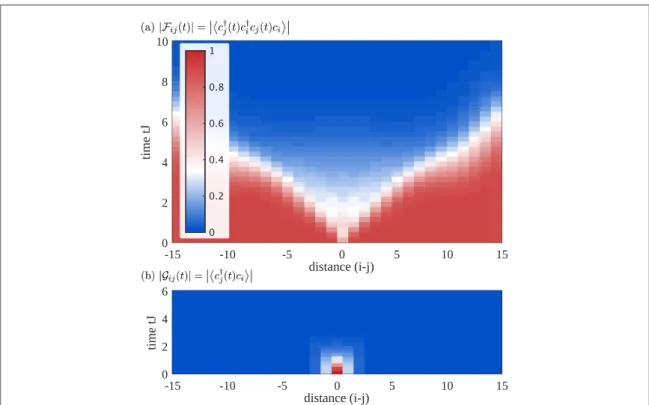
Figure 1.Dynamical correlation functions in the incoherent transport regime.(a)Out-of-time ordered(OTO)correlators measure the scrambling of information across a quantum state. We compute OTO correlatorsij( )t = ác t c c t cj†( )i† j( )iñin the 1D Bose– Hubbard model at high temperatureT=4Jfor interactionsU=J, chemical potentialm=0, and system sizeL=30. In the high temperature regime, well-defined quasiparticles cease to exist. However, the OTO correlatorijexhibits a light-cone spreading of information.(b)The breakdown of well-defined quasiparticles is demonstrated by the one-particle Green’s function
t c t c
ij j i
( )= á†( ) ñ, which quickly decays to zero withintJ~0.6. The lifetime is thus shorter than the hopping rate, indicating a regime of incoherent transport.
H J c c h.c. U n n n 2 1 , 1 i i i i i i i i 1
å
å
må
= - + + + - -ˆ ( † ) ˆ ( ˆ ) ˆ ( )whereJis the tunneling matrix element,Uthe interaction strength, andμthe chemical potential. The bosonic creation(annihilation)operator on siteiis denoted asci†(ci)and the local particle number operator isnˆi=c ci† i.
At zero temperature and commensuratefilling, the Bose–Hubbard model exhibits a quantum phase transition from a gapped Mott insulating phase with short range correlations at strong interactions to a compressible superfluid phase with power-law correlations at weak interactions[29]. Atfinite temperatures the system is a correlated, normalfluid. We compute the dynamical correlation functions atfinite-temperature for systems up toL=50 sites using MPO techniques. The presented results are evaluated for virtual bond dimension 200–400 and the local bosonic Hilbert space is truncated to three states, which is sufficient to render the system nonintegrable. The presented results are checked for convergence with respect to the MPO bond dimension and system size; see methods3.1for details on the numerical simulations.
1.1. Spread of quantum information
Recently, OTO correlation functions have been proposed as a useful diagnostic tool to quantify the dynamical spreading of quantum entanglement and quantum chaos in many-body systems. OTO correlators describe the growth of the commutator between two local operatorsWˆ andVˆin time
C t( )= -á∣[ ˆ ( ) ˆ ( )]∣W t ,V 0 2ñ. ( )2 In a semiclassical picture, the commutator in equation(2)can be replaced by Poisson brackets. Then, for the choice ofWˆ =pjandVˆ =pi, this quantity reduces toC t( )~ á ¶( p tj( ) ¶qi( ))0 2ñ. Therefore, the correlation
functionC(t)describes the sensitivity of the time evolution and is expected to grow exponentially at short times t
exp lL
~ [ ], with a ratelLthat resembles the Lyapunov exponent in classical chaotic dynamics. Rewriting these
momenta and coordinates as combinations of creation and annihilation operators, equation(2)generically consists of OTO correlators of the form
t c t c c t c . 3
ij j i j i
( )= á †( ) † ( ) ñ ( )
Below we mainly consider the quantum statistical averageá¼ñ =tr[ ˆr¼]over an initial thermal state with weights distributed according to the Gibbs ensemblerˆ=e-H Tˆ Z
whereZis the partition function and we set the Boltzmann constantkBto one. Alternatively, the average can also be performed with respect to an arbitrary initial state, for example a pure staterˆ =∣y0ñáy0∣. For thermalizing systems, it is then expected that an effective
temperature is approached at late times which depends on the energy density imprinted on the system by the initial state[30–32].
OTO correlatorsijevaluated at comparatively high temperaturesT=4J, interactionsU=J, and chemical potentialm=0are shown infigure1(a)as a function of timetand distance(i-j);for OTO correlators in the coherent Luttinger Liquid regime see[33]. Despite the high temperature, the OTO correlator
ij
unveils a pronounced light-cone spreading of the information across the quantum state for∣i-j∣7. For larger distances the light cone seems to exhibit a plateau, which we, however, attribute to thefinite MPO bond dimension considered in the numerical simulations; see methods3.1. OTO correlators are in that respect challenging to simulate with MPO techniques, because they directly reflect the fast spreading of entanglement.
The OTO correlatorij( )t should be contrasted to the time-ordered single-particle Green’s function
t c t c , 4
ij j i
( )= á †( ) ñ ( )
which is shown infigure1(b). In the incoherent transport regime, where well-defined quasiparticles do not exist, the Green’s functionij( )t rapidly decays in time. Therefore, it is not capable of characterizing the spread of quantum information or entanglement across the state which is generically not linked to the transport of quasi-particles[34]. For the chosen parameters(U=J,m=0,T=4J), wefind that the quasiparticle lifetime is approximatelytJ~0.6and hence shorter than the microscopic hopping rate, which indicates incoherent transport. By contrast, the OTO structure ofij( )t reveals a well defined linear spread of quantum information despite the high temperature.
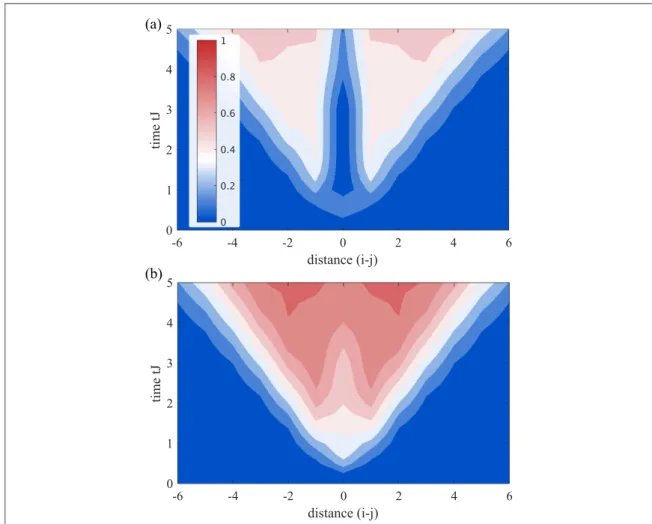
We now characterize the OTO correlatorsij( )t in detail. To this end, we subtractán nˆ ˆi jñfrom theij( )t and consider its relative change:ijr( )t =∣ij( )t - án nˆ ˆ ∣i jñ án nˆ ˆi jñ. Examples for the reduced OTO correlatorijr( )t are shown infigure2for interactionU=Jand different temperaturesT. The reduced OTO correlatorijr( )t starts off at zero, forms the light-cone plateau, and approaches the steady-state value as an exponential.
From the light-cone spread of the OTO correlator, we extract two velocities(figure3(a)):(1)the light-cone velocityvlc, which we define by the space–time region where the reduced OTO correlatorsijr( )t surpasses a small threshold of 0.05% of itsfinal value.(2)The butterfly velocityvb, which we define by the space–time region
where the OTO correlator attains a large fraction(20%)of itsfinal value. Wefind thatvbdoes not significantly
increases with temperatureTand is bounded from below by the zero temperature Luttinger liquid velocity; see figure3(b). The butterfly velocityvbis systematically lower thanvlcand is almost independent of temperature.
The butterfly velocity determines the time scaletscrfor scrambling information across the many-body quantum
state which is linear in system sizetscr~L vb. Based on results from holography, it has been argued in[16]that
the light-cone and the butterfly velocity should be quite generally the same. This should be contrasted to our
Figure 2.Light-cone spreading of quantum information. Contour plots of the reduced OTO correlator
t t n n n n
ij r
ij i j i j
( )~∣( )- ሠˆ ∣ñ ሠˆñas a function of time and distance for interaction strengthU=J, chemical potentialm=0, and temperature(a)T=2Jand(b)T=16J, respectively. The spreading of quantum information forms a light-cone pattern. The contour lines indicate changes ofijr( )t by 0.1.
Figure 3.Characterizing the speed of information propagation.(a)Reduced OTO correlatorsijr( )t are shown as a function of time
for different distances∣i-j∣, interaction strengthU=J, and temperatureT=4J. We introduce the light-cone velocityvlcby the
space–time region, wherersurpasses a small threshold and the butterfly velocityv
bwhere it attains a large fraction of order one.(b)
The light-cone velocityvlcgrows with temperature and is bounded from below by the zero temperature Luttinger liquid velocity (colored arrows). By contrast, the butterfly velocityvbis systematically smaller thanvlcand approximately independent of
results for the Bose–Hubbard model and to a study of non-relativistic non-Fermi liquids[13]. In both cases the butterfly velocity has been found to be smaller than the light-cone velocity. For details on the analysis of the OTO correlators; see methods3.2.
Previous studies of strongly coupledfield theories[9]or disordered SYK models[7]predict an exponential growth in the initial dynamics of the reduced OTO correlator of the formxr( )t ~exp[lL(t -x vb)]with
butterfly velocityvband a growth ratelL, which is refered to as Lyapunov exponent. Both systems display a clear
separation between the collision timeτand the scrambling timetscr, at which the OTO correlator assumes an
appreciably large value. Hence, in these systems the exponential growth occurs up to parametrically late times determined by a large parameterN, which controls the approach to a semiclassical limit. We tested the results of our numerical simulations against this prediction andfind that they are incompatible with an exponential growth in time inasmuch as there appears to be no parametrically large regime of exponential growth in our model, seefigure3. This is a consequence of the average particle density, which is controlled by the chemical potential, being typically on the order of one for the chosen parameters. This effectively restricts the accessed local Hilbert space dimension and hence there is no large separation between collision and scrambling time[35]. Therefore, we cannot unambiguously define a Lyapunov exponent. Finding the analytic form for the initial growth in our system remains an outstanding challenge.
Nonetheless, one can estimate a growth ratelLby linearizing the OTO correlator around the space–time
region set by the butterfly velocity, which is shown as a function of temperature for different values of the interaction strengthUand chemical potentialm=0infigure4. We note however that the concrete values for the Lyapunov exponent depend on the space–time region around which we linearize, seefigure8. It has been conjectured that the Lyapunov exponent is bounded by2pT, which is the value it assumes in a strongly coupled field theory with a gravity dual[9]. In our system,lLis parametrically lower than this bound and increases slowly
when lowering the temperature. Moreover, wefind that the dependence of the Lyapunov exponent on the interaction strengthUis small with slightly larger values oflLfor intermediate interaction strength,U=3J,
which is in the vicinity of the quantum critical point.
1.2. Thermalization
Closed quantum systems approach their global equilibrium only very slowly, due to the slow evolution of observables that overlap with conserved quantities. In the Bose–Hubbard model(1), energy, lattice momentum, and total particle number are conserved. From hydrodynamics we infer that, for example, the conserved particle number leads to a diffusion equation of the density[36,37]
n D n 0, 5
t 2
¶ - = ( )
whereDis the diffusion constant. The connected density correlation function
C xn( - ¢x t, - ¢ =t) Re[án x t n x t( , ) ( ¢ ¢ ñ - á, ) n x( )ñán x( ) ]¢ ñ relates the density at space–time(x,t)to the density at(x t¢ ¢, )vian x t( , )~
ò
d dt x C x¢ ¢ n( - ¢x t, - ¢t n x t) ( ¢ ¢, )and in a hydrodynamic regime is expected to be of the formFigure 4.Lyapunov exponent. The reduced OTO correlatorijr( )t is expected to grow exponentially on a timescale set by the butterfly
velocityvbwith a rate that defines the Lyapunov exponentlL. In our system, the regime of exponential growth is restricted to a rather
small time range, see alsofigure8. Our data suggests that the Lyapunov exponentlLis parametrically smaller than the conjectured
C x t C D t , 4 e , 6 n x D t 2 4 p @ -( ) ˜ ∣ ∣ ( ) ∣ ∣
withC˜ =
ò
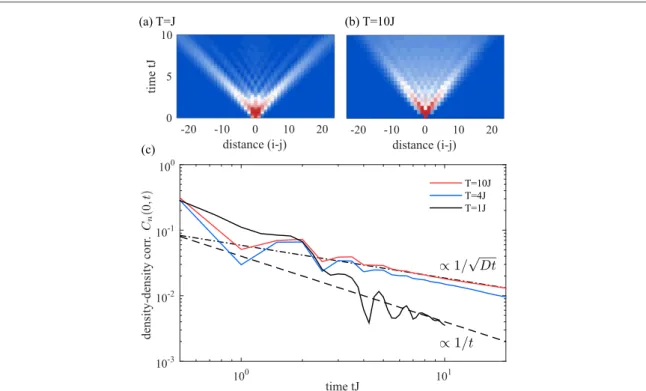
dx C xn( , 0). Whereas local equilibrium is approached after a few scattering events, attaining global equilibrium is restricted due to the relaxation of such conserved quantities, which have to be transported over long distances. At comparatively low temperatures(T=J),figure5(a), the ballistic spread of sound modes dominates the dynamics of the connected density correlator in the numerically accessible time regime. However, at high temperatures(T=10J),(b)the density correlator approaches diffusive transport after a few hopping scales and attains afinite value in the region between the sound modes. To be more quantitative, we study the local(x- ¢ =x 0)density correlation function. At high temperaturesT4Jthe local correlator exhibits a diffusive power-law decayC xn( =0,t)~1 Dt,(c). For this parameter set we extract the diffusion constant D=9.79 1( )a J2 forT=10JandD=14.29 27( )a J2 forT=4J, whereais the lattice spacing; see table1. Thedecrease of the diffusion constant with increasing temperature is somewhat counterintuitive. We attribute this behavior to the fact that the calculations are performed in the grand-canonical ensemble. Hence the particle density depends on the temperature and, in particular, increases with temperature in the chosen parameter regime. We note that the connected density correlator does not exhibit pronounced hydrodynamic long time tails, which could result from higher order gradient corrections to the diffusion equation and mask the1 Dt
Figure 5.Thermalization in closed quantum systems. Conserved quantities restrict the approach of a closed quantum system to global equilibrium, thus rendering global thermalization a slow process. In the Bose–Hubbard model the total particle number is conserved leading to diffusive power-law tails in the connected density correlatorC x tn( , )=Re[ ˆ ( ) ˆán t nx 0ñ - á ñá ñnˆx nˆ ].0 (a)At low
temperatures(T=J), where quasiparticles are reasonably well defined, the density correlator does not reach the diffusive regime within the accessible simulation time but is dominated by ballistic sound peaks.(b)By contrast, for high temperatures(T=10J)the crossover to diffusion becomes apparent.(c)For temperaturesT4Jthe local density correlatorCn(0,t)~1 Dt, whereDis the diffusion constant. By contrast, at low temperatureT=Jthe diffusive regime has not yet been reached within the numerically accessible times and the correlations rather decay ballisticallyCn(0,t)~1 t. The slow relaxation of the hydrodynamic modes leads to the global thermalization time scaletth~L D2 that is parametrically larger than the scrambling time scaletscr~L vbof quantum
information.
Table 1.Diffusion constantDand the ratioDlL vB2for different
temperaturesT. The errors as indicated in the parentheses are errors from thefits.
T/J D (a J2) D v L b2 l 4 14.29(27) 7.2(6) 6 11.69(10) 6.0(4) 8 10.42(04) 5.4(3) 10 9.79(01) 5.1(3)
decay. This seems to be a particular property of the density correlator, as wefind at high-temperatures pronouncedt-3 4corrections in the energy-density correlation function(not shown), in agreement with[37].
It has been proposed that the diffusion constant is related to the butterfly velocityvband the Lyapunov
exponentlLviaD~vb2 lL[38–41], where1 lLis a bound for the local thermalization time in which the
system is able to attain local equilibrium characterized by a local temperature and local chemical potential that varies between different regions in space. From our simulations, we obtain coefficients of the order
DlL vb2~5.5for temperaturesT6 ;J see table1, which seems to suggest a connection between the spread of information andlocalthermalization, as suggested by calculations for holographic matter. However, clearly
globalthermalization is a parametrically slower process than information scrambling and takes for systems of
sizeLtimes of the ordertth~L D2 . Experimentally measuring OTO correlators(section1.3)and density correlators(section3.3.3)will make it possible to further check these holographic predictions.
1.3. Measuring dynamical time-ordered and OTO correlators
We develop two generic interferometric protocols that measure time-ordered as well as OTO correlation functions for systems of bosons or fermions in an optical lattice. Thefirst is based ongloballyinterfering two many-body states and the second onlocalinterference. The quantum interference of two copies of the many-body state is realized by local beam splitter operations. Variants of this approach have been proposed to study Rényi entropies[42–44]and have been demonstrated experimentally using a quantum gas microscope[19,20]. Both protocols that we propose consist only of elements which have already been used in experiments. The two protocols are complementary and each of them has its own advantages. In the following, we sketch the main features of the protocols and refer to the methods section3.3for technical details on the implementation.
Global interferometry precisely yields the square modulus of the single-particle Green’s functions
t t
ij ij
gl 2
( )=∣ ( )∣ and the OTO correlatorsijgl( )t =∣ij( )∣t 2forpureinitial states(see section3.3.1). In a thermalizing system, effectivefinite temperatures can be obtained with the help of quenches from pure initial states. However, generic high temperature initial states are not accessible with this protocol. The measurement schemes proposed e.g. in[23]face similar challenges. The global interferometry protocol is furthermore limited to rather small system sizes, since the many-body wave function overlap has to be measured, which requires an extensive number of beam splitter operations.
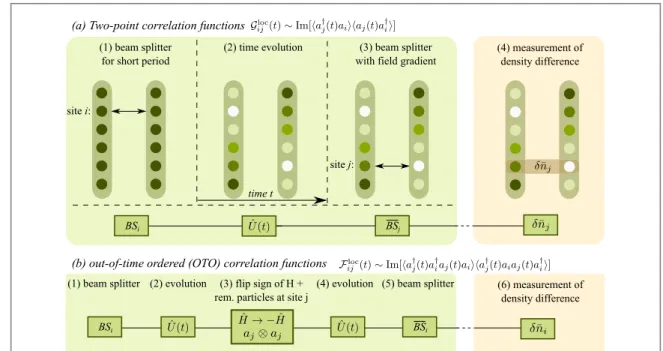
These limitations are overcome by the second proposed protocol which uses local interferometry(see section3.3.2for details on the implementation). In this protocol, only two local beam-splitter operations are required irrespective of the system size, and only local density differences between the two copies have to be measured. Furthermore, initial thermal density matrices can be studied as well. This local approach yields a slightly amended two-point correlation functionijloc( )t ~Im[áa t aj( ) iñáa t aj( ) iñ]
† † and OTO correlator
t Im a t a a t a a t a a t a
ij j i j i j i j i
loc
( )~ [á †( ) † ( ) ñá †( ) ( ) †ñ]. However, we demonstrate in section3.3.2that these
correlators carry much of the same information as the ones we discussed previously. Static correlation functions are accessible with the same techniques and an extension to higher order correlators is straightforward.
2. Discussion and outlook
We studied time-ordered as well as OTO correlation functions in the one-dimensional Bose–Hubbard model and suggest different protocols to experimentally access them. At high temperatures, well-defined quasi-particles cease to exist and the time-ordered Green’s function decays within short times. However, the spread of information is not necessarily linked to the transport of quasi-particles. Our numerical results for the OTO correlators clearly indicate the ballistic spread of information even at high temperatures where transport is incoherent. In our one-dimensional system, this linear spread sets the timescale for scrambling information across the quantum state to be proportional to the system size. Moreover, the existence of conserved quantities in the Bose–Hubbard model leads to diffusive behavior of the corresponding time-ordered correlation functions. Global thermalization therefore scales with the square of the system size and takes parametrically longer than scrambling quantum information.
For future work, it would be on the one hand interesting to develop analytical predictions for the growth of OTO correlators, which in our numerics deviates significantly from the simple exponential growth obtained in strongly coupledfield theories, or for the bounds that characterize the information propagation and Lyapunov exponents. On the other hand, the numerical study of OTO correlators in other interacting many-body systems, including Fermi–Hubbard models, spin models, or continuum Lieb–Liniger models, could be beneficial. Taking such routes could help to advance our fundamental understanding of information scrambling, transport, and thermalization.
Experimental measurements of both time-ordered and OTO correlators will be eminent for the investigation of the dynamical properties of many-body systems. We proposed two different protocols to
measure correlation functions, which can be either static, time ordered, or OTO. The schemes are respectively based on the global and local interference of two copies of the many-body state of interest. The required techniques have already been demonstrated in experiments with synthetic quantum matter. An extension of the described experimental schemes to two-dimensional systems is conceivable as well and could provide a valuable perspective on the dynamics of many-body quantum systems.
3. Methods
In this section, we discuss the numerical method with which the calculations have been performed, the procedure to obtain the velocitiesvlc,vband the Lyapunov exponentlL, as well as technical details on the
implementation of the proposed protocols.
3.1. Numerical simulations
Our numerical simulations are based onfinite-temperature, time-dependent MPO[45–50]. For the density correlations, we evaluate[49]
n t n Z n n Z n n 0 def 1 tr e e e 1 tr e e e e e e , 7 j H itH itH j iH H 2 iH iH j H 2 iH t t t t 2 2 2 2 ሠ( ) ˆ ( )ℓ ñ =b [ -b ( ˆℓ - ) ˆ ]= ⎡⎣
(
-b ˆℓ -)(
- ˆ -b)
⎦⎤ ( ) ˆ ˆ ˆ ˆ ˆ ˆ ˆ ˆ ˆwhereβis the inverse temperature andZthe partition function. We construct the MPO approximation of the two terms in the parentheses byfirst computinge-bH 2nˆ
ℓ ˆ
andnˆje-bHˆ 2, respectively, and then performing a real-time evolution up tot
2and
t
2
- . By exploiting the time translation invariance, n t nj 0 n t 2 nj t 2
ሠ( ) ˆ ( )ℓ ñ = áb ˆ (ℓ ) ˆ (- )ñb, the maximum simulated time has effectively been reduced by a factor two, which in turn reduces the required virtual bond dimension of the MPO.
To evaluatee-bHˆ 2
, we employ a second-order Suzuki–Trotter decomposition with imaginary time stepDt
(typicallyD =tJ 0.025)after splitting the Hamiltonian into even and odd bonds, as described in[45]. The real-time evolution proceeds by Liouville stepsA tˆ ( + D =t) eiDtHˆA tˆ ( )e- Di tHˆ
. For each of the steps we combine a fourth-order partitioned Runge–Kutta method[51]with even–odd bond splitting of the Hamiltonian. As noted in[49], the Liouville time evolution has the advantage that the virtual bond dimension does not increase outside the space–time cone set by Lieb–Robinson-type bounds. The high order decomposition also allows for relatively large time steps(in our caseD =tJ 0.125or 0.25).
For the OTO correlatorsác t c c t cj†( ) ℓ† j( ) ℓñb, a regrouping analogous to equation(7)would lead to four terms inside the trace, such that a straightforward contraction to evaluate the trace becomes computationally very expensive. Instead, we evaluate
c t c c t c Z c c c c 1 tr e e e e e 8 j j itH H j itH itH j itH á †( ) ℓ† ( ) ℓñ =b [( -b - ℓ)( - ℓ)] ( ) ˆ ˆ † ˆ † ˆ ˆ
and time-evolve bothe Hc j b
- ˆ †andc
jup to timet. Subsequent application of the site-local operatorscℓ†andcℓdoes not affect the virtual bond dimension in the MPO representation.
In our simulations, we restrict the local Hilbert space to three states mainly due to computational limitations. Since the average particle number per site is approximately one, this restriction should not
qualitatively affect the simulation results. Moreover, truncating the local Hilbert space to three states is sufficient to render the system non-integrable, which is crucial to observe the thermalization behavior studied in
this work.
Since OTO correlators are closely linked to the spreading of entanglement, it is challenging to simulate them using MPO techniques. Infigure6we compare the data obtained for the same simulation parameters but different maximal bond dimensions. The MPO bond dimension of 20 apparently leads to a spread of quantum information from distances∣i-j∣»6to∣i-j∣»10within a durationdt~0, which manifests itself in a plateau in the light-cone, seefigure6(a). Increasing the bond dimension shifts this numerical artifact to larger distances. It is however exponentially costly to reach full convergence of the OTO correlator. In the analysis of the numerical data we therefore only considered small distances, where we checked that increasing the bond dimension does not alter the correlators.
3.2. Data analysis
We describe in detail how we determine the light-cone velocityvlc, the butterfly velocityvb, and the Lyapunov
exponent. The light-cone velocity is defined as the ratio of the distance∣i-j∣and the time at which the reduced OTO correlatorijr( )t reaches a small threshold. The butterfly velocity, however, sets a scale for the time it takes to scramble information over the system and is therefore defined via the time at whichijr( )t attains a large value of order one. The specific threshold one chooses to determine the butterfly velocity is thus somewhat arbitrary.
We illustrate the dependence of the velocityvon the chosen threshold*of the reduced OTO correlatorijr( )t infigure7. For large values of*, the velocity converges toward a constant. Hence, the butterfly velocity will be largely insensitive to the precise choice of*as long as it is large enough. For the definition ofvb, we consider
the specific value of*b=0.2.
In the limit*0, there is a strong dependence ofvon the choice of the threshold. The light-cone velocityvlcis defined by the fastest spread of information through the system and is determined by the reduced
OTO correlator attaining a small value. To fulfill this definition, wefix*lc=0.0005;see inset infigure7. As described in section1.1, from the SYK model and strongly coupledfield theories one could expect that the OTO correlator grows exponentially on a timescale set approximately by the butterfly velocity. We thusfit the exponential function t a e 9 x r t x v L b ( )= · l
(
-)
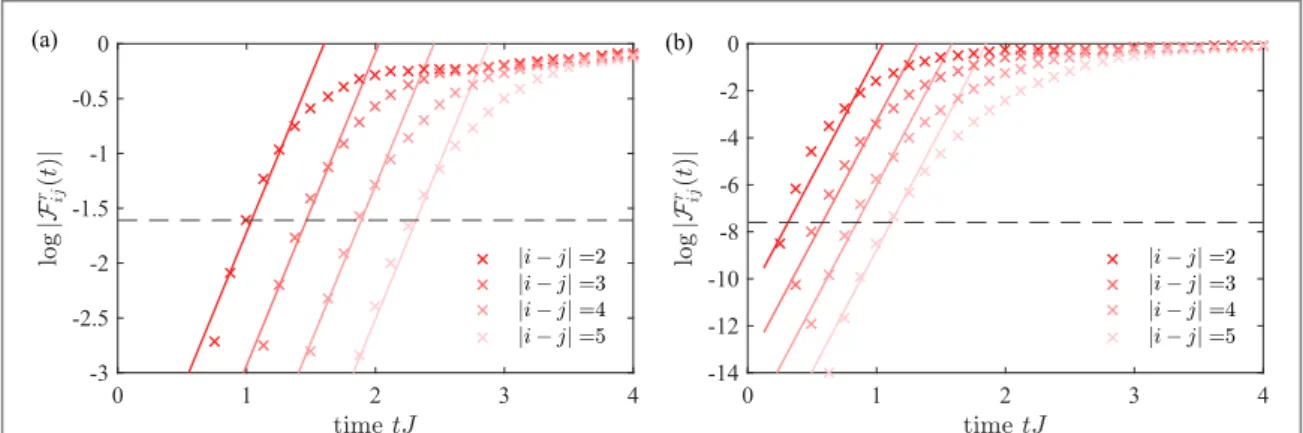
( )to the numerical data simultaneously for distances1∣i-j∣5within the range-2.5logijr( )t -1. The butterfly velocityvbis determined as described above with the threshold*=0.2, which lies well within
the interval of the considered data points; seefigure8(a)for an exemplary plot. We note, however, that our data does not support an exponential growth of the OTO correlator over parametrically large times, since the collision timeτis similar to the scrambiling timetscrin our system. This is demonstrated by extracting the
growth rateLlcfrom linearizing the OTO correlator around the light-cone velocity within the range
t
14logijr 4.5
- ( ) - ,figure8(b), which yields larger rates. In particular, for the parameters shown in
figure8, we obtainlL=2.9 1( )andL =lc 10.3 5( ), respectively.
Figure 6.Comparison of numerical data for different bond dimensions. OTO correlatorsij( )t are shown forT=4JandU=J, and bond dimension(a)20 and(b)400. The plateau emerging around∣i-j∣»5in(a)diminishes and appears only at larger distances for the higher bond dimension shown in(b). However, despite the large difference in the bond dimension, deviations from the linear light cone are still apparent.
Figure 7.Determining the light-conevlcand butterfly velocityvb. The velocities resulting from a linearfit to the times at whichijr( )t reaches the value*are shown forU=JandT={4, 10}J. The errorbars are thefitting errors. Inset: the inverse slope of the linear
3.3. Details on the experimental protocols
We elaborate on the different protocols outlined in section1.3, which can be used to experimentally access the theoreticalfindings presented in this work.
3.3.1. Global many-body interferometry
We consider a system of bosons or fermions in an optical lattice. At this point, we do not make any assumptions about the specific form of the HamiltonianHˆ. Wefirst focus on the real-time and spatially resolved single-particle Green’s functionsijgl( )t , which can be measured by the following protocol,figure9(a):(1)initially, prepare two identical copies of a pure state∣yñ Ä∣yñ. Remove a particle on siteiin the left system by locally transferring the atom to a hyperfine state that is decoupled from the rest of the system or by transferring it to a higher band of the optical lattice, yieldingci∣yñ Ä ∣yñ.(2)The system evolves in time for a period
t, exp[-iHt cˆ ] ∣iyñ Äexp[-iHtˆ ]∣yñ.(3)Create a hole on sitejof the right system
Figure 8.Determining the Lyapunov exponentlL. OTO correlatorsijr( )t are shown forT=10JandU=J. Solid lines depict the predicted exponential growth from which we determine(a)the Lyapunov exponentlL=2.9 1( )and(b)the light-cone exponent
10.3 5 lc
L = ( ). The dashed gray line denotes the threshold value*used to determine the velocitiesvbandvlc, respectively. We
obtain the exponents byfitting our data in a restricted regime around the threshold value*to the predicted exponential growth, see text for details. However, we note that in our data the exponential growth is limited to a rather small time range. The errorbars shown infigure4correspond to errors obtained from suchfits.
Figure 9.Probing dynamical correlation functions through theglobalinterference of two many-body states. Schematic illustration of the experimental protocol to determine the(a)time-ordered Green’s functionijgl( )t = á∣ y∣ ( ) ∣c t cj† iyñ∣2as well as(b)OTO correlation functionsglij( )t = á∣ y∣ ( )c t c c t cj† i† j( ) ∣iyñ∣2. Details of the protocol are described in the text.
t t e Htc c e . 10
i j Ht
l r i i
y ñ Ä y ñ º - yñ Ä - yñ
∣ ( ) ∣ ( ) ˆ ∣ ˆ ∣ ( )
Weabbreviate the sequence of the operations(1)–(3)asO i jˆ (, )and illustrate the corresponding quantum circuit in the bottom of the blue box infigure9(a).(4)Finally, measure the swap operatorˆ, which interchanges the
particles between the left and the right subsystem
t t t t t t c t c t
tr r l l r r l 2 j i 2 ijgl . 11
y y y y y y
á ñ =ˆ [∣ ( )ñá ( )∣Ä∣ ( )ñá ( )∣]= á∣ ( )∣ ( ) ∣ñ = á∣ †( ) ñ =∣ ( ) ( )
The expectation value of the swap operator is experimentally determined by a global 50%-50% beam splitter operation, which is realized by tunnel-coupling the left and the right system, followed by a measurement of the parity-projected particle number[19,42,43].
OTO correlation functions are measured in a similar fashion,figure9(b). To begin with, we recycle thefirst three steps of the Green’s function protocol, compiled inO i jˆ (, ). As a second step, the sign of the Hamiltonian needs to be inverted globally. The sign of the interaction can beflipped by ramping the magneticfield across a Feshbach resonance, as demonstrated experimentally, for instance, in the realization of negative temperature states[52]. Furthermore, by appropriately tuning the drive frequency of a modulated optical lattice, the sign of the hopping matrix element can beflipped[53]. Combining these already established experimental techniques, the global sign of the Hamiltonian is inverted. As a next step, the operationsO j iˆ ( , )are applied again, leading to the time evolved state
t t eHtc e c c e c e . 12
j Ht i i Ht j Ht
l r i i i i
y ñ Ä y ñ º - yñ Ä - yñ
∣ ( ) ∣ ( ) ˆ ˆ ∣ ˆ ˆ ∣ ( )
The square modulus of the OTO correlators is then obtained by measuring the wavefunction overlap of the left and the right system using beam splitters as discussed before.
For the measurement of both the Green’s function and the OTO correlators, the initial state∣yñcan be an arbitrary pure state, such as the ground state, or a simple product state. An effectivefinite temperature state can be obtained for quenches from initial pure states to somefinal Hamiltonian. In a thermalizing system[30–32], the effective temperature is then determined by the energy-density produced by the quantum quench. In the case of a thermal initial state, after thefirst three steps of our protocol, blue box infigure9, the system is prepared in the staterl( )t Ärr( )t , wherera( )t is a generic density matrix. The measurement of the swap operatorˆ
yields[43] t t t t t t t t t t tr tr tr tr . 13 l r l, r, l, r, l, r, l r
å
å
å
r r r r m m n n r r n m m n r r r r á ñ = Ä = ñá Ä ñá = ñá Ä ñá = = mn m n mn m n m m m ˆ ˆ ( ) ( ) ˆ ( ) ( )∣ ∣ ∣ ∣ ( ) ( )∣ ∣ ∣ ∣ ( ) ( ) ( ) ( ) ( )For pure states,rl,r( )t =∣yl,r( )t ñáyl,r( )∣t , we directly obtain equation(11). However, atfinite temperature, the measurement does not directly yield the square of the correlation function. In particular, we obtain for the Green’s function protocol
c c ti j c t cj i . 14
å
r r m n n má ñ = á ñá ñ
mn m n
ˆ ∣ † ( )∣ ∣ ( ) ∣† ( )
By contrast, the desired modulus square of the thermal Green’s function would be
c t ci j 2
å
r r mc c ti j m nc t cj in . 15á ñ = á ñá ñ
mn m n
∣ ( )† ∣ ∣ † ( )∣ ∣ ( ) ∣† ( )
Hence, at high temperatures, equation(14)is suppressed by a factor1 Z, whereZis the partition sum, and thus vanishes in the thermodynamic limit. A similar reasoning applies in the case of OTO correlators.
3.3.2. Local many-body interferometry
Interfering two system copies globally requires beam splitter operations with highfidelity, as in each
measurement for systems of sizeLthe same number of beam splitter operations have to be applied. To overcome this challenge, we introduce an alternative protocol that is scalable since it only requires two beam splitter operations irrespective of the system size.
A local beam splitter operation on sitelis realized by coupling the left and the right copy of the quantum system by a tunneling Hamiltonian
HˆlBS= -JBS(a bl† l+b al† l), (16) whereal†(bl†)creates a particle in the left(right)system. The unitary evolution under equation(16),
H
BSl exp i l
BS
t = - t
a b a b 1 2 1 i i 1 . 17 l l BS l l l = -= ⎜ ⎟ ⎛ ⎝ ⎜ ⎞ ⎠ ⎟
(
)
⎛⎝ ⎞⎠ ¯ ¯ ( )Furthermore, the phase of the beam splitter can be adjusted by applying afield gradient between the left and the
right systemHl h b b a a
F
2 l l l l
=
-ˆ ( † † )
for a duration f,R f exp iHl f
F t ( )t = [- ˆ t ]: R R BS BS 1 2 1 ie ie 1 , 18 l l i i f f = = -f f -⎛ ⎝ ⎜ ⎞⎠⎟ ( ) ( ) ( ) † wheref=htf.
The time ordered Green’s function for a system prepared in an arbitrary density matrix can be measured by the following sequence(figure10):(1)apply a beam splitter operation on siteifor a short durationtJBS1. In
that limit, the unitary evolution can be linearizedBSl 1 iHl O J
BS
BS2 2
t = - t+ t
( ) ˆ ( ).(2)Let the two copies
evolve for the physical timet.(3)Apply a 50%-50% beam splitter operation on sitejwith a phase that is detuned from thefirst one byf=p 2.(4)Finally, the density differencedn¯jbetween the right and the left subsystem is measured. This leads to the following measurement outcome
t BS e BS nBS e BS . 19
ij i Ht j j j Ht i
loc i i
( )= á †( )t ˆ †d¯ - ˆ ( )t ñ ( )
Wefirst calculate the densities after the beam splitter operationBSj, which gives
n a a 1 a b a b a 2 , 20 j j j j j j j l, = = - -¯ ¯ ¯† ( † †)( ) ( ) n b b 1 a b a b b 2 . 20 j j j j j j j r, = = + + ¯ ¯ ¯† ( † †)( ) ( )
Computing the density difference between the right and the left system, wefind
nj nl,j nr,j b aj j a bj j . 21
d¯ = ¯ - ¯ = -( † + † ) ( )
Considering now that the duration of thefirst beam splitter operation on siteiis short and using the particle number conservation, we obtain
t 4J Im a t a a t a O J . 22
ij j i j i
loc
BS BS3 3
( )= t {á †( ) ñá ( ) †ñ +} ( t ) ( )
The conventional time ordered one-body correlation function is defined asij( )t = áa t aj†( ) iñ. In our protocol, the imaginary part of the product of a particle and a hole correlation function is measured. However, we argue below that this observable carries related information as the time-ordered correlation functionij( )t ;see also figure11(b).
Figure 10.Probing dynamical correlation functions through thelocalinterference of two many-body states. Using local beam-splitter operations only, our protocol measures(a)time ordered correlatorlocij ( )t ~Im[áa t aj†( ) iñáa t aj( ) i†ñ]as well as(b)the OTO correlator ij t Im a t a a t aj i j i a t a a t aj i j i
loc
OTO correlators are measured by a straight forward extension;figure10(b):(1)apply a beam splitter operation for a short durationtJBS 1at sitei.(2)Let the system evolve for a physical timet.(3)Use single-site addressing to remove a particle on sitejin both copies.(4)Flip the sign of the HamiltonianHˆ -Hˆ, as
suggested in the previous section. Let the system evolve in time for the durationt.(5)Apply the 50%-50% beam splitter operationBSion sitei. Evaluating these steps, wefind
t a b n a b J a t a a t a a t a a t a O J BS e e BS BS e e BS 4 Im . 23 ij i Ht j j Ht i i i Ht j j Ht i j i j i j i j i loc i i i i BS BS3 3 t d t t t = á ´ ñ = á ñá ñ + - -( ) ( ) ¯ ( ) { ( ) ( ) ( ) ( ) } ( ) ( ) † ˆ † † ˆ † ˆ ˆ † † † †
This expression corresponds to the product of two OTO correlation function. Four point correlators in spin systems can be obtained with related protocols[18].
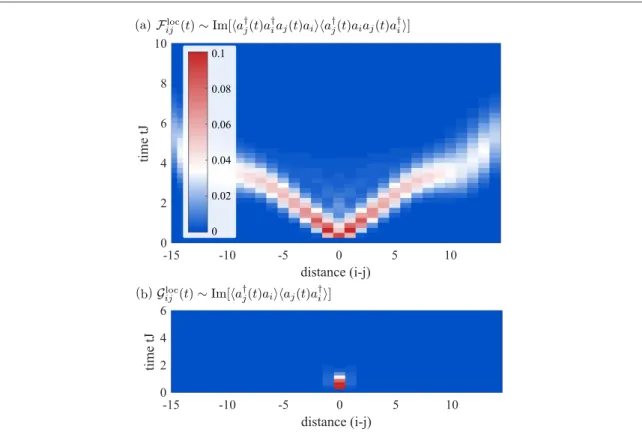
The OTO correlatorijloc( )t obtained from local interference contains at the considered temperatures essentially the same information as the one we originally introduced. As the protocol measures the imaginary part of a product of two OTO correlators, it starts out at zero. The scrambling across the quantum state manifests itself in the linear propagation of a wave-packet inijloc( )t (seefigure11(a))from which light-cone and butterfly velocities can be extracted. Infigure11(a), we once again attribute the plateau in the light-cone, which starts at
i-j 7
∣ ∣ , to thefinite MPO bond dimension of 400. Similarly,ijloc( )t starts off at zero but then develops a peak that quickly decays;figure11(b). From that we determine the quasiparticle lifetimetJ~0.32which corresponds roughly to half the lifetime obtained for the Green’s functionij( )t . This factor can be attributed to the fact that here the product of two correlation functions is measured.
With the protocols discussed so far, static one-body correlation functions can be measured by setting the physical timet=0. Moreover, a generalization of the local protocol makes it possible to measure static correlations functions ofarbitraryorder. Specifically, correlators ofdni¯ determine one-body correlation functions of the original many-body state:
n ni j 2 a ai j a ai j . 24
d d
á ¯ ¯ñ = á † ñá †ñ ( )
Here we used that the left and the right initial states are identical. Higher order static correlation functions in the creationai†and annihilation operatorsa
iare straightforwardly obtained by measuring higher order correlators indni¯. We emphasize that this protocol scales favorable with system size, and that correlators between arbitrary
Figure 11.Correlation functions obtained from the local interference of two quantum states.(a)OTO correlation functionsijloc( )t
and(b)time-ordered correlation functionsijloc( )t as measured by the protocol based on local beam splitter operations(section3.3.2)
contain similar information as the originally introduced correlators. The data is shown for temperatureT=4J, interactionsU=J, chemical potentialm=0, and systems of sizeL=30 and can thus be compared tofigure1.
sites and of arbitrary order can be taken in a single shot by performing the beam splitter operations on the full system.
The density matrix describing the quantum state of a system can be expressed as
r ... , 25 i i i i i i , , N N N 1 1 1
å
r= s Ä Äs ¼ ¼ ˆ ˆ ˆ ( )where is a normalization constant and thesˆijconstitute a suitable basis[54]. In the case of fermions or
hard-core bosons, one possible choice for the basis are the Pauli matrices. The knowledge of correlators up to sufficient order makes it possible to determine the so-called Stokes parametersri1,¼iNand thereby to reconstruct the
density matrix, which paves the way for the full state tomography of quantum states with massive particles.
3.3.3. Measuring dynamical density correlators
In this section we discuss two different possibilities to measure dynamical density correlation functions and thereby observe their diffusive behavior.
The dynamic structure factorS k( ,w), which is the spatial and temporal Fourier transform of the density correlatorC x tn( , ), can be measured with Bragg spectroscopy[55,56]. In Bragg spectroscopy, the detuning of the two laser beams sets the frequencyωand the angle between the beams the transferred momentumk. A measurement of the absorption of the system as a function ofkandωdirectly maps out the dynamic structure factorS k( ,w). Diffusion manifests itself in the wavevector and frequency resolved structure factorS k( ,w)as Lorentzian peaks with half-width-half-maximum that scales asDq2.
It is furthermore possible to measure the dissipative responseá[ ( )n ti ,nj]ñto a local perturbation of the system in a quantum gas microscope. To this end, a local potentialdH =njdmis created at sitejby applying a laser for a short timeτ, yielding the time evolutionexp[-id tH ]~ -1 id tH +O(dm t2 2). Measuring the
density at siteiafter the unitary time evolution for durationtwe obtain
t n t i n t ,n O . 26
ij i i j
loc 2 2
c ( )= á ( )ñ + dmtá[ ( ) ]ñ + (dm t ) ( )
In equilibrium, thefluctuation-dissipation theorem provides an exact relation betweená[ ( )n ti ,nj]ñand n t ni j
á ( ) ñ. The accurate measurement of the former therefore enables the observation of diffusive response in the dynamical density correlator.
Acknowledgments
We thank T Barthel, X Chen, S Gopalakrishnan, H-C Jiang, A Kitaev, and S Sachdev for useful discussions. We acknowledge support from the Technical University of Munich—Institute for Advanced Study, funded by the German Excellence Initiative and the European Union FP7 under grant agreement 291763(AB, MK), the DFG grant No. KN 1254/1-1(AB, MK), the Studienstiftung des deutschen Volkes(AB), and the Alexander von Humboldt foundation via a Feodor Lynen fellowship as well as support from the US Department of Energy, Office of Basic Energy Sciences, Division of Materials Sciences and Engineering, under Contract No. DE-AC02-76SF00515(CM).
ORCID
C B Mendl https://orcid.org/0000-0002-6386-0230
References
[1]Fetter A L and Walecka J D 1971Quantum Theory of Many-Particle Systems(New York: McGraw-Hill) [2]Sachdev S 2011Quantum Phase Transitions2nd edn(Cambridge: Cambridge University Press)
[3]Punk M, Chowdhury D and Sachdev S 2014 Topological excitations and the dynamic structure factor of spin liquids on the kagome latticeNat. Phys.10289–93
[4]Morampudi S C, Turner A M, Pollmann F and Wilczek F 2016 Statistics of fractionalized excitations through threshold spectroscopy arXiv:1608.05700
[5]Larkin A I and Ovchinnikov Y N 1969 Quasiclassical method in the theory of superconductivityJETP Lett.281200(http://www.jetp. ac.ru/cgi-bin/e/index/e/28/6/p1200?a=list)
[6]Shenker S H and Stanford D 2014 Black holes and the butterfly effectJ. High Energy Phys.201467
[7]Kitaev A Y 2015 A simple model of quantum holography, KITP Program on Entanglement in Strongly-Correlated Quantum Matter
(http://online.kitp.ucsb.edu/online/entangled15/kitaev/)
[8]Roberts D A, Stanford D and Susskind L 2015 Localized shocksJ. High Energy Phys.201551
[9]Maldacena J, Shenker S H and Stanford D 2016 A bound on chaosJ. High Energy Phys.2016106
[10]Hosur P, Qi X-L, Roberts D A and Yoshida B 2016 Chaos in quantum channelsJ. High Energy Phys.20164
[12]Banerjee S and Altman E 2017 Solvable model for a dynamical quantum phase transition from fast to slow scramblingPhys. Rev. B95 134302
[13]Patel A A and Sachdev S 2016 Quantum chaos on a critical Fermi surfaceProc. Natl Acad. Sci. USA1141844–9
[14]Stanford D 2016 Many-body chaos at weak couplingJ. High Energy Phys.20169
[15]Aleiner I L, Faoro L and Ioffe L B 2016 Microscopic model of quantum butterfly effect: out-of-time-order correlators and traveling combustion wavesAnn. Phys.375378–406
[16]Mezei M and Stanford D 2017 On entanglement spreading in chaotic systemsJ. High Energy Phys.201765
[17]Knap M, Kantian A, Giamarchi T, Bloch I, Lukin M D and Demler E 2013 Probing real-space and time-resolved correlation functions with many-body ramsey interferometryPhys. Rev. Lett.111147205
[18]Serbyn M, Knap M, Gopalakrishnan S, Papi Z, Yao N Y, Laumann C R, Abanin D A, Lukin M D and Demler E A 2014 Interferometric probes of many-body localizationPhys. Rev. Lett.113147204
[19]Islam R, Ma R, Preiss P M, Tai M E, Lukin A, Rispoli M and Greiner M 2015 Measuring entanglement entropy in a quantum many-body systemNature52877–83
[20]Kaufman A M, Tai M E, Lukin A, Rispoli M, Schittko R, Preiss P M and Greiner M 2016 Quantum thermalization through entanglement in an isolated many-body systemScience353794–800
[21]Swingle B, Bentsen G, Schleier-Smith M and Hayden P 2016 Measuring the scrambling of quantum informationPhys. Rev.A94040302
[22]Zhu G, Hafezi M and Grover T 2016 Measurement of many-body chaos using a quantum clockPhys. Rev.A94062329
[23]Yao N Y, Grusdt F, Swingle B, Lukin M D, Stamper-Kurn D M, Moore J E and Demler E A 2016 Interferometric approach to probing fast scrambling arXiv:1607.01801
[24]Shen H, Zhang P, Fan R and Zhai H 2016 Out-of-time-order correlation at a quantum phase transition arXiv:1608.02438
[25]Tsuji N, Werner P and Ueda M 2017 Exact out-of-time-ordered correlation functions for an interacting lattice fermion modelPhys. Rev.A95011601
[26]Roberts D A and Swingle B 2016 Lieb-robinson bound and the butterfly effect in quantumfield theoriesPhys. Rev. Lett.117091602
[27]Halpern N Y 2016 Jarzynski-like equality for the out-of-time-ordered correlatorPhys. Rev. A95012120
[28]Campisi M and Goold J 2016 Thermodynamics of quantum information scrambling arXiv:1609.05848
[29]Giamarchi T 2004Quantum Physics in One Dimension(Oxford: Oxford University Press) [30]Deutsch J M 1991 Quantum statistical mechanics in a closed systemPhys. Rev.A432046–9
[31]Srednicki M 1994 Chaos and quantum thermalizationPhys. Rev.E50888–901
[32]Rigol M, Dunjko V and Olshanii M 2008 Thermalization and its mechanism for generic isolated quantum systemsNature452854–8
[33]Dóra B and Moessner R 2016 Out-of-time-ordered density correlators in Luttinger liquids arXiv:1612.00614(cond-mat.str-el) [34]Kim H and Huse D A 2013 Ballistic spreading of entanglement in a diffusive nonintegrable systemPhys. Rev. Lett.111127205
[35]Kukuljan I, Grozdanov S and Prosen T 2017 Weak quantum chaos arXiv:1701.09147(cond-mat.stat-mech)
[36]Chaikin P M and Lubensky T C 2000Principles of Condensed Matter Physics(Cambridge, NY: Cambridge University Press) [37]Lux J, Müller J, Mitra A and Rosch A 2014 Hydrodynamic long-time tails after a quantum quenchPhys. Rev.A89053608
[38]Blake M 2016 Universal charge diffusion and the butterfly effect in holographic theoriesPhys. Rev. Lett.117091601
[39]Hartnoll S A 2015 Theory of universal incoherent metallic transportNat. Phys.1154–61
[40]Swingle B and Chowdhury D 2016 Slow scrambling in disordered quantum systemsPhys. Rev. B95060201
[41]Lucas A and Steinberg J 2016 Charge diffusion and the butterfly effect in striped holographic matterJ. High Energy Phys.2016143
[42]Alves C M and Jaksch D 2004 Multipartite entanglement detection in bosonsPhys. Rev. Lett.93110501
[43]Daley A J, Pichler H, Schachenmayer J and Zoller P 2012 Measuring entanglement growth in quench dynamics of bosons in an optical latticePhys. Rev. Lett.109020505
[44]Pichler H, Bonnes L, Daley A J, Läuchli A M and Zoller P 2013 Thermal versus entanglement entropy: a measurement protocol for fermionic atoms with a quantum gas microscopeNew J. Phys.15063003
[45]White S R and Feiguin A E 2004 Real-time evolution using the density matrix renormalization groupPhys. Rev. Lett.93076401
[46]Verstraete F, García-Ripoll J J and Cirac J I 2004 Matrix product density operators: simulation offinite-temperature and dissipative systemsPhys. Rev. Lett.93207204
[47]Verstraete F, Murg V and Cirac J I 2008 Matrix product states, projected entangled pair states, and variational renormalization group methods for quantum spin systemsAdv. Phys.57143–224
[48]Schollwöck U 2011 The density-matrix renormalization group in the age of matrix product statesAnn. Phys.32696–192
[49]Barthel T 2013 Precise evaluation of thermal response functions by optimized density matrix renormalization group schemesNew J. Phys.15073010
[50]Karrasch C, Bardarson J H and Moore J E 2013 Reducing the numerical effort offinite-temperature density matrix renormalization group transport calculationsNew J. Phys.15083031
[51]Blanes S and Moan P C 2002 Practical symplectic partitioned Runge-Kutta and Runge–Kutta–Nyström methodsJ. Comput. Appl. Math.142313–30
[52]Braun S, Ronzheimer J P, Schreiber M, Hodgman S S, Rom T, Bloch I and Schneider U 2013 Negative absolute temperature for motional degrees of freedomScience33952–5
[53]Lignier H, Sias C, Ciampini D, Singh Y, Zenesini A, Morsch O and Arimondo E 2007 Dynamical control of matter-wave tunneling in periodic potentialsPhys. Rev. Lett.99220403
[54]James D F V, Kwiat P G, Munro W J and White A G 2001 Measurement of qubitsPhys. Rev.A64052312
[55]Clément D, Fabbri N, Fallani L, Fort C and Inguscio M 2009 Exploring correlated 1D Bose gases from the superfluid to the Mott-insulator state by inelastic light scatteringPhys. Rev. Lett.102155301
[56]Ernst P T, Gotze S, Krauser J S, Pyka K, Luhmann D-S, Pfannkuche D and Sengstock K 2010 Probing superfluids in optical lattices by momentum-resolved Bragg spectroscopyNat. Phys.656–61