An Efficient Approach of Content Based
Image Retrieval using Texture, Color and
Shape Features of an Image
Suresh M B1, Dr.B Mohankumar Naik2Research Scholar, Department of Computer Science & Engg., JJTU, India Research Guide, Department of Computer Science & Engg., JJTU, India
Abstract:
retrieval of an image is an extra powerful and green for dealing with enormous photograph database. content based photograph retrieval (CBIR) is a one of the picture retrieval technique which makes use of consumer visible capabilities of an photograph together with color, form, and texture functions and so forth. it permits the quit user to offer a query photograph so one can retrieve the saved photos in database in keeping with their similarity to the question photograph. on this work, content based totally image retrieval is done by means of combining the two functions including color and texture. Color capabilities are extracted by way of using HSV histogram, color correlogram and color second values. Texture capabilities are extracted through segmentation based fractal texture analysis (SFTA). The accuracy of color histogram based totally matching can be accelerated by way of the use of shade coherence vector (CCV) for successive refinement. The velocity of shape based retrieval may be enhanced by way of considering approximate form in place of the exact form. The principle goal this work is classification of photo the use of SVM algorithm.Keywords
—
Image Retrieval; Content based image retrieval; HSV color histogram; color correlogram; color moments; SVM Algorithm; Relative Standard Derivation; Fractal Texture features.I. INTRODUCTION
Digital images are used in a huge variety of programs such as geography, medical, structure; advertising, layout, military and albums. We’ve a few difficulties in looking and organizing the biggest amount of snap shots in databases. the retrieval of photos is divided into strategies, which can be textual content primarily based and content based totally picture retrieval. in CBIR device, it is normal to organization the photo functions in three major classes: color, texture and shape. Coloration is by way of some distance the maximum commonplace visible function utilized in cbir, ordinarily because of the simplicity of extracting color records from snap shots. a digital photograph on this context is a fixed of pixels. each pixel represents a shade. colorations may be represented the use of exclusive shade spaces
depending at the requirements utilized by the researcher or depending on the software along with crimson-green-blue (rgb), hue-saturation-cost (hsv), yiq or yuv and so on. this paper additionally affords an method to retrieve pictures thru an automated segmentation approach. this lets in us to get approximate facts approximately the shape of the regions in the pix. form description or representation is an crucial issue each in object recognition and category. The segmentation is accomplished thru a stochastic algorithm the usage of the brightness of the regions underneath analysis.
2. RELATED WORK
Image retrieval in CBIR based totally at the visible functions along with texture, color and form. Texture analysis, is generally a very time-eating technique. Studies in texture analysis are very crucial, due to the fact this is used to improve the discriminatory capacity of the extracted image capabilities. so that it will as it should be capture the textural traits of an photo, texture evaluation algorithms use filter out banks or co-occurrence grey level matrices (GLCM) have to bear in mind multiple orientations and scales. the SFTA works a lot faster in terms of characteristic extraction time, when in comparison to Gabor and heraldic techniques.
2.1 Texture feature representation
Figure 2: Images are having different color in same class
Texture features is required here for the below reasons such as
1. Each class has set of images these color is independent but these texture information is dependent from one to one is shown in Figure 2.
2. Images are having same color with different
texture is shown in Figure 3.
Figure 3: Images are having same color in different classes
An enhanced input RGB image is converted into Grayscale image I. SFTA texture method applied multilevel Otsu thresholding on Grayscale image I for decomposing the segmented image in several parts. This is achieved by selecting pairs of thresholds (lower threshold tl and upper threshold tu) using Two Threshold Binary Decomposition (TTBD). SFTA feature vector correlate with the number of binary images acquired in TTBD phase. If the standard total number of extracted threshold is 4, we acquire 8 different binary images. Each binary image has three feature vectors that depict the boundaries fractal dimension. The purpose of fractal measurement is
used to narrate the boundaries complexity and
segmented image structures. An extracted vector features are fractal dimension, mean gray level, and
size of area image. SFTA algorithm has been
explained given below in figure 4.
Require: Grayscale image I and number of threshold nt.
Ensure: Feature vectorVSFTA.
1:T MultiLevelOtsu (I, nt)
2:TA{{ti, ti+1}: ti, ti+1∈ T, i∈ [1..|T|-1]} 3: TB{{ti, nl}: ti∈ T, i∈ [1...
4: i0
5: for {{tl, tu}: {tl, tu} ∈ TA∪ TB} do IbTwoThresholdSegmentation (I ,tl,tu)
6: Δ(x, y) FindBorders (Ib)
7: VSFTA[i] BoxCounting(Δ) 8: VSFTA[i+1] MeanGrayLevel(I, Ib) 9: VSFTA[i+2]PixelCount(Ib)
10: ii+3
11: end for
12: return VSFTA
Figure 4: SFTA Algorithm
2.2 Color feature representation
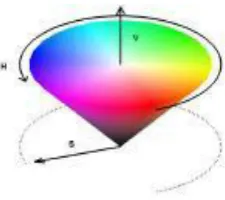
It has been reported that the HSV color space gives the best color histogram feature, among the different color spaces. For the initial process of histogram matching, we use the HSV color space. The HSV color space is preferred for
Manipulation of hue and saturation since it yields a greater dynamic range of saturation.
Figure 5: HSV Cone
1 may be associated with the point V = 0. The point S = 0, V = 1 is white.Intermediate values of V for S = 0 are the grays. Note that when S = 0, the value of H is irrelevant. From an artist’s viewpoint, any color with V = 1, S = 1 is a pure pigment whose color is defined by H. Adding white and black corresponds to decreasing S without changing V and corresponds to decreasing V without changing S respectively. Tones are created by decreasing both S and V.
Coloration coherence vector is double color histograms which consist of coherent vector and incoherent vector. we define a coloration's coherence as the degree to which pixels of that color are participants of big further-colored regions. we talk to those full-size regions as coherent areas, and take a look at that they're of good sized significance in characterizing Images. Our coherence classifies pixels as both coherent and incoherent. Coherent pixels are part of a few tremendous contiguous locations, at the same time as incoherent pixels are not. a coloration coherence vector represents this category for each coloration inside the image. this notion of coherence allows us to make exceptional differences that cannot be made with simple color histograms.
the preliminary level in computing a CCV [13] is just like the computation of a shade histogram. First blur the image barely via replacing pixel values with the average fee in a small nearby community consisting of the eight adjacent pixels. Outline the coloration area with simplest n wonderful hues inside the photograph. The following step is to categories the pixels within a given color bucket as both coherent and incoherent. A coherent pixel is part of a huge group of pixels of the equal color, whilst an incoherent pixel isn't. After phrases determine the
pixel organizations via computing related
components. When that is entire, each pixel will belong to precisely one connected aspect. Classify pixels as both coherent and incoherent depending on the size of its connected issue. a pixel is coherent if the size of its connected component exceeds a set value τ; otherwise, the pixel is incoherent.2.3 HSV color Histogram
Color feature is one of the most important things to access the image. The color of an image is represented from the famous color spaces like RGB, XYZ, YIQ, L*a*b, U*V*W, YUV and HSV [1]. HSV color space gives the best color histogram feature, among the different color spaces [1]. HSV color space is represented by three components such as Hue (H), Saturation(S), and Value (V).
Where i denotes the color bin in the color histogram. N denotes the total number of bins used in color histogram and H[i] denotes the total number of pixel of color I in an image. Generally, every pixel in an image will be in favor to color histogram bin. So that, in the image color histogram, each bin value gives the number of pixels those have the same corresponding color.
Algorithm
The computation of HSV color histogram has been done by using following steps as,
Step1: Convert RGB color image into HSV color space.
Step 2: Color quantization is carried out using color histogram by assigning 8 levels to hue, 2 levels to saturation and 2 levels to value for give a quantized HSV space with 8x2x2=32 histogram bins.
Step3: The normalized histogram is obtained by dividing with the total number of pixels.
2.4 Shape feature retrieval
Shape is an important visual feature and it is one of the basic features used to describe image content. However, shape representation and description is a difficult task. This is because when a 3-D real world object is projected onto a 2-D image plane, one dimension of object information is lost. As a result, the shape extracted from the image only partially represents the projected object. To make the problem even more complex, shape is often corrupted with noise, defects, arbitrary distortion and occlusion. Further it is not known what is important in shape. Current approaches have both positive and negative attributes; computer graphics or mathematics use effective shape representation which is unusable in shape recognition and vice versa. In spite of this, it is possible to find features common to most shape description approaches.
large differences; therefore, they are usually used as filters to eliminate false hits or combined with other shape descriptors to discriminate shapes. They are not suitableto stand alone shape descriptors. Ashape can be described by different aspects [15]. These shape parameters are Mass, Center of gravity(Centroid) , Mean, Variance, Dispersion, Axis of least inertia, Digital bending energy, Eccentricity, Circularity ratio, Elliptic variance, Rectangularity, Convexity, Solidity, Euler number, Profiles, Hole area ratio, etc. Some of these are described as follows.
Mass is the no. of pixels contained in one class. It is given as
Centroid is also called as the center of mass; h is a
mask of cluster c over image S(x, y). The co-ordinates (xc, yc) of the
Centroid are defined as:
x
c
xyx
h
(
x
,
y
)
mass
y
c
xyy
h
(
x
,
y
)
massThe mean and variance features of the class c are computed over the original image I considering
the resulting segmentation S, and they are
respectively denoted by µc and σ2c..
Dispersion is the sum of the distances of each region of a class from the class Centroid. The distance is calculated by
Euclidean distance formula. The dispersion can be given as
Disp
dist
(
O
c,
O
i,c)
Where, dist (Oc,Oi,c) is the Euclidean distance
Oc= Centroid of the class c
Oi,c= Centroid of region I of class c
Algorithm for shape Retrieval Step1: read the image
Step2: convert it from RGB to grayscale
Step3: determine the range and number of classes.
Step4: calculate the number of pixels i.e. mass belonging to each class.
Step5: calculate the Centroid and dispersion for each class.
Step6: compare Centroid of each class of query image with the Centroid of each class from database image and extract out that class.
Step7: compare that class’s mass and dispersion with respective class.
Step8: increase the count if it satisfies certain threshold.
Step9: consider second class and repeat steps 6-8 till all classes get over.
Step10: take another image from the database and repeat the comparison.
3. EXPERIMENTAL RESULTS
In proposed approaches, the image database contains 400 images, in database images, 100 images are used for testing and remaining 300 images are used for training. An input query image and total number of returned images are desired by the user. Features for query image are extracted by using SFTA and HSV color models.
Both color and shape retrieval algorithms are implemented in MATLAB with the database of 570 images. All the images are stored in JPEG format with size 384 × 256 or 256 × 384. There are six different categories; which includes 100 horse, 100 rose, 100 dinosaur, 100 bus, 100 elephants and 70 bikes. To evaluate the performance of the image retrieval algorithm we use the two most well known parameters; precision and recall.
recall
relevant retrieved
all relevant
4. CONCLUSION
CBIR is a process to go looking the applicable picture in database photograph when new or question photo is given through the user. on this paper, we use mixed texture, color and shape capabilities. to classify the question photo function vector with schooling samples the use of svm algorithm and preferred deviation is used here for similarity measurement. Overall performance dimension is calculated through the usage of precision and do not forget operations. the purpose of this paper become to enhance the accuracy (precision) of a CBIR software via permitting the gadget to retrieve greater photographs just like the supply photo. the brand new algorithms beneath research and also the recently published ones appear to be extraordinarily invasive on the picture. additionally each new algorithm is always seen to have positive regions in which it works high-quality and negative. the proposed methodology had extended the common precision from a mean of 44% to a mean of 72%.
5. REFERENCES
[1] MihranTuceryan and Anil K.Jain, Texture Analysis, The Handbook of Pattern Recognition and Computer Vision, pp.207 -248, 1998.
[2] AlceuFerraz Costa, Gabriel Humpire-Mamani, Agma Juci Machado Traina, “An Efficient Algorithm for Fractal Analysis of texture “, Graphics, Patterns and Images (SIBGRAPI), 2012 25th SIBGRAPI Conference, pp. 39 -46, 2012.
[3] C. Traina Jr., A. J. M. Traina, L. Wu, and C. Faloutsos, “Fast feature selection using fractal dimension,” in Brazilian Symposium on Databases (SBBD), João Pessoa, Brazil, 2000, pp. 158–171.
[4] P. K. Sahoo, S. Soltani, A. K. C. Wong, and Y. Chen, “A survey of thresholding techniques,” Computer Vision Graphics
Image Processing, Vol. 41, 1988, pp. 233-260.
[5] N. Otsu. A threshold selection method from gray- level histogram. IEEE Trans. Systems Man Cybern.
[6] Y. A. Aslandogan and C. T. Yu, "Techniques and Systems for Image and Video Retrieval," IEEE Transactions on Knowledge and Data Engineering, Vol. 11, Issue 1, pp. 56-63, Jan/Feb 1999.
[7] A. J. M. Traina, A. G. R. Balan, L. M. Bortolotti, and C. Traina Jr., “Content- based Image Retrieval Using Approximate Shape ofObjects”, Proceedings of the 17th IEEE Symposium on Computer- Based Medical Systems, pp. 91-96, 2004.
[8] Dengsheng Zhang and Guojun Lu, “Review of shape representation andd escription techniques”, Pattern Recognition Society. Published by Elsevier Ltd, Vol. 37, pp. 1-19, 2004.
[9] Sarfraz and M. Ridha “Content-Based Image Retrieval Using Multiple Shape Descriptors”, IEEE/ACS International Conference On Computer Systems and Applications, pp. 730-737, 2007.