
Ravi Kumar K. et al. J Sci Res Pharm, 2018;7(3):30-34
World Inventia Publishers
J
ournal of
S
cientific
R
esearch in
P
harmacy
http://www.jsrponline.com/
Vol. 7, Issue 3, 2018 ISSN: 2277-9469
USA CODEN: JSRPCJResearch Article
INSILICO ADME PROFILING OF CDK9 INHIBITORS
Ravi Kumar K. 1 *, Archana Giri 1, Rama Rao Nadendla 2
1 Centre for Biotechnology, Jawaharlal Nehru Technological University, Hyderabad - 500085, INDIA. 2 Chalapathi Institute of Pharmaceutical Sciences Guntur - 522034, INDIA.
Received on: 06-03-2018; Revised and Accepted on: 24-03-2018
ABSTRACT
S
everal drug targets have been identified in fighting against cancer. Inhibition of Cell cycle is one of the strategies used in anti-cancer research. CDKs [Cyclin Dependent Kinases] were found to be one of the promising drug targets. This work aims to find a potential molecule to inhibit CDKs that are involved in cell cycle progression. CDK 9 was chosen as potential drug target for cancer. Virtual screening was carried out against CDK 9 protein using Molecular Docking tools with molecules from ZINC database. Molecules were shortlisted based on their docking score, rerank score and energies. Insilico Toxicity and ADME [Absorption, Distribution, Metabolism and Excretion] analysis was carried to know the efficacy of the molecules before proceeding to invitro and invivo assays. Molecules under study were analyzed for ADME properties using Molinspiration, preAdmet and Swissadme servers. ADME profiles were evaluated and most of the molecules were found to be suitable for further studies. Insilico ADMET analysis is proved to be a good tool in drug discovery.KEYWORDS: CDK, Cancer, Toxicity, ADME, Virtual Screening.
INTRODUCTION
M
ajority of deaths occurred in world is due to cancer. In search of developing strategies against cancer a huge amount of resources are being invested in various projects across the nations [1].Drug designing is the important step in any drug discovery project. Insilico methods of drug design and development are proved to be efficient in saving lots of resources and time [2]. Cell cycle progression is
one of the important steps involved in cell proliferation. Inhibition of Cell cycle progression using CDK as target is one of most suitable strategy to fight against cancer [3]. Over the last 30 years methods of
computer aided drug design / discovery played a pivotal role in the development of therapeutic drugs [4]. The potential of any compound
used in therapeutics depends not only on the physical and chemical properties but also on Pharmaco dynamics [PD] and pharmaco kinetics [PK] aspects of the compounds. Pharmacodynamics correlates health effect of drugs on an individual patient while pharmacokinetics records the course of Absorption, Distribution, Metabolism and Excretion of a given drug, both are interrelated.
Over the past 5 decades ADME played a major role in drug design process. ADME means absorption, distribution, metabolism and excretion which explain about the pharmacokinetics aspects of a drug molecule. There are several incidents reporting the attrition of drug discovery projects just because of the poor ADME profiles [5]. Therefore
prior to synthesis and invivo studies, ADME profiling found to be more effective. Determination of ADME properties of compounds involves lot of experimental procedures to be followed which is time consuming and expensive. Therefore Insilco ADME models have been developed [6, 7]. In
*Corresponding author:
Ravi Kumar. K
Centre for Biotechnology,
Jawaharlal Nehru Technological University, Hyderabad - 500085, INDIA.
* E-Mail: [email protected]
DOI: https://doi.org/10.5281/zenodo.1207094
the present study an insilio approach has been utilized in determining the ADME profiles of the compounds known to be CDK 9 inhibitors.
MATERIALS AND METHODS
Insilico ADME analysis:
The Compounds used in this work were found to be inhibiting CDK 9 [8] protein as studied earlier using virtual screening studies [9].
The molecules were short listed based on their docking scores, ranking scores and rerank scores [9]. Virtual screening was carried with
molecules available in ZINC database [10].
Experimental:
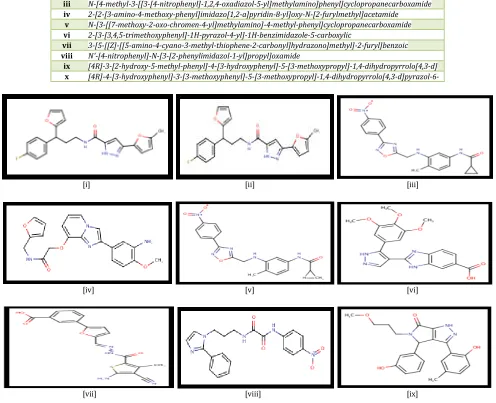
The test compounds to be used as potential CDK 9 inhibitors used in the study are listed in Table 1 and their structures are shown in Figure 1.
Calculation of ADME properties:
All the 2D molecular structures were drawn online at Molinspiration server [11]. ADME properties of test set compounds were
calculated using Molinspiration [11], PreAdmet [12] and Swiss ADME tools [13].
1. Plasma Protein binding:
A drug is more efficient if it is free to traverse across membranes and reach the target rather binding with plasma proteins. Compounds with more than 90% PPB values are more prone to plasma protein binding thereby less effective and vice versa. %PPB value less than 90% is more effective.
2. Blood brain barrier:
3. Human intestinal absorption:
One of the important parameter in ADME study is drug's intestinal absorption. When a drug is administered orally it has to be absorbed by intestine for further metabolism of the drugs. Human intestinal absorption was analyzed by combining the bioavailability and absorption generated from the ratio of excretion or excretion in urine, bile and feces together [15].
4. Skin Permeability:
In drug discovery the skin permeability of the compound is an important determinant factor with reference to adverse drug response in case drugs taken orally to determine in case of accidental contact with skin and the skin permeability in case of the drugs to be taken transdermally where the skin penetration is an important aspect. Preadmet asses the skin permeability of a compound the result value is given as logKp. Kp [cm/hour] is defined as: Kp= Km*D/h where Km is
distribution coefficient between stratum corneum and vehicle, and D is average diffusion coefficient [cm2/h], and h is thickness of skin [cm] [16].
5. Caco2 cell permeability:
For assessing the oral absorption Caco 2 cell line and MDCK cell line models have been used [17]. Caco-2 cells are derived from human
colon adenocarcinoma and possess multiple drug transport pathways through the intestinal epithelium.
6. MDCK cell permeability:
MDCK cell refers to Madin-Darby canine kidney cell. Compared to Caco -2 cells the life span of MDCK cells life span is less, there seems to be highly correlated. Hence along with Caco 2 cell lines MDCK cell system is also being used as a tool for rapid permeability screening. MDK cell permeability values < 25 is considered as low permeable, 25-500 - medium permeable and values >500 are considered as molecules with high permeability.
Table No. 1: Test Compounds used in study
S. No. Name
i N-[[3S]-3-[4-fluorophenyl]-3-[2-furyl]propyl]-3-[5-methyl-2-furyl]-1H-pyrazole-5-carboxamide
ii N-[[3R]-3-[4-fluorophenyl]-3-[2-furyl]propyl]-3-[5-methyl-2-furyl]-1H-pyrazole-5-carboxamide
iii N-[4-methyl-3-[[3-[4-nitrophenyl]-1,2,4-oxadiazol-5-yl]methylamino]phenyl]cyclopropanecarboxamide
iv 2-[2-[3-amino-4-methoxy-phenyl]imidazo[1,2-a]pyridin-8-yl]oxy-N-[2-furylmethyl]acetamide
v N-[3-[[7-methoxy-2-oxo-chromen-4-yl]methylamino]-4-methyl-phenyl]cyclopropanecarboxamide
vi 2-[3-[3,4,5-trimethoxyphenyl]-1H-pyrazol-4-yl]-1H-benzimidazole-5-carboxylic
vii 3-[5-[[Z]-[[5-amino-4-cyano-3-methyl-thiophene-2-carbonyl]hydrazono]methyl]-2-furyl]benzoic
viii N'-[4-nitrophenyl]-N-[3-[2-phenylimidazol-1-yl]propyl]oxamide
ix [4R]-3-[2-hydroxy-5-methyl-phenyl]-4-[3-hydroxyphenyl]-5-[3-methoxypropyl]-1,4-dihydropyrrolo[4,3-d]
x
[i] [ii] [iii]
[iv] [v] [vi]
[x]
Fig. 1: Structures of Test set Compounds
Other Parameters studied like MiLogP or WLogP, TPSA, natoms, MW, nON, nOHNH, nviolations, nrotb, and volume as per Molinspirations server. Using Swissadme server egg plot depiction [18] was made using TPSA vs WLogP values. It indicates the Blood brain barrier [BBB] penetration and Intestinal Absorption capacities [Table 3 & figure 2].
RESULTS & DISCUSSION
F
or the test compounds the calculated properties as determined by Molinspiration and Preadmet Servers were tabulated in Table 2 and 3.Table No. 2: Compound Properties analyzed by Molinspiration server
Property Parameter
Compound
1 2 3 4 5 6 7 8 9 10
miLogP 3.67 3.67 3.69 2.21 3.69 3.05 3.73 2.25 2.92 2.79
TPSA 84.06 84.06 125.87 104.04 125.87 122.37 141.72 121.85 98.68 87.69
natoms 29 29 29 29 29 29 28 29 29 29
MW 393.42 393.42 393.4 392.42 393.4 394.39 394.41 393.4 393.44 393.44
nON 6 6 9 8 9 9 8 9 7 7
nOHNH 2 2 2 3 2 3 4 2 3 2
nviolations 0 0 0 0 0 0 0 0 0 0
Nrotb 7 7 7 7 7 6 5 8 6 7
volume 345.54 345.54 340.19 344.44 340.19 336.15 325.5 344.58 353.99 354.96
Table No. 3: ADME parameters analyzed by preAdmet Server
Parameter Compound
1 2 3 4 5 6 7 8 9 10
BBB 1.81 1.81 0.06 0.03 0.06 0.07 0.11 0.05 0.68 0.57
Caco2 17.07 17.07 20.04 17.70 20.04 49.06 0.39 20.42 8.55 20.41
HIA 90.97 90.97 90.80 95.74 90.80 99.14 78.27 93.03 86.73 90.62
MDCK 0.35 0.35 1.57 14.07 1.57 2.01 0.18 1.80 5.58 4.95
PPB* 88.44 88.44 89.70 77.97 89.70 61.92 87.50 94.83 86.46 84.83
SP* -3.91 -3.91 -3.55 -4.01 -3.55 -4.08 -3.28 -3.37 -4.25 -4.15
*Plasma Protein Binding [PPB], Skin Permeability [SP]
1. Plasma Protein Binding: Preadmet analysis of the test set have been found almost all the molecules are having %PPB less than 90% except 8th molecule [table3].
2. Blood brain barrier: 0.04 - 1.81. [table 3] Almost all the molecules are having values less than 1 which means low absorption to CNS and only two molecules 1 and 2 are having values around 1.81 which is still acceptable as those compounds are intermediary in absorption to CNS. As the present work is on cancer and there is no CNS penetration of compounds is needed. Hence these compounds can be considered with reference to BBB penetration.
3. Human intestinal absorption: Preadmet asses the intestinal absorption capacity of the tested compounds and values ranging 0-20 % found to be poorly absorbed and 20-70 % moderately absorbed, values ranging 70-100 % are found to be compounds with greater absorption. Compounds 7 and 9 are having 78.2 and 86.7 %HIA and rest all are 90% and above % HIA values. Hence almost all molecules are found to be efficiently absorbed by human intestine.
4. Skin Permeability: all the compounds found [table 3] to be poorly permeable to skin as all compounds have Kp negative values. As the compounds are to be taken orally their skin permeability is to be low and accidental contact will not be having any effect on the skin.
5. Caco2 cell permeability: Values less than 4 are poorly permeable, 4-70 are moderately permeable and more than 4-70 are considered as highly permeable. In the present study preadmet has determined compound 7 is poorly permeable and rest all compounds are in the range of 17 - 50 which means almost all compounds are moderately permeable to Caco 2 cell lines.
Fig. 2: Egg plot denotes bioavailable region of property space with respect to wlog P and TPSA
[Yellow - BBB, White - Intestinal absorption, Grey - Poor intestinal absorption]
As discussed earlier [19] Caco2 cell line data alone cannot be
considered in evaluating gastro intestinal absorptions. In the present work the Caco 2 cell line absorption is showing poor where as human intestinal absorption capacity of all the molecules shown very high. Hence more studies have to be carried out before considering the compounds.
Lipophilicty is measured as a compound’s distribution across octanol vs water phase and is expressed as log of concentration rations of those phases [partition coefficient]. A logP value not more than 5 is highly desirable. This is also a part of Lipinski rule of five. All the test compounds have shown logP values under 5.
TPSA [Topological polar surface area [TPSA] can be defined as the total area in space covered by polar atoms like hydrogen atoms, oxygen atoms and nitrogen atoms present in the chemical structure. It is a measure of drub's ability in cell permeation.
Other parameters like natoms [No of Atoms], MW Molecular Weight, nON, nOHNH, nviolations, nrotb [no of rotatable bonds] and volume as analyzed by Molinspiration server are found to be in good terms.
Swissadme server used comparative information derived from poorly and highly absorbed drugs to model human passive intestinal absorption. Calculated passive intestinal absorption of drugs was displayed as a bi-plot [Boiled Egg Plot or Egg plot]. Bi-plot utilizes information generated from Wlog P [Y-axis] and Total Polar Surface Area [TPSA] [X-axis] mentioning well-absorbed molecules in space [fig.5]
Inside circle [yellow] depicts BBB- blood brain barrier, none of the compounds are in this region. The white region which is outer to yellow depicts the human intestinal absorption. Almost all compounds lies in this white area. Only molecule 7 is lying outside [grey area] which indicates poor intestinal absorption. From ADME profiling it can be concluded that Molecule 7 will be poorly absorbed even though it is in top 10 compounds of virtual screening studies. This is the advantage of Insilico adme profiling. The present graphical representation provides better understanding about absorption profile of novel molecules
CONCLUSION
I
t was reported [20] that generally it takes around 8 years inproject towards the success. The present study that overall Insilico ADME modeling found to be a good alternative over In vitro / In vivo models of ADME. Almost all the compounds were found to be suitable as potential candidate molecules as CDK 9 inhibitors. Once a good set of compounds were screened based on ADME modeling further In vitro and In vivo studies can move the discovery process further.
REFERENCES:
1. Chabner BA, Roberts TG Jr. Timeline: Chemotherapy and the war on cancer. Nat Rev Cancer 2005;5:65-72. Doi:10.1038/nrc1529. 2. Wadood A, Ahmed N, Shah L, Ahmad A, Hassan H, Shams S. In-silico drug design: An approach which revolutionarised the drug discovery process. OA Drug Design & Delivery 2013;1(1):3. 3. Marcos Malumbres, Paolo Pevarello, Mariano Barbacid, James R.
Bischoff. CDK inhibitors in cancer therapy: what is next?, Trends in Pharm Sci 2008;29(1):16-21. doi:10.1016/j.tips.2007.10.012. 4. Sliwoski G, Kothiwale S, Meiler J, Lowe EW. Computational Methods in Drug Discovery. Pharmacol Rev 2014 ;66(1):334-395. DOI:10.1124/pr.112.007336.
5. AW. Czarnik and HY. Mei. How and Why to Apply the Latest Technology, In Comprehensive Medicinal Chemistry II, edited by John B. Taylor and David J. Triggle, Elsevier, Oxford, 2007 ;531-554. doi:10.1016/B0-08-045044-X/00140-1.
6. Wang Y, Xing J, Xu Y, Zhou N, Peng J, Xiong Z, Liu X, Luo X, Luo C, Chen K, Zheng M, Jiang H. In silico ADME/T modeling for rational drug design. Q Rev Biophys 2015;48(4):488-515. doi:10.1017/S0033583515000190.
7. Kovačević SZ,Jevrić LR,Podunavac Kuzmanović SO,Lončar ES. Prediction of In-silico ADME Properties of 1,2-O-Isopropylidene Aldohexose Derivatives. Iran J Pharm Res. 2014;13(3):899-907. 8. Ravi Kumar Kurapati, Archana Giri and Rama Rao Nadendla.
Cross Docking as a method to select CDK-9 protein target for virtual screening studies. Int J Computat Bioinfo and In Silico Modeling 2013;2(6):275-277.
12. Bioinformatics and Molecular Design Research Center, Seul, South Corea, PreADMET program, 2004. Available from: URL: http://preadmet.bmdrc.org.
13. Swiss ADME: a free web tool to evaluate pharmacokinetics, drug-likeness and medicinal chemistry friendliness of small molecules. Sci Rep 2017;7:42717 doi:10.1038/srep42717 14. Ma XL, Chen C. & Yang J. Predictive model of blood-brain barrier
penetration of organic compounds. Acta Pharmacol Sinica
2005;26(4)500–512. DOI: 10.1111/j.1745-7254.2005.00068.x. 15. Zhao YH, Le J, Abraham MH, Hersey A, Eddershaw PJ, Luscombe
CN,et al. Evaluation of human intestinal absorption data and subsequent derivation of a quantitative structure-activity relationship [QSAR] with the Abraham descriptors. J Pharm Sci
2001;90:749–84. DOI: 10.1002/jps.1031.
16. Singh S, Singh J. Transdermal drug delivery by passive diffusion and iontophoresis: a review. Med Res Rev 1993;13:569–621. DOI: 10.1002/med.2610130504.
17. Shinji Yamashita, Tomoyuki Furubayashi, Makoto Kataoka, Toshiyasu Sakane, Hitoshi Sezaki, Hideaki Tokuda. Optimized conditions for prediction of intestinal drug permeability using Caco-2 cells. Eur J Pharm Sci 2000;10(3):195-204. DOI: 10.1016/S0928-0987[00]00076-2.
18. A Boiled-Egg to predict gastrointestinal absorption and brain penetration of small molecules. Chem Med Chem 2016;11(11): 1117-1121. DOI: 10.1002/cmdc.201600182.
19. Ren S, Lien EJ. Caco-2 cell permeability vs human gastro-intestinal absorption: QSPR analysis. In: Jucker E. [eds] Progress
in Drug Res 2000;54. Birkhäuser, Basel
https://doi.org/10.1007/978-3-0348-8391-7_1 doi:10.1007/978-3-0348-8391-7_1.
20. DiMasi, JA. New drug development in the United States from 1963 to 1999. Clinical Pharmacology Therapeutics 69, 286-296 (2001). DOI: 10.1067/mcp.2001.115132.
How to cite this article:
Ravi Kumar K. et al. INSILICO ADME PROFILING OF CDK9 INHIBITORS. J Sci Res Pharm 2018;7(3):30-34. DOI:
https://doi.org/10.5281/zenodo.1207094
Conflict of interest: The authors have declared that no conflict of interest exists.

![Fig. 2: Egg plot denotes bioavailable region of property space with respect to wlog P and TPSA[Yellow - BBB, White - Intestinal absorption, Grey - Poor intestinal absorption]](https://thumb-us.123doks.com/thumbv2/123dok_us/8399457.1686009/4.612.158.461.41.257/denotes-bioavailable-property-respect-intestinal-absorption-intestinal-absorption.webp)
