R E S E A R C H A R T I C L E
Open Access
Communication skills of medical students
during the OSCE: Gender-specific
differences in a longitudinal trend study
Joachim Graf
1,2,3, Robert Smolka
4, Elisabeth Simoes
2,3,5, Stephan Zipfel
1,6, Florian Junne
6, Friederike Holderried
7,10*,
Annette Wosnik
1, Anne M. Doherty
8, Karina Menzel
9and Anne Herrmann-Werner
6,10Abstract
Background:Communication skills are essential in a patient-centred health service and therefore in medical teaching. Although significant differences in communication behaviour of male and female students are known, gender differences in the performance of students are still under-reported. The aim of this study was to analyse gender differences in communication skills of medical students in the context of an OSCE exam (OSCE = Objective Structured Clinical Examination).
Methods:In a longitudinal trend study based on seven semester-cohorts, it was analysed if there are gender differences in medical students’communication skills. The students (self-perception) and standardized patients (SP) (external perception) were asked to rate the communication skills using uniform questionnaires. Statistical analysis was performed by using frequency analyses and t-tests in SPSS 21.
Results:Across all ratings in the self- and the external perception, there was a significant gender difference in favour of female students performing better in the dimensions of empathy, structure, verbal expression and non-verbal expression. The results of male students deteriorated across all dimensions in the external perception between 2011 and 2014.
Discussion & conclusion: It is important to consider if gender-specific teaching should be developed,
considering the reported differences between female and male students.
Keywords: Communications skills, Medical students, Self- and external perception, Gender differences, Osce,
Gender-specific teaching
Background
Communication skills of medical students
In order to be a‘good doctor’, physicians require not only clinical and scientific knowledge, but also excellent communication skills to ensure a good doctor-patient-relationship [1–6]. Good communication skills in physicians can be understood as a multidimensional phenomenon, which is characterised by an emphasis on patients’ expectations, concerns and emotions and their
need for information. Relationship building, negotiating and facilitating patients’ co-operation are also core ele-ments of communication skills [7]. As highly developed communication skills are crucial for doctor-patient inter-actions, it is recommended to incorporate them in teach-ing from the very beginnteach-ing at medical school [8, 9]. In Germany, the medical faculties are faced with the chal-lenge of implementing more practical examinations in-stead of written and oral exams to promote the social, communication and interpersonal skills in the teaching [10, 11]. Empathy and other aspects of communication skills of medical students are often in a need of optimization, but it is known that they can be improved by training programs in the context of medical teaching [12–15]. The development of standardized patients (SP) * Correspondence:[email protected]
7Department of Gastroenterology, Hepatology and Infectious Diseases,
University Hospital Tuebingen, Internal Medicine, Otfried-Müller-Strasse 10, D-72076 Tübingen, Germany
10Interdisciplinary Training Centre DocLab, Medical Faculty Tuebingen,
Elfriede-Aulhorn-Strasse 10, D-72076 Tuebingen, Germany Full list of author information is available at the end of the article
may be especially useful in improving the communication performance of the students [16]. Many medical schools introduced the OSCE (Objective Structured Clinical Examination) to examine communication skills, a mean-ingful and recognized way to improve the general doctor-patient communication [17, 18]. With the OSCE, it is possible to consider the students social, communication and interpersonal skills, which have been taught in special courses previously [17, 18]. The OSCE exam is a circuit of brief examinations, in which the students must demon-strate their communication skills and practical abilities by completing different tasks at each station, including his-tory talking or physical examinations involving SP where required in different medical specialities [19–23].
Communication skills: Gender specific aspects
It is well known that communication styles of female phy-sicians interacting with patients are consistently different from their male counterparts: female doctors ask more psychosocial questions, receive more positive patient talk, and demonstrate more positive nonverbal communication [24–26]. Female physicians typically show more empathy and use more positive statements than males when inter-acting with their patients [27]. When communicating diagnosis-specific information, male general practitioners (GPs) use more instrumental behaviour (giving informa-tion), while female GPs use more affective behaviour (giv-ing attention, reassurance) [28, 29]. Better communication competences in female students are found than in male students: it has been shown that female students score higher than their male counterparts after a training course in communication skills [30]. Other studies show that fe-male students obtain higher empathy scores than fe-male students [31, 32]. In the OSCE exam, female students have significantly better results in the communicative sections than their male counterparts [33] and show a better per-formance in most of the stations [34]. Female students are more sensitive in the doctor-patient relationship, but feel significantly less confident than male students in the OSCE [35]. However, it remains unclear whether the gen-der differences in communication performance in the OSCE could be the result of SP’s gender, because male and female SPs may sometimes differ in how they rate ex-aminees overall [26, 36]. Wiskin demonstrated that there is no significant relationship between SP gender and the result of the student, while the examiner’s gender appar-ently affected the results: Male examiners assess the com-munication skills of the female students significantly better than the female examiners, while both examiners gender rates female students significantly better than men [34]. Other studies demonstrate a significant influence of the SP gender: male students performed worse when interacting with male SP, and all students performed bet-ter when inbet-teracting with the female counbet-terparts [37].
Although significant differences in the communication be-haviour of male and female physicians are reported in studies, gender aspects are rarely taken into account in medical teaching of communication skills [28]. Despite the relevance of communication skills in medical teaching, gender differences in the performance of the students in the OSCE are still underreported.
In the light of competency-based developments like the CanMeds framework [38] or the German National Competence-Based Learning Objectives Catalogue [39], where the physician’s role as communicator is explicitly acknowledged and valued, it is crucial to identify students’ needs–not only in general, but also with regards to gender differences. To our knowledge, studies existing so far only used one-dimensional approaches (e.g. only assessors’view). However, as, due to their nature, external ratings are highly subjective, only one perspective might not be enough. Consequently, we decided to approach our research question in a multidimensional way by comparing external perception (SP) with students’ self-perception. To our knowledge, there are no longitudinal studies, in which the multidimensional phenomenon of students’communication skills is analysed in a gender-specific approach across all di-mensions of communication. Thus, the aim of this study was to analyse gender differences in communication skills of medical students in the context of an OSCE exam in a longitudinal approach in relation to the fact that the perspective (self- vs. external) influences the perception and so determines the response behaviour in the questionnaires.
Methods
asked to rate their own communication skills (self-percep-tion). During the OSCE all SP were asked to rate the stu-dents’communication skills (external perception). So the trend study was designed as a full-survey, because we interviewed all SP and all students performing the OSCE exam each semester. Both groups completed standardized uniform questionnaires to rate the following four dimen-sions of communication: empathy, structure, verbal expression and non-verbal expression, using a five- and six-point Likert scale, respectively. On the self-perception scale, 1 reflected“completely disagree” and 6“completely agree”. In the external rating of skills, 1 reflected the worst performance and 5 the best (see Tables 1 and 2). Our medical students are familiar with completing such ques-tionnaires and required no training. The SP completed a standardized training based on video case studies to en-able competent assessment. Many SP are professional ac-tors with diploma. In Tuebingen, SP have been a crucial part of medical training since 2004. Their operations are coordinated by a central programme with a designated quality management scheme. Basic SP training follows international standards [43–45] and is additionally modi-fied by students’evaluation to constantly monitor and im-prove performance. All SP involved in the OSCE have longstanding experience in medical teaching sessions. Summed up, the SP used in this study are thus qualified to assess the students’ communicative performance. In this study, we analysed the four dimensions of communi-cation as rated by students (self-perception) and SP (exter-nal perception) and compared them to identify possible differences between female and male students’ perform-ance in the four dimensions: empathy, structure, verbal
expression and non-verbal expression. We also analysed gender-specific differences between self- and external per-ception of the communication skills. Additionally, we ana-lysed any changes over the semesters in the different cohorts. For data processing, Microsoft Excel 2010 and IBM SPSS 21 were used. First we carried out a frequency analysis in order to identify the descriptive characteristics (means and related distributions (SD)) of the data. Subse-quently, we conducted unpaired t-tests for independent samples. The data were normally distributed in both di-mensions (self- vs. external perception). In all analyses, a p-value of <0.05 was considered to be statistically signifi-cant (α = 0.05). We used the Bonferroni correction to counteract the problem of multiple comparisons. Where there was homogeneity of variances on Levene’s test, we performed an ANOVA. When there was no homogeneity, we performed an unpaired t-test between the first and the last cohort. Before we analysed the gender-specific differ-ences in self- und external perception, reliability and valid-ity of both questionnaires were examined by performing multiple correlation, Cronbach’s Alpha, item-total correl-ation, inter-item correlation and factor analyses.
Results
Student population: Socio-demographic characteristics One thousand twenty seven students from 7 semester cohorts (summer semester 2011 to summer semester 2014) were recruited. The average age of students across all 7 cohorts was 24.9 ± 3.85 years. The gender distribu-tion of the total student populadistribu-tion was 60% female and 40% male (for further details see Table 3). Both question-naires (the 6-point Likert-skaled self-perception and the Table 1Items of the self-perception rating (students)
Item: Right now, I feel able to….. Rating
1.)…answer sympathetically to the verbal and non-verbal cues and needs of my counterpart (empathy) 1 = completely disagree; 2 = rather disagree; 3 = partly accept; 4 = rather agree; 5 = agree;
6 = completely agree 2.)…organize a conversation coherently and direct the flow of the conversation (structure)
3.)…adapt my manner to my counterpart in wording, voice modulation, speech rate etc. (verbal expression)
4.)…motivate my counterpart in the conversation by using non-verbal techniques (non-verbal expression)
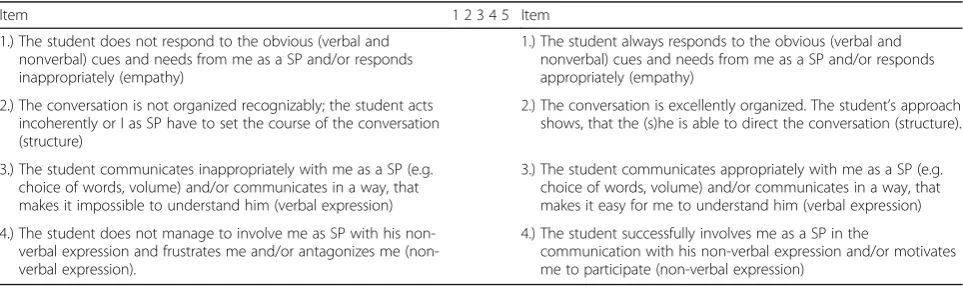
Table 2Items of the external perception rating (standardized patients)
Item 1 2 3 4 5 Item
1.) The student does not respond to the obvious (verbal and nonverbal) cues and needs from me as a SP and/or responds inappropriately (empathy)
1.) The student always responds to the obvious (verbal and nonverbal) cues and needs from me as a SP and/or responds appropriately (empathy)
2.) The conversation is not organized recognizably; the student acts incoherently or I as SP have to set the course of the conversation (structure)
2.) The conversation is excellently organized. The student’s approach shows, that the (s)he is able to direct the conversation (structure).
3.) The student communicates inappropriately with me as a SP (e.g. choice of words, volume) and/or communicates in a way, that makes it impossible to understand him (verbal expression)
3.) The student communicates appropriately with me as a SP (e.g. choice of words, volume) and/or communicates in a way, that makes it easy for me to understand him (verbal expression)
4.) The student does not manage to involve me as SP with his non-verbal expression and frustrates me and/or antagonizes me (non-verbal expression).
4.) The student successfully involves me as a SP in the
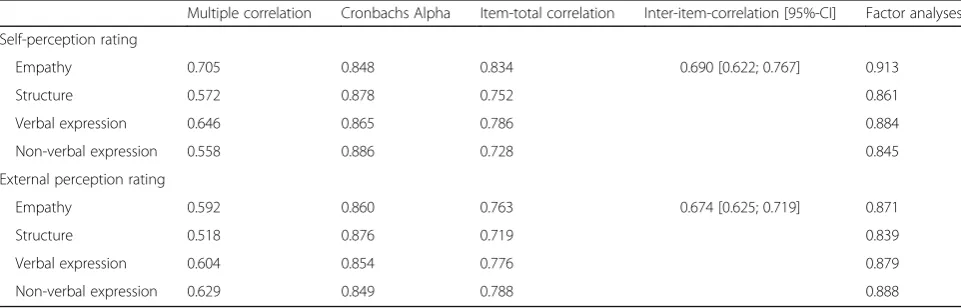
5-point Likert-skaled external perception assessment) were reliable and valid, because Cronbach’s Alpha and the item-total correlation amount to >0.7 and the factor analyses were >0.8 (see Table 4).
Self-perception of communication skills: gender specific differences
In general, students of both gender rated their communi-cation skills in all dimensions as good. When analysing the total of all seven semester cohorts, female students rated themselves better than their male counterparts across all four dimensions of communication (Table 5). The largest gender-specific differences in the rating concerned the di-mensions of empathy (mean female = 4.46; mean male = 4.25) and non-verbal expression (mean fe-male = 4.15; mean fe-male = 4.06), while slight differences exist in the dimensions of structure and verbal expression. In the total sample, female students rated their skills in the dimension of empathy highest (average score 4.46), closely followed by the dimensions of verbal expression (mean = 4.42) and structure (mean = 4.39), while the non-verbal expression was assessed less positively (mean = 4.15). In the male students, other priorities were found: here, the dimension of verbal expression was rated highest (average score 4.40), followed by the dimension of structure
(mean = 4.37). In contrast, the skills of the males in rela-tion to empathy and non-verbal expression were assessed less positively (mean = 4.25 and mean = 4.06). Because the female students rated themselves better than their male counterparts in all four dimensions, we analysed whether the differences between males and females were statistically significant. A significant association was found in the di-mension of empathy (p= 0.0039), while the differences in the other three dimensions in favour of female students were not statistically significant (Table 6). Comparing the mean scores (self-perception) of the first and last semester cohort (summer semester 2011 versus summer semester 2014), in both genders the dimensions of structure and non-verbal expression improved, while the verbal expres-sion was rated lower in 2014 than in 2011. The dimenexpres-sion of empathy scored better only in the male cohort, while the same dimension remained unchanged in the females (Table 7). The changes in the self-perception were not sta-tistically significant between 2011 and 2014. We could not perform ANOVA, because there was no homogeneity of variances on Levene’s test.
External perception by standardized patients
The external perception of communication skills as rated by the SP was different from the self-perception ratings of Table 3Characteristics of the student population: age and gender
Semester Number of students Gender distribution Age: Mean (Range (Min; Max)) [SD]
Male Female
2011 162 32% (n= 52) 68% (n= 110) 24.86 (27 (21;48)) [4.19]
2011–2012 168 42% (n= 71) 58% (n= 97) 25.40 (38 (21;59)) [4.24]
2012 148 34% (n= 51) 66% (n= 97) 24.38 (32 (20;52)) [3.61]
2012–2013 81 44% (n= 36) 56% (n= 45) 25.93 (25 (21;46)) [4.66]
2013 150 40% (n= 60) 60% (n= 90) 24.75 (13 (21;34)) [3.03]
2013–2014 165 47% (n= 77) 53% (n= 88) 25.29 (33 (19;52)) [3.98]
2014 153 41% (n= 63) 59% (n= 90) 23.7 (19 (20;39) [2.93]
Total 1027 40% (n= 410) 60% (n= 617) 24.84 (24) [3.85]
Table 4Reliability and validity analyses of self perception- and external perception dimensions
Multiple correlation Cronbachs Alpha Item-total correlation Inter-item-correlation [95%-CI] Factor analyses
Self-perception rating
Empathy 0.705 0.848 0.834 0.690 [0.622; 0.767] 0.913
Structure 0.572 0.878 0.752 0.861
Verbal expression 0.646 0.865 0.786 0.884
Non-verbal expression 0.558 0.886 0.728 0.845
External perception rating
Empathy 0.592 0.860 0.763 0.674 [0.625; 0.719] 0.871
Structure 0.518 0.876 0.719 0.839
Verbal expression 0.604 0.854 0.776 0.879
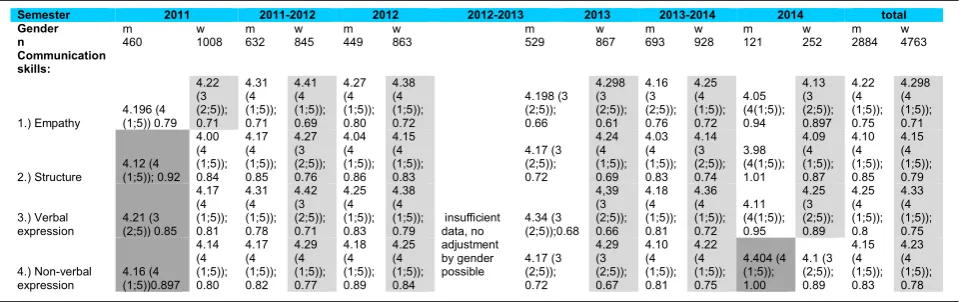
the students. In total n = 8484 communication sheets were analysed: each student (n = 1027) was assessed on average by 8.24 SPs. In the external perception, the female students were rated better than their male counterparts across all four dimensions of communication over all se-mesters. Here the highest rate was in the dimension of verbal expression (mean = 4.33), followed by the dimen-sion of empathy (mean = 4.298). In the dimendimen-sion of non-verbal expression the female students were rated with an average score of 4.23, with lowest scores in the dimension of structure (mean = 4.15). The male students showed the same pattern in the external perception: the dimension of verbal expression was rated highest (mean = 4.25), followed by empathy (mean = 4.22), non-verbal expression (mean = 4.15) and structure (mean = 4.10)(Table 8).
The same gender-specific mean differences were found in the dimensions of empathy (mean female = 4.3; mean male = 4.22; difference: 0.08; CI: -0.1138/ -0.0465, p = <0.0001), verbal expression (mean female = 4.33; mean male = 4.25; difference: 0.08; CI: -0.1186/ -0.0471, p = <0.0001) and non-verbal expression (mean fe-male = 4.23; mean fe-male = 4.15; difference: 0.08; CI: -0.1137/ -0.0397, p = <0.0001), while the differences in the dimension of structure were less (mean female = 4.15; mean male = 4.10; difference = 0.05; CI: -0.0878/ -0.127, p = 0.0085). In all four dimensions of communication, female students performed better than their male coun-terparts, and gender differences were statistically signifi-cant (Table 9).
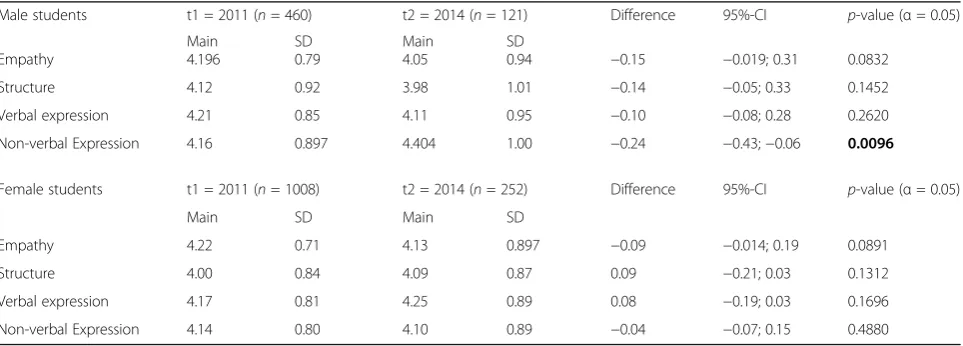
Comparing the mean scores (external perception) of the first and last semester cohort (summer semester 2011 ver-sus summer semester 2014), the SP ratings of the
communications skills in females and males developed very differently. In all four dimensions, the SP rated the male students in 2014 worse than in 2011. In the dimen-sion of non-verbal expresdimen-sion, we found a statistically sig-nificant worsening (p= 0.0096) between the first (summer semester 2011) and the last cohort (summer semester 2014). While the external perception of all four skills in the males deteriorated over the timeline, the communica-tion skills of the female students showed a mixed picture. The SP rated the females’competences in the dimensions of structure and verbal expression better in 2014 than in the summer semester 2011, whereas the dimensions of empathy and non-verbal expression worsened over the time. In all dimensions, the differences between the first and the last cohort in female students were much lower than in the males: we did not find statistically significant effects in the females (Table 10).
Discussion
Overall, the communication skills of students in the di-mensions of empathy, structure, verbal expression and non-verbal expression can be described as acceptable as measured in this OSCE, when rated by students them-selves and SP. But it remains open, how the results can be transferred to other exam situations or even further into practise. There is a lack of transferability studies, which analyse the correlation between the communicative results of an OSCE exam and the later performance in practise. Nevertheless, we found gender differences in all four di-mensions of self- and external perception, and demon-strated that female students performed better in all dimensions of the analysed communication skills. In the Table 5Gender-specific analysis of the self-perception rating across the four dimensions
Mean *, Standard Deviation; light grey = female students (f) performed better, dark grey = male students (m) performed better. * for all Items in all dimensions: range = 5 (Min = 1; Max = 6)
Table 6Statistical analysis of gender-specific differences in the self-perception rating of communication skills
Male (n= 410) Female (n= 617) Difference 95%-CI p-value (α= 0.05)
Mean SD Mean SD
Empathy 4.25 1.13 4.46 1.16 −0.21 −0.35;−0.07 0.0039
Structure 4.37 1.14 4.39 1.13 −0.02 −0.16;−0.12 0.7641
Verbal expression 4.40 1.21 4.42 1.18 −0.02 −0.17; 0.13 0.7864
whole collective, women were better than men in all four dimensions of communication (empathy, structure, verbal expression and non-verbal expression) in both rating per-spectives (self- and external perception). In general, ratings by SP was better than the students one: mean scores were 4.10–4.25 in men, and 4.15–4.33 in women on a 5-point Likert-scale, whereas mean scores in self-evaluation on a 6-point Likert-scale were 4.06–4.37 in male students, and 4.15–4.46 in female students, respectively. Interestingly, in male students a differing trend in self- and external percep-tion could be seen by focalising differences between 2011 and 2014: there was an improvement in 3 of 4 dimensions in the self-perception, while external perception worsened. This phenomenon was described as overestimating one’s clinical and communicational competences in literature and can be found more often in male students [46]. Al-though our results are consistent with other studies show-ing that female students obtain higher empathy scores than men [31, 32], no previous studies report such gender differences across all four dimensions of communication described above (empathy, structure, verbal expression, non-verbal expression). Despite the fact, that gender is a
well-known variable in the assessment of communication skills [34], and although gender effects determine medical communication [24, 25, 47], to our knowledge no study so far has been looking at the various of communication from two perspectives with a focus on gender differences. We demonstrated that female students are outperforming their male counterparts in communication skills as rated both by the self- and the external perception, and the differences in the SP ratings in favour of female students were statisti-cally significant. The influence of the SP gender is negli-gible, because the same number of male and female SP were used during the OSCE: each student was assessed by equal proportions of male and female SP. Nevertheless, there could be a limitating factor regarding the standard-ized patients as we only collected their gender but no fur-ther data – particularly no pseudonym or code. Thus, it was impossible to link any rating to the corresponding SP and calculate Fleiss` Kappa and the inter-rater reliability. An interesting finding is that the male students not only performed poorly compared to the females, but that the cohorts examined also worsened over time in all dimen-sions of the external dimension, while the females showed Table 7Change of the self-perception between 2011 and 2014 (unpaired t-test) in male and female students
Male students t1 = 2011 (n= 52) t2 = 2014 (n= 63) Difference 95%-CI p-value (α= 0.05)
Main SD Main SD
Empathy 4.23 1.198 4.48 0.95 0.25 −0.65; 0.15 0.2146
Structure 4.33 1.14 4.51 0.997 0.18 −0.57; 0.21 0.3684
Verbal expression 4.58 1.18 4.53 0.94 −0.05 −0.34; 0.44 0.8008
Non-verbal Expression 4.04 1.10 4.29 1.12 0.25 −0.66; 0.16 0.2323
Female students t1 = 2011 (n= 110) t2 = 2014 (n= 90) Difference 95%-CI p-value (α= 0.05)
Main SD Main SD
Empathy 4.43 1.19 4.43 1.23 0.0 −0.34; 0.34 1.0
Structure 4.34 1.11 4.49 1.18 0.15 −0.47; 0.17 0.3565
Verbal expression 4.44 1.07 4.37 1.20 −0.07 −0.25; 0.39 0.6635
Non-verbal Expression 4.09 1.19 4.34 1.21 0.25 −0.59; 0.09 0.1440
Table 8gender-specific analysis of the external perception dimensions
a lesser negative change in only two dimensions. This may be related to the decrease in age of medical students: in summer semester 2011 the average age of students was 24.86 year; by summer semester 2014 it had decreased to 23.7 years. Due to the conversion to an 8-year secondary school system and an abolition of a mandatory military and civil service, students in Germany (especially male stu-dents) are now much younger at enrolment in university than a few years ago. The improvement in empathy scores in male students between 2011 and 2014 is also an inter-esting finding. We demonstrated that the male perform-ance on the empathy scale improved on self-perception, but worsened on external perception. This is confirmed by other studies that demonstrated lower empathy values but higher self-confidence rates in male students [35], but also shows that male students are more unrealistic in estimat-ing their communication competences in empathy than fe-males. Overall, the study confirms that gender specific aspects of medical education are neglected [28]. Gender medicine teaching is still in the early stages in Germany, but it is clear that it has to implement in the health care and also in the medical teaching [48–51]. There is a need for a paradigm shift in medical care, research and teaching, to reach both genders similarly and to counteract existing gender-specific stereotypes [49]. In the art of conversation, men and women in general as well as female and male physicians in particular [24–29] differ from each other,
rendering it is necessary to integrate gender aspects in the teaching of communication skills, to increase the compe-tences especially of the male students. The results of the study sustain the demand for implementing gender-specific teaching formats for improving students’ commu-nication skills. Within these, well-known gender-specific reservations towards doctor-patient communication and its teaching should be addressed [52–55]. However, the aim should not be to eliminate differences in the way in which men and women communicate, but rather to look at inequality as an opportunity to improve the compe-tences of male and female students individually. There is great relevance in improving communication skills in medical students especially in the context of existing gender-specific differences in order to improve the physician-patient interaction for enhancement of patient care [2, 3, 5]. Especially the tendency of male students for overestimating their own clinical and communicative skills can pose a danger to patient’s safety [46], wherefore it is necessary to optimize their skills. Finally it could be dem-onstrate that the subjectivity of surveys for measurement of communication skills plays an increasingly important role, because there were differences between self- and ex-ternal perception in the semester-overall analyses. This suggests a possibly existing bias in other studies especially in those with a focus on only one dimension of perception. Using a multidimensional approach might be broadening Table 9statistical analysis of the gender-specific differences in the external perception
Male (n= 2884) Female (n= 4763) Difference 95%-CI p-value (α= 0,05)
Mean SD Mean SD
Empathy 4.22 0.75 4.3 0.71 −0.08 −0.1138;−0.0465 <0.0001
Structure 4.10 0.85 4.15 0.79 −0.05 −0.0878;−0.0127 0.0085
Verbal expression 4.25 0.8 4.33 0.75 −0.08 −0.1186;−0.0471 <0.0001
Non-verbal expression 4.15 0.83 4.23 0.78 −0.08 −0.1137;−0.0397 <0.0001
Table 10Change of the external perception between cohorts examined in 2011 and 2014 (unpaired t-test) in male and female students
Male students t1 = 2011 (n= 460) t2 = 2014 (n= 121) Difference 95%-CI p-value (α= 0.05)
Main SD Main SD
Empathy 4.196 0.79 4.05 0.94 −0.15 −0.019; 0.31 0.0832
Structure 4.12 0.92 3.98 1.01 −0.14 −0.05; 0.33 0.1452
Verbal expression 4.21 0.85 4.11 0.95 −0.10 −0.08; 0.28 0.2620
Non-verbal Expression 4.16 0.897 4.404 1.00 −0.24 −0.43;−0.06 0.0096
Female students t1 = 2011 (n= 1008) t2 = 2014 (n= 252) Difference 95%-CI p-value (α= 0.05)
Main SD Main SD
Empathy 4.22 0.71 4.13 0.897 −0.09 −0.014; 0.19 0.0891
Structure 4.00 0.84 4.09 0.87 0.09 −0.21; 0.03 0.1312
Verbal expression 4.17 0.81 4.25 0.89 0.08 −0.19; 0.03 0.1696
this picture. Further studies could look into the clinical transfer, or the assessors as a second external source of perception could additionally be included in the analyses.
Conclusions
Medical students in Tuebingen showed good overall com-munication skills in the four dimensions of empathy, con-tent structure, verbal expression and non-verbal expression, with gender-specific differences in all dimensions in favour of female students. With male students underperforming in all dimensions, the development of additional gender-specific teaching should be considered.
Abbreviations
GP:General Practitioners; OSCE: Objective Structured Clinical Examination; SP: Standardized Patients
Acknowledgements
We would like to thank all standardized patients and medical students who spent their invaluable time to fill in the questionnaires. Special thanks are due the Dean’s Office for Students’Affairs.
Funding
No funding was received.
Availability of data and materials
Data from journals used in this work found on publicly available repositories. Statistical Data used in this study may be available upon request. Please contact Joachim Graf [email protected]
Authors’contributions
JG: literature review and analysis, statistical analysis and interpretation of data, drafting of manuscript; RS/ ES/ SZ/ FJ/ FH/ AW/ AMD/ KM: critical revision of manuscript; analysis and interpretation of data; AHW: literature review, concept design, analysis and interpretation of data, critical revision of manuscript. All authors read and approved the final manuscript.
Competing interests
The authors declare that they have no competing interests.
Consent for publication
Consent for publication is not applicable for this work.
Ethics approval and consent to participate
Ethical approval has been given by the University Hospital Tuebingen Ethic’s Commission. Consent to participate was sought and gained from all participants in the study.
Publisher’s Note
Springer Nature remains neutral with regard to jurisdictional claims in published maps and institutional affiliations.
Author details
1Medical Faculty Tuebingen, Dean’s Office for Students’Affairs, Geissweg 5/1,
D-72076 Tuebingen, Germany.2Department of Women’s Health, Research Institute for Women’s Health, University Hospital Tuebingen, Calwerstrasse 7, D-72076 Tuebingen, Germany.3Department of Women’s Health, University Hospital Tuebingen, Calwerstrasse 7, D-72076 Tuebingen, Germany.4DRK Clinic Center Berlin, Hospital for Psychosomatic Medicine and Psychotherapy, Spandauer Damm 130, D-14050 Berlin, Germany.5Staff Section Social Medicine, University Hospital Tuebingen, Hoppe-Seyler-Strasse 6, D-72076 Tuebingen, Germany.6Department of Psychosomatic Medicine and Psychotherapy, University Hospital Tuebingen, Internal Medicine, Osianderstrasse 5, D-72076 Tuebingen, Germany.7Department of Gastroenterology, Hepatology and Infectious Diseases, University Hospital Tuebingen, Internal Medicine, Otfried-Müller-Strasse 10, D-72076 Tübingen, Germany.8Department of Psychiatry, University Hospital Galway, Galway,
Ireland.9Section of Public Health, University Hospital Duesseldorf, Moorenstrasse 5, D-40225 Duesseldorf, Germany.10Interdisciplinary Training Centre DocLab, Medical Faculty Tuebingen, Elfriede-Aulhorn-Strasse 10, D-72076 Tuebingen, Germany.
Received: 6 February 2017 Accepted: 22 April 2017
References
1. Herman DC, Abenstein JP. Communication technology: patient safety and the patient-physician relationship. Mayo Clin Proc. 2001;76(1):7–8. 2. Meyer GS, Arnheim L. The power of two: improving patient safety through
better physician-patient communication. Fam Pract Manag. 2002;9(7):47–8. 3. Scalise D. Clinical communication and patient safety. Hosp Health Netw.
2006;80(8):49–54. 2
4. Kampmann M. Communication errors are the most common cause of treatment failures [Kommunikationsfehler sind die häufigste Ursache von Therapiefehlern]. MMW Fortschr Med. 2006;148(3):32–5.
5. Kripalani S, LeFevre F, Phillips CO, Williams MV, Basaviah P, Baker DW. Deficits in communication and information transfer between hospital-based and primary care physicians: implications for patient safety and continuity of care. JAMA. 2007;297(8):831–41.
6. Krug SE. The art of communication: strategies to improve efficiency, quality of care and patient safety in the emergency department. Pediatr Radiol. 2008;38(Suppl 4):S655–9.
7. Deveugele M, Derese A, De Maesschalck S, Willems S, Van Driel M, De Maeseneer J. Teaching communication skills to medical students, a challenge in the curriculum? Patient Educ Couns. 2005;58(3):265–70. 8. Lahmann C, Dinkel A. Doctor-patient-communication. Conversational skills of
doctors–a highly skilled area [Arzt-Patienten-Kommunikation. Ärztliche Gesprächsführung–eine hohe Kunst]. MMW Fortschr Med. 2014;156(88):84–7. 9. Fragstein von M, Silverman J, Cushing A, Quilligan S, Salisbury H, Wiskin C.
UK consensus statement on the content of communication curricula in undergraduate medical education. Med Educ. 2008;12:1100–7.
10. Jagow G, Lohölter R. The new medical licensure act. Priorities of the reform and first experiences with the implementation [die neue Ärztliche Approbationsordnung. Schwerpunkte der reform und erste Erfahrungen mit der Umsetzung]. Bundesgesundheitsblatt. 2006;4:330–6.
11. German Council of Science and Humanities [Wissenschaftsrat]. Recommendations of the science council for the further development of the medical studies in Germany [Empfehlungen des Wissenschaftsrats zur Weiterentwicklung des Medizinstudiums in Deutschland]. Dresden 2014,URL: http://www.wissenschaftsrat.de/download/archiv/4017-14.pdf (Access: 1.11.2015).
12. Batt-Rawden SA, Chisolm MS, Anton B, Flickinger TE. Teaching empathy to medical students: an updated, systematic review. Acad Med. 2013;88(8):1171–7. 13. Choudhary A, Gupta V. Teaching communications skills to medical students: introducing the fine art of medical practice. Int J Appl Basic Med Res. 2015; 5(Suppl 1):S41–4.
14. Harlak H, Gemalmaz A, Gurel FS, Dereboy C, Ertekin K. Communication skills training: effects on attitudes toward communication skills and empathic tendency. Educ Health (Abingdon). 2008;21(2):62.
15. Ramasamy R, Murugaiyan SB, Shalini R, Vengadapathy KV, Gopal N. Communication skills for medical students–an overview. J Contemp Med Edu. 2014;2(2):134–40.
16. Gude T, Grimstad H, Holen A, Anvik T, Baerheim A, Fasmer OB, Hjortdahl P, Vaglum P. Can we rely on simulated patients' satisfaction with their consultation for assessing medical students' communication skills? A cross-sectional study BMC Med Educ. 2015;15:225. doi:10.1186/s12909-015-0508-x. 17. Dong T, LaRochelle JS, Durning SJ, Saguil A, Swygert K, Artino AR Jr.
Longitudinal effects of medical students' communication skills on future performance. Mil Med. 2015;180(4 Suppl):24–30.
18. Setyonugroho W, Kennedy KM, Kropmans TJ. Reliability and validity of OSCE checklists used to assess the communication skills of undergraduate medical students: a systematic review. Patient Educ Couns. 2015; doi:10. 1016/j.pec.2015.06.004. [Epub ahead of print pii: S0738-3991(15)00277-3.] 19. Harden RM, Stevenson M, Downie WW, Wilson GM. Assessment of clinical
competence using objective structured examinations. Br Med J. 1975;1:447–51. 20. Hodges B. OSCE! Variations on a theme by Harden. Med Educ. 2003;37:
21. Newble D. Techniques for measuring clinical competence: objective structured clinical examinations. Med Educ. 2004;38:199–203. 22. Schrauth M, Schmulius N, Zipfel S, Haarmeier T. Practical exams in the
discipline of neurology. The Tuebingen model [Praktische Prüfungen in der Neurologie. Das Tübinger Modell]. Nervenarzt. 2006;77:1464–8.
23. Schultz JH, Nikendei C, Weyrich P, Möltner A, Fischer MR, Jünger J. Quality assurance of exams through the example of the OSCE parcour. Experiences in the medical school of the university in Heidelberg [Qualitätssicherung von Prüfungen am Beispiel des OSCE-Prüfungsformats: Erfahrungen der Medizinischen Fakultät der Universität Heidelberg]. ZEFQ. 2008;102:668–72. 24. Roter DL, Hall JA, Aoki Y. Physician gender effects in medical
communication: a meta-analytic review. JAMA. 2002;288(6):756–64. 25. Roter DL, Hall JA. Physician gender and patient-centered communication: a
critical review of empirical research. Annu Rev Public Health. 2014;25:497–519. 26. Swygert KA, Cuddy MM, van Zanten M, Haist SR, Jobe AC. Gender differences in examinee performance on the step 2 clinical Skills_ data gathering (DG) and patient note (PN) components. Adv Health Sci Educ. 2012;17:557–71. 27. Bylund CL, Makoul G. Empathic communication and gender in the physician-patient encounter. Patient Educ Couns. 2002;48(3):207–16. 28. Dielissen P, Bottema B, Verdonk P, Lagro-Janssen T. Attention to gender in
communication skills assessment instruments in medical education: a review. Med Educ. 2011;45(3):239–48.
29. Meeuwesen L, Bensing J, van den Brink-Muinen A. Communicating fatigue in general practice and the role of gender. Patient Educ Couns. 2002;48(3):233–42. 30. Holm U, Aspegren K. Pedagogical methods and affect tolerance in medical
students. Med Educ. 1999;33(1):14–8.
31. Hojat M, Gonnella JS, Nasca TJ, Mangione S, Vergare M, Magee M. Physician empathy: definition, components, measurement, and relationship to gender and specialty CRMEHC Faculty Papers.2002a, Paper 4, URL: http://jdc. jefferson.edu/crmehc/4 (Access: 15.12.2015).
32. Hojat M, Gonnella JS, Mangione S, Nasca TJ, Veloski JJ, Erdmann JB, Callahan CA, Magee M. Empathy in medical students as related to academic performance, clinical competence and gender. Med Educ. 2002;36:522–7. 33. Fischer T, Chenot JF, Kleiber C, Kochen MM, Simmenroth-Nayda A, Staats H,
Herrmann-Lingen C. "Basic medical skills" - evaluation of a primary care oriented course concept within the new medical curriculum in Germany [Kurs "ärztliche Basisfähigkeiten" - evaluation eines primärärztlich orientierten Unterrichtskonzepts im Rahmen der neuen Approbationsordnung]. GMS Z Med Ausbild. 2005;22(3):Doc59. 34. Wiskin CM, Allan TF, Skelton JR. Gender as a variable in the assessment of
final year degree-level communication skills. Med Educ. 2004;38(2):129–37. 35. Blanch DC, Hall JA, Roter DL, Frankel RM. Medical student gender and issues
of confidence. Patient Educ Couns. 2008;72(3):374–81.
36. Cuddy MM, Swygert KA, Swanson DB, Jobe AC. A multi-level analysis of examinee gender, standardized patient gender and USMLE step 2 clinical skills communication and interpersonal skills scores. Acad Med. 2011;86(10 Suppl):S17–20.
37. Huang CC, Huang CC, Yang YY, Lin SJ, Chen JW. The influence of gender on the communication skills assessment of medical students. Eur J Intern Med. 2015;26(9):670–4.
38. The Royal College of Physicians and Surgeons of Canada. CanMEDs: essential roles and key competencies of specialist physicians. Med Teach. 2000;22:549–54.
39. Fischer MR, Bauer D, Mohn K, Projektgruppe NKLM. Finally finished! National Competence Based Catalogues of learning objectives for undergraduate medical education (NKLM) and dental education (NKLZ) ready for trial. GMS Z Med Ausbild. 2015;32(3):Doc35.
40. Van der Kamp LTP, Bijleveld CCJH. Methodological issues in longitudinal research. In: Bijleveld, CCJH, Van der Kamp, LTP et al. (Ed.). Longitudinal data analyses. Designs, models and methods. Wiltshire: Cromwell Press Ltd. 1998, pp. 1-45 (especially pp. 22f.).
41. Taris T. A primer in longitudinal data analysis. Wiltshire: Redwood Books; 2000. 42. Babble E. The basics of social research. Belmont/ CA: Thomson; 2008. p. 112f. 43. Collins JP, Harden RM. AMEE medical education guide no. 13: real patients,
simulated patients and simulators in clinical examinations. Med Teach. 1998;20(6): 508–21.
44. Cleland JA, Abe K, Rethans JJ. The use of simulated patients in medical education: AMEE guide no 42. Med Teach. 2009;31(9):477–86. 45. Kurtz SM, Silverman J, Draper J. Simulated patients. In: Teaching and
learning communication skills in medicine. Oxfordshire: Radcliffe Publishing; 2005.
46. Jünger J, Schellberg D, Nikendei C. Student‘s self-assessment of clinical competence and objective clinical performance in OSCE evaluation. GMS Z Med Ausbild. 2006;23(3):Doc51.
47. Woolf K, Haq I, McManus IC, Higham J, Dacre J. Exploring the
underperformance of male and minority ethnic medical students in first year clinical examinations. Adv Health Sci Educ Theory Pract. 2008;13(5):607–16. 48. Regitz-Zagrosek V. Sex and gender differences in health. Science & society
series on sex and science. EMBO Rep. 2012;13:596–603.
49. Regitz-Zagrosek V, Seeland U. Sex and gender differences in clinical medicine. In: Handbook of experimental pharmacology; 2012. p. 3–22. 50. Wong YL. Review paper: gender competencies in the medical curriculum:
addressing gender bias in medicine. Asia Pac J Public Health. 2009;21(4): 359–76.
51. Hochleitner M, Nachtschatt U, Siller H. How do we get gender medicine into medical education? Health Care Women Int. 2013;34(1):3–13. 52. Pavlova MA, Weber S, Simoes E, Sokolov AN. Gender Stereotype
Susceptibility. Avenanti A, ed. PLoS ONE. 2014;9(12):e114802. doi:10.1371/ journal.pone.0114802.
53. Löffler-Stastka H, Seitz T, Billeth S, Pastner B, Preusche I, Seidman C. Significance of gender in the attitude towards doctor-patient
communication in medical students and physicians. Wien Klin Wochenschr. 2016;128(17–18):663–8.
54. Molinuevo B, Aradilla-Herrero A, Nolla M, Clèries X. A comparison of medical students', residents' and tutors' attitudes towards communication skills learning. Educ Health (Abingdon). 2016;29(2):132–5.
55. Cleland J, Foster K, Moffat M. Undergraduate students' attitudes to communication skills learning differ depending on year of study and gender. Med Teach. 2005;27(3):246–51.
• We accept pre-submission inquiries
• Our selector tool helps you to find the most relevant journal
• We provide round the clock customer support • Convenient online submission
• Thorough peer review
• Inclusion in PubMed and all major indexing services
• Maximum visibility for your research
Submit your manuscript at www.biomedcentral.com/submit