5732
A Review On Techniques For Study Of DG
Integration Impacts On Reliability Of A
Distribution System.
Ravishankar B S, Vijayendra V K, Dr. K T Veeramanju.
Abstract: Increasing power demand and increased environmental concern have paved the way towards Distributed Generation (DG). The power system, especially the distribution system is turning out to be more complex with rapid deployment and penetration of DG. In a power system, distribution system is more prone to faults and reliability becomes an important aspect in a distribution network. Reliability of a system is the ability to provide interruption free quality power supply to the consumers and is normally evaluated using the appropriate indices. Various simulative, analytical, heuristic are established for DG placement and allocation and are providing better accuracy and convergence. In this context, a comprehensive review of literature covering different approaches for DG integration into the distribution system concentrating on reliability and loss reduction are analyzed in this paper. Importance is given to more of simulation techniques adopted in the literature using different software. These simulation techniques provides the system operators or Distribution Network Operators (DNOs) a ready tool to carryout studies for the real time network scenarios to arrive at the decisions..
Index Terms: Distributed Generation (DG), Distribution System, simulation techniques, modeling, renewable energy. —————————— ◆ ——————————
1
INTRODUCTION
The Distribution systems which were passive in nature with uni-directional power flows are transforming into active distribution systems with bidirectional power flows due to gradual increase in integration of small-scale DGs [1]. Integration of DG into the distribution system results in increased system availability and improved reliability of the system. Also, there is possibility of increased system complexity and problem of protection system co-ordination due to improper placement, sizing of DGs in distribution systems. About 70% of the losses occurring in the power system can be attributed to distribution system losses [19]. In order to reduce these losses, DGs integrated to the distribution system will be a good option. DGs may be based on renewable energy or non-renewable energy technologies. However, with the increased environmental concerns, renewable energy based DGs are gaining more importance. Renewable energy based DGs have many techno-economical and environmental advantages. Due to increased customers demand for reliable and quality power supply, evaluation of the impact of DG integration to improve performance of the system, especially reliability and reduction of losses is gaining more importance in the present distribution system operating scenario. Improvement in reliability and reduction in losses can be achieved only by optimal selection, placement and sizing of DGs. This will in turn have added benefit of improved voltage profile, better power quality, optimum system loadability, enhanced system security. This will also lead to reduced capital investments, repair and maintenance costs, fuel cost for conventional units and operational costs.
Renewable energy based DGs will have advantage of no-emissions, free availability and so on. In spite of it’s vide merits, DG technologies are associated with some disadvantages if not installed at proper locations and may lead various problems viz. increased losses, protection co-ordination problem, power quality issues. This problem of optimal selection, sizing and siting of DGs has been dealt with in literature using several techniques. Analytical techniques are suitable for small systems and not performing well for complex systems. Various meta-heuristic techniques are developed for large and complex system which provides good results. Many simulation techniques are adopted by using different power system simulation software which also provides good output indicators to arrive at suitable conclusions based on the simulation results. A review on DG integration simulation techniques adopted in different literatures concentrating on loss reduction, reliability improvement of distribution system has been presented in this paper. Different software is used to carry out the simulation studies and to arrive at suitable conclusion from the results. Simulation studies are gaining importance especially for real time systems to gain insight into the performance of new technologies and operational aspects. This is also applicable to DG integration into the distribution system. Simulation results will provide the network operators a good tool to anticipate the system performance in presence of DGs and to evaluate the reliability of the system. This paper has been organized into IV sections. This introduction section is followed by section-II which provides overview of distributed generation; section-III provides an overview of available techniques for DG integration, section-IV provides the summary and section-V throws light on future research options.
2 DISTRIBUTED GENERATION
2.1 Overview of DG Technologies.
Multifold benefits of DGs have made it more attractive than the conventional fossil fuel based generation stations. Various literatures have defined DGs in different terms. The simple _______________________________________
• Vijayendra V K is currently pursuing masters degree program in Energy systems & Management at JSS Science & Technology University, Mysuru, Karnataka, INDIA, PH-0821-2548285. E-mail: [email protected]
• Ravishankar B S is currently working as Assistant Professor, Department of E&EE, JSS Science & Technology University (SJCE), Mysuru, Karnataka, INDIA, PH-0821-2548285. E-mail: [email protected].
5733 definition as per [19], International Council on Large Electricity
Systems (CIGRE) defined DG as, all generation units with a maximum capacity of few kW to few 100s of MWs, that are usually integrated to the distribution system and that are neither centrally designed nor dispatched. In simple words, DGs are those units of power generation which are directly interconnected and integrated with the local
distribution system as against the connection to high voltage transmission network. The DGs may be broadly classified into Renewable Energy (RE) based DGs (Solar PV, wind turbines, hydro, fuel cells etc) non-renewable energy based or conventional energy based DGs (Reciprocating IC engines, gas engines, Diesel generators, micro turbines etc) and Storage DGs (Fly wheels, fuel cells, super capacitors etc). The different class of DGs based on power generation capacities and available technologies in each class are shown in the table-I.
2.2 Impacts of DG Integration
The important factors to be considered for integration of DG into the distribution system are location of DG in the system, the type of the DG, suitable size of the DG and number and rating of DG. All these factors will affect the system performance factors, mainly the system losses, system reliability and availability. Careful selection of all the above through suitable analysis and studies will ensure quality and reliable supply to the consumers. This will also improve the voltage profile and decrease the power loss in the system. Thus, it becomes necessary to study the impact of DG integration considering the above factors. The most important factor is reliability of the system. Thus, integration of DG in a distribution system is very critical from reliability point of view. Reliability of the system is measured in terms of reliability indices of the system and objective is to improve the reliability indices with integration of DG. Standard reliability indices are defined as per IEEE standard 1366 and many of the indices are considered in literatures [1-18]. Above technical impacts will eventually result in monetary benefits. Benefits will be for both the utilities and the consumers. Important economic impacts are reduced operation and maintenance costs, deferred investment for additional infrastructure, reduction in fuel expenditure, reduced reserve requirements and increased overall efficacy of the system. Large scale deployment of RE based DGs will result in reduction of green house gas emission. This will also reduce the dependency on fossil fuel based power plants and in turn reduce the harmful emissions. The increased attention towards pollution, climate
change, global warming and health hazards caused by pollutants has accelerated the usage of green energy based DGs. RE based DGs provide an effective solution to mitigate the problems associated with fossil fuel based generation. These RE based DGs can increase the country’s energy intensity by allowing for diversification of sources of energy.
3
DISTRIBUTED GENERATION
INTEGRATION IN A DISTRIBUTION SYSTEM
Available methods for analyzing the impact of DG integration into the electrical system can be broadly classified into Analytical techniques, classical techniques (non-heuristic), simulation techniques, meta-heuristic techniques, and hybrid approach. Several methodologies and models have been illustrated for the solution of DG integration in distribution systems. All these techniques will be having significant contribution to DG allocation and sizing in a distribution system. Different available algorithms under the above techniques are given in the literature [19, 20] except for simulation techniques. Several works are carried out to study the impact of DG integration into the distribution system with respect to different parameters using simulation procedures using appropriate software.3.1 Analytical Techniques.
An analytical technique is a method of obtaining a solution to a problem by using appropriate mathematical formulation of the problem. It is basically a mathematical modeling of the system under study. The solutions are obtained by direct numerical solution. These techniques offer good speed and less accuracy with less computation times. Analytical methods are well suited for small and simple systems [19]. For larger systems, analytical techniques are not well suited with lesser
computational efficiency. Few important analytical
methodology for study of DG integration are 2/3 golden rule, sensitive factor analysis, iterative methods, Eigen-value based analysis, index based method etc. Several of these methods have been illustrated in the literature for solving the optimal DG allocation and sizing problem [21]. An analytical method for determination of optimal DG location, size and type is demonstrated by using voltage sensitivity index and loss minimization is illustrated in [2] for IEEE 14 bus system. Load bus selection is effected through Voltage sensitivity Index (VSI) and DG type and size for the selected load bus is based on loss minimization. The impact of component outages on reliability of distribution system in presence of DG injection is analyzed using fault hazard analysis method for a real time distribution system feeder in Indonesia [11]. Methodology to calculate the optimal location and effective optimal size of the DG is illustrated in [14] based on loss sensitivity factor and voltage profile improvements so that influence of variation in location of DG with respect to total power loss and voltage is analyzed and methodology is tested for 33 bus radial distribution network.
3.2 Classical Techniques.
Classical techniques include optimization methods which are applied to larger systems for finding an optimal solution with better accuracy compared to analytical methods. These optimization methods are applied to the developed problem formulation to minimize or maximize as per the given set of conditions and within the range of constraints. Applied
TABLE 1
DG CLASS BASED ON CAPACITIES AND TECHNOLOGY Sl.
No.
Class of
DG Capacity range DG technologies
1 Micro DG 1 kW – 5 kW Solar PV, Micro hydro, Wind turbine, Fuel cells..
2 Small DGs 5kW ≤ 5 MW
Small hydro, Fuel cells, Wind turbine, Tidal Biomass, IC engines
3 Medium
DGs 5 MW ≤ 50 MW
Solar thermal & PV, geothermal, IC engines, Bio-mass, Hydrogen energy systems.
4 Large DGs 50 MW ≤ 300 MW
5734 methodology is developed to provide the optimized value of
the objective function. These techniques include linear programming, dynamic programming, sequential quadratic programming, optimal power flow, continuous power flow etc. Several of these techniques are illustrated in the literature and reviewed in the literature works [19,20,21].
3.3 Meta-Heuristic Techniques.
These techniques are based on smart intelligent methods and are capable of providing efficient, accurate and optimal solutions. These methodologies have been evolved from artificial intelligence techniques and are most suitable for solving complicated problems in various fields. These are robust techniques and result in near optimal solutions for complex problems. Some of the important algorithms adopted for solving DG integration problems are genetic algorithm, particle swarm optimization, fuzzy logic, artificial bee colony ant colony optimization etc. Several of these techniques are illustrated in the literature and reviewed in the literature works [19,20,21].
3.4 Hybrid Techniques.
Hybrid techniques include combination of two or more optimization techniques in order to solve the problem and to obtain an optimal solution. These include combination of genetic algorithm with fuzzy logic, flower pollination algorithm, firefly algorithm, invasive weed optimization etc [19].
3.5 Simulation Techniques.
Simulation technique is also a modeling approach which
provides sufficient information regarding the system
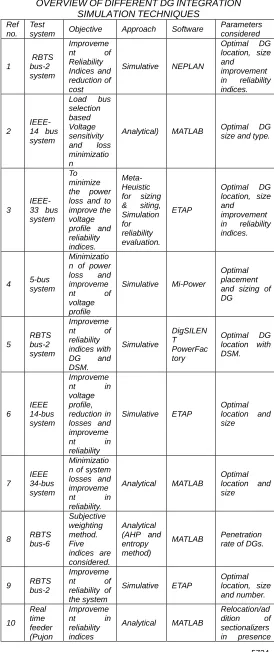
performance under different conditions. The solution for the given problem is obtained by modeling the system using different tools and carrying out the simulation under different scenarios of practical importance. A simulation modeling technique is used when an analytical formulation of a problem cannot be achieved to desired level. Simulation modeling approach provides results for specific use cases and conditions. The use cases are defined and specified by system planners and distribution network operators. The simulation should be run many times to balance the effect of numerical calculations. For use case with different set of conditions, the simulations should be run again. Such simulation techniques are acceptable when the results are validated in real time working systems under valid input assumptions. For better analysis, even though analytical approach is preferred over simulation approach, simulation approach can be used for validating the reality of the modeled system. A validated simulation result is acceptable in most of the case studies. Simulation techniques may be Monte Carlo simulation, Markov modeling and simulation using suitable software. These simulation results will provide sufficient information regarding the system performance under various conditions of importance and case study results will serve as reference for future works. For study of impacts of DG integration in a distribution system, several research works has been carried out by considering simulation studies of the test system under different scenarios. Different test systems are considered in researches and various scenarios are simulated to arrive at the conclusions. Based on the literature survey, Table-II provides the overview of different techniques along with test systems considered, objective considered in
the work, software used for simulation studies and parameters considered for the study.
TABLE 2
OVERVIEWOFDIFFERENTDGINTEGRATION
SIMULATIONTECHNIQUES
Ref no.
Test
system Objective Approach Software
Parameters considered 1 RBTS bus-2 system Improveme nt of Reliability Indices and reduction of cost
Simulative NEPLAN
Optimal DG location, size and
improvement in reliability indices.
2
IEEE-14 bus system
Load bus selection based Voltage sensitivity and loss minimizatio n
Analytical) MATLAB Optimal DG size and type.
3
IEEE-33 bus system
To minimize the power loss and to improve the voltage profile and reliability indices.
Meta-Heuistic for sizing & siting, Simulation for reliability evaluation.
ETAP
Optimal DG location, size and
improvement in reliability indices.
4 5-bus system
Minimizatio n of power loss and improveme nt of voltage profile
Simulative Mi-Power
Optimal placement and sizing of DG 5 RBTS bus-2 system Improveme nt of reliability indices with DG and DSM. Simulative DigSILEN T PowerFac tory
Optimal DG location with DSM. 6 IEEE 14-bus system Improveme nt in voltage profile, reduction in losses and improveme nt in reliability
Simulative ETAP
Optimal location and size 7 IEEE 34-bus system Minimizatio n of system losses and improveme nt in reliability.
Analytical MATLAB
Optimal location and size
8 RBTS bus-6
Subjective weighting method. Five indices are considered.
Analytical (AHP and entropy method)
MATLAB Penetration rate of DGs.
9 RBTS bus-2
Improveme nt of reliability of the system
Simulative ETAP
Optimal location, size and number. 10 Real time feeder (Pujon Improveme nt in reliability indices
Analytical MATLAB
5735 Ref
no. Test
system Objective Approach Software
Parameters considered
feeder) of DGs
11 Real time feeder (Thany aburi feeder)
Improveme nt in reliability indices
Simulative
DigSILEN T PowerFac tory
DG location and size.
12 5 bus system
Improveme nt in reliability indices with loss reduction and voltage profile improveme nt
Simulative Mi-Power
Optimal location and size
13
RBTS bus-2 system
Improveme nt in reliability indices.
Simulative ETAP
Optimal location and size
14
33 bus radial system
Reduction in real power loss and improveme nt in voltage profile
Analytical MATLAB
Optimal location and size
15
RBTS bus-2 system
Loss reduction and voltage improveme nt along with protection co-ordination
Simulative ETAP
Optimal location and size
16
RBTS bus-2 system
Improveme nt in reliability with DG and applying DSM.
Analytical MATLAB
Reliability with DG and DSM
17
29 bus Neplan test system
Improveme nt in voltage profile and power loss reduction
Simulative NEPLAN
Optimal loacation and size
18 A portion of Ommas sery feeder, Kerala
Improveme nt in reliability
Simulative Not mentioned
Optimal location and size
Simulation studies are carried out using Neplan software in [1,17], using ETAP in [3,6,9,13,15], DigSILENT PowerFactory in [5,11], using MiPower in [4,12] and using MATLAB in [2,7,8,10,14,16]. Real time feeder data has been considered in [10,11,18] for case studies. Along with the objective of improvement of reliability of the system, reduction in system loss and improvement in voltage profile has been considered as the objective in [2,3,4,6,7,12,14,15,17]. Concept of DSM has been considered in [5,16]. Solar PV has been the choice
of DG in most of the literature. Energy storage has been considered in [1], micro hydro in [10], Diesel generator in [17] and wind in [5,8,9,12,13,17].
4 CONCLUSIONS
The present work covers the techniques to study the impact of DG integration on reliability of distribution system focusing mainly on simulation technique. The paper illustrates the significance of DG integration into the distribution system and its impact on reliability of the distribution system. The main objective is to improve the reliability of the distribution system with DG integration along with other DG benefits such as loss reduction, voltage profile improvement, power quality
improvement and other associated economic and
environmental benefits. The various available techniques for studying the DG integration have been summarized in this paper. Analytical techniques are well suited for small and simple system and are faster in execution with less computation times. However, their results are only suggestive as it is based on assumptions. The classical techniques are more efficient and can be applied to larger systems. Heuristic techniques are robust and result in near optimal solutions for complex DG allocation and sizing problems. Even though these techniques are established for many test systems, the simulation techniques still have an important role and are a useful tool for network operators to have a picture of impact of DG integration. Real time systems can be simulated using the appropriate tools to arrive at decisions for interconnection of DGs at different locations and also regarding the size of the units to be interconnected.
5 FUTURE RESEARCH OPTIONS
The present work covers the techniques to study the impact of DG integration on reliability of distribution system focusing mainly on simulation technique. The paper illustrates the significance of DG integration into the distribution system and its impact on reliability of the distribution system. The main objective is to improve the reliability of the distribution system with DG integration along with other DG benefits such as loss reduction, voltage profile improvement, power quality
improvement and other associated economic and
environmental benefits. The various available techniques for studying the DG integration have been summarized in this paper. Analytical techniques are well suited for small and simple system and are faster in execution with less computation times. However, their results are only suggestive as it is based on assumptions. The classical techniques are more efficient and can be applied to larger systems. Heuristic techniques are robust and result in near optimal solutions for complex DG allocation and sizing problems. Even though these techniques are established for many test systems, the simulation techniques still have an important role and are a useful tool for network operators to have a picture of impact of DG integration. Real time systems can be simulated using the appropriate tools to arrive at decisions for interconnection of DGs at different locations and also regarding the size of the units to be interconnected.
6
ACKNOWLEDGMENT
5736 support.
7 REFERENCES
[1] A.T.Mohamed, A.A.Helal, S.M.El safty, “Distribution System Reliability Evaluation in Presence of DG”, IEEE, 2019.
[2] Ashutosh Barik, Srinivasalu G and Balakrishna P, “An
effective Method of optimal DG location, Type and Size to Deal with Power System Constraints”, ICSETS, IEEE, 2019.
[3] Sreevidya.L, S.U.Prabha and S.Sathiya, “Evaluation
of the Reliability of Distribution System with Distributed Generation using ETAP”, International Journal of Soft Computing and Engineering (IJSCE), ISSN: 2231-2307, Volue-8 Issue-5, January 2019.
[4] Rudresh B.Magadum and D.B Kulkarni, “Optimal
Location and Sizing of Multiple DG for Efficient Operation of Power System”, IEEE, 2018.
[5] Mohamed Mostafa, Mostafa Elshahed, Mohamed
S.Esobki, “The Impact of Distributed Energy Resources on the Reliability of Smart Distribution System”, Majlesi Journal of Electrical Engineering, Vol.12, No.4, December 2018.
[6] Muhammad Zahid Kamaruzaman, Noor Izzri Abdul
Wahab and Mohammad Nasrun Mohd Nasir, “Reliability Assessment of Power system with Renewable Source using ETAP”, Proceedings of the
SMART-2018, IEEE conference ID: 44078,
International conference on system modeling & advancement in research trends, November-2018.
[7] Vikas Singh Bhadoria, Nidhi Singal Pal, Vivek
Shrivastava and Shiva Pujan Jaiswal, “Reliability Improvement of Distribution system by Optimal Sitting and Sizing of Disperse Generation”, International Journal of Reliability, Quality and Safety Engineering, Vol.2, No.6 (2017) 1740006.
[8] Juan Li, Honglian Zhou, Erbiao Zhou, Jingjie Xue, Zifa Liu and Xuyang Wang, “Comprehensive Evaluation of Impacts of High Penetration of Distributed Generation Integration in Distribution Network, IEEE, 2017.
[9] Sanaullaha Ahmad, Azzam Ul Asar, Sana Sardar and
Babar Noor, “Impact of Distributed Generation on the Reliability of Local Distribution System”, International Journal of Advanced Computer Science and Applications, Vol.8, No.6, 2017.
[10]Hadi Suyono, Wiono, Rini Nur Hasanah and Syamsu
Dhuba, “Power Distribution System Reliability
Improvement due to Injection of Distributed
Generation”, IEEE, 2017.
[11]A.Ngaopitakkul, C.Jettanasen, “The Effects of
Multi-Distributed Generator on Distribution System
Reliability”, IEEE, 2017.
[12]M.R.Siddappaji, Dr.K.Thippeswamy, “Reliability
Indices Evaluation and Optimal Placement of Distributed Generation for Loss Reduction in Distribution System by using Fast Decoupled Method”, International Conference on Energy, Communication, Data Analytics and Soft Computing (ICECDS-2017).
[13]Sanaullaha Ahmad, Sana Sardar, Babar Noor and
Azzam Ul Asar, “Analyzing Distributed Generation
Impact on the Reliability of Electric Distribution Network”, International Journal of Advanced Computer Science and Applications, Vol.7, No.10, 2016.
[14]Prabhjot Kaur, Sandeep Kaur and Rintu Khanna,
“Optimal Placement and Sizing of DG Comparison of
Different Techniques of DG Placement”, 1st IEEE
International Conference on Power Electronics, Intelligent Control and Energy Systems (ICPEICES-2016).
[15]V.S.S.Sailaja, Dr.P.V.N.Prasad, “Determination of
Optimal Distributed Generation Size for Losses, Protection Co-Ordination and Reliability Evaluation Using ETAP”, Biennial International Conference on Power and Energy Systems:Towards Sustainable Energy (PESTSE), 2016.
[16]Maad Al Owaifeer, Mohammad AlMuhaini, “Reliability
Analysis of Distribution Systems with Hybrid Renewable Energy and Demand Side Management”, 13th International Multi-Conference on Systems, Signals & Devices, 2016.
[17]Vasilike Vita, Tareafa Alimardan and Lambros
Ekonomou, “The Impact of Distributed Generation in the Distribution Networks’ Voltage Profile and Energy Losses”, IEEE European Modelling Symposium, 2015.
[18]Rohit K.Mathew, Ashok.S and Kumaravel S,
“Analyzing the Effect of DG on Reliability of Distribution Systems”, IEEE, 2015.
[19]Kola Sampangi Sambaiah, “A Review on Optimal
Allocation and Sizing Techniques for DG in Distribution Systems”, International Journal of Renewable Energy Research, Vol.8, No.3, 2018. [20]Prem Prakash, Dheeraj K. Khatod, “Optimal sizing
and siting techniques for distributed generation in distribution systems: A review”, Renewable and Sustainable Energy Reviews 57 (2016) 111-130, Elseiver, 2015.
[21]Pavlos S.Georgilakis and Nikos D. Hatziargyriou,