Coreference Resolution for Swedish and German using Distant
Supervision
Alexander Wallin Lund University
Department of Computer Science Lund, Sweden
Pierre Nugues Lund University
Department of Computer Science Lund, Sweden
Abstract
Coreference resolution is the identification of phrases that refer to the same entity in a text. Current techniques to solve coref-erences use machine-learning algorithms, which require large annotated data sets. Such annotated resources are not available for most languages today. In this paper, we describe a method for solving coreferences for Swedish and German using distant su-pervision that does not use manually anno-tated texts.
We generate a weakly labelled training set using parallel corpora, English-Swedish and English-German, where we solve the coreference for English using CoreNLP and transfer it to Swedish and German using word alignments. To carry this out, we identify mentions from depen-dency graphs in both target languages us-ing hand-written rules. Finally, we ate the end-to-end results using the evalu-ation script from the CoNLL 2012 shared task for which we obtain a score of 34.98 for Swedish and 13.16 for German and, respectively, 46.73 and 36.98 using gold mentions.
1 Introduction
Coreference resolution is the process of determin-ing whether two expressions refer to the same en-tity and linking them in a body of text. The refer-ring words and phrases are generally called men-tions. Coreference resolution is instrumental in many language processing applications such as in-formation extraction, the construction of knowl-edge graphs, text summarizing, question answer-ing, etc.
As most current high-performance coreference solvers use machine-learning techniques and
su-pervised training (Clark and Manning, 2016), building solvers requires large amounts of texts, hand-annotated with coreference chains. Unfortu-nately, such corpora are expensive to produce and are far from being available for all the languages, including the Nordic languages.
In the case of Swedish, there seems to be only one available corpus annotated with coreferences: SUC-Core (Nilsson Bj¨orkenstam, 2013), which consists of 20,000 words and 2,758 coreferring mentions. In comparison, the CoNLL 2012 shared task (Pradhan et al., 2012) uses a training set of more than a million word and 155,560 coreferring mentions for the English language alone.
Although models trained on large corpora do not automatically result in better solver accura-cies, the two orders of magnitude difference be-tween the English CoNLL 2012 corpus and SUC-Core has certainly consequences on the model quality for English. Pradhan et al. (2012) posited that larger and more consistent corpora as well as a standardized evaluation scenario would be a way to improve the results in coreference resolu-tion. The same should apply to Swedish. Unfor-tunately, annotating 1,000,000 words by hand re-quires seems to be out of reach for this language for now.
In this paper, we describe a distant supervision technique to train a coreference solver for Swedish and other languages lacking large annotated cor-pora. Instead of using SUC-Core to train a model, we used it for evaluation.
2 Distant Supervision
Distant supervision is a form of supervised learn-ing, though the term is sometimes used inter-changeably with weak supervision and self train-ing dependtrain-ing on the source (Mintz et al., 2009; Yao et al., 2010). The primary difference between distant supervision and supervised learning lies in the annotation procedure of the training data;
supervised learning uses labelled data, often ob-tained through a manual annotation, whereas in the case of distant supervision, the annotation is automatically generated from another source than the training data itself.
Training data can be generated using various methods, such as simple heuristics or from the out-put of another model. Distant supervision will of-ten yield models that perform less well than mod-els using other forms of supervised learning (Yao et al., 2010). The advantage of distant supervision is that the training set does not need an initial an-notation. Distant supervision covers a wide range of methods. In this paper, we used an annotation projection, where the output of a coreference re-solver is transferred across a parallel corpus, from English to Swedish and English to German, and used as input for training a solver in the target lan-guage (Martins, 2015; Exner et al., 2015).
3 Previous Work
Parallel corpora have been used to transfer syntac-tic annotation. Hwa et al. (2005) is an example of this. In the case of coreference, Rahman and Ng (2012) used statistical machine translation to align words and sentences and transfer annotated data and other entities from one language to another. They collected a large corpus of text in Spanish and Italian, translating each sentence using ma-chine translation, applying a coreference solver on the generated text, and aligning the sentences us-ing unsupervised machine translation methods.
Martins (2015) developed a coreference solver for Spanish and Portuguese using distant su-pervision, where he transferred entity mentions from English to a target language using machine-learning techniques.
In this paper, we describe a new projection method, where we use a parallel corpus similarly to Hwa et al. (2005) and, where we follow the methods and metrics described by Rahman and Ng (2012). We also reused the maximum span heuristic in Martins (2015) and the pruning of doc-uments according to the ratio between correct and incorrect entity alignments.
4 Approach
4.1 Overview
Our goal was to create a coreference solver for Swedish and German with no labelled data to train the model. Swedish has no corpora of sufficient
size to train a general coreference solver, whereas German has a large labelled corpus in the form of T¨uba D/Z (Henrich and Hinrichs, 2014). Although we could have trained a solver from the T¨uba D/Z dataset, we applied the same projection methods to German to determine if our method would gen-eralize beyond Swedish.
We generated weakly labelled data using a par-allel corpus consisting of sentence-aligned text with a sentence mapping from English to Swedish and English to German. We annotated the En-glish text using a coreference solver for EnEn-glish and we transferred the coreference chains to the target language by word alignment. We then used the transferred coreference chains to train corefer-ence solvers for the target languages.
4.2 Processing Pipelines
We used three language-dependent processing pipelines:
• We applied Stanford’s CoreNLP (Manning et
al., 2014) to annotate the English part. We used the parts of speech, dependency graphs, and coreference chains;
• Mate Tools (Bj¨orkelund et al., 2010) for
Ger-man;
• For Swedish, we used Stagger ( ¨Ostling, 2013) for the parts of speech and MaltParser for the dependencies (Nivre et al., 2007). 4.3 Evaluation
As annotation and evaluation framework, we fol-lowed the CoNLL 2011 and 2012 shared tasks (Pradhan et al., 2011; Pradhan et al., 2012). These tasks evaluated coreference resolution systems for three languages: English, Arabic, and Chinese. To score the systems, they defined a set of metrics as well as a script that serves as standard in the field. We carried out the evaluation for both Swedish and German with this CoNLL script. For Swedish, we used SUC-Core (Nilsson Bj¨orkenstam, 2013) as a test set, while for German, we used the T¨uba-D/Z corpus in the same manner as with SUC-Core (Henrich and Hinrichs, 2013; Henrich and Hin-richs, 2014).
5 Parallel Corpora
5.1 Europarl
from the EU parliament gathered from 1996 in 21 language pairs.
Europarl is a large sentence-aligned unanno-tated corpus consisting of both text documents and web data in the XML format. Each language pair has alignment files to map the respective sen-tences in the different languages. We only used the text documents in this study and we removed unaligned sentences.
Koehn (2005) evaluated the Europarl corpus us-ing the BLEU metric (Papineni et al., 2002). High BLEU scores are preferable as they often result in better word alignments (Yarowsky et al., 2001).
The BLEU values for Europarl ranged from 10.3 to 40.2, with the English-to-Swedish at 24.8 and English-to-German at 17.6, where 0 means no alignment and 100 means a perfect align-ment. Additionally, Ahrenberg (2010) notes that the English-Swedish alignment of Europarl con-tains a high share of structurally complex rela-tions, which makes word alignment more difficult.
5.2 Word Alignment
To carry out the transfer of entity mentions, we aligned the sentences and the words of the parallel corpora, where English was the source language
and Swedish and German, the target languages. Europarl aligns the documents and sentences us-ing the Gale and Church algorithm. This intro-duces additional errors when aligning the words.
Instead, we used the precomputed word align-ments from the open parallel corpus, OPUS, where improper word alignments are mitigated (Lee et al., 2010; Tiedemann, 2012). The word align-ments in OPUS use the phrase-based grow-diag-final-and heuristic, which gave better results. Ad-ditionally, many of the challenges in aligning En-glish to Swedish described by Ahrenberg (2010) appeared to be mitigated.
6 Bilingual Mention Alignment
From the word alignment, we carried out the men-tion transfer. We used a variamen-tion of the maximum span heuristic.
6.1 Maximal Span Heuristic
Bilingual word alignment is complicated even un-der ideal circumstances as modeling errors, lan-guage differences, and slight differences in mean-ing may all affect the word alignment negatively.
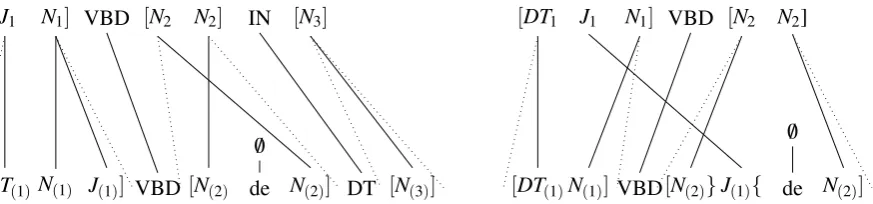
Figure 1 shows two examples of good and bad projections from Yarowsky et al. (2001). The fig-ures describe two projection scenarios with vary-ing levels of complexity from a source language on the top of the figures to a target language at the bottom. The solid lines correspond to word align-ments while the dotted lines define the boundaries of their maximum span heuristic. Yarowsky et al. (2001) argue that even though individual word alignments are incorrect, a group of words corre-sponding to a noun phrase in the source language tends to be aligned with another group in the target language. The largest span of aligned words from a noun phrase in the target language usually cor-responds to the original noun phrase in the source language.
Following Yarowsky et al. (2001), the maximal span heuristic is to discard any word alignment not mapped to the largest continuous span of the tar-get language and discard overlapping alignments, where one mention is not bounded by the other mentions for each mention.
The heuristic is nontrivial to evaluate and we primarily selected it for its simplicity, as well as its efficiency with coreference solvers for Spanish and Portuguese using distant supervision (Martins, 2015).
6.2 Maximum Span Optimal Mention
The maximum span heuristic uses no syntactic knowledge other than tokenization for the target language.
We implemented a variation of the maximum span heuristic which utilizes syntactic knowledge of the target language. We selected the largest mention bounded by each maximum span instead of the maximum span itself. As result, the gen-erated corpus would only consist of valid men-tions rather than brackets of text without any re-lation to a mention. This has the additional bene-fit of simplifying overlapping spans as a mention has a unique head and the problem of overlapping is replaced with pruning mentions with identical bounds.
6.3 Document Pruning
We removed some documents in the corpus from the generated data set according to two metrics: The document length and alignment agreement as in Martins (2015).
[J1 N1] VBD [N2 N2] IN [N3]
[DT(1)N(1) J(1)] VBD[N(2) de N(2)] DT [N(3)] /0
[DT1 J1 N1] VBD [N2 N2]
[image:4.595.93.530.64.166.2][DT(1)N(1)]VBD[N(2)}J(1){ de N(2)] /0
Figure 1: Left: Standard projection scenario according to Yarowsky et al. (2001); Right: Problematic projection scenario
words or more. To this effect, we aligned all the documents using the maximum span variant and we measured the alignment accuracy defined as the number of accepted alignments divided by the sum of all alignments.
We removed all the documents with lower than average alignment accuracy. Additionally, larger documents were removed until we could generate a total training set consisting of approximately a million words in total.
7 Evaluation
7.1 Metrics
There are multiple metrics to evaluate coreference resolution. We used the CoNLL 2012 score as it consists of a single value (Pradhan et al., 2012). This score is the mean of three other metrics:
MUC6 (Vilain et al., 1995),B3 (Bagga and Bald-win, 1998), and CEAFE (Luo, 2005). We also report the values we obtained withCEAFM, and
BLANC(Recasens and Hovy, 2011).
7.2 Test Sets
Swedish: SUC-Core. The SUC-Core corpus (Nilsson Bj¨orkenstam, 2013) consists of 20,000 words and tokens in 10 documents with 2,758 coreferring mentions. The corpus is a subset of the SUC 2.0 corpus, annotated with noun phrase coreferential links (Gustafson-Capkov´a and Hart-mann, 2006).
The corpus is much too small to train a corefer-ence solver, but it is more than sufficient to eval-uate solvers trained on some different source ma-terial. As a preparatory step to evaluate corefer-ence resolution in Swedish, the information from SUC-Core was merged with SUC 2.0 and SUC 3.0 to have a CoNLL 2012 compatible file format. Additionally, we removed the singletons from the merged data files.
German: T¨uba D/Z. The T¨uba D/Z corpus (Henrich and Hinrichs, 2013; Henrich and Hin-richs, 2014) consists of 1,787,801 words and to-kens organized in 3,644 files annotated with both part of speech and dependency graph information. Although the corpus would be sufficient in size to train a coreference solver, we only used it for evaluation in this work. As with SUC-Core, we removed all the singletons. Due to time and mem-ory constraints, we only used a subset of the T¨uba D/Z corpus for evaluation.
7.3 End-to-End Evaluation
Similarly to the CoNLL 2011 and 2012 shared tasks, we evaluated our system using gold and pre-dicted mention boundaries. When given the gold mentions, the solver knows the boundaries of all nonsingleton mentions in the test set, while with predicted mention boundaries, the solver has no prior knowledge about the test set. We also fol-lowed the shared tasks in only using machine-annotated parses as input.
The rationale for using gold mention bound-aries is that they correspond to the use of an ideal method for mention identification, where the re-sults are an upper bound for the solver as it does not consider singleton mentions (Pradhan et al., 2011).
8 Experimental Setup
8.1 Selection of Training Sets
For Swedish, we restricted the training set to the shortest documents containing at least one coref-erence chain. After selection and pruning, this set consisted of 4,366,897 words and 183,207 sen-tences in 1,717 documents.
pruning, the set consisted of 9,028,208 words and 342,852 sentences in 1,717 documents.
8.2 Mention Identification
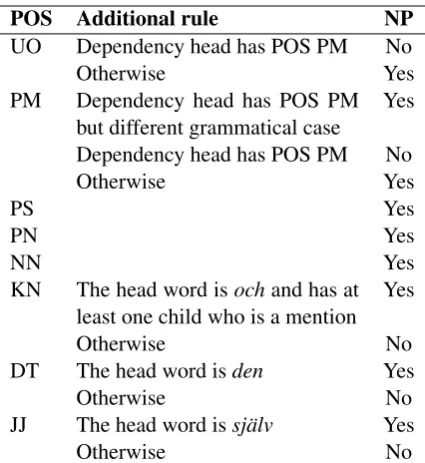
Swedish. The mentions in SUC-Core corre-spond to noun phrases. We identified them auto-matically from the dependency graphs produced by Maltparser using a set of rules based on the mention headwords. Table 1 shows these rules that consist of a part of speech and an additional con-straint. When a rule matches the part of speech of a word, we create the mention from its yield.
As SUC-Core does not explicitly define the mention bracketing rules, we had to further ana-lyze this corpus to discern basic patterns and ad-just the rules to better map the mention boundaries (Table 2).
German. The identification of noun phrases in German proved more complicated than in Swedish, especially due to the split antecedents linked by a coordinating conjunction. Consider the phrase Anna and Paul. Anna, Paul, as well as the whole phrase are mentions of entities. In Swedish, the corresponding phrase would beAnna och Paul with the conjunction och as the head word. The annotation scheme used for the TIGER corpus does not have the conjunction as head for coordinated noun phrases (Albert et al., 2003). In Swedish, the rule for identifying the same kind of split antecedents only needs to check whether a conjunction has children that were noun phrases, whereas in German the same rule required more analysis.
Table 3 shows the rules for the identification of noun phrases in German, and Table 4, the post-processing rules.
9 Algorithms
9.1 Generating a Training Set
To solve coreference, we used a variation of the closest antecedent approach described in Soon et al. (2001). This approach models chains as a pro-jected graph with mentions as vertices, where ev-ery mention has at most one antecedent and one anaphora. The modeling assumptions relaxes the complex relationship between coreferring men-tions by only considering the relamen-tionship between a mention and its closest antecedent.
The problem is framed as a binary classification problem, where the system only needs to decide
POS Additional rule NP
UO Dependency head has POS PM No
Otherwise Yes
PM Dependency head has POS PM
but different grammatical case
Yes
Dependency head has POS PM No
Otherwise Yes
PS Yes
PN Yes
NN Yes
KN The head word isochand has at least one child who is a mention Yes
Otherwise No
DT The head word isden Yes
Otherwise No
JJ The head word issj¨alv Yes
[image:5.595.310.523.60.292.2]Otherwise No
Table 1: Hand-written rules for noun phrase iden-tification for Swedish based on SUC-Core. The rules are ordered by precedence from top to bot-tom
# Description
1 Remove words from the beginning or the end of the phrase if they have the POS tags ET, EF or VB.
2 The first and last words closest to the men-tion head with the HP POS tag and all words further from the mention head is re-moved from the phrase.
3 Remove words from the beginning or the end of the phrase if they have the POS tags AB or MAD.
4 The first and last words closest to the men-tion head with the HP POS tag and with the dependency arch SS and all words fur-ther from the mention head is removed from the phrase.
5 Remove words from the end of the phrase if they have the POS tag PP.
6 Remove words from the beginning or the end of the phrase if they have the POS tag PAD.
Table 2: Additional hand-written rules for post processing the identified noun phrases
POS Additional rule NP
NN Depend. head has POS NN No
Otherwise Yes
NE Depend. head has POS NE No
Otherwise Yes
PRELS Yes
PRF Yes
PPOSAT Yes
PRELAT Yes
PIS Yes
PDAT Yes
PDS Yes
FM Yes
[image:6.595.76.289.60.253.2]CARD Yes
Table 3: Hand-written rules for noun phrase iden-tification for German based on T¨uba-D/Z
the positive ones, which may skew the model. We limited the ratio at somewhere between 4 and 5 % and randomizing which negative samples become part of the final training set.
9.2 Machine-Learning Algorithms
We used the C4.5, random forest, and logistic re-gression algorithms from the Weka Toolkit and LibLinear to train the models (Witten and Frank, 2005; Hall et al., 2009; Fan et al., 2008).
9.3 Features
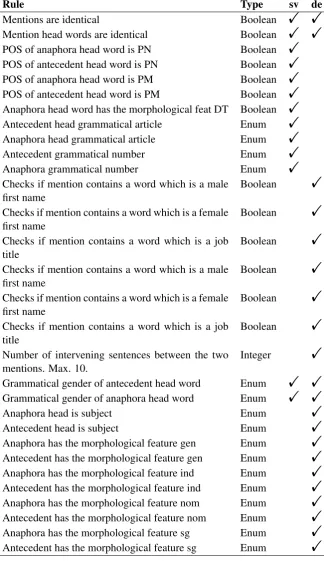
Swedish. As features, we used a subset Stam-borg et al. (2012) and Soon et al. (2001). Table 5 shows the complete list.
German. The feature set for German is de-scribed in Table 5. The primary difference be-tween German and Swedish is the addition of gen-der classified names. We used the lists of names and job titles from IMS Hotcoref DE (R¨osiger and Kuhn, 2016) to train the German model.
The morphological information from both CoreNLP and Mate Tools appeared to be limited when compared with Swedish, which is reflected in the feature set.
10 Results
10.1 Mention Alignment
Swedish. The Swedish EuroParl corpus consists of 8,445 documents. From these documents, we selected a subset consisting of 3,445 documents
# Rule
1 Remove words from the start or the end of the phrase if they have the POS tags $. $( PROP KON.
2 If there is a word with the POS tag VVPP after the head word the word prior to this word becomes the last word in the phrase.
3 If there is a dependant word with the POS tag KON and its string equals
undcreate additional mentions from the phrases left and right of this word.
4 If there is a word with the POS tag APPRART after the head word the word prior to this word becomes the last word in the phrase.
Table 4: Additional hand-written rules for post processing the identified noun phrases in German
based on the size, where we preferred the smaller documents.
The selected documents contained in total 1,189,557 mentions that were successfully trans-ferred and 541,608 rejected mentions.
We removed the documents with less than 70% successfully transferred mentions, which yielded a final tally of 515,777 successfully transferred mentions and 198,675 rejected mentions in 1,717 documents.
German. The German EuroParl corpus consists of 8,446 documents. From these documents, we randomly selected a subset consisting of 2,568 documents.
The selected documents contained in total 992,734 successfully transferred and 503,690 re-jected mentions.
We removed the documents with less than 60% successfully transferred mentions, which yielded a final tally of 975,539 successfully transferred mentions and 491,009 rejected mentions in 964 documents.
10.2 Mention Identification
Rule Type sv de
Mentions are identical Boolean ! !
Mention head words are identical Boolean ! !
POS of anaphora head word is PN Boolean !
POS of antecedent head word is PN Boolean !
POS of anaphora head word is PM Boolean !
POS of antecedent head word is PM Boolean !
Anaphora head word has the morphological feat DT Boolean !
Antecedent head grammatical article Enum !
Anaphora head grammatical article Enum !
Antecedent grammatical number Enum !
Anaphora grammatical number Enum !
Checks if mention contains a word which is a male
first name Boolean !
Checks if mention contains a word which is a female
first name Boolean !
Checks if mention contains a word which is a job
title Boolean !
Checks if mention contains a word which is a male first name
Boolean !
Checks if mention contains a word which is a female first name
Boolean !
Checks if mention contains a word which is a job
title Boolean !
Number of intervening sentences between the two
mentions. Max. 10. Integer !
Grammatical gender of antecedent head word Enum ! !
Grammatical gender of anaphora head word Enum ! !
Anaphora head is subject Enum !
Antecedent head is subject Enum !
Anaphora has the morphological feature gen Enum !
Antecedent has the morphological feature gen Enum !
Anaphora has the morphological feature ind Enum !
Antecedent has the morphological feature ind Enum !
Anaphora has the morphological feature nom Enum !
Antecedent has the morphological feature nom Enum !
Anaphora has the morphological feature sg Enum !
[image:7.595.136.461.65.627.2]Antecedent has the morphological feature sg Enum !
Table 5: The feature set used for Swedish (sv) and German (de)
German. Using the rules described in Table 3, we identified 65.90% of the mentions in T¨uba D/Z. With the additional post processing rules de-scribed in Table 4, we reached a percentage of 82.08%.
10.3 Coreference Resolution
Language Method MUC6 B3 CEAF
E CEAFM BLANC MELACoNLL
Swedish J48 46.72 29.11 28.32 32.67 29.94 34.98
Random forest 46.29 28.87 27.68 32.21 29.41 34.28
Logistic regression 39.18 2.4 1.01 8.88 5.46 14.19
German J48 34.29 2.63 2.55 12.81 4.67 13.16
Random forest 33.51 2.54 2.4 11.82 5.46 12.81
[image:8.595.83.518.63.159.2]Logistic regression 33.97 2.36 1.35 12.5 4.58 12.56
Table 6: End-to-end results using predicted mentions
Language Method MUC6 B3 CEAF
E CEAFM BLANC MELACoNLL
Swedish J48 61.43 37.78 40.97 42.36 41.51 46.73
Random forest 61.37 37.72 41.03 42.46 41.22 46.71
Logistic regression 84.77 13.37 1.95 16.68 15.5 33.37
German J48 82.69 19.74 5.86 26.75 19.56 36.1
Random forest 77.24 24.16 9.53 26.94 32.72 36.98
Logistic regression 83.71 17.6 4.5 25.58 16.61 35.27
Table 7: End-to-end results using gold mention boundaries
feature set.
11 Conclusion
In this paper, we have described end-to-end coref-erence solvers for Swedish and German that used no annotated data. We used feature sets limited to simple linguistic features easily extracted from the Swedish treebank and the German Tiger corpus, respectively. A large subset of the feature set of Stamborg et al. (2012) would very likely improve the results in this work.
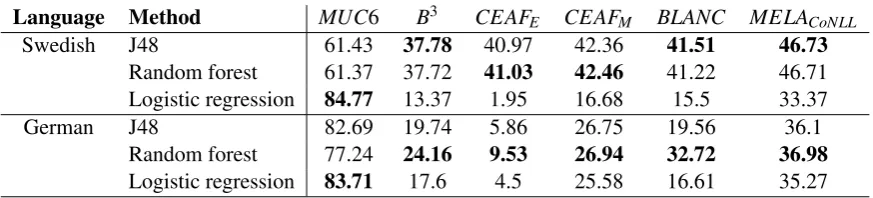
The results in Tables 6 and 7 show that even though the dependency grammar based approach for identifying mentions yields a decent perfor-mance compared with CoNLL 2011 and 2012, a better identification and pruning procedure would probably significantly improve the results. This is manifest in German, where using the gold men-tions results in a considerable increase of the scores: Table 7 shows a difference of more than 23 points compared with those in Table 6. This demonstrates that the large difference in scores between Swedish and German has its source in the methods used for mention identification rather than in the different feature sets or the correctness of the training set. This can be explained by the difficulty to predict mentions for German, possi-bly because of the differences in the dependency grammar format, as relatively few mentions were identified using their head elements.
The final results also show that classifiers based
on J48 and random forests produced better scores than logistic regression.
Coreference resolution using weak labelled training data from distant supervision enabled us to create coreference solvers for Swedish and Ger-man, even though the mention alignment in the parallel corpora was far from perfect. It is diffi-cult to compare results we obtained in this article with those presented in CoNLL, as the languages and test sets are different. Despite this, we ob-serve that when using gold mention boundaries, we reach aMELACoNLL score for Swedish that is comparable with results obtained for Arabic in the CoNLL-2012 shared task using the similar pre-conditions. We believe this shows the method we proposed is viable. Our results are, however, lower than those obtained for English and Chinese in the same task and could probably be improved with a better mention detection.
Acknowledgments
This research was supported by Vetenskapsr˚adet, the Swedish research council, under theDet digi-taliserade samh¨alletprogram.
References
[image:8.595.81.518.194.293.2]Tapias, editors,Proceedings of the Seventh Interna-tional Conference on Language Resources and Eval-uation (LREC’10), Valletta, Malta, may. European Language Resources Association (ELRA).
Stefanie Albert, Jan Anderssen, Regine Bader, Stephanie Becker, Tobias Bracht, Sabine Brants, Thorsten Brants, Vera Demberg, Stefanie Dipper, Peter Eisenberg, et al. 2003. Tiger annotationss-chema. Technical report, Universit¨at des Saarlan-des.
Amit Bagga and Breck Baldwin. 1998. Entity-based cross-document coreferencing using the vec-tor space model. In Proceedings of the 36th An-nual Meeting of the Association for Computational Linguistics and 17th International Conference on Computational Linguistics - Volume 1, ACL ’98, pages 79–85, Stroudsburg, PA, USA. Association for Computational Linguistics.
Anders Bj¨orkelund, Bernd Bohnet, Love Hafdell, and Pierre Nugues. 2010. A high-performance syntac-tic and semansyntac-tic dependency parser. InProceedings of the 23rd International Conference on Computa-tional Linguistics: Demonstrations, pages 33–36. Association for Computational Linguistics.
Kevin Clark and Christopher D. Manning. 2016. Im-proving coreference resolution by learning entity-level distributed representations. InProceedings of the 54th Annual Meeting of the Association for Com-putational Linguistics (Volume 1: Long Papers), pages 643–653, Berlin, Germany, August. Associ-ation for ComputAssoci-ational Linguistics.
Peter Exner, Marcus Klang, and Pierre Nugues. 2015. A distant supervision approach to semantic role la-beling. InFourth Joint Conference on Lexical and Computational Semantics (* SEM 2015).
Rong-En Fan, Kai-Wei Chang, Cho-Jui Hsieh, Xiang-Rui Wang, and Chih-Jen Lin. 2008. LIBLINEAR: A library for large linear classification. Journal of machine learning research, 9(Aug):1871–1874.
Sofia Gustafson-Capkov´a and Britt Hartmann. 2006. Manual of the Stockholm Ume˚a corpus version 2.0. Technical report, Stockholm University.
Mark Hall, Eibe Frank, Geoffrey Holmes, Bernhard Pfahringer, Peter Reutemann, and Ian H Witten. 2009. The WEKA data mining software: an update.
ACM SIGKDD explorations newsletter, 11(1):10– 18.
Verena Henrich and Erhard Hinrichs. 2013. Extending the T¨uBa-D/Z treebank with GermaNet sense anno-tation. InLanguage Processing and Knowledge in the Web, pages 89–96. Springer Berlin Heidelberg.
Verena Henrich and Erhard Hinrichs. 2014. Con-sistency of manual sense annotation and integration into the T¨uBa-D/Z treebank. InProceedings of the 13th International Workshop on Treebanks and Lin-guistic Theories (TLT13).
Rebecca Hwa, Philip Resnik, Amy Weinberg, Clara Cabezas, and Okan Kolak. 2005. Bootstrapping parsers via syntactic projection across parallel texts.
Natural language engineering, 11(03):311–325.
Philipp Koehn. 2005. Europarl: A parallel corpus for statistical machine translation. InMT summit, vol-ume 5, pages 79–86.
Jae-Hee Lee, Seung-Wook Lee, Gumwon Hong, Young-Sook Hwang, Sang-Bum Kim, and Hae-Chang Rim. 2010. A post-processing approach to statistical word alignment reflecting alignment ten-dency between part-of-speeches. In Proceedings of the 23rd International Conference on Computa-tional Linguistics: Posters, pages 623–629. Associ-ation for ComputAssoci-ational Linguistics.
Xiaoqiang Luo. 2005. On coreference resolution per-formance metrics. In Proceedings of the confer-ence on Human Language Technology and Empiri-cal Methods in Natural Language Processing, pages 25–32. Association for Computational Linguistics.
Christopher D. Manning, Mihai Surdeanu, John Bauer, Jenny Finkel, Steven J. Bethard, and David Mc-Closky. 2014. The Stanford CoreNLP natural lan-guage processing toolkit. InAssociation for Compu-tational Linguistics (ACL) System Demonstrations, pages 55–60.
Andr´e F. T. Martins. 2015. Transferring coreference resolvers with posterior regularization. In Proceed-ings of the 53rd Annual Meeting of the Association for Computational Linguistics and the 7th Interna-tional Joint Conference on Natural Language Pro-cessing (Volume 1: Long Papers), pages 1427–1437, Beijing, China, July. Association for Computational Linguistics.
Mike Mintz, Steven Bills, Rion Snow, and Dan Ju-rafsky. 2009. Distant supervision for relation ex-traction without labeled data. InProceedings of the Joint Conference of the 47th Annual Meeting of the ACL and the 4th International Joint Conference on Natural Language Processing of the AFNLP: Vol-ume 2-VolVol-ume 2, pages 1003–1011. Association for Computational Linguistics.
Kristina Nilsson Bj¨orkenstam. 2013. SUC-CORE: A balanced corpus annotated with noun phrase coref-erence. Northern European Journal of Language Technology (NEJLT), 3:19–39.
Joakim Nivre, Johan Hall, Jens Nilsson, Atanas Chanev, G¨ulsen Eryigit, Sandra K¨ubler, Svetoslav Marinov, and Erwin Marsi. 2007. MaltParser: A language-independent system for data-driven de-pendency parsing. Natural Language Engineering, 13(02):95–135.
Kishore Papineni, Salim Roukos, Todd Ward, and Wei-Jing Zhu. 2002. BLEU: a method for automatic evaluation of machine translation. InProceedings of the 40th annual meeting on association for compu-tational linguistics, pages 311–318. Association for Computational Linguistics.
Sameer Pradhan, Lance Ramshaw, Mitchell Marcus, Martha Palmer, Ralph Weischedel, and Nianwen Xue. 2011. CoNLL-2011 shared task: Modeling unrestricted coreference in ontonotes. In Proceed-ings of the Fifteenth Conference on Computational Natural Language Learning: Shared Task, pages 1– 27. Association for Computational Linguistics. Sameer Pradhan, Alessandro Moschitti, Nianwen Xue,
Olga Uryupina, and Yuchen Zhang. 2012. CoNLL-2012 shared task: Modeling multilingual unre-stricted coreference in ontonotes. In Joint Confer-ence on EMNLP and CoNLL-Shared Task, pages 1– 40. Association for Computational Linguistics. Altaf Rahman and Vincent Ng. 2012.
Translation-based projection for multilingual coreference reso-lution. In Proceedings of the 2012 Conference of the North American Chapter of the Association for Computational Linguistics: Human Language Tech-nologies, pages 720–730. Association for Computa-tional Linguistics.
Marta Recasens and Eduard Hovy. 2011. BLANC: Implementing the rand index for coreference evalu-ation. Natural Language Engineering, 17(04):485– 510.
Ina R¨osiger and Jonas Kuhn. 2016. IMS HotCoref DE: A data-driven co-reference resolver for German. In
LREC.
Wee Meng Soon, Hwee Tou Ng, and Daniel Chung Yong Lim. 2001. A machine learning ap-proach to coreference resolution of noun phrases.
Computational linguistics, 27(4):521–544.
Marcus Stamborg, Dennis Medved, Peter Exner, and Pierre Nugues. 2012. Using syntactic dependen-cies to solve coreferences. InJoint Conference on EMNLP and CoNLL-Shared Task, pages 64–70. As-sociation for Computational Linguistics.
J¨org Tiedemann. 2012. Parallel data, tools and in-terfaces in OPUS. In Nicoletta Calzolari (Con-ference Chair), Khalid Choukri, Thierry Declerck, Mehmet Ugur Dogan, Bente Maegaard, Joseph Mar-iani, Jan Odijk, and Stelios Piperidis, editors, Pro-ceedings of the Eight International Conference on Language Resources and Evaluation (LREC’12), Is-tanbul, Turkey, may. European Language Resources Association (ELRA).
Marc Vilain, John Burger, John Aberdeen, Dennis Con-nolly, and Lynette Hirschman. 1995. A model-theoretic coreference scoring scheme. In Proceed-ings of the 6th conference on Message understand-ing, pages 45–52. Association for Computational Linguistics.
Ian H Witten and Eibe Frank. 2005. Data Mining: Practical machine learning tools and techniques. Morgan Kaufmann.
Limin Yao, Sebastian Riedel, and Andrew McCallum. 2010. Collective cross-document relation extrac-tion without labelled data. In Proceedings of the 2010 Conference on Empirical Methods in Natural Language Processing, pages 1013–1023. Associa-tion for ComputaAssocia-tional Linguistics.