WATER ACTIVITy ChANGES oF MULTICoMPoNENT
FOOD MIXTURE DURING PROCESSING
j. š
tencl, T. Komprda
Received: February 25, 2004
Abstract
šTENCL, J., KOMPRDA, T.: Water activity changes of multicomponent food mixture during processing. Acta univ. agric. et silvic. Mendel. Brun., 2004, LII, No. 4, pp. 111-118
Water activity of multicomponent food mixture was analysed and measured. Samples of dry fermented sausages with two different starter cultures (Pediococcus pentosaceus + Staphylococcus carnosus and
Staphylococcus carnosus + Staphylococcus xylosus + Lactobacillus farciminis) were tested during
rip-ening (21 days) and storing (91 days). The basic raw materials were the same for all samples: lean beef meat, lean pork and pork fat in equal parts, nitrite salt mixture (2.5 %), and sugars (1.0 %). The method used for water activity tests was indirect manometric in a static environment. Moisture content of sam-ples was measured using halogen dryer. The course of water activity and moisture content of sausages was variable during ripening and steady during storage. Diagrams showed gradual decrease of both parameters. Mathematical models of water activity and moisture content for storage of dry fermented sausages were developed and statistically verified. The influence of starter cultures was not significant.
modeling, moisture content, ripening, sausage, storage, temperature
Ročník LII 11 Číslo 4, 2004
111 Water activity is a valuable tool for food scientists and technologists because it can be used to predict potential changes in food stability; it can be used for storing method determination, packaging selection and also ingredient selection. Foods are both homoge-neous and heterogehomoge-neous materials. For example sau-sage is a typical multicomponent food. There are
fre-quently questions: What is the water activity of such heterogeneous mixtures, where each wet component has different thermal and water sorption properties? To explain simply the role of activity in food-water-vapour interaction considers the general setup simu-lating a food system shown in Fig. 1.
The solvent in the system is water, and food con-stituents such as salts, sugars, meats, proteins, carbo-hydrates, and others are the solutes. At a constant tem-perature, all components and water in the food have the same thermodynamic state as defined by chemical potential. In describing the state of any system, an im-portant factor besides temperature, volume, concen-tration etc., is the free energy or Gibbs free energy, G = total energy (enthalpy factor) – unavailable energy (entropy factor) of the system (Hall, 1979; štencl, 2000)
G = H – TS (1).
In differential form, the expressions becomes
dG = dH – T dS – SdT (2).
Enthalpy is equal
H = E + PV (3)
or in differential form
dH = dE + PdV + VdP (4).
When one recalls (3) and (4) and substitutes for dH, the expression for the differential dG becomes
dG = dE + PdV + VdP – TdS – SdT (5).
For reversible change, where only pressure-volume work occurs, the first and second laws of thermody-namics give
dE = TdS – PdV (6).
Substituting the value of dE into equation (5) and cancelling like terms gives as the final equation for differential change in Gibbs free energy of homoge-neous system
dG = VdP – SdT (7).
The Gibbs free energy of a multicomponent sys-tem undergoing any change will depend not only on temperature and pressure as defined by equation (7) but also on the amount of each component present in the system, e.g. number of moles ni (Rao and Rizvi, 1995):
G = G (P, T, ni) (8).
A complete differential for the above equation would then be
∂G ∂G ∂G
dG = —– ∂P dP + —– dT + ∑ —– dni (9). T, ni ∂T P, ni ∂ni T, P, nj ≠ i
∂G
The partial molar Gibbs free energy —– is called
∂niT, P, nj ≠ i
chemical potential of component i, μi, and represents the change in the total free energy per mole of com-ponent i added, when the temperature, total pressure, and numbers of moles of all components other than i are held constant:
∂G
μi = —– (10).
∂ni T, P, nj ≠ i
Gibbs showed that for a simple system of one com-ponent and one phase or for a complex system of more than one component and existing in more than one phase, the necessary and sufficient condition for equilibrium is
μI
i = μIIi = μIIIi = … (11).
More correctly, the water in the system has the same thermodynamic state as defined by chemical potential. On a molar basis it is defined as (Čermák, 1979; Labuza, 1984)
μ = μ0 + RT ln a (12),
where μ0 is the chemical potential at some standard state, R is the gas constant, T is temperature and a is the thermodynamic activity of the particular sub-stance.
Consequentially, at a constant temperature, all com-ponents and water in the food (Fig. 1) are in the ther-modynamic equilibrium with each other in both the adsorbed and vapour phases. Considering only the water component in the two phases, their chemical potentials is equated, given by equation (13):
μw(vapour) = μw(food)iI = μ
w(food)iII = μw(food)iIII = … (13).
Since temperature was held constant, T is constant. In addition, μ0 and R are constants; thus, the activity of water aw in particular substances is also constant. Looking again at equation (12) with respect to state, it is possible to establish that the activity of the water in the headspace is also the same as it is in each par-ticular substance:
aw(food)I
i = aw(food)IIi = aw(food)IIIi = … =
= aw(air in headspace) (14).
Equation (14) represents the substance of common practical measurements of water activity (aw) of foods
and biological materials in general (Kaminski and Strumillo, 1994; Wolf et al., 1990; Labuza, 1984). At equilibrium, the aw (Iglesias and Chirife, 1982; Labuza, 1984) is related to the relative humidity of the surroundings atmosphere by
p relative.humidity.(%)
aw = — = ————————— [–] (15),
p0 100
where p is the water vapour pressure exerted by the food material, p0 the vapour pressure of pure water at temperature t0, which is the equilibrium temperature of the system.
The objective of this study is to determine water activity changes of typical multicomponent food, dry fermented sausage, during ripening and storage, to measure simultaneously the moisture content of the samples tested, and further analyse and statistically evaluate recorded values.
MATERIAL AND METhoDS
Two batches of dry fermented sausage “Herkules” were produced within a full-scale commercial produc-tion (Komprda et al., 2004). The basic raw materials were the same for each batch: lean beef meat, lean pork and pork fat used in equal parts, nitrite salt mixture
(2.5 %), and sugars (1.0 %). A special spicing mixture was applied according to the producer instructions. One of the two microbial starter cultures, Pediococcus pentosaceus + Staphylococcus carnosus (designated as HB) and Staphylococcus carnosus + Staphylococcus xylosus + Lactobacillus farciminis (HF), respectively, were admixed to the batch. Chopped and blended in-gredients were stuffed into the cutisine casing. The diameter typical for the usual “Herkules” sausage production was kept 80 mm. All products ripened in the same temperature/humidity conditions (includ-ing smok(includ-ing by the cold smoke): 27 °C/92 % 1st day,
20 °C/85 % 2nd to 12th day, and 12 °C /70 % until the
21st day (end of the ripening). Two pieces of each
sausage were analysed zero, 7th, 14th and 21st day of
ripening. The aw-value and moisture content (MC) of samples were analysed immediately after refrigerated transportation from the producer to the laboratory. The rest of the sausages were stored at the room conditions for three months after the ripening. The samples were taken for further analysis in fortnight intervals. Each type of test was carried out in two repetitions in each of the two sausages.
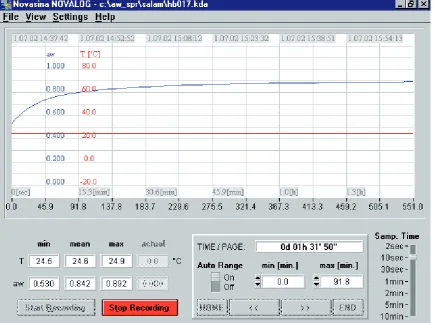
Fully computerized laboratory device with a con-trol software was used for the purpose of aw tests, see Fig. 2.
The method used was indirect manometric in a static environment. The mass of samples was 3.0 ± 0.5 g and the temperature of testing 24.5 ± 0.1 oC. The MC (wet
basis) was determined using a halogen dryer.
The linear regression for analysis of values mea-sured was used.
RESULTS AND DISCUSSIoN
The experimental values of aw and MC for sausages “Herkules” HB and HF are presented in Figs. 3 and 4, respectively.
3: Course of aw and MC tests of sausages HB during ripening and storage
Both diagrams show variable course of MC and aw
as well during ripening. It is in consequence of run-ning chemical and biological processes, and varying near ambient air conditions. There was the tempera-ture range from 27 to 12 °C and relative air humidity from 92 to 70 %. Temperature has significant influ-ence on aw in general, e.g. štencl et al., 1999; Iglesias and Chirife, 1976. A decrease of temperature causes a decrease of aw for the same MC and vice versa. All components of mixture have the same value of aw in the state of equilibrium between the material and en-vironment, see Eqns. (13) and (14). MC of mixtures depends on water sorption properties of each compo-nent under specific near ambient air conditions. This is the main reason of high variability of this parameter during ripening process. Following storing conditions
(temperature and relative air humidity) were stable already. Diagrams show gradual decrease of both parameters measured during this period. Decrease of MC and aw of dry fermented sausage HB and HF de-scribe Eqns. (16), (17) and (18), (19), respectively.
MC = 34.33-0.2132 * τ [%] (16),
aw = 0.97-0.0027 * τ [-] (17),
MC = 24.29-0.1348 * τ [%] (18),
aw = 0.887-0.0023 * τ [-] (19).
Results of linear regression are presented in Tab. I and II.
I: Regression statistic of dry fermented sausage HB
MC [%] aw [-] Correlation coefficient 0.952273 0.979255 Coefficient of determination 0.906823 0.950728 Standard error 1.247336 0.018378
II: Regression statistic of dry fermented sausage HF
5: Course of aw and MC of sausages HB, models for storage
6: Course of aw and MC of sausages HF, models for storage
Graphical models of MC and aw for storing process are shown in Figs. 5 and 6.
0 0,1 0,2 0,3 0,4 0,5 0,6 0,7 0,8 0,9 1
20 30 40 50 60 70 80 90 100 110 120
τ [day]
aw
[ - ]
0 5 10 15 20 25 30 35 40 45 50
MC [%]
aw [ - ] 0.97-0.0027*τ MC [ % ] 34.33-0.2132*τ
0 0,1 0,2 0,3 0,4 0,5 0,6 0,7 0,8 0,9 1
20 30 40 50 60 70 80 90 100 110 120
τ [day]
aw
[ - ]
0 5 10 15 20 25 30 35 40 45 50
MC [%]
LIST oF ABBREVIATIoNS a Thermodynamic activity aw Water activity
E Internal energy G Gibbs free energy H Enthalpy
P Pressure
R Gas constant S Entropy T Temperature V Volume
μ Chemical potential
SoUhRN
Změny vodní aktivity vícesložkové potravinové směsi v průběhu zpracovávání
Vodní aktivita je významný parametr pro stanovování a predikci potenciálních změn mikrobiální sta-bility potravin. Může být využita pro určování podmínek skladování, balení a také pro výběr ingredi-encí. Při jejím určování se vychází vždy z rovnovážného stavu testovaného vzorku a prostředí, což platí obecně, tedy i u vícesložkových směsí. Změny vodní aktivity a souvisejícího obsahu vlhkosti byly ana-lyzovány u vzorků trvanlivého fermentovaného salámu „Herkules“ vyrobeného se dvěma startovacími kulturami (Pediococcus pentosaceus + Staphylococcus carnosus a Staphylococcus carnosus +
Staphy-lococcus xylosus + Lactobacillus farciminis) během zrání (21 dní) a skladování (91 dní). Základními
surovinami pro jeho přípravu byly stejné díly hovězího a vepřového masa a vepřového tuku s přídav-kem směsi solí (2,5 %) a cukrů (1 %). Vodní aktivita byla měřena nepřímou manometrickou metodou ve statickém prostředí. Obsah vlhkosti byl stanovován v halogenové sušárně. Zrání probíhalo při spe-cifických podmínkách výrobce a skladování ve standardním neupravovaném prostředí. Průběh obou sledovaných veličin byl v době zrání kolísavý a při skladování stabilní. Pro skladování byly vytvořeny rovnice popisující změny vodní aktivity a vlhkosti v závislosti na čase. Matematické modely byly sta-tisticky vyhodnoceny lineární regresní analýzou. Význam odlišných startovacích kultur neměl zásadní vliv na vodní aktivitu ani na vlhkost.
modelování, obsah vlhkosti, salám, skladování, teplota, zrání
The study was supported by the grant MSM 432100001 awarded through the Ministry of Education of the Czech Republic.
REFERENCES
ČERMÁK, B.: Katalog termodynamických stavových funkcí vlhkosti materiálu, SVÚSS Běchovice, 1979: 5-11.
ČERMÁK, B.: Určování charakteru vazby vlhkosti s materiálem, SVÚSS Běchovice, 1990: 37-49. HALL, C. W.: Free Energy, Gibbs Energy. In:
Dicti-onary of Drying, Marcel Dekker, Inc., NY, 1979, 141, 150-151. ISBN 0-8247-6652-0.
IGLESIAS, H. A and CHIRIFE, J.: Equilibrium moisture contents of air dried beef: dependence on drying temperature, Journal of Food Technology, 1976, 11, 7: 565-573. ISSN 0022-1155.
KAMINSKI, W. and STRUMILLO, C.: The influ-ence of temperature on sorption isotherms of pro-tein-containing mixtures, Drying Technology, 1994, 12, 12: 1263-1276. ISSN 0737-3937.
KOMPRDA, T., SMĚLÁ, D., PECHOVÁ, P., KAL-ĚLÁ, D., PECHOVÁ, P., KAL-LÁ, D., PECHOVÁ, P.,
KAL-HOTKA, L., šTENCL, J., and KLEJDUS, B.: Effect of starter culture, spice mix and storage time and temperature on biogenic amine content of dry fermented sausages, Meat Science, 2004, 67, 4: 607-616. ISSN 0309-1740.
LABUZA, T. P.: Typical sorption isotherms. In: Moisture sorption, published by the American Association of Cereal Chemists, St. Paul, Minne-sota, 1984, pp 8-21. ISBN 0-913250-34-1.
RAO, M. A. and RIZVI, S. S. H.: Chemical poten-tial and phase equilibria. In: Engineering properties of foods, Marcel Dekker, Inc., NY, 1995, 226-241. ISBN 0-8247-8843-1.
šTENCL, J.: Water activity of agricultural products, Folia Universitatis Agriculturae et Silviculturae Mendelianae Brunensis, 2000: 3-7. ISBN 80-7157-434-1.
Address
Doc. Ing. Jiří štencl, DrSc., Ústav zemědělské, potravinářské a environmentální techniky, Prof. MVDr. Ing. Tomáš Komprda, CSc., Ústav technologie potravin, Mendelova zemědělská a lesnická univerzita v Brně, Zemědělská 1, 613 00 Brno, Česká republika
moisture content of prunes in the tepmerature range of 15-45 oC, Journal of Stored Products Research,
1999, 35, 1: 27-36. ISSN 0022-474X.