Air Force Institute of Technology
AFIT Scholar
Theses and Dissertations Student Graduate Works
3-21-2013
Modeling Cyber Situational Awareness through
Data Fusion
Evan L. Raulerson
Follow this and additional works at:https://scholar.afit.edu/etd Part of theDigital Communications and Networking Commons
This Thesis is brought to you for free and open access by the Student Graduate Works at AFIT Scholar. It has been accepted for inclusion in Theses and Dissertations by an authorized administrator of AFIT Scholar. For more information, please [email protected].
Recommended Citation
Raulerson, Evan L., "Modeling Cyber Situational Awareness through Data Fusion" (2013).Theses and Dissertations. 898.
MODELING CYBER SITUATIONAL AWARENESS THROUGH DATA FUSION
THESIS
Evan L. Raulerson, Captain, USAF AFIT-ENG-13-M-41
DEPARTMENT OF THE AIR FORCE AIR UNIVERSITY
AIR FORCE INSTITUTE OF TECHNOLOGY
Wright-Patterson Air Force Base, Ohio
DISTRIBUTION STATEMENT A.
The views expressed in this thesis are those of the author and do not reflect the official policy or position of the United States Air Force, the Department of Defense, or the United States Government.
This material is declared a work of the U.S. Government and is not subject to copyright protection in the United States.
AFIT-ENG-13-M-41
MODELING CYBER SITUATIONAL AWARENESS THROUGH DATA FUSION
THESIS
Presented to the Faculty
Department of Electrical and Computer Engineering Graduate School of Engineering and Management
Air Force Institute of Technology Air University
Air Education and Training Command in Partial Fulfillment of the Requirements for the Degree of Master of Science in Electrical Engineering
Evan L. Raulerson, B.S.C.S. Captain, USAF
March 2013
DISTRIBUTION STATEMENT A.
AFIT-ENG-13-M-41
MODELING CYBER SITUATIONAL AWARENESS THROUGH DATA FUSION
Evan L. Raulerson, B.S.C.S. Captain, USAF
Approved:
Kenneth Hopkinson, PhD (Chairman)
Maj Kennard Laviers, PhD (Committee Member)
Timothy Lacey, PhD (Committee Member)
Date
Date
AFIT-ENG-13-M-41
Abstract
Cyber attacks are compromising networks faster than administrators can respond. Network defenders are unable to become oriented with these attacks, determine the potential impacts, and assess the damages in a timely manner. Since the observations of network sensors are normally disjointed, analysis of the data is overwhelming and time is not spent efficiently. This time would be better used to determine and implement the best responses to network events to minimize damage. Automation in defending cyber networks requires a level of reasoning for adequate response. For the automated response systems that exist, they are mostly limited to scripted responses based on data from a single sensor. Better defense tools are required. For network administrators and automated decision-making agents to develop suitable response plans, they must know the correct and current information about the network. This research develops a system framework that aggregates data from heterogeneous network sensors, including intrusion detection systems, antivirus software, network mapping tools, and host monitoring software. The collected data is correlated into a single model that is easily interpreted by decision-making entities. This research proposes and tests an impact rating system that estimates the feasibility of an attack and its potential level of impact against the targeted network host as well the other hosts that reside on the network. The impact assessments would allow decision makers to prioritize attacks in real-time and attempt to mitigate the attacks in order of their estimated impact to the network. Additionally, this system provides the range of potential actions that an administrator would be allowed to perform on the network. For automated agents, the inclusion of the action set reduces the search space, allowing quicker results. The ultimate goal of this system is to provide computer network defense tools the situational awareness required to make the right decisions to mitigate cyber attacks in real-time.
To my adoring wife and children. Thank you for supporting me every step of the way and for the sacrifices you made during this research.
Acknowledgments
I would like to express my sincere appreciation to my wife. She always stood by me and gave me encouragement to overcome the stressful times. I am eternally grateful for her patience and inspiration.
I am thankful to Captain James Hannan and Captain James Emge for helping test the output of my system. Since their research systems used the data produced from the tools that I built, they further drove my system’s requirements. Additionally, Captain Emge helped set up the test environment and the attack scenarios for the experiment. The feedback and assistance they gave me helped make my system more usable and easily interoperable with other systems.
Finally, I would like to thank my advisor, Dr. Kenneth Hopkinson, and my committee, Dr. Timothy Lacey and Major Kennard Laviers. Their guidance and mentorship were invaluable during this research.
Table of Contents
Page
Abstract . . . iv
Dedication . . . v
Acknowledgments . . . vi
Table of Contents . . . vii
List of Figures . . . xi
List of Tables . . . xiii
List of Acronyms . . . xiv
I. Introduction . . . 1
1.1 Overview . . . 1
1.2 Problem Statement . . . 3
1.3 Goals and Approach . . . 4
1.4 Contribution . . . 4
1.5 Summary . . . 5
II. Literature Review . . . 6
2.1 Cyber Warfare . . . 6
2.1.1 Cyber Attack Vectors . . . 7
2.1.2 Cyber Defensive Maneuvers . . . 8
2.1.3 Warfare decision making . . . 11
2.2 Gathering network information . . . 12
2.2.1 Detection mechanisms . . . 13
2.2.2 Vulnerability databases . . . 15
2.3 Cyber attack vectoring prediction . . . 16
2.3.1 State Modeling . . . 17
2.3.2 Attack Trees and Graphs . . . 19
2.4 Data Fusion . . . 20
2.5 Intrusion Detection System (IDS) Alert Aggregation . . . 25
2.6 Impact Assessments . . . 26
Page
2.7.1 Scripted Responses . . . 27
2.7.2 Artificial Intelligence Systems . . . 28
2.8 Conclusion . . . 30
III. System Design . . . 31
3.1 Overview . . . 31 3.2 Requirements . . . 32 3.3 Approach . . . 33 3.4 Design . . . 33 3.4.1 System Framework . . . 33 3.4.2 Data acquisition . . . 35 3.4.3 Sensors Selection . . . 36 3.4.3.1 Snort . . . 36 3.4.3.2 Nmap . . . 39 3.4.3.3 Host Monitoring . . . 40 3.4.3.4 Antivirus . . . 40 3.5 Data repository . . . 41 3.5.1 Snort database . . . 41 3.5.2 PBNJ database . . . 43 3.5.3 Monitor database . . . 43 3.5.4 Vuln database . . . 45
3.6 Primary data orientation process . . . 46
3.7 Action set identification process . . . 48
3.7.1 Process Mechanics . . . 48
3.7.2 Contribution of Action Set Identification . . . 50
3.8 Attack criticality classification process . . . 51
3.8.1 Process Mechanics . . . 51
3.8.2 Rating System . . . 52
3.8.3 Contribution of Criticality Rating . . . 54
3.8.4 Example Execution of Criticality Assessment Process . . . 54
3.8.5 CVSS Scores and Predicted Impacts . . . 56
3.9 Modeler execution . . . 63
3.10 Summary . . . 64
IV. Methodology . . . 65
4.1 Introduction . . . 65
4.1.1 Problem Statement . . . 65
4.1.2 Goals and Hypothesis . . . 66
4.1.3 Approach . . . 67
Page
4.3 Attack Traffic Selection . . . 72
4.3.1 BackTrack5 and Metasploit Framework . . . 72
4.3.1.1 Network mapping and port scanning . . . 72
4.3.1.2 Structured Query Language (SQL) injection . . . 72
4.3.1.3 Operating System (OS) exploit . . . 73
4.3.1.4 Denial-of-Service (DoS) . . . 73 4.3.1.5 Password guessing . . . 73 4.3.1.6 Mail Blitz . . . 73 4.3.1.7 Netcat connection . . . 74 4.4 Experiment Design . . . 74 4.5 System Boundaries . . . 75 4.5.1 Performance Metrics . . . 75
4.5.1.1 Data-to-Information Ratio (DIR) . . . 75
4.5.1.2 System Confidence . . . 76 4.5.1.3 System Accuracy . . . 77 4.5.1.4 Relevance of Information . . . 77 4.5.2 Parameters . . . 78 4.5.3 Factors . . . 79 4.5.4 Evaluation Techniques . . . 80 4.6 Limitations . . . 81 4.7 Summary . . . 82
V. Results and Analysis . . . 83
5.1 Overview . . . 83
5.2 Implementation . . . 83
5.3 Data Reduction Results . . . 85
5.3.1 DIR . . . 85 5.4 Confidence Results . . . 87 5.4.1 Recall . . . 87 5.4.2 Precision . . . 89 5.4.3 Fragmentation Rate . . . 90 5.4.4 Misassociation Rate . . . 92
5.4.5 True Positive Rate versus False Positive Rate . . . 94
5.5 System Purity Results . . . 95
5.5.1 Misassignment Rate . . . 95
5.5.2 Evidence Recall . . . 96
5.6 Information Relevance Results . . . 98
5.6.1 High Impact Activities of Interest . . . 98
5.6.2 High-Medium Impact Activities of Interest . . . 99
Page VI. Conclusion . . . 103 6.1 Overview . . . 103 6.2 Test Results . . . 103 6.3 Contributions . . . 104 6.4 System Limitations . . . 104 6.5 Future Work . . . 105 6.6 Summary . . . 107 Bibliography . . . 108
List of Figures
Figure Page
2.1 State Transition Diagram . . . 17
2.2 Original 1992 JDL Data Fusion Model . . . 21
2.3 Endsley’s dynamic decision making model . . . 22
2.4 AFRL’s situation awareness reference model . . . 24
3.1 System Data Flow Diagram . . . 32
3.2 Modeler Data Flow Diagram . . . 33
3.3 Sensors Input Data Flow Diagram . . . 37
3.4 Example eXtensible Markup Language (XML) Model . . . 46
3.5 Action Identification Data Flow Diagram . . . 49
3.6 Impact Assessment Data Flow Diagram . . . 52
3.7 Snapshot CVE-2007-1204 from National Vulnerability Database (NVD) . . . . 55
3.8 Snapshot CVE-2012-4168 from NVD . . . 55
4.1 Virtual Network Topology . . . 70
5.1 Attack frequency in ground truth . . . 84
5.2 Data-to-Information Ratio . . . 86
5.3 Distribution for Data-to-Information Ratio . . . 87
5.4 System Recall Rate . . . 88
5.5 Distribution for Recall Values . . . 88
5.6 System Precision Rate . . . 89
5.7 Distribution for Precision Values . . . 90
5.8 System Fragmentation Rate . . . 91
5.9 Distribution for fragmentation values . . . 92
Figure Page
5.11 Distribution for missassociation values . . . 93
5.12 ROC Curve for System Accuracy . . . 94
5.13 System Misassignment Rate . . . 95
5.14 Distribution for Misassignment Values . . . 96
5.15 System Evidence Recall Rate . . . 97
5.16 Distribution for Evidence Recall Values . . . 97
5.17 High Impact Activities of Interest (AOI) Relevancy Ratio . . . 98
5.18 Distribution for High Impact AOI Values . . . 99
5.19 High-Medium Impact AOI Relevancy Ratio . . . 100
List of Tables
Table Page
2.1 Cyber attack methods . . . 8
3.1 Snort MySQL Tables . . . 42
3.2 PBNJ MySQL Tables . . . 43
3.3 Custom-built MySQL Tables . . . 44
3.4 Exploit MySQL Tables . . . 45
3.5 Network Node Attribute Sources . . . 47
3.6 Proposed Server Action Set List . . . 49
3.7 Proposed Client Action Set List . . . 50
3.8 Firewall Action Set List . . . 50
3.9 Threat Criticality Ranks . . . 53
3.10 Example Vulnerable Hosts for Criticality Assessment Experiment . . . 54
3.11 CVSS calculation for FTP brute-force attempt . . . 57
3.12 Common Vulnerability Scoring System (CVSS) calculation for Netcat connection 58 3.13 CVSS calculation for email blitz . . . 59
3.14 CVSS calculation for NETBIOS Server Message Block (SMB) buffer overflow 60 3.15 CVSS calculation for Nmap scan . . . 61
3.16 CVSS calculation for SQL injection attempt . . . 62
3.17 CVSS calculation for SYN flood DoS . . . 63
4.1 Server Configuration . . . 68
4.2 Configuration of VMware Guest Machines . . . 71
5.1 Raw Data for Samples 1 - 12 . . . 84
List of Acronyms
Acronym Definition
AFIT Air Force Institute of Technology . . . 103
AI artificial intelligent . . . 64
AOI Activities of Interest . . . 77
AFRL Air Force Research Laboratories . . . 102
ARMOUR TDP Automated Network Defense Tech Demonstration Project . . . 11
ARP Address Resolution Protocol . . . 9
COTS Commercial-Off-The-Shelf . . . 31
CPU Central Processing Unit . . . 68
CVE Common Vulnerabilities and Exposures . . . 106
CVSS Common Vulnerability Scoring System . . . 45
DIR Data-to-Information Ratio . . . 85
DMZ DeMilitarized Zone . . . 69
DNS Domain Name Service . . . 68
DoD Department of Defense . . . 107
DoS Denial-of-Service . . . 83
DDoS Distributed Denial-of-Service . . . 83
FTP File Transfer Protocol . . . 83
GB Gigabyte . . . 68
GHz Gigahertz . . . 68
GIG Global Information Grid . . . 1
HTTPS Hypertext Transfer Protocol–Secure . . . 9
ICMP Internet Control Message Protocol . . . 8
Acronym Definition
IP Internet Protocol . . . 79
IPSec Internet Protocol Security . . . 9
IT information technology . . . 103
JDL Joint Director’s of Laboratories . . . 105
LAN Local Area Network . . . 107
MB Megabyte MDP Markov Decision Process . . . 17
NAIR Novel Automated Intrusion Response . . . 17
NIPRNet Non-Secure Internet Protocol Router Network . . . 2
NVD National Vulnerability Database . . . 54
OODA Observe, Orient, Decide, and Act . . . 107
OpenVAS Open Vulnerability Assessment System . . . 105
OPSEC Operations Security . . . 8
OS Operating System . . . 104
PHP (Personal home page) Hypertext Preprocessor ROC Receiver Operator Characteristic . . . 94
SIPRNet Secret Internet Protocol Router Network . . . 2
SMB Server Message Block . . . 83
SQL Structured Query Language . . . 84
SSH Secure Socket Host . . . 35
SUT System Under Test . . . 83
S/MIME Secure/Multipurpose Internet Mail Extensions . . . 9
TB Terabyte . . . 68
TVA Topological Vulnerability Analysis . . . 19
Acronym Definition
VM Virtual Machine . . . 68 XML eXtensible Markup Language . . . 31
MODELING CYBER SITUATIONAL AWARENESS THROUGH DATA FUSION
I. Introduction
1.1 Overview
The Department of Defense (DoD) and industry partners have placed many investments in building their cyber infrastructures, but as the footprint grows, so does the number of attack vectors for malicious actors. Cyberspace is plagued by a perpetual barrage of cyber attacks from countless directions; this makes cyberspace a difficult domain to defend. The threat of cyber attacks or malware infections are a constant threat from government and commercial businesses alike. Per the Symantec Intelligence Quarterly: July - September 2011 [51], Symantec observed from their sensors 155 million cyber attacks during the quarter. In addition, Symantec estimates that between 80,000 and 100,000 web-based attacks occur every day. Many of these attacks go unnoticed by their victims. The Symantec 2012 summer report [53] details that about 45% of all cyber attacks are targeted at the defense industry; even small businesses are affected: they are struck with about 36% of all cyber attacks. This growing problem must be reduced.
In 2009, then Secretary of Defense Robert M. Gates [13] testified to the Senate’s Armed Services Committee that the Armed Forces’ Global Information Grid (GIG), the United States military’s combined computer networks, are under threat of attack. He added that it takes as little as ”cheap technology and minimal investment” to become a serious threat in cyberspace. Former SecDef Gates estimated that the GIG contained more than 15 thousand networks and close to 7 million computers. Four years later, the present size of the GIG has undoubtedly increased. Against a network as large as the GIG, many attacks
The uncertainty of cyberspace activities has only become more clouded over time. In 2010, William J. Lynn, the former Deputy Secretary of Defense, described in the Pentagon’s Cyberstrategy the events that the led to Operation Buckshot Yankee. He told of a rogue thumb drive that was plugged into a U.S Central Command computer system. From the thumb drive, a virus spread through the Non-Secure Internet Protocol Router Network (NIPRNet) and the Secret Internet Protocol Router Network (SIPRNet) and opened backdoors for unauthorized agents to steal sensitive information. If the network administrators had more oversight of what was occurring within their networks, the damage would have been greatly reduced.
To better defend in cyberspace, cyber defenders must first have situational awareness of their respective cyber networks. Dr. Eugene Schultz explained in an article on the Network Security Consulting Blog [44] that network situational awareness is underrated and essential to accurately defend in cyberspace. A key point he made was that administrators are bombarded with too much information to derive the necessary details to defend a network. He focused on the events of the TJX Company network breaches, which occurred for eighteen months [44]. Dr. Shultz argued that with proper situational awareness, the holes in the network could have been closed and the intruders stopped before they acquired over 45 million credit card numbers. Monetary gains may appear to be the driving force in attacks on civilian networks, but there are other driving forces working against government and military networks.
The Air Force has already acknowledged that cyber situational awareness is a vital component of cyber warfare and is direly needed. Dr. Mark Maybury describes in the Air Forces Cyber Vision for 2025 [26] that activities in cyber war will definitely escalate. In the prescribed roadmap, Dr. Maybury emphasized the need for situational awareness and battle damage assessments for the domain. The goal is to gain a foothold in establishing
situational awareness and data fusion for the cyber domain between the years 2012 and 2020.
1.2 Problem Statement
As stated, a major shortfall in defending cyberspace is that the domain is difficult to analyze; there is a lack of situational awareness in computer networks. The primary cause of this is that sensors are disjoint. Related data amongst different objects are not linked, making the big picture difficult to see. This forces administrators to cross reference the information, costing excessive time that can be efficiently used elsewhere.
Additionally, most research and development in cyber warfare uses simulated network environments as the underlying system. These simulated networks comprise of scripted data that resemble real networks in some way. Results from tests that were run on such systems are not given the same recognition as tests from actual networks since simulations cannot account for all of the variances that a real network creates. In addition, systems developed for a simulated network often encounters problems when converting to a real network. These systems must often be redesigned when they do not interface correctly to actual networking systems.
Furthermore, tools for network management, such as visualization and decision-making tools, require network situational awareness that includes prioritized events and impact assessments for the known network assets [47]. For research and development of systems that depend on situational awareness, there are no off-the-shelf products or simple approach that can be used. Developers must start from scratch and develop a cyber situational awareness system to support their tools or research. Most often the time spent building this system is too overwhelming for many, thus simulated systems are used instead. A prebuilt system or a simple approach with guidelines and setup instructions are essential for the research and development community to advance cyber situational awareness and defense.
1.3 Goals and Approach
This research has several goals that will be pursued in order to reach solutions to the aforementioned problems.
First, a system architecture and framework will be designed and implemented that provides situational awareness of a computer network. The design will be supported and adhere to past and current research in the cyber situational awareness domain, primarily stemming from the Joint Director’s of Laboratories (JDL) data fusion model [64] and research by the Air Force Research Laboratories (AFRL). This system will aim to be a simple framework for achieving situational awareness in a real Local Area Network (LAN). From the designed framework, this research will result in a tool for aggregating data from heterogeneous sensors to create a real-time network model. The model will detail network traffic events, network asset discovery and inventory, network host monitoring, and threat impact assessments.
To assess the validity of the system, it will be installed in a real network and tested with actual cyber attacks. The environment will consist of a virtual network that contains various client and server Virtual Machine (VM)s. The modeling software will collect data from the network and provide actual on-going assessments of the network.
1.4 Contribution
This research will contribute to the United States Air Force and to the information technology (IT) community in several ways. First, a process will be developed to guide researchers to achieve basic cyber situational awareness of LANs they possess. This process will be simple to follow as it is aimed to reach a situational awareness state quickly so that researchers can focus on building upon the situational awareness framework or other cyber defense research.
In addition to the process, a tool that adheres to the process will be developed. Air Force researchers will have this tool available, enabling them to accelerate their research.
Furthermore, the process and the tool will contain methods to determine in real-time the impact of attacks in regards to actual computers in the network. An impact scoring system will be proposed and tested that ranks the severity of attacks. The impact assessment process will reduce the time in responding to attacks by showing administrators what they should be concerned with and what information is be irrelevant.
Ultimately, this research will create a foundation for future research to be able to use a real network and tools to pursue development and advancements in cyber attack and defense.
1.5 Summary
This chapter explained that a greater network situational awareness is needed to accurately defend in cyberspace in a timely manner. A network modeling system will be developed and tested to solve this problem.
This tool will provide the right information to network administrators, visualization tools, or automated agents to protect and defend their networks.
To progress in the research and solve the problem statement, four phases must be addressed and completed. These phases are detailed in chapters two through five. Chapter two explains the current and past research in defending cyberspace, achieving network situational awareness, methods of data fusion, and modeling the situational awareness for further use and analysis. Chapter three contains the design of the system and how it was developed. Chapter four outlines how the system will be tested and how the metrics will be achieved. In chapter five, the results of the experiment is revealed and statistics will be applied to show how accurate the network modeling system is in identifying cyber attacks. In addition to these four chapters, chapter six will conclude and summarize the research and experiment.
II. Literature Review
Researchers have been scrutinizing the cyber situational awareness problem since the late 1980s [64]. As new requirements arise for defending cyberspace, the lack of proper cyber situation awareness becomes more apparent. Presently, information technology (IT) networks require a cognitive reasoning and planning system that is able to implement real-time defensive measures. Tools that emphasis network visualization and automated response depend on refined cyber situational awareness inputs [47]. Shiravi et al. [47] explain that situations and critical network events must be prioritized for such administration tools. In order for systems to determine the best response to a cyber attack, respond to the attack, and learn from its successes and mistakes, a cyber situational awareness framework must be in place that provides the necessary data at the right time [47]. This chapter will focus on describing tools, processes, and research in cyber situational awareness and data fusion.
In examining automated cyber defense, specific categories of research must be analyzed. The field of cyber warfare must be assessed to determine cyber attack vectors and appropriate defensive responses. This chapter will emphasize competing data fusion techniques and avenues. In addition, this chapter will explore the requirements for making decisions and predicting future states of a network in support of cyberspace defense; this includes the areas of artificial intelligence that encompass state modeling and heuristics.
2.1 Cyber Warfare
Cyber warfare covers topics such as the actions of network attack and network defense. These attack and defense actions compete against one another in computer networks. To effectively win requires that one understand their own and their opponents’ decision making
processes [7]. This section analyzes cyber warfare techniques and fundamental situational awareness.
2.1.1 Cyber Attack Vectors.
In cyber warfare, the actions of black hat hackers are a major concern of computer network administrators [9]. A ”black hat” type of hacker is a network user that exploits network vulnerabilities for personal gain or for the sake hurting others [48]. To adequately defend against malicious attacks, defensive systems must have situational awareness of the domain [47]. The following sources identify attack vectors that must be considered to defend a network appropriately.
Black hat agents generally follow some sort of methodology when trying to exploit or compromise a computer system, as identified by Dr. Eric Cole [9]. He describes the attack methodology of attackers as being broken into specific phases: scanning, exploitation, maintaining access, and covering tracks. In scanning, networks are probed for vulnerabilities. This is the phase in which the attacker maps the network and determines which ports are open on the machines. In the exploitation phase, attackers attempt to gain unauthorized access to computer systems and network traffic. This includes pushing malicious code to the machines, traffic spoofing, man-in-the-middle attacks, replay attacks, system scanning, and software exploitation. The next phase, maintaining access, involves the attacker creating a presence on the host machines and developing a backdoor for quick access. In covering tracks, the attacker hides their presence on the host, which may include rootkits.
Ed Skoudis and Tom Liston explain other attacks in their book [48] such as password cracking and rootkits. Password cracking occurs in the exploitation phase, while rootkits help an attacker maintain their presence on a system and cover their tracks. Furthermore, Zheng Wu et al. [65] identify four primary means of attack: information gathering,
privilege escalation, illegal file modifications, and resource exhaustion. From these sources, the attack vectors can be categorized into steps as seen in the following table:
Table 2.1: Cyber attack methods
Category Attack
Scanning
Network mapping Port scanning Vulnerability scanning
Gaining access/exploitation
Spoofing Password cracking Software exploitation
Structured Query Language (SQL) injections
Maintaining access Rootkits
Backdoors
Covering tracks Rootkits
Illegal file modification
In the cyber attack methodology, reconnaissance cannot be observed by network sensors; this crucial step is normally fulfilled outside of the target network [48]. Mitigating the leverage that black hat agents gain from reconnaissance can be minimized with Operations Security (OPSEC), the practice of minimizing accidental disclosure of critical information. With the exception of the reconnaissance phase, the other phases connect the attacker to the network and can be observed by network sensors. The attacks described in the aforementioned phases should be considered when protecting computer networks.
2.1.2 Cyber Defensive Maneuvers.
To defend against cyber attacks, the network administrators must establish defensive measures and prepare courses of action to use against such attacks. In their book, Skoudis and Liston detail methods [48] to address or respond to cyber attacks. The following list summarizes Skoudis and Liston’s methods for securing IT networks against these attacks.
Network mapping To suppress the attackers’ ability to learn the configuration of the local network, the network gateways should block Internet Control Message
Protocol (ICMP) messages and disable ”Time Exceeded” messages. This limits the information gathering ability of attackers; conversely, it can make managing a network more difficult for administrators.
Port scanning Unused ports and their services should be disabled to reduce the informa-tion gained during port scans. All open ports are potential egress points for attackers. Minimizing the number of open ports limits the attack vectors into and through a network.
Vulnerability scanning Administrators should remove vulnerabilities from their systems whenever possible. Systems should be patched and unused ports closed. System administrators should use the same type of tools as the attackers would use to scan their own machines; periodic scans can reveal new vulnerabilities to administrators over time.
Password cracking Automated tools exist that can brute-force or crack passwords for network accounts and encrypted files. Administrators should institute strong password policies across their networks that aim to make using automated cracking futile. These policies should include minimum character length and expiration dates for passwords.
Sniffing attacks Network traffic can be encrypted to prevent outsiders from reading and exploiting network traffic. Using Internet Protocol Security (IPSec), Hypertext Trans-fer Protocol–Secure (HTTPS), and Secure/Multipurpose Internet Mail Extensions (S/MIME) can greatly harden the network. Switches should be used instead of hubs, since hubs broadcast everyone’s’ traffic to all connected computers, while switches only send traffic to the intended destination. The use of static Address Resolution Protocol (ARP) tables on host machines can help prevent ARP cache poisoning,
Internet Protocol (IP) spoofing IP spoofing is a technique used to hide one’s IP address when performing unauthorized actions on a network. To minimize IP spoofing, firewalls should have inbound and outbound filters to prevent anomalous traffic. This traffic may include packets coming or leaving the network with an incorrect source IP address; packets leaving the network should have a source IP address of that network interface, while packets entering the network should not have a source IP of that network. Systems should be patched so that the latest techniques are employed to prevent predictions of the packet sequence numbers, which allow attackers to insert illegitimate packets into network traffic.
SQL injections Black hat users can take advantage of exploits in public-facing web servers that connect to internal databases. By altering web page scripts or inserting unintended scripts into web page forms, the server may disclose critical information from the database to the attacker. These SQL injection attacks towards web servers can be prevented or minimized by having the web application filter user input, limit the web application’s permissions, and utilize parameterized queries.
Malicious software Backdoors, spyware, and viruses can be mitigated by running antivirus applications on the hosts, which can quarantine infections when found. Rootkits can be discovered by fingerprinting the software in the system and periodically validating the integrity of the software. Removing the infected program may not completely remove the threat. The best way to recover from a rootkit is to reinstall the system from scratch or restore the system to a clean backup.
To add to Skoudis and Liston’s recommended response techniques, Wu et al. [65] add additional methods. In their network defense model, Wu et al. describe basic responses to intrusions in their system to include powering off the host, rebooting the host, killing a connection, restarting a connection, killing a process, restarting a process, modifying
privileges, modifying file attributes, disabling a user, or no response. These actions should be considered when identifying the full range of possible responses to cyber attacks.
2.1.3 Warfare decision making.
To adequately defend against cyber attacks, administrators must know when and how attacks are penetrating their defenses [47]. This knowledge of what is happening in their network or environment is situational awareness [55]. In cyber warfare, computer networks are treated as the battlespace. Similar to land, air, and sea battlespaces [37], the factors of the cyber battlespace must be identified and presented to the cyber warfighter.
Most research in cyber situational awareness stem from military situational awareness doctrine. For instance, the reference [59] identifies that a network that can adapt itself should be defined as a network that ”has a cognitive process that can perceive current network conditions, and then plan, decide, orient, and act on those conditions.” This decision making process stems from the Observe, Orient, Decide, and Act (OODA) loop developed by John Boyd [7]. This feedback loop from airpower doctrine describes four phases to formulating a best response to a situation–observe, orient, decide, and act. This process has been widely embraced and adapted to various domains, including information networks.
Building upon the OODA loop, Sawilla and Wiemer [43] propose a process called Automated Network Defense Tech Demonstration Project (ARMOUR TDP) that aims to automate network defense. This situational awareness process was developed to be used in military computer systems. In addition, Klein et al. [20] described their own approach to fit cyber defense into the OODA loop. Combined, these two approaches adapted cyber into the OODA loop per the following guidelines:
• The ”observe” phase is satisfied by using sensors across the network. Tools such as host monitoring software, intrusion detection systems, anti-virus scanners, and
• In the ”orient” phase, the information from the sensors is prioritized and associated with data and policies already known in the system. Data can be organized into a classification scheme and combined to form a better picture of the environment. • In the ”decide” phase, the system chooses an action that is most appropriate in
resolving a problem or optimizing for the network. The decision should take into account the data collected and the estimated intent of the attacker. This action should be optimal for the network and least optimal for attackers.
• The ”act” phase simply involves fulfilling the newly decided change to the network. The system implements the chosen action to the applicable areas of the network.
This section defined and described leading approaches in cyber situational awareness. In developing a system that would provide the current state of a network, network data must be collected or observed and then oriented in a way that is simple to read and understandable.
2.2 Gathering network information
The first step in developing cyber situational awareness, as stated in the previous section, is to gather data from the network. There are many tools in the commercial market and services provided by government organizations that provide state-of-the-art information gathering and analysis techniques. The following sensors and tracking systems set the foundation for a cyber defense posture, but combined, they can present information overload [4]. In addition, not all of the data necessary to make the right decisions are provided by a single sensor, so sensor data must be aggregated [4]. The tools in the following subsections are vetted by the information technology security community [31] [45] as the best in their categories.
2.2.1 Detection mechanisms.
Companies sometimes shy away from implementing intrusion detection systems on their networks due to the perception that they are expensive and difficult to deploy [8]. Several Commercial-Off-The-Shelf (COTS) products make this perception false; these products are flexible enough to be installed in various network topologies, simple to use, and are either free or low-cost. These robust products have already been developed to identify intrusions, anomalies, and vulnerabilities in computer networks. The following popular detection systems can be easily deployed in networks and are able to interface with new systems.
Snort® Developed by Sourcefire [49], Snort is an Intrusion Detection System (IDS) that sniffs network traffic. It is able to indentify many cyber attacks attempsts to include scanning and exploitation.
Nmap Created by Fyodor Vaskovich (Gordon Lyon) [33], this is a network exploration tool that identifies details on hosts. It can fingerprint operating system versions, running services, available ports, and the filters that are on the host. During scans, the host running Nmap will send packets to a target machine. Depending on the type of scan Nmap is performing, thousands of packets may be sent across the network, which is very noisy and may alert IDSs.
Nessus Nessus is a powerful host vulnerability scanner, developed by Tenable Network Security®[57]. It identifies open services on a machine, the services’ vulnerabilities, and the exploits used to take advantage of the vulnerabilities. Like Nmap, it probes a target machine with numerous packets that can be noisy. Nessus references its online database, which is updated daily for the latest attack vectors.
Nagios Core is a system to be installed on a server, which receives inputs from deployed Nagios services on host systems. The Nagios Core builds a picture of the hosts’ statuses and provides administrators alerts to activities in their networks. This system is open source and is extensible to third-party programs.
Open Vulnerability Assessment System (OpenVAS) OpenVAS is a set of tools created to scan networks for vulnerabilities and manage the results [35]. OpenVAS is completely freeware. It is built to be used in Linux, but also has limited compatibility with Windows. In addition, the OpenVAS framework and system updates the scanner with new tests daily and provides a community bug tracking service.
Nexpose® Nexpose is a vulnerability scanner developed by Rapid7, the creators of Metasploit®[38]. Nexpose has a community version that is free, which was designed for networks having less than thirty users. Also, they have an enterprise version for larger networks. Rapid7 describes the community version as being able to scan networks, databases, and operating systems. The enterprise version has the same features, but it can also scan virtualized machines and create custom reports. Both can operate on Linux or Windows.
SAINT® Developed by SAINT Corporation [40], SAINT is a popular vulnerability scanner and penetration tool. SAINT Corporation touts that it can assess a plethora of devices and is compliant across government and Department of Defense (DoD) standards. A paid subscription is necessary to use the SAINT cyber security tools.
These aforementioned tools are vetted by the computer security industry and are considered best and most reliable [31] [45]. Since the purpose and output of these tools give administrators different views of the network, a compilation of selected tools are needed to build an operational picture. Correlation of data from various heterogeneous tools such as these would give network administrators the necessary data to defend their networks [34].
The choice of sensors is only one factor in data acquisition; sensor placement is another factor. There are different approaches to how the sensors and monitors should be deployed across a network. Technical report 2010-078 by Air Force Research Laboratories (AFRL) [17] discuss their choice of optimal placement of sensors on a network. In their assessment, it was found to be better to focus placing sensors over mission critical assets versus wasting resources on analyzing every machine. They focused on critical paths and considered alerts on those paths to be higher than other alerts.
In contrast to AFRL’s approach, the paper by Chengchen et. al [15] described a strategic sensor placement across a network. They emphasized that sensors be equally distributed across the network versus at the entry points. They simulated a ten-node network and found the distributed approach to be better than having sensors solely at the gateway. Since the test by Chengchen et. al was not compared against an asset-based approach, as proposed by AFRL, a superior approach cannot be derived. AFRL’s approach was focused on cost and resources, while the research by Chengchen et. al focused on detection rates, so the research may not be accurately compared.
2.2.2 Vulnerability databases.
Network sensors are not the only data sources needed to explore situational awareness on a network. Network data must be analyzed for vulnerabilities, which requires data on vulnerability requirements. Just as networks constantly change, attack vectors change as well. As new attacks are discovered each day, network analysis tools must remain up-to-date on the latest vulnerabilities and exploits [9]. There are several public databases that track vulnerabilities and detail patching measures for known exploits. The following list describes popular exploit and vulnerability databases:
Common Vulnerabilities and Exposures Common Vulnerabilities and Exposures (CVE)®[29] is an online system of tracking computer vulnerabilities and patch management. CVE
imposes identifiers on vulnerabilities, which are widely used by other systems in tracking bugs.
National Vulnerability Database (NVD) Hosted by the National Institute of Standards and Technology, the NVD [32] provides an online repository of vulnerabilities. NVD supports the CVE identification system.
Bugtraq Bugtraq is an online database of vulnerabilities, which is hosted by SecurityFocus™ [46]. It strives to bring the IT community together to discuss and share awareness of computer security vulnerabilities.
DeepSight™Threat Management System DeepSight is a security tool by Symantec™ [52]. It provides an online dashboard of cyber threats across the globe, from data discovered by the DeepSight Extractor tool used by its customer base.
The information from these databases can provide a network situation awareness system the necessary vulnerability assessment data to expose many of the holes in modern networks. In addition, as new information is discovered, network tools should reference these sources often to ensure a defensive system is up-to-date and does not error in identifying known vulnerabilities. COTS IDSs must also be able to automatically update with the information these sources provide.
2.3 Cyber attack vectoring prediction
In depth research has been conducted to understand and map cyber attack vectors and methodologies. Identifying an attack that is occurring is only the first step. Further analysis must be accomplished to determine what else is left for the attacker to pursue and what the goal might be. It may be difficult to determine the precise intentions of an attacker, but there are trends that show the probabilities of subsequent actions. The following subsections describe techniques in portraying a network and determining potential subsequent states.
2.3.1 State Modeling.
In order for the network to be evaluated and its future states predicted, it must be modeled as a snapshot in time. Models must be designed to have only the information needed by the system. Too many features will cost unnecessary resources when performing searches, while too few features will portray an incomplete model. The following sources explain effective ways to portray a network with minimal features.
Milner [28] describes the concept of a derivation tree, which is a collection of an expression’s derivatives, where E → α → E0. In this, E represents the expressions of an agent’s behavior, whileαrepresents the transition of an action. These derivation trees appear related to Markov Decision Process (MDP). Milner further expressed the states of agent configurations as algorithms. The foundation of the work built upon the simple concept of a transfer of information as between a sender and receiver through a medium.
Described by Russell and Norvig [39], a simpler method of expressing the transition between states is to look at the state transition diagram. This shows that actions occur as transitions between state models, seen in the diagram below:
State
Action
State
Figure 2.1: State Transition Diagram
Russell and Norvig [39] further explain MDP as a process that can decide on an optimal state based on a previous state in a stochastic environment. The use of MDPs in cyber warfare research has been promising. The Novel Automated Intrusion Response
(NAIR) system, by Xin Zan et al. [68], is modeled by MDPs. In the system, actions are associated with probabilities. NAIR has three modules; one module generates states, another predicts attacker intent from the states, and the final module creates a policy or plan of action based on input from the other two modules. The system determines the probability of states using forward chaining in the MDPs. Furthermore, Fava et al. [11] provided an approach to characterize and predict cyber attacks through MDPs. The approach aimed to predict events in multi-stage attacks by identifying actions that correspond to steps in an attack graph. From these resources, MDPs provide a structured means to predict and identify actions on a computer network.
Reference [59] explains that modeling networks into states can be complex and resource intensive. Though, all of the system’s details are unnecessary for a network manager to make a decision to protect or optimize the network; a smaller model of the network is sufficient. Lye and Wing [23] describe their methods in portraying a computer network. Their features include the network hardware, software on the machines, how the computers are connected to one another, and privileges of users on the devices.
Upon gathering and correlating the necessary data to accurately model a network, it has to be presented in a way that is flexible enough for different automated systems to analyze and update. Fava et al. [11] describe cyber attacks in eXtensible Markup Language (XML) format. With XML, they wrapped the data in tags. They followed an attack by listing all of the indicators within a set of ”Track” tags. The child tags included alert, sensor, category, and description data. Upon completely applying network data to the tags, the contained data formed an extensive picture of the network. XML format is a robust method of organizing data and easily sharable between different platforms [63]. This method shows the feasibility to model a complete network state in XML.
2.3.2 Attack Trees and Graphs.
Attack trees, described by Tran and Jin [61], are classification models that identify objects by their characteristics. Each node of the tree contains a different conditional rule that moves the object to one of its leaf nodes. Upon being mapped by the tree, the object would contain a new classifier.
Attack trees and graphs are useful to indentify attacks on a network [60]. Once an ongoing attack is identified, predictions can be made as to which actions the attacker may choose next. Tidwell et al. [60] propose an extended attack tree that identifies the dependencies of actions for a cyber attack to occur. This method details the steps of an attacker to achieve a desired goal. The attacker’s potential goals would reside in leaf nodes; the actions of a current state would map to a node on the tree and would show the possible outcomes in its child nodes. Tidwell et al. further show that it is beneficial to create dependencies on parent and child nodes and add parameters to the nodes that aided in determining the most likely path that an attacker would take.
AFRL’s technical report [17] describes their attack graph approach called Topological Vulnerability Analysis (TVA). This method maps the dependencies of vulnerabilities and shows the paths that attackers would use to exploit a network. This method provides the defensive strategies that should be used in mitigating the attacks. One such strategy described is the optimal placement of sensors on the network. Based on what the attack graph knows, it can reduce false positive alerts from the IDS. The goal of this research is to fortify a network prior to attacks.
The concepts of attack trees and graphs are similar to dependency tables. Tree and graphs can be viewed as a graphical representation of rows that point to other rows in a table. This concept can be expanded to be useful for other network strategies. It would be just as simple to create a tree that supports defensive postures and network health as it is to map network attacks.
2.4 Data Fusion
To capture the entire picture of network health and cyber attacks, data will have to be retrieved from distributed sensors, likely of different types. The acquired information must then be merged into a single model; this merging of information is called data fusion.
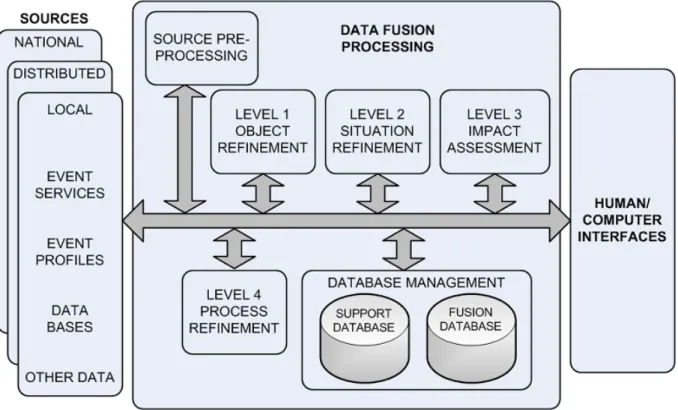
In 1987, the Joint Director’s of Laboratories (JDL) Subgroup developed the Data Fusion Lexicon [64] as an approach to refine data collected from various systems. The JDL data fusion model was designed to take data from any aspect of the world, like flight information or network traffic, and process it in a way that the output is more useful. The output is supposed to better estimate, predict, or assess the environment under observation. The Data Fusion Lexicon defined data fusion as a method to combine information from ”single or multiple sources” in order to estimate a situation, but Steinberg et. al [50] further refined the definition to ”the process of combining data to refine state estimates and predictions.”
The JDL data fusion model has five levels of data processing. Steinberg et. al [50] summarized and interpreted the JDL as follows:
Level zero: Sub-Object Data Assignment Level zero is the stage where the data is collected. Sensors determine or predict what state objects are in and reports that value.
Level one: Object Assessment This stage correlates sensor alerts together to form event tracks. Event tracks include the combined data to describe an attack. State information can be used to make inferences about singles objects.
Level two: Situation Assessment After the state information about single objects are obtained, the objects can be compared an analyzed. Knowledge aggregated from multiple objects provides the understanding of the current situation.
Level three: Impact Assessment The impact assessment stage involves analyzing the data and determining how the data affects the states, actions, or entities in the environment. Particularly, for actions that are occurring or could occur, this assessment determines how they will affect the next state or environment.
Level four: Process Refinement This stage involves taking the information learned about the previous stages and adapting the system. This may involve updated repositories or profiles. This stage depends on machine learning algorithms.
This five-level system can be seen in the following figure developed and presented by the JDL Subgroup [64].
In the diagram, the sources and source preprocessing stages represent level zero. Following preprocessing, the data is refined and groomed in stages one through four. The data is then stored in a database and presented to the end user or additional systems.
Steinberg et. al [50] further proposed updates to the JDL data fusion model. They refined the framework to include trees and relationship graphs for how the information should be assessed by the system. In addition, they added additional explanations for each of the data processing levels on top of their interpretation of the original model.
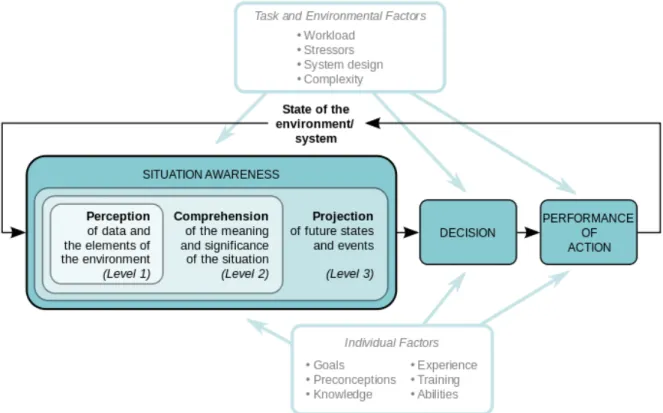
An alternative data fusion and situational awareness model was developed by Dr. Mica Endsley [10]. Her approach was simpler but does not account for as much data as the JDL model. Endsley’s model has three primary stages as seen in the following figure:
The first stage in Endsley’s situational awareness model is similar to Level One in the JDL model, as it addresses having the information about a single object. Endsley’s second stage resembles Level Two in the JDL model. The goal of the second stage is also to determine the current situation by assessing the relationships between objects. While the JDL model addresses both impact assessment and future state predictions, Endsley’s model aggregates these into a single stage where state predictions are performed.
From these two competing frameworks, many branches in data fusion and situational awareness appear. One such branch by Wei Gao et al. [12] describe a data fusion approach which merges a rough set data with neural network data. They describe rough set theory as a method to decrease the data size by parsing through the data and removing redundant items. They claim it will potentially improve the speed and the identification rate within the overall system. Once their data set is reduced, they then aim on using learning algorithms to build a neural network. The end goal of their research is to improve training, or the learning phase of a neural network, before it is made operational.
Tran and Jin [61] proposed an approach that processed the same data set with a decision tree and a Gaussian mixture model. The two data outputs were designed not to overlap, but complemented on one another; one produced numerical data, while the other produced symbolic data. They performed two experiments, swapping the output type for the second experiment. Using this approach, there was a less than 1% improvement. The potential improvement of this research would be to use different processes that produce overlapping data, and then have a process that chooses the best output.
Network modeling research has previously been researched at Air Force Institute of Technology (AFIT). Lieutenant Ji ’s research aimed to classify systems based on analyzing data from network sensors [18]. Her method of fusing data from both host IDSs and network IDSs resulted in a reduction of alerts. In addition, the data fusion showed greater effectiveness by about 28% versus individual classification systems. The output of
this research was limited to classifying systems as ”normal”, ”scanning”, and ”infected”. Lieutenant Ji ’s system ultimately did not provide enough information for cyber situational awareness, as it was limited by the state information employed.
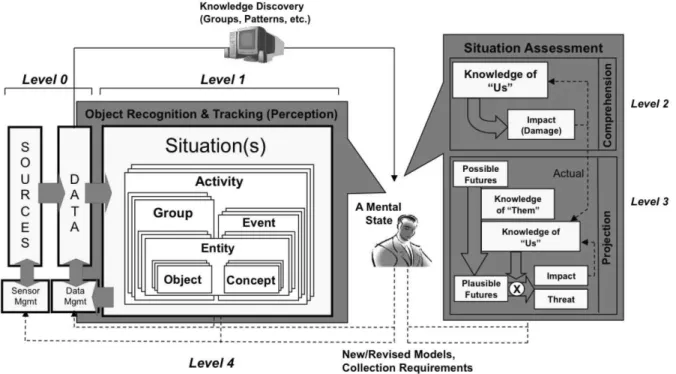
Researchers at AFRL are conducting research on data fusion and cyber situational awareness in order to build a system resembling the JDL data fusion model. By combining the JDL data fusion model and Dr. Endsley’s dynamic decision making model, Tadda and Salerno [55] created a new model for situational awareness.
Figure 2.4: AFRL’s situation awareness reference model
In Tadda and Salerno’s situation awareness reference model, the original JDL model levels are split into two different processes. Levels zero and one, data acquisition and object correlation, are a single process. Within this object’s identification modules, they defined the object structures that they aim to track. In addition, JDL model levels two and three,
the situation and impact assessments, have been placed into another process devoted to situation assessment.
Through their studies, Blasch et al. [5], Salerno [41], and Tadda et al. [56] developed methods to measure the suitability of a system. Their metrics include system confidence, accuracy, timeliness, and relevance determinations on specific interests. These metrics focus on measuring the detection abilities of an IDS, the aggregation of IDS alerts, and the impact assessment system.
2.5 IDS Alert Aggregation
Raw data from intrusion detection systems are often overwhelming for administrators or systems to read and analyze due to the many alerts that are generated for each attack [25].
As some attacks occur in different stages, these alerts must be combined or clustered into single groups. Mathew et al. provide a method to associate IDS alerts into multistage attack scenarios [25]. This is accomplished through the process of template matching. As alert are processed through the system, their attributes are compared and matched against the template scenarios. Matching alerts are fit into ”scenario graphs” that represent the attacks. This method significantly reduces the amount of alerts that decision makers must analyze. In addition, the attacker’s goals can begin to appear as the ”scenario graphs” are analyzed.
Tadda et al. [56] explains that once enough observations are collected that portray a specific attack, the alerts can be aggregated into a track. They detail that tracks should represent steps in an attacker’s methodology. The tracks can then be managed over time by adding or removing observations and determining whether the attacks met their goals or failed. Tracks become a series of evidence that characterizes the attacker’s profile.
2.6 Impact Assessments
As a part of situational awareness identified in the JDL data fusion model [64], impact assessment is a critical process that lends to proper choices in defensive actions. Impact is defined as the ”force” or change that is applied from one entity to another [66]. Steinberg [50] interpreted the impact assessment phase of JDL data fusion model as as step to determining the ”effects” of events on objects. In cyber networks, impact can be viewed as the amount of damage or loss of a network entity from some event.
Researchers have looked at different approaches to accurately assess impacts on networks from cyber attacks. One technique by Argauer and Yang [2] aimed to perform impact assessments on services, users, individual hosts, and the network subnets. They then aggregated the values for a mean value for the attack. They used Common Vulnerability Scoring System (CVSS) values for the exploits in their experiment. The research also identified which attacks made sense and those that did not. The experiments were only performed on a simulated network environment with simulated attacks. The research did not specifically explain predictions for whether attacks were expected to succeed or fail. While the impact assessments accounted for impacts against the targeted hosts during attacks, it did not predict impacts against other hosts on the networks if the attacks were shifted to those other machines.
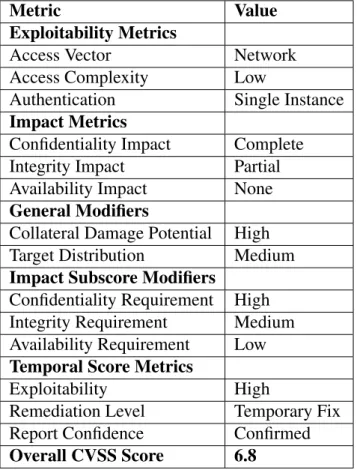
The aforementioned CVSS [27] is a system that provides scores to the vulnerabilities and attacks catalogued in the CVE online repository [29]. The scores depend on metrics such as knowledge that the exploit exists, the complexity of performing the attack, how many machines on the network would be affected, and how much access to the network the attacker requires to perform the attack. Additionally, the score depends on the exploits potential impact to target’s confidentiality, integrity, and availability. General scores are provided to exploits in the CVE catalogue, but using the CVSS calculator [32], custom scores can be computed by network administrators.
Salerno et al. [42] further refine the impact assessment process by identifying requirements needed for a true assessment to occur. They specify that the process requires both information about the attacker and information about the target network. The attacker’s information includes what the attacker is capable of doing and what are the attacker’s goals. The target or defender’s information is necessary to determine if they attack can succeed. This information includes an inventory of the target network and vulnerability assessments for the network nodes. Comparing data from both perspectives gives insight to what effects actions will have on future states.
2.7 Uses of Cyber Situational Awareness
The primary reason for network situational awareness is so that defensive actions can be performed and that the network can be optimized. There are different ways to go about responding to attacks, which will be explained in this section.
2.7.1 Scripted Responses.
Several approaches have been used to respond to network intrusions. These approaches are far from fool-proof, but can be analyzed to determine how they can be improved through situational awareness.
The first technique is to automatically update firewall rules. Dr. Anton Chuvakin and Vladislav Myasnyankin [8] identified that the Guardian Active Response tool for Snort is an efficient method to provide an automated response to attacks. Guardian Active Response listens to the alerts generated by Snort to update the rules in real-time. The goal of Guardian Active Response is to prevent the action that caused the alert, eliminating future occurrences. Though, there can be issues where some alerts should be ignored or other defensive actions performed on the network for the sake of functionality. If legitimate traffic is not correctly classified, the legitimate traffic could be blacklisted along with the malicious traffic.
Another technique is called session sniping. Larsen [21] describes session sniping as a technique that begins when an IDS identifies a series of packets to be malicious. Since most of the packets already arrived at the host, they are outside of the firewall’s ability to stop. With session snipping, a spoofed RESET packet can be sent to the host, telling the host to ignore those packets it already received. If the host had not yet processed a series of malicious packets, session sniping is useful to stop the traffic after it already arrived.
These techniques must be considered when developing a network situational awareness framework. The framework must be able to provide response tools the necessary information to formulate the best response. The two techniques above simply rely on alerts from an IDS or firewall, instead of a robust network picture, but there are tools that would require such a detailed situational awareness to efficiently operate.
2.7.2 Artificial Intelligence Systems.
The next method for automated cyber defense is to use a reasoning agent. Reasoning agents are made up of artificial intelligent (AI) systems may use the models to make decisions using game theory, plan future actions, and then learn from these actions. To build an efficient model to be used by AI agents, an understanding of these concepts and their requirements must be brought to light. The following research and definitions explain these concepts.
In AI, game theory is a view that multiple players in an environment compete against one another as if playing a game [39]. For this network defense environment, the player is the automated network defender, while its opponents are adversaries that attempt to attack the network.
Typically, an agent uses some type of search to determine the best courses of action in game theory [39]. Searches involve determining a large set of possible future states and determining the best set of actions that it takes to reach a goal state. A state is a snapshot of information about an object. To determine if some future state is better than another,
heuristics must be applied to the values within states. A heuristic is the cost or value in reaching a state.
Several examples exist that involve applying game theory to cyber defense. In evaluating network nodes that were infected with malware, Khousani et al. [19] considered the heuristics to be service degradation, resources used maliciously, host damage, and host destruction. In addition, reference [67] measured network services in their own network security model. They analyzed a server’s availability, response rate, throughput, number of connections, and system errors. Each were quantified and combined to form the metric for that network service. Combined, these measureable network characteristics appear to be able to portray network health.
Additionally, Lye and Wing [23] advise that states should be measured with costs and rewards. Costs include resources, including time, which is needed to overcome a hurdle in the network or repair damage. Costs are denoted by negative values. On the other hand, rewards indicate positive values that are attractive to the attacker or administrator. A reward for the attacker may be the acquisition of information or the damage performed on the network.
Once states can be measured, AI systems can plan actions. Russell and Norvig [39] explain that planning in artificial intelligence is a method to find a set of actions to achieve a goal. This is accomplished determining the best sequence of states that map to a goal state.
State modeling and heuristic value determination help AI systems in analyzing information and making decisions. Providing the network information that applies to these described heuristics would be necessary when developing a situational awareness system. The right features of states must be included in the models that would support AI’s determinations for which states are better.
2.8 Conclusion
From this review of related work, it is apparent that there is a strong emphasis on identifying and preventing cyber attacks. Many tools support this endeavor, but there needs to be a consolidation of these tools. There should not need to be redundant work, but new methods could prove useful that supports collaboration between tools and techniques. It is necessary for a data fusion method to exist between network intrusion detection systems and host intrusion detection systems. Information from these merged systems should have data filtered to represent only the most relevant information necessary to portray a computer network, while identifying cyber attacks and assessing their potential impact.
III. System Design
3.1 Overview
To create the prototype system and test the hypothesis, a monitoring system will be developed primarily from Commercial-Off-The-Shelf (COTS) software. The COTS products used will be responsible for the detection of cyber events. This research is limited to fusing the data from those sensors. If an event is not observed, it is at the fault of the COTS product. With COTS products used as the sensors of the system, the system will be designed for interoperability with other COTS products. For this experiment, the COTS sensors will be used on a small test network. The network will be sandboxed to allow a safe environment to perform malicious attacks that the sensors can observe.
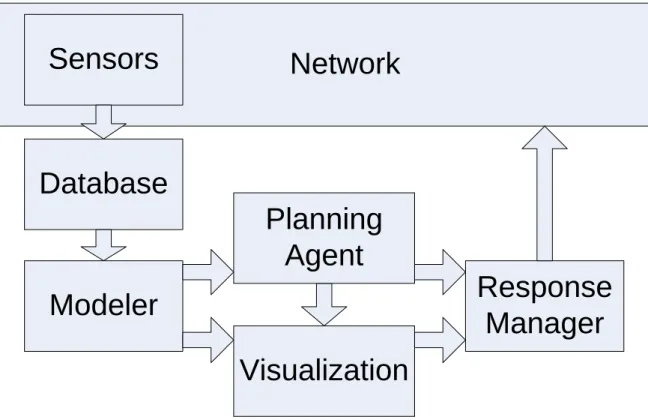
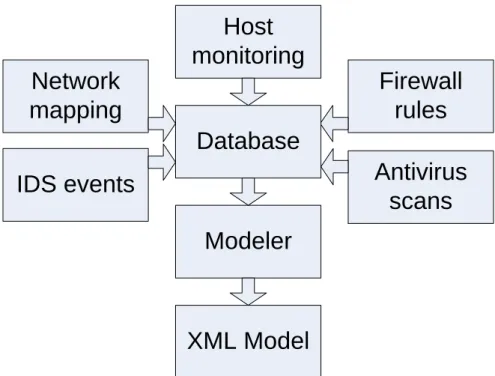
In terms of data flow for the system, the sensors first observe network events, which are then logged to the database. Three analysis modules will query that database and collaborate on a single model in eXtensible Markup Language (XML) format. The model then can be used by decision-making entities to make a decision on how to administer the network. This process is depicted in the diagram on the next page.
When comparing the preceding data flow to John Boyd’s Observe, Orient, Decide, and Act (OODA) loop [7], it is apparent that this process can be dividing into the four distinct actions in the loop: the sensors act as the observe phase; the modeler, action set identifier, and the attack criticality identifier act as the orient phase; the visualization and decision-making agents make up the decide phase; and the responder module suffices for the act phase. This research is more concerned with the ”observe” and ”orient” phases of the loop. This data flow is supported by other explanations of using the OODA loop in the cyber domain [43] [19], which were explained in chapter two.
Network
Database
Sensors
Visualization
Modeler
Planning
Agent
Response
Manager
Figure 3.1: System Data Flow Diagram
3.2 Requirements
To provide cyber situational awareness to visualization and decision-making tools, the following requirements must be implemented into the program.
• The program shall mostly depend on COTS software for data acquisition.
• The program shall acquire host information, to include bandwidth, memory, and user information.
• The program shall reduce information by correlating Intrusion Detection System (IDS) alerts from the same attack into a single track or object.
• The program shall report the model in XML format.
3.3 Approach
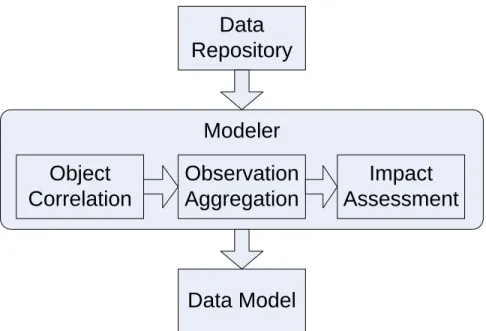
The following data flow diagram details how situational awareness will be achieved by the modeler program.
Data
Repository
Modeler
Object
Correlation
Impact
Assessment
Observation
Aggregation
Data Model
Figure 3.2: Modeler Data Flow Diagram
3.4 Design
The following subsections explain what COTS sensors will be used, how they will submit their data,
3.4.1 System Framework.
The following list of components and objects describes the information flow through the system.
for providing a broader awareness of the network. Some sensors may be installed on monitored hosts across the network, sending updates to the monitor. Other sensors will be installed on the monitor host, observing the network hosts.
Data store The database shall be the link between the sensors and the orientation components. Each sensor will insert records into a shared database as observations are made. The database will be installed on the network monitoring host.
Modeler The network modeling program shall query the database continuously for updates. The modeler will aggregate the network data and presented in a universally readable format, XML. The network will be the root object in the model; it will have child tags, such as hosts, the IDS, routers, and switches.
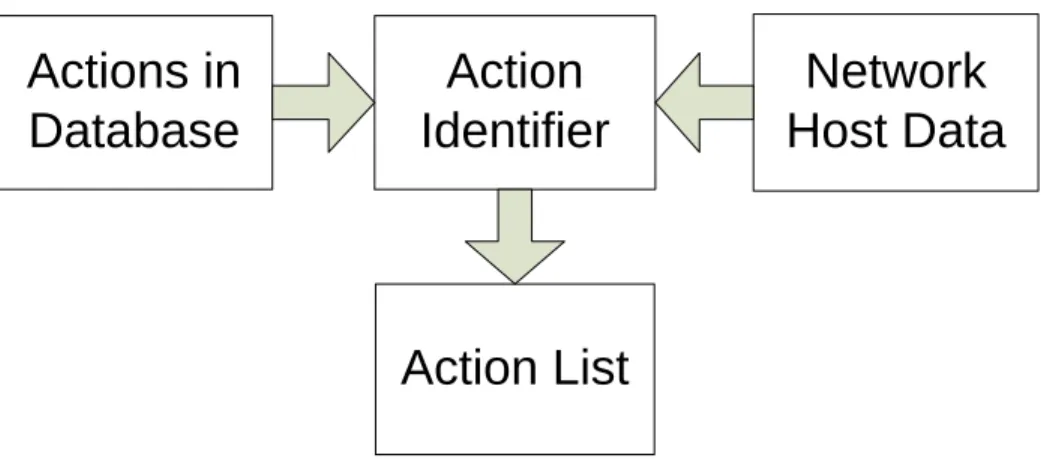
Action set identifier Once the XML file is created, the action set identification module shall identify the potential actions an administrator can perform on the network to defend against cyber threats. The module will query the database for actions based on the attributes found in the XML model. The actions may be different depending on the host, for instance, a user’s account password may be reset on a client host, rules updated on the firewall, or the mail server receives a system update. Within the host tags, the available set of actions specific to that host will be listed.
Attack criticality identifier The attack criticality identification module shall determine the threat an observed attack has on its target and the other network hosts; it will provide a score that outlines the potential severity of the attack. This rating scale ranges from a one, at which the attack is expected to fail, up to a seven, where the attack is expected to succeed and the target suffer a high-degree of compromise. Section 3.7 outlines the rating system in detail. This score will be tagged and appended to its IDS event in the XML model.
XML model After the three modules complete their analysis of the network, the final XML model will be ready for analysis by decision-making agents.
Visualization and decision-making agents These are the decision-making components of the system, whether by human administrator or an artificially intelligent agent. This phase of the system is outside of the scope of this specific research, but will be modeled for completeness. For the experiment, an expert system will receive the network model and mak