University of Colorado, Boulder
CU Scholar
Computer Science Graduate Theses & Dissertations Computer Science
Spring 1-1-2011
Generating, Optimizing, and Scheduling a
Compiler Level Representation of Stream
Parallelism
Jeffrey M. Fifield
University of Colorado at Boulder, [email protected]
Follow this and additional works at:http://scholar.colorado.edu/csci_gradetds
Part of theComputer Sciences Commons
This Dissertation is brought to you for free and open access by Computer Science at CU Scholar. It has been accepted for inclusion in Computer Science Graduate Theses & Dissertations by an authorized administrator of CU Scholar. For more information, please contact
Recommended Citation
Fifield, Jeffrey M., "Generating, Optimizing, and Scheduling a Compiler Level Representation of Stream Parallelism" (2011).
Representation of Stream Parallelism
by
Jeffrey M. Fifield
B.S., University of Michigan, 2000 M.S., University of Colorado, 2006
A thesis submitted to the Faculty of the Graduate School of the University of Colorado in partial fulfillment
of the requirements for the degree of Doctor of Philosophy
Department of Computer Science 2011
Generating, Optimizing, and Scheduling a Compiler Level Representation of Stream Parallelism written by Jeffrey M. Fifield
has been approved for the Department of Computer Science
Dirk Grunwald
Jeremy Siek
Date
The final copy of this thesis has been examined by the signatories, and we find that both the content and the form meet acceptable presentation standards of scholarly work in the above
Fifield, Jeffrey M. (Ph.D., Computer Science)
Generating, Optimizing, and Scheduling a Compiler Level Representation of Stream Parallelism Thesis directed by Dirk Grunwald
Stream parallelism is often cited as a powerful programming model for expressing paral-lel computation for multi-core and heterogeneous computers. It allows programmers to concisely describe the concurrency and communication requirements found in a program and it allows com-pilers and runtime systems to easily generate efficient code targeting parallel hardware. This type of stream parallelism is often restricted to use the Synchronous Dataflow (SDF) model and imple-mented using static compilation and scheduling techniques. While powerful, SDF and the associ-ated static methods have real limitations when applied to general purpose programing on general purpose hardware.
To increase generality, we can define stream parallelism as a graph of processes communicat-ing with one another over unidirectional data channels. Although dynamic schedulcommunicat-ing techniques have been developed for this more general model, the powerful compiler transformations that are available under the SDF model no longer apply. This is made worse by the fact that general purpose models are typically implemented as software frameworks on top of high-level general purpose languages.
The Stream and Kernel Intermediate Representation (SKIR) is a compiler level representa-tion of stream parallelism for general purpose languages. A SKIR compiler is able to recognize and take advantage of SDF style parallelism while allowing more general programs. This thesis presents the SKIR program representation and describes how it can be used as compiler target for several different high level languages. We show a dynamic scheduling mechanism for SKIR pro-grams based on the concepts of coroutines and task stealing. We also propose code optimizations to reduce runtime overhead associated with dynamic scheduling. Such techniques are not possible in a high-level software framework and provide performance that meets or exceeds the performance
Contents
Chapter
1 Introduction 1
1.1 Streaming Models . . . 3
1.2 Limitations of Existing Programming Methods . . . 5
1.2.1 Dynamic Applications . . . 6
1.2.2 Portability . . . 10
1.3 Contributions . . . 11
2 Language Constructs for Stream Parallel Computation 15 2.1 Kernels . . . 16
2.2 Streams . . . 21
2.3 Stream Graph Construction . . . 22
2.4 Scheduling . . . 24
3 The Stream and Kernel Intermediate Representation (SKIR) 25 3.1 Introduction . . . 25
3.2 SKIR Kernels . . . 26
3.2.1 Hierarchical Kernels . . . 32
3.3 SKIR Streams . . . 33
3.4 SKIR Memory Model . . . 34
3.5.1 Example 1: Static Stream Graph . . . 36
3.5.2 Example 2: Dynamic Stream Graph . . . 36
3.6 Implementation . . . 39
4 Compiling High-Level Languages to SKIR 41 4.1 Compiler Intrinsics: C Language . . . 41
4.1.1 Example . . . 42 4.1.2 Implementation . . . 42 4.1.3 Discussion . . . 44 4.2 User Library: C++ . . . . 44 4.2.1 Example . . . 45 4.2.2 Implementation . . . 47
4.3 Stream Language Front-end: StreamIt . . . 50
4.3.1 Generating Filters . . . 50
4.3.2 Generating Pipelines and Split-Joins . . . 54
4.3.3 Other Language Features . . . 58
4.4 Embedded DSL: JavaScript . . . 60
4.4.1 Sluice . . . 62
4.4.2 Dynamic Recompilation for SKIR . . . 64
4.4.3 Offloading Kernel Execution . . . 66
4.4.4 Discussion . . . 68
4.5 Conclusion . . . 69
5 SKIR Dynamic Scheduling 70 5.1 Stream Implementation . . . 71
5.2 Single Threaded Execution . . . 73
5.3 Multithreaded Execution . . . 80
6 SKIR Compilation 87
6.1 Static vs. Dynamic SKIR Compilation . . . 87
6.2 Kernel Analysis . . . 90
6.2.1 Detecting Hierarchical Kernels . . . 90
6.2.2 Detecting Data Parallelism . . . 91
6.2.3 Determining Rates . . . 91
6.3 Kernel Specialization . . . 94
6.3.1 Kernel Batching . . . 95
6.3.2 Generating Kernels as Coroutines . . . 96
6.3.3 Coroutine Elimination . . . 101
6.3.4 Specialization Templates . . . 103
6.3.5 Summary . . . 106
6.4 Code Generation . . . 108
6.5 Compiling for GPUs . . . 108
6.6 Stream Graph Level Transformations . . . 112
6.6.1 Fusion: Reducing Parallelism . . . 113
6.6.2 Fission: Increasing Parallelism . . . 115
7 Performance Evaluation 118 7.1 Benchmarks . . . 118
7.2 Results . . . 121
7.3 Sluice . . . 134
7.3.1 Single Threaded Offload . . . 136
7.3.2 Task Parallel Execution . . . 138
7.3.3 Data Parallel Execution . . . 139
8 Related Work 141 8.1 Compiler Representations for Stream Parallelism . . . 141
8.2 Dynamic Scheduling of Stream Parallelism . . . 143 8.3 Stream Parallelism for Heterogeneous Hardware . . . 145
9 Conclusion 146
Tables
Table
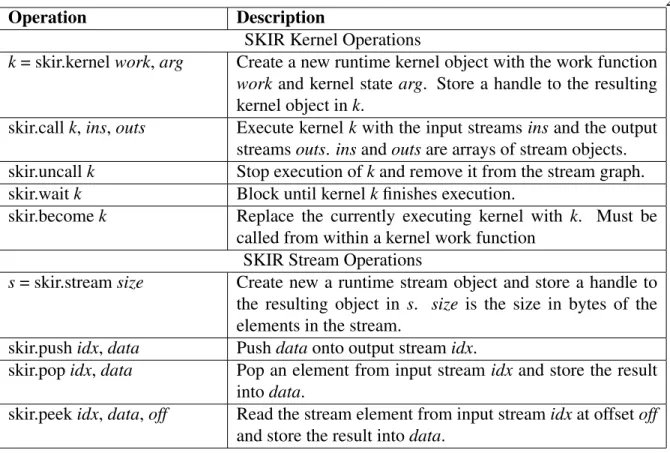
3.1 Overview of the Stream and Kernel Intermediate Representation (SKIR) operations. 26 7.1 The number and size of kernels for each benchmark. We bin the kernels in each
benchmark according to their execution time in cycles. The table shows the number of kernels in each bin. . . 123
Figures
Figure
1.1 Pipeline found in thededupbenchmark. . . 7 1.2 Prime sieve implemented in the Go language. . . 9 2.1 A data parallel addition written AMD’s Brook+ language . . . 16 2.2 A four stage pipeline in the language proposed by Kahn and MacQueen [40]. . . . 17 2.3 A four stage pipeline written in the StreamIt language. . . 18 2.4 A kernel object in the GNU Radio stream processing system. . . 19 2.5 An FM receiver application created for the GNU Radio stream processing
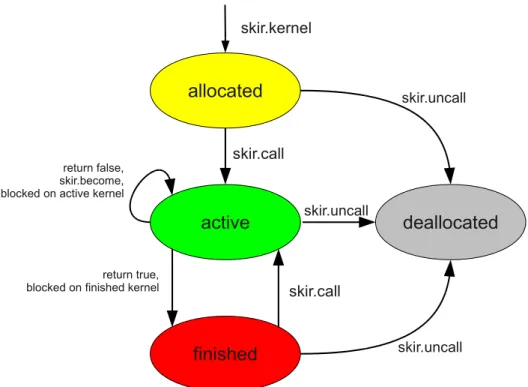
frame-work using a graphical user interface. . . 23 2.6 Constructing a stream graph for an equalizer in StreamIt. . . 24 3.1 SKIR kernel state transitions . . . 30 3.2 An example of a static SKIR program graph. The main procedure defines and
executes a four stage pipeline similar to the one in Figure 2.2. The program is written in SKIR pseudo-code. . . 37 3.3 An example of a dynamic SKIR program graph. This figure shows the prime sieve
program written as SKIR pseudo-code. It is similar to the Go program shown in Figure 1.2. . . 38 4.1 SKIR C Intrinsics. Each C intrinsic maps to one SKIR intrinsic . . . 42
4.2 A simple SKIR program constructed using C compiler intrinsics. This program
creates two streams of integers, adds them together, then prints the result. . . 43
4.3 An example of a SKIR C++program using the C++user library from Figure 4.4. . . 46
4.4 An example of a C++library providing an object oriented interface for stream par-allelism using the SKIR C intrinsics. . . 48
4.5 A simple three stage pipeline written in StreamIt . . . 51
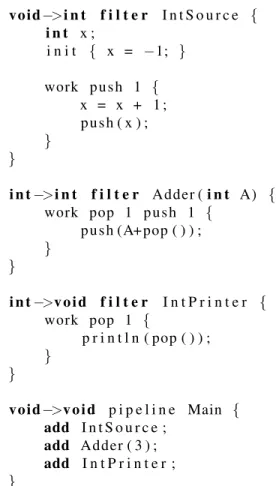
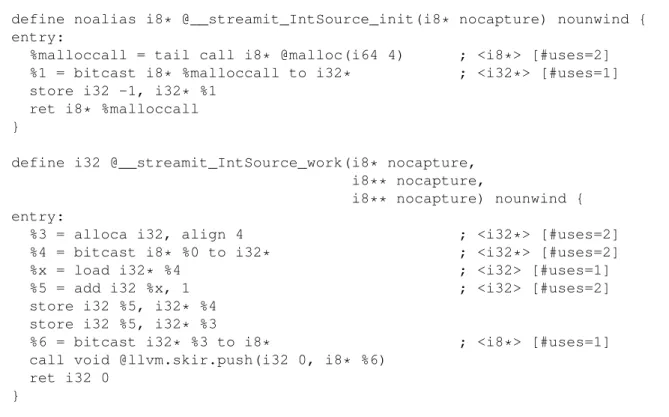
4.6 The result of compiling the IntSourcefilter from Figure 4.5 with the StreamIt to SKIR compiler. . . 52
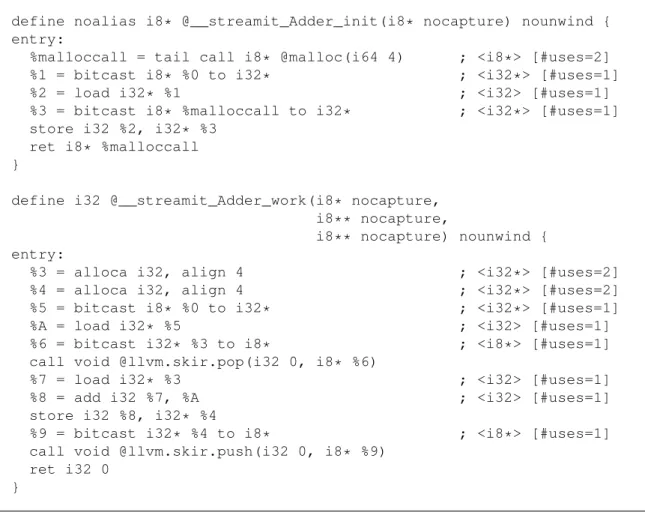
4.7 The result of compiling the Adder filter from Figure 4.5 with the StreamIt to SKIR compiler. . . 53
4.8 The result of compiling theMainfilter from Figure 4.5 with the StreamIt to SKIR compiler. . . 55
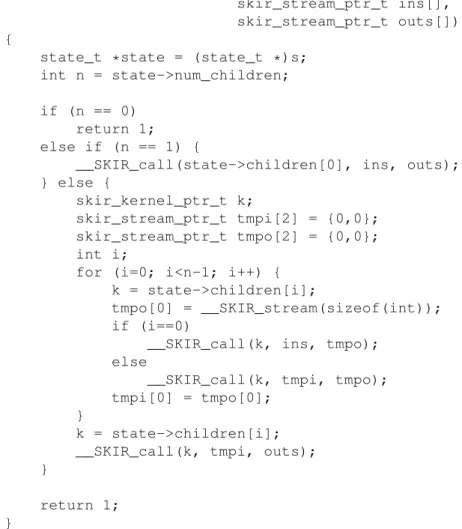
4.9 The pipeline filter from the StreamIt to SKIR compiler runtime library. . . 56
4.10 A generic duplicating splitter from the StreamIt to SKIR compiler runtime library. . 57
4.11 An example of a StreamIt prework function. . . 58
4.12 An example of a StreamIt feedback loop. . . 58
4.13 Array based vs. stream based addition in JavaScript . . . 61
4.14 Two simple Sluice kernels. The kernel on the left implements a simple counter. The kernel on the right adds the same value to each item popped the input stream and pushes the result to its output stream. . . 63
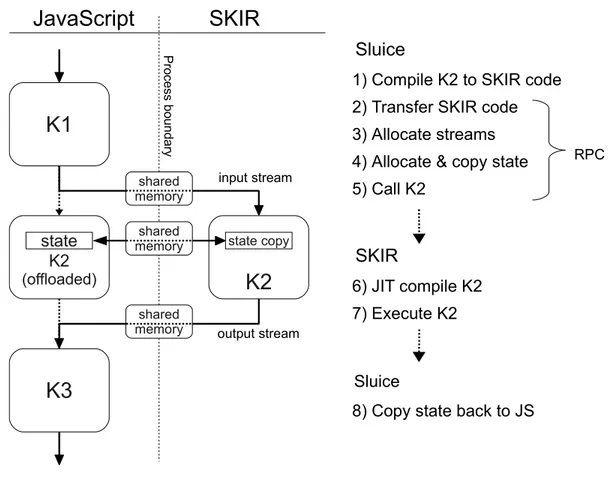
4.15 An overview of Sluice kernel offload. . . 67
5.1 Basic lock free queue operations . . . 72
5.2 Simplified version of the SKIR stream buffer data structure . . . 73
5.3 An example of producer-consumer coroutines . . . 75
5.4 Yielding lock free queue operations . . . 76
5.6 A single threaded scheduling algorithm for coroutine style kernel work functions. . 77
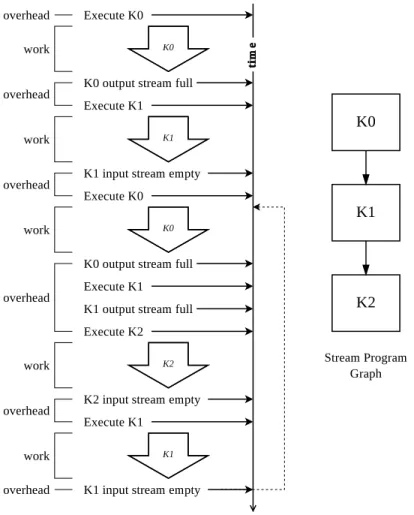
5.7 An example of single threaded execution of a three stage pipeline. The large down-ward arrows represent work being done by a kernel, the dotted lines represent work stealing, and the horizontal arrows represent scheduling events. Time flows down. . 79
5.8 The KERNELTASK::EXECUTE method runs the kernel work function and makes scheduling decisions in conjunction with a work stealing algorithm. The next task to run is returned. . . 81
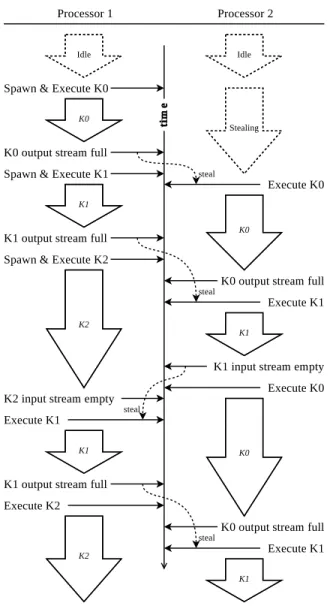
5.9 An example of two processors executing a three stage pipeline. The large down-ward arrows represent work being done by a kernel, the dotted lines represent work stealing, and the horizontal arrows represent scheduling events. Time flows down. . 82
6.1 An example of a SKIR C program with a statically analyzable stream graph. . . 89
6.2 Applying batching toSKIR CONSUMERproducesBATCHED CONSUMER. . . 95
6.3 Kernel work function template implementing batching. . . 96
6.4 An implementation of theskir.popoperation. . . 97
6.5 SKIR coroutine helper function for x86-64. . . 98
6.6 Implementation ofskir.yieldfor x86-64. . . 99
6.7 Implementation ofskir.returnfor x86-64. . . 100
6.8 A coroutine elimination work function template. . . 102
6.9 An implementation ofskir.popfor use with coroutine elimination. . . 103
6.10 Generating specializedskir.poptemplates with meta-programming. . . 105
6.11 Execution order of SKIR kernel specialization passes. . . 106
6.12 An example of the one work function instance per iteration execution strategy used by the OpenCL backend. In this example the kernel has an input rate of 2 and an output rate of 3. . . 110
6.13 The structure of OpenCL offload within the SKIR runtime. . . 111
6.15 SKIR kernel fusion algorithm. . . 114 6.16 SKIR kernel fission. . . 116 7.1 A SKIR version of the CalculateForces kernel from the nbody benchmark. The
code is written in C++ using a class library interface to the SKIR intrinsics. . . 122 7.2 Throughput obtained by the SKIR compiler and scheduler for the StreamIt
bench-marks using a varying number of threads. Error bars indicate one standard deviation.124 7.3 The results of performing coroutine elimination on the StreamIt benchmarks using
the SKIR just-in-time compiler. . . 125 7.4 The results of performing dynamic fusion on the StreamIt benchmarks using the
SKIR just-in-time compiler. . . 126 7.5 Throughput obtained by the SKIR dynamic scheduler, the StreamIt static
sched-uler, and the GNU Radio dynamic scheduler for the StreamIt benchmarks using a varying number of threads. Error bars indicate one standard deviation. . . 128 7.6 Throughput obtained by the SKIR dynamic scheduler, the StreamIt compiler
tar-geting 8 threads, and the StreamIt compiler tartar-geting the actual number of threads. Error bars indicate one standard deviation. . . 130 7.7 A comparison of SKIR performance to the performance of coarse-grained pipeline
parallel applications parallelized using Pthreads, TBB, and FastFlow. Performance is measured as execution time. . . 132 7.8 Performance of thenbodybenchmark running on SKIR using kernel fission on the
CPU and OpenCL on the GPU. . . 134 7.9 Comparison of Pixastic code (left) with the same code ported to Sluice (right). The
code that is shown inverts all the pixels in an image. . . 135 7.10 The CalculateForces kernel found in thenbodybenchmark. Ported from the SKIR
7.11 Performance of Pixastic image processing routines coded as ordinary JavaScript compared to the performance of the same routines running as Sluice kernels using the SKIR runtime. . . 137 7.12 Performance of the nbody benchmark implemented as procedural JavaScript, as
Sluice code, and as Sluice code with CalculateForces kernel running on SKIR runtime. . . 138 7.13 Per image processing time for the Pixastic benchmarks implemented when a
vary-ing number of images are processed usvary-ing Sluice task parallelism. . . 139 7.14 Speedup of thenbodybenchmark due to data parallelism when the CalculateForces
kernel is run on a multi-threaded SKIR runtime compared to the same benchmark using a single-threaded SKIR runtime. . . 140 8.1 An example of SVM-C pseudo code. . . 142
Introduction
It has long been clear that the era of rapidly improving single processor performance is over. A decade ago, technological and economic realities forced the semiconductor industry to stop pur-suing increased clock speed as the primary means of improving performance. At the same time, computer architects had already extracted much of the performance to be gained from the exploita-tion of instrucexploita-tion level parallelism and predicexploita-tion. Nevertheless, Moore’s Law has continued to hold and the number of transistors available to hardware architects has continued to increase. As a result, the semiconductor industry has been forced to provide performance improvements by adding more processing elements per chip with every new silicon generation. Chips with 10’s to 100’s of processing cores are already a reality and will soon become the norm. Even mainstream mobile phones contain multiple processors, vector instruction set extensions, and programmable graphics hardware.
Chip manufacturers are also attempting to differentiate their products and tailor their designs to different markets. The result is increased heterogeneity among the individual cores in single sys-tems and among different versions of the same architecture. Processing cores in the same product family can vary greatly in functionality, performance and energy efficiency. Compute accelerators that were previously fixed function and single purpose are becoming more programable and more general purpose. Looking forward, there is a continued desire to investigate and invest in hetero-geneous processor designs, many-core architectures, and processors using reconfigurable logic.
could simply wait for the next processor generation and see their program run much faster on the new chip. Faster hardware designs, not better programs, provided most of the performance gains. While this is still true to some extent, the trends in mainstream processor design listed above are causing a shift in who is responsible for the performance of computer software. The burden of taking advantage of new hardware capabilities is shifting from away from processor architects and onto the backs of programmers, languages designers, and compilers.
Unfortunately, writing algorithms and compilers that can take advantage of parallel proces-sor designs is challenging. Creating parallel code that is efficient, correct, and portable is difficult even for the most skilled programmers. Mainstream languages are highly sequential and contain only primitive support for parallel constructs. Common parallel programming constructs such as threads, locks, and SIMD intrinsics are to parallel programing as assembly language is to sequential programming, and are notoriously difficult to use correctly. Decades of research on parallelizing sequential languages has failed to produce compiler technology that can automatically extract par-allelism from much more than simple loop nests. Adding heterogeneity into the mix only makes the problem of parallelizing applications more difficult. To sustain the historical performance gains of the computer industry, new programming techniques must be developed for the new hardware architectures reaching the mainstream market.
Stream parallel programming is one technique that has been used for exploiting parallel hardware, such as multi-core processors and vector acceleration units, as well as non-traditional programmable hardware such as graphics processors (GPU) and field programmable gate arrays (FPGA). In the stream parallel model, a program is made up of a number of computationalkernels
that produce and consume streams of data. The kernels are linked together via their input and output streams to form astream graphrepresenting an algorithm. This abstraction is a natural fit for many application domains. Any data driven application that must process large flows of data with fairly regular computation is a good candidate for the stream parallel model. This includes many algorithms that exhibit data or pipeline parallelism such as those found in graphics, all kinds of signal processing (e.g. audio, video, radio), scientific codes, financial applications, network
processing, and most recently, distributed real-time processing of social network feeds [13]. The kernel and stream based construction of stream programs has two benefits. It makes parallelism and inter-task communication easy to express by programmers and it makes paral-lelism and inter-task communication easy to extract by compilers. There are three general types of parallelism that can be expressed by programmers and extracted by compilers in stream paral-lel programs. Because individual kernels are conceptually concurrent, with independent threads of control, kernels operating concurrently in different regions of a stream graph naturally exhibit task parallelism. Other kernels might be directly connected to one another in a producer consumer relationship. These kernels exhibit pipeline parallelism and can be scheduled to run on differ-ent processors with communication channels allocated between them. Finally, some kernels are stateless, and as a result do not carry dependencies from one execution to the next. These kernels exhibit data parallelism and many instances of the same kernel can be working on different parts of the input stream(s) at the same time.
1.1 Streaming Models
There are two formal models of computation that are generally usually used to describe stream parallel computation. They are Kahn Process Networks and Synchronous Dataflow Net-works. A related model of computation that is also popular is Communicating Sequential Pro-cesses.
A Kahn Process Network (KPN) consists of a network of deterministic processes (kernels) communicating using unbounded first-in first-out data channels (streams) [39]. These channels are the only means with which processes can communication with one another. In the KPN model, processes can always enqueue data to their output stream, will always block on a read of an empty input stream, and are not allowed to test for the presence or absence of data in the channels. Because of these properties, Kahn process networks are deterministic. That is, the same input on a set of channels will always produce the same output, independent of processes execution order. A KPN is called bounded if it is possible to run the network to completion using a bounded amount of
buffer space between the processes. It is undecidable to statically determine the amount of buffer space required between processes. However, it is possible to dynamically adjust the amount of buffer space such that bounded networks require only bounded buffer space [48].
A restricted form of the KPN model is the Synchronous Dataflow Network (SDF) [43]. Under SDF, the processes in the network execute atomically, reading all their inputs and writing all their outputs in a single execution. If an execution of a kernel cannot run to completion because it lacks input data or lacks output buffer space, then it will not run at all. In a SDF computation, the number of inputs read and written to and from each data channel is fixed and known to the system at compile time. This means that for a given network, the compiler can prove the absence of deadlock, can compute a static execution schedule, and can determine static buffer sizes for that schedule. Because they can be statically analyzed and scheduled, SDF networks generally exhibit more potential for optimization than KPNs.
The Communicating Sequential Process (CSP) model of computation is a formal model closely related to Kahn process networks. A primary difference between KPN and CSP is that CSP communication channels involve synchronous unbuffered rendezvous between the sender and the receiver. That is, a sender cannot transmit a message until a receiver is ready to receive it. Another significant difference is that CSP processes are allowed to non-deterministically read a message from one of a set of input channels. As in KPNs, determining deadlock freedom is undecidable.
The motivation for this thesis is to enable flexible use of stream parallelism in general pur-pose languages and for a variety of application domains. Stream parallelism is therefore viewed as a slight generalization of the KPN model. We want to allow for programs with dynamic behaviors not supported under the SDF model (including dynamic input and output rates) or the KPN model (e.g. dynamic stream graphs, non-deterministic kernels). As with any programming construct, it is beneficial to write stream parallel programs in a certain way to promote compiler optimiza-tion. For stream parallel programs, this simply means writing code in a style close to the SDF model when compiler optimization is most important. An analogy is that C/C++programmers can write loops following certain restrictions when auto-vectorization, loop unrolling, or other loop
transformations are important, and allow themselves more freedom when it is not.
1.2 Limitations of Existing Programming Methods
The authors of the StreamIt project correctly observed that languages prior to their own have either elegant and general ways for expressing streams, but are too general for aggressive optimization (e.g. functional languages), or provide good analysis and optimization of stream graphs, but are narrowly focused and exist largely outside of programming languages, applying mainly to specific domains (e.g. modeling systems for DSP) [52][32]. As a result, they propose a language, StreamIt, that is very close to the synchronous dataflow model, allowing for high performance implementation, but which also has a programmer friendly syntax [34]. Although they succeeded in their goals, the programming model is still very close to SDF and the language is not practical for general use.
In this dissertation we reject the notion that support for aggressive optimization and support for more general forms of stream parallelism are mutually exclusive. We argue for a middle way; that is, allow for a general form of process networks and apply aggressive SDF style optimization where possible. We can identify two major shortcomings with respect to existing methods of pro-gramming using the stream parallel model that prevent this from happening. These shortcomings are the result of the artificial division between support for optimizable stream graphs and support for generality.
The first shortcoming is the lack of stream parallelism in general purpose languages. As alluded to in the motivations for StreamIt cited above, there is little support for writing opti-mizable stream parallel algorithms in mainstream general purpose languages. If there is support available, it is in the form of a user library or framework which can provide stream parallel ab-stractions, but which cannot provide stream graph optimization. Recent examples of this approach for the C++language are GNU Radio, Feedback-Directed Pipeline Parallelism, DoPE, and Fast-Flow [4][51][49][19]. While these frameworks employ efficient dynamic scheduling mechanisms, they cannot employ the optimization, parallel scheduling, or code generation techniques that make
a specialized stream parallel language attractive. A good example of this is seen in DoPE [49], where the best result required manual kernel fusion. This basic stream graph transformation is easily performed by stream parallel compilers but very difficult to achieve using only a C++library. The second shortcoming is the lack of generality in stream parallel languages. While a language like StreamIt is an excellent platform for research into static stream graph transfor-mations, it does nothing to help programmers use stream parallelism in existing general purpose languages. It still requires that programmers use a specialized language of limited scope. In par-ticular, the set of real applications that use only SDF or KPN style computation without requiring other abstractions or third party libraries is very small. Languages specific to stream parallelism feature powerful graph transformation, scheduling, and code generation techniques, but lack the ability to express or execute computation outside of stream parallel models.
Within the category of generality are two very useful features missing from high performance static compilers for stream parallelism. These aresupport for dynamic applicationsandsupport
for portability and forward-scaling. It is useful to examine both of these in more detail.
1.2.1 Dynamic Applications
Our first missing feature with respect to generality in stream parallel languages – support for dynamic applications – can be viewed from multiple perspectives. We expand on three of them:
(1) Applications where individual kernels have dynamic performance characteristics.
(2) Applications where an actoroutsideof the stream graph wishes to reconfigure the graph. (3) Applications where a kernelinsideof the stream graph wishes to reconfigure itself.
As a simple example of the first case, we can consider the dedupprogram from the Parsec benchmark suite [21]. This application is a data compression/decompression benchmark. The compression algorithm is used by Parsec for actual benchmarking. It is written in a stream parallel style as a five stage dataflow pipeline, pictured in Figure 1.1. The developer of this program
implemented parallel execution with Pthreads and wrote a custom queuing mechanism to deal with stream communication. It would have been much easier to write the program in an environment with support for stream parallelism.
DataProcess FindAllAnchor ChunkProcess SendBlock
Compress
Figure 1.1: Pipeline found in thededupbenchmark.
The stages of thededupcompression algorithm are unchanging and can be viewed as kernels in a static program graph. Despite this, we cannot use SDF style scheduling or code transformation on the full graph. This is because two of the program stages, ChunkProcess and SendBlock, do not have fixed input and output rates. ChunkProcess conditionally sends its output to one of two destinations depending on whether or not the data being processed hits in a compression cache. If the data is not present in the cache, then the data must be sent to the Compression stage. Otherwise, it can be sent directly to the SendBlock stage. The result is that static compiler and scheduler cannot predict the output rates of ChunkProcess or the input rates of SendBlock. One could make the graph synchronous by tagging data as cached in the ChunkProcess stage, sending all data to the Compress stage, then using the identity operation in Compress for tagged data chunks. But doing this makes the runtime of Compress highly variable and dependent on the particular input data being compressed. While general purpose frameworks with dynamic scheduling can handle this gracefully, stream parallel languages using static scheduling can not.
The second case above – applications where an actor outside of a stream graph wishes to reconfigure the graph – is easily illustrated using an example from software defined radio. In many radio applications the signal processing and modulation schemes for a particular protocol can change over time depending on the radio environment and user requirements. As an example we describe at a high level the structure of a software receiver for orthogonal frequency division multiple access (OFDMA). One place this technology is used is in the WiMAX standard.
In a software implementation of a receiver for OFDMA, we begin with time domain samples converted from the analog domain to the digital domain by an analog-to-digital converter (A/D). The samples obtained from the A/D must be preprocessed before we can apply OFMDA demod-ulation and obtain the encoded digital information. This preprocessing step includes things like automatic gain control and filtering. Here we encounter the first place where the stream graph might be significantly reconfigured while running. Filter operations are used to smooth data or to eliminate interference from frequencies the receiver is not interested in. The effectiveness of any particular filter is largely determined by the number oftapsthat are used. Each tap serves as a co-efficient in a dot product operation. This dot product operation is performed to produce one output sample for every input sample using a sliding window of data in the input stream. By increasing the number of taps, we generally increase the effectiveness of the filter but we also increase the computation requirements of the filter. One of the benefits of software defined radio is that an algorithm can make this trade-off dynamically. Unfortunately, for a SDF style stream parallel pro-gram this means the weighting of the filter kernel might change significantly in the static execution schedule or that buffer sizes related to the windowing operation (i.e. the input rate) must change. Either of these events could require recompilation of the entire stream graph.
After preprocessing, our software OFDMA receiver will perform a Fast Fourier Transform (FFT) operation to transform the signal from the time domain to the frequency domain. Depend-ing on the OFDMA protocol beDepend-ing used, the width of the FFT may, like the number of filter taps, require dynamic modification. The implications of this change with regard to the stream graph are similar to the number taps used by filters. That is, the computation and communication require-ments of the FFT can change significantly. After the FFT operation, our partially demodulated OFDMA signal consists of some number of small frequency bands called sub-carriers. Each of the sub-carriers is demodulated using a scheme dictated by the radio environment and user require-ments. As with the filter and FFT, dynamic modification of the sub-carrier modulation schemes is desirable, and can have significant implications on the stream graph. After demodulating our individual sub-carriers, we finally have bits. It is common for these bits to be coded using an error
coding scheme such as Viterbi or Reed-Solomon encoding. One of the advantages of software de-fined radio is that these too can be dynamically changed. Again, this can have a significant impact on the structure of the stream graph with respect to computation requirements and stream commu-nication rates. It is desirable to have a system that easily accommodates these kinds of dynamic changes to a stream graph.
The third case listed above – a kernel inside of the stream graph that wishes to reconfigure itself – can be illustrated using an amusing example credited to Doug McIlroy but made popular by Rob Pike. The example is the implementation of the prime sieve of Eratosthenes written as a self modifying pipeline of kernels. A version of the algorithm implemented in the CSP language Go is shown in Figure 1.2 [5].
package main import "fmt"
// Send the sequence 2, 3, 4, ... to channel ’ch’. func generate(ch chan int) {
for i := 2; ; i++ {
ch <- i // Send ’i’ to channel ’ch’. }
}
// Copy the values from channel ’in’ to channel ’out’, // removing those divisible by ’prime’.
func filter(in, out chan int, prime int) { for {
i := <-in // Receive value of new variable ’i’ from ’in’. if i%prime != 0 {
out <- i // Send ’i’ to channel ’out’. }
} }
// The prime sieve: Daisy-chain filter processes together. func main() {
ch := make(chan int) // Create a new channel.
go generate(ch) // Start generate() as a goroutine.
for i := 0; i < 100; i++ { // Print the first hundred primes. prime := <-ch fmt.Println(prime) ch1 := make(chan int) go filter(ch, ch1, prime) ch = ch1 } }
Figure 1.2: Prime sieve implemented in the Go language.
The sieve program begins by connecting agoroutinecomputing a sequence of integers to a printer goroutine that prints its input. The sequence of integers starts with the prime number 2.
Each time the printer goroutine receives an input it constructs new a goroutine which filters out all multiples of that number. It then inserts the new goroutine into the pipeline between itself and and its source. By induction, all the numbers received by the printing filter are prime. The result is a pipeline which grows by one each time a new prime is discovered. Although this program is typically given as an example in a CSP language like Go, it is more of a stream parallel style dataflow algorithm than a CSP style rendezvous algorithm. Furthermore, each configuration of the pipeline can be expressed as a KPN computation. More complex examples of this type of recursively defined stream graphs can be found in McIlroy’s paper on computing power sets [46].
A more practical example of this kind of dynamic graph reconfiguration is found in programs where a kernel must perform some initialization work before the stream graph enters a steady state. In stream graphs with feedback loops it might be necessary to initialize the back edge stream in the graph with data before starting the computation. In DSP applications it might be necessary to write some amount of data to an output stream to implement a delay. Both cases are easily implemented by a kernel that pushes some data to an output stream, then replaces itself with another kernel which provides the steady state functionality.
1.2.2 Portability
Another desirable feature with respect to generality in stream parallel languages - support for portability and forward-scaling – is based on the observation that computing platforms and proces-sor designs, even within a single product line of a single architecture, are increasingly diverse and heterogeneous. These trends require that parallel codes written for high performance, like stream parallel algorithms, be written with a certain amount of robustness to architectural variation. Un-fortunately, static scheduling and compilation methods fail in this regard, and not just for stream parallel applications. For example, if a program using vector ISA extensions must be compiled to run on a wide variety of end user machines then the developer has two choices. Use the low-est common denominator, and compile for the most widely available (i.e. oldlow-est) ISA extensions, giving up performance on newer processors. Or, somehow ship a “fat binary” which can select
at runtime the appropriate version of code to run. One way to get this for free is to compile to a common intermediate form, such as a virtual machine, and use runtime compilation.
Forward Scaling is a term used by Intel to describe the increasing need for dynamic com-pilation on Intel platforms to provide portability with respect to future (and past) products. They say it is required because “the performance of parallel applications is very sensitive to core count, vector ISA width (e.g., SSE), core-to-core latencies, memory hierarchy design, and synchroniza-tion costs,” and because all of these factors are changing rapidly in the x86 architecture [29]. They propose that one solution is to write code using a well defined programming model (in their case parallel arrays) in a way that allows an algorithm to be analyzed at runtime, then re-optimize the program dynamically as appropriate for the algorithm being executed and the hardware that it is executing on. This thesis advocates a similar approach, only for stream parallel computation.
Synchronous dataflow style stream parallelism has been shown to be a good programming model for targeting non-traditional processors such as GPUs [23][38][54], and FPGAs [24][25] [31][36]. However, the portability problems above are made worse when heterogeneous computa-tion is added to the mix. As an example, consider a program where some piece of the code is well suited for execution on a GPU. It may be the case that doing so on one system hurts performance because the cost of communicating data between the CPU and a discrete GPU overwhelms the performance gains. On another system, the same program might have access to low latency shared memory between the CPU and an integrated GPU resulting in increased performance. Achieving the best performance for this kind of a program requires a sophisticated awareness of the execu-tion environment. In the case of stream parallelism, the static optimizaexecu-tion techniques of existing stream parallel languages should be coupled with dynamic compilation and execution mechanisms in order to gain the desired runtime platform awareness and portability.
1.3 Contributions
In this dissertation we present a compiler level representation for stream parallel compu-tation which addresses the limicompu-tations discussed in the previous section. We describe a general
purpose solution which can be implemented in a fully dynamic and high performance manner. It is general purpose because it is source language and target architecture independent. It is dynamic because it supports dynamic programs, dynamic compilation, and dynamic scheduling. Because it is a compiler level representation, execution can be implemented in a high performance manner.
The underlying thesis for this work can be summarized by the following statement:
Thesis Statement: By preserving high level stream graph information, a low level representation
can provide portability and generality in the context of stream processing on parallel and heteroge-neous hardware. Furthermore, such a representation can be parallelized and executed efficiently on such hardware using generic parallelization mechanisms, without limiting ease of programming.
The contributions of this dissertation can be summarized as follows:
(1) A low level representation for stream parallel computation, SKIR (Chapter 3). The
Stream and Kernel Intermediate Representation (SKIR) allows for the expression of stream parallel computation at the level of a compiler intermediate representation or virtual ma-chine instruction set. It can be used by both stream specific and general purpose program-ming languages. It allows static and dynamic compilation and execution strategies as well as static and dynamic stream graphs.
(2) A set of case studies showing that SKIR can be used effectively as a compilation
target for stream parallel computation written in high level languages (Chapter 4).
We present four very different high level language interfaces to SKIR: a set of C language compiler intrinsics, giving almost direct access to the SKIR primitives; an object oriented C++user library, similar in style to other C++frameworks for parallelism; a language front end for StreamIt, currently the standard language for experimentation with static stream program transformations; and a JavaScript to SKIR compiler, showing how even very
high level dynamic languages can benefit from the stream parallel model using a dynamic SKIR implementation.
(3) A scheme for the dynamic scheduling of stream parallel computation combining
co-operative multitasking with randomized task stealing (Chapter 5). With the advent
of parallel programming environments like Cilk and Thread Building Blocks, randomized task stealing has become a popular mechanism for expressing concurrency and obtaining parallel execution. The reasons for this are that task stealing naturally provides good load balancing and low overhead task switching. We show how to combine this technique with one of the oldest mechanisms for cooperative multitasking in stream parallel programs to obtain efficient parallel execution.
(4) An optimizing just-in-time compiler for stream parallel programs (Chapter 6) To
enable dynamic compilation and optimization of stream parallel programs, we have built a just-in-time (JIT) compiler for SKIR programs. The JIT compiler transforms SKIR kernels into a form that can execute concurrently and provides the implementation of the data stream abstraction. The compiler can also apply static analysis to determine which parts of a stream graph conform to the synchronous data flow model and apply additional kernel optimization and stream graph transformations those kernels and sub-graphs.
(5) A performance evaluation of the SKIR runtime, JIT compiler, and dynamic
sched-uler on a diverse set of benchmarks (Chapter 7). The dynamic SKIR environment is
evaluated on two sets of benchmarks. The first is a set of StreamIt benchmarks where SDF semantics are present, low overhead execution is important because kernels are fine grained, and high performance is the primary goal. The performance is compared to a fully dynamic system and a fully static system. The second set of benchmarks is taken from a variety of application domains and includes data parallel and pipeline parallel stream graph topologies. These benchmarks use a variety of implementation technologies and contain one or two compute intense kernels and one or more lightweight kernels.
Per-formance is again the primary goal and SKIR perPer-formance is compared with the original implementation of each benchmark.
Additionally, an overview of the stream parallel programming model is given in Chapter 2 and Chapter 8 reviews related work. We conclude in Chapter 9.
Language Constructs for Stream Parallel Computation
The stream parallel model is widely used for data-centric computations that have high com-putational intensity, that can be decomposed into independent components, and that use their inputs very few times before throwing them away. This is traditionally true of application domains such as graphics and signal processing but increasingly applies to other application domains as well.
This chapter presents features common to different stream parallel programming languages, differentiating characteristics of different stream parallel programming languages, and defines ter-minology used in the rest of this dissertation. This is done in the context of four example stream processing systems. It is important that any low level abstraction for stream parallelism – like SKIR – is able to express common high level stream parallel programming constructs.
Stream parallel computation is based on two main concepts: streamsandkernels. A stream is typically an unbounded collection of data elements. It is much like a common queue abstraction except that it is allowed to be conceptually infinite in size. It has push and pop operations like a first-in first-out queue where elements are written by pushing data to one end of the stream and read by popping from the other end of the stream.
A kernel is simply a procedure that is specifically designed to execute using streams as its primary inputs and outputs. It may contain state but does not share data with other parts of the program except using streams. To create a stream parallel computation, streams and kernels are connected together to form astream graph. The stream graph is a directed graph with kernels as the nodes and streams as the edges. Stream data flows along the edges in the graph and is processed
by the kernels at the nodes in the graph. Cycles are allowed in the graph but the stream parallel model does not prevent programs containing deadlock from being written.
2.1 Kernels
There are two basic conceptual representations of kernels used in stream programming lan-guages. They are either viewed as specialkernel functionor as specialkernel objects.
Using the function representation, kernels are defined and executed similar to an ordinary procedure call. This is the case in the StreamC/KernelC [41] and Brook family of languages [22][23][44]. An example of a Brook program is shown in Figure 2.1. Using this approach,
kernel void sum(float a<>, float b<>, out float c<>) {
c = a + b; }
int main(int argc, char** argv) { int i, j; float a<10, 10>; float b<10, 10>; float c<10, 10>; float input_a[10][10]; float input_b[10][10]; float input_c[10][10]; for(i=0; i<10; i++) {
for(j=0; j<10; j++) { input_a[i][j] = (float) i; input_b[i][j] = (float) j; } } streamRead(a, input_a); streamRead(b, input_b); sum(a, b, c); streamWrite(c, input_c); }
Figure 2.1: A data parallel addition written AMD’s Brook+ language
the main distinction between kernel and non-kernel functions is that kernel functions can operate directly on streams (declared using angle brackets in Brook) while non-kernel functions must use an API to manipulate streams. The Brook language also requires that kernels be side-effect free, implying that they are data parallel. This is because this particular language specifically targets data parallel hardware such as GPUs. Also, unlike some of the other stream parallel languages
described in this dissertation, Brook operates on finite size streams. Other programming languages targeting graphics processors, such as CUDA and OpenCL, inherit many characteristics from the Brook language.
A similar kernel model is found in one of the earliest stream processing languages, proposed by Kahn and MacQueen [40], and shown in Figure 2.2. The code in the figure describes and
Process PRODUCER out QO; vars N; 0 -> N;
repeat INCREMENT N; PUT(N,Q0) forever Endprocess;
Process TRANSDUCER A in QI out QO; repeat PUT(A + GET(QI), QO) forever Endprocess;
Process CONSUMER in QI;
repeat 20 times PRINT(GET(QI)) close Endprocess; Process GO; doco channels Q1 Q2 Q3; PRODUCER(Q1); TRANSDUCER(1,Q1,Q2); TRANSDUCER(-1,Q2,Q3); CONSUMER(Q3); closeco Endprocess;
Start doco GO() closeco;
Figure 2.2: A four stage pipeline in the language proposed by Kahn and MacQueen [40].
executes a four stage pipeline. Like in Brook, kernels (Processes) in this language operate on streams (channels) and are invoked using an ordinary procedure call syntax. One difference is that this language allows writable state to be present in the kernels. This feature increases generality but makes it harder to detect data parallelism. TheTRANSDUCERkernel exhibits data parallelism, but in order to take advantage of that parallelism, the compiler will have to determine that it exists. The example also shows pipeline parallelism between the kernels.
The other common language construct for representing kernels is as a special object. Using this model, the kernel is an object or similar structure containing a kernel work function. The kernel work function is equivalent to a kernel represented as a special function as described above. In addition to the kernel work function, the object might contain additional metadata describing the operation of the kernel, encapsulated program state, and helper methods such as constructors and destructors. One form of metadata sometimes associated with the kernel is the amount of data read from each input stream and written to each output stream each time the kernel work function
is executed. This information, which we call theinput ratesandoutput ratesof the kernel, gives the compiler insight into the behavior of the kernel and can be used to find efficient schedules for executing a stream graph or to enable stream graph transformations. An example of a programming language featuring object based kernels with rate metadata is the StreamIt programming language [34]. An example StreamIt program is shown in Figure 2.3. This is essentially the same program
void->int filter IntSource { int x; init { x = 0; } work push 1 { push(x); x = x + 1; } }
int->int filter Adder(int A) {
work push 1 pop 1 { push(A+pop()); } }
int->void filter IntPrinter { work pop 1 { println(pop()); } }
void->void pipeline Main { add IntSource;
add Adder(1); add Adder(-1); add IntPrinter; }
Figure 2.3: A four stage pipeline written in the StreamIt language.
as the one shown in Figure 2.2, a simple four stage pipeline. The three kernels in this program are the objectsIntSource,Adder, andIntPrinter. In StreamIt, kernel work functions are namedworkand constructors are namedinit. Kernels can also contain other helper functions. In the example, theIntSouce kernel contains encapsulated statexand a constructor function. TheAdderkernel also has read-only state in the form of the kernel parameter A. The kernels in the figure are also annotated with their input and output rates. These are the statementspush 1 andpop 1.
When a kernel work function is annotated with its rate information or when the compiler can determine this information through compiler analysis, we call the kernel asynchronous kernelwith
must have static rates. Although kernels in the StreamIt language are not technically required to be synchronous, in practice they are because this information is provided as programmer annotations and because the original StreamIt compiler depends on synchronous kernels for scheduling. For more general models such as KPN, static or dynamic rates are possible.
Another object oriented stream parallel programing environment is GNU Radio [4]. GNU Radio is a C++programming framework and runtime system designed for digital signal processing. It is an example of a framework for expressing stream parallelism layered on top of an existing general purpose language. In it, hand tuned kernels written in C++ are connected together using a Python API. An example of a constructor and work function for a kernel object from the GNU Radio tutorial are shown in Figure 2.4. In GNU Radio, kernels are calledBlocks. The block in
howto_square_ff::howto_square_ff () : gr_block ("square_ff",
gr_make_io_signature (MIN_IN, MAX_IN, sizeof (float)), gr_make_io_signature (MIN_OUT, MAX_OUT, sizeof (float))) {
} int
howto_square_ff::general_work (int noutput_items, gr_vector_int &ninput_items,
gr_vector_const_void_star &input_items, gr_vector_void_star &output_items) {
const float *in = (const float *) input_items[0]; float *out = (float *) output_items[0];
for (int i = 0; i < noutput_items; i++){ out[i] = in[i] * in[i];
}
// Tell runtime system how many input items we consumed on // each input stream.
consume_each (noutput_items);
// Tell runtime system how many output items we produced. return noutput_items;
}
Figure 2.4: A kernel object in the GNU Radio stream processing system.
the figure computes the square of its input stream and writes the result to its output stream. In the figure we can see that the block constructor declares the number of input and output streams the block can handle, as well as the size of data items in the input and output streams. The kernel work function is the method namedgeneral work. This function extracts data from its input
buffers, performs the required computation and writes the result to its output buffers. It then tells the runtime how much data was read/written and returns control to the scheduler.
In both the function and object forms of kernels, we end up with a kernel work function describing the computation performed by the kernel. There are two ways that kernel work functions are written in stream parallel languages. For convenience, we call them implicitly looped and
explicitly looped.
The kernels in the Brook (Figure 2.1) and StreamIt (Figure 2.3) examples above are im-plicitly looped. In systems with imim-plicitly looped kernels, kernel work functions are written to consume the least amount of input necessary to produce output. The functions are assumed to be wrapped in an implicit loop which will repeatedly call the function until all input data is consumed or until the program terminates. Another way to think of this is that implicitly looped kernel work functions implement one iteration of some loop. Within implicitly looped kernel work functions, the programmer does not have to manage blocking or buffering of stream communication or other-wise be aware of stream communication implementation details. Similarly, the programmer does not have to be aware of runtime scheduling mechanisms. Instead, it is assumed that when an im-plicitly looped kernel work function is called the kernel can execute without blocking to wait for input data in an input stream or buffer space in an output stream.
In contrast, the kernels in the language of Kahn and MacQueen (Figure 2.2) and in the GNU Radio framework (Figure 2.4) are explicitly looped. In systems with explicitly looped kernels, kernel work functions do not have an implicit loop around them. Instead, the programmer is responsible for constructing any loops needed to consume input during the execution of the stream graph. Depending on the system, the programmer may need to be aware of stream communication implementation details and/or interact with the scheduler in order to block or yield for buffer space correctly. In Figure 2.2, the programmer constructs while loops inside of the kernel work functions to consume the appropriate amount of input. ThePRODUCERandTRANSDUCERkernels will run as long as the stream graph is active, and the CONSUMER kernel runs for 20 iterations. When CONSUMERfinishes, the others will as well. We see more extensive programmer involvement in
the GNU Radio example. Here the kernel work function is passed an input buffer and an output buffer. The programmer must manually extract the inputs and write the outputs in an explicit loop. After completing the available work, the kernel tells the scheduler how much data it has consumed and how much data it has produced. By returning, the kernel effectively blocks until more input is available.
The advantage of implicit looping is that the compiler has more freedom in how it schedules and executes the kernel. In particular, it allows easy decomposition of data parallel kernels and merging of fine grained kernels. In contrast, the explicit looping style often gives the programmer more control over the execution of the kernel. This means the programmer can potentially hand tune the kernel for performance, but the compiler has less freedom to perform code transformations or to alter scheduling mechanisms.
2.2 Streams
The way that streams work is fairly uniform across stream parallel languages, but there are a few variations. Streams are typically unbounded, as in the Kahn/MacQueen, StreamIt, and GNU Radio examples above, although in some systems they are declared with a finite size similar to an ordinary array, as in Brook. They have first-in first-out semantics with some form ofpushandpop
operators to add and remove elements from the stream. In the Brook and GNU Radio examples these are expressed as ordinary memory reads and writes while in Kahn/MacQueen and StreamIt, these are named constructs in the language.
Some languages add apeekoperator that can read a data item from a stream without remov-ing it from the stream. This can be useful for kernels such as filters which read a slidremov-ing window of stream data for each output produced. Without the peek operator these types of kernels would need to maintain state between iterations. With a peek operator they can be state free and potentially data parallel. In the example languages, peek is explicit in StreamIt and available in GNU Radio as raw stream buffer access.
operators. That is, it is never necessary for the programmer to test a input stream for data or an output stream for buffer space. They only return after completing their operation. Testing for presence or absence of data is not allowed under either the SDF or KPN programming models.
2.3 Stream Graph Construction
It is convenient and correct to think of kernels and streams as nodes and edges in a stream graph. There are several different ways that the structure of stream graphs can be expressed in stream parallel programming languages.
One method is to simply invoke kernels with the syntax of an ordinary procedure call. Ex-amples of this approach are found in the GO process in the Kahn/MacQueen example in Figure 2.2 and in themainfunction shown in the Brook example in Figure 2.1. Using this approach, the compiler must either run the kernels one at a time, or it must extract the edges of the stream graph by examining the uses of streams by the kernel call statements.
A second approach is to programmatically construct the stream graph. This is the approach taken in the GNU Radio framework. In that system, kernels are compiled into a library of pro-cessing blocks. At runtime, a Python program allocates instance of blocks, connects them together into a stream graph, and triggers execution. For example, to connect two signal source kernels to a single audio sink kernel (i.e. a speaker) in GNU Radio, we can use the following Python code which produces a U.S. dialtone:
src0 = gr.sig_source_f(sample_rate, gr.GR_SIN_WAVE, 350, ampl) src1 = gr.sig_source_f(sample_rate, gr.GR_SIN_WAVE, 440, ampl) dst = audio.sink(sample_rate, "")
self.connect(src0, (dst, 0)) self.connect(src1, (dst, 1))
... graph.run()
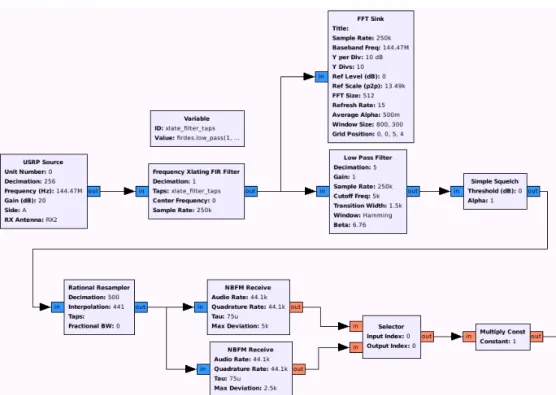
A third approach is to specify the structure of the stream graph directly in a text based language or using a graphical interface. In GNU Radio, for example, it is possible to create stream graphs using a graphical interface called GRC, instead of using Python directly. Figure 2.5 shows
Figure 2.5: An FM receiver application created for the GNU Radio stream processing framework using a graphical user interface.
a graphical example of a signal processing application created using this software. It is easy to imagine how the GRC software can translate this graphical representation into the appropriate sequence of stream graph operations in Python code.
A hierarchical stream graph construction method is built into the StreamIt language. Kernel work functions can perform work on their input streams or they can declare a set of children kernels to do the work for them. These children kernels are connected to one another using several patterns built into the language. They can be connected as pipelines or in various split-join patterns. A split-join is a pattern where a parent kernel’s input stream is split or duplicated among the inputs of its children kernels, then the outputs of those children are recombined into a single stream which serves as the output of the parent kernel. The pipeline pattern can be seen in the Main kernel in Figure 2.3. Another StreamIt example is shown in Figure 2.6. This example is from the StreamIt Cookbook [16]. In the program fragment shown in the figure, the pipeline pattern is used in theBandPassFilterkernel and the split-join pattern is used in the BPFCorekernel. The
float->float pipeline BandPassFilter(float rate, float low, float high, int taps) {
add BPFCore(rate, low, high, taps); add Subtracter();
}
float->float splitjoin BPFCore (float rate, float low, float high, int taps) {
split duplicate;
add LowPassFilter(rate, low, taps, 0); add LowPassFilter(rate, high, taps, 0); join roundrobin;
}
float->float filter Subtracter {
work pop 2 push 1 {
push(peek(1) - peek(0)); pop(); pop();
} }
Figure 2.6: Constructing a stream graph for an equalizer in StreamIt.
hierarchically defined structure of the computation is shown graphically alongside the program text.
2.4 Scheduling
The individual kernels in stream programs can be statically scheduled prior to execution or dynamically scheduled at runtime. This is not really a feature of the language as much as a feature of the implementation of the compiler or runtime. Nevertheless, the design of the language can impact the ability to use one or the other form of scheduling. For example, in a language like StreamIt, where the structure of the stream graph is explicit, it is much easier to come up with a static schedule than in other languages where the structure of the stream graph is not obvious. In a system like GNU Radio, the opposite is true. Because the stream graph is constructed at runtime using pre-compiled components, effective static scheduling is difficult.
The Stream and Kernel Intermediate Representation (SKIR)
3.1 Introduction
The Stream and Kernel Intermediate Representation (SKIR) provides the two basic con-structs, streamsand kernels, required by stream parallel programs. It also includes operations to create streams, to identify and execute kernels, and to construct and modify stream graphs. It can be used as an extension to low level program representations targeted by front-end compilers – such as JVM, LLVM, or CIL – or as a set low level primitives exposed as compiler intrinsics to domain specific libraries and frameworks. The stream and kernel abstractions are provided by SKIR as a set of low-level instruction-like operations. Applications create and execute streaming computation by sequentially executing procedural SKIR operations at runtime. A complete list of SKIR operations is shown in Table 3.1.
The design goals for SKIR are to address the limitations detailed in Chapter 1. That is, (1) Support a variety of stream parallel and general purpose source languages. (2) Support a variety of stream parallel programing models.
(3) Support static and/or dynamic compilation and optimization. (4) Support dynamic stream graphs.
In addition, SKIR aims to,
(5) Provide an abstraction layer to hide the implementation details of parallel execution and stream communication.
Operation Description
SKIR Kernel Operations
k= skir.kernelwork,arg Create a new runtime kernel object with the work function
workand kernel state arg. Store a handle to the resulting kernel object ink.
skir.callk,ins,outs Execute kernelkwith the input streamsinsand the output streamsouts. insandoutsare arrays of stream objects. skir.uncallk Stop execution ofkand remove it from the stream graph. skir.waitk Block until kernelkfinishes execution.
skir.becomek Replace the currently executing kernel with k. Must be called from within a kernel work function
SKIR Stream Operations
s= skir.streamsize Create new a runtime stream object and store a handle to the resulting object in s. size is the size in bytes of the elements in the stream.
skir.pushidx,data Pushdataonto output streamidx.
skir.popidx,data Pop an element from input streamidx and store the result intodata.
skir.peekidx,data,off Read the stream element from input streamidxat offsetoff
and store the result intodata.
Table 3.1: Overview of the Stream and Kernel Intermediate Representation (SKIR) operations.
3.2 SKIR Kernels
SKIR kernels are kernel objects managed by the SKIR compiler and runtime which encap-sulate a single kernel work function and any associated kernel state. They are created with the
skir.kerneloperation,
kernel = skir.kernel(work, arg)
This operation takes two parameters,workandarg. Theworkparameter is a pointer to a kernel work function. This is the function to be called when a kernel is scheduled for execution. The required form of this function is discussed below. The arg parameter is a pointer that will be passed to the kernel work function when it is called by the SKIR runtime. This parameter is useful for passing kernel state or arguments to the work function. The stream parallel programming model used by SKIR assumes that program state, including state accessed through theargparameter, is
for the most part not shared between kernels. This is discussed in more detail in Section 3.4. However, a SKIR implementation cannot assume that a kernel is side-effect free. That is, a SKIR implementation must determine using static analysis or other methods that a kernel is data parallel. As a practical matter, we note that if theargparameter is a typed pointer (e.g. notvoid*in C), then an implementation can likely perform better analysis with respect to data parallel execution and execution on non-CPU devices. However, the use of a typed pointer is not a requirement of SKIR.
The result of theskir.kerneloperation is an opaque reference to an implementation de-fined SKIRkernel object. These objects are used as an arguments to theskir.call,skir.wait,
skir.become, andskir.uncalloperations. The behavior of any other operation performed
on kernel objects is undefined. A kernel object can be in one of four states: allocated, active,
finished, ordeallocated. These states are used by SKIR implementations and are not made visible to the program. The skir.kernel operation returns a kernel in theallocated state. A SKIR implementation may start analyzing the kernel work function associated with the kernel object any time after theskir.kerneloperation but the implementation cannot start executing the kernel.
Kernels are spawned for execution using theskir.calloperation,
stream ins[] = {..., null}
stream outs[] = (..., null} skir.call(kernel, ins, outs)
The parameters to skir.call are the kernel to execute followed by null-terminated arrays of input and output streams. The input and output streams in the arrays must be stream objects returned byskir.streamoperations. Stream objects can be present in at most one input stream array and at most one output stream array. The effect of askir.calloperation is toconnectthe given input and output streams to the given kernel object then transition anallocated orfinished
kernel object to the activestate. Any stream already connected to the kernel different from the streams given to skir.call is disconnected. A SKIR implementation may execute a kernel if and only if the kernel object is in the active state. The behavior of skir.call for active,
deallocated, or invalid kernel objects is undefined. The SKIR implementation is not required to check that the number of input and output streams passed to askir.calloperation or the size of data the streams contain is compatible with the given kernel’s work function. If it is not compatible, the runtime behavior is undefined.
Theskir.waitoperation provides synchronization between kernels and the threads that spawned them,
skir.wait(kernel)
The skir.waitoperation takes a kernel object as its single parameter. When executed it will block ifkernelis in theallocatedoractivestates. Theskir.waitoperation returns immedi-ately when the kernel is in, or transitions to, thefinishedordeallocatedstates. Theskir.wait operation also returns immediately ifkernelis an invalid kernel object.
To forcibly stop a kernel from executing and/or deallocate a kernel object, a program can execute askir.uncalloperation,
skir.uncall(kernel)
The skir.uncall operation stops the execution ofkernel, disconnects any input or output streams connected to the kernel object, transitions the kernel object to the deallocatedstate, then returns once the SKIR implementation can guarantee that the kernel will no longer execute. An implementation must also guarantee that execution stops normally, with the kernel work function retuning a boolean value. That is, it will not preemptively suspend a kernel. Upon returning from skir.uncall, the value ofkernelis undefined with respect to the SKIR program. Internally, a SKIR implementation may free any resources associated with any kernel object in thedealloated
state.
Kernel work functions in SKIR are ordinary procedures with a certain form. They are implic-itly looped and always have three pointers as their only parameters. The first parameter receives theargpointer that was given as an argument to theskir.kerneloperation. The second and third parameters receive the arrays of input and output streams that were passed as arguments to
theskir.calloperation. These arrays are primarily for building hierarchical kernels (described below) and for internal use by a SKIR implementation. We could have made the second and third parameters optional, but we favored a uniform kernel work function prototype instead. The result of directly accessing or manipulating the arrays of input and output streams or the stream objects they contain is undefined for non-hierarchical work functions. Stream data is accessed from within kernel work functions using the skir.push, skir.pop, and skir.peek operations. The behavior of these operations is undefined outside of the work functions of activekernels. Kernel work functions always return a boolean value. A return value oftrueindicates that the kernel has finished executing and should be transitioned to thefinishedstate by the SKIR implementation. A return value of falseindicates that the kernel can process more data and should remain in the
activestate.
Non-hierarchical kernels can replace their functionality in an active program by executing a
skir.becomeoperation,
skir.become(kernel)
The skir.become operation takes a single parameter, the new kernel to be used in place
of the currently executing kernel. The kernel parameter must be the result of askir.call operation invoked from within the kernel work function executing theskir.becomeoperation. The effect of the skir.become operation is to immediately and atomically replace the kernel work function and the kernel state of the running kernel object with that ofkernel. The kernel remains in the activestate and the streams connected to the kernel object remain the same. This implies that the new kernel work function must be compatible with the number of connected input and output streams and the size of data they contain. If it is not compatible, the behavior of the kernel object is now undefined. When the kernel object transitions to thefinishedordeallocated
state, the SKIR implementation must reset the kernel object’s kernel work function and kernel state to the values passed as arguments to the originalskir.kerneloperation for the kernel object. The implementation can then deallocate any resources associated with the internalkernelobject which was the argument toskir.become.
The skir.become operation is useful in cases where a kernel has to perform some ini-tialization work before the stream graph enters a steady state. For example in stream graphs with feedback loops it might be necessary to initialize the back edge stream in the graph with some data. Another simple example is a kernel implementing a delay in a DSP application. In this case, the kernel might push some number of zeros to an output stream, then replace itself with an identity function. By using theskir.becomeoperation, the kernel can avoid internal branches and have fixed output rate(s).
allocated
active
finished
deallocated return true,
blocked on finished kernel return false, skir.become, blocked on active kernel
skir.kernel skir.uncall skir.uncall skir.uncall skir.call skir.call
Figure 3.1: SKIR kernel state transitions
The state transitions of kernel objects are summarized in Figure 3.1. Kernel objects are created in theallocatedstate. Once a kernel has been spawned for execution usingskir.call, it is in the active state and the kernel work function will be executed repeatedly by the SKIR runtime until it leaves that state. Anactivekernel transitions tofinishedif it returnstrueor if it becomes blocked on a stream operation where the kernel connected to the other end of the stream is in the finished state. For example, if a kernel A tries to execute a skir.pop instruction on