Acid Amplification Assay
Eric T. Beck,aBlake W. Buchan,a,bKatherine M. Riebe,aBrenda R. Alkins,dPreeti Pancholi,cPaul A. Granato,dNathan A. Ledeboera,b
Department of Microbiology, Dynacare Laboratories, Milwaukee, Wisconsin, USAa; Department of Pathology, Medical College of Wisconsin, Milwaukee Wisconsin, USAb; Department of Pathology, The Ohio State University Wexner Medical Center, Columbus, Ohio, USAc; Department of Microbiology, Laboratory Alliance of Central New York, Liverpool, New York, USAd
Clostridium difficile
is a Gram-positive bacterium commonly found in health care and long-term-care facilities and is the most
common cause of antibiotic-associated diarrhea. Rapid detection of this bacterium can assist physicians in implementing
con-tact precautions and appropriate antibiotic therapy in a timely manner. The purpose of this study was to compare the clinical
performance of the Quidel Lyra Direct C. difficile assay (Lyra assay) (Quidel, San Diego, CA) to that of a direct cell culture
cyto-toxicity neutralization assay (CCNA) and enhanced toxigenic culture. This study was performed at three geographically diverse
laboratories within the United States using residual stool specimens submitted for routine
C. difficile
testing. Residual samples
were tested using the Lyra assay on three real-time PCR platforms, and results were compared to those for direct CCNA and
en-hanced toxigenic culture. The test results for all platforms were consistent across all three test sites. The sensitivity and
specific-ity of the Lyra assay on the SmartCycler II, ABI 7500 Fast DX, and ABI QuantStudio DX instruments compared to CCNA were
90.0% and 93.3%, 95.0% and 94.2%, and 93.8% and 95.0%, respectively. Compared to enhanced toxigenic culture, the sensitivity
and specificity of the Lyra assay on the SmartCycler II, ABI 7500, and QuantStudio instruments were 82.1% and 96.9%, 89.3%
and 98.8%, and 85.7% and 99.0%, respectively. Overall, the Lyra assay is easy to use and versatile and compares well to
C.
diffi-cile
culture methods.
C
lostridium difficile
is a Gram-positive, anaerobic bacillus,
which has emerged as a major nosocomial pathogen and the
leading infectious cause of antibiotic-associated diarrhea and
pseudomembranous colitis (
1
). In the United States, the number
of
C. difficile
infections (CDI) in hospitalized patients has
in-creased from approximately 150,000 patients in 2001 to
⬎
300,000
patients in 2005 and continues to rise (
2
). The increased economic
burden in hospitalized patients due to CDI has been estimated at
$9,822 to $13,854 per patient, and total patient costs (health care
costs plus lost wages) associated with CDI have been estimated to
exceed $1 billion annually in the United States alone (
3
,
4
). Several
recent studies have demonstrated that rapid and accurate
detec-tion of
C. difficile
is an important component of combating
hos-pital-acquired CDI and can have a significant benefit to patients
and hospitals from a financial and clinical perspective (
4–6
).
The most appropriate testing strategy for detection of
C.
diffi-cile
is not standardized and remains controversial. Several
tradi-tional (nonmolecular) techniques are currently employed in the
diagnosis of
C. difficile
disease. Enzyme immunoassays (EIAs) test
for the presence of either
C. difficile
cytotoxins or glutamate
dehy-drogenase (GDH) (a
C. difficile
metabolic enzyme). These assays
can be performed within a few hours, but they lack sensitivity and
specificity, and the GDH assays cannot differentiate between
cy-totoxic and noncycy-totoxic strains of
C. difficile
. EIAs are not
rec-ommended as the sole diagnostic for detection of
C. difficile
dis-ease (
1
,
7–11
). Cell culture cytotoxicity neutralization assays
(CCNA) detect the presence of
C. difficile
cytotoxin by inoculating
cell cultures with clarified stool specimens in the presence and
absence of
C. difficile
antitoxins and can take up to 48 h to
com-plete. Finally, enhanced toxigenic culture utilizes traditional
C.
difficile
culture methods followed by CCNA on suspected isolates.
The Infectious Disease Society of America and Society for
Health-care Epidemiology of America (IDSA/SHEA) guidelines state that
enhanced toxigenic culture is the gold standard to which all assays
should be compared due to the high sensitivity and specificity, but
that this type of testing is not clinically practical due to the slow
turnaround time (2 to 3 days) and the lack of standardized
proto-cols (
1
,
7
).
Molecular diagnostics may allow laboratories to combine the
best features of all traditional
C. difficile
diagnostics from the speed
and ease of EIAs to the high sensitivity and specificity of enhanced
toxigenic culture (
12
,
13
). One recent study shows that the
num-ber of unnecessary days of contact precaution and unjustified
an-tibiotic usage decreased by nearly 40% for those patients who were
diagnosed as negative for CDI by molecular testing compared to
those diagnosed with CCNA or enhanced cell culture. The same
study showed that the use of molecular testing decreased the
length of hospitalization on average by more than 7 days
com-pared to that for CCNA or enhanced cell culture (
6
).
The Quidel Lyra Direct C. difficile assay (Lyra assay) (Quidel,
San Diego, CA) is a qualitative real-time PCR assay that detects the
presence of the
C. difficile tcdA
and/or
tcdB
gene in liquid or soft
stool specimens. Specimens are processed through a simple
prep-aration step that does not require specialized equipment.
Pro-cessed specimens are tested via a standard TaqMan real-time PCR
assay utilizing primers/probes that detect but do not distinguish
Received4 November 2013Returned for modification24 December 2013 Accepted21 March 2014
Published ahead of print26 March 2014 Editor:P. Bourbeau
Address correspondence to Nathan A. Ledeboer, [email protected].
Copyright © 2014, American Society for Microbiology. All Rights Reserved.
doi:10.1128/JCM.03089-13
on May 16, 2020 by guest
http://jcm.asm.org/
the
tcdA
and
tcdB
genes. The purpose of this study was to compare
the clinical performance of the Lyra assay to that of direct CCNA
and enhanced toxigenic culture using residual specimens from
three geographically diverse laboratories within the United States.
Testing with the Lyra assay was performed using three real-time
PCR platforms, and results were compared to those for direct
CCNA and enhanced toxigenic culture.
MATERIALS AND METHODS
Participating centers and overall study design.Three laboratories par-ticipated in a prospective study to assess the clinical performance of the Lyra assay: The Medical College of Wisconsin, Milwaukee, WI; The Ohio State University, Columbus, OH; and Laboratory Alliance of New York, Syracuse, NY. All of the laboratories received the appropriate Institutional Review Board approvals or waivers consistent with local human subject research requirements. All sites performed the Lyra assay with residual deidentified stool specimens that were submitted for routineC. difficile testing according to each laboratory’s standard practices. An aliquot of each stool specimen was submitted to a central reference laboratory (Di-agnostic Hybrids, Athens, OH) for direct cell culture cytotoxicity neutral-ization assay (CCNA) and enhanced toxigenic culture (see Materials and Methods, below).
Specimen collection and handling.A minimum of 2 ml of liquid stool or a marble-sized soft stool specimen that takes the shape of its container was required for a sample to be enrolled. Each specimen was tested ac-cording to the laboratory’s standard of care, and an aliquot was then transferred to a new tube with a sterile paddle. Specimens were assigned unique specimen identification numbers, and the following patient de-mographics were recorded: gender, age, collection date, and presence or absence ofC. difficileby the laboratory’s routine method. Each specimen was inoculated into a vial of Lyra process buffer 1 within 24 h of collection. The remaining specimen aliquots were stored and shipped to the refer-ence laboratory at 2 to 8°C, where referrefer-ence testing was initiated within 48 h of sample collection. In total, 619 specimens were enrolled in this study and tested with the Lyra assay on three real-time PCR platforms and with CCNA and enhanced toxigenic culture.
Direct cell culture cytotoxicity neutralization assay.An aliquot of each stool specimen was processed within 48 h of collection for directC. difficileCCNA. A 1:5 dilution was prepared by adding 0.5 ml of the stool specimen to 2.0 ml of CCNA diluent. The dilution was mixed well and then centrifuged for 5 min at 2,000⫻g. The supernatant was removed and filtered using a 0.45-m filter. One hundred microliters of the sample was inoculated into two wells: a control well (containing the sample and 100 l ofC. difficileantitoxin) and a specimen test well (containing the sample and 100l of phosphate-buffered saline). These dilutions were incubated at room temperature for 30 min. Fifty microliters of each dilution was inoculated into two separate wells of a tissue culture plate containing human foreskin fibroblasts and 150l of tissue culture medium (Diag-nostic Hybrids, Athens, OH). The final dilution of the specimen in each well was 1:40. Cell cultures were incubated at 35°C and were examined at 24 and 48 h. Cell rounding was used to indicate a cytotoxic effect. Speci-mens were considered positive for the presence ofC. difficilecytotoxin B if at least 50% of the cells showed cytotoxic effects and if the cytotoxicity was neutralized in the control well by the antitoxin.
EnhancedC. difficiletoxigenic cell culture.An aliquot of each stool specimen was processed within 48 h of collection for enhanced toxigenic culture. Approximately 0.1 g (1 to 2 drops) of each stool specimen was added to a prereduced chopped-meat glucose (CMG) broth (Hardy Di-agnostics, Santa Maria, CA) and incubated at 35°C for 48 to 72 h. The broths were subcultured to modified cycloserine-cefoxitin-fructose agar plates with horse blood (CCFA-HB) (Remel, Lenexa, KS). CCFA-HB plates were streaked for isolation and incubated anaerobically at 35°C in a GasPak EZ anaerobe pouch system for 48 to 72 h. Following incubation, all plates were examined for colonies morphologically resemblingC. dif-ficile(gray-white colonies with raised centers and irregular filamentous or
opaque edges on CCFA-HB plates). All colonies resembling aClostridium species were evaluated by Gram stain, vancomycin susceptibility, aerotol-erance, and the presence of proline aminopeptidase.C. difficilewas iden-tified as strict anaerobic, Gram-positive bacilli (appearing singly or in chains), susceptible to vancomycin, positive for the presence of proline aminopeptidase, and having a characteristic “horse manure” odor. Iso-lates ofC. difficilewere inoculated into prereduced CMG and incubated at 35°C for 4 to 5 days. The presence ofC. difficiletoxin B in the broth culture was determined using the same CCNA test described previously with the exception of specimen preparation. For CCNA from CMG cultures, 0.5 ml of the CMG culture broth was centrifuged for 5 min at 2,000⫻g, and then 0.2 ml of the supernatant was combined with 1.8 ml of the CCNA diluent (1:10 dilution). The diluted specimen was filtered and used in the CCNA assay as described previously.
Quidel Lyra Direct C. difficile assay.The Lyra assay is a real-time PCR assay performed on one of three open-platform, real-time thermocyclers (SmartCycler II [SC II], Cepheid, Sunnyvale, CA; ABI 7500 Fast DX [ABI 7500], Applied Biosystems, Carlsbad, CA; and ABI QuantStudio DX [QS DX], Applied Biosystems, Carlsbad, CA). The test is performed by placing a swab into a liquid or soft stool specimen, evenly coating it with speci-men, adding it to process buffer 1, and swirling the swab. Thirty microli-ters of process buffer 1 containing specimen is added to process buffer 2, and the sample is then ready for real-time PCR. Each vial of lyophilized master mix is rehydrated in 135l of rehydration solution (sufficient for 8 reactions), and 15l of master mix is combined with 5l of sample (in process buffer 2). Each specimen was processed once and used for testing with the Lyra assay on all three of the real-time PCR platforms. The results from each instrument were analyzed separately, and any invalid results were retested.
Controls.Positive and negative controls were included with each set of processed specimens. The controls were processed in the same manner as the patient specimens. The positive control contained a purified, inac-tivated strain ofC. difficile(NAP1), and the negative control consisted of aC. difficile-free dilution matrix. The positive and negative controls had to perform as expected for the sample run to be valid. If one of the controls was invalid, the entire run was repeated.
In addition to the external controls, each sample contained an internal control, which was used to determine whether the samples were processed correctly and/or to detect the presence of PCR inhibitors in the specimen. The internal control is a component of process buffer 2 and does not have to be added to each sample individually.
Result interpretation.The Lyra assay provides a qualitative result for the presence or absence of thetcdAandtcdBgenes. The test result is positive when amplification of thetcdAortcdBgene(s) occurs regardless of whether or not amplification of the internal control occurs. The test result is negative when no amplification of thetcdAandtcdBgenes occurs and amplification of the internal control is present. Test results are invalid when there is no amplification of either thetcdAandtcdBgenes or the internal control. Invalid results were repeated once by retesting a new 5-l aliquot of sample in process buffer 2.
Data analysis and statistical methods.Results of the Lyra assay were compared to the CCNA results and to enhanced toxigenic culture using the CCNA or enhanced toxigenic culture results as the gold standard. Any results that were discordant between the Lyra assay and CCNA or enhanced toxi-genic culture were considered false-positive or -negative results for the Lyra assay. The Lyra results were analyzed individually for each of the three differ-ent thermocycling platforms. The clinical sensitivity and specificity along with the 95% confidence intervals were calculated using the efficient-score method (14). The sensitivity and specificity of the Lyra assay were compared between platforms using McNemar’s test (15,16).
RESULTS
During the course of this study, 619 specimens were evaluated
with the Lyra assay. Five (0.81%), nine (1.45%), and one (0.16%)
of the samples were invalid on the SC II, 7500 Fast, and QS DX
on May 16, 2020 by guest
http://jcm.asm.org/
instruments, respectively. After repeating all tests, only one
re-mained invalid. In comparison, results for three (0.48%) samples
were indeterminate using CCNA due to the presence of
cytotox-icity in the control well, and zero (0.00%) of the samples were
indeterminate using enhanced toxigenic culture. Only the 601
re-sults that were valid on the first attempt with all test platforms and
assays were used to evaluate sensitivity and specificity.
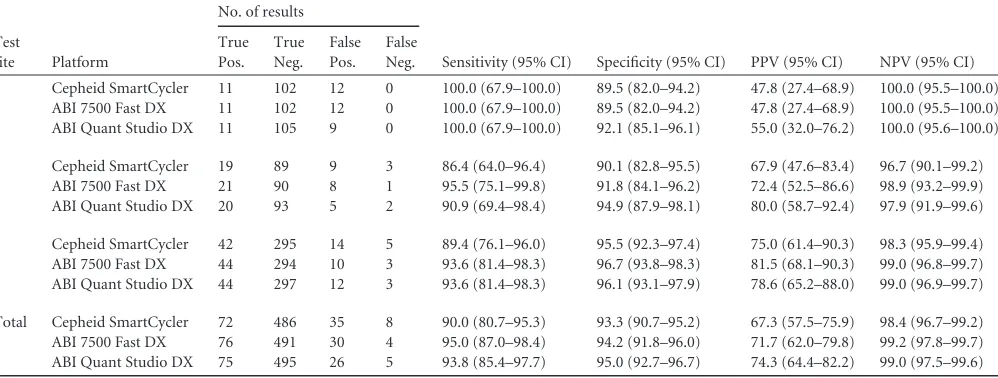
Tables 1
and
2
summarize the test results for the Lyra assay
compared to CCNA. The sensitivity with the SC II instrument was
the least consistent across test sites, ranging from 86.4 to
100.0%, followed by the QS DX (90.9 to 100.0%) and the ABI
7500 (93.6 to 100.0%). Specificity was the least consistent
across test sites on the ABI 7500 instrument (89.5 to 96.7%),
followed by the SC II (89.5 to 95.5%) and QS DX systems (92.1
to 96.1%). The overall sensitivity (95% confidence interval) of
the Lyra assay compared to that of CCNA on the SC II, ABI
7500, and QS DX instruments was 90.0% (80.7 to 95.3%),
95.0% (87.0 to 98.4%), and 93.8% (85.4 to 97.7%),
respec-tively. The overall specificities (95% confidence interval) of the
Lyra assay compared to those of CCNA on the SC II, ABI 7500,
and QS DX instruments was 93.3% (90.7 to 95.2%), 94.2%
(91.8 to 96.0%), and 95.0% (92.7 to 96.7%), respectively.
Com-pared to CCNA, the ABI 7500 instrument was the most
sensi-tive and the QS DX was the most specific, though there were no
statistical differences in performance on any of the platforms
(
Table 2
).
Tables 3
and
4
summarize the test results for the Lyra assay
compared to enhanced toxigenic culture. The sensitivity with the
SCII instrument was the least consistent across test sites, ranging
from 77.4 to 92.3%, followed by that with the QS DX (83.3 to
92.3%) and ABI 7500 (87.1 to 96.2%) instruments. The specificity
with the ABI 7500 platform was the least consistent across sites
(95.7 to 100.0%), followed by that with the SC II (95.7 to 97.3%)
and QS DX (98.6 to 100.0%) instruments. The overall sensitivities
(95% confidence interval) of the Lyra assay compared to
en-hanced toxigenic culture on the SC II, ABI 7500, and QS DX
plat-forms were 82.1% (73.5 to 88.5%), 89.3% (81.7 to 94.1%), and
85.7% (77.5 to 91.4%), respectively. The overall specificities (95%
confidence interval) of the Lyra assay compared to enhanced
tox-igenic culture on the SC II, ABI 7500, and QS DX platforms were
96.9% (94.9 to 98.2%), 98.8% (97.2 to 99.5%), and 99.0% (97.4 to
99.6%), respectively. Like the comparison to CCNA, the Lyra
as-say was the most sensitive on the ABI 7500 instrument and the
most specific on the QS DX platforms compared to enhanced
toxigenic culture. Unlike the comparisons of the Lyra assay to
CCNA, there were significant differences in sensitivity and
speci-ficity between platforms. Results with the ABI 7500 instrument
were significantly more sensitive than those with SC II (
P
⫽
0.008), and both the ABI 7500 and QS DX results were
signifi-cantly more specific than those of the SC II assay (
P
⫽
0.022 and
P
⫽
0.021, respectively).
DISCUSSION
The Lyra assay is an FDA-approved real-time PCR assay for the
detection of the
C. difficile tcdA
and
tcdB
genes. In this study, we
compared the performance of the Lyra assay to that of two
well-TABLE 1Overall performance characteristics of the LyraC. difficileassay compared to cell culture cytotoxicity neutralization assayaTest
site Platform
No. of results
Sensitivity (95% CI) Specificity (95% CI) PPV (95% CI) NPV (95% CI) True
Pos. True Neg.
False Pos.
False Neg.
1 Cepheid SmartCycler 11 102 12 0 100.0 (67.9–100.0) 89.5 (82.0–94.2) 47.8 (27.4–68.9) 100.0 (95.5–100.0) ABI 7500 Fast DX 11 102 12 0 100.0 (67.9–100.0) 89.5 (82.0–94.2) 47.8 (27.4–68.9) 100.0 (95.5–100.0) ABI Quant Studio DX 11 105 9 0 100.0 (67.9–100.0) 92.1 (85.1–96.1) 55.0 (32.0–76.2) 100.0 (95.6–100.0)
2 Cepheid SmartCycler 19 89 9 3 86.4 (64.0–96.4) 90.1 (82.8–95.5) 67.9 (47.6–83.4) 96.7 (90.1–99.2) ABI 7500 Fast DX 21 90 8 1 95.5 (75.1–99.8) 91.8 (84.1–96.2) 72.4 (52.5–86.6) 98.9 (93.2–99.9) ABI Quant Studio DX 20 93 5 2 90.9 (69.4–98.4) 94.9 (87.9–98.1) 80.0 (58.7–92.4) 97.9 (91.9–99.6)
3 Cepheid SmartCycler 42 295 14 5 89.4 (76.1–96.0) 95.5 (92.3–97.4) 75.0 (61.4–90.3) 98.3 (95.9–99.4) ABI 7500 Fast DX 44 294 10 3 93.6 (81.4–98.3) 96.7 (93.8–98.3) 81.5 (68.1–90.3) 99.0 (96.8–99.7) ABI Quant Studio DX 44 297 12 3 93.6 (81.4–98.3) 96.1 (93.1–97.9) 78.6 (65.2–88.0) 99.0 (96.9–99.7)
Total Cepheid SmartCycler 72 486 35 8 90.0 (80.7–95.3) 93.3 (90.7–95.2) 67.3 (57.5–75.9) 98.4 (96.7–99.2) ABI 7500 Fast DX 76 491 30 4 95.0 (87.0–98.4) 94.2 (91.8–96.0) 71.7 (62.0–79.8) 99.2 (97.8–99.7) ABI Quant Studio DX 75 495 26 5 93.8 (85.4–97.7) 95.0 (92.7–96.7) 74.3 (64.4–82.2) 99.0 (97.5–99.6)
a
[image:3.585.44.543.79.268.2]Pos., positive; Neg., negative; CI, confidence interval.
TABLE 2Comparison of LyraC. difficileassay on different thermocycling platforms to cell culture cytotoxicity neutralization assaya
Platform
Comparison
ABI 7500 Fast DX ABI QuantStudio DX Cepheid SmartCycler II
ABI 7500 Fast DX 94.2% vs 95.0%;P⫽0.424 94.2% vs 93.3%;P⫽0.332
ABI QuantStudio DX 93.8% vs 95.0%;Pⴝ1.000 95.0% vs 93.3%;P⫽0.064
Cepheid SmartCycler II 90.0% vs 95.0%;Pⴝ0.125 90.0% vs 93.8%;Pⴝ0.250
a
Percentage from the platform in the row is listed first; that for the platform in the column is listed second. Boldface values indicate sensitivity; those in regular font indicate specificity.
on May 16, 2020 by guest
http://jcm.asm.org/
[image:3.585.45.547.645.706.2]established culture methods. Additionally, we compared the
per-formance of the assay across all three real-time platforms which
are FDA cleared for use with this assay, in parallel, using the same
specimens.
Compared to CCNA, the real-time PCR platforms did not
sig-nificantly vary in performance, with sensitivities and specificities
ranging from 90.0 to 95.5% and 93.3 to 95.0%. However,
com-pared to enhanced toxigenic culture, the ABI 7500 platform was
significantly more sensitive than the SC II (89.3 versus 82.1%),
and both the ABI 7500 and QS DX were significantly more specific
than the SC II (98.8% and 99.0% versus 96.9%). There are several
possible explanations for these discrepancies. The most logical
reason is that the SC II performs extension at a lower temperature
(66°C) than the ABI 7500 (68°C) or the QS DX (68°C), increasing
the chance for nonspecific amplification. Another difference
be-tween the platforms is the filters. All of the instruments have
sim-ilar optical filters, but the optimal wavelengths for each filter are
not exactly the same, and even slight differences in the optics could
account for the differences in the results. Finally, the QS DX and
ABI 7500 utilize a 96-well plate format where the cycling and
optics are consistent for all wells of the plate. The SC II platform
works more like a series of individual thermocyclers. If even one
SC II module at one test site was slightly out of calibration, it
would be difficult to notice and could account for a few additional
false results. It would take only a few additional false results to
make the platform appear less sensitive or specific. Despite the fact
that there are some significant differences between platforms, the
results with all platforms compare favorably to those obtained
with other molecular assays for the detection of
C. difficile
, as
evidenced by the product inserts and many additional clinical
studies (
11
,
17–24
).
In addition to the fact that there are some performance
differ-ences between thermocycling platforms, the Lyra assay also has a
few other minor drawbacks. These include the fact that it does not
identify specific
C. difficile
markers that are often associated with
epidemic strains of
C. difficile
(e.g., binary toxin or
⌬
tcdC
deletion
mutations). However, this is only a minor concern, since none of
the current infection control or treatment guidelines recommend
changes in practice or treatment based solely on the strain
C.
dif-ficile
(
7
). Another minor drawback of this test is that it lends itself
more to a “batch testing” format rather than an “on-demand
test-ing” format. The batches can be relatively small based on the
re-agent packaging, but the need for inclusion of a positive and
neg-ative control with each sample makes testing most efficient and
cost-effective when samples are processed simultaneously in
larger batches.
[image:4.585.44.544.77.268.2]Like other recently FDA-approved
C. difficile
molecular assays,
the Lyra assay requires only 2 to 3 h to complete and compares
favorably to enhanced toxigenic culture (sensitivity and specificity
of approximately 85.7% and 98.3%, respectively, depending on
the thermocycling platform used for testing). These results are
relatively consistent across three test sites on all three test
plat-forms despite the fact that each site may have different patient
populations and different
C. difficile
ribotypes circulating. Finally,
TABLE 3Overall performance characteristics of LyraC. difficileassay compared to enhanced toxigenic cultureaTest
site Platform
No. of results
Sensitivity (95% CI) Specificity (95% CI) PPV (95% CI) NPV (95% CI) True
Pos. True Neg.
False Pos.
False Neg.
1 Cepheid SmartCycler 20 98 3 4 83.3 (61.8–94.5) 97.0 (90.9–99.2) 87.0 (65.3–96.6) 96.1 (89.7–98.7) ABI 7500 Fast DX 21 99 2 3 87.5 (66.5–96.7) 98.0 (92.3–99.7) 91.3 (70.5–98.5) 97.1 (91.0–99.2) ABI Quant Studio DX 20 101 0 4 83.3 (61.8–94.5) 100.0 (95.4–100.0) 100.0 (80.0–100.0) 96.2 (90.0–98.8)
2 Cepheid SmartCycler 24 90 4 2 92.3 (73.4–98.7) 95.7 (88.8–98.6) 85.7 (66.4–95.3) 97.8 (91.6–99.6) ABI 7500 Fast DX 25 90 4 1 96.2 (78.4–99.8) 95.7 (88.8–98.6) 86.2 (67.4–95.5) 98.9 (93.2–99.9) ABI Quant Studio DX 24 93 1 2 92.3 (73.4–98.7) 98.9 (93.4–99.9) 96.0 (77.7–99.8) 97.9 (91.9–99.6)
3 Cepheid SmartCycler 48 286 8 14 77.4 (64.7–86.7) 97.3 (94.5–98.7) 85.7 (73.2–93.2) 95.3 (92.1–97.3) ABI 7500 Fast DX 54 294 0 8 87.1 (75.6–93.9) 100.0 (98.4–100.0) 100.0 (91.7–100.0) 97.4 (94.6–98.8) ABI Quant Studio DX 52 290 4 10 83.9 (71.9–91.6) 98.6 (96.3–99.6) 92.9 (81.9–97.7) 96.7 (93.8–98.3)
Total Cepheid SmartCycler 92 474 15 20 82.1 (73.5–88.5) 96.9 (94.9–98.2) 86.0 (77.6–91.7) 96.0 (93.7–97.) ABI 7500 Fast DX 100 483 6 12 89.3 (81.7–94.1) 98.8 (97.2–99.5) 94.3 (87.6–97.7) 97.6 (95.7–98.7) ABI Quant Studio DX 96 484 5 16 85.7 (77.5–91.4) 99.0 (97.4–99.6) 95.0 (88.3–98.2) 96.8 (94.7–98.1)
a
Pos., positive; Neg., negative; CI, confidence interval.
TABLE 4Comparison of LyraC. difficileassay on different thermocycling platforms to enhanced toxigenic culturea
Platform
Comparison
ABI 7500 Fast DX ABI QuantStudio DX Cepheid SmartCycler II
ABI 7500 Fast DX 98.8% vs 99.0%;P⫽1.000 98.8% vs 96.9%;P⫽0.022ⴱ
ABI QuantStudio DX 85.7% vs 89.3%;Pⴝ0.125 99.0% vs 96.9%;P⫽0.021ⴱ
Cepheid SmartCycler II 82.1% vs 89.3%;Pⴝ0.008ⴱ 82.1% vs 85.7%;Pⴝ0.219
aPercentage from the platform in the row is listed first; that for the platform in the column is listed second. Boldface values indicate sensitivity; those in regular font indicate
specificity.
ⴱ, significant difference in performance of LyraC. difficileassay between test platforms.
on May 16, 2020 by guest
http://jcm.asm.org/
[image:4.585.38.547.637.696.2]the only equipment required to run this assay is a real-time
ther-mocycler. With three options to choose from, most
high-com-plexity laboratories will already have one of these instruments
available, making the initial investment more manageable.
Over-all, the Lyra assay has proven to be an easy-to-use, versatile
mo-lecular test for the detection of toxigenic
C. difficile
infection.
ACKNOWLEDGMENTS
We thank the Diagnostic Hybrids Reference Laboratory (Athens, OH) for serving as the central reference laboratory for this study. In addition, we are grateful to the staff of all of the clinical laboratories who participated in this study for their support and help in evaluating the LyraC. difficile assay.
This study was sponsored by Quidel Corporation (San Diego, CA).
REFERENCES
1.Stevens DL, Bryant AE, Berger A, von Eichel-Streiber C.2011. Clostrid-ium, p 834 – 857.InVersalovic J, Carroll KC, Funke G, Jorgensen JH, Landry ML, Warnock DW (ed), Manual of clinical microbiology, 10th ed, vol 1. ASM Press, Washington, DC.
2.Elixhauser A, Jhung M.2008.Clostridium difficile-associated disease in U.S. hospitals, 1993–2005.Healthcare Cost and Unitization Project. Sta-tistical brief no. 50.http://www.hcup-us.ahrq.gov/reports/statbriefs/sb50 .pdf.
3.Kyne L, Hamel MB, Polavaram R, Kelly CP.2002. Health care costs and mortality associated with nosocomial diarrhea due toClostridium difficile. Clin. Infect. Dis.34:346 –353.http://dx.doi.org/10.1086/338260. 4.Bouza E.2012. Consequences ofClostridium difficileinfection:
under-standing the healthcare burden. Clin. Microbiol. Infect.18(Suppl 6):5–12. http://dx.doi.org/10.1111/1469-0691.12064.
5.Badger VO, Ledeboer NA, Graham MB, Edmiston CE, Jr.2012. Clos-tridium difficile: epidemiology, pathogenesis, management, and preven-tion of a recalcitrant healthcare-associated pathogen. J. Parenter. Enteral. Nutr.36:645– 662.http://dx.doi.org/10.1177/0148607112446703. 6.Barbut T, Surgers L, Eckert C, Visseaux B, Cuingnet M, Mesquita C,
Pradier N, Thiriez A, Ait-Ammar N, Aifaoui A, Grandsire E, Lalande V. 20 March 2013. Does a rapid diagnosis ofClostridium difficileinfection impact quality of patient management? Clin. Microbiol. Infect.http://dx .doi.org/10.1111/1469-0691.12221.
7.Cohen SH, Gerding DN, Johnson S, Kelly CP, Loo VG, McDonald LC, Pepin J, Wilcox MH.2010. Clinical practice guidelines forClostridium difficileinfection in adults: 2010 update by the Society for Healthcare Epidemiology of America (SHEA) and the infectious diseases society of America (IDSA). Infect. Control Hosp. Epidemiol.31:431– 455.http://dx .doi.org/10.1086/651706.
8.Massey V, Gregson DB, Chagla AG, Storey M, John MA, Hussain Z. 2003. Clinical usefulness of components of the Triage immunoassay, en-zyme immunoassay for toxins A and B, and cytotoxin B tissue culture assay for the diagnosis ofClostridium difficilediarrhea. Am. J. Clin. Pathol. 119:45– 49.http://dx.doi.org/10.1309/U8ATL52Q60XYAVX6.
9.Vanpoucke H, De BT, Claeys G, Vaneechoutte M, Verschraegen G. 2001. Evaluation of six commercial assays for the rapid detection of Clos-tridium difficiletoxin and/or antigen in stool specimens. Clin. Microbiol. Infect.7:55– 64.http://dx.doi.org/10.1046/j.1469-0691.2001.00141.x. 10. Wilcox MH.2012. Overcoming barriers to effective recognition and
di-agnosis ofClostridium difficileinfection. Clin. Microbiol. Infect.18(Suppl 6):13–20.http://dx.doi.org/10.1111/1469-0691.12057.
11. Buchan BW, Mackey TA, Daly JA, Alger G, Deny GA, Peterson LR,
Kehl SC, Ledeboer NA.2012. Multicenter clinical evaluation of the Por-trait ToxigenicC. difficileAssay for detection of toxigenicClostridium difficilestrains in clinical stool specimens. J. Clin. Microbiol.50:3932– 3936.http://dx.doi.org/10.1128/JCM.02083-12.
12. Carroll KC.2011. Tests for the diagnosis ofClostridium difficileinfection: the next generation. Anaerobe17:170 –174.http://dx.doi.org/10.1016/j .anaerobe.2011.01.002.
13. Belanger SD, Boissinot M, Clarioux N, Picard FJ, Bergeron MG. 2003. Rapid detection ofClostridium difficilein feces by real-time PCR. J. Clin. Microbiol. 41:730 –734. http://dx.doi.org/10.1128/JCM.41.2.730 -734.2003.
14. Newcombe RG.1998. Two-sided confidence intervals for the single propor-tion: comparison of seven methods. Stat. Med.17:857– 872.http://dx.doi.org /10.1002/(SICI)1097-0258(19980430)17:8⬍857::AID-SIM777⬎3.0.CO;2-E. 15. McNemar Q.1947. Note on the sampling error of the difference between correlated proportions or percentages. Psychometrika12:153–157.http: //dx.doi.org/10.1007/BF02295996.
16. Stuart A.1955. A test for homogeneity of the marginal distributions in a two-way classification. Biometrika42:412– 416.http://dx.doi.org/10.1093 /biomet/42.3-4.412.
17. Stamper PD, Alcabasa R, Aird D, Babiker W, Wehrlin J, Ikpeama I, Carroll KC.2009. Comparison of a commercial real-time PCR assay for tcdBdetection to a cell culture cytotoxicity assay and toxigenic culture for direct detection of toxin-producingClostridium difficilein clinical sam-ples. J. Clin. Microbiol. 47:373–378. http://dx.doi.org/10.1128/JCM .01613-08.
18. Stamper PD, Babiker W, Alcabasa R, Aird D, Wehrlin J, Ikpeama I, Gluck L, Carroll KC.2009. Evaluation of a new commercial TaqMan PCR assay for direct detection of theClostridium difficiletoxin B gene in clinical stool specimens. J. Clin. Microbiol.47:3846 –3850.http://dx.doi.org/10 .1128/JCM.01490-09.
19. Novak-Weekley SM, Marlowe EM, Miller JM, Cumpio J, Nomura JH, Vance PH, Weissfeld A.2010.Clostridium difficiletesting in the clinical laboratory by use of multiple testing algorithms. J. Clin. Microbiol.48: 889 – 893.http://dx.doi.org/10.1128/JCM.01801-09.
20. Noren T, Alriksson I, Andersson J, Akerlund T, Unemo M.2011. Rapid and sensitive loop-mediated isothermal amplification test forClostridium difficiledetection challenges cytotoxin B cell test and culture as gold stan-dard. J. Clin. Microbiol. 49:710 –711. http://dx.doi.org/10.1128/JCM .01824-10.
21. Hicke B, Pasko C, Groves B, Ager E, Corpuz M, Frech G, Munns D, Smith W, Warcup A, Denys G, Ledeboer NA, Lindsey W, Owen C, Rea L, Jenison R.2012. Automated detection of toxigenicClostridium difficile in clinical samples: isothermaltcdBamplification coupled to array-based detection. J. Clin. Microbiol. 50:2681–2687.http://dx.doi.org/10.1128 /JCM.00621-12.
22. Le Guern R, Herwegh S, Grandbastien B, Courcol R, Wallet F.2012. Evaluation of a new molecular test, the BD Max Cdiff, for detection of toxigenicClostridium difficilein fecal samples. J. Clin. Microbiol.50:3089. http://dx.doi.org/10.1128/JCM.01250-12.
23. Pancholi P, Kelly C, Raczkowski M, Balada-Llasat JM.2012. Detection of toxigenicClostridium difficile: comparison of the cell culture neutral-ization, Xpert C. difficile, Xpert C. difficile/Epi, and Illumigene C. difficile assays. J. Clin. Microbiol.50:1331–1335.http://dx.doi.org/10.1128/JCM .06597-11.
24. Viala C, Le MA, Maataoui N, Rousseau C, Collignon A, Poilane I.2012. Comparison of commercial molecular assays for toxigenicClostridium difficiledetection in stools: BD GeneOhm Cdiff, XPert C. difficile and illumigene C. difficile. J. Microbiol. Methods90:83– 85.http://dx.doi.org /10.1016/j.mimet.2012.04.017.