2019 International Conference on Computation and Information Science (ICCIS 2019) ISBN: 978-1-60595-644-2
Hierarchical Classification Algorithm
Based on FastText
Yaxin Ran, Hongqi Han, Yunliang Zhang, Xiaorui Zhai
and Mengjuan Weng
ABSTRACT
At present, methods for automatic assigning labels for literature using the Chinese Library Classification system are mostly based on machine learning methods, and many use the build knowledge base to improve classification effect. These methods are applicable to small-scale dataset, and as the categorical numbers increase, the classification effect will decrease and the time cost will increase dramatically. The paper proposes a hierarchical classification algorithm based on fastText text classification tool to solve classification indexing problem on large-scale literature dataset. The algorithm trains the two-layer classifier from the top-down method and designs an optimization algorithm to reduce the error transmission between the two layers. Experimental results showed that the optimized hierarchical classification technique improved the classification effect compared to the traditional classification technique.
1. INTRODUCTION
At present, most of the domestic library and information fields use the Chinese Library Classification (CLC) system to classify the information resources such as books, journal articles, and web pages [1]. The CLC system is the most widely used large-scale comprehensive classification in China. It uses a hierarchical structure to
Yaxin Ran, Institute of Scientific and Technical Information of China, No.15 Fuxing Road, Beijing, 100038, China
classify literature resources, and its tertiary categories reach thousands. With the increasing enrichment of network data resources, how to accurately classify and index the large-scale categories of literature based on the CLC system has become one of the urgent problems to be solved in the field of library and information.
As a common algorithm for text classification, generally, the traditional machine learning classification algorithm is applied to the CLC system. Li and Ma [2] established a hierarchical classification model earlier in the CLC system and used machine learning algorithms to classify scientific paper data. Zhang et al. [3] used the hierarchical structure to refine the classification and finalize the classification based on the CLC system. Most of these methods use machine learning classification technology. As the number of data sets and the number of categories increase, the machine learning classification algorithm will face time overhead and classification accuracy.
In recent years, the classification algorithm based on neural network has shown excellent effect in the computer vision field, and more and more researchers have applied it to the Natural language processing (NLP) field. Guo [4] introduced the convolutional neural network [5] into the automatic classification of the literature for the first time and trained the classification model based on the CLC system. The final experiment achieved good results in the four-level classification. However, the model has a huge time overhead. The Dai et al. [6] first applied the fastText algorithm based on neural network structure to Chinese text classification. The experiment achieved a macro accuracy of 0.87 on 830,000 text data of 14 major categories, and the average training time was 1 minute. Compared to other deep learning classification algorithms, FastText solves the problem of the large time overhead.
This paper attempts to introduce the fastText algorithm into the automatic classification of literature based on the classification scheme of the CLC system and trains the hierarchical classifier and designs the optimization algorithm to solve the problem of transmission of error of hierarchical classification.
2. RELATED WORKS
For the case of a large number of dataset categories, the hierarchical classification methods are used for text classification mostly. This is based on the premise that the more the number of documents, the worse the classification effect is. For the CLC system, its hierarchical structure just fits the idea of hierarchical classification.
hierarchical classification model oriented to the scientific and technological field can effectively improve the classification accuracy. Su et al [7] discussed the key issues of dataset skew, multi-layer classification and algorithm scalability for machine learning text classification technology, and proposed rationalization suggestions.
Most of these methods apply traditional machine learning classification algorithms such as support vector machine [8], k-nearest neighbor [9], etc. to the classification scheme of the CLC system. However, with the increase of the size and category of data sets, there will be three problems when using machine learning algorithm classification: 1) when the data set category is more, the classification effect is worse; 2) when the data set size is large, the training time Slower; 3) the data distribution is uneven under each category, increasing the difficulty of classification.
In recent years, the key technology of text categorization - text representation has made a big breakthrough. It has gone through the process from one-hot representation [10] to distributed representation [11]. The latter's advantage over the former is to solve the feature dimension disaster problem and consider the connection between semantics. Distributed representations have derived a variety of models, such as word2vec [12] (2013), GloVe [13] (2014), and so on.
The text classification algorithms based on these text representation models have also made great progress, and the neural network-based classification algorithms have become mainstream. Guo introduced the convolutional neural network into the automatic classification of the literature and achieved good results in the training of about 1.7 million data sets in the National Newspaper Index. However, this neural network model consumes a lot of time.
In 2016, Facebook open source a fastText [14] tool focused on text categorization. It provides a simple and efficient text classification method and the experiment shows that it is often on par with deep learning classifiers in terms of accuracy, and many orders of magnitude faster for training comparable to that of a deep learning classifier. The Dai et al. applied the fastText algorithm based on neural network structure to Chinese text classification for the first time. Experiments show that the fastText algorithm excels in efficiency and classification.
Based on this, this paper will use the fastText algorithm to study the hierarchical classification algorithm based on CLC system.
3. HIERARCHICAL CLASSIFICATION METHOD BASED ON FASTTEXT
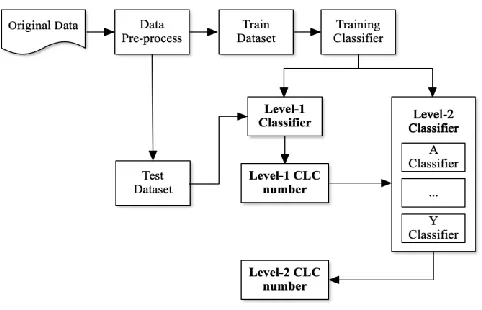
classifiers. The stage of test performs a test on the two-layer classifier with the test dataset, and finally obtains the classification result (Figure 1.).
Figure 1. An overview of hierarchical classification system.
3.1 Data Pre-process
The original literature should be cleaned and transformed to required format for training. Firstly, extracting key fields from the original literature, such as title, summary, and the CLC number. The CLC number is the label of the literature. After word segmentation and stop words removing, the data will be transformed to required format for fastText training, and the format of each text record is: "__label__, text", then the text records will be saved in a file of '.txt' format for the training requirements.
3.2 Training and testing Classifier
After the data pre-process, all the literature data will be divided into training dataset and test dataset according to a certain proportion (the value of proportion will be determined in the experiment). And the training data will be used as the input parameter of the text classification interface, provided by fastText, to train the classifier.
wrong, then final result must also be wrong. Thus, the following design method are proposed.
If the number of level-1 category in the training dataset is 𝑁, then after training, 𝑁 + 1 classifiers are obtained. The level-1 classifier corresponds to the first layer classifier, denoted as 𝐿1, and the level-2 classifier corresponds to the second layer classifier, denoted as 𝐿2−𝑖(𝑖 = 1,2,3, … , 𝑛).
Suppose document 𝐷 is classified by 𝐿1 to obtain several categories 𝐶𝑖(𝑖 = 1,2,3, … , 𝑛), then 𝑃1(𝐶𝑖) indicates the probability of prediction as 𝐶𝑖.When the document 𝐷 is classified into several categories 𝐶𝑖 by 𝐿1, the 𝑚1 categories whose probability is ranked in the top-m1 are selected, and the document 𝐷 is respectively sent to the corresponding 𝑚1 level-2 classifiers, and then each 𝐿2−𝑖 Select the 𝑚2 categories with the highest probability. This finally results in 𝑚1∗ 𝑚2 classification results, and then we select the category with the highest probability, which is the final classification result. Therefore, the mapping formula for defining 𝐶𝑘−𝑚𝑎𝑥 and prediction probability is shown in (1):
1 2 1
= ( j( ))
k max j m m k
C f max P C
(1)
Where 𝑗 represents one of 𝑚1∗ 𝑚2 results, and 𝑃𝑗(𝐶𝑘) represents the probability that document 𝐷 is assigned to 𝐶𝑘 under result 𝑗. The method is also known as M-double maximum class (MDMC) algorithm.
4. EXPERIMENT
4.1 Experiment Data
The experimental data is derived from the actual text classification project, which is process of training nearly 510,000 Chinese literature and getting a classifier, and then automatically indexing the tertiary CLC number for new literature.
After pre-processing dataset, the data of 21 first categories and 932 tertiary categories is obtained. Then the dataset is divided into train dataset and test dataset according to the rate of 5:2.
4.2 Experiment Results
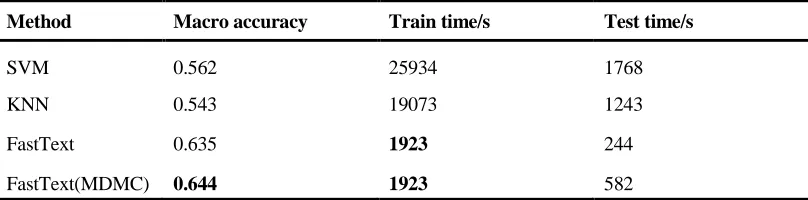
dataset. TABLE I lists the macro accuracy of hierarchical classification test and the time overhead of training and testing.
Figure 2. Test results of hierarchical classification. We implement the test with three classification algorithms on 21 categories of test dataset, the X-axis indicates the 21 categories and the Y-axis
indicates the range of accuracy.
TABLE I. THE CONTRAST OF MACRO ACCURACY AND TTRAIN TIME. THE FASTTEX/T WITH MDMC METHOD ACHIEVES THE BEST MACRO ACCURACY OF 0.644.
Method Macro accuracy Train time/s Test time/s
SVM 0.562 25934 1768
KNN 0.543 19073 1243
FastText 0.635 1923 244
FastText(MDMC) 0.644 1923 582
From the results in Figure 2, there is a little difference between the accuracy of SVM model and KNN model, but the accuracy of fasttext model in almost all categories is higher than SVM and KNN model.
[image:6.612.96.500.451.551.2]time of fastText model is almost 10 times faster than KNN and much more 10 times faster than SVM. Meanwhile, it also shows the test time of fastText is faster. It demonstrates that the fastText model is more efficient than SVM and KNN.
5. CONCLUSIONS
Aiming at the huge number of categories under the classification system of the CLC system, this paper proposed a hierarchical classification algorithm based on the fastText. In addition, the paper designs an optimization algorithm called MDMC algorithm to solve the problem of error transfer between hierarchical levels. Experiment shows that the performance of hierarchical classifiers based on fastText algorithm is improved compared some machine learning algorithm, and the accuracy of hierarchical classification is improved by using optimization algorithm.
ACKNOWLEDGEMENTS
This work is mainly supported by the Program of the China Knowledge Centre for Engineering Science and Technology (CKCEST-2019-2-2) and the Sentiment Analysis Research Based on Barrage Comments and User Reviews (QN2019-11).
REFERENCES
1. L. He, H. Hou, Z. Bai and X. Zhang. 2006. “Automatic Multi-layer Classification Method Based on Integration of Machine Learning and Indexing Experience,” Journal of the China Society for Scientific and Technical Information, 25(6), 39-43.
2. S. Li, J. Ma, Y. Zhao and J. Lei. 2006. “The study on automatic classification of digital documents of scientific papers,” Journal of Shandong University, 41(3), 81-84.
3. Y. Zhang and C. Xue. 2013. “The Construction of Multiple-layer Chinese Knowledge Database for Text Classification Based on Chinese Library Classification,” National Knowledge Organization and Knowledge Link Academic Exchange, 13-18.
4. L. Guo. 2017. “Study of Automatic Classification of Literature Based on Convolution Neural Network,” Library and Information, 37(06), 96-103.
5. Krizhevsky, A., Sutskever, I., & Hinton, G. E. 2012. “ImageNet Classification with Deep Convolution,” neural information processing systems, 141(5), 1097-1105.
6. L. Dai and K. Jiang. 2018. “Chinese Text Classification Based on fastText,” Computer and Modernization, 273(5), 39-44+89.
7. J. Su, B. Zhang and X. Xu. 2006. “Advances in Machine Learning Based Text Categorization,” Journal of Software, 17(9), 1848-1859.
8. S. Ji and B. Li. 2008. “Chinese Text Categorization Algorithm Based on SVM,” Journal of Chongqing Institute of Technology, 22(7), 84-87.
10.Ling W, Luís T, Marujo L, et al. 2015. “Finding function in form: Compositional character models for open vocabulary word representation,” Proceedings of the 2015 Conference on Empirical Methods in Natural Language Processing, 1520–1530.
11.Himon G E. 1986. “Learning distributed representations of concepts,” Proceedings of CogSci, 1-12.
12.Mikolov T, Chen K, Corrado G, et a1. 2013. “Efficient Estimation of Word Representations in Vector Space,” ICLR 2013.
13.Pennington J, Socher R, Manning C. 2014. “Glove: Global vectors for word representation,” Proceedings of the 2014 conference on empirical methods in natural language processing. 1532-1543.