PARIS RESEARCH LABORATORY
d i g i t a l
November 1992 Hassan A¨ıt-Kaci
A Feature Constraint System
for Logic Programming
with Entailment
Hassan A¨ıt-Kaci Andreas Podelski
Publication Notes
This report is a revised version of a paper that appeared in the Proceedings of the International Conference on Fifth Generation Computer Systems (FGCS) which took place in Tokyo, Japan, in June 1992, and also as DFKI Research Report RR-92-17. This full version will appear as a journal article in the forthcoming special issue of Theoretical Computer Science on the fifth FGCS edited by Shigeki Goto and Ken Satoh.
Hassan A¨ıt-Kaci’s and Andreas Podelski’s address is: Digital Equipment Corporation, Paris Research Laboratory, 85, avenue Victor Hugo, 92563 Rueil-Malmaison Cedex, France (email:
[email protected]@prl.dec.com).
Gert Smolka’s address is: German Research Center for Artificial Intelligence (DFKI) and Universit¨at des Saarlandes, Stuhlsatzenhausweg 3, 6600 Saarbr¨ucken 11, Germany (email:
c
Digital Equipment Corporation and DFKI 1992
This work may not be copied or reproduced in whole or in part for any commercial purpose. Permission to copy in whole or in part without payment of fee is granted for non-profit educational and research purposes provided that all such whole or partial copies include the following: a notice that such copying is by joint permission of the Paris Research Laboratory of Digital Equipment Centre Technique Europe (Rueil-Malmaison, France) and of the German Research Center for Artificial Intelligence (Saarbr¨ucken, Germany); an acknowledgement of the authors and individual contributors to the work; and all applicable portions of the copyright notice. All rights reserved.
We introduce a constraint system called FT. This system offers a theoretical and practical alternative to the usual Herbrand system of constraints over constructor trees. Like Herbrand, FT provides a universal data structure based on trees. However, the trees of FT (called feature trees) are more general than the constructor trees of Herbrand, and the constraints of FT are of finer grain and of different expressiveness. The essential novelty of FT is provided by functional attributes called features which allow representing data as extensible records, a more flexible way than that offered by Herbrand’s fixed arity constructors. The feature tree structure determines an algebraic semantics for FT. We establish a logical semantics thanks to three axiom schemes presenting the first-order theory FT. We propose using FT as a constraint system for logic programming. We provide a test for constraint unsatisfiability, and a test for constraint entailment. The former corresponds to unification and the latter to matching. The combination of the two is needed for advanced control mechanisms. We use the concept of relative simplification of constraints, a normalization process that decides entailment and unsatisfiability simultaneously. The two major technical contributions of this work are: (1) an incremental system performing relative simplification for FT that we prove to be sound and complete; and (2) a proof showing that FT satisfies independence of negative constraints, the property that conjoined negative constraints may be handled independently.
R ´esum ´e
Keywords
Constraint systems, constructor trees, feature trees, unification, matching, constraint entailment, logic programming, committed-choice languages, residuation, coroutining.
Acknowledgements
Gert Smolka was supported in part by the Bundesminister f¨ur Forschung und Technologie under contract ITW 9105. We wish to thank Kathleen Milsted and Ralf Treinen for their constructive comments. We are also grateful to the anonymous referee for TCS who provided `a propos comments and suggestions in an extensive review. Last but not least, we thank yet and again Jean-Christophe Patat, PRL’s librarian, for his careful proofreading.
2 Feature Trees and Constraints 4
3 Basic Simplification 7
4 Entailment, Independence and Negation 10
5 Entailment Simplification 12
6 Conclusion 17
1 Introduction
An important structural property of many logic programming systems is the fact that they factorize into a constraint system and a relational facility. Colmerauer’s Prolog II [10] is an early language design making explicit use of this property. CLP (Constraint Logic Programming [12]), ALPS [18], CCP (Concurrent Constraint Programming [23]), and KAP (Kernel Andorra Prolog [11]) are recent logic programming frameworks that exploit this property to its full extent by being parameterized with respect to an abstract class of constraint systems. The basic operation these frameworks require of a constraint system is a test for unsatisfiability. In addition, ALPS, CCP, and KAP require a test for entailment between constraints, which is needed for advanced control mechanisms such as delaying, coroutining, synchronization, committed choice, and deep constraint propagation. LIFE [5, 6], formally a CLP language, employs a related, but limited, suspension strategy to enforce deterministic functional application. Given this situation, constraint systems are a central issue in research on logic programming.
The constraint systems of most existing logic programming languages are variations and extensions of Herbrand [16], the constraint system underlying Prolog. The individuals of Herbrand are trees corresponding to ground terms, and the atomic constraints are equations between terms. Seen from the perspective of programming, Herbrand provides a universal data structure as a logical system.
This paper presents a constraint system FT, which we feel is an intriguing alternative to Herbrand both theoretically and practically. Like Herbrand, FT provides a universal data structure based on trees. However, the trees of FT (called feature trees) are more general than the trees of Herbrand (called constructor trees), and the constraints of FT are of a finer grain and of different expressiveness. The essential novelty of FT is due to functional attributes called features, which provide for record-like descriptions of data avoiding the overspecification intrinsic in Herbrand’s constructor-based descriptions. For the special case of constructor trees, features amount to argument selectors for constructors.
Constructor trees are useful for structuring data in modern symbolic programming languages; e.g., Prolog and ML. This gives the more flexible feature trees an interesting potential. More precisely, feature trees model extensible record structures. They form the semantics of record calculi like [1], which are used in symbolic programming languages [5] and in computational linguistics (for example, see [3, 24] and the book [8]). Generally, these extensible record structures allow hierarchical representation of partial knowledge. They lend themselves to object-oriented programming techniques [3].
Let us suppose that we want to say thatxis a wine whose grape is riesling and whose color iswhite. To do this in Herbrand, one may write the equation:
x=wine(riesling;white;y1;. . .;yn)
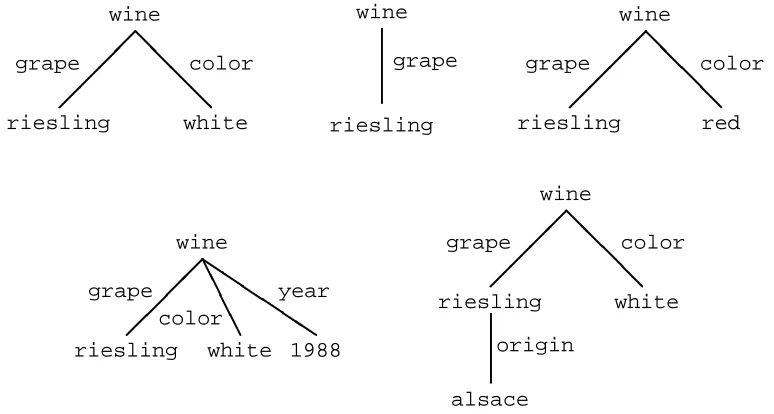
2 Hassan A¨ıt-Kaci, Andreas Podelski, and Gert Smolka @ @ @ @ white color grape riesling wine grape riesling wine @ @ @ @ red color grape riesling wine Q Q Q Q Q Q A A A A 1988 year color white grape riesling wine @ @ @ @ alsace origin white color grape riesling wine
Figure 1: Examples of Feature Trees.
arguments y1;. . .;yn carry the remaining “features” of the chosen representation of wines. The obvious difficulty with this description is that it says more than we want to say; namely, that the constructorwinehas n +2arguments and that the “features”grapeandcolorare represented as the first and the second argument.
The constraint system FT avoids this overspecification by allowing the description
x:wine[grape)riesling; color)white] (1)
saying thatxhas sort wine, its featuregrapeisriesling, and its featurecoloriswhite. Nothing is said about other features of x, which may or may not exist.
The individuals of FT are feature trees. A feature tree is a possibly infinite tree whose nodes are labeled with symbols called sorts, and whose edges are labeled with symbols called features. The labeling with features is deterministic in that all edges departing from a node must be labeled with distinct features. Thus, every direct subtree of a feature tree can be identified by the feature labeling the edge leading to it. The constructor trees of Herbrand can be represented as feature trees whose edges are labeled with natural numbers indicating the corresponding argument positions.
Examples of feature trees are shown in Figure 1. All but the second and third feature tree in Figure 1 satisfy the description (1).
The constraints of FT are ordinary first-order formulae taken over a signature that accommo-dates sorts as unary predicates and features as binary predicates. Thus the description (1) is actually syntactic sugar for the formula:
wine(x)^9y(grape(x;y)^riesling(y))
^9y(color(x;y) ^white(y)):
The set of all rational feature trees is made into a corresponding logical structureT by letting
A(x) hold if and only if the root of x is labeled with the sort A, and letting f(x;y)hold if and only if x has y as direct subtree via the feature f . The feature tree structureT fixes an algebraic semantics for FT.
We will also establish a logical semantics, which is given by three axiom schemes fixing a first-order theory FT. Backofen and Smolka [7] show thatT is a model of FT and that FT is in fact a complete theory, which means that FT is exactly the theory induced byT. However, we will not use the completeness result in the present paper, but show explicitly that entailment with respect toT is the same as entailment with respect to FT.
The two major technical contributions of this paper are (1) an incremental simplification system for entailment that is proven to be sound and complete, and (2) a proof showing that the “independence of negative constraints” property [9, 16, 17] holds for FT.
The incremental entailment simplification system is the prerequisite for FT’s use with either of the constraint programming frameworks ALPS, CCP, KAP or LIFE mentioned at the beginning of this section. Roughly, these systems are concurrent thanks to a new effective discipline for procedure parameter-passing that we could describe as “call-by-constraint-entailment” (as opposed to Prolog’s call-by-unification).
The independence property is important since it means that negative constraints on feature trees can be solved (exactly like in Colmerauer’s work on disequations over infinite trees [9]). Namely, thanks to independence, a conjunction with more than one negated constraints
^:1 ^. . .^:n can be solved by testing separately each negated constraint i for entailment, for i = 1;. . .;n. This, of course, is done by our simplification system for entailment.
One origin of FT is A¨ıt-Kaci’s -term calculus [1], which is at the heart of the programming languageLOGIN[3] and further extended in the languageLIFE[5] with functions over feature structures thanks to a generalization of the concept of residuation of Le Fun [4].1 Other precursors of FT are the feature descriptions found in unification grammars [15, 14] developed for natural language processing, and also the formalisms of Mukai [19, 20] (for a thorough survey of precursors in this field, cf., [8]). These early feature structure formalisms were presented in a non logical form. Major steps in the process of their understanding and logical reformulation are the articles [22, 25, 13, 24]. Feature trees, the feature tree structureT, and the axiomatization ofT were first given in [7]. The technique of relative simplification of constraints was first introduced and used in [6] to explain the behavior of functions as passive constraints in LIFE.
The paper is organized as follows. Section 2 defines the basic notions and discusses the differences in expressivity between Herbrand and FT. Section 3 gives a basic simplification system that decides satisfiability of positive constraints. The material of Section 4 is not limited
4 Hassan A¨ıt-Kaci, Andreas Podelski, and Gert Smolka
to FT but discusses the notion of incremental entailment checking and its connection with the independence property and negation. Section 5 gives the entailment simplification system, proves it sound, complete and terminating, and also proves that FT satisfies the independence property.
2 Feature Trees and Constraints
To give a rigorous formalization of feature trees, we first fix two disjoint alphabetsSandF, whose symbols are called sorts and features, respectively. The letters A, B, C will always denote sorts, and the letters f , g, h will always denote features. Words overF are called paths. The concatenation of two paths v and w results in the path vw. The symbol"denotes the empty path, v"="v=v, andF
?
denotes the set of all paths.
A tree domain is a nonempty set DF ?
that is prefix-closed; that is, if vw2D, then v2D. Thus, it always contains the empty path.
A feature tree is a mapping t : D!Sfrom a tree domain D into the set of sorts. The paths in the domain of a feature tree represent the nodes of the tree; the empty path represents its root. The letters s and t are used to denote feature trees.
When convenient, we may consider a feature tree t as a relation, i.e., t F ?
S, and write
(w;A)2 t instead of t(w) =A. (Clearly, a relation t F ?
S is a feature tree if and only if D = fw j 9A:(w;A) 2 tg is a tree domain and t is functional; that is, if (w;A) 2 t and
(w;B) 2t, then A = B.) As relations, i.e., as subsets ofF ?
S, feature trees are partially ordered by set inclusion. We say that s is smaller than (or, is a prefix-subtree of; or, subsumes; or, approximates) t if st.
The subtree wt of a feature tree t at one of its nodes w is the feature tree defined by (as a relation):
wt := f(v;A)j(wv;A)2tg:
If D is the domain of t, then the domain of wt is the set w 1D=fvjwv 2Dg. Thus, wt is given as the mapping wt : w 1D!S defined on its domain by wt(v)=t(wv). A feature tree
s is called a subtree of a feature tree t if it is a subtree s=wt at one of its nodes w, and a direct subtree if w2F.
A feature tree t with domain D is called rational if (1) t has only finitely many subtrees and (2) t is finitely branching; that is: for every w 2D, wF \D= fwf 2D jf 2 Fg is finite. Assuming (1), the condition (2) is equivalent to saying that there exist finitely many features f1;. . .;fnsuch that Dff1;. . .;fng
? .
Constraints over feature trees will be defined as first-order formulae. We first fix a first-order signatureS]F by taking sorts as unary and features as binary relation symbols. Moreover, we fix an infinite alphabet of variables and adopt the convention that x, y, z always denote variables. Under this signature, every term is a variable and an atomic formula is either a feature constraint xfy (f(x;y) in standard notation), a sort constraint Ax (A(x) in standard
notation), an equation x :
=y,?(“false”), or>(“true”). Compound formulae are obtained as usual by the connectives^, _,!, $, :and the quantifiers9and8. We use ˜9and ˜8to denote the existential and universal closure of a formula, respectively. Moreover,V()is taken to denote the set of all variables that occur free in a formula. The lettersand will always denote formulae. In the following we will not make a distinction between formulae and constraints; that is, a constraint is a formula as defined above.
S]F-structures and validity of formulae inS]F-structures are defined as usual. Since we consider onlyS]F-structures in the following, we will simply speak of structures. A theory is a set of closed formulae. A model of a theory is a structure that satisfies every formula of the theory. A formulais a consequence of a theory T (T j=) if ˜8holds in every model of T. A formulais satisfiable in a structure Aif ˜9 holds inA. Two formulae , are
equivalent in a structureAif ˜8($ )holds inA. We say that a formulaentails a formula in a structureA [theory T] and write j=
A [
j=T ] if ˜8 ( ! ) holds in A; i.e.,
Aj=8(˜ ! )[is a consequence of T; i.e., FT j=8(˜ ! )]. A theory T is complete if for every closed formulaeitheror:is a consequence of T.
The feature tree structureT is theS]F-structure defined as follows:
the domain ofT is the set of all rational feature trees;
t2A T
if and only if t(")=A (t’s root is labeled with A);
(s;t)2f T
if and only if f 2Dsand t=fs (t is the subtree of s at f ).
Roughly, the Herbrand constraint y=A(x1;x2), where A is a binary constructor symbol, and the feature constraint Ay^y1x1^y2x2, where A is a sort and1;2;. . . are features, correspond to each other. (We will see later that this correspondance is a formal one for satisfiability, but nor for entailment.) Now it becomes clear what we mean by saying that feature constraints are finer grained. Also, feature trees are more general in the sense that they satisfy more constraints. For example, no constructor tree y satisfies both y=A(x1;x2)and y=A(x1;x2;x3).
Next we discuss the expressivity of our constraints with respect to feature trees (that is, with respect to the feature tree structureT) by means of examples. The constraint:
:9y(xfy)
says that x has no subtree at f ; that is, that there is no edge departing from x’s root that is labeled with f . To say that x has subtree y at path f1fn, we can use the constraint:
9z19zn 1(xf1z1^z1f2z2^. . .^zn 1fny):
Now let us look at statements we cannot express. One simple unexpressible statement is “y is a subtree of x” (that is, “9w: y =wx”). Moreover, we cannot express that x is smaller than
y. Finally, if we assume that the alphabetF of features is infinite, we cannot say that x has subtrees at features f1;. . .;fnbut no subtree at any other feature. In particular, we then cannot say that x is a primitive feature tree; that is, has no proper subtree.
6 Hassan A¨ıt-Kaci, Andreas Podelski, and Gert Smolka
(Ax1) 8x8y8z(xfy^xfz!y :
=z) (for every feature f )
(Ax2) 8x(Ax^Bx!?) (for every two distinct sorts A and B).
The first axiom scheme says that features are functional and the second scheme says that sorts are mutually disjoint. Clearly,T is a model of FT0. Moreover, FT0 is incomplete (for instance,9x(Ax)holds inT but not in other models of FT0). We will see in the next section that FT0plays an important role with respect to basic constraint simplification.
Next we introduce some additional notation needed in the rest of the paper. This notation will also allow us to state a third axiom scheme that, as shown in [7], extends FT0 to a complete axiomatization ofT.
Throughout the paper we assume that conjunction of formulae is an associative and commu-tative operator that has>as neutral element. This means that we identify^( ^ )with
^( ^), and ^>with (but not, for example, xfy^xfy with xfy). A conjunction of atomic formulae can thus be seen as the finite multiset of these formulae, where conjunction is multiset union, and>(the “empty conjunction”) is the empty multiset. We will write (or 2, if is an atomic formula) if there exists a formula
0
such that ^ 0
=.
We will use an additional atomic formula xf"(“f undefined on x”) that is taken to be equivalent to:9y(xfy), for some variable y (other than x).
Only for the formulation of the third axiom we introduce the notion of a solved-clause, which is either > or a conjunctionof atomic formulae of the form xfy, Ax or xf" such that the following conditions are satisfied:
1. if Ax2and Bx2, then A=B;
2. if xfy2and xfz2, then y=z;
3. if xfy2, then xf"2=.
Given a solved-clause, we say that a variable x is dependent inifcontains a constraint of the form Ax, xfy or xf", and useD V()to denote the set of all variables that are dependent in.
The theory FT is obtained from FT0by adding the axiom scheme:
(Ax3) 8˜ 9X (for every solved-clauseand X=D V()). Theorem 1 The feature tree structureT is a model of the theory FT.
Proof: We will only show thatT is a model of the third axiom. Let X be the set of dependent variables of the solved-clause, X =D V(). Letbe anyT-valuation defined onV() X; we write the tree(y)as ty. We will extendon X such thatT;j=.
Given x2X, we define the “punctual” tree tx=f(";A)g, where A2Sis the sort such that Ax2, if it exists, and arbitrary, otherwise. Now we are going to use the notion of tree sum of Nivat [21], where w 1t=f(wv;A)j(v;A)2tg(“the tree t translated by w”), and we define:
(x)= ]
fw
1t yjx
w
;y for some y2V(); w2F ?
g:
Here the relation;w is given by: x "
;x, and x
wf
;y if x
w
;y 0
and y0
fy2, for some y 0
2V()and some f 2F. Since:
(x)= [
fw
1
(y)j . . .g
and, for a node w of(x), w(x)=(y), it follows that(x)is a rational tree and thatT;j=.
For another proof of this theorem see [7], which also proves that FT is a complete theory if the alphabets of sorts and features are infinite.
A practical motivation for the assumption on the infiniteness ofF (and of S as well) is the need to account for dynamic record field updates. It turns out that this semantical point of view has advantages in efficiency as well. Thus, the algorithms we present in this paper for entailment and for solving negative constraints on feature trees rely on the infiniteness ofF andS.
3 Basic Simplification
A basic constraint is either?or a possibly empty conjunction of atomic formulae of the form
Ax, xfy, and x :
= y. The following five basic simplification rules constitute a simplification system for basic constraints, which, as we will see, decides whether a basic constraint is satisfiable inT.
1. xfy^xfz^
xfz^y : =z^
2. Ax
^Bx^ ?
A6=B
3. Ax^Ax^
Ax^
4. x : =y^
x :
=y^[x y]
x2V()and x6=y
5. x : =x^
8 Hassan A¨ıt-Kaci, Andreas Podelski, and Gert Smolka
The notation [x y] is used to denote the formula that is obtained from by replacing every occurrence of x with y. We say that a constraint simplifies to a constraint by a simplification ruleif
is an instance of. We say that a constraintsimplifies to a constraint if either= orsimplifies to in finitely many steps each licensed by one of the five simplification rules given above.
Example 3.1 In order to check whether the two feature descriptions x[f ) u : A] and
y[f ) v : A] are unifiable, in the sense of [3], we will simplify the basic constraint
xfu^yfv^Au^Av^z : =x^y
: =z.
The following basic simplification chain, leads to a solved constraint (which, as shown in [24, 5], exhibits unifiability):
xfu^yfv^Au^Av^z : =x^y
: =z
by Rule 4 ) xfu^yfv^Au^Av^z : =x^y
: =x
by Rule 4 ) xfu^xfv^Au^Av^ z : =x^y
: =x
by Rule 1 ) xfv^Au^Av^ u : =v^z
: =x^y
: =x
by Rule 4 ) xfv^Av^Av^ u : =v^z
: =x^y
: =x
by Rule 3 ) xfv^Av^ u : =v^z
: =x^y
: =x
Using the same steps up to the last one, the constraint xfu^yfv^Au^Bv^z : =x^y
: =z simplifies to?(in the last step, Rule 2 instead of Rule 3 is applied).
Proposition 1 If the basic constraintsimplifies to , then FT0j=$ .
Proof: The rules 3, 4 and 5 perform equivalence transformations with respect to every structure. The rules 1 and 2 correspond exactly to the two axiom schemes of FT0 and perform equivalence transformations with respect to every model of FT0.
We say that a basic constraintbinds a variable x to y if x :
=y 2and x occurs only once in . At this point it is important to note that we consider equations as ordered; that is, assume that x :
=y is different from y :
=x if x6=y. We say that a variable x is eliminated, or bound by , ifbinds x to some variable y.
Proposition 2 The basic simplification rules are terminating.
Proof: First observe that the simplification rules do not add new variables and preserve eliminated variables. Furthermore, Rule 4 increases the number of eliminated variables by one. Hence we know that if an infinite simplification chain exists, we can assume without loss of generality that it only employs the Rules 1, 3 and 5. Since Rule 1 decreases the number of feature constraints “xfy”, which is not increased by Rules 3 and 5, we know that if an infinite simplification chain exists, we can assume without loss of generality that it only employs Rules 3 and 5. Since this is clearly impossible, an infinite simplification chain cannot exist.
A basic constraint is called normal if none of the five simplification rules applies to it. A constraint is called a normal form of a basic constraintifcan be simplified to and is normal. A solved constraint is a normal constraint that is different from?.
So far we know that we can compute for any basic constrainta normal form by applying the simplification rules as long as they are applicable. Although the normal form may not be unique for, we know thatand are equivalent in every model of FT0. It remains to show that every solved constraint is satisfiable inT.
Every basic constrainthas a unique decomposition=N^Gsuch thatNis a possibly empty conjunction of equations “x :
=y” and andGis a possibly empty conjunction of feature constraints “xfy” and sort constraints “Ax”. We callN the normalizer and andGthe graph of.
Proposition 3 A basic constraint6=?is solved if and only if the following conditions hold:
1. an equation x :
=y appears inonly if x is eliminated in;
2. the graph ofis a solved clause;
3. no primitive constraint appears more than once in.
Proposition 4 Every solved constraint is satisfiable in every model of FT.
Proof: Letbe a solved constraint andAbe a model of FT. Then we know by axiom scheme Ax3 that the graphGof a solved constraintis satisfiable in an FT-modelA. A variable valuation intoAsuch thatA;j=Gcan be extended on all eliminated variables simply by(x)=(y)if
x :
=y2, such thatA;j=.
The following theorem states that basic simplification yields a decision procedure for satisfia-bility of basic constraints.
Theorem 2 Let be a normal form of a basic constraint. Thenis satisfiable inT if and
only if 6=?.
Proof: Sinceand are equivalent in every model of FT0 andT is a model of FT0, it suffices to show that is satisfiable inT if and only if 6=?. To show the nontrivial direction, suppose 6=?. Then is solved and we know by the preceding proposition that is satisfiable in every model of FT. SinceT is a model of FT, we know that is satisfiable inT.
10 Hassan A¨ıt-Kaci, Andreas Podelski, and Gert Smolka
Theorem 3 For every basic constraintthe following statements are equivalent:
T j=9˜ , 9modelAof FT0: Aj=9˜ , FT j=9:˜
Proof: The implication1)2holds sinceT is a model of FT0. The implication3)1follows from the fact thatT is a model of FT. It remains to show that2)3.
Let be satisfiable in some model of FT0. Then we can apply the simplification rules toand compute a normal form such that and are equivalent in every model of FT0. Hence is satisfiable in some model of FT0. Thus 6=?, which means that is solved. Hence we know by the preceding proposition that is satisfiable in every model of FT. Sinceand are equivalent in every model of FT0FT, we have thatis satisfiable in every model of FT.
4 Entailment, Independence and Negation
In this section we discuss some general properties of constraint entailment. This prepares the ground for the next section, which is concerned with entailment simplification in the feature tree constraint system.
Throughout this section we assume that A is a structure, and are formulae that can be interpreted inA, and that X is a finite set of variables.
We say thatdisentailsinAifentails:inA. Ifis satisfiable inA, thencannot both entail and disentail9XinA. We say thatdeterminesinAifeither entails or disentails
inA.
Given , and X, we want to determine in an incremental manner whether entails or disentails9X. Typically, will not determine9Xwhen9Xis considered first, but this may change when is strengthened to^
0
. To this end, we use the concept of relative simplification of constraints first introduced in [6]. The basic idea leading to an incremental entailment checker is to simplifywith respect to (relatively to) the context and the local
variables X. Given, X and, simplification must yield a formula such that:
j= A
9X$9X :
The following facts provide some evidence that this is the appropriate invariant for entailment simplification.
Proposition 5 Let j= A
9X$9X . Then:
1. j= A
9Xif and only ifj= A
9X ;
2. j= A
:9Xif and only ifj= A
:9X ;
3. if =?, then j= A
:9X;
4. if 9X holds in inA, then j= A
9X.
Statements 1 and 2 say that it does not matter whether entailment and disentailment are decided for or . Statement 3 gives a local condition for disentailment, and Statement 4 gives a local condition for entailment. The entailment simplification system for feature trees given in the next section will in fact decide entailment and disentailment by simplifying such that the condition of Statement 4 is met in the case of entailment, and that the condition of Statement 3 is met in the case of disentailment.
In practice, one can ensure by variable renaming that no variable of X occurs in . The next fact says that then it suffices if entailment simplification respects the more convenient invariant:
Aj=^$^ :
This is the invariant respected by our system (cf. Proposition 8).
Proposition 6 Let X\V()=;. Then:
1. if Aj=^$^ , then j= A
9X$9X ;
2. j= A
:9Xif and only if^ is unsatisfiable inA.
That is, the conjunction^is satisfiable if and only if either entails9X, or it does not determine9X.
The independence of negative constraints [9, 16, 17] is an important property of constraint systems. If it holds, simplification of conjunctions of positive and negative constraints can be reduced to entailment simplification of conjunctions of positive constraints. In order to see why, observe that^:1^. . .^nis unsatisfiable if and only ifentails1_. . ._n.
To define the independence property, we assume that a constraint system is a pair consisting of a structureAand a set of basic constraints. From basic constraints one can build more complex constraints using the connectives and quantifiers of predicate logic. We say that a constraint system satisfies the independence property if:
j= A
9X11_. . ._9Xnnif and only if9i: j= A
9Xii for all basic constraints,1;. . .;nand all finite sets of variables X1;. . .;Xn.
Proposition 7 If a constraint system satisfies the independence property, then the following statements hold (,and1;. . .;nare basic constraints):
1. ^:9X11^. . .^:9Xnn unsatisfiable inAif and only if9i: j= A
9Xii;
2. if^:9X11^. . .^:9Xnn is satisfiable inA, then^:9X11^. . .^:9Xnnj= A
9X
if and only ifj= A
12 Hassan A¨ıt-Kaci, Andreas Podelski, and Gert Smolka
5 Entailment Simplification
We will now use the general setting of the previous section for the specific case of feature tree constraints. Throughout this section we assume thatis a solved constraint and X is a finite set of variables not occurring in. We will callthe context, the variables in X local, and all other variables global. Relative simplification is always carried out with respect to the context.
If T is a theory andand are possibly open formulae, we writej=T (read: entails in T) if ˜8(! )holds in T.
The next theorem expresses the same observations stated before Theorem 3 regarding disentailment rather than satisfiability.
Theorem 4 For every basic constraint, the following equivalences hold:
j= T
:9Xif and only ifj=FT
0 :9Xif and only ifj=FT :9X:
Proof: Implication “2)3” holds since FT0FT. Implication “3)1” holds sinceT is a model of
FT. To show implication “1)2”, supposej= T
:9X. Then we know by Proposition 6 that^ is unsatisfiable inT. Thus we know by Theorem 3 that^is unsatisfiable in every model of FT0. Hence we know by Proposition 6 thatj=FT
0:9X.
For every basic constraintand every variable x we define:
x :=
y if x :
=y2and x is eliminated;
x otherwise. A basic constraint is X-oriented if x
:
= y 2 always implies x 2 X or y 62 X. A basic constraintis pivoted if x
:
=y2implies that x is eliminated in (and then y is a “pivot”). The following entailment simplification rules simplify basic constraints to basic constraints with respect to a contextand local variables X.
1. xfu^
u : =v^
yfv2^; y=x
2.
u :
=v^ 8 > <
> :
xfu^yfv;
x=y; u6=v; X-oriented and pivoted
3. ?
Ax^By^; x=y; A6=B
4. Ax^
Ay2^; y=x
5. x : =y^
x :
=y^[x y] (
x6=y; x2V();
(x2X or y2= X)
6. x : =y^
y : =x^
x2= X; y2X
7.
[x y]
x :
=y2; x2V()
8. x : =x^
We say that a basic constraintsimplifies to a constraintwith respect toand X if= or
simplifies to in finitely many steps each licensed by one of the eight simplification rules given above. The notions of normal and normal form with respect toare defined accordingly.
Example 5.1 Assume, in the context of functions in LIFE [6] (the case of guarded Horn clauses [18] is quite similar), that a function fun is defined in the form fun(z;z)!. . ., and that it is called as fun(x[f ) u : A];y[f ) v : B]). That is, the actual parameter pair of feature descriptions(x[f ) u : A];y[f ) v : B]) has to be tested upon matching of (and incompatibility with) the formal parameter pair (z;z). (This is in order to know whether that function call fires, fails, or residuates.) As shown in [24, 5], this corresponds to testing whether the context=xfu^yfv^Au^Bv entails the guard9z(x
: =z^y
: =z). Let X=fzg. Then we have the following simplification chain with respect toand X:
x : =z^y
: =z
by Rule E6 ) ;X z
: =x^y
: =z
by Rule E5 ) ;X z
: =x^y
: =x
by Rule E2 ) ;X u
: =v^z
: =x^y
: =x
by Rule E3 ) ;X
?
Let us now take as context ˜ = xfu^yfv^Au. Then ˜ = u : = v^z
: = x^y
: = x is normal with respect to ˜and X. We shall see that this normal form tells us that ˜ does not determine ˜. If ˜gets strengthened either to ˜^Bv (as above), or to ˜^x
:
=y, then the strengthened context does determine: it disentails in the first and entails in the second case. The basic normal form of ˜^x
:
=y is yfu^Au^v : =u^x
:
=y; with respect to this context
˜
simplifies to z : =y.
In the previous example,=z : = x^y
:
=x simplifies to1= u : =v^z
: = x^y
:
14 Hassan A¨ıt-Kaci, Andreas Podelski, and Gert Smolka
follows:
^
= xfu^yfv^Au^Bv ^z : =x^y
: =x
by Rule B4 ) xfu^xfv^Au^Bv ^z : =x^y
: =x
by Rule B1 ) xfv^Au^Bv ^u : =v^z
: =x^y
: =x = 0 ^ 0 1
We observe that^1is equal to 0
^ 0
1, modulo renaming y by1y=x and u by1u=v, and modulo the repetition of xfv.
Lemma 1 Letsimplify to1 with respect to and X, not using Rule E6 (in an entailment
simplification step). Then^ simplifies to some 0
^ 0
1 which is equal to ^1 up to
variable renaming and repetition of conjuncts.
Proof: Clearly, each entailment simplification rule, except for E6, corresponds directly to a basic simplification rule (namely, E1 and E2 to B1, E3 to B2, E4 to B3, E5 and E7 to B4, and E8 to B5). If the application of the entailment simplification rule torelies on a condition of the formx=y orx=y where x6=x or y6=y, then x
:
=x2or y :
=y2, and Rule B4 is first applied to ^, eliminating x byx (y byy).
When comparing^1and 0
^ 0
1, renamings take account of these variable eliminations. Note
that, if the rule applied tois E2, then 0
has one feature constraint xfv less than— which, after renaming, has a repetition of exactly this constraint.
Proposition 8 Ifsimplifies to with respect toand X, then^and^ are equivalent
in every model of FT0.
Proof: Follows from Lemma 1 and Proposition 1.
Proposition 9 The entailment simplification rules are terminating, providedand X are fixed.
Proof: First we strengthen the statement by weakening the applicability conditionsy = x in Rules E1 and E4 toy=x. Then from Lemma 1 follows: (*) Each entailment simplification rule applies to1with respect toand X if and only if it applies to
0
1with respect to 0
and X — except possibly for E5, when the corresponding variable has already been eliminated in an “extra” basic simplification step.
If 0
has one conjunct of the form xfu less than, then (*) still holds; regarding a new application of E2 this is ensured by its (therefore so complicated. . . ) applicability condition.
With Condition (*), it is possible to prove by induction on n: For every entailment simplification chain;1;. . .;nwith respect toand X, there exists a ‘basic plus Rule E6’ simplification chain ^; 1^
0
1;. . .;n+k^ 0
n+k, where k0is the number of “extra” variable elimination steps. Since, according to Proposition 2, basic simplification chains are finite, so are entailment simplification chains.
So far we know that we can compute for any basic constrainta normal form with respect toand X by applying the simplification rules as long as they are applicable. Although the normal form may not be unique, we know that ^ and^ are equivalent in every model of FT0.
Proposition 10 For every basic constraintone can compute a normal form with respect
toand X. Every such normal form satisfies: j= T
9Xif and only if j= T
9X , and j=FT 9Xif and only ifj=FT 9X .
Proof: Follows from Propositions 8, 9, 6 and 5.
In the following we will show that from the entailment normal form ofwith respect to
it is easy to tell whether we have entailment, disentailment or neither. Moreover, the basic normal form of^is exactly^ in the first case (and in the second, where^?=?), and “almost” in the third case (cf. Lemma 1).
Proposition 11 A basic constraint6=?is normal with respect toand X if and only if the
following conditions are satisfied:
1. is solved, X-oriented, and contains no variable that is bound by;
2. ifx=y and xfu2, then yfv62for every v;
3. ifx=y and xfu2and yfv2, thenu=v;
4. ifx=y and Ax2, then By62for every B;
5. ifx=y and Ax2and By2, then A=B.
Lemma 2 If6=?is normal with respect toand X, then^is satisfiable in every model
of FT.
Proof: Let6=?be normal with respect toand X. Furthermore, let=N^Gand=N^G be the unique decompositions into normalizer and graph. Since the variables bound byN occur neither inGnor in, it suffices to show thatG^N^Gis satisfiable in every model of FT. LetN(G)be the basic constraint that is obtained fromGby applying all bindings ofN. Then G^N^Gis equivalent toN^N(G)^Gand no variable bound byNoccurs inN(G)^G. Hence it suffices to show thatN(G)^Gis satisfiable in every model of FT. With Conditions 2–5 of the preceding proposition it is easy to see thatN(G)^Gis a solved clause. Hence we know by axiom scheme Ax3 thatN(G)^Gis satisfiable in every model of FT.
16 Hassan A¨ıt-Kaci, Andreas Podelski, and Gert Smolka
Theorem 5 (Disentailment) Let be a normal form of with respect to and X. Then
j= T
:9Xif and only if =?.
Proof: Suppose =?. Thenj= T
:9X and hencej= T
:9Xby Proposition 10. To show the other direction, supposej=
T
:9X. Thenj= T
:9X by Proposition 10 and hence ^ unsatisfiable inT by Proposition 6. SinceT is a model of FT (Theorem 1), we know by the preceding lemma that =?(since is assumed to be normal).
We say that a variable x is dependent in a solved constraint if contains a constraint of the form Ax, xfy or x :
=y. (Recall that equations are ordered; thus y is not dependent in the constraint x :
=y.) We use D V()to denote the set of all variables that are dependent in a solved constraint.
In the following we will assume that the underlying signatureS]F has at least one sort and at least one feature that does not occur in the constraints under consideration. This assumption is certainly satisfied if the signature has infinitely many sorts and infinitely many features.
Lemma 3 Let1;. . .;nbe basic constraints different from?, and X1;. . .;Xnbe finite sets of
variables disjoint fromV(). Moreover, for every i=1;. . .;n, letibe normal with respect to and Xi, and letihave a dependent variable that is not in Xi. Then^:9X11^. . .^:9Xnn
is satisfiable in every model of FT.
Proof: Let =N^G be the unique decomposition of into normalizer and graph. Since the variables bound byNoccur neither inGnor in anyi, it suffices to show thatG^:9X11^. . .^ :9Xnn is satisfiable in every model of FT. Thus it suffices to exhibit a solved clause such that Gand, for every i=1;. . .;n,V()is disjoint with Xiand^iis unsatisfiable in every model of FT.
Without loss of generality we can assume that every Xiis disjoint withV()andV(j) Xjfor all j. Hence we can pick in everyia dependent variable xisuch that xi2=Xjfor any j.
Let z1;. . .;zkbe all variables that occur on either side of equation xi :
=y2i, i=1;. . .;n (recall that xiis fixed for i). None of these variables occurs in any Xjsince everyiis Xi-oriented. Next we fix a feature g and a sort B such that neither occurs inor anyi.
Now is obtained fromby adding constraints as follows: if Axi 2i, then add Bxi; if xify2i, then add xif"; to enforce that the variables z1;. . .;zkare pairwise distinct, add:
zkgzk 1 ^ . . . ^ z2gz1 ^ z1g":
It is straightforward to verify that these additions toyield a solved clauseas required.
Proposition 12 Ifis solved andD V()X, then FTj=8 9˜ X.
Proof: Let=N^Gbe the decomposition ofin normalizer and graph. Since every variable bound byis in X, it suffices to show that ˜89XGis a consequence of FT. This follows immediately from axiom scheme Ax3 sinceGis a solved clause.
The following theorem states that relative simplification yields a decision procedure for entailment of basic constraints.
Theorem 6 (Entailment) Let be a normal form of with respect to and X. Then
j= T
9X if and only if 6=? and D V( )X.
Proof: Supposej= T
9X. Then we knowj= T
9X by Proposition 10, and thus^:9X is unsatisfiable inT. Sinceis solved, we know thatis satisfiable inT and hence that^9X is satisfiable inT. Thus 6=?. Since^:9X is unsatisfiable inT andT is a model of FT, we know by Lemma 3 thatD V( )X.
To show the other direction, suppose 6=?andD V( )X. Then FTj=
˜
89X by Proposition 12, and henceT j=
˜
89X . Thusj= T
9X , and hencej= T
9Xby Proposition 10.
The next theorem shows that it does not matter whether entailment of basic constraints is interpreted in the algebraic semantics (i.e., in the feature tree structureT) or in the logical semantics (given by the axioms of FT). Now, of course, the third axiom is necessary (take, for example, as context the true constraint>).
Theorem 7 Letbe a basic constraint. Thenj= T
9Xif and only ifj=FT 9X.
Proof: One direction holds since T is a model of FT. To show the other direction, suppose j=
T
9X. Without loss of generality we can assume thatis normal with respect toand X. Hence we know by Theorem 6 that6=?andD V( )X. Thus FTj=
˜
89Xby Proposition 12 and hencej=FT9X.
We finally show that our constraint system enjoys the property which allows one to solve conjunctions of negative constraints through relative simplification.
Theorem 8 (Independence) Let 1;. . .;n be basic constraints, and X1;. . .;Xn be finite
sets of variables. Then:
j= T
9X11_. . ._9Xnnif and only if9i: j= T
9Xii:
Proof: To show the nontrivial direction, suppose j= T
9X11_. . ._9Xnn. Without loss of generality we can assume that, for all i=1;. . .;n, Xiis disjoint fromV(),iis normal with respect toand Xi, andi6=?. Since^:9X11^. . .^:9Xnnis unsatisfiable inT andT is a model of
FT, we know by Lemma 3 thatD V(k)Xkfor some k. Hencej= T
9Xkkby Theorem 6. 6 Conclusion
18 Hassan A¨ıt-Kaci, Andreas Podelski, and Gert Smolka
that these are superior to the constructor-based descriptions of Herbrand in that they allow expressing partial knowledge in a more flexible way.
The declarative semantics of FT is specified both algebraically (the feature tree structureT) and logically (the first-order theory FT given by three axiom schemes).
The operational semantics for FT is given by an incremental constraint simplification system, which can check satisfiability of and entailment between constraints. Since FT satisfies the independence property, the simplification system can also check satisfiability of conjunctions of positive and negative constraints.
We see four directions for further research.
First, FT should be strengthened such that it subsumes the expressivity of rational constructor trees [9, 10]. As is, FT cannot express that x is a tree having direct subtrees at exactly the features f1;. . .;fn. It turns out that the system CFT [26] obtained from FT by adding the primitive constraint:
xff1;. . .;fng
(x has direct subtrees at exactly the features f1;. . .;fn) has the same nice properties as FT. In contrast to FT, CFT can express constructor constraints; for instance, the constructor constraint x :
=A(y;z)can be expressed equivalently as Ax^xf1;2g^x1y^x2z, if we assume that A is a sort and the numbers1;2are features.
Second, it seems attractive to extend FT such that it can accommodate a sort lattice as used in [1, 3, 4, 5, 25]. One possibility to do this is to assume a partial orderon sorts and replace sort constraints Ax with quasi-sort constraints [A]x whose declarative semantics is given as:
[A]x _
BA
Bx:
Given the assumption that the sort orderinghas greatest lower bounds if lower bounds exist, it seems that the results and the simplification system given for FT carry over with minor changes.
Third, the worst-case complexity of entailment of basic constraints checking in FT should be established. We conjecture it to be quasi-linear in the size of and, provided the available features (finitely many) are fixed a priori.
Lastly, implementation techniques for FT at the level of the Warren abstract machine [2] need to be developed.
References
1. H. A¨ıt-Kaci. An algebraic semantics approach to the effective resolution of type equations. Theoretical Computer Science, 45:293–351, 1986.
2. H. A¨ıt-Kaci. Warren’s Abstract Machine: A Tutorial Reconstruction. The MIT Press, Cambridge, MA, 1991.
3. H. A¨ıt-Kaci and R. Nasr. LOGIN: A logic programming language with built-in inheritance. The Journal of Logic Programming, 3:185–215, 1986.
4. H. A¨ıt-Kaci and R. Nasr. Integrating logic and functional programming. Lisp and Symbolic Computation, 2:51–89, 1989.
5. H. A¨ıt-Kaci and A. Podelski. Towards a Meaning of LIFE. Proceedings of the 3rd Inter-national Symposium on Programming Language Implementation and Logic Programming (Passau, Germany), J. Maluszy ´nski and M. Wirsing, editors. LNCS 528, pages 255–274, Springer-Verlag, 1991.
6. H. A¨ıt-Kaci and A. Podelski. Functions as Passive Constraints in LIFE. PRL Research Report 13. Digital Equipment Corporation, Paris Research Laboratory. Rueil-Malmaison, France, June 1991 (Revised, November 1992).
7. R. Backofen and G. Smolka. A complete and decidable feature theory. DFKI Research Report RR-30-92, German Research Center for Artificial Intelligence, Saarbr¨ucken, Germany (1992).
8. B. Carpenter. The Logic of Typed Feature Structures, volume 32 of Cambridge Tracts in Theoretical Computer Science. Cambridge University Press, Cambridge, UK, 1992.
9. A. Colmerauer. Equations and inequations on finite and infinite trees. In Proceedings of the 2nd International Conference on Fifth Generation Computer Systems, pages 85–99, 1984.
10. A. Colmerauer, H. Kanoui, and M. V. Caneghem. Prolog, theoretical principles and current trends. Technology and Science of Informatics, 2(4):255–292, 1983.
11. S. Haridi and S. Janson. Kernel Andorra Prolog and its computation model. In D. Warren and P. Szeredi, editors, Logic Programming, Proceedings of the 7th International Conference, pages 31–48, Cambridge, MA, June 1990. The MIT Press.
12. J. Jaffar and J. L. Lassez. Constraint logic programming. In Proceedings of the 14th ACM Symposium on Principles of Programming Languages, pages 111–119, Munich, Germany, Jan. 1987.
20 Hassan A¨ıt-Kaci, Andreas Podelski, and Gert Smolka
14. R. M. Kaplan and J. Bresnan. Lexical-Functional Grammar: A formal system for gram-matical representation. In J. Bresnan, editor, The Mental Representation of Gramgram-matical Relations, pages 173–281. The MIT Press, Cambridge, MA, 1982.
15. M. Kay. Functional grammar. In Proceedings of the Fifth Annual Meeting of the Berkeley Linguistics Society, Berkeley, CA, 1979. Berkeley Linguistics Society.
16. J. L. Lassez, M. Maher, and K. Marriot. Unification revisited. In Jack Minker, editor, Foundations of Deductive Databases and Logic Programming. Morgan Kaufmann, Los Altos, CA, 1988.
17. J. L. Lassez and K. McAloon. A constraint sequent calculus. In Fifth Annual IEEE Symposium on Logic in Computer Science, pages 52–61, June 1990.
18. M. Maher. Logic semantics for a class of committed-choice programs. In J.-L. Lassez, editor, Logic Programming, Proceedings of the Fourth International Conference, pages 858–876, Cambridge, MA, 1987. The MIT Press.
19. K. Mukai. Partially specified terms in logic programming for linguistic analysis. In Proceedings of the 6th International Conference on Fifth Generation Computer Systems, 1988.
20. K. Mukai. Constraint Logic Programming and the Unification of Information. PhD thesis, Tokyo Institute of Technology, Tokyo, Japan, 1991.
21. M. Nivat. Elements of a theory of tree codes. In M. Nivat, A. Podelski, editors, Tree Automata (Advances and Open Problems), Amsterdam, NE, 1992. Elsevier Science Publishers.
22. W. C. Rounds and R. T. Kasper. A complete logical calculus for record structures representing linguistic information. In Proceedings of the 1st IEEE Symposium on Logic in Computer Science, pages 38–43, Boston, MA, 1986.
23. V. Saraswat and M. Rinard. Concurrent constraint programming. In Proceedings of the 7th Annual ACM Symposium on Principles of Programming Languages, pages 232–245, San Francisco, CA, January 1990.
24. G. Smolka. Feature constraint logics for unification grammars. The Journal of Logic Programming, 12:51–87, 1992.
25. G. Smolka and H. A¨ıt-Kaci. Inheritance hierarchies: Semantics and unification. Journal of Symbolic Computation, 7:343–370, 1989.
26. G. Smolka and R. Treinen. Relative simplification for and independence of CFT. Draft, German Research Center for Artificial Intelligence (DFKI), Stuhlsatzenhausweg 3, 6600 Saarbr¨ucken 11, Germany, 1992. To appear.
The following documents may be ordered by regular mail from: Librarian – Research Reports
Digital Equipment Corporation Paris Research Laboratory 85, avenue Victor Hugo 92563 Rueil-Malmaison Cedex France.
It is also possible to obtain them by electronic mail. For more information, send a message whose subject line [email protected], from within Digital, todecprl::doc-server.
Research Report 1: Incremental Computation of Planar Maps. Michel Gangnet, Jean-Claude Herv ´e, Thierry Pudet, and Jean-Manuel Van Thong. May 1989.
Research Report 2: BigNum: A Portable and Efficient Package for Arbitrary-Precision Arithmetic. Bernard Serpette, Jean Vuillemin, and Jean-Claude Herv´e. May 1989.
Research Report 3: Introduction to Programmable Active Memories. Patrice Bertin, Didier Roncin, and Jean Vuillemin. June 1989.
Research Report 4: Compiling Pattern Matching by Term Decomposition. Laurence Puel and Asc ´ander Su ´arez. January 1990.
Research Report 5: The WAM: A (Real) Tutorial. Hassan A¨ıt-Kaci. January 1990.
Research Report 6: Binary Periodic Synchronizing Sequences. Marcin Skubiszewski. May 1991.
Research Report 7: The Siphon: Managing Distant Replicated Repositories. Francis J. Prusker and Edward P. Wobber. May 1991.
Research Report 8: Constructive Logics. Part I: A Tutorial on Proof Systems and Typed
-Calculi. Jean Gallier. May 1991.
Research Report 9: Constructive Logics. Part II: Linear Logic and Proof Nets. Jean Gallier. May 1991.
Research Report 12: Residuation and Guarded Rules for Constraint Logic Programming. Gert Smolka. June 1991.
Research Report 13: Functions as Passive Constraints in LIFE. Hassan A¨ıt-Kaci and Andreas Podelski. June 1991 (Revised, November 1992).
Research Report 14: Automatic Motion Planning for Complex Articulated Bodies. J ´er ˆome Barraquand. June 1991.
Research Report 15: A Hardware Implementation of Pure Esterel. G ´erard Berry. July 1991.
Research Report 16: Contribution `a la R ´esolution Num ´erique des ´Equations de Laplace et de la Chaleur. Jean Vuillemin. February 1992.
Research Report 17: Inferring Graphical Constraints with Rockit. Solange Karsenty, James A. Landay, and Chris Weikart. March 1992.
Research Report 18: Abstract Interpretation by Dynamic Partitioning. Fran¸cois Bourdoncle. March 1992.
Research Report 19: Measuring System Performance with Reprogrammable Hardware. Mark Shand. August 1992.
20
A
F
e
a
ture
C
ons
tr
a
int
Sy
s
te
m
fo
r
Logi
c
P
rogra
mmi
ng
w
it
h
Ent
a
ilm
e
n
t
Ha
ssa
n
A
¨ıt-K
a
c
i,
A
ndreas
P
odels
k
i,
and
Gert
S
m
olk
a
d i g i t a l
PARIS RESEARCH LABORATORY
85, Avenue Victor Hugo