Journal of Theoretical and Applied Information Technology 10th April 2014. Vol. 62 No.1
© 2005 - 2014 JATIT & LLS. All rights reserved.
ISSN: 1992-8645 www.jatit.org E-ISSN: 1817-3195
AN RFID BASED SUPPLY CHAIN INVENTORY
MANAGEMENT SOLUTION FOR THE PETROLEUM
DEVELOPMENT INDUSTRY: A CASE STUDY FOR SHELL
NIGERIA
1INALEGWU ADOGA, 2RAUL VALVERDE
1 Conceptual Engineer, Royal Dutch Shell Group, Nigeria
2
Lecturer, Department of Supply Chain and Business Technology Management, Concordia University
Montreal, Canada
E-mail: [email protected], [email protected]
ABSTRACT
The objective of this paper is to show that an RFID supply chain inventory management system can be a viable solution to the myriad of challenges encountered in the operation of the warehouses and stores in the petroleum development industry. This study involved the analysis of the warehouse and inventory management system in Shell Petroleum Development Company (SPDC) in Nigeria with a view of identifying current operational challenges and proffers solutions to these challenges. A systems architecture of the solution is presented in the paper and a partial prototype implemented with the purpose to highlight how modern information technology and communication tools can be used as a value added tool in the supply chain management of SPDC.
Keywords: Inventory Management Systems, Supply Chain Systems, RFID, Petroleum Systems
1.
INTRODUCTIONThis study looks at the organizational challenges in warehousing and inventory management operations in Shell Petroleum Development Company, Nigeria (SPDC) and how the implementation of an RFID based supply chain inventory management system can help in the resolution of the problems. These challenges include inaccurate stock accounting (shortages and overages), theft, and high man-hour requirement for stock taking activities among other things. The study aims to answer the question: can RFID technology be used to enhance operational inventory management in Shell Nigerian operation?
The approach was to first carry out an analysis of the existing warehousing and inventory management system in SPDC, indentify issues and challenges (through interviews with key personnel’s in the department and personal observation and tour of the facilities) and then proposed how modern Information and RFID based supply chain inventory management system can be used to address the issues so identified. Although the study deliverables will include the description
and analysis of the architecture of an RFID based data capture management system tailored to solving the identified challenges in SPDC warehousing system, a partial prototype was implemented with the following objectives;
• Demonstrate the concept (RFID system)
• Demonstrate the effectiveness of RFID tag on and around metal objects which in itself is said to be a challenge [1].
• Track the movement of materials in and out of the trial area
• And to demonstrate the simplicity or otherwise of using the system in a real world environment within Shell Nigeria.
2.
LITERATURE REVIEWsensor to a database [3]. It is similar to barcode system with the main difference been its non-line of sight capability and also with an added benefit in that most RFID system used the EPCglobal Gen II protocol in tag coding which allows for item level identification which is not practical with the UPC standard used in barcode system.
The use of RFID devices is said to date back to the second world war when the military use them for the identification of friendly aircrafts [3] however, the current explosion in the use of the technology is largely attributed to two main events; The decision of the United States Department of Defense (DOD) to adopt the technology as the means of tracking its inventory [4] and WalMarts decision in 2003 mandating its suppliers to start in 2005 to tag all goods supplied to its supermarket chain [3]. Since then, the technology has cut on probably spurred on by reduction in prices of tags. RFIDs have also been successfully implemented in the retail industry [5] in particular for fast checkout operations. An RFiD system consist primarily of a tag (a transponder containing information about an item), a reader (an RF generator designed to query the information on the tag) and an antenna (sends out a continuous RF signal). A reader is an always on device that interrogates tags within its near field. Readers also contain software (middleware) that interprets the information gained from the tags [5]
.
An RFiD tag is the means of storing the item information and as such has to be attached or embedded in the item. There are three types of tags in use today, depending on their source of power and categorized as [6];
1. Passive tags: This type of tags obtain all their energy by interacting with the field of the interrogator device (reader)
2. Active tags: Active tags are self-powered usually with on-board battery
3. Semi-Passive tags: Semi-passive tags uses on-board battery for some functions but still gets some power from the reader.
Near field is a radio transmission phenomenon and it is an area in space where the electromagnetic field is strong enough to induce an electric field in a coil [4] and it can be determined by the equation
r = λ/2π (1)
where r is the near field in meters
and λ is the wavelength of the RF signal
For a reader to be able to interrogate a passive tag, the tag must be within its near field. This limitation does not however apply to active tags as they have their own power source and can therefore transmit and receive signals without being in the near field of the reader [4].
In general, RFID technology is increasingly being used to improve various industrial processes, such as supply chain management [7].
3.
CASE STUDYShell Nigeria (SPDC) is the largest International Oil and Gas Exploration and Production Company operating in Nigeria. The company manages about 50% of the African nation’s hydrocarbon asset with an annual capital expenditure of over 3 billion US dollars, a large portion of which is spent on purchase of materials for new projects and running spares for existing infrastructure.
Shell Nigeria (SPDC) supply chain management system, to which the warehousing department is a part of, does not operate like the typical SCM organization in that it procures products and services from many and provide service to only one, SPDC, albeit the multiple departments within the Shell Nigeria organization. Its activity is limited to mainly goods receipt, storage (warehousing) and delivery. The SCM function in Shell is like in most other organization of strategic importance to the achievement of the overall company goals. Heizer and Render [8] in analyzing issues in global supply chain stated that a requirement for success by SCM organizations in the distribution and delivery of goods is leveraging on modern information technology and communication infrastructure. This is also applicable to the SCM or warehouse operation in SPDC and to be able to continue its strategic role in the operation and growth of the company, it (the warehouse organization) has to update its IT infrastructure to meet its numerous challenges.
The logistics and warehouse team is the super market to the company, projects or operations team seeking materials send requests or orders to the logistics and warehouse team who in turns fulfill such orders from locally held stocks, if the item are commonly used materials, or places special orders with third party vendors who delivers at later dates. Keeping track of materials in these storage locations presents challenges of its own. Inventory management practices at the moment can be described as semi-automated with data entry and materials coding manually done while a ERP software from SAP is used to manage requests, receipts and deliveries to and from customers. The SAP tool is only available to internal Shell users. Transactions between Shell and third parties are manually processed. When a materials request is made that would have to be fulfilled by third party vendors, the tool generates a purchase order which is converted to an agreement (contract) between Shell and the vendor and upon receipt of the order it is then manually uploaded into the database via SAP and a notification of receipt send to the Shell originator for collection. For commonly stocked items, the originator of an order uses the ERP tool to search for the item in the various warehouses, if the material sort is available, a materials request would be raised with a nominated account where charges will be settled for the particular request. A local materials order is then raised and once approved the originator goes to the store to pick the item. A weigh bill (gate pass) will be issued as proof of transaction to enable the materials be moved from the store.
The warehouse and logistics team play critical role in the smooth operation of the company’s activities by stocking commonly used items and critical spares also the need to mitigate project delays arising from untimely delivery of long lead time items means that some non - commonly used items are also stocked. Projects most times order security quantities along with their orders and some of these items end up in the surplus materials store at the end of the project to be made available to other projects at little or no cost (having been paid for previously except where some transportation and handling cost has to be incurred). These practices results in some items remaining in the warehouses for a very long time. It is not uncommon to find cases where some multimillion dollar project materials remained in storage for more than a decade after procurement.
The varying storage duration coupled with the current process of data management makes tracking material very challenging and some materials though physically present and in storage have no record in the main inventory database or cannot be traced because there were wrongly tagged. The immediate consequences of the current inventory management practices are that
• An accurate record of inventory is not available
• Stock reconciliation is difficult with issues of shortages and overages common
• The is a high risk of materials theft
• Inefficient utilization of storage space (obsolete stock taken up valuable spaces)
• Cases of multiple procurement of similar materials
• High inventory management cost
Figure 1 Store NG1101 Layout
4.
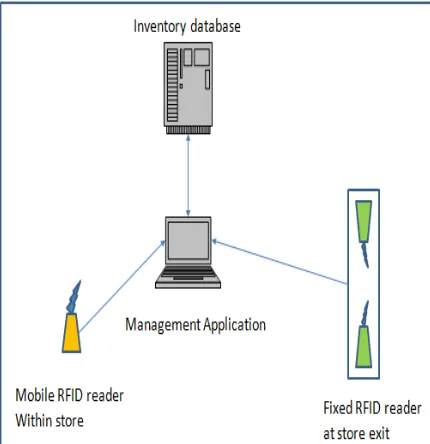
SOLUTION ARCHITECTUREAn RFID solution for store NG1101 would require a series fixed readers mounted at certain locations in the main store and store exit with a number of mobile readers for the outdoor area. The tag readers will be linked to the ERP system database that will detect and trace the movement of tagged items in and out of the stores. The mobile readers will help in the outdoor storage area that will not be covered by the fixed scanners during stock accounting.
[image:4.612.93.300.94.243.2]Figure 2 RFID Based Supply Chain Inventory Management System Architecture
Figure 3 RFID Reader Near Field
For store NG1101 with four meter high shelves, the reader has to have a near field of at least four meters to be effective. This system would required an RFID reader with a theorectical wave length of 25m and frequency of 12MHz, the commercially available 13.56MHz would thus be very suitable for the proposed system. The required system would be deployed in the manner depicted in fig 4 below.
Figure 4 Store Layout Showing Multi-Tag Reader System Deployment
[image:4.612.314.515.345.485.2] [image:4.612.91.306.391.613.2]5.
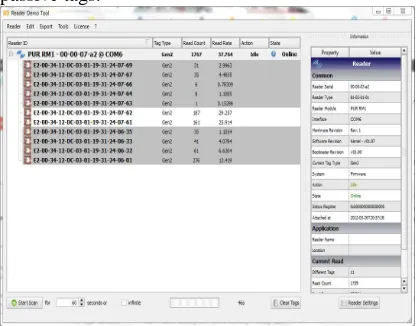
RESULTS [image:5.612.90.298.234.397.2]A small prototype of limited scope was built with the help of a mobile desktop based RFID with the objective to help to understand some of the practical challenges of developing and deploying a full fledge solution. Fig 5 below shows the screen captured from the system. The system consists of a USB based 915MHz UHF reader (read range of 10cm, for reasons discussed earlier) along with some RFID on metal tags and other variants of passive tags.
Figure 5 RFID Demo Reader
The output data identifies the tags being read, the reader type, the number of times the tag was read, the time the reading took place and finally the reader Id which was not requested in this case but would be very important in a multi tag setup for tracking the movement of items and personnel. The result shows that within a space of 12secs eleven tags were read a total of 842 times with some tags (closest to the reader) being read as much as much as 276 times within 2secs. This shows the potentials for the system as a means of stock evaluation. This means that if all the 150 materials composing about 23491 items in store NG1101 were to be tagged and within the read range of a mobile RFID reader, it is possible to obtain their status within 6mins and an array of readers whose coverage spans the whole warehouse would complete the read within two seconds. When compared the two months’ time period that is required for the same operation currently the deployment of and RFID would be a game changer and will greatly enhance operational efficiency as well as eliminate the errors.
6.
CONCLUSIONSThis study has shown that the use of RFID technology is a viable alternative to the current mode inventory managing in Shell Nigeria and has the potential to greatly enhance the operational efficiency of the logistic and warehouse organization.
This study highlighted the challenges of inventory management in SPDC and feasibility of dealing with these challenges using modern information technology tools and the implication for operational efficiency the outcome of a successful deployment of a function RFID system would bode well for the warehouse system which is a critical team in the realization of the company’s strategic goals.
REFERENCES:
[1] Gao, B., & Yuen, M. M. (200). Passive UHF RFID with ferrite electromagnetic band gap (EBG) material for metal objects tracking. In Electronic Components and Technology Conference, 2008. ECTC 2008. 58th (pp. 1990-1994). IEEE.
[2] Finkenzeller, K. (1999). RFID Handbook: Radio-frequency identification fundamentals and applications (pp. 151-158). New York: Wiley.
[3] Matta, V. A. (2008). Predicting the Adoption of Radio Frequency Identification Systems in the Supply Chain. ProQuest..
.[4] Sen, D., Sen, P., & Das, A. M. (2009). RFID for Energy and Utility Industries. Pennwell Books.. [5] Rathore, A., & Valverde, R. (2011). An RFID
based E-commerce solution for the implementation of secure unattended stores. Journal of Emerging Trends in Computing and Information Sciences, 2(8), 376-389.
[6] Khan N and Valverde R (2014), The use of RFID based supply chain systems in data centers for the improvement of the performance of financial institutions, Journal of Engineering Management Research, 3(1).
[7] Khoussainova, N., Balazinska, M., & Suciu, D. (2007). Probabilistic rfid data management. Technical Reprot TR2007-03-01, University of Washington, Seattle, Washington.