398
WEB SERVICE DESCRIPTION FRAMEWORK AND
SELECTION MECHANISM TOWARDS BALANCED
PERCEPTIONS OF FQOS AND QOS
1,2ZHONG WU, 2GUIHUA NIE, 2DONGLIN CHEN, 2PEILU ZHANG
1
Research Center for E-Business and Intelligence Service, Wuhan University of Technology, Wuhan
430070, Hubei, China
2Department of Economic and Management, Wuhan University of Technology HuaXia College, Wuhan
430223, Hubei, China
ABSTRACT
With the growing expansion of web services resources on the internet, more and more users come to appreciate the difficulty of searching self-gratification information from the mass information. This paper analyzes functional attributes and un-functional attributes of Web service resources, builds the mapping relationship between FQoS and QoS, and defines the index system structure of FQoS (Functional Quality of Service) and QoS (Quality of Service, also can be called non-functional attributes)based on the existing theories. It realizes QoS quantification of Web service resource by parameters numeralization and normalization, proposes a Web service description framework and selection mechanism towards balanced perceptions of FQoS and QoS, and then makes a theoretical foundation for Web service description, discovery and selection oriented equilibrium perception of FQoS and QoS.
Keywords: Web Service Resource, Service Description, Service Discovery, FQOS, QOS
1. INTRODUCTION
With the emerging of web services, the usage of web services has changed from search mode to select mode, that is to say, the key question is no longer about how to find out the required services, but about how to select the best service from numerous functional demands of Web services. Then, the quality of service (QoS) is introduced in the web services field. How to provide web services with QoS guarantees has caused the attention of people, and how to choose the best service to meet the needs of the requesters has also become a research focus in the field of web services. In order to select the best service from a large number of web services, many problems need to be solved, such as the description of the QoS, monitor and management, and the service discovery and service selection based on QoS.
The process of web service discovery on the internet is like the process of information retrieval by search engine. It needs to make a matching analysis between the service information consumers and web service description information. So describing web services is the premise of the entire work. The first researches on web service discovery are mainly based on the registration center and
distributed systems service discovery as well as based on the keywords service discovery. With regard to the former, as the extent of intelligence is not high enough for the discovery process, it leads to the final service discovery inefficient. With regards to the latter, because of the lack of description of web services on the semantic level resulting recall rate and precision rate are low, and the results of the real needs of users are not returned. Therefore, semantic-based service discovery comes into being. Although the method is able to use semantic logical reasoning to improve the accuracy of web service matching, the reasoning complexity has greatly increased the working strength of the whole discovery process and reduced the matching efficiency. Currently, more and more scholars begin studying web services discovery mechanism based on QoS-aware, the aim is to achieve the matching based on the description of the QoS layer. This method takes into account the semantic relation of services, and it can effectively solve the redundancy problem and improve the recall rate and precision rate of service discovery.
399 differences among QoS indicators. One is the index system differences. Dimitrios defined QoS by 26 indicators including security, readability, performance and configuration[1]. LIU Dong-mei defined QoS by 5 indicators including price, response time and success rate, etc[2]. Vuong Xuan TRAN defined a 3-layer index system by 16 indicators[3]. Another is differences in the definition of indicators. Dimitrios tied the response time and network delay which customers were most concerned about for a performance sub-indicator[1]. But Robert Aboolian believed that reaction time was equal to transaction time plus queuing time plus network delay[4]. (2)The QoS perspectives of customer and supplier are different, the QoS of customer perspective is abstract, vague and imprecise[5]. (3)Service functions were confused with the concept of QoS, and the functional attributes and non-functional attributes could not be distinguished[6]. (4)There is no truly effective extension to the functionality and quality of service. The users’demand for services had been transformed from a traditional single way for the form of a combination of web services and entity services [7].
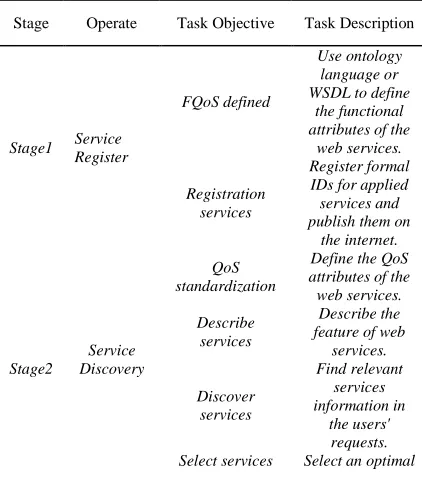
[image:2.612.88.299.497.738.2]On the basis of existing research, this article proposes a web service description, discovery and selection mechanism towards balanced perceptions of FQoS and QoS. In this mechanism, FQoS is more used to describe and discover services, and QoS is more used to select services. Specific process is shown in Table 1.
Table 1 : Fqos And Qos Balanced Perception Of The Web Service Discovery And Execution Process
Stage Operate Task Objective Task Description
Stage1 Service
Register
FQoS defined
Use ontology language or WSDL to define
the functional attributes of the
web services.
Registration services
Register formal IDs for applied services and publish them on
the internet.
Stage2
Service Discovery
QoS standardization
Define the QoS attributes of the web services.
Describe services
Describe the feature of web
services.
Discover services
Find relevant services information in
the users' requests. Select services Select an optimal
service from the demand services.
Stage3
Service Execution
Execute services
Achieve service binded and executed process.
Supervise QoS
Feedback the users' views that
are collected to QoS center in order to update
the users' expectations.
2. FQOS OF THE WEB SERVICES
RESOURCE
FQoS which is the functional attributes of the web services resource is explicit and is the functional descriptions of the web service resources. Although web services are transparent for users, the implementation process of the service is a black-box operation, which means that the users don't know how the web services to make accurately functional operation. The only way to understand the services for the outside world is the description of web services as well as the related formal information. But the logic behind this information is not visible, and has nothing to do with the service requesters. Therefore, it is particularly important to infer service functions from these desirable web service description information and match the services from the functions in the entire Web service discovery process.
400 The development of web service has prompted the web service discovery mechanism based on UDDI. Scilicet, describing the web service function attributes and mining users’ function demands on web service by UDDI, it helps the users quickly find out the service matched with expected function. XIE Dan divided the functional attributes of web services into three categories such as functional semantics, interface semantics and execution semantics. Functional semantics was composed of Category and Capability. Interface semantics described the service operation information such as input semantic information, output semantic information, error messages, pre-conditions and the execution results. Execution semantics included PreOperation and PostOperation. LIU Chuan-chang held that the functionality description of web service included input parameters, output parameters, pre-conditions and post-effect[9]. Buhwan Jeong summarized the service functional attributes as a collection of five major attributes such as the type of service, the service name, the name of the operation, data definitions and notes[10]. Although many scholars have analyzed the functional attributes composition of the service, the majority of them are limited to describe web services or build web service ontology, and did not carry out the in-depth study. In area of web service discovery research, most scholars focused on the non-functional attributes QoS in web services and rarely considered the functional attributes FQoS and combined it with calculation to select the optimal service.
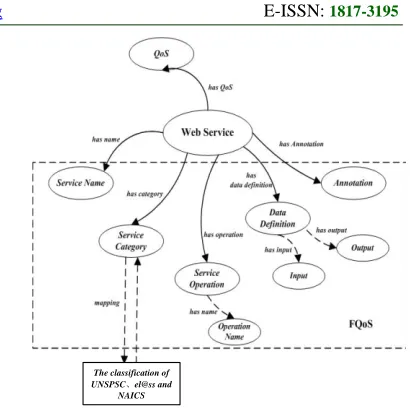
Based on the synthesis of existing research, this section defines web services FQoS as an indicators architecture which is constituted by Service Category, Service Name, Operation Name, Data Definition and Annotation. The description framework is shown in Figure 1.
The classification of UNSPSC、el@ss and
[image:3.612.322.527.76.280.2]NAICS
Figure 1: Description Framework Of Fqos
It can be seen from Figure 1 that Service Category refers to the classification of web services, such as the tourism web services and medical industry web services. In most cases, the international classification standards such as UNSPSC, eCl@ss and NAICS are adopted to describe classification frameworks. Service Name can be seen as a unique identifier for a service to generalize the related description of services. Web services include a series of operations and Operation Name can provide users with a more specific service functions. The Input and Output Data Definition describes the most important input and output parameters’ information of the web service functional attributes, and these data are defined by the XML format. Annotation is an auxiliary description is used to describe a web service in the text information or the structured information.
According to the structural characteristics and morphology of each web service functional attributes, this article divides FQoS into three types such as atomic labels (such as the Classification of Services, the Service Name and Operation nName), structured XML data (such as the Input and Output Data Definition) and text data (such as Service Annotation Information).
3. QOS OF THE WEB SERVICE
RESOURCES
3.1 QOS-Dimensional Model Of The Web
Service Resources
401 and more service providers offer the same or similar web services. Only consider the service functional attributes is completely unable to meet the users’ demands for multi-levels, and the UDDI does not directly support the semantic information provided by web services. Therefore, the discovery and selection of web services based on QoS emerged. The QoS of web service refers to an index set that can reflect all the non-functional attributes of the web service. QoS is not only associated with the web service itself, and is closely related to the network environment of web services.
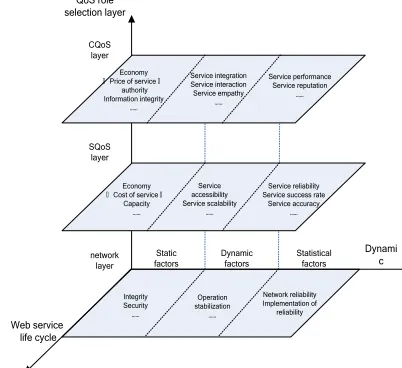
[image:4.612.101.302.304.488.2]In order to reflect the influence of QoS requirements and the results of the evaluation by different roles in different web services life cycle, in this section we propose a multi-level, dynamic and new QoS-dimensional model[1] , as shown in Figure 2.
Web service life cycle
CQoS layer
SQoS layer
network layer
Static
factors Dynamic factors Statistical factors
Economy ( Price of service (
authority Information integrity
……
Service integration Service interaction Service empathy
……
Service performance Service reputation
……
Economy ( Cost of service (
Capacity ……
Service accessibility Service scalability
……
Service reliability Service success rate Service accuracy
……
Integrity Security ……
Operation stabilization ……
Network reliability Implementation of reliability QoS role
selection layer
Dynami c
Figure 2: The Three-Dimensional Model Of Web Services QOS
The three-dimensional model of web services QoS uses three dimensions such as QoS role selection layer, web services life cycle and dynamic to comprehensively describe the feedback factors in all aspects of the quality of service in the process of web services.
1)QoS role selection layer
There are differences in business perspective and information transparency in web services, wherein the QoS indicators of the customer perspective are easily ignored by suppliers, and the QoS indicators of the suppliers’ demands can not be perceived and recognized by clients due to their professional nature. Therefore we need to take into account both the customers’ perspective and the suppliers’ perspective. By studying the semantic mapping mechanism between Customer Quality of Service
(CQoS) and Supply Quality of Service (SQoS), we can achieve the multilevel nature of QoS parameters. Network layer QoS parameters refer to the basic needs of web services for network quality, they are the premise that meet CQoS layer and SQoS layer, and the web QoS parameters that both the customers and service providers need to consider.
2)Dynamic nature
According to the dynamically change way of QoS parameters, we divide QoS parameters into static factors, dynamic factors and statistical factors. Wherein static factors are mainly depend on the web service itself, and don’t change throughout the service process, dynamic factors can be continuously changed with the specific conditions, statistical factors refer to the QoS parameters that were received by statistical data after cumulating services.
3)Web services life cycle
Web service has a time-varying selectivity, that is, the different roles in the web services at different life-cycle stages can dynamically select different evaluation indicators for the evaluation of QoS. For example, the factors of QoS needed by the users are different at service using stage and service billing stage. At service using stage, the users primarily focused on the performance indicators of web services, but at service billing stage, the users are more inclined to price factors. In order to better calculate the QoS value for the recommendation of web services, we can consider to set different preference weights by taking into account the specific situation of QoS indicators in different web services life cycle.
3.2Design based on the index system of QoS
According to the existing QoS research results and the above QoS dimensional model, in this section we select the appropriate QoS indicators based on the perspective of users and suppliers, construct the indicators architecture of CQoS and SQoS and then analyze, define and quantify the QoS indicators of this structural system.
402 Integrity, Stability and Robustness, and then use it to achieve the mapping relationship among different indicators, expand and improve the QoS indicator system, as shown in Figure 3.
[image:5.612.90.295.143.308.2]Mapping Performance Price Security Reputation Personalization Empathising Reliability Response Time Capacity Confidentiality Authentication Authorization Data Encryption Interactivity CQoS Scalability Cost Integrity Availability Robustness Stability MTTR UpTime SQoS
Figure 3:The Qos Index System Architecture With Mutual Mapping Cqos With Sqos
3.2.1CQoS index system
1)Performance description is the functional performance of web services from the customer perspective. This paper mainly considers the two parameters such as Capacity and Response Time. Capacity refers to the limitation of the number of requests a web service can handle, usually measured by requests number of the service / sec. When a web service operation beyond its Capacity, its availability and reliability will subsequently have a negative impact. The Capacity of the web service can be expressed as:
t n N P n i / 1 requests Capacity
∑
== (1)
The method is to be measured by calculating the historical average Capacity. Wherein Nrequests represents the number of web service requests that are processed in the
i
-th time period,n
is the number of execution time periods, andt
represents the time period of the Capacity calculated.Response Time is the time interval that requests for service response, that is the total time from the requisition to the acquisition of web service. Usually it can be composed by the three parts of the delay time, the execution time and the transmission time. Delay time is the time difference in the whole process of the requisition submitted by users and the acquisition received by the providers of web services. It mainly includes the request queuing time and request establishing time. Some studies have shown that if an e-commerce website daily income of $ 100,000, 1 second delay of a page will cause an annual loss of 2.5 million.
Due to the dynamic variability of the delay time, the paper mainly consider the historical average delay time: T t T t T T T i
∑
= + = 1 ng establishi Request queuing Request Delay time )) ( ) ( ((2)
In the above formula, TRequest queuing(t) refers to the
request queuing time in the
t
-th time period.) (
ng establishi Request t
T refers to the request establishing time
in the
t
-th time period. T represents the time period of service execution.Execution time refers to the execution operation time spent by the web service providers after receiving the service request to the web service, that is the time used to process the service requests of users. Execution time is measured by the historical average execution time:
T t T T T i
∑
= = 1 time Execution time Execution ) ((3)
Similarly,TExecution time(t) refers to the execution
time in the
t
-th time period. T represents the time period of service execution.Transmission time is the time to return the results of the services to the users after the completion of the web services, it can be obtained based on the past history of service operation execution, namely:
T t T T T i
∑
= = 1 on time Transmissi on time Transmissi ) ((4)
In the above formula, TTransmission time(t) refers to the transmission time in the
t
-th time period. T represents the time period of service execution.Therefore, the response time of web service can be expressed as:
on time Transmissi time Execution Delay time time
Response T T T
P = + + (5)
In summary, the final performance index function of web services is:
) , , , ( ) , ( on time Transmissi time Execution Delay time Capacity Time Response Capacity e Performanc P P P P f P P f Q =
= (6
)
403 price refers to the price both the users and service providers acceptable after their mutual agreement. In order to facilitate the calculation and avoid the dynamic of auction price and negotiating price, this section calculates a web service price on the basis of fixed price mode, that is ( )
price Fixed price
Service f P
Q = .
3 ) Reliability refers to the possibility of successful use of web services. It can include the indicators such as Error Rate (the probability of call failure), MTBF (the average time of service failures), Resilience (the service's ability to recover from failure), Failover Capability (whether the service has failover capacity and transfer speed) and Fault Resilience (ability to service to quickly recover from natural and man-made fault). In order to facilitate the calculation, in this paper, the ratio of the number times of successful execution of web services and the number times of the services’ total requests in a time period is calculated as the standard for reliability, namely:
requests Services
execution Successful y
Reliabilit N N
Q = (7)
4)Reputation is a parameter for measuring the credibility of web services providers, it is from the comprehensive evaluation of the web services users. In order to facilitate the calculation, reputation is only regarded as a level indicator in the whole QoS measurement process, it can be expressed as:
{very high,high,normal,low, very low} Reputation=
Q (8)
5)Security considers the security levels of the service, it describes whether the service is able to confidentially encrypt information and provide access control, it mainly includes Confidentiality (whether the service can maintain the confidentiality of client information and make it not be leaked), Authentication (whether the service accepts anonymous users), Authorization and Data Encryption (the type and degree of protection of service data encryption technology). As the description of security is abstract, the paper also use level indicators to expresse it:
{very good,good,normal,poor, very poor}
Security=
Q (9)
6)Empathising describes whether services can put themselves in for the sake of users and make the user's personalized recommendation. It primarily considers the interactivity and personalization of the service according to the web service evaluation by the majority of users. It can be expressed as:
{very good,good,normal,poor, very poor}
g Empathisin =
Q (10)
3.2.2SQoS index system
1)Cost has described the service economy from the supplier’s point of view, it is corresponded to the service price at the user layer. Service cost and service price both have contradiction and unity. Web service providers hope to obtain the highest profit with the lowest cost, and users want to get the highest level of service by the lowest cost. Therefore, the final web service cost is the compromise price that the service providers and users expected, and is the uniform standard of the psychological expectations between the two main roles in the process of Web services.
2)Availability refers to there is a corresponding probability of web services on the customer's request, it is a growing dimension. Generally speaking availability and reliability are relatively parallel, but the capacities are opposite. Availability has two subclasses such asMTTR and UpTime. MTTR refers to the average time required to restore a failed service again, UpTime refers to the continued operation period of the services in the premise of no failures.
3)Scalability refers to whether the web services can be carried out appropriate capacity expansion and performance extension according to the needs of users.
4)Integrity is used to measure the capability of web services that prevent unauthorized access as well as protect the integrity of the information. It considers how correlatively maintain the correctness of the initial state.
5)Stability refers to the change condition of web service attributes.
6)Robustness refers to the affordability for error when input abnormal data or wrong invoke service. It is used to measure the quick recovery capability for incomplete input and the capability for correcting web service composition.
3.2.3the quantization of the QoS parameters
404 needs high price of the service, and vice versa. A QoS parameter may be interosculated with another QoS parameter by some relationship, such as an independent, converse, same or similar relationship, or a QoS parameter is a set of several other QoS parameters. The relationship between every two QoS parameters can be describe by varying degrees of word such as strong, moderate, weak or no.
The attribute values of the QoS parameters have different evaluation methods. Some parameters are sensitive to the values that can be quantified by exact values, such as the price of service. Some parameters are relatively insensitive, they can only be expressed by the form of the certain floating interval, such as response time is described by an approximate range under normal circumstances. Some other parameters are completely insensitive to the values, they can only utilize the form of levels to represent, such as security can be divided into high, medium, and low multiple levels. So, in order to ensure the comparability of the QoS parameters and achieve the matching of web service QoS indicators, it is necessary to make normalization process for all parameters and make the range of the attribute values in a uniform interval range.
Before the normalization process, we must first transform the interval and level QoS parameters into values. For Interval QoS parameter q, we assume its range is [m, n], the numerical formulas can be described to be expressed as:
value 2( )
m n
q
n m
+ =
−
(11)
For level QoS parameters, we suppose there are n level indicators, the corresponding values are1, 2, 3 ... n.
After the normalization process, this section utilizes different normalized standards to forward and negative QoS attributes mentioned in literature [11].
Forward type:
= −
≠ − −
− =
′
0 min . max . 1
0 min . max . min . max .
min . .
.
q q
q q q
q q value q e valu q
(12)
Negative type:
= −
≠ − −
− = ′
0 min . max . 1
0 min . max . min . max .
. max . .
q q
q q q
q
value q q e valu q
(13)
In the above two formulas, q.max and q.min respectively denotes the maximum and minimum values of all the QoS attribute values of web services. After the normalization process, the intervals of the attribute values of the QoS parameters [q.max, q.min] is transformed into [0,1],
and for the quality of the web service the transformed value is the larger the better.
4. CONCLUSION
With the growing expansion of web services resources on the internet, more and more users come to appreciate the difficulty of searching self-gratification information from the mass information. How to quickly discover the web services needed by users from the vast resources and effectively recommend has become an important challenge. This article has discussed functional attributes and non-functional attributes of the web services resources from the web services resources balanced perception of FQoS and QoS, analyzed the present research situation of web services resource FQoS, defined the composition of FQoS by atomic labels, structured XML data and text data, constructed a three-dimensional model of web service QoS and designed a QoS indicators architecture by the mapping of CQoS and SQoS. Through the specific description of FQoS and QoS, it has provided a theoretical basis for the construction of web service resource ontology model and intelligent recommendation technology.
However, the design of FQoS and QoS index system can not effectively reflect the reality, and there is no research on how to obtain these attributes parameters. The description of the web services resources also need to be further explored.
ACKNOWLEDGEMENTS
This work has been funded by National Natural Science Foundation of China ( No. 70972094, No. 71072077, and No. 71172043); National Key Technology Research Development Program No. 2011BAH16B02; the Fundamental Research Funds for the Central Universities No. 2012-YB-20.
REFERENCES:
[1] Dimitrios Tsesmetzis, Ioanna Roussaki, “Modeling and Simulation of QoS-aware Web Service Selection for Provider Profit Maximization”, Simulation, Vol. 83, No.1, 2007, pp. 93-106.
405 [3] Vuong Xuan Tran,Hidekazu Tsuji, “Semantics
in QoS for Web Services: A Survey and Analysis on Semantics in QoS for Web Services”, Proceedings of International Conference on Advanced Information Networking and Applications, IEEE Conference
Publishing Computer Society, May 26-29, 2009,
pp. 379-385.
[4] Robert Aboolian, Yi Sun, Gary J.Koe, “A Location–Allocation Problem for a Web Services Provider in a Competitive Market”,
Production, Manufacturing and Logistics, Vol.
194, No. 1, 2009, pp. 64-77.
[5] Ping Wang, “QoS-aware Web services selection with intuitionistic fuzzy set under consumer’s vague perception”, Expert Systems with
Applications, Vol. 36, No. 3, 2009, pp.
4460-4466.
[6] TAO Chun-hua, FENG Zhi-yong, “Novel QoS-aware Web service recommendation model”,
Application Research of Computers, Vol. 27,
No. 10, 2010, pp. 3902-3905,3914.
[7] Ping Wang, Kuo-Ming Chao, Chi-Chun Lo, “On Optimal Decision for QoS-aware Composite Service Selection”, Expert
Systems with Applications, Vol. 37, No. 1,
2010, pp. 440-449.
[8] XIE Dan, YING Shi, CAO Honghua, “Resources Description Framework for Service RDF4S Based on Semantics”,
Journal of Wuhan University, Vol. 54, No. 1,
2008, pp. 71-76.
[9] LIU Chuan-chang, CHEN Jun-liang, “Goal Web Services Description Ontology and Service Discovery Model”, Computer
Engineering, Vol. 33, No. 18, 2007, pp.
187-189.
[10] Buhwan Jeong, Hyunbo Cho, Choonghyun Lee, “ On the functional quality of service (FQoS) to discover and compose interoperable web services”, Expert Systems
with Applications, Vol. 36, No. 3, 2009, pp.
5411-5418.
[11] Angus F.M. Huang, Ci-Wei Lan, Setphen J.H. Yang, “An optimal QoS-based Web service selection scheme”, Information
Science, Vol. 179, No. 19, 2009, pp.