Modeling and Minimization of Cyber Attacks through
Optimization Technique
Narander Kumar, Rashmi Singh and Vipin Saxena
Department of Computer Science Babasaheb Bhimrao Ambedkar University
Lucknow (U.P.),226025, India
ABSTRACT
In the daily routine work on the internet, the people are using the services like email, money transfer, accessing of web pages, social networking, downloads, communication on network, etc. Hackers are hacking the web pages, emails, etc which are reported in the cyber police station. The present work is based upon the cyber attacks in the Indian scenario and different cyber attacks have been identified and these attacks are optimized by applying a well known optimization technique known as Hungarian method which is based upon that the number of person are affected with minimization losses delete. A well known Unified Modeling Language (UML) modeling is also used to design the UML activity model which is validated through a Finite State Machine (FSM) technique and observed that the proposed method is optimized method for getting minimum losses across the network which is based upon distributed computing network.
Keywords
Modeling, Cyber Attacks, Hungarian, Optimization, UML and FSM
1.
RELATED WORK
In the present paper, a well known Platform Independent language is used to construct various UML models. UML stands for Unified Modeling Language and invented by Booch et al. [1-2]. They described all the important diagrams related to static and dynamic representation of the research problem. OMG [3-4] is the Object Management Group who has released various versions of UML. The modeling is necessary for representing the research problem in the pictorial way and thereafter coder develops the code for the proposed model. Since, the present work is related to the Cyber Security models therefore let us describe some important contribution done by the researchers in these field. Communal Analysis Suspicion Scoring (CASS) for generating numeric suspicion scores are well described by Phua et al.[5] for the streaming of the credit card applications. Baber et al.[6] stated that computer conditions(tablets and computers) lead to faster performance when compared with paper conditions while there was no difference in content and quality of reports. Cetin et al.[7] described the recent developments in technology used by youngsters which are increasingly creating environments in which students can exhibit bullying behaviors in schools via electronic devices. Cyber bullying and Cyber victim can be used as scale for determining the level of exposure to or exhibiting cyber bullying behaviors among students in high school. Daman and Ozecilik[8] described a novel combination of the two well known meta heuristic approaches, namely the Genetic algorithm and the Scatter search which can be applied to improve the credit card
fraud detection solution. Jamieson et al.[9] described a deep understanding of identification of crime by using the concept of hierarchical classes and explained clear structure for crime management. All these are defined as per the current status of law and proposed a solution for the minimization of the crime. Solms and Niekerk[10] described that Information security is the protection of information, which is an asset, from possible harm resulting from various threats and vulnerabilities. Cyber security, on the other hand, is not necessarily only the protection of cyberspace, but also the protection of these function in cyberspace and any of their assets that can be reached via cyberspace. Tehrane et al. [11] described Cyber terrorism is a transnational crime; it should be subjected to universal jurisdiction through multinational cooperation. The most suitable method to counter future transnational crimes such as cyber terrorism is universal jurisdiction. Maskun et al. [12] stated that Internet has become a global phenomenon; numerous advantages and disadvantages (crimes) which are being gotten and committed through the internet. To cope with both advantages and disadvantages, cyber security is needed to guarantee people to use internet safely.
The present work is based upon the identification of the major cyber attacks which are faced by the users in the daily routine work and losses due to attacks are computed and thereafter an optimization technique is used for the minimization of the losses. UML is also used for a model based on the minimization of the losses and the model is also validated through the FSM technique.
2.
UML MODELING
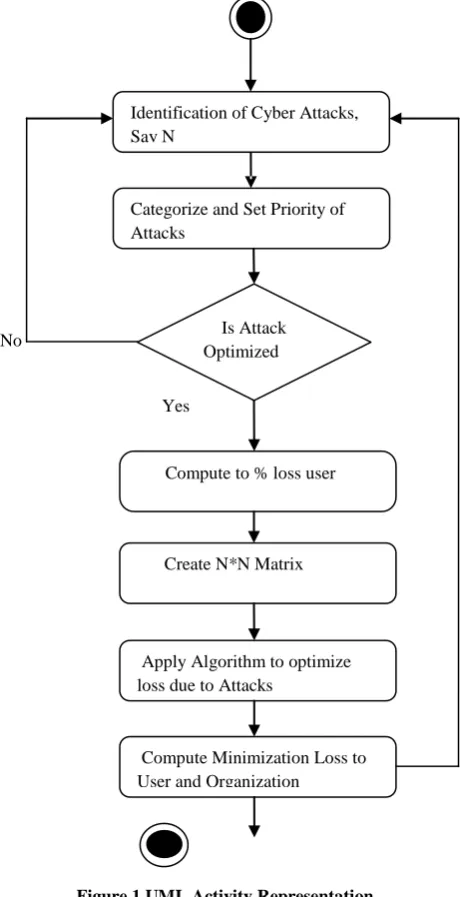
A UML activity diagram is designed for the minimization of individual loss to the department and also consolidated loss to the organization. The steps involved for the minimization of losses are summarized below:
Step 1: Identify the types of page which should fit within a rectangle of Cyber Attacks & let us consider there are N;
Step 2: Categorize and fix the Priority of Cyber attacks which can be minimized for loss i.e. arrange in the decreasing order which shows that the maximum loss shall be minimized first;
Step 3: If the prioritized losses are already minimized then go to step 1 else follow the next step 4;
Step 4: Compute % loss to the user;
Categorize and Set Priority of Attacks
Identification of Cyber Attacks, Say N
Identification of Cyber Attacks, Say N
Identification of Cyber Attacks, Say N
Compute to % loss user
Create N*N Matrix
Apply Algorithm to optimize loss due to Attacks
Compute Minimization Loss to User and Organization
Is Attack Optimized
o
Step 6: Apply the algorithm to optimize the loss due to the Cyber Attacks;
Step 7: Compute the minimization loss to the users and to the organization.
The above steps are represented through UML activity diagram and shown in the figure 1. It consists of six major activities which are controlled by one condition. The Hungarian method is applied after creation of NxN matrix and the cells represent percentage of loss. The data is considered for the twelve major cyber attacks and proposed steps can handle the data upto N numbers of cyber attacks. A mathematical formulation of the problem is also done for the Hungarian method as it supports for N numbers of cyber attacks. After that a matrix for NxN is generated and it can be easily programmed for finding the minimum percentage of loss.
No
Yes
[image:2.595.324.532.182.417.2]
Figure 1 UML Activity Representation
3.
MATHEMATICAL FORMULATION
Let Cyber attacks are categorized by the set CA= {CA1 , CA2,
CA3 ,………CAN}. Let these attacks are detected
and taken upto N attacks and due to these attacks let losses are
L1,L2,L3……….LN then to minimize these losses the
following objective function is formulated N
Z=Min ∑ Li * CAi
i=1
[image:2.595.54.286.254.703.2]Then the problem is converted into N*N matrix and in this case N is covered as N=12 and attacks are shown in table 1.
Table 1. List of Cyber Attacks
Code Description
CA1 Stealing of Database
CA2 Hacking of Websites
CA3 Job Scams/Frauds
CA4 Mobile Crimes
CA5 Antisocial Activities
CA6 Stealing of Bandwidth
CA7 Cloning of Debit/Credit Card
CA8 E-Commerce Fraud
CA9 Unauthorized Network Access
CA10 Theft of Password
CA11 Identity Theft
CA12 Cyber Blackmailing/Harassment
The different departments are consulted to make loss table as shown in table 2 and it is based upon the sample questionnaire and survey is completed for the 100 users but for computation purpose same size is considered as N=12. The steps for Hungarian method are described below in the object-oriented form:
Step 1:- Let us define obj.A[i][j], where i=1(1)12,j=1(1)12 and store the losses in 12x12 matrix A[i][j];
Step 2:- Select Min A[i][j] for each row i and subtract it from each element of each row of A[i][j] i.e. obj.A[m][j]=obj.A[m][j]-min A[m][j] where m=1(1)12 and update obj.A[i][j];
Step 3:- Select Min A[i][j] for each column j and subtract it from each element of each column of A[i][j] i.e. obj.A[i][n]=obj.A[i][n]-min A[i][n] where n=1(1)12 and update obj.A[i][j];
Step 4:-Cut the lines row wise first & then column wise with coverage of maximum zeros.
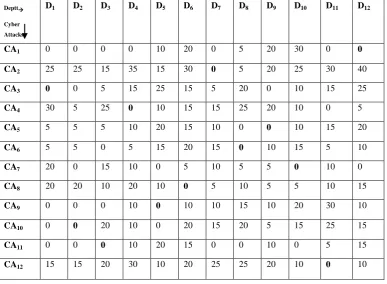
Table 2 Data Representation of Cyber Attacks versus Departments
Table 3. Final Matrix After Applying Hungarian Method
From the above table, minimum loss is computed for each of the department and observed that the minimum loss is to department1 which is just 10%. The overall loss to all the departments is also computed which is 25% for all twelve
cyber attacks and for all the departments. These are summarized below in following table:
Deptt
Cyber
Attacks
D1 D2 D3 D4 D5 D6 D7 D8 D9 D10 D11 D12
CA1 20 30 20 20 30 40 20 30 40 50 30 20
CA2 60 70 50 70 50 65 35 45 55 60 65 75
CA3 10 20 15 25 35 25 15 35 10 20 25 35
CA4 75 60 70 45 55 60 60 75 65 55 45 50
CA5 25 35 25 30 40 35 30 25 20 30 35 40
CA6 15 25 10 15 25 30 25 15 20 25 15 20
CA7 40 30 35 30 20 25 30 30 25 20 30 20
CA8 50 60 40 50 40 30 35 45 35 35 40 45
CA9 15 25 15 25 15 25 25 35 25 35 45 25
CA10 40 50 60 50 40 60 55 65 45 55 65 55
CA11 15 25 15 25 35 30 15 20 25 15 20 30
CA12 40 50 45 55 35 45 50 55 45 35 25 35
Deptt
Cyber
Attacks
D1 D2 D3 D4 D5 D6 D7 D8 D9 D10 D11 D12
CA1 0 0 0 0 10 20 0 5 20 30 0 0
CA2 25 25 15 35 15 30 0 5 20 25 30 40
CA3 0 0 5 15 25 15 5 20 0 10 15 25
CA4 30 5 25 0 10 15 15 25 20 10 0 5
CA5 5 5 5 10 20 15 10 0 0 10 15 20
CA6 5 5 0 5 15 20 15 0 10 15 5 10
CA7 20 0 15 10 0 5 10 5 5 0 10 0
CA8 20 20 10 20 10 0 5 10 5 5 10 15
CA9 0 0 0 10 0 10 10 15 10 20 30 10
CA10 0 0 20 10 0 20 15 20 5 15 25 15
CA11 0 0 0 10 20 15 0 0 10 0 5 15
[image:3.595.106.494.427.711.2]Cyber Attack Deptt. No. Minimum Loss Computed
CA1 D12 20
CA2 D7 35
CA3 D1 10
CA4 D4 45
CA5 D9 20
CA6 D8 15
CA7 D10 20
CA8 D6 30
CA9 D5 15
CA10 D2 50
CA11 D3 15
CA12 D11 25
Grand total = 300
Over all percentage loss to all departments = 25%
GENERATION OR TEST CASES:-
Let us consider the theory of automata for designing the Finite State Machine (FSM) which is defined by M and given by following
M = (Q,Ʃ, δ, q0, F)
Where
Q = finite set of states; Ʃ = finite set of input symbols;
(Alphabets and Numbers); δ = Transition between two states;
q0 = Initial state;
F = Final state;
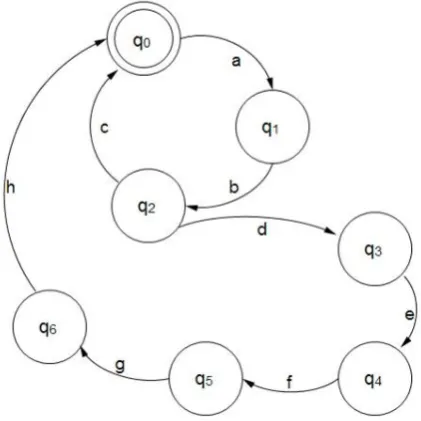
From the above definition of automata, a finite state diagram is represented in the figure 2. In which there are seven states represented as Q = {q0, q1, q2, q3, q4, q5, q6} and these are
[image:4.595.55.280.69.250.2]according to the activity diagram represented in the figure1 and it is represented in the following table 4.
[image:4.595.309.540.86.221.2]Figure 2 FSM Representation of Activity Diagram
Table 4.Representation of States Name of State Description of State
q0
q1
q2
q3
q4
q5
q6
Identification of Cyber Attack Categorize and set priority of Attacks Attack optimization
Compute to % loss user Create matrix
Apply algorithm to optimize loss Compute minimum loss to user
Now, the transition is represented by δ (q0, a), where a is the
set of inputs and inputs are considered as
[image:4.595.310.548.305.468.2]Ʃ = {a, b, c, d, e, f, g, h} and representation is recorded in the following table 5.
Table 5.Representation of Input Symbols Name of Input Description of Input
a List of Cyber Attacks
b Priority list of Cyber Attacks c Not optimized list of Cyber Attacks d Optimized list of Cyber Attacks e List of losses
f Resultant matrix with Cyber Attacks and Losses
g Final optimized matrix h Minimum loss result
On the basis of above, a transition table is given below with following figure :→
δ (q0,a) → q1
δ (q1,b) → q2
δ (q2,c) → q0
δ (q2,d) → q3
δ (q3,e) → q4
δ (q4,f) → q5
δ (q5,g) → q6
δ (q6,h) → q0
Table 6. A Transition Table
a
b
c
d
e
f
g
h
q
0q
1-
-
-
-
-
-
-
q
1-
q
2-
-
-
-
-
-
q
2-
-
q
0q
3-
-
-
-
q
3-
-
-
-
q
4-
-
-
[image:4.595.77.288.498.709.2]q
5-
-
-
-
-
-q
6-
q
6-
-
-
-
-
-
-
q
0
By the use of above grammer different test cases are generated and explained below in brief:-
Valid Test Case 1:- Cyber attacks losses are not optimized It is represented by
δ (q0,a) → q1 => q0→ a q1
δ (q1,b) → q2 => q1→ b q2
δ (q2,c) → q0 => q2→ c q0
After changing the states or removing the non terminals, the string is given by
q0 = abc q0 = abc
This represents that the Cyber Attack losses are not optimized.
Valid Test 2:- Cyber attacks losses are optimized It is represented by
δ (q0,a) → q1 => q0→ a q1
δ (q1,b) → q2 => q1→ b q2
δ (q2,d) → q3 => q2→ d q3
δ (q3,e) → q4 => q2→ e q4
δ (q4,f) → q5 => q2→ f q5
δ (q5,g) → q6 => q2→ g q6
δ (q6,h) → q0 => q2→ h q0
After changing the states or removing the non terminals, the string is given by
q0 = abdefghq0 = abdefgh
This represents that the cyber attack losses are optimized which is as per expectation.
4.
CONCLUSIONS
From the above work it is concluded that the UML is a powerful modeling language which is used to make design of any kind of the research problem and in the above work, it is used for designing of UML activity diagram for minimization of losses from the cyber attacks. The diagram is converted into the FSM for finding the valid test cases which also validate the proposed model. A well known Hungarian approach is used to minimize the cyber attacks and it is observed that the said attacks give the percentage losses to the corresponding departments. The same work can be extended for the finite numbers of the departments and according to the list of cyber attacks and limitation is that the matrix should be NxN matrix which means that the numbers of attacks should be equal to the numbers of the departments.
5.
REFERENCES
[1] Booch G., Rambaugh J., and Jacobson I., “The Unified Modeling Language User Guide”, Twelfth Indian Reprint, Pearson Education, 2004. Strategies.
[2] Booch G., Rumbaugh J., and Jacobson I., “The Unified Modeling Language User Guide”, China Machine Press,Beijing, 2006.
[3] OMG, “Unified Modeling Language (UML)-Version1.5”, OMG document formal/2003-3-01, (2003), Needham, MA.
[4] OMG, “Unified Modeling Language Specification”, http://www.omg.org (Accessed on 12th Sept. 2012), 1997.
[5] Phua C., Gayler R., Lee V. and Miles K.S., “On the Communal Analysis Suspicion Scoring for Identity Crime in Streaming Credit Applications”. An European Journal of Operational Research, Vol. 195, 2009, pp. 595-612.
[6] Baber C., Smith P., Bulter M., Cross J., and Hunter J., “Mobile Technology for Crime Scene Examination”. An International Journal of Human Computer Studies, Vol. 67, 2009 pp. 464-474.
[7] Cetin B., Yaman E., and Peker A., “Cyber Victim and Bullying Scale : A Study of Validity and Reliability”. An International Journal of Computer & Education. Vol. 57, 2011, pp. 2261-2271.
[8] Duman E. and Ozcelik M.H., “Detecting Credit Card and Fraud by Genetic Algorithm and Scatter Search”. An International Journal of Expert Systems with Applications. Vol. 38, 2011, pp. 13057-13063.
[9] Jamieson R., Land L.P.W., Winchester D., Stephens G., Steel A., Maurushat A., and Sarre R. “Addressing Identity Crime in Crime Management Information Systems: Definitions Classification, and Empirics” Computer Law & Security Review. Vol. 28, 2012, pp 381-395.
[10] Solms R.V. and Niekerk J.V. “From Information Security to Cyber Security”.Elsevier publication of Computer & Security. Vol.38, 2013, pp. 97-102. [11] Tehrani P.M., Manap N.A., and Taji H. “Cyber
Terrorism Challenges: The Need For A Global Response to A Multi-Jurisdictional Crime.” Elsevier publication of Computer Law &security review. Vol. 29, 2013, pp. 207-215.