An Efficient Approach for Event based Clustering for
Wireless Sensor Network
Amandeep Kaur
Research scholar
CT Group of Institutions, Jalandhar
Rupinder Kaur Gill
Assistant Professor CT Group of Institutions, Jalandhar
ABSTRACT
The wireless sensor networks (WSNs) is one of the highly adopted field of research in recent years of scientific world. A WSN consists of sensors also known as motes which are distributed over a geographical area to monitor physical or environmental conditions and to transfer their sensed data cooperatively through multi-hops to the Base Station (BS). The critical fact about sensor nodes is their limited energy. Sensor nodes die due to run out of energy quickly because of the small size of the sensor nodes. Many energy efficient routing protocols and techniques have been developed to solve this problem and to increase the lifetime of the network. For energy conservation in wireless sensor network an Event Driven Hierarchical Cluster based Routing Protocol is proposed. Whenever there is an occurrence of event in the area of interest, then the information gathered from this event is passed to the sink through different cluster head which has high energy and smallest distance to the sink Simulation results show that routing of event data through different clusters improve the lifetime of the network compared to other clustering scheme and shows significant performance increase.
Keywords
Wireless sensor networks; sensors, routing, hierarchical, event, cluster; data aggregation.
1.
INTRODUCTION
In past few years wireless sensor network gain tremendous popularity in various fields due to its versatility, simplicity and extremely moderate and cost sparing establishment.Wireless sensor network is defined as the collection of hundred or thousand of nodes equipped with sensor. There are different Sensors such as pressure, humidity, accelerometer, thermal, camera, microphone, etc. They monitor conditions at different locations, such as temperature, noise level, humidity, lighting condition, vehicular movement, pressure, soil makeup, mechanical stress level on attached objects, noise levels, the absence and pressure of certain kinds of objects, the current characteristics such as direction, speed, size of an object [1] in the area of deployment. Sensor nodes are small, light weighted, low powered, wireless device having sensing, communication and processing capabilities. Sensor nodes are densely deployed in the network and they are deployed either in ad hoc or in pre planned manner. In ad hoc deployment sensor nodes are deployed directly in the area of interest by falling from aeroplane. In pre planned deployment sensor nodes are deployed in a pre planned manner and data is routed through a pre planned path.
Wireless sensor network serve various applications like habitat monitoring, health monitoring, military survival lance, target tracking and building monitoring .Wireless sensor
network was originally developed for battlefield surveillance by military applications [2].
Wireless sensor network has huge advantages but it still has many disadvantages. The nodes in the wireless sensor network have resource constraint in case of energy, computation, memory and limited communication capabilities. Among these issues, in a WSN, high rate of energy consumption is the most challengeable concern for researchers.
To increase the WSNs lifetimes, energy consumption must be minimized as much as possible. In most WSNs applications, sensor node is equipped with a tiny power source. This power source may be a battery with limited energy which transfer the electric power to all sub-systems of the sensor nodes such as sensing sub-system, processing subsystem , communication subsystem etc. The sensor node is in life even the battery energy is not fully consumed. In addition, sensor nodes maybe deployed in unattended areas like volcano, forest, desert etc so we need to maximize the lifetime of sensor nodes by optimizing the use of energy.
Because of hardware constraints such as limited battery, direct transmission may not be established across the whole network because data transmission process consume a large amount of energy than sensing and processing task. In order to share information between sensor nodes which cannot communicate directly, communication may occur via intermediate nodes in a multi-hop fashion. Since the power attenuation of a wireless link is proportional to square or even higher order of the distance between the sensor node also called sender and the sink also known as receiver, multi-hop routing is assumed to use less energy than direct communication In order to minimize energy consumption several mechanisms are proposed such as control packet elimination, topology control, radio scheduling, most importantly data aggregation and clustering.
Various examination studies shows that the hierarchical network routing and the clustering mechanisms make significant improvement in WSNs in reducing energy consumption and overhead. Clustering protocols can reduce communication overhead since they do not have to manage the information of sensor nodes location. As a result, it allows nodes saving more energy leading to a longer network life time [3].
2.
HIERARCHAL MECHANISUM
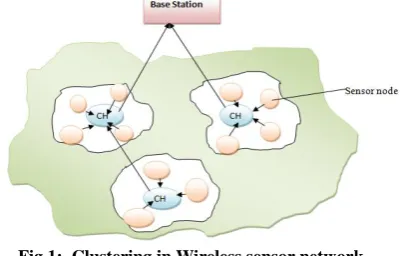
protocols have been proposed to realize power efficient communication in these networks. Clustering is considered as an efficient approach to minimize energy consumption in the network and prolonging the network lifetime. Clustering is defines as the grouping of densely deployed sensor nodes in the network. A single group of sensor nodes are called cluster. Clustering is a two level hierarchy. In which sensor nodes are at lower level and cluster head is at higher level. In clustering sensor nodes grouped together to form clusters and a node out of each cluster is selected as a cluster head. The node which has high energy level is selected as a cluster head because a cluster head node is responsible for long distance communication in the network. All sensor nodes in the cluster is in direct contact with the cluster head. Sensor nodes sense the parameters such as temperature, humidity, speed etc and send the sensed data to the cluster head. Cluster head aggregate the data send by these sensor nodes because the nodes are densely deployed in the network and due to this the chances of similar data are very high. With the help of data aggregation and data fusion the redundant data is removed and this reduces the number of messages transmitted to the sink. Cluster head transfer the data to the sink through other cluster heads in the network and this will help in increasing the longevity of the sensor network. Clustering process mainly consists of two phases:
Cluster formation.
Cluster Head selection.
[image:2.595.63.265.485.613.2]In cluster formation process sensor nodes in the network combine together to form small groups called clusters. In cluster head selection phase the nodes that fulfill the specific selection criteria such as high energy, high received signal strength is selected as a cluster head. The components involved in clustering are: Base station, Cluster head, Sensor field, sensor nodes, Sink. Much energy efficient routing protocols are designed based on the clustering structure where cluster-heads are elected periodically such as HEED. The process of clustering is show in fig 1.
Fig 1: Clustering in Wireless sensor network.
3.
HEED PROTOCOL
HEED stands for Hybrid Energy Efficient Distributed. HEED is a cluster based protocol. It uses residual energy as a basic parameter for selecting cluster head, the nodes having high residual energy is consider as a cluster head but in case when there are more than one nodes competing to become a cluster head then secondary parameters such as node degree, distances to neighbours is selected to break tie between the candidate nodes. The main assumption in HEED protocol is that all nodes in the network are homogenous means all sensor nodes in the network have same initial energy level. HEED has four main primary objectives [2]:
Improving network lifetime by distributing energy consumption.
Terminating the clustering process within a constant number of iterations.
Minimizing control.
Well-distributed cluster heads production.
4.
DATA DELIVERY MODELS
There are mainly three delivery models. They are query driven, event driven and continuous delivery models.
Event Driven Delivery Model: In event driven delivery model when an event occurs in the network the sensor nodes that sense that event take part in data transmission.
Query Driven Delivery Model: In query driven delivery model sink send a query to each node in the network and the nodes that have data according to or related to the query send the data to the sink.
Continuous Delivery Model: In continuous delivery model each node sense the network continuously and send data to the sink periodically.
Configuring the whole network as event-driven is an attractive option for a large number of applications since it typically sends small amount of messages. Event driven clustering is an energy efficient approach, since message transmissions are much more energy consuming when compared to sensing and (CPU) processing.
Event driven protocols are used to conserve the energy of the sensor nodes. In event-driven sensor network applications, events occur randomly and transiently, and accompanied by the burst of large numbers of data, therefore, network energy consumption is uneven.
5.
MOTIVATION
WSNs are highly adopted in different fields including habitat monitoring, home automation, fire detection, surveillance and reconnaissance, traffic control etc. due numerous benefits it offers. WSNs use is severely bounded by the energy constraints, the sensor nodes have limited energy and a large amount of energy gets consumed during communication process than sensing and processing process. The energy consumption is more in data communication than data sensing and processing processes done by the sensor nodes. The high consumption of energy affects the longevity of the network.
6.
PROPOSED METHOD
From past few years many researches has been done on data aggregation schemes. The key issue in wireless sensor network is that the sensor nodes are resource constraints. Sensor nodes are small, low powered battery device which is responsible for sensing, processing and communication tasks in the network. Due to densely deployment of sensor nodes in the network the data produced by these nearby neighbour nodes are identical, which result in large amount of redundant messages transmission. Due to large number of redundant data the energy consumption become high. Energy efficient data aggregation algorithms are a challenging task in wireless sensor network. The main aim of data aggregation protocol is to eliminate redundant data and subsequently increase network longevity.
Various researches in the past few decades shows that data aggregation and in-network processing are highly beneficial for reducing energy consumption in the network and for enhancing the network lifetime. In this paper a novel data routing for in-network aggregation has been proposed with key aspects such as low number of messages for establishing a routing tree, increased number of routes that are overlapped, high data aggregation rate and transmission. The proposed approach is also a cluster based approach with a goal to build a shortest path routing tree that connect maximum number of source nodes to the base station and maximized data aggregation in the network. Clustering is a common technique for data aggregation and collaborative processing in wireless sensor networks. Since energy supplies are limited in sensor nodes communication among nodes must be both network and energy efficient. To prolong the network lifetime, routing protocols for wireless sensor networks must support both continuous and event-driven monitoring. Continuous monitoring is needed to provide information on periodic basis. On the other hand, event-driven is important to monitor environment as much as to information base stations when an event occur. Thus, the proposed method is expected to achieve minimization of energy consumption in the routing.
7.
SIMULATION AND RESULTS
7.1
Performance Analysis
In order to check the performance of the proposed protocol in terms of its efficiency there are different metrics to be used. In this paper, we use End-to-End Delay and packet delivery ratio for protocols evaluation.
7.2
Simulation Setup
[image:3.595.316.544.223.466.2]In this section, the proposed method has been implemented in NS2.35 simulator. The simulation is run with 49 sensor nodes. These nodes are uniformly dispersed in 1000*1000 meter square field. Table 1 shows the network parameter and their respective values.
Table 1. Simulation Parameters.
Simulator NS 2.35
No. of events 3
Simulation time 70 sec
No. of nodes 49
Topology 1000m* 1000m
Transmission range 250 m
Traffic CBR
Packet Size 512
Initial energy 100 J
Antenna Omni directional
Propagation model Two ray ground
7.3
Results
7.3.1
End-to-End Delay
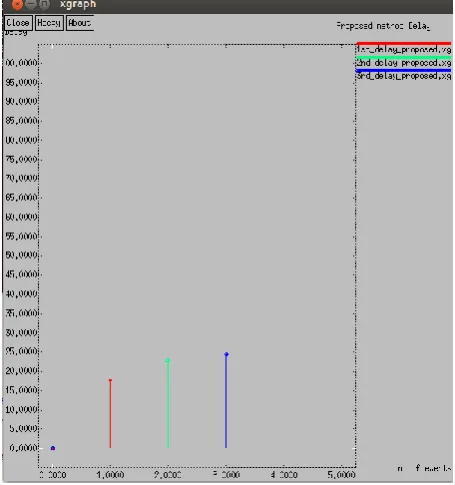
[image:3.595.317.542.489.669.2]End-to-End Delay is defined as the average time taken by a data packet to reach at the destination. The lower value of end to end delay means the better performance of the protocol.In Figure 2 and 3, along x-axis delay and along y-axis number of events is plotted. From the graphs, it can be observed that value for end-to-end delay in proposed method is lower as compared to the existing method. This means that our proposed method is better than the existing method.
Fig 2: End-to-End Delay in Proposed Method
Fig 3: End-to-End Delay in Existing Method
7.3.2
Packet Delivery Ratio
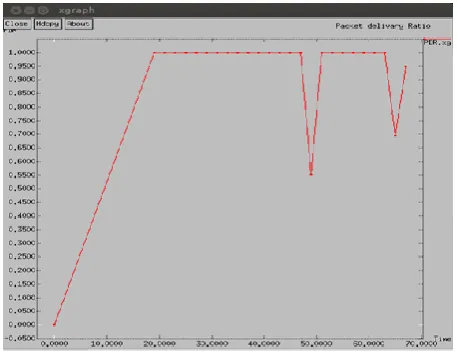
[image:3.595.49.285.641.766.2]Fig 4: Packet Delivery Ratio in Proposed Method
Fig 5: Packet Delivery Ratio in Existing Method
8.
CONCLUSION
In this paper an overview of the event based clustering and data aggregation used in WSNs is presented. The main key issue in Wireless Sensor Network is limitted energy. The concept of dividing the sensor nodes that sense an events in into clusters known as clustering is beneficial for energy conservation in WSNs. In clustering the data sense by the cluster nodes is aggregated to reduce redundant data that save energy of the sensor nodes because it reduces the number of data transmitted to the base station. Sensor nodes have energy constraints therefore various approaches or protocol has been proposed for increasing the lifetime of the wireless sensor network.
9.
ACKNOWLEDGMENTS
The paper has been written with the guidance and active support of my department and who have helped me in this work. I would like to thank all the individuals whose encouragement and support has made this work possible.
10.
REFERENCES
[1] Chen, Y-C., and C-Y. Wen. "Distributed Clustering With Directional Antennas for Wireless Sensor Networks." Sensors Journal, IEEE 13.6 (2013): 2166-2180.
[2] Amandeep Kaur, Rupinder Kaur, “Energy Efficient Routing for Wireless Sensor Network through Event-Based Clustering Mechanism”, International Journal of Advanced Research in Computer Science and Software Engineering (IJARCSSE), Volume 4, Issue 6, pp. 163-168, June 2014.
[3] Bokare, Mr Madhav, and Mrs Anagha Ralegaonkar. "Wireless Sensor Network."
[4] Stefanos A. Nikolidakis, Dionisis Kandris, Dimitrios D. Vergados and Christos Douligeris, “Energy Efficient Routing in Wireless Sensor Networks Through Balanced Clustering”, Algorithms 2013, 6, 29-42; doi:10.3390 [5] Ihsan Ali , Rahim Khan, Mehdi Hassan, and Mustaq
Ahmad, “Energy Aware Routing and Data Aggregation in Wireless Sensor Networks”, 2nd International Conference on Machine Learning and Computer Science (IMLCS'2013) May 6-7, 2013 Kuala Lumpur (Malaysia)
[6] Manju Bala and Lalit Awasthi, “Proficient D-HEED Protocol for Maximizing the Lifetime of WSN and Comparative Performance Investigations with Various Deployment Strategies”, International Journal of Advanced Science and Technology Vol.45, August, 2012
[7] Leandro Villas, Azzedine Boukerche, Heitor S. Ramos, Horacio A. B. F. de Oliveira, Regina B. de Araujo and Antonio A. F. Loureiro, “DRINA: A Lightweight and Reliable Routing Approach for in-Network Aggregation in Wireless Sensor Networks”, 2012 IEEE
[8] Kiran Maraiya, Kamal Kant, Nitin Gupta, “Wireless Sensor Network: A Review on Data Aggregation”, International Journal of Scientific & Engineering Research Volume 2, Issue 4, April -2011 ISSN 2229-5518, IJSER 2011
[9] D.D.Chaudhary, Pranav Pawar, Dr. L.M. Waghmare, “Comparison and Performance Evaluation of Wireless Sensor Network with different Routing Protocols”, 2011 International Conference on Information and Electronics Engineering, IPCSIT vol.6 (2011), IACSIT Press, Singapore
[10] Harneet Kour, Ajay K. Sharma, “Hybrid Energy Efficient Distributed Protocol for Heterogeneous Wireless Sensor Network”, International Journal of Computer Applications (0975–8887) Volume 4–No.6 , July 2010
[11] Suat Ozdemir, Yang Xiao, “Secure data aggregation in wireless sensor networks: A comprehensive overview”, Computer Networks 53 (2009) 2022–2037.
[12] M. BHEEMALINGAIAH, M. M. NAIDU, D. Sreenivasa RAO, “Energy Aware Clustered Based Multipath Routing in Mobile Ad Hoc Networks”, I. J. Communications, Network and System Sciences, 2009, 2, 91-168, Published Online May 2009 in SciRes.
[13]Bhaskar Krishnamachari, Deborah Estrin, Stephen Wicker,”The Impact of Data Aggregation in Wireless Sensor Networks”,
[image:4.595.54.283.275.454.2][15]Ossama Younis and Sonia Fahmy, “HEED: A Hybrid, Energy-Efficient, Distributed Clustering Approach for Ad-hoc Sensor Networks”,
[16] Bhaskar Krishnamachari, Deborah Estrin, Stephen Wicker “Impact of Data Aggregation in Wireless Sensor Networks”,
[17]Giuseppe Anastasi, Marco Conti, Mario Di Francesco, Andrea Passarella, “Energy Conservation in Wireless Sensor Networks: a Survey”,
[18] Kemal Akkaya and Mohamed Younis, Moustafa Youssef, “Efficient Aggregation of Delay-Constrained Data in Wireless Sensor Networks”
[19] Ramesh Rajagopalan, Pramod K. Varshaney, “Data aggregation techniques in sensor networks: A survey”,
[20]Kamanashis Biswas, Vallipuram Muthukkumarasamy, Elankayer Sithirasenan, “Maximal Clique Based Clustering Scheme for Wireless Sensor Networks”, IEEE. [21]M. Young, The Technical Writer’s Handbook. Mill