Capstone Summary Report: Development of the 2012-2017 Orange County, North Carolina Master Aging Plan
Capstone Students Phoebe Goldberg
Laura Major Marcia Perritt Hannah Prentice-Dunn
Rebecca Woodruff
Orange County Department on Aging Janice Tyler
Mary Fraser, MPA, DSW Faculty Advisors Bob DeVellis, PhD Brenda DeVellis, PhD
UNC Honor Code
Acknowledgements
List of Acronyms
AARP – formerly American Association of Retired Persons, a national non-profit organization that serves older adults
HB – Department of Health Behavior GDP – Gross Domestic Product MAP – Master Aging Plan
OC BOCC – Orange County Board of County Commissioners OCDOA - Orange County Department on Aging
PCP – Primary Care Physicians
Abstract
Background: Adults 65 years and older currently constitute roughly 10% of the total population in Orange County, North Carolina (U.S. Census Bureau, 2010a). With the aging of the Boomer population (e.g. people born between the years 1946-1964), and the desirability of Orange County as a retirement destination, this proportion is only expected to increase (Herzog, Wilson, & Rideout, 2010). This presents numerous challenges for Orange County. Among these challenges are a higher demand for health and human services, accessible transportation, affordable housing options, caregiver support systems, and information dissemination strategies. Methods: In order to address these issues, the Orange County Department on Aging (OCDOA), in collaboration with a Capstone team from the Department of Health Behavior (HB) at the University of North Carolina (UNC) Gillings School of Global Public Health, along with other aging services stakeholders, developed a five-year strategic plan called the 2012-2017 Master Aging Plan (MAP). Methods for the MAP development process included a formative assessment over the summer of 2011, a Community Forum, a public comment period, meetings with MAP Management and MAP Steering Committees, and a four-month work group process to develop objectives and strategies in five areas: 1) Health and Wellness, 2) Housing, 3) Navigation & Transportation, 4) Community
Engagement and 5) Aging in Place. Results: 113 participants attended the Community Forum. Work group participants were recruited from the Community Forum, publicity, and recommendations from the MAP Steering Committee and MAP Management Committee. Each of the five work groups met five times between November and February, and had between 13-25 participants. Each work group produced a list of objectives and strategies related its subject area, and the Capstone students compiled these
recommendations after the completion of the work group process to create the draft MAP. The draft MAP was reviewed several times by the MAP Management Committee and MAP Steering Committee and made public for a two-week public comment period in mid-March. After incorporating changes and feedback from these stakeholders, the Capstone team presented the final 2012-2017 MAP to the Orange County Board of County Commissioners on May 1st. Discussion: Engaging stakeholders from the beginning of the MAP development process allowed our team to create more feasible and targeted recommendations for improving programs, services, and policies to support older adults in Orange County. To ensure the sustainability and continued implementation of the 2012-2017 MAP, we recommend that an interdisciplinary monitoring board review county progress annually, OCDOA staff job positions and evaluations are based upon the indicators set out in the plan, and an effort be made throughout the next five years to educate the public on MAP progress and its role in their daily lives. Major Deliverables of Capstone Project
Table of Contents
I. Introduction………..p. 1
II. Background………...p. 2
III. Methods………...p. 10
a. Logic Model………...p. 11
b. Planning for Sustainability……….p. 11 c. Engagement & Assessment Activities………...p. 13
d. Work Plan Deliverables……….p. 18
IV. Results………p. 18
a. Sustainability Findings………..p. 18
b. Engagement & Assessment Findings………p. 22
c. Summary of Deliverables………..p. 26
V. Discussion………p. 31
a. Strengths and Limitations of Engagement & Assessment Activities………p. 31 b. Potential Impact & Benefits………...p. 32 c. Lessons Learned & Challenges……….p. 33 d. Considerations for Sustainability………...p. 34 VI. Conclusion & Recommended Next Steps……….p. 35
VII. Appendices………..p. 41
a. Final Work Plan
Introduction
Adults 65 years and older currently constitute roughly 10% of the total population in Orange County, North Carolina (U.S. Census Bureau, 2010a). With the aging of the Boomer population (i.e., people born between the years 1946-1964), and the desirability of Orange County as a retirement
destination, this proportion is only expected to increase (Herzog, Wilson, & Rideout, 2010). This presents numerous challenges for Orange County. Among these challenges are a higher demand for health and human services, accessible transportation, affordable housing options, caregiver support systems, and information dissemination strategies. In order to address these issues, the Orange County Department on Aging (OCDOA) has developed a five-year strategic plan in collaboration with a Capstone team from the Department of Health Behavior (HB) at the University of North Carolina (UNC) Gillings School of Global Public Health and other aging services stakeholders.
In the second year of the HB program, students are required to complete a Capstone project, replacing the prior curriculum requirement of a master’s paper. The Capstone projects are conducted by groups of students that work with community organizations to produce deliverables that advance the mission of the organizations. Capstone is designed to provide students with real-world learning
experiences, provide public service to local community organizations, and produce deliverables that have real public health impact. Fitting with this charge, the OCDOA’s strategic plan, called the 2012-2017 Master Aging Plan (MAP), establishes five-year goals, objectives and indicators to improve the quality of life for older adults in Orange County. The MAP was accepted on May 1st, 2012 by the Board of County Commissioners (OC BOCC), and will be used to guide the work of the OCDOA, other county
departments, and private sector providers.
hotline, providing Mood, Mobility and Memory1 clinics; consultations with social workers; support groups; and opportunities for social and physical activity. The bulk of these efforts are concentrated at Orange County’s two senior centers: the Central Orange Senior Center in Hillsborough and the Robert and Pearl Seymour Center in Chapel Hill. While the senior centers are intended to be a one-stop shop model for aging services for older adults, the OCDOA is committed to the idea of senior centers “without walls” (OCDOA, 2011). This means that the OCDOA recognizes that their work does not stop at the centers and needs to reach older adults who cannot easily access them, such as residents in the more rural Northern part of the county and those in long-term care facilities.
The goals of this Capstone project were to 1) obtain community input in the creation of the MAP, 2) involve other county officials and community organizations in the MAP development process, 3) build in an evaluation plan, and 4) author the MAP. This summary report will describe in more detail how these goals were achieved. We begin with a literature review to provide background information on the
pertinent issues affecting older adults in Orange County. We then present our logic model as a display of the inputs and activities that led to our outputs, outcomes, and intended impacts. Next, we discuss in more depth our methods for developing the 2012-2017 MAP, including our community engagement process and how we plan to sustain the efforts and results of our Capstone project. The next part of the report focuses on the main deliverables of our project, followed by a description of the impacts and benefits of our project. We then conclude our paper with a discussion of our challenges, key findings, lessons learned, and recommended next steps for the Master Aging Plan process.
Background
To identify the most important topics to address in the writing of this plan, the OCDOA and two HB students (My-Linh Luong and Rebecca Woodruff2) conducted a formative assessment over the summer of 2011. This formative assessment included focus groups with citizens from the county’s seven townships and 22 county department directors. Because the summer project primarily used
1 A clinic that provides free screenings to older adults related to depression, dementia, and physical health.
representative samples of people, the Capstone team identified the need to further solicit citizen input. As such, we planned and executed a Community Forum, which was publicized as the Community Kick-off Event and attended by over 110 people who generated additional topics for the MAP to address.
All Community Forum attendees voted on the topics, which resulted in the formation of five work groups: 1) Health and Wellness, 2) Housing, 3) Navigation and Transportation, 4) Community
Engagement, and 5) Aging in Place.3 The Health and Wellness work group addressed a broad range of topics, including access to appropriate medical care, emphasizing healthy lifestyles and prevention, mental health services, long-term care programs and services, and physician education. The Housing work group primarily addressed the availability and affordability of appropriate housing stock for aging adults in Orange County, and the Navigation and Transportation work group focused on issues for older adults and individuals with disabilities related to public transportation, walkability,4 and driving. The Community Engagement work group discussed topics related to technology and information sharing, work and retirement support, and ways to prevent older adults’ social isolation (i.e. lack of contact with others), and the Aging in Place work group focused on programs, services, and supports that would help Orange County adults stay in their own homes as they age. As the efforts of the five work groups formed the basis for the recommended objectives and strategies for the final MAP, these topic areas will serve as the framework for the following literature review that uses national, state, and local data to describe the needs of older adults and their families.
Health and Wellness
As America’s Boomer cohort ages, there are numerous issues that must be addressed in order to provide adequate care and prevent poor health among older adults. The formative assessment and Community Forum revealed several subtopics important to include in the Health and Wellness work group: affordability of healthcare, finding appropriate care, mental health, and caregiving support
3 In addition to these five work groups, a collection of OCDOA staff, volunteers, and the Capstone team called the
MAP Management Committee identified several topics from the community forum as crosscutting issues for all work groups to address, including affordability and economic concerns, geographic equity, attention to under-represented groups, workforce preparation, and information dissemination.
(Woodruff & Luong, 2011).
In the last thirty years, healthcare expenditures in the U.S. have grown at more than twice the rate of the Gross Domestic Product (GDP), resulting in higher out-of-pocket payments and reduced
affordability for those on restricted incomes (Fierro, 2006). As individuals age, they are more likely to develop chronic diseases, which often translates into expensive medical care (NCOA, n.d.).
Compounding this issue is the fact that adults aged 50 and over are more likely to have inconsistent healthcare coverage and those with low incomes or poor insurance coverage spend a substantial proportion of their incomes on healthcare costs (Collins, Davis, Schoen, Doty, & Kriss, 2006). While access to primary care physicians (PCPs) can reduce medical costs, the shortage of PCPs in some regions of the country and overall lack of PCPs trained to work with older adults may limit their access to appropriate primary care, especially those on Medicaid and Medicare (Scheffler & Spetz, 2011). In Orange County, citizens identified the challenges of finding aging-appropriate medical care and understanding public or private insurance coverage as barriers to their quality of life.
In addition to physical health, mental health is a major contributor to quality of life. Poor mental health among older adults has been tied to increased risk behaviors, slower recovery from illnesses, and the development of new physical or mental health problems (CDC, n.d.a). National data also indicate that older adults are at increased risk for depression and are often misdiagnosed or undertreated due to
providers’ incorrectly viewing depression as a natural part of aging (CDC, 2009). Based on the number of days in the last month an older adult felt poor mental health due to “stress, depression, and problems with other emotions”, the CDC’s State of Aging and Health report ranked North Carolina as 7th worst in the nation for “frequent mental distress” among seniors (CDC, n.d.b). Though county-level data on the mental health of older adults is unavailable, these facts illustrate the importance of including mental health issues in the 2012-2017 MAP in order to maximize Orange County citizens’ quality of life.
services. While local data is not available on caregivers, 65% of caregivers nationally report increased anxiety and stress, and 54% of caregivers in America are over 50 years old, compounding the already-present health issues of an aging population (Evercare and National Alliance for Caregiving, 2007). As almost one in five Americans are currently providing caretaker support for an older adult, it was essential for the MAP to provide support services to those who are filling a large need in Orange County (Evercare and National Alliance for Caregiving, 2007).
Navigation and Transportation
Also contributing to quality of life for older adults and their families is the area of Navigation and Transportation (Cvitkovich & Wister, 2001; Ritter, Straight, & Evans, 2002). Here, the terms navigation and transportation are considered together to indicate attention to multiple modes of travel, including walking, driving, and other means, in creating a holistic transportation system.
The formative assessment and Community Forum preceding the development of the 2012-2017 MAP showed continuity with previous MAP objectives, indicating, in part, the need for system expansion into rural areas and further alignment of the county’s several transportation services and plans (OCDOA, 2007; Woodruff & Luong, 2011). Particularly for older adults with limited functional ability (i.e., having mental or physical disabilities that hinder independent movement), effective navigation and transportation are critical for staying engaged in the community, and maintaining health and the ability to age in place (Cvitkovich & Wister, 2001; Ritter et al., 2002). A national study conducted by AARP found that 86% of adults over age 50 drive, while 13% use ride sharing and 5% use public transportation (Ritter et al., 2002). The same study found that some problems related to ride sharing and public transportation include feeling a lack of independence and not being able to reach desired destinations (Ritter et al., 2002). Still,
2010b; County Health Rankings, 2012). These statistics suggest that residents in all parts of the county may not have access to the transportation they need, particularly among the elderly.
One citizen-identified priority new to this 2012-2017 MAP was Orange County’s walkability, or the ease and safety with which pedestrians can travel, for older adults and those with disabilities
(Woodruff & Luong, 2011). Walkability is a critical topic for the health and wellness of older adults. Sidewalks, curbs, and streets are often problematic areas for the elderly, with outdoor falls among adults commonly caused by uneven surfaces and tripping (Li et al., 2006). By including key agencies and examining local and national evidence, the Navigation and Transportation work group was able to address the issues of system expansion and alignment, walkability, and more in their recommendations for the 2012-2017 MAP, and thereby support the objectives of the other work groups as well.
Aging in Place
The term aging in place refers to an older adult’s ability to live the rest of his/her life in his/her home (or other non-healthcare environment of choice) as long as possible. Aging in place has significant benefits to one’s wellbeing and quality of life: a comfortable environment, proximity to family, a sense of community and familiarity, and feelings of independence (Endres, Freedman, Fried, & Wasik, 1997; Wagner, 2010). There are a number of clinical, social, and environmental factors that influence an older adult’s ability to age in place safely and confidently. Appropriate and accessible support services, assistive technology (technology or devices that provide greater independence to individuals with physical or mental disabilities), strong social networks, and universal community design (design of buildings, products, and environments to be usable by all people, without adaptation or specialized design) are all examples of facilitating factors that extend the livability of one’s home into old age (Fielo & Warren, 2001).
Orange County residents: promotion of planned and naturally occurring continuing care retirement communities, home modifications and repairs, home-based personal care and healthcare services, safety and security, falls prevention, long-term care insurance, nutrition, and social isolation. Evidence suggests that home-based care services, which address many of the aforementioned concerns, are cost-effective and have a positive impact on physical and mental health (Rantz et al., 2011). Additionally, studies have found that older adults who utilize home repair services, another need identified through the formative assessment and Community Forum, are less likely to relocate from their homes (Tang, 2010).
Neighborhoods can play a large role in determining one’s ability to age in place, especially as older adults become more reliant on their immediate environments as they age (Burns, Lavoie, & Rose, 2011). Community Forum participants and OCDOA staff expressed interest in the Village model
(Woodruff & Luong, 2011), which relies on a more informal network of community members to provide volunteer and paid assistance to aging populations within a specific geographic community. Villages may develop through grassroots efforts or through existing social service agencies that use formal services (McDonough & Davitt, 2011). Villages and other naturally occurring retirement communities are a low-cost, community-level approach to facilitating healthy aging (Masotti, Fick, Johnson-Masotti, & MacLeod, 2006). The OCDOA and other organizations participating in the MAP process may have the combined capacity to organize and promote the creation of Villages in Orange County, as recommended in the 2012-2017 MAP.
Housing
Meeting the demand for high-quality, available, and affordable housing options is also necessary for ensuring a high quality of life for adults as they age. As discussed above, older adults report a
preference for aging in their own homes or in the communities with which they are familiar (AARP Public Policy Institute, 2010; Woodruff & Luong, 2011). However, for a variety of reasons, such as the burden of household maintenance to those with declining health status, many adults choose to live in places that are not single-family dwellings. As such, the 2012-2017 MAP focuses on ensuring a high-quality housing stock in Orange County to meet the varied needs of older adults.
Many independent housing models exist, including continuing care retirement communities, co-housing, shared co-housing, senior retirement communities, family care homes, and multilevel communities (Herzog et al., 2010). These housing models are well suited to adults who are able to live safely alone or in small groups, and can contract with providers for assistance with activities of daily living, such as dressing, bathing, and cooking. In addition to independent living options, the County must provide housing options for older adults who require or anticipate needing more support over the course of their lives through a variety of long-term care options, including assisted living, nursing homes, and continuing care retirement centers. Although housing reform in the current MAP focuses largely on housing
availability and facilitating an entrepreneurial business environment, the formative assessment showed that this approach may not be appropriate for the more rural, Northern area of the County. In this region, older adults may be more likely to stay in their homes as they age and rely on extra-familial social networks, such as churches, for the care they need (Woodruff & Luong, 2011). Consequently, the particular needs of this group were addressed in the Aging in Place work group.
needs of older adults in Orange County comes with many accompanying concerns. Among these concerns are educating adults to make informed decisions about housing, the high cost of living in Orange County, shortening the wait lists for long-term care facilities, high taxes as a barrier to entrepreneurship, and the fact that many supported living facilities are not covered by Medicaid or other insurance providers (AARP Public Policy Institute, 2006). By increasing the availability of housing options, creating a business climate supportive of building new developments, and ensuring the affordability and quality of housing options, the 2012-2017 MAP supports the housing-related quality of life goals of Orange County. Community Engagement
The 2012-2017 MAP also addresses quality of life issues related to community engagement in Orange County. As older adults retire and leave the workforce, the reduction in the amount of time they are occupied each day presents opportunities for more and varied engagement with the community. In Orange County, 82% of adults 65 and older are not part of the workforce (U.S. Census Bureau, 2010c). Additionally, citizens who participated in the formative assessment and Community Forum identified community engagement as a primary concern for wellbeing and quality of life (Woodruff & Luong, 2011). Research has demonstrated that social engagement is positively associated with physical health, meaning that adults who are more engaged typically have better health and less disability (Cherry et al., 2011; de Leon, Glass, & Berkman, 2003). Furthermore, engagement is also linked with increased mental health and protection against loneliness (Croezen, Haveman-Nies, Alvarado, Van't Veer, & De Groot, 2009). Two of the most important subtopics identified in the formative assessment and Community Forum to address these community-engagement needs of Orange County citizens were isolation and information sharing (Woodruff & Luong, 2011).
opportunities for involvement with the community as their social networks naturally begin to decrease (Woodruff & Luong, 2011). Orange County’s two state of the art senior centers are significant
achievements in the area of community engagement from previous MAPs, and more engagement can be facilitated in these centers (OCDOA, 2010).
Orange County community members also highlighted information sharing as a priority. Specifically, older adults were concerned about the increasing use of technology to disseminate information because many have a hard time accessing and using e-mail or the Internet (Woodruff & Luong, 2011). The OCDOA (2010) has developed training resources, such as SeniorNet,5 to help older adults utilize technology more effectively, as this issue has increasing prominence as technology permeates more aspects of daily life. In addition, studies have shown that once trained, computer and Internet use has led to decreased depression and loneliness as well as increased life satisfaction in older adults (White et al., 2002). The significance of these topics for older adults’ health and quality of life led the Community Engagement work group to develop objectives and strategies to address these issues, along with others, in the 2012-2017 MAP.
Methods
The Capstone team used a variety of methods to fulfill the four goals of the Capstone project, and to ultimately create a MAP that addresses the issues described in the literature review. After explaining the logic model behind this Capstone project and discussing our overall methods around planning for sustainability and community engagement, we will describe in detail the main activities that contribute to the development of the 2012-2017 MAP.
5
Capstone OCDOA Logic Model
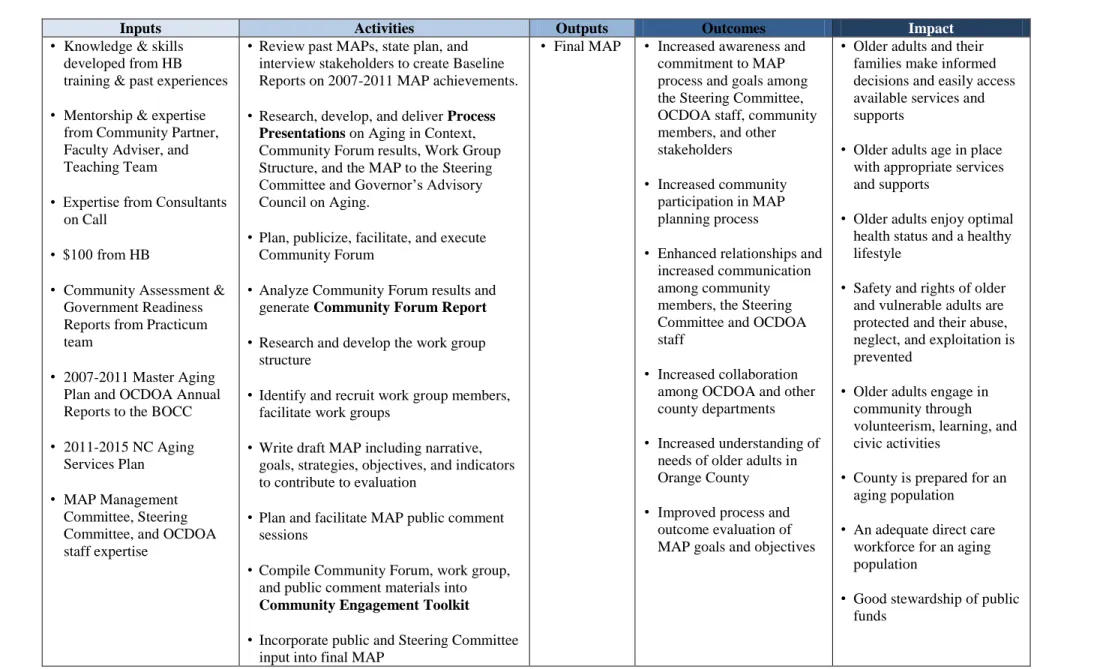
Logic models are graphic, systematic presentations of the relationships between the resources invested, the planned activities, and the expected results of the project (W. K. Kellogg Foundation, 2004). Logic models also assist in identifying critical elements in a project and provide the foundation for evaluation questions (W. K. Kellogg Foundation, 2004). The Capstone OCDOA logic model in Figure 1 outlines the critical activities of the MAP planning process, as well as the short-term and long-term expected outcomes. The inputs are the resources invested in the project, which includes the expertise of students, staff, and consultants on call, as well as formative research conducted by practicum students. The activities listed in the OCDOA logic model involve actions such as research, development, and facilitation that contributed to our first three preliminary deliverables (highlighted in bold), and resulted in the fourth, main deliverable stated in our work plan, which is shown in the outputs column. Outcomes are the expected short-term results of the project, such as increased awareness and communication. The impacts listed are the Capstone project’s expected long-term results. These long-term impacts align with the goals set forth in the 2012-2017 MAP, which are based on the state of North Carolina’s State Aging Services Plan (DAAS, 2011).
Planning for Sustainability
The Capstone project’s intended long-term impacts will be best achieved if the materials and processes created for this project are sustained by the OCDOA after the project’s completion in May 2012. Because the OCDOA and other community leaders will carry out the implementation of the 2012-2017 MAP without the involvement of the current Capstone students, it is critical for the MAP planning process to include elements that promote sustainability.6 For the purposes of this document, we define sustainability as the MAP’s institutionalization within the OCDOA, continued quality of life benefits for Orange County’s older adult population, and continued capacity building in Orange County related to programs and services offered to older adults (Shediac-Rizkallah & Bone, 1998).
6The OCDOA will have a new Capstone team for the 2012-2013 academic year. These students will work to
Figure 1: Logic Model
Inputs Activities Outputs Outcomes Impact
• Knowledge & skills developed from HB training & past experiences
• Mentorship & expertise from Community Partner, Faculty Adviser, and Teaching Team
• Expertise from Consultants on Call
• $100 from HB
• Community Assessment & Government Readiness Reports from Practicum team
• 2007-2011 Master Aging
Plan and OCDOA Annual Reports to the BOCC
• 2011-2015 NC Aging
Services Plan
• MAP Management
Committee, Steering Committee, and OCDOA staff expertise
• Review past MAPs, state plan, and
interview stakeholders to create Baseline Reports on 2007-2011 MAP achievements.
• Research, develop, and deliver Process Presentations on Aging in Context, Community Forum results, Work Group Structure, and the MAP to the Steering Committee and Governor’s Advisory Council on Aging.
• Plan, publicize, facilitate, and execute Community Forum
• Analyze Community Forum results and
generate Community Forum Report
• Research and develop the work group
structure
• Identify and recruit work group members, facilitate work groups
• Write draft MAP including narrative, goals, strategies, objectives, and indicators to contribute to evaluation
• Plan and facilitate MAP public comment
sessions
• Compile Community Forum, work group,
and public comment materials into Community Engagement Toolkit
• Incorporate public and Steering Committee input into final MAP
• Final MAP • Increased awareness and
commitment to MAP process and goals among the Steering Committee, OCDOA staff, community members, and other stakeholders
• Increased community
participation in MAP planning process
• Enhanced relationships and increased communication among community members, the Steering Committee and OCDOA staff
• Increased collaboration among OCDOA and other county departments
• Increased understanding of needs of older adults in Orange County
• Improved process and
outcome evaluation of MAP goals and objectives
• Older adults and their families make informed decisions and easily access available services and supports
• Older adults age in place with appropriate services and supports
• Older adults enjoy optimal health status and a healthy lifestyle
• Safety and rights of older and vulnerable adults are protected and their abuse, neglect, and exploitation is prevented
• Older adults engage in community through volunteerism, learning, and civic activities
• County is prepared for an aging population
• An adequate direct care workforce for an aging population
To assess these outcomes, the Capstone team followed Shediac-Rizkallah and Bone’s (1998) sustainability framework, which requires consideration of factors related to the OCDOA organizational setting, broader community, and MAP design process to ensure that the final plan will be appropriately implemented (Shediac-Rizkallah & Bone, 1998). Due to this unique and broad county process, we focused on all three sustainability factors to ensure the plan is implemented thoroughly in the future. Discussion of how the Capstone team included these factors in the MAP planning process is described later in the Results section.
Engagement and Assessment Activities
The importance of community engagement in developing and implementing health behavior interventions is well documented, yet it also has important applications for the strategic planning of government services. One of the goals for the 2012-2017 MAP was to incorporate more and better quality community engagement activities than had been included in the development of past MAPs. The 2011-2012 Capstone team was charged with helping to realize this goal. Our team referred to McCloskey et al.’s (2011) Principles for Community Engagement, a handbook that describes the philosophy and practice of community engagement, to design and evaluate the community engagement activities related to the development of the MAP.
Similar to other county-level government strategic plans, the MAP is intended to be
representative of the needs of Orange County consumers and providers of aging services. The primary intended beneficiaries of the MAP are older adults residing in Orange County, but in this context,
community can be understood more broadly to include the families and caregivers of older adults, Orange County government department staff, in-home care providers, and long-term care providers. In order to ensure that the final 2012-2017 MAP was representative, our Capstone deliverables provided
The benefits of community engagement extend beyond increasing representativeness, as the MAP’s ultimate purpose is to respond to the quality of life needs and concerns articulated by older adults. To confirm that the issues included in the MAP are salient to the community, we used Arnstein’s Ladder (1969) to guide community engagement in the research and development of the MAP. Arnstein (1969) demonstrates the importance of citizen empowerment when planning programs or interventions. The 2012-2017 MAP planning process was not as participatory as it could have been because of the limited extent to which some stakeholder groups were successfully involved, but it was an improvement on past MAP processes in that we attempted to balance and incorporate the input of all those community beneficiaries as listed above who did participate (Arnstein, 1969).
Earlier MAP processes engaged the public through one-way communication efforts between OCDOA staff and community members. Previous MAP authors educated the public on the purpose, content, and rationale behind MAP goals and objectives, soliciting the public’s approval through presentations and public relations campaigns. For the 2012-2017 MAP, the Capstone team and the OCDOA staff sought to engage the public, county agencies, and aging stakeholders in meaningful, two-way communication. Community members were able to set the agenda for the work group process by prioritizing salient issues at the Community Forum. Through the work group process, OCDOA staff, community members, and the Capstone team worked hand-in-hand to develop objectives and strategies that addressed the priorities identified through the Community Forum. Capstone students facilitated the process, but the content of the MAP came directly from work group participants, who represented a cross-section of Orange County residents and professionals. The public had additional opportunities to provide feedback on the MAP through public comment sessions, which were held seven locations across the County. These activities are described in greater detail below.
government level and use their collective knowledge, experiences, and connections to effect change. Citizens would also learn more about the barriers associated with funding and program implementation at the county level and thereby be better-informed advocates and supporters of county programming. Likewise, OCDOA staff would be more aware of issues, as well as assets, within the local community and be able to incorporate this into program planning. Lastly, involving citizens in planning for future MAPs would increase accountability for the plan’s subsequent monitoring and evaluation.
Having described why engaging the community is important, we will now review in more detail our specific steps in doing so. The following community engagement activities are listed in chronological order as they were done in the development of the work plan deliverables.
Community Forum
The first method that the Capstone team and the OCDOA used to engage Orange County residents was a community forum. The Community Forum was advertised in local newspapers, through the OCDOA and other county agency listservs, at the two Senior Centers, and by flyers placed at various locales throughout the county (e.g. supermarkets, community organizations, businesses, etc.). The Community Forum took place on October 5, 2011 at the Seymour Center in Chapel Hill, with 113
involved as either a work group member or as a resource. The Community Forum’s activities thus allowed community members to have their concerns heard and responded to immediately, and allowed them to decide which topics would be the focus of the 2012-2017 MAP.
MAP Work Groups
The five MAP work groups were collectively the second major community engagement activity included in our Capstone project. Each Capstone student and two OCDOA staff members were assigned to one of the five work groups. The student and staff were responsible for holding five work group meetings from November 2011 – February 2012, delegating homework assignments7 and facilitating the prioritization of objectives, strategies, and indicators for each of the eight MAP goals. In addition to community members and professionals who were recruited through their participation in the summer formative assessment and the Community Forum, the student-staff triads also recruited a core group of five to ten individuals identified by the Steering Committee and Advisory Board on Aging. This core group was expected to provide direction and guidance to the work group due to their professional
experiences and expertise. Across the five work groups, the date, time, and location of each meeting were made publicly available in an effort to encourage participation from as many community members as possible. The output of the five work groups was a prioritized list of objectives, strategies, and indicators for each of the eight MAP goals. The five Capstone students used this list to write the draft MAP in March 2012.
MAP Public Comment Period
The third community engagement activity of this Capstone project was public comment, in the form of seven in-person sessions and paper/electronic surveys that were created by the Capstone team and made available to citizens in March 2012. The purpose of the public comment period was to give the broader Orange County community an opportunity to read and critique the draft MAP before it was presented to the Board of County Commissioners in May 2012. Responding to feedback from the
7Homework assignments included researching existing and potential services and facilitators and barriers to their
Community Forum, the OCDOA intentionally scheduled these sessions for both the Central Orange Senior Center in Hillsborough, the Seymour Center in Chapel Hill, and several other community centers in an attempt to increase participation from residents in rural Northern Orange County. Each Capstone team member facilitated a session and recorded comments for the OCDOA to process and use to make changes to the MAP.
Steering Committee Meetings
The Capstone team and OCDOA staff also presented the MAP development process and draft to the Steering Committee throughout the year to obtain further input. The MAP Steering Committee was comprised of over thirty upper-level managers and directors of organizations that were directly affected by the strategies proposed in the MAP, such as county agencies, local healthcare organizations and nonprofits, UNC research institutes, and other agencies that provide aging-related services. A complete Steering Committee roster can be found in Appendix B. The Steering Committee members and their respective organizations were key stakeholders in the planning process as they shared responsibility with the OCDOA in implementing and evaluating the goals, objectives, and strategies outlined in the MAP. The OCDOA and Capstone team engaged Steering Committee members early on in the process. Prior to the start of the Capstone project, the OCDOA invited members to participate in the Committee, which met quarterly over the course of the year. Through presentations at the meetings and electronic
communication, Steering Committee members were kept abreast of the MAP planning process and asked to give feedback on the content of the plan. The members were asked to commit to objectives and strategies outlined in the MAP that were relevant to their organizations. The Steering Committee also assisted throughout the planning process by recommending participants for and publicizing the work group process and providing support at the presentation of the final plan to the OC BOCC.
Governor’s Advisory Council on Aging
development of the MAP and highlight the County’s role as leader in MAP development, but it also sparked interest among the Board’s members to implement the MAP development process elsewhere in North Carolina. By sharing this process with leaders at the state level, as well as thoroughly documenting the process, the Capstone team is hopeful that this experience will lead to more participatory and
collaborative MAP planning processes throughout the state of North Carolina. Work Plan Deliverables
The four deliverables for this Capstone project include Orange County Master Aging Plan Process Presentations, the Orange County Master Aging Plan Community Forum Report, the Orange County Master Aging Plan Community Engagement Toolkit, and the Master Aging Plan for Orange County. As shown in the logic model (Figure 1), each of these was developed through the community engagement activities described above. Some of the deliverables were set by the community partner at the outset of the project, such as the Master Aging Plan for Orange County. Other deliverables were created in partnership with the Capstone team and teaching team, such as the Orange County Master Aging Plan Community Engagement Toolkit. The Capstone faculty advisors provided support by attending several of the Orange County Master Aging Plan Process Presentations and the Community Forum itself. The deliverables’ collective purpose was to create a utilization-focused strategic plan through a structured process that could be replicated and improved upon in years to come. Through the partnerships among the community partner, OCDOA staff, Capstone students, faculty advisors, and teaching team, we were able to document our process for future users.
Results
Sustainability Findings
Organizational Factors
The first organizational factor that will contribute to OCDOA implementation of the MAP is its institutional strength. The OCDOA is one of the largest and oldest Departments on Aging in the state of North Carolina, with well-equipped programs and services focused at two county senior centers. The 2012-2017 MAP will be the OCDOA’s third five-year strategic plan, indicating a well-established organizational basis for the process. While a new OCDOA director, Janice Tyler, oversaw this MAP, the Capstone group viewed this leadership change as a strength given the Director’s long history at the OCDOA and her openness to new ideas in the MAP development process.
Individual champions of the MAP and the level of community engagement via committee membership by the OCDOA will also contribute to the sustainability of the MAP over time. The two most notable committees overseeing the MAP planning process were the Steering Committee and the MAP Management Committee. Because the OCDOA will be the center of implementation for the MAP, this collaboration between the Capstone team and the OCDOA committees prevented segregation of knowledge and expertise during the planning process. This collaboration also allowed the Capstone team to repeatedly consult with OCDOA staff and county leaders to ensure the usefulness and effectiveness of the MAP as it was being developed.
Community Factors
The participatory nature of the MAP planning process and its integration into the broader political, social, and economic environment of the county will allow the MAP to avoid sustainability issues that typically beset other community-based initiatives. Older adults in Orange County, the intended beneficiaries of the MAP, have been directly involved with the identification of issues to be addressed by the MAP, as well as the design of objectives and action steps to address these issues. This involvement took place through the Community Forum and the MAP work groups.
The Community Forum, as previously described, sought a wide range of community participation among older adults, members of county departments, and organizations that have a hand in influencing the quality of life of older adults. Of the 78 attendees who provided their age, 63% were over 50 years old. The Capstone team invited Community Forum attendees to join work groups that addressed the themes that were prioritized by attendees at the event.
The MAP work groups brought together various community stakeholders, which enhanced the MAP’s potential to have a widespread and lasting impact. The work group process helped to create a sense of ownership among committee members, thereby compelling members to feel responsible for ensuring that the objectives set forth in the MAP are closely monitored throughout the five-year implementation period. Ultimately, the work group process strengthened the community’s capacity to engage with county government and understand political and economic environments impacting aging. Ideally, the MAP planning experience has inspired community participants to become more involved with county government in the future through Advisory Board on Aging membership and policy advocacy.
of moving forward with MAP goals and strategies. Including socioeconomic and political considerations in the MAP planning process helped to ensure the sustainability of the MAP. Budgets for County agencies will not be increased in the upcoming fiscal year and it is difficult to predict whether any increases in funding allocations will occur in upcoming years. Work group members were creative in determining ways to leverage existing staff and resources, as well as in seeking outside funding sources to add to existing programs and services under the current County budget constraints.
MAP Design Factors
A major contribution of the Capstone team was the inclusion of an evaluation process into the structure of the MAP, to be used throughout implementation. Despite the OCDOA’s limited capacity to conduct close monitoring and evaluation of the MAP implementation, the Capstone students worked with OCDOA staff to define a monitoring and evaluation plan that will be feasible given the agency’s staff and resource constraints. One example of this work was the Capstone team’s recommendation that the
OCDOA create a summer practicum position to assist with creating an implementation plan and building the capacity of OCDOA staff to monitor and evaluate the MAP. Another example of this work was including strategies and indicators of success for every objective listed in the plan. Measuring the effectiveness of the strategies outlined in the MAP will allow the OCDOA to not only make course corrections over the next five years, but to demonstrate that MAPs are a useful tool for other local governments to adopt.
In addition to the MAP itself, the Capstone team has documented the MAP planning process through the creation of a Community Engagement Toolkit so that it may be replicated for the 2018-2023 MAP and adopted in other North Carolina counties. This deliverable will greatly enhance the
Engagement and Assessment Findings Community Forum
Engaging with the community through a forum helped the Capstone team to understand what issues are salient to older adults in Orange County. The small-group discussions allowed community members voice their concerns and issues that were most important to them, which were recorded and brought forward to the larger group for prioritization. Because the Capstone team had limited prior experience with aging-related issues in Orange County, the Community Forum participants were valuable sources of knowledge. The community members are experts by virtue of living in Orange County and using its aging services and programs. The Community Forum was a novel component of the MAP development process, and as such, the Capstone team collected feedback on the event through satisfaction surveys. Two areas for improvement emerged from this feedback. First, the small-group discussions tended to spend more time expounding on negative aspects of aging in Orange County without identifying potential solutions to these problems. Additionally, survey respondents valued the prioritization process as a method to determine the work group topics, but they also thought that the logistics of the voting and prioritization process could be improved in future MAP cycles.
The Community Forum had a large impact on the Capstone project primarily because it built on the formative assessment to determine which topics would be addressed in work groups and which specific issues within those topics would be examined in depth (Woodruff & Luong, 2011). In addition, Community Forum participants who indicated their interest in participating in a work group served as the basis for work group recruitment. Another outcome of the event was identifying topics that became crosscutting issues, such as geographic location, underserved populations, and cost, which all work groups considered.
minority groups, young people, and individuals from the Northern part of the County. Our recommendations for discussing these limitations are discussed below.
MAP Work Groups
The work groups were instrumental to the bottom-up creation of the 2012-2017 MAP, as the five meetings strategically led community members to develop a list of prioritized objectives and strategies to include in the plan. After the first meeting, each work group created a comprehensive list of the issues that needed to be addressed within that group. The result of the second meeting was the identification of which services should be added, protected, expanded, or improved in Orange County (DAAS, 2011). In the third meeting, work group members used the information gathered in the first two meetings to identify countywide problems and potential solutions to those problems. Meeting four was spent evaluating the solutions across a number of dimensions, including feasibility, efficacy, reach, and others, as well as prioritizing both the problems and solutions, based on the evaluations. Finally, in meeting five, work group members translated the list of prioritized problems and solutions into objectives and strategies, organized under the eight goals of NC’s Aging Services Plan. The Capstone team combined and streamlined these objectives and strategies into the first iteration of the MAP.
agencies, like the Department of Social Services and faith-based organizations, were not represented. The OCDOA recognizes this as a limitation and will pursue further contact to ensure the involvement of these agencies in the implementation of the current MAP and the development of the next.
MAP Public Comment Period
The MAP public comment period served as a supplement to the work group process, in that it provided reinforcement that the topics already identified were important to the community and indicated gaps in the MAP. In large part, public comment participants provided positive feedback on the MAP development process as well as the content of the draft for public comment. However, the public comment period also brought to light two important issues that had been overlooked. The first of these was attention and sensitivity to LGBTQIA individuals and the second was the need for
non-denominational spiritual services at the senior centers. These issues were discussed in different work groups, but there was no explicit mention of them in the MAP itself. After reviewing the public comment period responses, the Capstone team and MAP Management Committee revised the MAP to ensure these concerns were addressed.
The strengths of this approach centered on the fact that, in response to feedback from the formative assessment and Community Forum, public comment sessions were held at a variety of times and locations around Orange County, including the two senior centers, libraries, and churches. This allowed for the ability to obtain feedback from a wider variety of community members. Additionally, as many of these community members had not been involved in the development process previously, they provided us with new insights and identified which parts of the MAP needed additional clarification. Although we improved the MAP as a result of the public comment period, our response rate for both the survey and the sessions was low, pointing to a need for more publicity and awareness in future MAPs. Steering Committee Meetings
in the MAP. However, the Steering Committee meetings also guided the Capstone team and the OCDOA throughout the development process by identifying work group members, listing duplications of effort and potential partners across Orange County, providing feedback on the feasibility of MAP objectives after the work group process, and finally, endorsing the revised draft of the MAP after the public comment period.
The benefit of engaging this group was partnering with stakeholders with the ability to implement the objectives and strategies identified by community members. Without the support and commitment of these individuals, implementing the MAP as a countywide plan, as desired by the community, would be near impossible. One of the challenges was balancing having a document that Steering Committee could feel comfortable endorsing while remaining true to the wishes of our work groups. To address this, we often had to break the loftier strategies down into manageable steps for implementation, which will help allow for the continued involvement of the Steering Committee over the next five years.
Governor’s Advisory Council on Aging
While the Steering Committee will help increase the sustainability of the MAP, it is our hope that our presentation to the Governor’s Advisory Council on Aging will contribute to the dissemination of the MAP’s development process. Following the presentation, the Governor’s Advisory Council on Aging members expressed interest in having the OCDOA speak with other county aging departments on participatory and collaborative strategic planning. In fact, our community partner, Janice Tyler, has proposed the idea of holding a conference on this topic for aging department staff across the state.
Summary of Deliverables
The table below summarizes this Capstone project’s major deliverables, including methods used, key findings, and lessons learned. These deliverables were chosen in partnership with the OCDOA and Capstone faculty advisers. The fourth deliverable, the final MAP, was the culminating product of our Capstone project. The other major deliverables listed relate to the MAP planning process and will be especially useful in future MAP planning cycles conducted by the OCDOA and also in helping to disseminate the results of the MAP process to other stakeholders and interested communities. These deliverables outline the MAP development process, identify challenges and lessons learned, share the results and tools of specific components of the planning process, and allow for improved future planning processes rooted in community engagement.
Table 1. Summary of Major Deliverables
Deliverable 1: Orange County Master Aging Plan Process Presentations
Purpose: 1) Inform and update high-level county and state stakeholders on the MAP Process; 2) Gain input and guidance during MAP development process from diverse county organizations; 3) Gain commitment, resources, and support from high-level stakeholders to carry out MAP goals and objectives over the next five years.
Timeline: Steering Committee Presentations: September 14th, October 26th, February 29th, April 10th; Presentation to Governor’s Advisory Council on Aging: March 27th
Methods Key Findings
Presentations:
1. PowerPoint Presentation to Steering
Committee summarizing formative assessment (9/14/11)
2. PowerPoint Presentation to Steering Committee summarizing results of the Community Forum (10/16/11)
3. PowerPoint Presentations summarizing the work group process and draft MAP (2/29/12) 4. PowerPoint Presentation summarizing Orange
County’s 2012-2017 MAP development process for Governor’s Advisory Board on Aging (3/27/12)
5. PowerPoint Presentation to Steering
Committee summarizing the final draft of the MAP (4/10/12)
Existing partnerships are essential to recruiting work group members. In future MAPs, there should be a more
concerted effort to reach out to minority populations, residents of rural areas, and younger adults.
Finding more interactive ways to
incorporate Steering Committee members into the planning process could help to increase the commitment of agencies outside the OCDOA to MAP goals. Community engagement in strategic
planning requires substantial staff
commitment and resources, but makes for a more comprehensive and relevant final plan.
Discussions:
Steering Committee small-group discussions (2/29/12): Steering Committee members reviewed the objectives, strategies, and indicators for 3 of the 8 goals, and offered comments on duplication of existing programs or services in Orange County, feasibility, and resources their organizations could offer.
Deliverable 2: Orange County Master Aging Plan Community Forum Report
Purpose:1) Provide demographic data on participants of Forum, 2) Summarize findings of the prioritization process, 3) Summarize participant evaluations.
Timeline: Forum development, implementation, and analysis: September – October 15th, 2011 (~ 1 ½ months)
Methods Key Findings
Recruitment
1. Publicity: including a press release, article in Senior Times, email announcement, and posters placed around Orange County by volunteers.
Meeting Procedures
2. Participants received a packet of information including an evaluation form, a work group sign-up form, and a summary of the important aging issues created from the formative assessment.
3. Participants were randomly split into small groups and tasked with adding any aging issues that were missing from the formative
assessment findings.
4. All aging issues were explained to forum participants, and participants were asked to prioritize the issues by importance. Votes were weighted such that the 1st place cast five points, and the 5th place card cast one point for an issue.
Participants
110 participants came to the Community Forum
64% were from Chapel Hill, 20% were from Hillsboro and Carrboro
Percent of participants who were aged 50-59 was 11%; 60-79 (14%); 80-89 (14%); 90-99 (2%); 1-40 (8%)
Participant Evaluation Results
Participant evaluations were mostly positive, but identified the following areas for
improvement:
o more experienced facilitators, o larger font on PowerPoint Slides o longer small-group discussions o including a description of MAP
planning and implementation process Aging Issues Prioritization Results (with points)
1. Health & Wellness (212) 2. Housing (147)
3. Navigation & Transportation (145) 4. Information Sharing (135)
Meeting Analysis
5. Capstone team members scored each aging issue based on the weighted votes.
6. Capstone team members created a report, including a description of attendance, the prioritization process, and summary of participant evaluations.
6. Aging in Place Supports (92) 7. Community Engagement (80) 8. Safety & Security (56)
9. Long-Term Care & End of Life (48) 10. Food & Nutrition (43)
11. Public Education (36) 12. Mental Health (28) 13. Physical Education (10) Recommendations for Improvement
Involve more minorities, younger adults, and underrepresented residents.
Advertise event more widely.
Consider holding multiple Community Forums in townships around the county. Conduct more extensive small group
facilitator trainings.
Deliverable 3: Orange County Master Aging Plan Community Engagement Toolkit
Purpose: 1) Provide OCDOA and other counties with a summary of the community forum, work group process, and public comment period; 2) Provide OCDOA and other counties with agendas, presentations, and templates for conducting their own community engagement efforts for a Master Aging Plan.
Timeline: November 10th, 2011 – February 13th, 2012 (~ 3 ½ months)
Methods Key Findings
Work Group Formation
1. Five work group topics: Health & Wellness, Navigation & Transportation, Aging in Place, Housing, and Community Engagement.
2. All 13 aging issues prioritized at the Community Forum were split among the five work group topics.
3. Participants were recruited from Summer Community Assessment, Community Forum, publicity in Senior Times, and recommended by MAP Steering Committee and MAP Management Committee members.
4. Each Capstone student led one work group. Work Group Process Overview
1. Each work group held 5 meetings between November 2011 and February 2012.
2. Each work group had between 13-25 participants 3. Work group meeting times were decided using a
free, online poll (Doodle.com). The meeting time with most participants available was chosen. 4. Homework assignments were given to all
participants after each meeting to prepare for the next discussion.
Participants
Each work group had 13-25 participants. Comprised of interested citizens,
professionals working in related topic areas, and representation from county departments.
Results
Each work group produced a prioritized list of objective and strategies to be included in the draft MAP.
Addition of LGBTQIA concerns and spiritual needs of older adults into the MAP, as a result of the public comment period.
Recommendations for Improvement Work groups would benefit from
highly skilled facilitation.
Small groups (within work groups) help to elicit feedback from more reserved work group members. Staff buy-in is key to a successful and
5. Each work group used slightly different methods to address the issues outlined below, including small-group and large small-group discussions.
6. A prioritization survey was created by each Capstone student after Meeting 4 and sent to her respective work group. Participants were asked to rank each objective created in their work group by importance, as well all strategies for each objective. Work Group Meetings:
1. “Where We’ve Been and Where We’re Going” Introduce work group process.
List existing programs and services in Orange County.
Suggest how to improve, expand, protect, or implement new programs and services. 2. “Barriers and Facilitators to Success”
Discuss barriers and facilitators that may hinder or help progress.
Recommend solutions for how to improve, expand, protect, or implement new programs and services, considering barriers.
3. “Focus on Solutions”
Review all problem areas and solutions proposed in work group to-date.
Add any recommended solutions that were missing and delete duplicated ideas. 4. “Drilling Down to Objectives”
Detail evaluation and editing of objectives and strategies to make them more feasible.
5. “Finalizing Objectives and Strategies” Review prioritization results.
Finalize wording of objectives and strategies to submit to MAP Management Committee.
Community Engagement Toolkit
1. Compilation of draft agendas, presentations, homework exercises, and worksheets from work group process.
2. Compilation of community forum publicity, planning, and facilitation materials.
3. Public comment period questionnaire.
Fewer yet longer work group meetings are recommended.
In the future, a website to share documents and updates on the work group process is strongly
recommended. This would be useful in sharing information between members, as well as allowing for a more
transparent work group process to the wider public.
Holding work group meetings in the evening may allow for greater involvement from community members, but may limit the involvement of professionals. Facilitators should ensure that the
viewpoint of professional work group members not overshadow the
perspectives of community members. Some of the homework assignments,
especially the one related to barriers and facilitators, were confusing to work group members. Future MAPs should eliminate or revise problematic homework assignments.
More online survey exercises would ensure that more reserved participants have a voice in the process.
Deliverable 4: Master Aging Plan for Orange County
Purpose:1) Outline recommendations and strategies for Orange County to support its aging population over the next 5 years; 2) Provide indicators and an evaluation plan for the OCDOA and other county organizations to evaluate progress; 3) Obtain buy-in and cooperation from other county agencies by naming them as collaborators in the plan.
Timeline:August, 2011 – May 1st, 2012 (~ 7 ½ months)
Methods Key Findings
1. Executive Summary of Goals and Objectives for Steering Committee (2/22/12)
a. Capstone students combined all work groups’ objectives and strategies. b. MAP Management Committee and
Capstone students included indicators and agencies responsible for each objective.
2. Draft Master Aging Plan (2/29/12)
a. Capstone students drafted the narrative of the draft MAP, including an overview of the development process and aging demographics of Orange County. 3. Public comment sessions (3/13/12 – 3/22/12)
a. 7 Public Comment Meetings held throughout county between 2/13/12 and 3/22/12.
b. Draft MAP made available online, sent out through listservs, and hard copies available at Senior Centers.
c. Public comment collected through online survey and paper surveys attached to the back of the draft MAP.
4. Draft Master Aging Plan after public comment period (4/3/12)
a. Public input comments compiled and summarized for MAP Management Committee by Capstone team.
b. Initial edits and comments incorporated into draft MAP.
c. Public comments summarized and presented to MAP Steering Committee on 4/10/12.
5. Final Master Aging Plan (4/15/12)
a. Edits made to draft MAP incorporating public comments and Steering
Committee recommendations. 6. Presentation to Orange County Board of
County Commissioners for Master Aging Plan approval – 5/1/12
What went well:
Facilitated alignment with the NC Division on Aging and Adults Services (NC DAAS) plan by adopting the state plan structure (e.g., the eight guiding principles).
Included specific strategies to achieve each objective in the plan.
Included indicators to measure the success or achievement of each objective in the plan. Identified agencies responsible for
implementing each objective in the plan. Included comprehensive discussion of the
methods used to develop the plan to promote dissemination and sustainability in future MAP cycles.
Created a user-friendly, attractive plan.
What should be improved:
Create a website or a file-sharing resource to improve communication within work groups, between work groups, and make the MAP development process transparent to the general public.
Some strategies and indicators in the plan may require further development.
Sustainability Recommendations for 2012-2017 MAP
1. OCDOA should implement an interdisciplinary monitoring board to review county progress toward goals and objectives annually. 2. OCDOA staff job positions and process
evaluations are based upon the indicators set out in the plan.
Discussion
Strengths and Limitations of Engagement & Assessment Activities
Overall, the Capstone team succeeded in increasing the number and quality of community engagement events included in this MAP planning cycle as compared to previous efforts. However, there are major areas for improvement, including reaching and involving populations outside of the
predominantly white, middle class residents of Chapel Hill and Carrboro. One suggestion is that the OCDOA collaborate with other non-profits and community groups whose membership is comprised of the target population for community engagement (such as minority residents and younger adults). The OCDOA should begin cultivating these relationships during the implementation phase of the 2012-2017 MAP so that these partnerships are in place in time for the next MAP planning process in 2017. For example, the OCDOA should develop a partnership with the Chapel Hill-Carrboro chapter of the NAACP, local PTAs, and neighborhood associations.
A major limitation of the MAP work group process was the lack of a website to facilitate communication within and between work groups and to make the whole process available to the general public. In future cycles, the Capstone team recommends that the OCDOA create a MAP-specific website (linked through the OCDOA website) to share documents with work group members, provide resources and useful links, upload work group homework and examples, and share updates on the planning process. This website could also assisted with better information sharing among work group members, the
Despite the limitations and those described in the results and discussion section of this document, the community engagement process was successful in many ways. The work group membership was a particularly successful component of the Capstone project’s community engagement efforts. The work groups were comprised of both professionals who work in aging-related fields and older adults. This allowed for greater interaction between professionals and community members, enhancing the quality of the content of the MAP while also creating a forum for dialogue between working professionals and the intended beneficiaries of their programs. Some Capstone team members noted, however, that the work group conversations tended to be dominated by those with more technical expertise, or in some cases were lacking in professional guidance. In future MAP planning, facilitators should both design work group activities that acknowledge and highlight the unique perspectives that community members bring to the work group process and ensure that all relevant organizations are represented.
Potential Impact & Benefits
The development of the MAP presents the opportunity for countywide collaboration that
transcends levels of government and crosses professional sectors to support a common goal of creating a community that is responsive to the needs of older adults. Ideally, the MAP supports the OCDOA’s overarching goal of creating an ideal place to grow old, which is best defined by the eight guiding principles of the MAP itself:
Empower older adults, their families, and other consumers to make informed decisions and to easily access available services and supports.
Enable older adults to age in their place of choice with appropriate services and supports. Empower older adults to enjoy optimal health status and to have a healthy lifestyle.
Promote the safety and rights of older and vulnerable adults to prevent their abuse, neglect, and exploitation.
Empower older adults to engage in the community through volunteerism, lifelong learning, and civic activities.
Prepare Orange County for an aging population.
Promote an adequate direct care workforce for an aging population and opportunities for older workers.
Maintain good stewardship of publicly funded services.