1
SOIL SCIENCE LESSON PLAN FOR THE CAL POLY LEARN BY DOING LAB
A Senior Project
Presented to
The Faculty of the Natural Resources Management and Environmental Sciences Department
California Polytechnic State University, San Luis Obispo
In Partial Fulfillment
Of the Requirements for the Degree
Earth Sciences; Bachelor of Science
By
Kelsey Ormonde
April 2017
2
APPROVAL PAGE
ERSC/SS SENIOR PROJECT AGREEMENT
1. Identification of parties:
Kelsey Ormonde, Earth Sciences major
Dr. Christopher Appel, faculty advisor
Natural Resources Management and Environmental Sciences department California Polytechnic State University, San Luis Obispo
2. Identification of project (topic/subject & tentative title):
Soil Science Learn by Doing Lab
3. Agreement summary:
Kelsey Ormonde agrees to prepare a literature review focused on soil science education. Ormonde will also prepare a lesson plan to be utilized by the Learn by Doing Lab (LBDL) Program on the topic of soil science. Ormonde has registered for ERSC 461/462/463 and will accomplish work during winter quarter 2016, following the attached timeline. Upon satisfactory completion, Professor Appel will submit appropriate grades for this work and the NRES
department will consider the senior project requirement fulfilled.
4. Conditions:
a. Work to be performed:
(1) Project purpose, objectives, and relevance to planning:
The purpose of the senior project was to develop a lesson plan to educate 5th – 8th grade students about soil science. Cal Poly’s Learn by Doing Lab specializes in teaching various scientific topics and fields to elementary – middle school age students from all over California. Although the program was overseen by Cal Poly professors, the majority of activities, demonstrations, experiments and teaching was accomplished by Cal Poly students. The LBDL course (SCM 302) offered Cal Poly students the opportunity to experience teaching middle school age students using interactive experiments in STEM fields.
3
background information to assist with the development of the lesson plan, and 2) to create a LBDL lesson plan about soil science.
Our Soils are a vital natural resource, and will continue to be so if managed sustainably. A LBDL focused on soil science is a great opportunity to educate students about soils and hopefully spark their interests in this little known field of science.
(2) Approach or method, including information sources:
The approach for this senior project was a case study in written form.
The information was obtained from the online journal resources provided by the Cal Poly Robert E. Kennedy Library, the Soil Science Society of America website, as well as course materials from soil science classes taken by Ormonde.
(3) Major headings, tentative chapter outline:
• Literature Review
o Recent enrollment trends indications
o How to increase interest and awareness in the field of soil science
o What are methods currently being implemented in classrooms to teach soil science
• LBDL Soil Science Lesson Plan
o What is Soil Science?
▪ Define soil science
▪ Include interactive demonstration
o 3 disciplines of Soil Science
▪ Physical
• Interactive activity with soil texture
▪ Chemical
• Interactive experiment with soil filtration
▪ Biological
• Discuss soil macro and micro organisms
• Prepare “worm terrariums” with students
b. Considerations:
4
basis for grades):
Project Timeline for March 2016
Week Date Tasks
1 2/29-3/4 • Prepare Senior Project Agreement
• Review Senior Project Agreement with faculty advisor
2 3/7-3/11
• Review research materials previously collected
• Begin writing literature review
• Begin developing lesson plan
3 3/14-3/18
• Finish writing literature review and lesson plan
• Submit draft of senior project for review to faculty advisor
• Revise senior project as needed and submit completed project
(2) Product (format):
8 ½ x 11 printed report
(3) Support services (e.g., use of laboratory, library, photographic equipment, data processing):
Access to desktop with Microsoft Office Suite
5. Signature of parties:
a. ____________________________________________________________________
student date
b. ____________________________________________________________________
5
ACKNOWLEDGEMENTS
Thank you, Natural Resources Management and Environmental Sciences Department, for
allowing me the opportunity to study Earth Sciences and completing my project. I would not be
where I am today without your help and support. I cherish my experiences and everything I have
learned from my professors and the staff.
Special thanks to my advisor, Dr. Chip Appel for providing essential guidance for my
major and my senior project. Thank you for your patience and understanding.
Thank you, Dr. Karen Vaughan, for helping me with picking a topic for my senior project
and inspiring me to continue my education.
Thank you, Dr. Seth Bush, for your input and assistance with this project. May this report
be of use to you for future Learn By Doing Labs.
Thank you, Dr. Thompson, for agreeing to be my secondary advisor. I appreciate all of
your help and guidance.
Thank you, Paula, for helping me realize the importance of my project and encouraging
me to pursue it further.
Thank you to my friends and family who supported me through the process of completing
6
ABSTRACT
To increase interest in soil science and other related sciences, educational materials need
to be tailored to appeal to younger students. The purpose of this project was to create a soil
science lesson plan that could be utilized by the Cal Poly Learn By Doing Lab. Information from
several articles, textbooks, lesson plans, and websites was reviewed to create a soil science
lesson plan for students in 5-8th grade. The lesson plan focused on the three sub-disciplines of
soil science; physical, chemical, and biological. Activities were created to correspond to the three
sub-disciplines. Alternate activities were created to allow for substitutions. The concluding
activity incorporated the three sub-disciplines by discussing the important processes soil
provides for life on earth. The lesson plan was written to be educational, but also entertaining for
7
TABLE OF CONTENTS
APPROVAL PAGE ... 2
ACKNOWLEDGEMENTS ... 5
ABSTRACT ... 6
TABLE OF CONTENTS ... 7
LIST OF TABLES AND FIGURES... 8
CHAPTER 1 ... 9
INTRODUCTION ... 9
OBJECTIVES ... 10
CHAPTER 2 ... 11
LITERATURE REVIEW ... 11
CHAPTER 3 ... 18
LESSON PLAN ... 18
ACTIVITY BOOKLET ... 19
ACTIVITY 1 - INTRODUCTION ... 21
ACTIVITY 2 - PHYSICAL ... 24
ACTIVITY 3 - CHEMICAL ... 28
ACTIVITY 4 - BIOLOGICAL ... 33
ACTIVITY 5 - CLOSING ... 36
ALTERNATE ACTIVITIES ... 38
HELPFUL TIPS ... 44
CHAPTER 4 ... 45
CONCLUSION ... 45
REFERENCES ... 46
APPENDIX ... 49
i. Eosin Y Material Safety Data Sheet (MSDS). ... 49
ii. Methylene Blue MSDS. ... 56
iii. Guide to Texture by Feel ... 62
iv. Soil Texture Triangle ... 63
v. Additional Resources ... 64
8
LIST OF TABLES AND FIGURES
Table 1 - NGSS DCIs and the related SS LBDL activities (NGSS, 2017). ... 65
Figure 1 - Soil Science LBDL Activity Booklet (Ormonde, 2017). ... 19
Figure 2 - Root Hairs (Nielsen, 2013). ... 21
Figure 3 - Fungus (Fleming, 2014). ... 21
Figure 4 – Soil Humus (California Quarry Products, 2017). ... 21
Figure 5 – Magnified illustration of particle sizes (RainMachine, 2017). ... 22
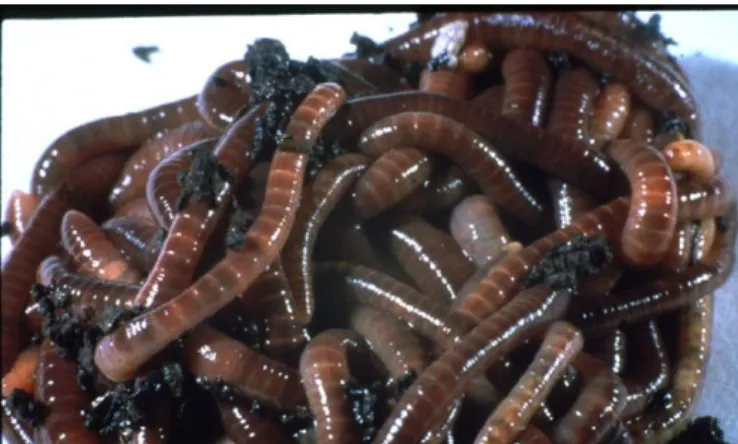
Figure 6- Earthworms (Edwards, 2017)... 22
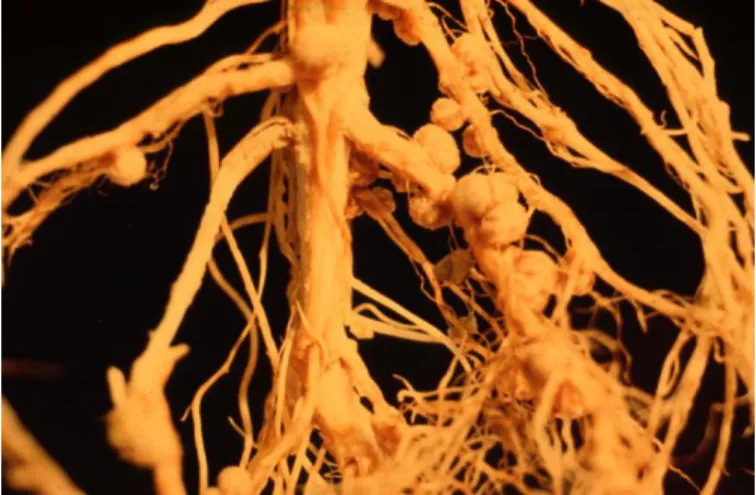
Figure 7 - Root nodules containing rhizobium bacteria (Temple, 2017). ... 23
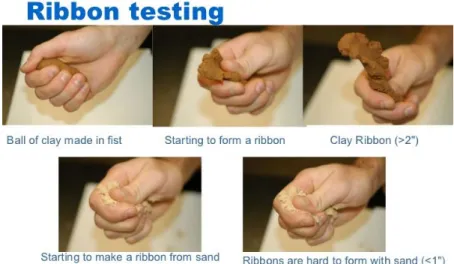
Figure 8 - Making a soil ribbon (Slide Share, 2011). ... 24
Figure 9 - Mortar and pestle (UnidanX, 2016). ... 27
Figure 10 - 2-mm sieve (Ormonde, 2017). ... 27
Figure 11 - Lab equipment set up (Ormonde, 2017). ... 28
Figure 12 - Eosin Y as a solid (Sololewski, 2017). ... 29
Figure 13 - Glass funnel with clay soil (Ormonde, 2017). ... 29
Figure 14 - Funnel (Ormonde, 2017). ... 30
Figure 15 - Methylene blue in aqueous solution (Wikipedia, 2017). ... 30
Figure 16 - Rinsed soda bottles (Hillbilly Jillies, 2009). ... 33
Figure 17 - Terrariums with soil, organic matter, and worms (Hillbilly Jillies, 2009). ... 34
Figure 18 - Covering the top with plastic wrap (Hillbilly Jillies, 2009). ... 34
Figure 19 - Gluing the sleeve (Hillbilly Jillies, 2009). ... 35
Figure 20 - Completed Worm Terrarium (Hillbilly Jillies, 2009). ... 35
Figure 21 - Ecological Processes of Soil (Brady and Weil, 2010). ... 37
Figure 22 - Soil Monoliths (Ormonde, 2017). ... 38
Figure 23 - Diagram of a soil profile (USDA NRCS, 2017).) ... 38
Figure 24 - Insects made of clay (Pottery Space, 2017). ... 39
Figure 25 - The Soil Food Web (Pinterest, 2017). ... 40
Figure 26 - Larger particles separated out of solution first (Day, 2017). ... 41
Figure 27 - Dr. Robinson instructing students during soil filtration activity (Robinson, 2017). .. 42
Figure 28 - Soil filtration results (Robinson, 2017). ... 42
Figure 29 - Soil Texture by Feel (Thein, 1979). ... 62
9
CHAPTER 1
INTRODUCTION
The purpose of this senior project was to develop a lesson plan to educate 5th – 8th grade
students about soil science. Cal Poly’s Learn by Doing Lab (LBDL) specializes in teaching
various scientific topics to elementary through middle school age students from all over
California. Although the program was overseen by Cal Poly professors, the majority of activities,
demonstrations, experiments and teaching was accomplished by Cal Poly students. The LBDL
course (SCM 302) offered at Cal Poly gives students the opportunity to experience teaching to
middle school age students with interactive experiments in STEM fields.
The project objectives were to 1) conduct a literature review of published papers focused
on soil science education, teaching, enrollment trends, and employment, and 2) to create a soil
science LBDL lesson plan.
Our Soils are a vital natural resource, and will continue to be so if managed sustainably.
A LBDL focused on soil science is a great opportunity to educate students about soils and
10 OBJECTIVES
• Educate 5th-8th grade students about soil science through interactive experiments
• Complete a literature review focused on articles discussing soil science education
• Write a soil science lesson plan for Cal Poly’s Learn by Doing Lab
11
CHAPTER 2
LITERATURE REVIEW
Introduction
Soils are a resource upon which every human being depends. However, the scientific
discipline of soil science is a relatively new field, dating back to the late 1800s. Not only is soil
science a distinct field of science, it is also inter-disciplinary. This created a problem for soil
science in the academic and professional worlds, where it has been absorbed into other fields and
professions. To keep soil science current with the ever-changing world of academics, updates
needed to be utilized. The changes included adopting new teaching styles, educating the public in
an entertaining and informative way, creating interactive teaching programs for primary school
students, updating university programs to reflect the qualifications employers are looking for,
and shifting the academic field from agricultural to environmental (Brevik et al, 2014).
History of Soil Science: Education
The academic history of soils is relatively short, but full of changes. Unlike other
scientific disciplines dating back hundreds of years, soil science university programs were first
established during the late 1800s, when the United States government began to conduct soil
surveys. Scientists were hired to complete the surveys, though they lacked the necessary training.
The demand for scientists with knowledge of soils prompted the formation of soil science
programs at universities such as the University of North Carolina and Earlham College. One of
12
written by T. Lyttleton Lyon, Elmer O. Fippin, and Harry O. Buckman in 1909 (Brevik et. al.,
2014).
As the study of soils at the university level grew, liberal art schools that had helped start
soil science programs were replaced by agricultural colleges and land grant universities. Land
grant universities were created by the Morrill Act of 1862. These universities received federal
funding to provide the working class practical education on agriculture, engineering, and military
arts (Brevik et. al., 2014).
During the 20th Century, soil science became a standalone academic discipline, and was
associated with land grant universities. Today, most soil science departments have been
hybridized with other related programs, such as agricultural and environmental management,
environmental sciences, and forest resources. About 5% of the universities offering a soils
degree have a department strictly for soil science. The wide variety in names of departments
indicated a strength and weakness of the discipline; soil science was interdisciplinary and could
contribute to other fields, however this could also allow for it to become absorbed into related
fields (Brevik et. al., 2014).
Interestingly, there was a decline in enrollment in soil science since the 1980s to the
mid-1990s. However, since 2005, enrollments have increased. The increased interest in the field is
promising, though the concern was how to retain interest in the future. Professors, universities, as
well as the Soil Science Society of America (SSSA) researched what caused a drop in enrollment
13 Enrollment Trends in Soil Science Programs
Enrollment trends in the past 20 years have dropped. In more recent years, however,
enrollment has increased. A survey conducted by the Soil Science Society of America (SSSA) in
1992 with a follow-up in 2004 showed over 80% of the universities that participated experienced
a decline in soil science students. Soil science enrollment data between the academic years of
2007-2008 through 2013-2014 at 14 colleges was analyzed by Dr. Brevik and his co-authors to
determine if enrollment numbers were increasing or decreasing. The results were encouraging
with a 46% increase in undergraduate enrollment and a 50% increase in graduate program
enrollment. SSSA student membership has also increased, further supporting the determination
of increasing student numbers in soil science in the United States. Additional evidence outside of
enrollment supports the increased interest in soil science, such as a rise in global studies
including soil science, the United Nation’s declaration of 2015 as the International Year of Soils,
and increased soils publications (Brevik et. al., 2014).
To find out the cause of the decrease in enrollment, surveys were conducted by the SSSA
and Economic Sciences Research Center at Washington State University in 2008. The objectives
of the surveys included enrollment trends, career opportunities, issues in soil science education,
and faculty. The three target groups of the surveys were current undergraduate, graduate and
recent graduates in soils programs, college departments, and employers in the United States and
Canada (Halvin et. al., 2010).
Student Input
The majority of student responses (81%) were graduate students. That may have skewed
the results of the survey in favor of pursuing a career in soil science due to masters programs’
14
more or less related to soil science. Responses to the survey provided interesting insight on how
students, faculty, and professionals view soil science (Halvin et. al., 2010).
The main reasons students were drawn to the major were classes and projects in college,
previous experience working in agriculture, professor-suggested, or a class or project during or
before high school. Student interest in soils programs increased after completing soil science
courses. The results suggested the best method to increase interest in soil science would be to
offer courses that complement other majors, as well as attract students who are undeclared.
Furthermore, the lack of soil science education in primary schools suggested that including soil
science and related disciplines in K-12 may increase interest. Students also chose more
contemporary majors when asked about employment fields, such as environmental science, land
management, and agronomy (Halvin et. al., 2010).
The survey results suggested that the discipline needs to develop an environmental focus,
instead of mainly agricultural. The survey also indicated several areas for improvement,
including difficulty in finding a job, updating soil science’s image to the public, finding ways to
better engage younger generations in soils, and the imperative role of soil judging for field
experience (Halvin et. al., 2010).
Department Input
The department respondents had a different view of the soil science discipline when
compared to the student respondents. Most responded that enrollment had not significantly
changed in the past 10 years, nor would it likely change in the next 10 years. Department
respondents also indicated that job opportunities had increased in the past 10 years. In contrast to
the college departments, students seemed to predict a decline in enrollment if soil science
15
Employer Input
Employer respondents differed from college departments, and indicated that it will be
more challenging to find trained soil scientists in the future. This response suggested a lack of
effective communication between the needs of employers and the training and education offered
by university soil science departments. When compared to other disciplines, soil science was
viewed as part of the responsibilities of professionals, as opposed to a separate expertise.
Employers seemed most concerned with the association of soil science with traditional agronomy
and the lack of marketing for licensing and certification (Halvin et. al., 2010).
Solutions
Several associations in and outside the United States have made efforts to promote and
retain interest in soil science. A group of faculty from Australian universities concluded that soil
science was a unique discipline, and requires teaching methods that were tailored to the
discipline. After a survey and several cycles of review, 11 teaching principles were developed for
soil science education. The principles were a mix of generic and discipline-specific, and were
explained in detail in Field’s article. The teaching principles included uniqueness, fieldwork,
jargon, active learning, connections, systems, communication, authentic problems, feedback,
assessment, and outcomes (Field et. al., 2011).
Starting in 1994, the SSSA teamed with the Smithsonian Institute to develop an
interactive soil science exhibit aimed at teaching the general public about the importance of soil
science in a non-traditional setting. Throughout the planning process, several lessons were
developed to aid those in the future who may undergo a similar educational project. In order to
complete the massive undertaking of developing an exhibit for the Smithsonian as well as a
16
thinking outside the box were necessities. In 2008, the “Dig It! The Secrets of Soil” exhibit
opened at the Smithsonian NMNH. After two successful years at the museum, the exhibit was
closed and reopened as a traveling exhibit until 2014. In preparation for the future of soil science
and the SSSA, six goals were created to maintain and increase interest in the field. The goals
were to embrace the public, strong branding of the SSSA with soil science, expand the political
presence of soil science, branch out to related disciplines and scientific associations, rethink
delivery of soils information, and develop a leading think tank on soil (Drohan et. al., 2010).
In the civil engineering discipline, David Elton created an educational program called
Soils Magic. Alike to the decrease in interest and enrollment in soil science during the late 1990s and early 2000s, civil engineering experienced a similar decrease. Elton focused capturing the
interest of students from kindergarten through 12th through interactive civil engineering
experiments. His efforts served two purposes: encouraging students to study math and science in
elementary school, and encouraging students to pursue engineering in college. Elton worked with
several K-12 teachers and designed the experiments in Soils Magic to be simple, low cost, and quick setup time. Elton found his experiments worked well with middle school students, and by
keeping the activities short was able to capture their attention for the duration of the activities.
Allowing students to participate in the experiments or assist with testing were also effective in
teaching the concepts or objectives of the activities. Feedback from teachers was positive; many
felt the program was more interactive and entertaining than conventional methods used in
laboratory classes (Elton et. al., 2006).
Conclusion
When compared to other scientific disciplines, soil science is relatively new. Over the
17
academics and professionals in the field have changed. The study of was created from the
government’s need for soil scientists to complete surveys in the late 1800s. In the academic
realm, soil science began at a handful of liberal arts universities. Soil science shifted to an
agricultural focus when land grant universities began to offer soils programs. Today, this small
niche has grown into the inter-disciplinary field of soil science. To help keep soil science a
distinct discipline, several surveys of faculty, students, and professionals have been conducted.
The results of these surveys showed a disconnect between what universities require of soil
science students, the expectations of students and what the professional world required.
Enrollment in soil science programs peaked during the 1980s and declined until the early 2000s.
In response to the declining enrollment, universities merged soil science into related
departments, or stopped offering soils programs. Although soil science has been strongly
associated with agriculture in the past, the discipline has shifted to an environmental focus. In
response to several surveys, solutions to increase enrollment in soil science and the public’s
awareness of the scientific field have been developed. These included developing new teaching
styles specific to soil science, creating the interactive soils exhibit, Dig It! The Secrets of Soil at
the Smithsonian Museum of Natural History, updating university programs to include
professional qualifications, and including soil science in primary school education. In order for
soil science to remain a distinct discipline in the future, a balance needs to be made between the
requirements in academic and professional fields. Increased efforts to educate the public about
18
CHAPTER 3
LESSON PLAN
LBDL Soil Science Lesson Plan
• Introduction
o Interactive demonstration with different organic and inorganic components of soil
• 3 sub-disciplines of Soil Science
o Activity 1: Physical
▪ Interactive activity with soil texture
o Activity 2: Chemical
▪ Interactive experiment with soil filtration
o Activity 3: Biological
▪ Discuss soil macro and micro organisms
▪ Prepare “worm terrariums” with students
• Closing Activity
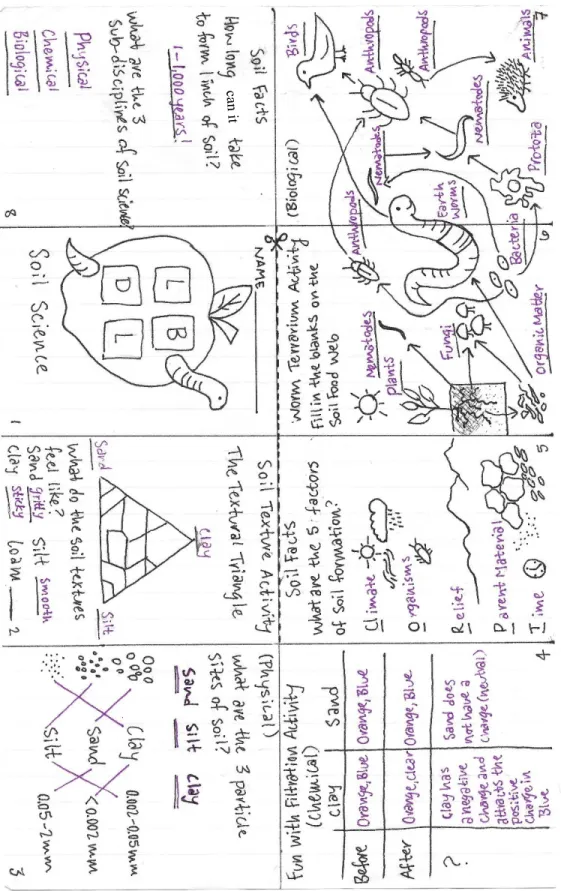
19 ACTIVITY BOOKLET
20
Please Note:
• Cut the paper along the dotted line, and fold along the solid lines to make a booklet
• The pages of the booklet correspond to each activity (physical, chemical, and biological)
21 ACTIVITY 1 - INTRODUCTION
Title: What Am I?!
Learning Objectives/Brief Description:
• Introduce the lesson to students via a guessing game
of what they think they are looking at
• Introduction to the lesson/general definition of soil
• Three main components of soil; physical, biological, chemical
Activity Booklet Pages: N/A
Duration: 5 minutes
Materials Needed:
• Microscope
• Projector
• Soil samples with interesting features such as:
o Root hairs/fungi
o Soil macro-organisms
o Organic matter vs inorganic
matter
• Samples that represent the different
components of soil
o Rocks, minerals, humus,
water, etc.
Figure 2 - Root Hairs (Nielsen, 2013).
Figure 3 - Fungus (Fleming, 2014).
22 o Biological components
Setup Procedure:
1. This experiment should be set up
before the students enter the room to
help keep the element of surprise.
2. Separate each specimen into
containers. Line up containers to
enable specimens to be swapped out
easily from the microscope.
Operation of the Activity/Experiment:
1. Welcome and introduce the students to the Learn By Doing Lab. Allowing students to
participate, ask them, “what do these things have in common?” Let them make a few
guesses, offer hints if needed to help guide them to the right answer-soil! Explain that all
the specimens are different components of soil, the stuff below our feet. Explain that the
lab will be about the three main components that make up soil (physical, chemical,
biological). Ask the students what they
think soil is. Define soil as a mix of
minerals, gases, liquids, organic matter, and
organisms that support our lives on Earth. Figure 5 – Magnified illustration of particle sizes (RainMachine, 2017).
23
2. After the introduction, hand out booklets, and divide students into 3 groups.
Notes/Helpful Tips:
• Capturing the student’s attention
can be difficult at times. Do your
best to show enthusiasm in the
introduction, and they’ll be
hooked! Having a few interesting
facts about soil can help as well.
24 ACTIVITY 2 - PHYSICAL
Title: Soil Texture (Physical)
Learning Objectives/Brief
Description:
• Students will learn about
the physical properties
of soil including:
o Soil texture
o Particle size
• students will learn about soil texture by texturing different samples
• Make the connection on why soil texture is important for water filtration and storage.
Activity Booklet Pages: 2-3
Duration: 15 minutes
Materials Needed:
• Soil samples
o Sandy soil (sandy loam or
loamy sand)
o Silty soil (silt loam)
o Clay (clay loam or clay)
o Loam
• Spray bottles
• Water and squeezable pray water
bottles
• Mortar and pestle
• 2-mm sieve
• Soil texture triangle poster
• Newspaper print roll or old
25
• Paper towels • Hand broom and dustpan
Setup Procedure:
1. Cover lab tables with newspaper print or any paper to help keep surfaces clean.
2. Place the tubs of soil so they have enough space in between to allow multiple students to
reach them (or use separate tables if there’s enough room). Label the samples with
numbers 1-3, and the loam as “Goldilocks.”
3. Place paper towels, hand brush and dustpan, and any other materials nearby for easy
cleanup.
Operation of the Activity/Experiment:
1. Introduce the activity and separate the students into 3 groups; one for sand, one for silt,
and one for clay. Leave the actual textures a surprise until after the students have textured
all the samples. Explain the texture triangle and what it represents. For example, relate
the fibers that make up fabrics; like the many different textures of fabrics, there are also
many different textures of soil (12). Explain how particle size affects soil texture (the
smaller the particle, the smoother the texture, etc.).
2. Have each student start with a small handful of soil. Add water slowly, and knead the soil
in your hand until the water is absorbed. Add more water if the sample is too dry, or add
more dry soil if it’s too saturated. The soil should have a putty-like consistency; sand will
26
3. Ask the students to describe the how the soil feels; is it sticky, smooth, gritty etc. Help
students fill out answers in the corresponding pages of the activity booklet. Ask what
sample corresponds with what texture on the texture triangle. Ask students which sample
they think will hold the most water (clay). Which soil will allow the most water to
move/percolate through it (sand)?
4. Switch between the three soil samples, and compare their similarities and differences.
Ask the students which particle size corresponds to which of the three samples they
worked with. Once all three groups have handled the different soil samples, bring out the
“Goldilocks Soil.” Have each student work up a sample, and guess what they think the
texture is (it’s a mix of all three!). Make the connection between the perfect mix of the
loam, and why it is the “Goldilocks Soil” (it’s the most ideal for growing plants; doesn’t
drain too quickly or too slowly, holds nutrients well, doesn’t get too compacted, etc.).
Variation:
Challenge the students to a ribboning contest. With a moistened soil sample, form it into
a ball in the palm of your hand. Squeeze the ball between your thumb and forefinger to
make a ribbon; see Figure 7 for making a soil ribbon. See which soil makes the longest
ribbon, and who can make the longest ribbon.
Notes/Helpful Tips:
• Texturing soil can be rather messy, especially with young students and you may want to
do it outside. Having a hand washing station nearby (or a bucket full of warm water for
27 • The soil textures do not necessarily need to
be entirely one particle size (for example,
pure clay). Consult the soil textural triangle
in the Appendix for similar textures of the
samples you plan to include in the activity.
• Depending on the soil samples used, they
may need to be ground down with a mortar and pestle and passed through a 2-mm sieve.
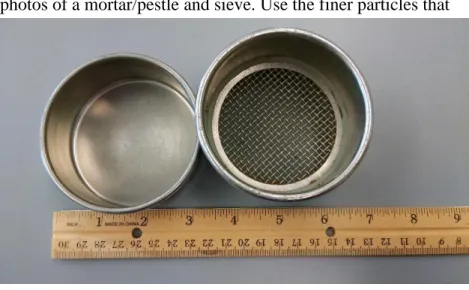
See figures 9 and 10 for photos of a mortar/pestle and sieve. Use the finer particles that
passed through the
sieve for texturing.
Save the coarser
particles that did not
pass through the sieve
for the soil chemistry
activity. Grinding soil
and using a sieve is easy, and can be a fun addition to texturing for students. Figure 9 - Mortar and pestle (UnidanX, 2016).
28 ACTIVITY 3 - CHEMICAL
Title: Fun with Filtration (Soil Chemistry)
Learning Objectives/Brief Description:
• Educate students on the importance
of soil filtration
• Define cations and anions
Materials Needed:
• 50 mL graduated burettes
• Funnels
• Cheese cloth or Coffee filter/filter
paper
• Eosin Yellow solution (negative
charge)
• Methylene Blue Solution (positive
charge)
• Deionized Water
• 2-mm sieve
• Mortar and pestle
• Containers for holding the soil (100
mL)
• 2 containers for collecting the filtrate
(100 mL)
• Stands
• Soil with a clayey texture and good
structure
• Sand (optional)
29
Activity Booklet Page: 4
Duration: 15-20 minutes
Setup Procedure:
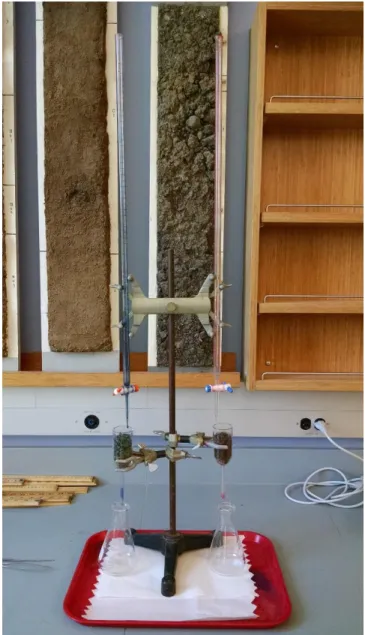
1. Setup the experiment before the activity. Fix the
50 mL graduated burettes and funnels to the
stands, and place a 100 mL beaker under each.
Have the solutions off to the side and ready for
the experiment.
2. Pass the clay soil through a 2-mm sieve. The coarser
particles that don’t pass through the sieve (approximately
pea-sized) work well for this experiment. Save the finer particles for
the soil texturing activity.
3. For the sand soil sample, use a texture similar to beach sand
that is fairly uniform with little to no impurities. Including sand in
the experiment is optional.
4. Line the bottom of the funnel with cheese cloth or filter paper (or a coffee filter) and add
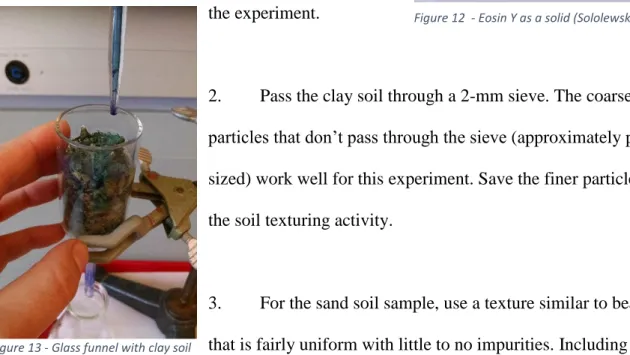
soil. Leave space at the top for the solutions to sink in. See Figure 13 for a funnel filled
with soil.
Figure 12 - Eosin Y as a solid (Sololewski, 2017).
30
5. Moisten the soil until saturated with water
before leaching to help expedite the process.
Operation of the Activity/Experiment:
1. Introduce the activity to the students.
Explain how the experiment works. Ask each student
to observe the solutions, and write down the color (orange and blue).
2. Begin with the clay soil, since the change is more noticeable. With two of the graduated
burettes and funnels ready, begin pouring the Eosin Yellow solution on the soil until it is
saturated. Add more as necessary, and the leachate
should begin to collect in the beaker below. Ask the
students to watch closely. Write down the color of
the leachate, and if they noticed any changes
(shouldn’t be any).
3. Use the second unused leaching tube for the
Methylene Blue solution. Pour the solution over the
soil until it is saturated, and begins to filter out
leachate into the beaker below. Add more solution as
needed to produce an observable amount of leachate, this may take a few minutes.
4. While the soil is filtering the solutions, explain the basics of what is happening. Like
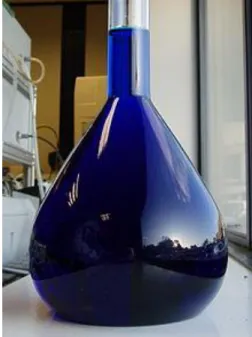
everything that surrounds us, soil is made of atoms and molecules. Molecules, which are Figure 15 - Methylene blue in aqueous solution (Wikipedia, 2017).
31
made up of atoms, can have a positive or negative charge, like a magnet. The clay has
molecules with a charge, as does the solution. After enough leachate has collected, ask
the students what colors they see. The blue from the Methylene blue solution has been
filtered out, but why not the Eosin Yellow?
5. Ask the students to guess why, and help guide them to the answer. The solutions have
different charges, and the opposing charge is attracted to the clay and is filtered out.
Since the Methylene Blue has a positive charge, and the clay has a negative charge, it
sticks to the clay like a magnet and is filtered out. Since the Eosin Yellow has a negative
charge, it is not filtered out by the clay. This experiment is a basic example of how soil
can filter out pollutants and fertilizers that have negative charge (e.g. nitrate NO3-) that
can get into groundwater and contaminate it.
6. With the remaining two graduated burettes, run the experiment again with the samples of
sand. The solutions will move through the sand much quicker than the clay. Ask the
students if there was any change in color (there shouldn’t be). Explain that the sand does
not have a charge like the clay, and therefore will not filter out the colors.
7. Conclude the experiment by making the connection between fertilizers. Nitrate pollution of groundwater is a concern in areas near farms because it cannot be filtered out by the
soil. Soils also can only filter out so much pollutants, like a sponge that can only hold a
set amount of water. That’s why it is important to know what type of soil crops are grown
32
Variation:
See the Soil Filtration Activity in the Alternate Activities Section The alternate activity
uses grape Kool-Aid instead of the harder to obtain Eosin Y and Methylene Blue.
Notes/Helpful Tips:
• If time is limited, the experiment can be conducted with the clay soil, instead of both the
sand and clay soils. Sand was included to show that soils can have different charges.
• Depending on the soil samples used, they may need to be ground down with a mortar and
pestle and passed through a 2-mm sieve. See figures 9 and 10 for photos of a
mortar/pestle and sieve. Grinding soil and using a sieve is fairly easy, and can be a fun
addition to texturing for students.
33 ACTIVITY 4 - BIOLOGICAL
Title: Worm Terrariums (Soil Biology)
Learning Objectives/Brief Description:
• Educate students on the importance of the biological components of soil via a worm
terrarium
Materials Needed:
• Empty plastic soda containers
(preferably 16 ounces and clear
plastic)
• Potting soil
• Sand
• water
• Construction paper
• Glue
• Drawing/painting materials
• Plastic wrap
• Scissors
• Dried organic matter (hay or straw,
leaves, sawdust, etc.)
• Worms
Activity Booklet Pages: 6-7
Duration: 15-20 minutes
34
Setup Procedure:
1. Rinse out the plastic containers and cut off the top about 2 inches.
2. Fill the containers with alternating
layers of potting soil, sand, and dried
organic matter (give some examples
of what to use). Leave roughly 1 inch
of space at the top.
3. Add 3-6 worms in each container.
Cover with a layer of dried leaves
and hay. Indicate where they can get the worms
4. Add water until the soil is moistened (be careful not to over saturate, worms may drown).
5. Cover the top of the plastic container
with plastic wrap. Poke holes into the
top to allow for air flow.
6. Cut construction paper to the
appropriate length and height of the
plastic container, and glue both ends together to create a removable sleeve. Students can Figure 17 - Terrariums with soil, organic matter, and worms (Hillbilly Jillies, 2009).
35
decorate their sleeve if they wish. The sleeve acts as a
shade for the worms so they do not over-heat, but can
also be removed to view them.
7. Place the worm terrarium in a cool place and check
daily if water needs to be added. Within a few days,
worm activity should be visible, such as trails and
casts.
Notes/Helpful Tips
• Instead of using markers and other art materials to
decorate the sleeves, gather several soil samples with
varying colors and moisten to the consistency of water
color paints. Allow time for the soil paint to dry before
gluing the sleeve.
• Be sure to instruct students how to properly care for the worms at home. It may be
helpful to have the instructions printed on the sleeves so students and parents know how
to care for the terrarium.
Figure 20 - Completed Worm Terrarium (Hillbilly Jillies, 2009).
36 ACTIVITY 5 - CLOSING
Title: What Can Soils Do for You?
Learning Objectives/Brief Description:
• Educate students about the important processes that soils provide for our lives
Materials Needed:
• Soil ecological processes illustration (see Figure 21)
Setup Procedure: None
Operation of the Activity/Experiment:
1. Once the students have completed each of the three activities, conclude the lab by
discussing some of the processes soil provides for our lives (soil filters out pollutants and
stores water, provides habitat for organisms, supports our roads and buildings, absorbs
carbon dioxide from the atmosphere, enables us to grow crops, etc.). See Figure 21 for
illustrations of the ecological processes.
2. Ask the students what they have learned, and if they have any questions.
37
38 ALTERNATE ACTIVITIES
• Soil Monoliths/Profiles:
o find the horizons (why are they
different colors)
▪ amount of organic matter,
minerals, parent materials,
etc.
Figure 23 - Diagram of a soil profile (USDA NRCS, 2017).)
39 • Clay Animals
o Use moistened clay as if it was modeling clay to create animals that live in/near
soil (worms/snails/nematodes/beetles etc.).
40 • Soil Food Web
o Use a poster of the soil food web or draw a food web on a dry erase board. Have
the students help make the connections between the soil, the plants, and
organisms. See Figure 25 for an illustration of the soil food web.
o In addition to teaching the soil food web by using a drawing, you can help the
students fill in the blanks on their activity booklet on pages 6 and 7.
41 • Particle Size Separation
o Fill mason jars with approximately 1/3 soil, and 2/3 water. Tighten the lid and
shake the jar.
o Observe the jar every few minutes to see which particles settle out first. Ask the
students which particle size will sink to the bottom first and why (larger
particles/sand will settle to the bottom first because they are denser than the
smaller particles). This experiment ties in with the soil texture activity.
42 • Soil Filtration
o Dr. Clay Robinson from
Iowa State University came
up with a similar experiment
that uses Grape Kool-Aid.
The experiment is similar,
and uses paper cups instead
of formal lab equipment. The
results are not as dramatic as
using the Eosin Yellow and Methylene Blue solutions. However, the solutions are
not as easy to obtain as Grape Kool-Aid.
o Place 2 funnels in a funnel rack. Fill one funnel with the pea-sized play and the
other with beach sand. Moisten the soil with water until saturated. Place a 100 mL
beaker (or cup) under each
funnel to catch the leachate.
The leachate from the clay
will be a red/pinkish color.
The leachate from the sand
should have no change in
color.
Figure 27 - Dr. Robinson instructing students during soil filtration activity (Robinson, 2017).
43 o Mix Grape Kool-Aid powder into water until dissolved. Use a smaller amount of
water than directed on the packaging to make the solution more concentrated.
o The dye in the Grape Kool-Aid is made up of red and blue to make purple. The
blue dye has a positive charge, and is attracted to the negative charge of the clay
and filtered out. The red dye has a negative charge, and is not attracted to the clay.
The leachate from the clay should only have a reddish color due to the blue dye
being filtered out.
o The leachate from the sand should not a change in color since the sand has a
44 HELPFUL TIPS
• Allow for a few minutes in between each activity to allow for a smooth transition from
one activity to the next.
• The three main activities (excluding the introduction and conclusion) can be completed in
any order. The goal is allowing students to start at any of the three and rotate between
them.
• Alternate activities are included to keep the students engaged.
• See Additional Resources in the Appendix for resources that provide additional
45
CHAPTER 4
CONCLUSION
The goal of this senior project was to create a soil science lesson plan for the Learn by
Doing Lab at Cal Poly. The lesson was intended for 5-8th grade students. Although the lesson
plan was written for the LBDL, it can also be used by other instructors who wish to teach their
students about soil science. The combination of activities and experiments were not tested during
the project. However, the activities were all from reputable sources and were entertaining and
educational for students. The activities were chosen for their simplicity, content, educational
value, and because they are fun. Alternate activities were included to give the instructor options
46 REFERENCES
Appel, C., D. Dingus, B. Hallock, L. Moody, L. Raio, and T. Rice et. al. 2015. Lab 8: Soil Testing and Fertilizers. Introductory Soil Science Laboratory. Natural Resources Management and Environmental Sciences Department, California Polytechnic State University, San Luis Obispo, CA. Manual. 185-197.
Arcos Organics. 2014. Eosin Y Safety Data Sheet. Available at
https://www.fishersci.com/shop/msdsproxy?productName=AC152881000&productDesc
ription=eosin-y-pure-high-purity-biological-stain-acros-organicstrade&catNo=AC152881000&vendorId=VN00032119&storeId=10652 (accessed 11 April 2017). Fisher Scientific, Fair Lawn, NJ.
Baveye, P., S. Allaire, R. Bryant, A. Jacobson, and J. Tandarich. 2006. Whither Goes Soil Science in the United States and Canada? Soil Science. 171:501-518.
Brady, N., and R. Weil. 2010. A Method for Determining Texture by Feel. Elements of the Nature and Properties of Soil. 103.
Brady, N., and R. Weil. 2010. Soils as Media for Plant Growth, Figure 1.2. Elements of the Nature and Properties of Soil. 3.
Brevik, E., S. Abit, D. Brown, H. Dolliver, D. Hopkins, and D. Lindbo et. al. 2014. Soil Science Education in the United States: History and Current Enrollment Trends. Journal of the Indian Society of Soil Science. 64:299-306.
California Quarry Products. 2017. Humus, Organic Compost, Planter Mix. Available at http://californiaquarryproducts.com/humus_compost_planter_mix.php (accessed 11 April 2017). California Quarry Products, Lancaster, CA.
Day, J. 2017. DIY Soil Texture Test for Your Yard. Available at
https://www.todayshomeowner.com/diy-soil-texture-test-for-your-yard/ (accessed 11 April 2017). Today’s Homeowner with Danny Lipford.
DeMoss, J. 2014. Utilizing Indicator of Reduction in Soils Tubes to Affirm Serpentinitic Hydric Soil on the California Central Coast.
Drohan, P., H. Cheng, J. Halvin, and J. Megonigal. 2010. The “Dig It!” Smithsonian Soils Exhibition: Lessons Learned and Goals for the Future. Soil Science Society of America Journal. 74:697-705.
47
Edwards, C.2017. Earthworms. Available at
https://www.nrcs.usda.gov/wps/portal/nrcs/detailfull/soils/health/biology/?cid=nrcs142p 2_053863 (accessed 11 April 2017). USDA Natural Resources Conservation Service.
Elton, D. 2001. Soils Magic. 1st ed. Geo-Institute of the American Society of Civil Engineers. Reston, VA.
Elton, D., J. Hanson, and D. Shannon. 2006. Soils Magic: Bringing Civil Engineering to the K-12 Classroom. Journal of Professional Issues in Engineering Education and Practice. 132:125-132.
Field, D., L. Abbott, S. Cattle, C. Grant, L. Jarrett, and A. Koppi et. al. 2011. Soil Science teaching principles. Geoderma. 167-168:9-14.
Fisher Scientific. 2010. Methylene Blue Safety Data Sheet. Available at
https://www.fishersci.com/shop/msdsproxy?productName=BP117100&productDescript
ion=METHYLENE+BLUE+100G&catNo=BP117-100&vendorId=VN00033897&storeId=10652 (accessed 11 April 2017). Fisher Scientific, Fair Lawn, NJ.
Fleming, N. 2014. Plants talk to each other using an internet of fungus. Available at
http://www.bbc.com/earth/story/20141111-plants-have-a-hidden-internet?ocid=twert (accessed 11 April 2017). BBC earth.
Halvin, J., N. Balster, S. Chapman, D. Ferris, T. Thompson, and T. Smith. 2010. Trends in Soil Science Education and Employment. Soil Science Society of America Journal. 74:1429-1432.
Hillbilly Jillies. 2009. Wormery. Available at
http://hillbillyjillies.blogspot.com/2009/06/wormery.html (accessed 27 December 2016). Blog Spot.
NGSS. 2017. Disciplinary Core Ideas. Available at http://www.nextgenscience.org/ (accessed 13 April 2017). Next Generation Science Standards.
Nielsen, R. 2013. Root Development in Young Corn. Available at
https://www.agry.purdue.edu/ext/corn/news/timeless/roots.html (accessed 11 April 2017). Purdue University, Department of Agronomy, Corny News Network Articles. Pinterest. 2017. Soil food web. Available at
https://www.pinterest.com/johnnyooo/soil-food-web/ (accessed 11 April 2017). Pinterest.
Pottery Space. 2017. Clay Making Workshops. Available at
http://www.potteryspace.ie/workshops.php (accessed 11 April 2017). Pottery Space, Tallaght, Dublin, Ireland.
48
Robinson, C. 2017. Soil is a Filter. Available at
http://www.doctordirt.org/teachingresources/soilfilter (accessed 7 April 2017). Dr. Dirt – K-12 Teaching Resources.
Slide Share. 2011. Soil Science. Available at https://www.slideshare.net/parrc/soil-science (accessed 11 April 2017). Slide Share. 41.
Sobolewski, A. 2017. Eosin Y. Available at https://en.wikipedia.org/wiki/Eosin_Y (accessed 14 April 2017). Wikipedia.
Temple, S. 2017. Soil Bacteria. Available at
https://www.nrcs.usda.gov/wps/portal/nrcs/detailfull/soils/health/biology/?cid=nrcs142p 2_053862 (accessed 11 April 2017). USDA Natural Resources Conservation Service.
Thein, S. Modified 1979. Guide to Texture by Feel [Online]. Available at
https://www.nrcs.usda.gov/wps/portal/nrcs/detail/soils/edu/?cid=nrcs142p2_054311 (accessed 11 April 2017). USDA Natural Resources Conservation Service.
UnidanX. 2016. Coors Mortar and Pestle. Available at
https://www.reddit.com/r/mildlyinteresting/comments/3t4beo/my_scientific_mortar_an d_pestle_was_made_by_coors/ (accessed 14 April 2017). Reddit.
USDA - Natural Resources Conservation Service. 2017. A Soil Profile. Available at
https://www.nrcs.usda.gov/wps/portal/nrcs/detail/soils/edu/?cid=nrcs142p2_054308 (accessed 11 April 2017). USDA Natural Resources Conservation Service.
USDA - Natural Resources Conservation Service. 2017. Soil Biology Primer Photo Gallery. Available at
https://www.nrcs.usda.gov/wps/portal/nrcs/photogallery/soils/health/biology/gallery/?ci d=1788&position=Promo (accessed 11 April 2017). USDA Natural Resources Conservation Service.
USDA – Natural Resources Conservation Service. 2017. Soil Texture Calculator. Available at https://www.nrcs.usda.gov/wps/portal/nrcs/detail/soils/survey/?cid=nrcs142p2_054167 (accessed 11 April 2017). USDA Natural Resources Conservation Service.
Washington State University Libraries. 2016. SSSA Citation Style Quick Guide [Online]. Available at http://www.wsulibs.wsu.edu/quickguides/sssa (accessed 12 March 2016). WSU Libraries, Pullman, WA.
Wikipedia. 2017. Methylene blue. Available at https://en.wikipedia.org/wiki/Methylene_blue (accessed 14 April 2017). Wikipedia.
49 APPENDIX
i. Eosin Y Material Safety Data Sheet (MSDS).
Revision Date 23-Apr-2014
SAFETY DATA SHEET
Revision Number 1
Product Name Eosin Y
Cat No. : AC152880000; AC152880250; AC152881000; AC152885000
Synonyms Eosin Yellowish; C.I. 45380; Acid Red 87; 2`,4`,5`,7`-Tetrabromofluorescein, disodium salt
Recommended Use Laboratory chemicals
Uses advised against No Information available Details of the supplier of the safety data sheet
Company
Fisher Scientific One Reagent Lane Fair Lawn, NJ 07410 Tel: (201) 796-7100
Entity / Business Name Acros Organics One Reagent Lane Fair Lawn, NJ 07410
Emergency Telephone Number
For information US call: 001-800-ACROS-01 /
Europe call: +32 14 57 52 11
Emergency Number US:001-201-796-7100 /
Europe: +32 14 57 52 99
CHEMTREC Tel. No.US:001-800-424-9300 /
Europe:001-703-527-3887
Classification
This chemical is considered hazardous by the 2012 OSHA Hazard Communication Standard (29 CFR 1910.1200)
Label Elements Signal Word Warning
Hazard Statements
Causes serious eye irritation
Precautionary Statements Prevention
Wash face, hands and any exposed skin thoroughly after handling Wear eye/face protection
1. Identification
2. Hazard(s) identification
Eosin Y Revision Date 22-December-2015
50
Eyes
IF IN EYES: Rinse cautiously with water for several minutes. Remove contact lenses, if present and easy to do. Continue rinsing If eye irritation persists: Get medical advice/attention.
Hazards not otherwise classified (HNOC) None identified
Haz/Non-haz
Component CAS-No Weight %
Acid red 87 17372-87-1 >95
Eye Contact Rinse immediately with plenty of water, also under the eyelids, for at least 15 minutes. Obtain medical attention.
Skin Contact Wash off immediately with plenty of water for at least 15 minutes. Get medical attention if symptoms occur..
Inhalation Move to fresh air. If breathing is difficult, give oxygen. Get medical attention if symptoms occur.
Ingestion Do not induce vomiting. Obtain medical attention.
Most important symptoms/effects No information available
Notes to Physician Treat symptomatically.
Suitable Extinguishing Media Use water spray, alcohol-resistant foam, dry chemical or carbon dioxide.
Unsuitable Extinguishing Media No information available.
Flash Point No information available.
Method - No information available
Autoignition Temperature No information available. Explosion Limits
Upper No data available
Lower No data available
Sensitivity to Mechanical Impact No information available
Sensitivity to Static Discharge No information available
Specific Hazards Arising from the Chemical
Thermal decomposition can lead to release of irritating gases and vapors.
Hazardous Combustion Products Carbon monoxide (CO), Carbon dioxide (CO2), Hydrogen halides, Bromine, Sodium oxides.
Protective Equipment and Precautions for Firefighters
As in any fire, wear self-contained breathing apparatus pressure-demand, MSHA/NIOSH (approved or equivalent) and full protective gear.
NFPA
3. Composition / information on ingredients
4. First-aid measures
Eosin Y Revision Date 22-December-2015 51 Health 1 Flammability 0 Instability 0 Physical hazards N/A
Personal Precautions Use personal protective equipment. Ensure adequate ventilation. Avoid dust formation. Avoid
contact with skin, eyes and clothing.
Environmental Precautions Avoid release to the environment. See Section 12 for additional ecological Information.
Methods for Containment and Clean Up
Sweep up or vacuum up spillage and collect in suitable container for disposal. Avoid dust formation.
Handling Wear personal protective equipment. Ensure adequate ventilation. Avoid dust formation. Avoid contact with skin and eyes. Avoid ingestion and inhalation.
Storage Keep containers tightly closed in a dry, cool and well-ventilated place.
Exposure Guidelines This product does not contain any hazardous materials with occupational exposure limits established by the region specific regulatory bodies.
Engineering Measures Ensure adequate ventilation, especially in confined areas. Ensure that eyewash stations and safety showers are close to the workstation location.
Personal Protective Equipment
Eye/face Protection Wear appropriate protective eyeglasses or chemical safety goggles as described by OSHA's eye and face protection regulations in 29 CFR 1910.133 or European Standard EN166
Skin and body protection Wear appropriate protective gloves and clothing to prevent skin exposure.
Respiratory Protection Follow the OSHA respirator regulations found in 29 CFR 1910.134 or European Standard EN
149. Use a NIOSH/MSHA or European Standard EN 149 approved respirator if exposure limits are exceeded or if irritation or other symptoms are experienced.
Hygiene Measures Handle in accordance with good industrial hygiene and safety practice
Physical State Powder Solid
Appearance Red brown
Odor Odorless
Odor Threshold No information available.
pH 7-10
Melting Point/Range 300°C / 572°F
Boiling Point/Range No information available.
Flash Point No information available.
Evaporation Rate No information available.
Flammability (solid,gas) No information available Flammability or explosive limits
Upper No data available
Lower No data available
Vapor Pressure negligible
Vapor Density No information available.
Relative Density 1.018
6. Accidental release measures
7. Handling and storage
8. Exposure controls / personal protection
Eosin Y Revision Date 22-December-2015
52
Solubility No information available.
Partition coefficient; n-octanol/water No data available
Autoignition Temperature No information available.
Decomposition temperature > 300°C
Viscosity No information available.
Molecular Formula C20 H6 Br4 Na2 O5
Molecular Weight 691.85
Reactive Hazard None known, based on information available.
Stability Stable under normal conditions. Moisture sensitive.
Conditions to Avoid Avoid dust formation. Incompatible products. Excess heat. Exposure to moisture.
Incompatible Materials Strong oxidizing agents, Strong acids, alkaline, Strong reducing agents
Hazardous Decomposition Products Carbon monoxide (CO), Carbon dioxide (CO2), Hydrogen halides, Bromine, Sodium oxides
Hazardous Polymerization Hazardous polymerization does not occur.
Hazardous Reactions None under normal processing
Acute Toxicity
Product Information No acute toxicity information is available for this product Component Information
Toxicologically Synergistic Products
No information available.
Delayed and immediate effects as well as chronic effects from short and long-term exposure Irritation Irritating to eyes
Sensitization No information available.
Carcinogenicity The table below indicates whether each agency has listed any ingredient as a carcinogen
Component CAS-No IARC NTP ACGIH OSHA Mexico
Acid red 87 17372-87-1 Not listed Not listed Not listed Not listed Not listed
Mutagenic Effects Not mutagenic in AMES Test
Reproductive Effects No information available.
Developmental Effects No information available.
Teratogenicity No information available.
STOT - single exposure None known.
STOT - repeated exposure None known.
Aspiration hazard No information available.
9. Physical and chemical properties
10. Stability and reactivity
Eosin Y Revision Date 22-December-2015
53
Symptoms / effects, both acute and delayed
No information available
Endocrine Disruptor Information No information available
Other Adverse Effects The toxicological properties have not been fully investigated..
Ecotoxicity
Do not empty into drains.
Component Freshwater Algae Freshwater Fish Microtox Water Flea
Acid red 87 Not listed LC50= 1200 mg/L/48h
(Oryzias latipes)
Not listed Not listed
Persistence and Degradability No information available. Bioaccumulation/ Accumulation No information available Mobility .
Component log Pow
Acid red 87 4.80
Waste Disposal Methods Chemical waste generators must determine whether a discarded chemical is classified as a
hazardous waste. Chemical waste generators must also consult local, regional, and national hazardous waste regulations to ensure complete and accurate classification
DOT Not regulated
TDG Not regulated
IATA Not regulated
IMDG/IMO Not regulated
International Inventories
Component TSCA DSL NDSL EINECS ELINCS NLP PICCS ENCS AICS IECSC KECL
Acid red 87 X X - 241-409-6 - X X X X X
Legend: X - Listed
E - Indicates a substance that is the subject of a Section 5(e) Consent order under TSCA. F - Indicates a substance that is the subject of a Section 5(f) Rule under TSCA.
N - Indicates a polymeric substance containing no free-radical initiator in its inventory name but is considered to cover the designated polymer made with any free-radical initiator regardless of the amount used.
P - Indicates a commenced PMN substance
R - Indicates a substance that is the subject of a Section 6 risk management rule under TSCA. S - Indicates a substance that is identified in a proposed or final Significant New Use Rule
T - Indicates a substance that is the subject of a Section 4 test rule under TSCA.
12. Ecological information
13. Disposal considerations
14. Transport information
Eosin Y Revision Date 22-December-2015
54 XU - Indicates a substance exempt from reporting under the Inventory Update Rule, i.e. Partial Updating of the TSCA Inventory Data Base Production and Site Reports (40 CFR 710(B).
Y1 - Indicates an exempt polymer that has a number-average molecular weight of 1,000 or greater.
Y2 - Indicates an exempt polymer that is a polyester and is made only from reactants included in a specified list of low concern reactants that comprises one of the eligibility criteria for the exemption rule.
U.S. Federal Regulations
TSCA 12(b) Not applicable
SARA 313 Not applicable
SARA 311/312 Hazardous Categorization
Acute Health Hazard Yes
Chronic Health Hazard No
Fire Hazard No
Sudden Release of Pressure Hazard No
Reactive Hazard No
Clean Water Act Not applicable
Clean Air Act Not applicable
OSHA Occupational Safety and Health Administration Not applicable
CERCLA Not applicable
California Proposition 65 This product does not contain any Proposition 65 chemicals.
State Right-to-Know Not applicable
U.S. Department of Transportation Reportable Quantity (RQ): N
DOT Marine Pollutant N
DOT Severe Marine Pollutant N
U.S. Department of Homeland Security
This product does not contain any DHS chemicals.
Other International Regulations
Mexico - Grade No information available
Canada
This product has been classified in accordance with the hazard criteria of the Controlled Products Regulations (CPR) and the MSDS contains all the information required by the CPR.
Eosin Y Revision Date 22-December-2015
55
Prepared By Regulatory Affairs Thermo Fisher Scientific Email: [email protected]
Revision Date 23-Apr-2014
Print Date 23-Apr-2014
Revision Summary This document has been updated to comply with the US OSHA HazCom 2012 Standard
replacing the current legislation under 29 CFR 1910.1200 to align with the Globally Harmonized System of Classification and Labeling of Chemicals (GHS).
Disclaimer
The information provided on this Safety Data Sheet is correct to the best of our knowledge, information and belief at the date of its publication. The information given is designed only as a guide for safe handling, use, processing, storage,
transportation, disposal and release and is not to be considered as a warranty or quality specification. The information relates only to the specific material designated and may not be valid for such material used in combination with any other material or in any process, unless specified in the text.
End of SDS
Eosin Y Revision Date 22-December-2015
56
ii. Methylene Blue MSDS.
SAFETY DATA SHEET
Creation Date 23-Feb-2010 Revision Date 22-Dec-2015 Revision Number 1
Product Name Methylene Blue Cat No. : BP117-100 Synonyms Basic Blue 9
Recommended Use Laboratory chemicals.
Uses advised against No Information available Details of the supplier of the safety data sheet
Company
Fisher Scientific One Reagent Lane Fair Lawn, NJ 07410 Tel: (201) 796-7100
Emergency Telephone Number
CHEMTRECÒ, Inside the USA: 800-424-9300 CHEMTRECÒ, Outside the USA: 001-703-527-3887
Classification
This chemical is considered hazardous by the 2012 OSHA Hazard Communication Standard (29 CFR 1910.1200)
Label Elements
Signal Word
Warning
Hazard Statements Harmful if swallowed
Precautionary Statements Prevention
Wash face, hands and any exposed skin thoroughly after handling Do not eat, drink or smoke when using this product Ingestion
1. Identification
2. Hazard(s) identification
Revision Date 22-Dec-2015
Methylene Blue
57
IF SWALLOWED: Call a POISON CENTER or doctor/physician if you feel unwell Rinse mouth Disposal
Dispose of contents/container to an approved waste disposal plant Hazards not otherwise classified (HNOC)
None identified
Component CAS-No Weight %
Methylene blue 61-73-4 >95
Eye Contact Rinse immediately with plenty of water, also under the eyelids, for at least 15 minutes. Obtain medical attention.
Skin Contact Wash off immediately with plenty of water for at least 15 minutes. Get medical attention if symptoms occur.
Inhalation Move to fresh air. If breathing is difficult, give oxygen. Do not use mouth-to-mouth method if victim ingested or inhaled the substance; give artificial respiration with the aid of a pocket mask equipped with a one-way valve or other proper respiratory medical device. Obtain medical attention.
Ingestion Do not induce vomiting. Call a physician or Poison Control Center immediately.
Most important symptoms/effects No information available.
Notes to Physician Treat symptomatically
Suitable Extinguishing Media Use water spray, alcohol-resistant foam, dry chemical or carbon dioxide.
Unsuitable Extinguishing Media No information available
Flash Point No information available
Method - No information available
Autoignition Temperature Explosion Limits
Upper No data available
Lower No data available
Sensitivity to Mechanical Impact No information available
Sensitivity to Static Discharge No information available
Specific Hazards Arising from the Chemical
Thermal decomposition can lead to release of irritating gases and vapors. Keep product and empty container away from heat and sources of ignition.
Hazardous Combustion Products
Hydrogen chloride gas Nitrogen oxides (NOx) Carbon monoxide (CO) Carbon dioxide (CO2)
Protective Equipment and Precautions for Firefighters
As in any fire, wear self-contained breathing apparatus pressure-demand, MSHA/NIOSH (approved or equivalent) and full protective gear.
NFPA
3. Composition / information on ingredients
4. First-aid measures