ORIGINAL RESEARCH ARTICLE
Factors Influencing the Use of Anemia Preventing Measures among
Antenatal Clinic Attendees in the Kintampo North Municipality,
Ghana
DOI: 10.29063/ajrh2019/v23i2.4
Olivia
Lumor1*, Francis Dzabeng
2and Richard M. Adanu
3Kintampo North Municipal Health Directorate, Ghana Health Service1; Kintampo Health Research Centre, Ghana2; School of Public Health, University of Ghana3
*For Correspondence: Email: [email protected]; Phone: +233 (0)242041843
Abstract
Anemia in pregnancy is a key public health problem worldwide. It results from a wide variety of causes. The World Health Organization (WHO) has recommended specific measures to help prevent anemia during pregnancy, which countries are required to integrate into their antenatal care. This study was designed to determine the factors influencing the use of anaemia preventing measures among antenatal clinic attendees in the Kintampo North Municipality, Ghana. A cross sectional study was conducted among pregnant women attending the clinics after 36 weeks of pregnancy. Demographic data and information on use of all interventions were obtained using a structured questionnaire. The factors associated with the use of the interventions were identified using multiple logistic regression. The use of all anemia preventing interventions among pregnant women was found to be 30%. The study identified that use of all anemia preventing measures among pregnant women is quite low. Provision of antihelmithics to pregnant women and their health education on the benefits of the use of anaemia preventing measures would help increase the usage of the interventions. (Afr J Reprod Health 2019; 23[2]: 35-43).
Keywords: Anemia in pregnancy, anemia prevention in pregnancy, Kintampo North, Ghana
Résumé
L'anémie pendant la grossesse est un problème majeur de santé publique dans le monde. Il résulte d'une grande variété de causes. L'Organisation mondiale de la santé (OMS) a recommandé certaines mesures pour aider à prévenir l'anémie pendant la grossesse, ce qui oblige les pays à intégrer leurs soins prénatals. Cette étude visait à déterminer les facteurs qui influent sur l‘utilisation des mesures de prévention de l‘anémie chez les préposés aux consultations prénatales de la municipalité de Kintampo du nord, au Ghana. Une étude transversale a été menée auprès des femmes enceintes à 36 semaines de gestation et au-dessus. Les données démographiques et les informations sur l'utilisation de toutes les interventions ont été obtenues à l'aide d'un questionnaire structuré. Les facteurs associés à l'utilisation des interventions ont été identifiés à l'aide d'une régression logistique multiple. L‘utilisation de toutes les interventions de prévention de l‘anémie chez les femmes enceintes s‘est avérée être de 30%. L'étude a révélé que l'utilisation de toutes les mesures de prévention de l'anémie chez les femmes enceintes est assez faible. La fourniture d'anthelminthiques aux cliniques prénatales et l'éducation sanitaire sur les avantages de leur utilisation contribueraient à accroître l'utilisation des interventions. (Afr J Reprod Health 2019; 23[2]: 35-43).
Mots-clés: Anémie pendant la grossesse, prévention de l'anémie pendant la grossesse, Kintampo du nord, Ghana
Introduction
Anemia in pregnancy is a major public health problem that affects pregnant women in both developing and developed countries, but pregnant women in developing countries are mostly
34%2. In 2015 and 2016, anemia in pregnancy prevalence in the Kintampo North Municipal, one of the Municipalities in Ghana was 16.4% and 21.3% respectively. The prevalence, however, is slightly higher in the 36 weeks gestation group; 24.0% in 2015 and 16.7% in 20163.
Anemia in pregnancy results from a wide range of causes. Worldwide, the major cause of anemia in pregnancy is iron deficiency4. Iron deficiency is the cause of 50% of all cases of anemia during pregnancy. Iron requirements increases significantly during pregnancy, this is because iron is required to expand plasma volume, increase red cell mass and for the development of the placenta and the fetus. Iron deficiency during pregnancy causes hemoglobin concentration of the maternal blood to fall to an average of approximately 11.0 g/dl during the 36th week of gestation1, 4.
The leading cause of iron deficiency among pregnant women includes increase iron requirements due to pregnancy, poor absorption of iron from diets, and low intake of iron4. Hemolysis because of malaria, congenital hereditary defects in hemoglobin synthesis and glucose-6-phosphate dehydrogenase deficiency are also causes of anemia during pregnancy2. Other causes are; blood loss associated with schistosomiasis, hookworm infestation and nutritional deficiency such as vitamin B12 and folic acid4.
Studies have shown that, maternal anemia leads to antepartum and postpartum hemorrhage, spontaneous abortion and maternal mortality. Additionally, maternal anemia leads to preterm delivery, low birth weigth, congenital anomalies and fetal death5-8.
Anemia in pregnancy due to iron deficiency, hemolysis because of malaria infection, and helminthic infestation are preventable causes9. The WHO has recommended a package of measures to help prevent these causes of anemia during pregnancy for countries to integrate into their antenatal care. Ghana is one of the countries that have integrated this policy into its antenatal care. The interventions are: daily iron supplementation throughout pregnancy, use of insecticide treated bed nets (ITNs) throughout
pregnancy, use of sulphadoxine pyrimethamine (SP) as intermittent preventive treatment in pregnancy (IPTp) and antihelminthics in the second trimester of pregnancy. Because the causes of anemia for which these interventions target coexist, the WHO recommends that these interventions should not be done in isolation since they are known to significantly prevent anemia in pregnancy if not done separately4.
Worldwide, numerous studies have been done on the usage of these individual interventions including their effectiveness and factors that may be influencing the intervention usage among pregnant women, but not much is known about the use of all the interventions and the factors that influence their use among pregnant women. Information on the usage of all the interventions among pregnant women in the Kintampo North Municipality is not available.
Consequently, this study was conducted to estimate the proportion of pregnant women using anemia preventing interventions and determine the factors influencing the use of these interventions.
Methods
Study design and setting
(CHPS) compounds offering basic health care manned by 2 doctors, 30 midwives, and 46 community health nurses/officers (CHNs/CHOs)
.
Study variables
Dependent variable
The use of anaemia preventing interventions during pregnancy was the outcome variable. These included:
1. Daily iron supplementation throughout pregnancy.
2. Use of insecticide treated bed nets (ITNs) throughout pregnancy.
3. Use of sulphadoxine pyrimethamine (SP) as intermittent preventive treatment in pregnancy (IPTp).
4. Use of antihelminthics in the second trimester of pregnancy.
These interventions were used to construct a binary variable as follows: 1 for women who received all the 4 interventions and 0 otherwise (i.e. <4 interventions)
Independent variables
These were parity of mother, gestational age of mother at first ANC visit, frequency of subsequent visits, knowledge of pregnant women about interventions and availability of interventions at health facility. Other variables included educational level of mother, maternal age, occupation and marital status.
Sample size estimation
Sample size for the study was determined using the formula n = (z2 pq)/d2 where
N = sample size
Z = z value for 95% confidence interval = 1.96 P = estimated proportion = 21% = 0.21
Q = 1-p = 1 – 0.21 = 0.79
D = distance on either side of the mean in confidence interval = 5% = 0.05
N = (1.962×0.21×0.79)/0.052
N = 254 + 10% N = 279
10% of the calculated sample was added to the sample size to cater for refusals and non-respondents. Therefore, the total sample size would be 279.
Assumption on estimated proportion: per the WHO guidelines, if interventions are followed correctly, by the time mother is due for her fourth dose of SP, she would have had all interventions (including required minimum of 3rd dose of SP) to prevent anemia during pregnancy10. The average annual SP4 coverage of Kintampo North which is 21%3 was used as the estimated proportion.
Study population and sampling procedure
The study was conducted among pregnant women at 36 weeks gestation and above attending ANC in selected seven (7) health facilities providing ANC services in the Kintampo North Municipality. Pregnant women at 36 weeks gestation and above who did not take sulphonamides due to medical conditions and all pregnant women below 36 weeks gestation were not included in the study. Study facilities were purposively selected. Facilities with an average attendance of four and above for pregnant women at 36 weeks gestation and above in a month were used for the study. Although the estimated sample size was 279, a total of 171 respondents were enrolled because the number of the targeted respondents for the period allocated for data collection was lower than expected. Respondents were enrolled into the study (if they provide consent) as and when they report to the facility for the entire duration of data collection. The number of respondents per study site is as shown in Table 1.
Data collection and quality control
A structured questionnaire made up of open and closed ended questions was administered by trained research assistants from the 1st to the 31st of May 2017. The questionnaire captured the
during pregnancy andfactors affecting use of anemia preventing measures. The principal investigator supervised the data collection process. Each questionnaire was pre-labelled with a unique respondent identification number for easy identification and retrieval. Questionnaires were cross-checked daily by the study team after data collection to determine the completeness of the data and to make corrections where possible. Data was thoroughly cleanedbefore analysis. Data from completed questionnaires were keyed in to both Microsoft Access and Microsoft Excel 2013 by two (2) different data entry clerks to check for data entry error
.
Statistical analysis
Descriptive analysis was performed to show the background characteristics of the respondents. Frequencies and percentages were generated to describe the distribution covariates and coverage of interventions for all participants. Multiple logistic regression was used to estimate associations between each independent variable and the dependent variable. Prior to fitting the multivariable model, potential multi-collinearity among independent variables were assessed using tolerance and variance inflation factor cut points of 0.1 and 4.0. The models were built using backward stepwise elimination procedure. Factors significantly associated with study outcome at p-value< 0.20 or that were hypothesized to be associated with study outcome were retained. The final model assessed the effect of the independent variables on the intervention uptake. A two-sided p-value of 0.05 was considered statistically significant. STATA software version 14 (StataCorp. LP, College Station, USA) was used to perform all analysis.
Results
Background characteristics of respondents
A total of 171 questionnaires were administered, they were all used for analysis because they did not contain any errors or missing values. The ages of respondents were between 15 and 45 years with
a mean of 27.4 ±6.4 years. Teenagers (15-19 years) constituted 9.9% (17) of the respondents.
Average monthly income for employed
respondents was between GHS 86.00 (USD 17.8) and GHS 6450.00 (USD 1343.8). Most of the respondents, 98.8% (169) resided within the municipality whiles 1.2% (2) resided outside the municipality. More than half, 62.6 % (107) resided within Kintampo Township. Table 1 gives a detailed description of the respondents.
Proportion
of
respondents
using
interventions
The proportion of respondents who had all four anemia preventing interventions was 29.8% (51), the remaining 70.2% (73) had less than the four interventions. Uptake of SP1 was 36.8% (63) while SP2 was 26.3% (45). Uptake of SP3 was 17.5% (30), SP4 and SP5 was 9.9% (17) and 9.4% (16) and, respectively. All the respondents were on iron supplements which they took daily. Majority of the respondents 94.2% (161) owned an ITN of which about 81.9% (140) obtained it free of charge from the health facility. Tables 3 and 4 show the use of interventions among respondents.
Multiple logistic regression of factors
associated with use of interventions
The unadjusted analysis showed an association between parity and the use of anemia preventing interventions during pregnancy. Women with a parity of two or three had 1.68 the odds of using all interventions compared to women with a parity of zero or one (uOR = 1.68; 95% CI 1.05 – 2.68). After adjusting for the other factors in the model, the association between parity and use of the interventions remained significant (aOR = 3.54; 95% CI 1.97 – 6.37). Women who had junior high school education had 1.96 times the odds of using the interventions compared to women who had no education (uOR = 1.96; 95% CI 1.18 – 3.24). Compared to employed women, the use of the
interventions during pregnancy among
Table 1: Distribution of sample size by study facility
Name of Health Facility Total number of respondents enrolled Kintampo Municipal Hospital
(urban)
88
Glory Prince of Peace Maternity Home (urban)
40
Yizura Hospital (urban) 6 New Longoro Health Center (rural)
3
Dawadawa Health Center (rural) 14 Kunsu Health Center (rural) 13 Gulumpe CHPS (rural) 7
Total 171
Table 2: Background Characteristics of pregnant women in Kintampo North Municipality, Ghana (n=171)
Variables Number % Age group
15 – 24 60 35.1
25 – 29 51 29.8
30 – 34 36 21.1
35 + 24 14.0
Parity
None or once 68 39.8
Twice or three times 75 43.9
Four or more 28 16.4
Marital status
Unmarried 41 24.0
Married 130 76.0
Education level
None 54 31.6
Primary 22 12.9
JHS 68 39.8
Secondary+ 27 15.8
Employment status
Employed 133 77.8
Unemployed 38 22.2
Monthly income (GH¢)
≤100 (≤USD 20.83) 139 81.3 >100 (>USD 20.83) 32 18.7
analysis (aOR = 5.51; 95% CI 2.32 – 13.09). Women who made their first visit to the ANC in their second trimester had 0.35 odds of using the interventions as compared to those who made the first visit in their first trimester (uOR = 0.65; 95% CI 0.42 – 0.99). After adjusting for the other factors, the association was still significant (aOR = 0.28; 95% CI 0.14 – 0.59) (Table 6).
Discussion
The study revealed that about 30% of pregnant women use all interventions to prevent anemia during pregnancy. Even though this coverage is low considering the 21.3% prevalence of anemia among pregnant women in the study area3, there are no similar studies to compare these findings with. The proportion of pregnant women using individual anemia preventing measures have been well documented in studies conducted all over the world. Generally, use of iron supplements during pregnancy has a high coverage, while 92% coverage is reported for Ghana11, 99% coverage is reported for Akaki Kality Sub-city in Ethiopia12. In this study, use of iron supplement among pregnant women was 100%; this is like what has been reported in other studies.
ITN use among pregnant women in this study was 73.1%, even though this finding is in line with a study conducted in Western Kenya13 which reported 85% it contradicts National Malaria Control Programme14 which reports use of ITN among pregnant women in Ghana as 33%. The reason for the high usage recorded in this study could be increase in ITN ownership due to free distribution of ITNs in ANCs and child welfare clinics in the country since 2013.
Table 3: Proportion of pregnant women in Kintampo
North Municipality, Ghana on anti-anemia
interventions (n=171)
Variable Number % Sulphadoxine Pyrimethamine
dose
<3 46 26.9
3+ 125 73.1
Insecticide Treated Net use
No 46 26.9
Yes 125 73.1
Iron supplement intake
No 0 0.0
Yes 171 100.0
Antihelminthic taken in 2nd trimester
No 120 70.2
Yes 51 29.8
Similarly, this study recorded 29.8% usage. The low usage of antihelminthic observed in this study and other studies is possibly due to lack of staff understanding of the benefits of the management of worm infestation in anemia prevention and because antihelminthics are not provided free of charge to ANC as the other interventions. For instance, in Gulumpe Health Centre (H/C), antihelminthics were available but none of the respondents interviewed there were given some. Kunsu H/C did not have any antihelminthic in stock and respondents did not know that the use of antihelminthic was one of the measures of anemia prevention during pregnancy. Kintampo municipal hospital, the main referral facility in the municipality did not have any antihelminthics at the ANC. Kintampo North Municipal has a hookworm prevalence of 45%17 and per the WHO guidelines antihelminthic treatment should be done in the second trimester in areas where hookworm prevalence is greater than 20%9.
Factors associated with use of anemia
preventing measures
Use of anemia preventing measures is known to be associated with factors such as high socio-economic status, frequent periodic shortage and late clinic attendance. Other factors include frequency of subsequent visit, parity, gestational age at first visit, educational background, type of
facility and health education16,18,19. Even though this study did not include all the above-mentioned factors, the association between the factors studied and the outcome variable were similar to previous studies. This study, however, had a different outcome variable, use of all anemia preventing measures, which captures aspects of outcome variables in previous studies.
Although Nganda et al16, reported an association between use of IPTp with SP and maternal age, it indicated that there was no association between use of ITNs and maternal age. This current study‘s finding confirms that there is no association between maternal age and the use of all the interventions. The reason for the lack of association was not clear in this study, further studies are needed to ascertain the reason for this.
The findings of this study demonstrated that there was an association between parity and the use of anemia preventing measures. This is consistent with Hill et al18, and Kiwuwa and Mutubenga19 which identified parity as a key determinant to use of the interventions. It was noted in this study and previous studies that primigravidaes were more likely to use the interventions compared to multigravidaes, lack of previous pregnancy experience could possibly be a reason for this. Contrary to Hill et al.18, which recorded a strong association between marital status and use of ITN, the findings of this study did not reveal any association. This seems to suggest that the use of ITN is not necessarily a function of marital status but interventions targeting ITN use among pregnant women should encouraged regardless of marital status.
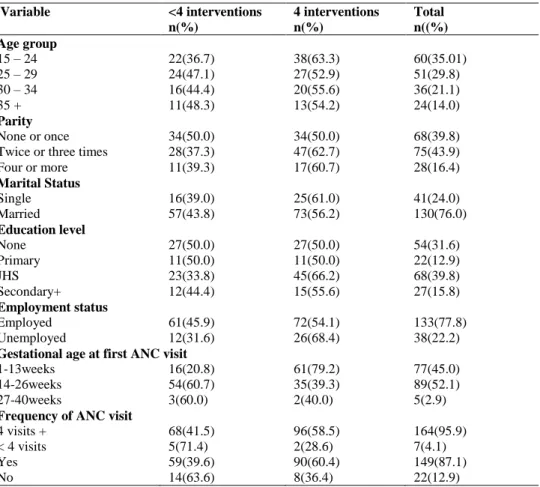
Table 4: Comparison of proportion of pregnant women who used <4 Interventions and all the 4 interventions (n=171)
Variable <4 interventions 4 interventions Total
n(%) n(%) n((%)
Age group
15 – 24 22(36.7) 38(63.3) 60(35.01)
25 – 29 24(47.1) 27(52.9) 51(29.8)
30 – 34 16(44.4) 20(55.6) 36(21.1)
35 + 11(48.3) 13(54.2) 24(14.0)
Parity
None or once 34(50.0) 34(50.0) 68(39.8)
Twice or three times 28(37.3) 47(62.7) 75(43.9)
Four or more 11(39.3) 17(60.7) 28(16.4)
Marital Status
Single 16(39.0) 25(61.0) 41(24.0)
Married 57(43.8) 73(56.2) 130(76.0)
Education level
None 27(50.0) 27(50.0) 54(31.6)
Primary 11(50.0) 11(50.0) 22(12.9)
JHS 23(33.8) 45(66.2) 68(39.8)
Secondary+ 12(44.4) 15(55.6) 27(15.8)
Employment status
Employed 61(45.9) 72(54.1) 133(77.8)
Unemployed 12(31.6) 26(68.4) 38(22.2)
Gestational age at first ANC visit
1-13weeks 16(20.8) 61(79.2) 77(45.0)
14-26weeks 54(60.7) 35(39.3) 89(52.1)
27-40weeks 3(60.0) 2(40.0) 5(2.9)
Frequency of ANC visit
4 visits + 68(41.5) 96(58.5) 164(95.9)
< 4 visits 5(71.4) 2(28.6) 7(4.1)
Yes 59(39.6) 90(60.4) 149(87.1)
No 14(63.6) 8(36.4) 22(12.9)
Table 5: Availability of interventions at the health facility
Variable Number (%) Availability of Antihelminthic at facility
Yes 73 (42.7)
No 98 (57.3)
Availability of Iron at facility
Yes 171(100)
No 0(0.0)
Availability of SP at facility
Yes 171(100)
No 0(0.0)
Availability of SP at facility
Yes 171(100)
No 0(0.0)
generation which partly eliminates the problem of accessibility to health facilities.
The strong association observed between gestational age at first visit and use of the
interventions is in line with Hill et al18, which reported similar findings. Early initiation of ANC attendance means that there will be high number of subsequent visits which make a woman more likely to receive the interventions. Both the unadjusted and adjusted analysis showed no association between the availability of antihelminthics in the facility and use of the intervention. The association between frequency of subsequent visit and the use of the intervention reported in Kiwuwa and Mutubenga19 is like the findings of this study.
Ethical Consideration
Table 6: Multiple Logistic Regression of Factors Associated with use of Interventions
Variable Univariate Multivariate
uOR(95%CI) aOR(95%CI)
Age group
15-24 1 - 25 – 29 1.12(0.65 - 1.95) - 30 – 34 1.25(0.65 - 2.42) - 35 + 1.18(0.53 - 2.64)
Parity
None or once 1 Twice or
three 1.68(1.05 - 2.68)* 3.54(1.97 - 6.37)** Four or more 1.55(0.72 - 3.31) 4.57(1.76 -11.89)**
Marital status
Unmarried 1
Married 1.28(0.9 - 1.81) -
Education
None 1
Primary 1(0.43 - 2.31) - Junior
Secondary 1.96(1.18 - 3.24)* - Secondary+ 1.25(0.58 - 2.68) -
Employment status
Employed 1
Unemployed 2.17(1.09 - 4.3)* 5.51(2.32 -13.09)**
Gestational age at 1st ANC visit
1-13weeks 1
14-26weeks 0.65(0.42 - 0.99)* 0.28(0.14 - 0.59)** 27-40weeks 0.67(0.11 - 4.01) 0.20(0.03 - 1.26)
Knowledge on Anaemia prevention
Yes 1
No 0.57(0.24 - 1.37) -
Availability of Antihelmintic
Yes 1
No 0.88(0.59 - 1.32) 0.69(0.35 - 1.34)
Frequency of ANC visit
4 visits + 1
< 4 visits 0.4(0.08 - 2.07) 0.18(0.04 - 0.92)*
**p-value < 0.001 *p-value <0.05; CI: Confidence Interval; aOR: Adjusted Odd Ratio; uOR: Unadjusted Odd Ratio
Approval was also sought from the Kintampo North Municipal Health Directorate and all heads of facility as well as unit heads in the study sites. Informed consent was obtained from all respondents and their confidentiality was assured before the interview.
Conclusion
The use of anemia preventing measures among pregnant women in the Kintampo North Municipality in this study was quite low. Factors
that significantly influenced the use of all anemia preventing measures among pregnant women were parity, employment status and gestational age at first ANC. Others include frequency of subsequent visits and availability of antihelminthic in the health facility. The findings of this study reveal that the underlisted strategies can help increase the usage of the interventions among pregnant women.
1. Antihelminthics used in pregnancy should be made available to all antenatal clinics.
2. In addition to giving out the intervention, health education targeting especially multigravidaes should be reinforced on the importance of their use. Public health authorities and actors can undertake mass awareness campaign to educate mothers on early initiation and continual attendance of ANC
3. Regular refresher training on the benefits and timing of the interventions should be conducted for all ANC staff.
Conflict of Interest
The authors declare no conflict of interest regarding this research.
Acknowledgements
The authors are very grateful to the Director and staff of the Kintampo North Municipal Health Directorate for their administrative support. They are also grateful to community members, chiefs, elders and the study participants for their support and contributions to this research.
Contribution of Authors
References
1. World Health Organization. Worldwide prevalence of anaemia 1993-2005: WHO global database on aneamia. World Health Organization 2008; 41. 2. Engmann C, Adanu R, Lu T S, Bose C, and Lozoff B.
Anemia and iron deficiency in pregnant Ghanaian women from urban areas. International Journal of Gynecology and Obstetrics 2008; 101(1), 62–66. 3. Kintampo North Municipal Health Directorate. 2016
Annual Report.Kintampo: Ghana, 2017, 56. 4. World Health Organization. Iron Deficiency Anaemia:
Assessment, Prevention and Control, A guide for program managers. World Health Organization 2001a; 114.
5. Sifakis S and Pharmakides G. Anemia in pregnancy. Annals of the New York Academy ofSciences2000; 900:125–136.
6. Kalaivani K. Prevalence & consequences of anaemia in pregnancy. Indian Journal of Medical Research2009; 130(5): 627–633.
7. Rasmussen K. Is There a Causal Relationship between Iron Deficiency or Iron-Deficiency Anemia and Weight at Birth, Length of Gestation and Perinatal Mortality? The Journal of Nutrition2001; 131(2S– 2): 590S–601S.
8. World Health Organization. Guideline: Daily iron and folic acid supplementation in pregnant women. Geneva: swizerland, 2012;46: 323–329.
9. World Health Organization. Focusing on anaemia: Towards an integrated approach for effective anaemia control, 2004.
10. World Health Organization. WHO policy brief for the implementation of intermittent preventive treatment of malaria in pregnancy. WHO Department of Maternal, Newborn, Child and Adolescent Health, 2014.
11. Ghana Statistical Service and Ghana Health Service. Ghana Demogragraphic and Health Survey 2014. Rockvile: Maryland, 2015.
12. Gebreamlak B, Dadi AF and Atnafu A. High adherence to iron/folic acid supplementation during pregnancy time among antenatal and postnatal care attendant mothers in Governmental Health Centers in Akaki Kality Sub City, Addis Ababa, Ethiopia: Hierarchical negative binomial poisson regression. PLoS ONE 2017;12(1): 1–11.
13. Ter Kuile FO, Terlouw DJ, Phillips-howard PA, Hawley W A, Friedman JF, Kariuki S K, Shi YP, Kolczak
MS, Lal AA, Vulule JM and Nahlen BL. Reduction of malaria during pregnancy by permethrin-treated bed nets in an area of intense perennial malaria transmission in western kenya.AJTMH 2003; 68(4): 50–60.
14. National Malaria Control Programme. Ghana Malaria Programme Review: Final Report. Accra: Ghana, 2013, 198.
15. Sambili B, Kimambo R, Peng Y, Ishunga E, Matasha E, Matumu G, Noronha R and Ngilangwa, D P. Factors Influencing Anti-Malarial Prophylaxis and Iron Supplementation Non-Compliance among Pregnant Women in Simiyu Region, Tanzania. Int. J. Environ.Res. Public Health2016; 13(7): 626. 16. Nganda R Y, Drakeley C, Reyburn H, and Marchant T.
Knowledge of malaria influences the use of insecticide treated nets but not intermittent presumptive treatment by pregnant women in Tanzania. Malaria Journal2004; 3(1): 42.
17. Humphries D, Simms B T, Davey D, Otchere J, Quagraine J, Terryah S, Newton S, Berg E, Harrison ML, Boakye D, Willson M and Cappello, M. Hookworm Infection among School Age Children in Kintampo North Municipality, Ghana : Nutritional Risk Factors and Response to Albendazole Treatment. AJTMH2013; 89(3): 540– 548.
18. Hill J, Hoyt J, van Eijk AM, D‘Mello-Guyett L, ter Kuile FO, Steketee R, Smith H and Webster J. Factors Affecting the Delivery, Access, and Use of Interventions to Prevent Malaria in Pregnancy in Sub-Saharan Africa: A Systematic Review and Meta-Analysis. PLoS Medicine2013;10(7). 19. Kiwuwa M S and Mufubenga P. Use of antenatal care,
maternity services, intermittent presumptive treatment and insecticide treated bed nets by pregnant women in Luwero district, Uganda. Malaria Journal2008;7: 44.
20. Ngimuh L, Fokan, BE, Anchang-Kimbi K J and Wanji, S. Factors associated to the use of insecticide treated nets and intermittent preventive treatment for malaria control during pregnancy in Cameroon. Archives of Public Health 2016; 74(1): 5.