collaborative spaces
Preetam Singh Heeramun, Dr. Dragana Nikolic, Dr. Chris Harty
University of Reading, United Kingdom
[email protected],[email protected],[email protected]
Abstract. Collaboration often involves the use of digital technologies to help team members visualise and interact with project information, affecting the way projects are delivered in a competitive industry. Collaboration can be either co-located or remote, and in both instances benefit from digital technologies ranging from audio, video, or web conferencing to more advanced immersive room-based systems, designed to support collaborative tasks and deliver different types of user experiences. This exploratory position paper provides an overview of the early stages of the research examining the relationship between the technology, space and the users when designing, implementing and delivering technology-enabled collaborative spaces. The research identifies example users’ requirements and factors which typically inform the design process in terms of specifying, implementing, delivering and supporting technology-enabled collaborative spaces and how digital technologies can shape the team collaboration beyond the initial technology assumptions. This is expected to inform the design and use of future technology-enabled collaborative spaces for both co-located and virtual working settings, as well as guiding with a framework for evaluating successful deployment of digital technologies and their anticipated as well as unanticipated use in projects.
Introduction
Digital technologies have become central to how organisations run their operations, which are now more dispersed on a global scale, raising the need for efficient virtual collaboration. At the same time, with the changing workforce, organisations are reviewing and addressing how the workplace is designed and how their employees are enabled with the appropriate tools, technologies, knowledge and spaces to be more productive. Industry sectors such as oil and gas, architecture, engineering and construction (AEC), use an array of digital collaboration technologies to support different types of collaborative activities. There are also several examples of existing deployments of collaborative systems which are known to have low levels of adoption and poor utilisation within organisations resulting from e.g. lack of effective user training, low availability,
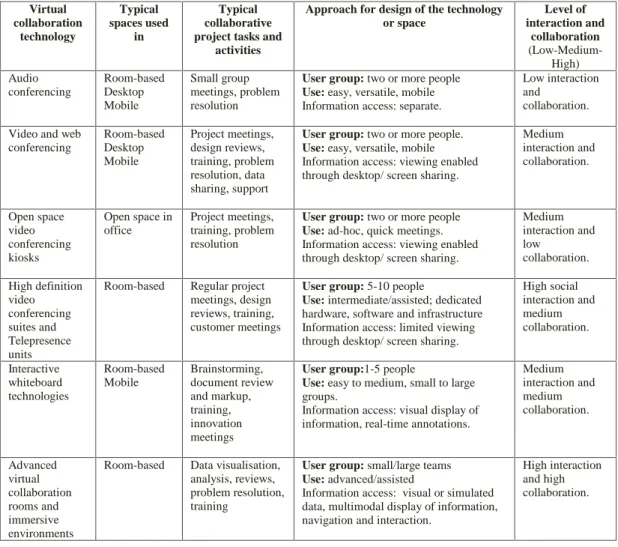
complex user interfaces and inappropriation of the technology to the users’ daily needs. Based on personal hands-on experience and knowledge of developing collaborative meeting systems, Table I lists collaborative technologies commonly usedfor synchronous remote collaboration (i.e. occurring at the same time but in different places). They are compared, based on early stage research investigations of their use in different industry sectors, by their spatial requirements for typical tasks involved in collaborative meetings e.g. in the context of reviewing key data and information involved during the design phase of projects. These technologies can also facilitate both co-located and virtual collaboration.
Table I. Initial overview of virtual collaboration technologies for synchronous collaboration
Virtual collaboration technology Typical spaces used in Typical collaborative project tasks and
activities
Approach for design of the technology or space Level of interaction and collaboration (Low-Medium-High) Audio conferencing Room-based Desktop Mobile Small group meetings, problem resolution
User group: two or more people Use: easy, versatile, mobile
Information access: separate.
Low interaction and
collaboration. Video and web
conferencing Room-based Desktop Mobile Project meetings, design reviews, training, problem resolution, data sharing, support
User group: two or more people. Use: easy, versatile, mobile
Information access: viewing enabled through desktop/ screen sharing.
Medium interaction and collaboration. Open space video conferencing kiosks Open space in office Project meetings, training, problem resolution
User group: two or more people Use: ad-hoc, quick meetings.
Information access: viewing enabled through desktop/ screen sharing.
Medium interaction and low collaboration. High definition video conferencing suites and Telepresence units
Room-based Regular project meetings, design reviews, training, customer meetings
User group: 5-10 people
Use: intermediate/assisted; dedicated
hardware, software and infrastructure Information access: limited viewing through desktop/ screen sharing.
High social interaction and medium collaboration. Interactive whiteboard technologies Room-based Mobile Brainstorming, document review and markup, training, innovation meetings
User group:1-5 people
Use: easy to medium, small to large
groups.
Information access: visual display of information, real-time annotations.
Medium interaction and medium collaboration. Advanced virtual collaboration rooms and immersive environments
Room-based Data visualisation, analysis, reviews, problem resolution, training
User group: small/large teams Use: advanced/assisted
Information access: visual or simulated data, multimodal display of information, navigation and interaction.
High interaction and high collaboration.
Collaboration is defined as a process where a team of two or more people work together on a common task to achieve a shared goal, while collaboration technology refers to one or more computer-based tools that supports the team in communicating and coordinating relevant information, either locally or remotely (Zigurs et al., 2006). Considering the physical space, collaboration technologies are typically deployed in dedicated room-based environments, open office space or at the office desk, which is likely to impact their design and use (Mittleman, 2009).
While the types of digital technologies for collaboration are generally well known and explored (Frost and Sullivan, 2012), the way physical aspects shape the deployment of collaborative technologies and respective collaborative practices is still little studied. While organisations are adopting new work models impacting the group and individual spaces used for collaborative working, the space design typically does not adequately support the desired level of collaboration that is most likely to yield high value outcomes to organisations (Brager et al., 2000). Specifically, spatial attributes and technical features of the environment that support impromptu interactions, casual meetings, and collaboration need to be identified and better understood. To explore this physical aspect and spatial characteristics of both virtual and co-located collaboration we use the term
technology-enabled collaborative space (TeCS).
Background
Understanding the task, technology and context fit
Digital technologies supporting synchronous collaboration range from standard audio-video conferencing and interactive whiteboard technologies to advanced virtual collaboration rooms and immersive environments (Frost and Sullivan, 2012). Although the time-space groupware matrix (Johansen, 1988) helps classify the technology to be used in different time and space scenarios, it does not however provide an understanding of the specific tasks and user requirements that would guide the deployment of relevant collaborative technologies. Rather, a greater complexity and need is to integrate and evaluate how the technology and facilitates the tasks and activities it will be used for (Zigurs et al., 2006). To address this complexity, a clear understanding of the contexts in which collaboration unfolds is critical e.g. is the collaboration technology being used for a simple collaborative task such a co-authoring a report or a more complex task such as reviewing the design drawings for a high-value construction project involving dispersed teams globally. As virtual teams and organization become more dispersed, their reliance on collaboration technology for supporting a variety of functions becomes greater, highlighting the need for the technology to create a shared space (Zigurs et al., 2006).
Design and deployment of collaboration technologies and spaces
(Mival et al., 2013) researched how interactive and collaborative work environments are designed to engage users and deliver ease of use and interaction. They took into consideration the spaces in which technology are used and user interactions which can be facilitated. The impacts of such environments on co-located and virtual team working (Fruchter, 2006) and their benefits to the organisation (Lindeblad, 2010) have been explored, which include the dynamics of how individuals and teams can work globally using technology-enabled collaborative spaces. (Harrison et al., 1996) also investigate the roles of space and place in the context of collaborative systems. As shown in Table I, different types of collaboration technologies and environments exist to support individual and team working. An initial review of these collaborative systems reveals that the physical environment and space is a key part of the design of collaboration
technologies and spaces as it influences how they are used (e.g. by individuals and or teams), which types of collaborative tasks can be facilitated and how users interact with the systems. This is further demonstrated in (Haworth, 2011) where the reasons for team members to choose a particular type of collaborative meeting space are linked to their collaboration needs and the type of meeting they wish to have. This guides with the design and implementation of appropriate types of collaboration spaces such as presentation, tactical execution, strategic thinking and social spaces.
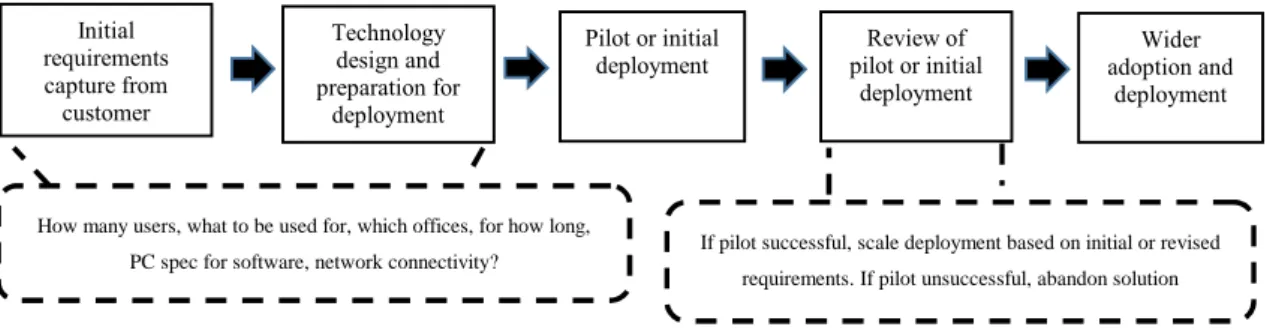
(Mival et al., 2013) propose a six-stage protocol for organisations who seek to adopt collaborative systems for their employees. This approach in the form of an ethnographic study would involve attending and observing daily briefings and internal client meetings, documenting the communication and information workflow between participants, recording the users’ needs and concerns to capture the users’ requirements, and lastly obtain the buy-in of the actual users of the space. Based on the requirements captured through this process, the technology specification and its design are aligned to the user expectations and physical space in which the users will collaborate. Furthermore, the importance of integrating people, processes, space and technology are highlighted in establishing a Collaborative Work Environment (CWE) framework for large-scale implementation (Rindahl et al., 2014; Van den Berg et al., 2013). Better understanding of the users’ needs and collaborative work practices remains a challenge and is critical for the technology design and deployment process (Rindahl et al., 2014). The adoption and deployment of virtual collaboration technologies has typically been the responsibility of the IT department within organizations, but the process is changing due to a growing number of different stakeholders involved in the decision making process. To design and deliver specific collaboration technologies and systems, vendors typically capture user requirements in a very traditional, technology-focused process (Figure 1). This example process is based on practical experience as a designer and developer of the technologies for supporting virtual working and the spaces they form part of.
Figure 1 Example process for requirements capture for design of virtual collaboration
technologies
This process demonstrates that little emphasis is placed on understanding the actual space in which the technology is to be deployed and detailed user requirements. The issues with such approaches which are technology-centric are highlighted in (Rindahl et al., 2014) where the technology can fail to be appropriated to its actual use. The process also provides limited understanding of the types of collaborative activities and tasks as the use of the technology matures and the adoption is scaled up beyond initial deployment. After the digital technologies and collaborative environments are deployed, there is a two-way effect in terms of how well these technologies meet the users’ requirements and also how they may extend and shape the desired collaborative practices.
Initial requirements capture from customer Pilot or initial deployment Technology design and preparation for deployment Review of pilot or initial deployment Wider adoption and deployment
How many users, what to be used for, which offices, for how long, PC spec for software, network connectivity?
If pilot successful, scale deployment based on initial or revised requirements. If pilot unsuccessful, abandon solution
Existing research reveals a fragmented understanding of collaborative practices shaped by the technology-enabled collaborative spaces. This is mostly evident in the significant lack of systematic research and data on team spaces that goes beyond anecdotal information (Brager et al., 2000). To understand the lifecycle of the technology-enabled collaborative spaces and how they may shape collaboration beyond users’ requirements, this initial exploratory paper proposes to further study:
The relationship between the collaborative tasks and technology-enabled collaborative spaces in the context of projects involving geographically dispersed teams e.g. collaborative design reviews in construction projects;
How user requirements are captured to formulate a design brief and used to inform the current approaches for designing collaborative spaces e.g. based on an ethnographic approach;
How the physical attributes of collaboration spaces affect the TeCS design; and
Documenting the frequency and types of uses, success level, and short-long term use of TeCS once they are deployed, adopted and implemented into organisations.
An integrated approach for TeCS
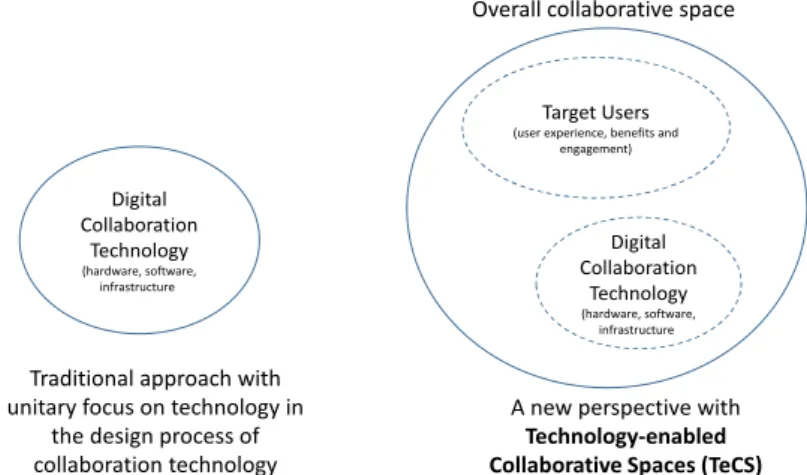
An approach which holistically considers people, technology and space in the design process and after the deployment can further inform future design and enrich user interactions within the space to support changing needs of users and changing tasks. This leads to the shift in focus from collaboration technologies alone to technology-enabled collaborative spaces (TeCS) where the technology is a part of a broader infrastructure that can be applied to both co-located and virtual collaborative working contexts (Figure 2).
Traditional approach with unitary focus on technology in
the design process of collaboration technology
A new perspective with
Technology-enabled Collaborative Spaces (TeCS)
Digital Collaboration Technology (hardware, software, infrastructure) Digital Collaboration Technology (hardware, software, infrastructure) Target Users (user experience, benefits and
engagement)
Overall collaborative space
Figure 2 A high level description of the new perspective for designing TeCS
It is expected that this approach will also inform the way user and organizational requirements are captured and applied in the design process for TeCS. This would facilitate the involvement of multiple stakeholders from different parts of the organization in design and deployment stages. The holistic approach
accommodates changes in user or organizational requirements over time, facilitating wider adoption and deployment. Building further from the presented concept for designing and deploying TeCS, the next research steps will involve ethnographic observations of currently deployed TeCS use and interviews in order to define the framework using data such as location of the deployment, layout of the office and physical space and size of the space, number of users, times of day for use, frequency of use. The use of TeCS beyond the original requirements and assumptions will also be monitored and captured as part of the framework.
Conclusions and future work
Organisations globally are faced with unprecedented choice for supporting collaborative meetings and activities. Although technology-enabled collaborative spaces have evolved significantly, it is still difficult to evaluate the success of the design of such spaces once deployed and in use. A framework which allows effective capture of user requirements and expectations will benefit the design of such spaces as well as verifying the appropriation of the technology design against how it is actually used when deployed and as the adoption matures over time.
References
Brager, G., Heerwagen, J., Buaman, F., Huizenga, C., Powell, K., Ruland, A. and Ring, E. (2000) Team spaces and collaboration: Links to the physical environment.
Frost and Sullivan (2012) Selection and Use of Collaboration Tools to Maximise Team Performance
Fruchter, R. (2006) Explicit choices and emergent work practices in global team work. Joint International Conference on Computing and Decision Making in Civil and Building Engineering. Harrison, S., Dourish, P. (1996) Re-Place-ing space: The roles of place and space in collaborative systems. Proc. CSCW’96, ACM Press (1996), 67-76.
Haworth (2011) Collaborative Spaces. A whitepaper by Haworth Knowledge and Research Team. Johansen, R. (1988) Groupware: Computer support for business teams.
Lindeblad, P. (2012) Organisational effects of virtual meetings.
Mittleman, D. D. (2009) Planning and design considerations for computer supported collaboration spaces. Journal of the Association for Information Systems, Volume 10, Special Issue, pp.
278-305.
Mival, O. and Benyon, D. (2013) Implementing and ICE: A methodology for the design, development and installation of Interactive Collaborative Environments in real world industrial settings.
Rindahl, G. and Sarshar, S. (2014) Integrated Operation Collaboration Technologies–Remaining Challenges and Opportunities. SPE Intelligent Energy Conference, Netherlands, 1-3 April 2014. Van der Berg, F., Giles, A.R., Graves, M., Heath, E. and Evans, A. (2014) Collaborative Work Environments deployed on a Global Scale.
Zigurs, I. and Munkvold, B. (2006) Collaboration technologies, tasks and contexts: Evolution and opportunity.