AUSTRALIAN JOURNAL OF BASIC AND
Open Access Journal
Published BY AENSI Publication
© 2016 AENSI Publisher All rights reserved
This work is licensed under the Creative Commons Attribution International License (CC BY).
http://creativecommons.org/licenses/by/4.0/
To Cite This Article: Elumalaivasan P., Kulothungan K., Ganapathy Sannasi Attribute Based Encryption Techniques for Decentralized Disruption Tolerant Networks
Trust Based Ciphertext Policy Attribute Based Encryption Techniques for
Decentralized Disruption Tolerant Networks
Elumalaivasan P., Kulothungan K., Ganapathy Sannasi
Department of Computer Science and Engineering, CEG Campus, Anna University, Chennai
Address For Correspondence:
Elumalaivasan P., Department of Computer Science and Engineering, CEG Campus, Anna University, Chennai E-mail: [email protected]
A R T I C L E I N F O Article history:
Received 04 December 2015 Accepted 22 January 2016 Available online 14 February 2016
Keywords:
Disruption Tolerant Networking
(DTN),Node Location, Access
control,Attribute Based Encryption (ABE) Secure Data retrieval, Trust management
Data confidentiality and secure data retrieval policy plays main role in data communication as well as crypto system. Attribute-based encryption scheme is useful
requirements for secure data retrieval in Disruption Tolerant Networks (DTNs)
2009). Attribute Based Encryption provides a security mechanism that enables an access control over encr data using access policies and necessary attributes by applying private keys for encrypting cipher texts.
The cipher text policy attribute implement access control effectively
introduces several security and privacy challenges including attribute revocation, key updates, and co of attributes issued from different authorities. Implementation of CP
multiple key authorities manage the keys collectively, but from independent locations. In a group communication, the members of the group may leave and new members may join the group. In such a scenario, it is necessary to maintain backward and forward secrecies to enhance the confidentiality of data. Moreover, the Key updates and key sharing problems are resolved by introducing a secured key distribution protocol that exploits the characteristic of the decentralized DTNs architectu
Attribute-based encryption (ABE) fulfills the requirements for secured data storage, retrieval and
AUSTRALIAN JOURNAL OF BASIC AND
APPLIED SCIENCES
ISSN:1991-8178 EISSN: 2309-8414 Journal home page: www.ajbasweb.com
© 2016 AENSI Publisher All rights reserved
This work is licensed under the Creative Commons Attribution International License (CC BY). http://creativecommons.org/licenses/by/4.0/
Elumalaivasan P., Kulothungan K., Ganapathy Sannasi and Kannan Arputharaj., Trust Based Ciphertext Policy Attribute Based Encryption Techniques for Decentralized Disruption Tolerant Networks. Aust. J. Basic & Appl. Sci.,
Trust Based Ciphertext Policy Attribute Based Encryption Techniques for
Decentralized Disruption Tolerant Networks
Ganapathy Sannasi and Kannan Arputharaj
Department of Computer Science and Engineering, CEG Campus, Anna University, Chennai-25
Department of Computer Science and Engineering, CEG Campus, Anna University,
Chennai-A B S T R Chennai-A C T
In extreme wireless network environment, Mobile Nodes suffers from inter communication such as military networks and hostile environments. Disruption Tolerant Networks (DTNs) technologies provide challenging and successful solutions for end to end connection between nodes. In this network, the encrypted data is stored in the external storage node and retrieved it by decryption from it, as the confidential data to be retrieved securely it has to consider some security sch0065mes.
Based Encryption (ABE) is a new approach to cryptography that full fills the requirements for secure data retrieval in DTNs. The existing system involves some challenging issues like intimacy, attribute update and trust management and in Cipher text Policy Attribute Based Encryption (CP-ABE) having key updating issue. To overcome this, we propose a new scheme in this paper for securing the data accessed which is based on the Trust based Cipher text Policy Attribute
ABE) scheme which provides a scalable way for confidential data retrieval and reduce complexity. In addition, the location of the node is also traced by using network protocols to make more flexible and for easy communication between
nodes. Here various key authorities maintain their attributes independently. In addition, trust values are calculated for each node and updated in the trust table each and every time. This proposed method provides enhanced security using trust
technique when compared with the other existing approaches
INTRODUCTION
Data confidentiality and secure data retrieval policy plays main role in data communication as well as based encryption scheme is useful for enhancing the security by satisfying the requirements for secure data retrieval in Disruption Tolerant Networks (DTNs) (Chase, M. and S.S.M. Chow,
. Attribute Based Encryption provides a security mechanism that enables an access control over encr data using access policies and necessary attributes by applying private keys for encrypting cipher texts.
The cipher text policy attribute-based encryption is a promising encryption technique which can be used to implement access control effectively. However, the problem of applying CP-ABE in decentralized DTNs introduces several security and privacy challenges including attribute revocation, key updates, and co
of attributes issued from different authorities. Implementation of CP-ABE for decentralized DTNs where multiple key authorities manage the keys collectively, but from independent locations. In a group communication, the members of the group may leave and new members may join the group. In such a scenario, backward and forward secrecies to enhance the confidentiality of data. Moreover, the Key updates and key sharing problems are resolved by introducing a secured key distribution protocol that exploits the characteristic of the decentralized DTNs architecture (Roy, S. and M. Chuah, 2009
based encryption (ABE) fulfills the requirements for secured data storage, retrieval and
Trust Based Ciphertext Policy Aust. J. Basic & Appl. Sci., 10(2): 18-26, 2016
Trust Based Ciphertext Policy Attribute Based Encryption Techniques for
-25.
In extreme wireless network environment, Mobile Nodes suffers from inter communication such as military networks and hostile environments. Disruption challenging and successful solutions for end to end connection between nodes. In this network, the encrypted data is stored in the external storage node and retrieved it by decryption from it, as the confidential sider some security sch0065mes. Attribute-Based Encryption (ABE) is a new approach to cryptography that full fills the
. The existing system involves some trust management and in Cipher ABE) having key updating issue. To overcome this, we propose a new scheme in this paper for securing the data accessed which is based on the Trust based Cipher text Policy Attribute Based Encryption
(TCP-provides a scalable way for confidential data retrieval and reduce complexity. In addition, the location of the node is also traced by using network protocols to make more flexible and for easy communication between surrounding nodes. Here various key authorities maintain their attributes independently. In addition, trust values are calculated for each node and updated in the trust table each and every time. This proposed method provides enhanced security using trust based encryption technique when compared with the other existing approaches.
Data confidentiality and secure data retrieval policy plays main role in data communication as well as for enhancing the security by satisfying the Chase, M. and S.S.M. Chow, . Attribute Based Encryption provides a security mechanism that enables an access control over encrypted data using access policies and necessary attributes by applying private keys for encrypting cipher texts.
based encryption is a promising encryption technique which can be used to ABE in decentralized DTNs introduces several security and privacy challenges including attribute revocation, key updates, and co-ordination decentralized DTNs where multiple key authorities manage the keys collectively, but from independent locations. In a group communication, the members of the group may leave and new members may join the group. In such a scenario, backward and forward secrecies to enhance the confidentiality of data. Moreover, the Key updates and key sharing problems are resolved by introducing a secured key distribution protocol that
Roy, S. and M. Chuah, 2009).
communication in DTNs. For enhancing the security of stored data, it is necessary to provide an effective access control policy which is applied over encrypted data using private keys and cipher texts. Moreover, ABE provides a scalable way of encrypting data such that the encryptor defines the attribute set that the decryptor needs to possess in order to decrypt the cipher text. Thus different members of the group are allowed to decrypt different pieces of data by using their private keys and the public key distributed already to them and by following the security policies. However, the problem of introducing new ABE to DTNs will lead to new complexities with respect to privacy management. But in the existing systems, CP-ABE is used to generate a private key of user based on their attribute keys (John Brent andAmit Sahai, 2011). Every time when a user enters or removes from certain group then immediate key update operations are performed. For this purpose, a new key management scheme which can recognize the valid members of the groups with a key having some common components appended with some private components. Such type of key updates will produce high computation complexity and communication overhead due to key revocation and new key computation for other members (Chuah, M. and P. Yang, 2007). Therefore, it is necessary to reduce the computation complexity for the other members of the group using an efficient key distribution algorithm with high confidentiality. So, Revathi and Raghavendra have proposed a trust based CP-ABE with tracking the location of nodes for providing effective security (Revathi, S. and Raghavendra, 2014).
The main objectives of this work are:
i) To make multiple key authorities to manage their attributes independently in DTNs using the proposed Trust based CP-ABE.
ii) To provide a facility for maintenance of backward and forward secrecy through key revocation and key update on confidential data.
iii) To track the location of the nodes to improve the communication performance.
iv) To enhance the network throughput by providing a secure routing algorithms by using trust evaluation.
Literature survey:
CP-ABE is a promising approach that fulfills the requirements for secure data retrieval in DTNs. Each and every time a member join or leave from the network, the networking management system should change the attribute keys to overcome trust violations. This can be performed by updating the trust values of neighbor nodes and location of nodes traced by geographical routing protocols.
There are many works on network security and secure routing protocols which are available in the literature (Revathi, S. and Raghavendra, 2014; Burgess, J., 2006; Rama Sundari Battula and O.S. Khanna, 2013; JunbeomHur and Dong Kun Noh, 2011; John Brent andAmit Sahai, 2011; Roy, S. and M. Chuah, 2009; Chuah, M. and P. Yang, 2007; Jinsong Han and Lei HuPseudo, 2007; Kulothungan, K., 2011). Among them, John Burgess Brian Gallagher David Jensen and Brian Neil Levine, implemented MaxProp in Disruption tolerant networks DTNs that allow for routing in networks. Disruption-tolerant networks give the continuous network connectivity between nodes in extreme terrestrial environment. MaxProp is effective protocol in the DTN for message passing, it schedules the dropped packets as well as the transmit packets to other peers. MaxProp having some time limit for evaluation and trace real DTN environments, where contemporaneous end-to-end paths are unstable or unlikely. MaxProp is based on prioritizing and scheduling the routing of packets which are transmitted to the neighbors and also to schedule the packets which are to be dropped. For this purpose, priorities based on paths, historical trust values of nodes, acknowledgements and new type of control packets are introduced.
Rama SundariBattula and Khanna (2013) proposed a geographical routing protocol that uses location information to formulate an efficient route search toward the destination. Here, the location of node information can be determined by the Geographic Routing Protocols in the wireless sensor networks. In this scenario, the nodes may be either in distributed and localized sensors are they will be in the interconnecting network, so that the mobility support can be facilitated. Since each node sends its coordinates periodically, all its neighbors update their routing tables accordingly. Each node aware of its all live neighbor nodes, but it causes more overhead and authorization policy issue. This work is more suitable for table driven routing protocols. JunbeomHur and Dong Kun Noh (2011)proposed a security mechanism in which the storage outsourcing requirements are optimized by using access control policies and cryptographic methods. In this model, the receiver must know the access control policies and keys in order to decrypt the cipher text. Their main objective is to provide fine-grained access control with multiple granularities to reduce the data outsourcing in the system.
complexity based on the number of attributes involved in the encryption and decryption process. In their ABE scheme, multiple attribute-authorities are used to monitor different combination of attributes which are used as components of keys used for encryption and decryption. In their work, a central authority is used to generate and distribute the keys to the participating nodes. The main advantage of their key management scheme is that they not only use a centralized authority but also global identifiers to enhance the security.
Roy and Chuah (2009) proposed a new security mechanism for mobile nodes in some challenging network scenarios which suffers from intermittent connectivity and frequent partitions. Their model is more suitable for ad-hoc networks which are used in battlefields, earthquake recovery systems and other emergency applications. In their work, the Disruption Tolerant Network technologies are designed to enable nodes to communicate with one another’s-ABE and to provide a flexible fine-grained access control such that the encrypted data stored in the network is accessible only to authorized users. Two unique scenarios are incorporation of dynamic attributes whose value may change over time and the revocation feature. Attribute revocation is also implemented in this DTN system. Chuah and Yang, (2009) proposed a replication scheme for effective data replication and distributed querying in sparsely connected networks. In their model, they addressed how should a query response be routed back to the querying node and how should node movement should be implemented. There are three main components in our content-based information retrieval system, namely are data caching, query dissemination and message routing. Here to find query success ratio is big issue.
Mohammad Momani, Johnson Agbinya (2007) proposed a new algorithm for calculating trust in Wireless Sensor Networks with Quality of Services (QoS) requirements expected to be fulfilled by nodes. Here mention the trust calculation between the nodes to make more secure the network by the previous experience from the surrounding nodes can be calculated, each and every time the trust value calculated and reported in the surrounding nodes. The creation, operation, communication and energy management in this network are modeled using trust management techniques. Chuah and Yang (2006) proposed a store-and-forward approach for enhancing the QoS in DTNs. Moreover, it provides store and forward concepts for which it can deliver the probability based on routing and message ferrying in DTN. But there is no long time storing capacity, no concept of replicate data. Implementation of a node density based on adaptive routing scheme that allows regular nodes to volunteer to be message ferries when there are very few neighbors. Rong Ding and Lei Yang (2015) proposed a geographic routing protocol which is used to find the position of the nodes and to identify the malicious nodes. It uses Greedy Perimeter Stateless Routing and Reactive Geographic Routing Protocol to find out the neighbor node and location of nodes. Also calculate the end to end delay between the paths. Here the demerit is more overhead, Distance calculation of dynamic nodes are more complicated.
Proposed System Architecture:
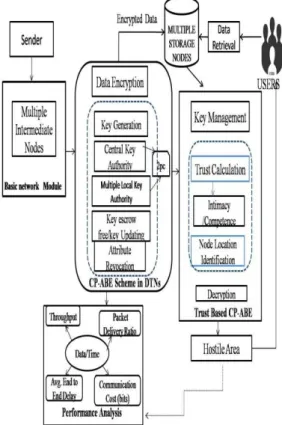
In this paper, a new security system is proposed using Trust based CP-ABE in decentralized DTNs for secure data retrieval. For this purpose, we created a simulation environment on wireless network topology and implemented it using existing protocol and with more number of nodes. In this model, source node will send the data to destination node through intermediate nodes in the networks. Here the packets transfer using general network, so that we can show how the data transmission occurs in general wireless networks. However, the problem of using key distribution and the application of CP-ABE in DTNs introduce new security challenges including attribute revocation, key escrow, and co-ordination of attributes issued from different authorities. Secure data retrieval scheme is proposed in this work using trust based CP-ABE for decentralized DTNs where the multiple key authorities manage their key values based on attributes. The key exchange policy by updating the group key each time a member leave or join enhances backward/forward secrecy of confidential data by reducing the windows of vulnerability as shown in Fig.1.
In Trust based CP-ABE, centralized authority's master secret key is used to generate the private keys of participating nodes that are identified using a set of attributes. So, the key authority can decrypt every cipher text and is also responsible for group key generation, key distribution, key updates and validation of attribute based encryption. If the key authority is compromised by adversaries when the authority is deployed in a server with malicious neighbors, it will be a potential threat to the data confidentiality or privacy especially when the data is highly sensitive.
theattributes to be used, nonce and IP address of participating nodes. This protocol is called a two party computation(2PC) protocol since the communication is always betweenthe key distribution center and the participating nodes. If any two participating nodes want to communicate with each other, they have to approach the centralized key distributioncenter to get the keys for communication. Therefore, thismodel is fully controlled by the centralized authority.
Fig. 1: System Architecture.
An efficient and secure data retrieval method using trust based CP-ABE is used for decentralized DTNs where multiple key authorities manage their attributes independently. The key update problem is addressed by resolving the key parameters confidentiality of the stored data is guaranteed even under the new environment where more attackers are present and hence the key authorities might be compromised or not fully trusted. In addition, the fine-grained key revocation can be done for each attribute group. Trust value for each neighbor node is calculated, according to high trust value data can be pass apart from this node location also traced to reduce the selfishness. In this paper, first we analyze and then compare the efficiency of the proposed scheme to the multi-authority and trust values for trust based CP-ABE schemes in theoretical aspects, make a compression with existing system. Then we demonstrate in the network simulation in terms of the communication cost.
Proposed System:
System Description and Assumptions:
Fig.1 shows the architecture of the DTNs, which consists of the following system entities:
Key Authorities:
The key authority is the centralized server which is responsible for key generation, key distribution and controlling communication.
Storage node:
This node is responsible for encrypting the data and storing them in encrypted format.
Sender:
The sender is responsible for communicating with the centralized server to get the key, finding the attributes for encryption, describing the encryption policies and to send the data.
Users are mobile nodes who want to access the data stored in the storage node. For this purpose, they have to communicate with centralized server, get the updated key information, and know the encryption and decryption policies and to read the data from the storage.
Attribute Revocation:
Whenever a member leaves from the group, the attributes pertaining to that user must be dropped from the encryption attributes. The keys generated thereafter will not use the attributes of the user who left the group.
Trust Value:
The trust management is achieved by first determining the best trust formation model given a set of parameters. It is updated periodically based on the behavior of neighboring nodes.
Location Tracking:
Location of a user must be tracked so that the location dependent queries can be handled easily. For this purpose, each user is assigned with a profile and credentials. Agents are used to search the home location of users and also the locations to which the mobile node will move frequently. A registration procedure is also used in this model where the mobile node can register with a new key distribution centre if it moves away from the centralized authority. In this scenario, the new key distribution centre will coordinate with the centralized authority for effective key management.
A. System Modelling:
In this section, we provide the details of the multi-authority CP-ABE scheme which works under a centralized authority for secured data storage and retrieval in decentralized DTNs. In this model, each local authority issues partially personalized information and attribute key to the users and it uses the 2PC protocol to communicate with the central authority. Each attribute key of a user is updated during member joins and leaves in order to maintain backward and forward secrecy. Thus, the security has been enhanced in the proposed scheme.
B. System Construction: The concept of CP-ABE is:
• Private key assigned to “attributes” • Cipher text associated with “access policy” • Can decrypt only when attributes satisfy policy.
Central key Authority:
• Choose a random exponent β∈R Z*p.
Let h=gβ
• Masters (Secret Key)/public key PKCA=h, MKCA=β.
Local Key Authority:
• Choose a random exponent αi∈R Z*p.
• Masters (Secret Key)/public key pair is PKAi=e (g,g)
αi
,MKAi=αi.
An efficient and secure data retrieval method using CP-ABE is used for decentralized DTNs where multiple key authorities manage their attributes independently. The inherent key escrow problem is addressed by effective key updates in order to enhance the confidentiality of the stored data which is guaranteed even under the hostile environment where key authorities local and central might be compromised or not fully trusted.
Key Generation: (MK, L):
The key generation algorithm runs by CA. It takes as input the master key of CA and the set of attributes L for user, then generate the secret key SK
Algorithm for key generation:
A trusted party chooses and publishes a (large) prime number ‘p’ and an integer ‘g’ with a large prime order in the field F*p. The steps of the proposed algorithm are based on Diffie-Hellman key exchange protocol [6] as described below:
1. The sender selects a large prime number p.
iii) The receiver chooses a secret integer b1 and appends it with a nonce generated by the key distribution centre and appends them to get b.
iv) Compute B ≡ gb(mod p). 2. Masters (Secret Key)
Compute the number C=Ba(mod p) andD=Ab(mod p).The shared secret value is Ba ≡ (gb)a≡ gab≡ (ga)b≡ Ab(mod p).
Data Encryption:
Here when a sender wants to deliver its confidential data M, he defines the tree access structure T over the universe of attributes L, encrypts the data under to enforce attribute-based access control on the data and stores it into the storage node. The encryption algorithm takes as input the message M, public parameter PK and access structure A over the universe of attributes. Generate the output CT such that only those users who had valid set of attributes that satisfy the access policy can only able to decrypt. Assume that the CT implicitly contains access structure A.
Data Decryption:
When a user receives the ciphertext from the storage node, the user decrypts the ciphertext with its secret key. The decrypt algorithm run by user takes input the public parameter, the ciphertext CT contains access structure A and the secret key (SK) contain of user attribute set S. If S satisfies the access tree then algorithm decrypt the CT and give M otherwise gives “ϕ”.
Trust Evaluation:
The trust management is achieved by first determining the best trust formation model given a set of model parameters specifying the environment conditions and then at runtime this trust system learns and adapts to changing environment conditions by using the best trust formation model identified from static analysis.
Calculation of trust value:
In trust based CP-ABE the same CP-ABE is implemented apart from this the trust value is calculated among the all nodes for communication
= Ty( )
Where: TY(i) – Trust value of the ith trust category.
n – Number of trust categories.
=∑ T (x)n
Where: Tj(x) – Trust value of node J on Node X.
n – Number of the surrounding nodes.
= T (x)
Where: Tk(x) –Risk value of kth trust category.
n – Number of trust categories. C= f1 (A, B)
E=f2 (C,D) = f2 (f1 (A,B),D)
Calculate Ty(x) = A, if the trust from previous interactions is enough B, if the trust from recommendations is
enoughC, if j(A.B) value is enoughD, if the D is positional trust is enoughE, if j(C,D) value is enough.
Node Location Identification:
The geographical routing is also known as position-based routing or geometric routing is a technique to deliver a message to a node in a network over multiple hops by means of position information. Routing decisions are not based on network addresses and routing tables instead messages are routed towards a destination location. By using this routing algorithm the location information can be obtained. Location of nodes also detected and intimates the position to neighbour nodes. Each node determines its own geographic position using a mechanism such as GPS; positions consist of latitude and longitude. A node announces its presence, position, and velocity to its neighbours by broadcasting periodic HELLO packets. Each node maintains a table of its current neighbour’s identities and geographic positions. The header of a packet destined for a particular node contains the destination’s identity as well as its geographic position.
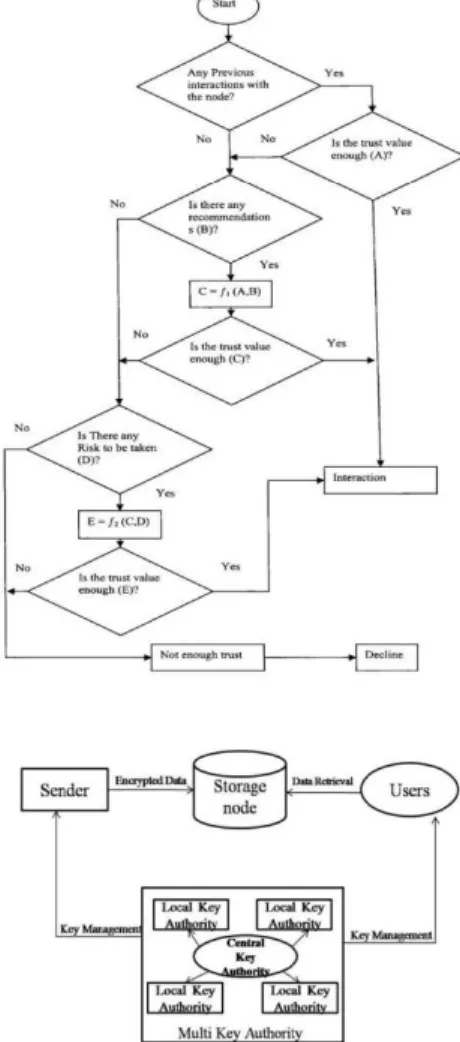
multi-authority CP-ABE scheme for secure data retrieval in decentralized DTNs. Each local multi-authority issues partial personalized and attribute key components to a user by performing secure 2PC protocol with the central authority. Fig.2 shows the trust evaluation process. It clearly shows the trust evaluation whether the trust value is acceptable or not enough for further process. If the trust value is acceptable then can proceed further otherwise can find is there any recommendation. By involving the recommendation process on that can proceed or decline. Data confidentiality on the stored the data against unauthorized users can be triviallyguaranteed which shownin Fig.3
Fig. 2: Trust Evaluation.
Fig. 3: Data Retrieval.
RESULTS AND DISCUSSION
The proposed systemdata accessed and secure data retrieval on TCP-ABE implemented in NS2Simulator. Here, we performed access control and secure data retrieval by TCP-ABE as well as location of node also tracked by using geographical routing protocols which helps to identify the position on nodes and to control the access of data.Table1show all evaluation factors calculated values likecommunication cost, average end to end delay, throughput and packet delivery ratio.
Table 1: Evaluation Values.
From Fig.4, it can be observed that the performance of the proposed system is that the communication cost and delay are gradually decreases based on increasing the simulation time. Moreover, the throughput and packet delivery ratio are gradually increases depends on the simulation time.
Fig. 4: Throughput, Packet delivery ratio, End-to-end delay, Communication cost.
Table 2: Throughput Comparison.
Time (ms) CP-ABE (kbps) TCP-ABE (kbps)
30 267.57 277.79
40 326.03 414.18
50 326.13 496.58
60 326.22 550.82
70 326.31 589.42
From Table 2, it can be observed that the comparison between the existing systems CP-ABE throughput with proposed system TCP-ABE throughput.
Fig. 5: Comparative Analysis.
From Fig.5, it can be observed that the performance of the proposed system is better when it is compared with the existing system performance.
Conclusion And Future Works:
Disruption Tolerant Network (DTN) Technologies arebecoming challenging and successful solution for End To End communication between wireless devices. Now DTN are becomes successful solution in hostile area like military applications that allows wireless devices.Confidential data can be access by using external storage nodes.TCP-ABE is a successful cryptographic solution to access control and secure data retrieval in decentralized DTN networkswherethe multiple key authorities manage their attributes independently. Trust value evaluated among all nodes and updated each and every time in trust table. Apart from this location of nodes also traced by using GPS protocols. For which improve performance and reduce communication cost. The future works in this direction can be the introduction of new trust mechanism and encryption policy with the uses of intelligent agents.
REFERENCES
Burgess, J., B. Gallagher, D. Jensen and B.N. Levine, 2006. “Maxprop: Routing for vehicle-based disruption tolerant networks,” in Proc. IEEE INFOCOM, 1–11.
0 500 1000
0 20 40 60 80
Throughput Comparison
Chase, M. and S.S.M. Chow, 2009. “Improving privacy and security in multi authority attribute- based encryption”, in Proc. ACM Conf. Comput. Common Security, 121–130.
Chuah, M. and P. Yang, 2006. “Node density-based adaptive routing scheme for disruption tolerant networks”, in Proc. IEEE MILCOM, 1–11.
Chuah, M. and P. Yang, 2007. “Performance evaluation of content-based information retrieval schemes for DTNs”, in Proc. IEEE MILCOM, 1–7.
Dhiren Kumar Dalai, P. Elumalaivasan, V.P. Sreejith, 2015. “An Analysis on Attribute based Encryption for Secure Data Retrieval in DTNs”, International Journal of Advance Research in Science and Engineering, 04(02): 169-175.
Jerusha, S., K. Kulothungan, A. Kannan, 2012. “Location aware cluster based routing in wireless sensor networks”, International Journal of Computer & Communication Technology, ISSN (PRINT), 0975-7449.
Jinsong Han and Lei HuPseudo, 2007. “Trust: Zero-Knowledge Based Authentication in Anonymous Peer-to-Peer Protocols”, in Proc. ACM Conf. Comput.Commun. Security, 1-10.
John Brent andAmit Sahai, 2011. “Ciphertext-Policy Attribute-Based Encryption”,International Association for cryptographic Research,In Proceedings of IEEE SP, Oakland, 53-70.
JunbeomHur and Dong Kun Noh, 2011. “Attribute-Based Access Control with Efficient Revocation in Data Outsourcing Systems”, IEEE Transactions on Parallel and Distributed Systems, 22(7): 1214-1221.
JunbeomHur, 2013. “Improving Security and Efficiency in Attribute-Based Data Sharing”, IEEE Transactions on Knowledge and Data Engineering, 25(10): 2271-2282.
Kulothungan, K., S. Ganapathy, S. Indira Gandhi, P. Yogesh, A. Kannan, 2011. “Intelligent Secured Fault Tolerant Routing in Wireless Sensor Networks Using Clustering Approach”, 6(5): 210-215.
Mohammad Momani and Johnson Agbinya, 2007. “A New Algorithm of Trust Formation in Wireless Sensor Networks”, presented at ACM International Conference Proceeding Series, Dunedin, New Zealand, 1-6.
Rama Sundari Battula and O.S. Khanna, 2013. “Geographic Routing Protocols for Wireless Sensor Networks: A Review ”,International Journal of Engineering and Innovative Techonology, 2(12): 39-42.
Revathi, S. and Raghavendra, 2014. “Advanced Data Access Scheme in Disruption Tolerant Network”, International Journal of Innovative Research in Computer and Communication Engineering, 1-7.
Rong Ding and Lei Yang, 2006.” A Reactive Geographic Routing Protocol for Wireless Sensor Networks”, in Proc. IEEEIntelligent Sensors, Sensor Networks and Information Processing, 1-11.
Roy, S. and M. Chuah, 2009. “Secure Data Retrieval Based on Ciphertext Policy Attribute-Based Encryption (CP-ABE) System for the DTNs”,Lehigh CSE Tech. Rep., 1-11.