The Thirty-Third AAAI Conference on Artificial Intelligence (AAAI-19)
Exploring Answer Stance Detection with Recurrent Conditional Attention
Jianhua Yuan,
1Yanyan Zhao,
2Jingfang Xu,
3Bing Qin
1∗1Research Center for Social Computing and Information Retrieval, Harbin Institute of Technology, China
2Department of Media Technology and Art, Harbin Institute of Technology, China 3Sogou Technology Inc, Beijing, China
{jhyuan, yyzhao, qinb}@ir.hit.edu.cn, [email protected]
Abstract
Detecting stance from certain types of question-answer pairs is an interesting problem which has not been carefully ex-plored. Unlike previous stance detection tasks, targets here are not given entities or claims but entire questions, which makes it difficult to capture the semantics of targets and build target-dependent representations of answers. To ad-dress them, we introduce the Recurrent Conditional Atten-tion (RCA) model which incorporates a condiAtten-tional attenAtten-tion structure into the recurrent reading process. RCA iteratively guides the distillation of question semantic with answer in-formation and collects stance-oriented text relating to ques-tion, further revealing mutual relationship among stance, an-swer and question. Experiments on a manually labeled Chi-nese community QA stance dataset show that RCA outper-forms four strong baselines by average 2.90% onmacro-F1
and 2.66% onmicro-F1respectively.
Introduction
The goal of stance detection is to classify the attitude ex-pressed in a text towards a given target, as favor,against, or neutral. Most previous work focused on stance detec-tion problems in corpus including online debates (Hasan and Ng 2013; Sridhar et al. 2015), news articles (Ferreira and Vlachos 2016), tweets (Mohammad et al. 2016), fake news (Bhatt et al. 2018), and rumors (Qazvinian et al. 2011). To our best knowledge, few has noticed that in certain types of QA pairs, answerers usually express their opinions about/towards entities or claims hold by the questions. Min-ing these QA pairs and detectMin-ing people’s stances embed-ded in them will benefit a variety of tasks including opinion-oriented question answering and opinion summarization of QA pairs.
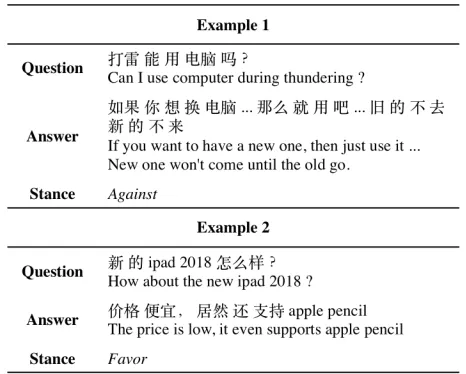
In this paper, we focus on the problem of answer stance detection in community QA (AnswerStance). As shown in Figure 1, given a question and an answer, the task aims to de-termine whether the answer holds afavor,againstorneutral attitude towards the entity or claim in that question. Apart from Yes/No type questions in QA tasks, we also deal with questions asking for viewpoint, such as the example 2 in Figure 1. Moreover, this task differs from traditional stance
∗
Corresponding Author
Copyright c2019, Association for the Advancement of Artificial Intelligence (www.aaai.org). All rights reserved.
Figure 1: Two types of example from answer stance detec-tion task.
detection task, e.g. stance classification in tweets and fake news, in that: targets here are not given entities or claims but the whole questions. Such difference requires abstracting the semantic meanings of questions before inferring the stance.
Various models have been proposed to solve stance de-tection problems. Some apply traditional machine learn-ing models with manually collected rich features (Sob-hani, Mohammad, and Kiritchenko 2016). Others imple-ment deep learning models such as Recurrent Neural Net-works (RNNs) (Augenstein et al. 2016; Du et al. 2017) and Convolutional Neural Networks (CNNs) (Wei et al. 2016; Vijayaraghavan et al. 2016). While these methods deal with given targets including either entities like “Donald Trump” or entire claims like tweets and news, none has tackled tar-gets in question forms. More importantly, in AnswerStance task, semantic representations of the question (target) should be further improved with the answer (text) information in or-der to get better unor-derstand of the stance, which so far has been neglected by most of these methods.
be-tween question and answer. At each reading step, RCA conditions the representation of answer text on most re-cently updated question vector. Between two consecu-tive steps, the latest answer representation guides the dis-tillation of question vector. Through the above reading process, RCA gradually polishes the higher level stance state for final prediction. We then further evaluate our model on a manually annotated Chinese QA stance dataset, which is publicly available along with the source code at https://github.com/surpriseshelf/AnswerStance.
In summary, the main contributions of this paper are three-fold:
• We propose the task ofanswer stance detectionand create a Chinese QA stance dataset comprised of over 13,000
pairs withfavor,againstandneutralstance labels.
• We develop the RCA model to leverage the mutual depen-dency between questions and answers through a recurrent conditional attention structure.
• We conduct extensive experiments on the stance dataset. Empirical results reveal that the RCA model is superior to a number of baselines and several competitive systems for stance detection tasks.
Problem Formulation
In this section, we introduce the answer stance classification problem and formulate it as a target-dependent task.
Notation and Problem Definition
Formally, given a question sentence of N words XQ =
{xQ1, xQ2, . . . , xQN} and an answer of M words XA =
{xA1, xA2, . . . , xAM}, where eachxi is a word represented by
ad-dimension vector from a large pre-trained word embed-ding matrix, the task of answer stance detection in commu-nity question-answering (AnswerStance) aims at determin-ing the stance label of answer textXAtowards the question
XQ. For the Example 2 in Figure 1, the answer explicitly
expresses afavorstance by praising the price of “new ipad 2018”.
Comparison with Other Tasks
Different from Yes/No question answering task (Nakov et al. 2015), we also tackle viewpoint type questions. In Yes/No type instances, answers can be seen as conveying authors’ favor or against stance towards statements made in ques-tions. In viewpoint type, a questioner usually asks for overall opinions of an entity.
Unlike previous stance detection tasks, where either enti-ties like “Donald Trump”(Mohammad et al. 2016) or claims like tweets (Derczynski et al. 2017) and news headlines (Bhatt et al. 2018) are given as targets, in AnswerStance, such kind of targets are not given but replaced by entire questions. In fact, the actual targets in our task manifest as entities in viewpoint questions and claims in Yes/No ques-tions. While treating the entire question as a target doesn’t introduce ambiguity, it still retains all the semantic meaning of the entity or claim in that question.
Approach
In this section, we introduce the Recurrent Conditional At-tention model (RCA) for answer stance detection in cQA. We first give an overview of the approach. Then we present how to polish stance states with conditional attention struc-ture over QA pairs. Finally, we describe the training objec-tives. An overall architecture of RCA model is shown in Fig-ure 2.
An Overview of RCA
Given a question XQ and an answer XA, we first map
each word into its embedding vector. Since further under-standing of questions requires more powerful models than simple bag-of-words (BOW) commonly adopted in pre-vious work (Tang, Qin, and Liu 2016; Du et al. 2017; Chen et al. 2017), we turn to recurrent neural networks (El-man 1990) for better se(El-mantic representations of words in context. In practice, we adopt Gated Recurrent Unit network (GRU) (Cho et al. 2014) in our model. Given an input se-quenceX ={x1, x2, . . . , xt, . . . , xT}ofT tokens, at each
time stept, a GRU updates its hidden statehtaccording to
the current inputxtas well as the previous hidden stateht−1:
ht=GRU(ht−1, xt) (1)
We employ two bi-directional GRU (Bi-GRU) to retain context from both sides for questions and answers. For the i-th word, the concatenation of bi-directional hidden states of Bi-GRU is used, which namely arehQi for question word andhAi for answer word.
Motivated by the idea ofattention-over-attention(Cui et al. 2017), we would like to build an answer-aware question vector as well as a question-dependent answer representa-tion. To achieve these, we incorporate a conditional attention structure into the recurrent reading process. Specifically, af-ter we learned the contextual vectors of each word in both questions and answers, we apply another GRU based mod-ule to conditionally attend these representations and update the stance state accordingly.
We usestto denote stance state that summarize the stance
information after reading the QA pair forttimes and start with s0 set to all 0 in order to mimic neutral stance be-fore reading any particular QA pair. At the first reading step, we regards0as the input to adaptively select important evidencesQ˜1 from question through attention. We update stance statesfor one GRU step withs0andQ˜1. The tem-poral stance states∗1, combining both previous stance clues and most recently selected question context, is fed to attend state-related informationA˜1from answer hidden states. Af-ter that, we output the stance representations1 for current reading step by fusings∗1andA˜1with another GRU step. In a similar way, we run the above conditional attention mul-tiple times, so that more abstractive evidence from question and answer could be accumulated to the stance state for final prediction.
Figure 2: An overall architecture of RCA.
Conditional Attention
We describe details of conditional attention in this part. The intuition is that mining the dependent relationship be-tween question and answer would be useful to find stance-oriented evidence from both sides. Hence, the representa-tions of question and answer should be conditioned on each other. In one conditional attention structure, the representa-tion of answer text is attended by the stance state with most recently updated question vector. Between two consecutive conditional attention structures, the previous step’s stance state with latest added answer information helps capture the semantic meaning of a question.
In the following, we present how RCA distills targets semantics from questions and builds target-dependent an-swer representations with respect to previously accumulated stance statest−1.
Question Attention The basic idea is that different words in question should be assigned distinct importance dur-ing capturdur-ing the semantics of questions. Words like “How about” are not likely to provide informative clues of a ques-tion while words like “German team” usually appear as an entity of stance receiver. Thus, we introduce attention mech-anism (Bahdanau, Cho, and Bengio 2014) to guide the dis-covery of those importance words. We aggregate the seman-tic meaning of a questionQwith respect to previous stance state st−1 that describes the relationship among question, answer and stance.
We use the inner product between previous stance state st−1and hidden states of question words to score the con-tribution of each word made to question representations at reading steptas follows:
uQti=sTt−1hQi (2)
wherehQi is the i-th hidden state concatenation of an an-swer,uQti is the unnormalized attention weight ofi-th word in question at reading stept.
Then, we normalize the importance score uQti through a softmax layer to get attention weightaQti of each question word:
aQti = exp(u
Q ti)
PN 1 exp(u
Q tj)
(3)
whereN is the number of words in the question sentences. After that, we compute target representationQ˜tat reading
steptas a weighted sum of all hidden states of a question by following equation:
˜ Qt=
N
X
1
aQti∗hQi (4)
Answer Attention Similarly, not all words in answer sen-tence contribute equally to the final stance toward the ques-tion, words like “surely” and “bad” play a more important role in stance prediction while other words like “today” and “balloon” are less likely to imply attitudes.
After we acquire the new question vectorQ˜t, we hope to
build a target-dependent answer representation conditioned on previous stance state st−1 and question vector Q˜t. We
then updatest−1withQ˜tusing a GRU step and atanh
acti-vation1:
s∗t =tanh(GRUCA(st−1,Q˜t)) (5)
Ideally,s∗tshould contain more recent question semantics together with the relationship among answer, question and stance. We measure the importance of each answer word and acquire a weighted sum vectorA˜tconditioned on temporal
stance states∗t in similar ways:
uAti = (s∗t)ThAi (6)
aAti = exp(u
A ti)
PM 1 exp(u
A tj)
(7)
1
In preliminary experiments, we tried directly using GRU out-puts without a nonlinear transformation, and found that adding a
˜
At =
M
X
1
aAti∗hAi (8)
wherehAi is the representation ofi-th word from an answer andM is the number of words in an answer.A˜tstands for
the new answer vector for polishing the stance state.
Recurrent Stance Polishing
As mentioned earlier, the stance for current reading step is obtained from both the history stance vectorst−1 and new contextQ˜t andA˜t of QA pair. Obviously, the final states
for drawing stance labels should be directly conditioned on ˜
At. Therefore, we update stance states withA˜tusing another
GRU step:
st=GRUCA(s∗t,A˜t) (9)
By this time, we finish one reasoning step over the QA pairs. Note that, during one reading step, we take two GRU time steps sequentially. Following previous works in tar-get dependent sentiment analysis (Tang, Qin, and Liu 2016; Chen et al. 2017), we repeat the reading process forktimes and polish stance states with conditional attention structure, wherek is an empirically chosen small number such as 3 and 5.
When reading for multiple steps, mutual conditional re-lationships between questions and answers are introduced naturally, which greatly helps distill the semantic mean-ings of questions with answer information and vice versa. Such deliberation process ensures that RCA is capable of gradually retrieving stance-oriented semantic representa-tions from question-answer pairs.
Model Training
We treat the last stance state sk of the reading process as
final stance representation. We then feedsk into a softmax
layer to predict the possible stance label. Given the train-ing datasetDand stance category setC, the RCA model is trained in an end-to-end fashion by minimizing the cross-entropy loss between gold labels and predictions together with anL2regularization term:
L=−
|D|
X
i=1
|C|
X
j=1
yijlogf(xQi , xAi ) +λkθk2 (10)
where|D|is the number of QA pairs inD,iis the index of QA pair in dataset,jis the index of category,f(xQi , xAi )is the predicted stance distribution of the model and θis the parameter set.
Experimental Setup
In this section, we introduce statistics of our stance dataset in community QA, implementation details, evaluation metrics and comparative methods.
Datasets
For our experiments, we collect question-answer pairs from popular Chinese question and answer websites including
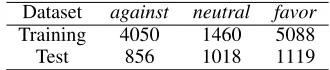
Dataset against neutral favor Training 4050 1460 5088
Test 856 1018 1119
Table 1: Statistics of annotated answer stance dataset in community question-answer.
Baidu Knows2, Sogou Wenwen3 and Mingyi4. We parse
these websites with pre-defined templates to get structured question-answer pairs. Duplicate instances are removed be-fore labeling. We ask three annotators to annotate the extracted question-answer pairs with most salient stance, choose the labels through majority vote and abandon pairs with ambiguous stances. The inter annotator agreement is 78.2%. While question-answer pairs without stances are mostly filtered with some rules based on URL and text, the remaining of them are removed during annotation pro-cess. Finally, we get a dataset of 13,591hquestion, answeri
pairs which are mainly relating to daily topics like preg-nancy, food safety, diseases, etc. The detailed statistics of the dataset is shown in Table 1.
Implementation details
All models are implemented using PyTorch5. A
100-dimensional word embeddings trained on a 10-billion-words Chinese encyclopedia corpus withword2vec(Mikolov et al. 2013) is used as the input of all models and is then fine-tuned during training. The weights of networks are initial-ized with a uniform distribution µ(−0.1,0.1). We apply Adam (Kingma and Ba 2014) to optimize the models and initial learning rate is set to 1e-4. We split one-tenth of the training set for tuning parameters and apply early-stopping according to performance on validation set during training. Mini-batch size is set to 8 for all models and dropout of 0.5 is adopted for preventing over-fitting. The maximum sequence lengths of question and answer are set to 25 and 45 respec-tively according to the statistics of training set. We segment all the Chinese sentences with LTP (Che, Li, and Liu 2010).
Evaluation Metrics
Following previous evaluations (Mohammad et al. 2016; Xu et al. 2016) which treat neutralas a class not of interest, we also adopt bothmacro-andmicro- average F1score of favorandagainstclasses. However, different from SemEval 2016, we only apply commonmacro- andmicro-F1score here instead of an arithmetic mean ofFf avor andFagainst.
We present the accuracyof all labels for comparison with different baselines as well.
Comparative Methods
We compare with the following baseline methods:
2
https://zhidao.baidu.com/ 3http://wenwen.sogou.com/ 4
http://ask.mingyi.com/ 5
Model Acc Fagainst Ff avor Fmacro Fmicro
BOW 0.5132 0.5779 0.6519 0.6157 0.6181 CNN 0.5359 0.6373 0.6422 0.6408 0.6402 LSTM 0.5316 0.6148 0.6541 0.6346 0.6367 BLSTM 0.5747 0.6336 0.6854 0.6599 0.6623 TAN 0.5780 0.6410 0.6917 0.6667 0.6692 RAM 0.5874 0.6742 0.6885 0.6815 0.6824 BiCond 0.5887 0.6623 0.6885 0.6754 0.6771 AoA 0.5864 0.6586 0.6963 0.6775 0.6796
RCA 0.6204 0.7066 0.7016 0.7043 0.7037
Table 2: Performance comparison of different stance detection models on test set.
• BOW: The Bag-of-Words model (BOW) sums all the word vectors in a sentence equally.
• (B)LSTM: We use two separate (B)LSTMs for question and answer respectively.
• CNN: Similarly, we use two separate CNNs for question and answer respectively.
• TAN: Du et al.(2017) applied Target-specific Attention model (TAN) to target-dependent stance classification in tweets and micro-blogs.
• BiCond: Augenstein et al. (2016) proposed Bi-directional Conditional Encoding model to solve stance detection problem in tweets.
• AoA: Cui et al. (2017) developed an attention-over-attention model to dynamically choose the appropriate part of text from answer document dependent on query with inter sentence attentions.
• RAM: Chenet al.(2017) adopts a memory network based structure which recurrently attends the text with BOW vectors of targets.
For BOW, LSTM, BLSTM and CNN models, we con-catenate question and answer vectors as stance features. For TAN, BiCond and RAM methods, we re-implement them by following settings in original papers and choose the best hyper-parameters on development set. Besides, we let the RCA model read the QA pair for three times (i.e.3 reading steps).
Since we try to detect stance from QA pairs with neural models rather than hand-craft features, we leave the compar-ison with feature-based SVM models in SemEval2015 Task 3 (Nakov et al. 2015). Instead, we take CNN and AoA mod-els as representatives from QA community. Also, we com-pare with TAN and BiCond from previous stance detection tasks. Furthermore, RAM is adopted for comparison with Memory Network based model that has multiple attention layers.
Results and Discussion
Main Results
Experimental results are given in Table 2.
Comparison of baselines.As in many cases, the stance labels can be directly and correctly predicted from short an-swer sentence, even simple BOW models can easily reach
Figure 3: Visualization of attention weights from four mod-els. Note that only RCA and AoA generate attention weights on questions and we only present attention weights at last reading step from RAM and RCA models. Deeper color im-plies larger probability.
macro- and micro-F1 scores over 0.6. Since solving An-swerStance problems require understanding of answers with regard to questions, TAN, RAM, BiCond and AoA models with either attention or conditional encoding structures out-performs BOW, CNN and LSTM that simply concatenate question and answer vectors, by a large margin in terms of both F1 scores.
Comparison with attention-based models.AoA model outperforms TAN by over 1% in bothmacroandmicro-F1 scores for that AoA also utilizes the answer text for better question representation, which in return contributes to more accurate answer representations. Since answers usually ex-press implicit stances with indirect exex-pressions to the ques-tions, semantic relationships between them are more com-plex to model. As a result, RAM which employs a recurrent attention module to reason over the QA pairs multiple times, achieves top performances among all the baseline models. We can observe that our model consistently outperforms all the baseline models in terms of both macroandmicro- F1 scores which reveals that combining both the conditional at-tention and polishing process works better at deliberating the real stance.
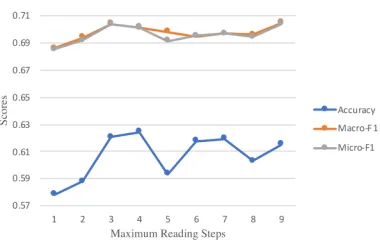
im-Figure 4: Performances of RCA models with different max-imum reading steps. Evaluation metrics includeaccuracyof three class,microandmacro F1score offavorandagainst class.
Model Fmacro Fmicro
Full RCA model 0.7043 0.7037
−Question GRU 0.6772 0.6765
−Question Attention 0.6847 0.6845
−Answer Attention 0.6693 0.6703
−Conditional Attention 0.6815 0.6795
−All Attention 0.6555 0.6588
Table 3: An ablation test of RCA model on the test set. Macro and micro average F1 scores are presented.
portance weights of question words. As shown in Figure 3, for the question, AoA assigns the largest weight to the word “has” while RCA emphasizes on “benefits”. For the answer, RCA assigns the largest weight to key word “promote” and only RCA correctly predicts the right stancefavor.
Influence of Maximum Reading Steps
Figure 4 describes the performance of RCA with respect to maximum reading steps. Among the displayed models, we can find that reading the question-answer pairs for multiple times is always better than only once. By conducting multi-ple conditional attention steps, RCA is able to supmulti-plement the missing clues for final stance prediction. When read-ing the context for 9 times, the RCA achieves best perfor-mance both onmacro-andmicro- F1scores. Similar to pre-vious models based on Memory Networks with “multi-hop attention” (Sukhbaatar et al. 2015; Tang, Qin, and Liu 2016; Chen et al. 2017), adding the number of reading steps doesn’t monotonically contribute to the performance but in-crease running time as well as the risk of over-fitting.
Ablation Test of RCA
To further explore how well each part contributes to predict-ing stance, we conduct an ablation test of the RCA model on test set. From Table 3, we can tell that modeling ques-tion words with GRU instead of word embeddings in RCA contributes about 2.71%macro F1score and 2.72%micro F1score, showing the necessity of better semantic composi-tion of quescomposi-tions. Since AnswerStance is a target-dependent
stance classification problem, attending answer with ques-tion informaques-tion is more important than attending quesques-tion with answer information.
Discussion of Conditional Attention
While previous memory networks (Sukhbaatar et al. 2015; Tang, Qin, and Liu 2016; Chen et al. 2017) usually first en-code a target or question into a fixed-sized vector and keep it unchanged during multiple attention hops. In RCA, the re-current reading steps is deeply coupled with conditional at-tention structure, where the question representations are pol-ished regarding to the previous stance states which contain mutual relationships among question, answer and stance. This makes two consequent reading steps more similar to the idea ofattention-over-attention.
However, different from AoA model (Cui et al. 2017), the conditional attention structure in RCA utilizes a stance vec-tor as the proxy to attend the question and answer, where answer words are first conditioned on the stance states with most recently updated target representation and then the question words are conditioned on next stance state with latest added answer information. Thereby, the stance vec-tor can serve as a good semantic summary of the question-answer pair, which is proven to be more suitable than other mingling methods for the answer stance detection task. Be-sides, through recurrent iterations, RCA obtains the ability of deliberating stance orientation by gradually abstracting in-depth semantic representations of question-answer pairs, which significantly contributes to making more accurate pre-dictions of stance labels.
Case Study
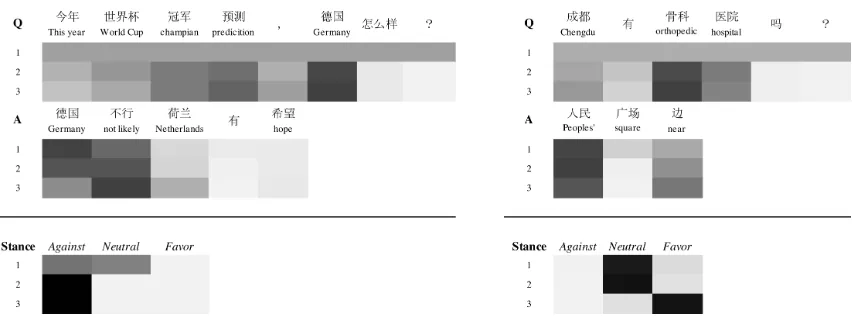
We visualize the prediction process of RCA with 3 read-ing steps in Figure 5. For the left example, we can see that RCA gradually captures important words like “German” from question and “not likely” from answer. For the right ex-ample, RCA places higher importance to “near” which im-plies the existence of the hospital step by step. These two examples demonstrates the effectiveness of our model.
Related Work
In this section, we briefly review related work on stance de-tection task and target dependent models.
Stance Detection
Figure 5: Visualization of stance state at each reading step through a softmax classifier and attention weights of each question and answer word for the examples. Deeper color implies larger probability. A RCA model with 3 reading steps is used for illustration.
Similarly, we also tackle stance detection in community QA as a generalized target dependent stance detection task, in which the question can be seen as the target and answer as the context.
Target-Dependent Models
Various deep learning approaches have been proposed to solve the target dependent sentiment classification and stance detection problem. Tang et al.(2016) used target-dependent LSTM (TD-LSTM) to model the preceding and following contexts surrounding the target so as to learn tar-get dependent representations of review sentences. Wanget al.(2016) and Duet al.(2017) incorporate attention mech-anism into LSTM to acquire target dependent review rep-resentation in sentiment analysis and tweet reprep-resentations in stance detection respectively. Our model is partly moti-vated by (Tang, Qin, and Liu 2016; Chen et al. 2017) which employ memory networks with multi-hop attention to learn target relevant sentence presentation for sentiment analysis. Though achieving excellent performance on previous target dependent tasks, most of these memory networks only en-code the targets once without modifying these representa-tions with information from review or answer text. Hence, they are not capable of capturing the complex interaction between the target question and answer sentence in Answer-Stance.
Conclusion
In this paper, we develop the RCA model for answer stance detection in community QA. The RCA model can effec-tively represent questions and answers with mutual condi-tional attention and can polish the stance states through re-current reading. Experiments on a stance-annotated Chinese Community QA dataset demonstrate that RCA model out-performs other competitive baseline methods.
For future work, we would like to investigate automatic control of maximum reading steps based on the complexity of given QA pairs with reinforcement learning techniques.
Acknowledgments
We would like to thank all the anonymous reviewers for their insightful comments. Meanwhile, we thank Dr. Xi-aocheng Feng, Prof. Wanxiang Che and Dr. Weinan Zhang for their help on revising the manuscript. The paper is sup-ported by National Natural Science Foundation of China (No. 61632011, No. 61772153 and No. 71490722). The pa-per is also supported by Sogou Technology Inc.
References
Augenstein, I.; Rockt¨aschel, T.; Vlachos, A.; and Bontcheva, K. 2016. Stance detection with bidirectional conditional en-coding. InProceedings of the 2016 Conference on Empirical Methods in Natural Language Processing, 876–885. Bahdanau, D.; Cho, K.; and Bengio, Y. 2014. Neural Ma-chine Translation by Jointly Learning to Align and Trans-late. ArXiv e-prints.
Bhatt, G.; Sharma, A.; Sharma, S.; Nagpal, A.; Raman, B.; and Mittal, A. 2018. Combining neural, statistical and exter-nal features for fake news stance identification. In Compan-ion Proceedings of the The Web Conference 2018, WWW ’18, 1353–1357. Republic and Canton of Geneva, Switzer-land: International World Wide Web Conferences Steering Committee.
Che, W.; Li, Z.; and Liu, T. 2010. Ltp: A chinese language technology platform. InColing 2010: Demonstrations, 13– 16.
Chen, P.; Sun, Z.; Bing, L.; and Yang, W. 2017. Recurrent attention network on memory for aspect sentiment analysis. InProceedings of the 2017 Conference on Empirical Meth-ods in Natural Language Processing, 452–461.
Cui, Y.; Chen, Z.; Wei, S.; Wang, S.; Liu, T.; and Hu, G. 2017. Attention-over-attention neural networks for reading comprehension. InProceedings of the 55th Annual Meeting of the Association for Computational Linguistics (Volume 1: Long Papers), 593–602. Vancouver, Canada: Association for Computational Linguistics.
Derczynski, L.; Bontcheva, K.; Liakata, M.; Procter, R.; Wong Sak Hoi, G.; and Zubiaga, A. 2017. Semeval-2017 task 8: Rumoureval: Determining rumour veracity and sup-port for rumours. InProceedings of the 11th International Workshop on Semantic Evaluation (SemEval-2017), 69–76. Vancouver, Canada: Association for Computational Linguis-tics.
Du, J.; Xu, R.; He, Y.; and Gui, L. 2017. Stance classifica-tion with target-specific neural attenclassifica-tion. InProceedings of the Twenty-Sixth International Joint Conference on Artificial Intelligence, 3988–3994.
Elman, J. L. 1990. Finding structure in time. Cognitive Science14(2):179–211.
Ferreira, W., and Vlachos, A. 2016. Emergent: a novel data-set for stance classification. InProceedings of the 2016 Con-ference of the North American Chapter of the Association for Computational Linguistics: Human Language Technolo-gies, 1163–1168.
Hasan, K. S., and Ng, V. 2013. Stance classification of ideological debates: Data, models, features, and constraints. InProceedings of the Sixth International Joint Conference on Natural Language Processing, 1348–1356.
Kingma, D. P., and Ba, J. 2014. Adam: A method for stochastic optimization.CoRRabs/1412.6980.
Mikolov, T.; Sutskever, I.; Chen, K.; Corrado, G. S.; and Dean, J. 2013. Distributed representations of words and phrases and their compositionality. InAdvances in neural information processing systems, 3111–3119.
Mohammad, S.; Kiritchenko, S.; Sobhani, P.; Zhu, X.; and Cherry, C. 2016. Semeval-2016 task 6: Detecting stance in tweets. InProceedings of the 10th International Workshop on Semantic Evaluation, 31–41.
Nakov, P.; M`arquez, L.; Magdy, W.; Moschitti, A.; Glass, J.; and Randeree, B. 2015. Semeval-2015 task 3: Answer selection in community question answering. InProceedings of the 9th International Workshop on Semantic Evaluation (SemEval 2015), 269–281. Denver, Colorado: Association for Computational Linguistics.
Qazvinian, V.; Rosengren, E.; Radev, D. R.; and Mei, Q. 2011. Rumor has it: Identifying misinformation in mi-croblogs. InProceedings of the 2011 Conference on Empir-ical Methods in Natural Language Processing, 1589–1599. Sobhani, P.; Mohammad, S.; and Kiritchenko, S. 2016. De-tecting stance in tweets and analyzing its interaction with sentiment. InProceedings of the Fifth Joint Conference on Lexical and Computational Semantics, 159–169.
Sridhar, D.; Foulds, J.; Huang, B.; Getoor, L.; and Walker, M. 2015. Joint models of disagreement and stance in online debate. InProceedings of the 53rd Annual Meeting of the Association for Computational Linguistics and the 7th
Inter-national Joint Conference on Natural Language Processing, 116–125.
Sukhbaatar, S.; szlam, a.; Weston, J.; and Fergus, R. 2015. End-to-end memory networks. In Cortes, C.; Lawrence, N. D.; Lee, D. D.; Sugiyama, M.; and Garnett, R., eds., Ad-vances in Neural Information Processing Systems 28. Cur-ran Associates, Inc. 2440–2448.
Tang, D.; Qin, B.; Feng, X.; and Liu, T. 2016. Effective lstms for target-dependent sentiment classification. In Pro-ceedings of COLING 2016, 3298–3307.
Tang, D.; Qin, B.; and Liu, T. 2016. Aspect level sentiment classification with deep memory network. InProceedings of the 2016 Conference on Empirical Methods in Natural Language Processing, 214–224.
Vijayaraghavan, P.; Sysoev, I.; Vosoughi, S.; and Roy, D. 2016. Deepstance at semeval-2016 task 6: Detecting stance in tweets using character and word-level cnns. In Proceed-ings of the 10th International Workshop on Semantic Eval-uation (SemEval-2016), 413–419. San Diego, California: Association for Computational Linguistics.
Wang, Y.; Huang, M.; zhu, x.; and Zhao, L. 2016. Attention-based lstm for aspect-level sentiment classification. In Pro-ceedings of the 2016 Conference on Empirical Methods in Natural Language Processing, 606–615.
Wei, W.; Zhang, X.; Liu, X.; Chen, W.; and Wang, T. 2016. pkudblab at semeval-2016 task 6 : A specific convolutional neural network system for effective stance detection. In Pro-ceedings of the 10th International Workshop on Semantic Evaluation, 384–388.