WSN Data Transmission Algorithm Based on Spatial
Data Aggregation
https://doi.org/10.3991/ijoe.v13i12.7884
Liang Hu, Huayi Yin!!", Chaoqun Hong
Xiamen University of Technology, Xiamen, Fujian, China
Abstract—In this paper, considering the high energy consumption, loss of network lifetime and data leak in transmission during the data aggregation of the wireless sensor network, we propose an improved spatial data aggregation algorithm. Through comparison with traditional data aggregation algorithms, we verify the feasibility and rationality of the proposed algorithm and obtain the following conclusions: the proposed algorithm carries out node sensing and data aggregation within a certain area based on multiple dynamic routes. The calculation process does not require encryption and decryption, and is not af-fected by network topology, so it can better address the data aggregation prob-lems in the dynamic change of network structure. Compared with other tradi-tional data aggregation algorithms, the proposed algorithm has the advantages of low traffic, low energy consumption in data transmission, low probability of data leakage and high transmission accuracy. In data aggregation, 3 slices is the optimal quantity.
Keywords—wireless sensor network, data aggregation, data security, slice, node
1
Introduction
Wireless sensor network (WSN) is a new communication mode that has been in-creasingly popular in recent years. Its biggest feature is the use of wireless communi-cation to carry out data transmission through a large number of sensing nodes, which greatly reduces the consumption of cable communication fiber. So far, it has been applied in transportation, environmental monitoring, national defense, electronic communications and other fields (Culler, 2004; Tan, et al, 2008; Parmar and Jinwala, 2016; Akyildiz, Sankarasubramaniam and Cayirci, 2002).
started relevant studies (Nasser and Chen, 2007; Ming and Vincent, 2007; Yahya and Benothman, 2009).
Traditional data privacy protection and data aggregation algorithms are mainly based on network topology (tree and cluster types). The sensor nodes of the above algorithm are subject to serious losses and susceptible to environmental impacts dur-ing service. The new research worked on data aggregation based on route algorithm (Wei and Yang, 2013; Lee, Kim and Chang, 2014), but few took data security into account (Conti et al, 2009). During the calculation process, frequent encryption and decryption operations increase the overall operation time (Zhou, Yang and He, 2014; Yang et al, 2008). In addition, in some special circumstances, hackers can use forged data, identity or Trojan attacks to shorten the lifetime of the wireless sensor data transmission system, increase energy consumption and even paralyze the entire net-work (Chan, 2007; Kumar and Dutta, 2015; Shakshuki Malik and Denko, 2008; Tang et al, 2011; Ozdemir and Xiao, 2011).
In this paper, considering the high energy consumption, loss of network lifetime and data leak in transmission during the data aggregation of the wireless sensor net-work, we propose an improved spatial data aggregation algorithm. Through compari-son with the traditional data aggregation algorithms, we verify the feasibility and rationality of the proposed algorithm.
2
WSN spatial data aggregation algorithm
2.1 Relevant work and preliminaries
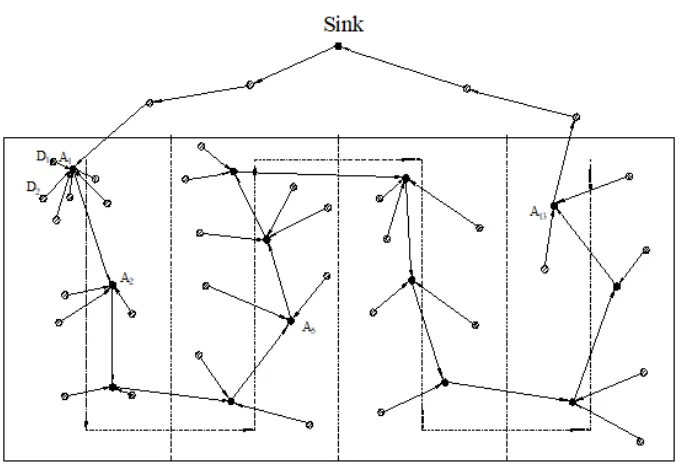
The core purpose of data aggregation of the wireless sensor network is to simplify data, eliminate duplicated data, reduce redundant data and traffic to ultimately achieve energy saving and prolong network operation time. The traditional spatial data aggregation algorithms mainly adopt the tree-type network and node cluster topology structures, both of which are root nodes of Sink. They aggregate data through nodes and then transmit the encrypted or disturbed aggregation structures back to Sink. Their shortcoming is high energy consumption. In this paper, we make improvements based on the traditional data aggregation algorithms. Data aggregation mainly carries out node sensing within a certain area based on multiple dynamic routes. The algorithm process is shown in Figure 1.
The curved path in the figure represents the ideal route for spatial data aggregation. and the width of the two dotted lines is the width of the data aggregation route. The node sensing algorithm based on multiple dynamic routes has the following steps: first, it sends the system data aggregation request to the regional initial node (A1)
through Sink, and then aggregates the sensed data ((D1 and D2) in the node according
to the route aggregation method, transmits them along the ideal route, determines the next aggregation node (A2) on the path and sends another aggregation request from
the system to A2 to aggregate the sensed data around A2. The subsequent data
aggrega-tion is carried out in the same way until all data in the area are aggregated. At last, it sends the aggregation results back to Sink and completes a single aggregation task in the area. According to existing studies, when the spacing between two routes is less than about 0.9 times the radio range, all the node sensed data in the area can be ag-gregated.
In the process of data transmission, the attack patterns that the wireless sensor net-work may encounter mainly include eavesdropping attacks and capturing of sensor nodes. Therefore, the main objectives of data privacy protection are to ensure the privacy of sensed data, reduce the transmission energy consumption and improve data aggregation accuracy. A good data aggregation algorithm can reduce the number of eavesdropping and collusion attacks against data, minimize the extra overheads and has great scalability.
The security of adjacent nodes in the transmission channel is guaranteed by the en-cryption algorithm. In this paper, we use the random secret key allocation algorithm. Supposing the probability of the two nodes having the same secret key is Pcom, and that the probability that the third transmission node still has the same secret key is Povhe, the calculation method is as follows:
2.2 Aggregation algorithm design and performance analysis
On the basis of the previous research, in this paper, we propose an improved spa-tial data aggregation algorithm (ISDAA). This algorithm is divided into five stages: initialization, route design, aggregation request, data aggregation and aggregation completion. Initialization means selecting k secret keys from the key collection to establish node channels; and route design involves setting the communication radius, communication routes and route width.
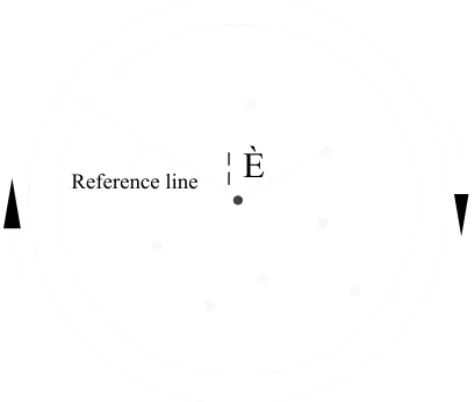
The data aggregation phase is the core part of the algorithm. The initial aggrega-tion node receives the aggregaaggrega-tion command, and through the transmission of aggre-gation nodes in the area, the last aggreaggre-gation node in the area will also receive the aggregation command. Through the data slicing command, the sensed data are pro-tected. Reorganization operation is carried out in the latter stage of data transmission. The distance between nodes is not fixed. If the node spacing is large, the link quality will be poor, but if the node spacing is small, the communication channels will con-flict with each other. Therefore, the traffic should be reduced and the transmission process should be simplified. The detailed scheme is shown in Figure 2. The simpli-fied algorithm is based on the ring virtual token. While receiving the aggregation task, the initial aggregation node also receives the reference line information. Through calculation, the algorithm obtains the transmission slicing information. Based on the angle between the aggregation node and the sensed data, it carries out the slicing operation and transmits the slices to the next node, and then reorganizes the data in the transmission process, which means it has to carry out two rounds of transmission.
Suppose the sensed data in the transmission process is divided into J slices, that the smaller the value of J is, the smaller the energy consumption and traffic will be, and that the value of J should meet the constraint conditions as shown in Formula (2):
(2) Ji and Jir are the number of the calculated sensed node and other sensed node data slices, and Jsec is the relevant parameter.
All the slices are reorganized and transmitted to the target aggregation node. The whole process can be expressed in Formula (3):
Re
c
!
A
i:
v
id=
v
in+
d
iAgg
!
v
Aagg=
(
v
id"
d
i)
+
v
Ai=1 n
#
Tra
!
v
Ad=
v
Aagg+
d
AiAi+1
$
%
&&
'
&
&
(3)
where, Rec stands for receiving; Agg means aggregation; Tra means transmission; v represents slice.
We further analyze the security performance of the proposed algorithm. In the ag-gregation and slicing of the sensed data in the area, the probability of slice data leak-age PiD and the probability of aggregation node data leakage PiA are respectively:
(4)
where, Pr is the probability of obtaining an arbitrary slice.
The traffic of data aggregation in the area can be calculated with Formula (5):
(
)
1
0.5
N1
SLNs i i
T
=
"
=e
+
!
n
(5)
e is the length of the encrypted data; and niSLN is the number of nodes. There should be at least one communication channel between adjacent nodes. Through complex calculation, the total traffic in the area can be converted as follows:
(6)
communica-tion security, data aggregacommunica-tion is carried out for z times in each cycle. Then data ag-gregation traffic each time is
(7)
The energy consumption by data aggregation of wireless sensors is mainly concen-trated in the communication and computation stages. The energy consumption of the sensing nodes ED and that of the aggregating nodes EA are respectively:
(
)
(
)
1
1
mm
mm D
r
D i T i A R
i A
D r
A A T i A R
i
E
J d e
J d B
e
E
B e
n
J
d e
=
!
"
#
=
$ $
+
$
+
$
%
&
'
%
(
%
=
"
$
+
+ +
$ $
#
&
'
%)
*
*
(8)
3
Simulation test and verification analysis
In order to verify the rationality and advantages of the WSN data aggregation algo-rithm proposed in this paper, we compare the proposed algoalgo-rithm with the secure encrypted data aggregation (SEDA), itinerary based window query execution (IWQE) and pattern-code-based security data aggregation algorithm (ESPDA) in terms of communication quality, communication energy consumption, communication accura-cy and privaaccura-cy protection. The test environment for all these 4 algorithms is as fol-lows: Core-i5; 16G memory; Win7 operating system; software environment Matlab; and experimental data set Inter Data. In order to improve the calculation accuracy, each calculation result is the average value after 30 rounds of calculation and the wireless sensor network topology generated in each round is random.
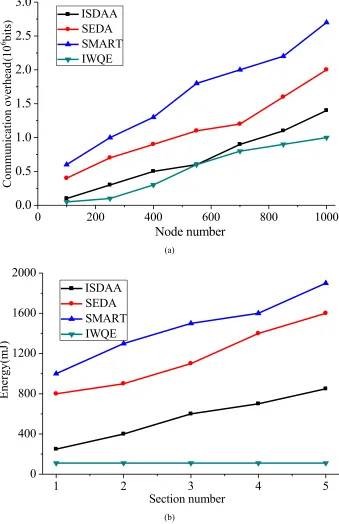
Figure 3 shows the traffic changes in four kinds of algorithms along with the num-ber of nodes (Figure 4a) and numnum-ber of slices (Figure 4b). From the figure, we can see that the traffic of SMART algorithm is much greater than those of the other three algorithms, because in the calculation process, the SMART algorithm must slice all sensed data before carrying out the transmission and encryption; the traffic of the IWQE algorithm is the smallest, but the algorithm does not consider the privacy of data transmission, which can easily lead to data leakage. The algorithm proposed in this paper has small traffic under different number of nodes and slices, and with the increase of N and J, the traffic of this algorithm decreases much faster than those of the other ones, proving the superiority of the algorithm.
0
200
400
600
800
1000
0.0
0.5
1.0
1.5
2.0
2.5
3.0
C
om
m
un
ic
atio
n ov
er
he
ad
(
10
6
bi
ts
)
Node number
!
ISDAA
SEDA
SMART
IWQE
(a)
1
2
3
4
5
0
400
800
1200
1600
2000
!
ISDAA
SEDA
SMART
IWQE
Ene
rgy
(m
J)
Section number
(b)
100 200 300 400 500 600 700 800 900 1000
0
400
800
1200
1600
2000
2400
2800
3200
!ISDAA
SEDA
SMART
IWQE
Ene
rgy
(m
J)
Node number
(a)
1
2
3
4
5
0
400
800
1200
1600
2000
!ISDAA
SEDA
SMART
IWQE
Ene
rgy
(m
J)
Section number
(b)
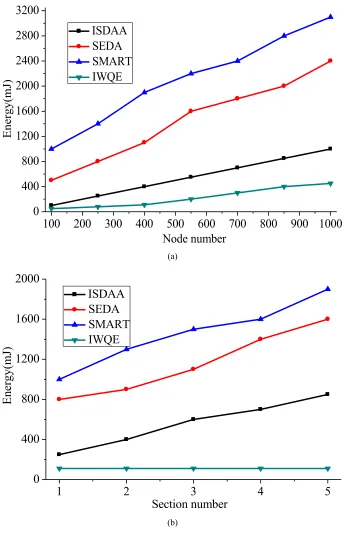
the SMART algorithm and the SEDA algorithm. When the number of nodes reaches 1000, the energy consumption of this algorithm is 32.2% and 41.67% of the SMART algorithm and the SEDA algorithm, respectively; and with the increase of slices, this algorithm saves more energy than the SMART algorithm and the SEDA algorithm, and the energy consumption of the IWQE algorithm is not affected by the number of slices.
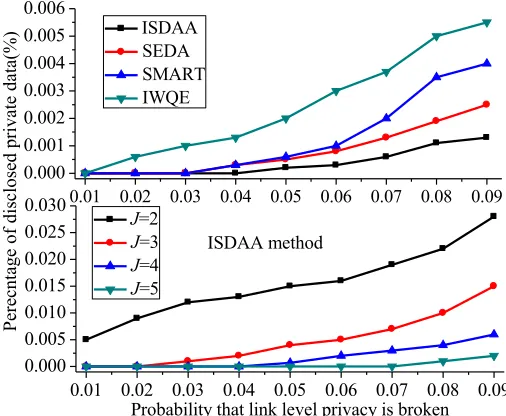
Figure 5(a) shows the probabilities of the 4 aggregation algorithms having sensed data leakages in a certain area. It can be seen from the figure that when the probability of link level damage is small (<0.04), the SMART algorithm, the SEDA algorithm and the proposed algorithm all have small probabilities of data leakage, indicating that the three algorithms all have high security; when the probability of link level damage is >0.04, the data leakage probabilities of the SMART algorithm and the SEDA algorithm are significantly increased. The data leakage probability of the IWQE algorithm is maintained at a high level. This is because the IWQE algorithm does not consider the degree of access of the nodes, leading to varying privacy of different nodes. As a result, the average privacy of the sensed data is low. From Fig-ure 5(a), we can see that the degree of access and the number of slices are important parameters to measure the security of the algorithm.
Figure 5(b) shows the sensed data leakage probabilities of the improved algorithm proposed in this paper under different numbers of slices. As can be seen from the figure, when the number of slices is small, the security of the sensed data is poor, and with the increase of node slices, the probability of data leakage is significantly re-duced. When the number of slices reaches 4, the security of the data aggregation pro-cess can be guaranteed.
In the data aggregation process, when there is no data, energy or communication loss, the data aggregation accuracy can reach 100%. But in actual calculation, due to network interferences and data processing delays, data can be easily lost in the trans-mission process. The data aggregation accuracy is defined as follows:
P
c=
AR
d
ii=1
N
!
(9)
Figure 6(b) shows the accuracy of the proposed algorithm under different numbers of slices. As can be seen from the figure, the smaller the number of slices is, the high-er the accuracy of the algorithm. This is because when thhigh-ere are many slices, the sys-tem needs to transmit more data packets, and accordingly there is a greater probability of data leakage and collision in the transmission process. From Figure 5 and 6, it can be seen that 3 slices is a proper quantity for the data aggregation of this algorithm.
0.01 0.02 0.03 0.04 0.05 0.06 0.07 0.08 0.09 0.000 0.001 0.002 0.003 0.004 0.005 0.006
0.01 0.02 0.03 0.04 0.05 0.06 0.07 0.08 0.09 0.000 0.005 0.010 0.015 0.020 0.025 0.030 !ISDAA SEDA SMART IWQE Per ecntage of disclos ed pr ivate da ta(% ) ISDAA method
!J=2
J=3
J=4
J=5
Probability that link level privacy is broken
Fig. 5. The change of privacy comparisons with different algorithms and sections
0 10 20 30 40 50
0.0 0.2 0.4 0.6 0.8 1.0
0 10 20 30 40 50
0.4 0.5 0.6 0.7 0.8 !ISDAA SEDA SMART IWQE Accu racy ISDAA method
!J=2
J=3
J=4
J=5
Epoch duration(s)
4
Conclusions
In this paper, considering the high energy consumption, loss of network lifetime and data leak in transmission during the data aggregation of the wireless sensor net-work, we propose an improved spatial data aggregation algorithm. Through compari-son with traditional data aggregation algorithms, we verify the feasibility and rational-ity of the proposed algorithm and obtain the following conclusions:
1.The proposed algorithm carries out node sensing and data aggregation within a cer-tain area based on multiple dynamic routes. The calculation process does not re-quire encryption and decryption, and is not affected by network topology, so it can better address the data aggregation problems in the dynamic change of network structure.
2.Compared with other traditional data aggregation algorithms, the proposed algo-rithm has the advantages of low traffic, low energy consumption in data transmis-sion, low probability of data leakage and high transmission accuracy. In data ag-gregation, 3 slices is the optimal quantity.
5
Acknowledgements
Supported by Natural Science Foundation of P. R. China (No.61503316, No.61562 033), Fujian Province Science and Technology Plan of External Cooperation Project (No.2016I0015), Foundation of Fujian Educational Committee(No. JAT160358), The Fujian Provincial High School Natural Science Foundation of China(No. JZ160472), Xiamen Science and Technology Plan of University Innovation Project (No.3502Z 20153020).
6
References
[1]Culler, D. (2004). Overview of sensor networks. COMPUTER -LOS ALAMITOS, 37(8), 41-49. https://doi.org/10.5772/49376
[2]Yan, T., Gu, Y., He, T., & Stankovic, J. A. (2008). Design and optimization of distributed sensing coverage in wireless sensor networks. Acm Transactions on Embedded Computing Systems,7(3), 33. https://doi.org/10.1145/1347375.1347386
[3]Parmar, K., & Jinwala, D. C. (2016). Concealed data aggregation in wireless sensor net-works: A comprehensive survey. Computer Networks,103(C), 207-227.
https://doi.org/10.1016/j.comnet.2016.04.013
[4]Akyildiz, I. F., Su, W., Sankarasubramaniam, Y., & Cayirci, E. (2002). Wireless sensor networks: a survey. Computer Networks the International Journal of Computer & Tele-communications Networking, 38(4), 393-422. https://doi.org/10.1016/S1389-1286(01)00302-4
[5]Nasser, N., & Chen, Y. (2007). Seem: secure and energy-efficient multipath routing proto-col for wireless sensor networks. Computer Communications, 30(11–12), 2401-2412.
[6]Ming Lu, Y., & Vincent, W. S. W. (2007). An energy-efficient multipath routing protocol for wireless sensor networks: research articles. International Journal of Communication Systems, 20(7), 747-766. https://doi.org/10.1109/VTCF.2006.505
[7]Yahya, B., & Benothman, J. (2009). Reer: robust and energy efficient multipath routing protocol for wireless sensor networks. 1-7. https://doi.org/10.1109/GLOCOM.2009.54255 87
[8]Wei, L. I., & Yang, G. (2013). Energy-saving data aggregation algorithm for protecting privacy and integrity. Journal of Computer Applications, 33(9), 2505-2510.
https://doi.org/10.3724/SP.J.1087.2013.02505
[9]Lee, H., Kim, T. H., & Chang, J. W. (2014). An efficient data aggregation scheme for pro-tecting the integrity of sensitive data in wireless sensor networks., 280, 207-214.
https://doi.org/10.1007/978-3-642-41671-2_27
[10]Conti, M., Zhang, L., Roy, S., Pietro, R. D., Jajodia, S., & Mancini, L. V. (2009). Privacy-preserving robust data aggregation in wireless sensor networks. Security & Communica-tion Networks, 2(2), 195–213. https://doi.org/10.1002/sec.95
[11]Zhou, Q., Yang, G., & He, L. (2014). A secure-enhanced data aggregation based on ecc in wireless sensor networks. Sensors, 14(4), 6701-6721. https://doi.org/10.3390/s140406701
[12]Madden, S., Franklin, M. J., Hellerstein, J. M., & Hong, W. (2002). Tag: a tiny aggrega-tion service for ad-hoc sensor networks. Acm Sigops Operating Systems Review, 36(SI), 131-146. https://doi.org/10.1145/844128.844142
[13]Yang, Y., Wang, X., Zhu, S., & Cao, G. (2008). Sdap:a secure hop-by-hop data aggrega-tion protocol for sensor networks. Acm Transacaggrega-tions on Informaaggrega-tion & System Security, 11(4), 1-43. https://doi.org/10.1145/1380564.1380568
[14]Chan, H., Perrig, A., Przydatek, B., & Song, D. (2007). Sia: secure information aggrega-tion in sensor networks. Journal of Computer Security, 15(1), 69-102.
https://doi.org/10.3233/JCS-2007-15104
[15]Kumar, M., & Dutta, K. (2015). A survey of security concerns in various data aggregation techniques in wireless sensor networks. 41(3), 191-201. https://doi.org/10.1007/978-81-322-2009-1_1
[16]Shakshuki, E., Malik, H., & Denko, M. K. (2008). Software agent-based directed diffusion in wireless sensor network. Telecommunication Systems, 38(3-4), 161-174.
https://doi.org/10.1007/s11235-008-9102-4
[17]Tang, J., Dai, S., Li, J., & Li, S. (2011). Gossip-based scalable directed diffusion for wire-less sensor networks. International Journal of Communication Systems, 24(11), 1418–
1430. https://doi.org/10.1002/dac.1224
[18]Ozdemir, S., & Xiao, Y. (2011). Integrity protecting hierarchical concealed data aggrega-tion for wireless sensor networks. Computer Networks, 55(8), 1735-1746.
https://doi.org/10.1016/j.comnet.2011.01.006
7
Author
Liang Hu, Huayi Yin, and Chaoqun Hong are with the School of Computer and Information Engineering, Xiamen University of Technology, Xiamen, Fujian 361024, China ([email protected]).