Experimental Analysis of Workability and
Characteristic Strength of M40 and M60 Grade
of Concrete by Partial Replacement of Cement
with Nano TiO
2
P. Bhargavi Bh Revathi
PG Student Assistant Professor
Department of Civil Engineering Department of Civil Engineering
DNR College of Engineering & Technology, Bhimavaram, Andhrapradesh, India
DNR College of Engineering & Technology, Bhimavaram, Andhrapradesh, India
M. L Kumar Assistant Professor Department of Civil Engineering
DNR College of Engineering & Technology, Bhimavaram, Andhrapradesh, India
Abstract
Concrete is one of the necessary elements for structural work in the modern construction and it contains several intervals such as flaws, voids, fissures, bleeding channels, etc. It is difficult to explain how exactly these various intervals give a reduction in actual strength of concrete. Therefore there is need to implement modern techniques by which reduction in concrete strength can be prevented at the micro and nano levels. In this present work, it is to study the exhibition of M40 and M60 grade concretes with the use of nano materials has been replacing the cement with nanotitanium dioxide (TiO2). The workability of M40 and M60 grade concrete with and without replacing Nano TiO2 has been studied by conducting slump cone and compaction factor tests. At last, the characteristic strength of both grades of concrete have been studied by performing accomplish compression test and split tensile test. The application of nano technology is by including nano materials in concrete have given a new extent to improve the mechanical properties of concrete. Based on the results, it was observed that the Nano TiO2 particles have been very effective for the replacement of cement at 1.0% and the compressive strength was increased around 8%. This is used at the places where high strength parameter, durability and low permeability are required.
Keywords: Nano TiO2 Workability
_______________________________________________________________________________________________________
I. INTRODUCTION
Need of the Project
To prevent the strength reduction of concrete, due to various flaws and capillary cavities.
To reduce the maintenance efforts in cleaning concrete surfaces with the advantage of self-cleaning property of the Nano material.
To reduce cement consumption by using partially eco-friendly binding material.
Objective of Work
To use Nano materials in making cement concrete.
To study the effect of partial replacement of cement with NanoTio2 on fresh and hardened properties of M40 and M60 grade concrete.
To know the optimum content of Nano material in cement concrete.
General
Cement is one of the main ingredients of concrete and which acts as blinding material. When after is added to cement, as a result of hydration process calcium will cause undesirable capillary cavities. Capillary cavities will be larger with the increase in water cement ratio and with lower water cement ratio the cement particles are closer together.
as strength and permeability, are related to the pore structure of concrete. It is generally agreed that the pore structure of concrete is one of its most impotent characteristics and strongly affects both its durability and mechanical properties.
Concrete is most usable material in construction industry, it is been required to improve its quality. Concrete properties by incorporating of Nano particles have shown significant results than conventional concrete.
II. RESULTS AND DISCUSSIONS
Concrete with or without replacement of cement with Nano TiO2 is investigated by conducting workability tests in accordance with IS 1199-1959 and strength tests in accordance with IS 516-1959. The values obtained by experimental investigation are tabulated and represented in charts to show the workability, compressive strength, split tensile strength and flexural strength of concrete
Workability Tests
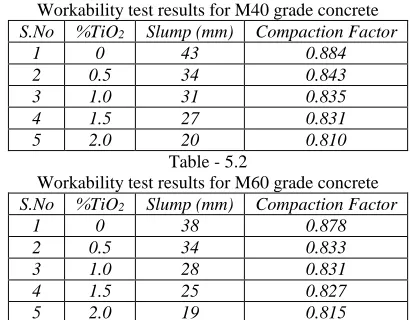
The workability test results are obtained by conducting slump cone test and compaction factor test for M40 and M60 grade concrete with partial replacement of cement with Nano TiO2 by 0.5%, 1%, 1.5% and 2% are shown in table 5.1 and 5.2.
Table - 5.1
Workability test results for M40 grade concrete
S.No %TiO2 Slump (mm) Compaction Factor
1 0 43 0.884 2 0.5 34 0.843 3 1.0 31 0.835 4 1.5 27 0.831 5 2.0 20 0.810
Table - 5.2
Workability test results for M60 grade concrete
S.No %TiO2 Slump (mm) Compaction Factor
1 0 38 0.878 2 0.5 34 0.833 3 1.0 28 0.831 4 1.5 25 0.827 5 2.0 19 0.815
From the above tables 5.1 and 5.2 it is observed that values obtained by slump and compaction factor tests are decreased with the increase in % of Nano TiO2. In mix design of M40 and M60 grade concretes workability is assumed as in terms of slump as 50m and in terms of compaction factor as 0.8, but the test results shown decrease in values of slump and compaction factor which might be because of increase in powder content lead to prevention of free movement of particles, considerable difference is not found between M40 and M60 grade concretes in the values of slump and compaction factor tests for all the percentage of replacements of cement with Nano TiO2.
Compressive Strength
The compressive strength of conventional and simultaneously replacement for M40 and M60 grade concrete, is determined by testing 10mm x 100mm x 100mm cubes for 3day, 7days and 28 days strengths in compression testing machine. Cubes about a total number of 90 specimens from all 10 mix proportions are tested. Minimum of 3 specimens are tested to obtain test strength from each variation. The test results are shown in Table 5.3 and Table 5.4.
Table - 5.3
Compressive Strength Test Results for M40 grade concrete
S.No %TiO2 Compressive Strength (N/mm 2)
3 days 7 days 28 days 56 days 1 0 31.15 38.82 58.49 62.17 2 0.5 30.89 38.59 57.39 61.45 3 1.0 33.62 41.72 61.22 64.36 4 1.5 32.55 40.59 56.09 60.74 5 2.0 28.19 35.59 47.22 52.28
Table - 5.4
Compressive Strength Test Results for M60 grade concrete
S.No %TiO2 Compressive Strength (N/mm 2)
From the above tables 5.3 and 5.4 it is found that at 1% replacement of cement with Nano TiO2 shown maximum values for all the periods of curing. Therefore 1% of Nano TiO2 content can be optimum content in cement concrete. The compressive strength of M40 grade concrete with 1% Nano TiO2 content is 8% more than same M40 conventional concrete. The compressive strength of M60 grade concrete with 1% Nano TiO2 content is 7% more than same M60 conventional concrete. Further increase in replacement of cement with Nano TiO2 resulted decrease in strength whichmight be because of reduction in space available for development of C-S-H gel.
From all the percentages of replacements for M40 grade concrete it can be observed that the maximum compressive strength is 62.33 N/mm2 and lowest compressive strength is48.33 N/mm2 and lowest compressive strength is 48.33 N/mm2. In case of M60 grade concrete it can be observed that the maximum compressive strength is 74.66 N/mm2 and lowest compressive strength is 66.66 N/mm2.
Split Tensile Strength
The split tensile strength of conventional and simultaneous replacements for M40 and M60 grade concrete are determined by testing 200mm x 100mm cylinders for 3 days, 7 days and 28days strengths in compression testing machine. Cylinders about a total number of 90 specimens from 10 mix proportions are tested. Minimum of 3 specimens are tested to obtain test strength from each variation. The test results are shown in Table 5.5 and Table 5.6.
Table - 5.5
Split Tensile Strength Test Results for M40 grade concrete
S.No %TiO2 Split Tensile Strength (N/mm 2)
3 days 7 days 28 days 56 days 1 0 1.842 2.304 3.354 7.443 2 0.5 2.244 3.177 3.521 7.627 3 1 2.181 3.177 3.674 7.684 4 1.5 2.041 2.805 3.214 7.352 5 2 2.032 2.286 2.696 6.891
Table - 5.6
Split Tensile Strength Test Results for M60 grade concrete
S.No %TiO2 Split Tensile Strength (N/mm 2)
3 days 7 days 28 days 56 days 1 0 2.646 3.084 3.302 7.413 2 0.5 2.817 3.120 3.484 7.746 3 1 3.226 3.277 3.705 7.985 4 1.5 2.937 3.044 3.135 7.206 5 2 2.608 2.805 3.087 7.073
From the above tables 5.5 and 5.6 it is observed that at 1% replacement of cement with Nano TiO2 shows maximum values for all the periods of curing. Therefore 1% of Nano TiO2 content can be optimum content in cement concrete. The split tensile strength of M40 grade concrete with1% Nano TiO2 content is 12% more than M60 conventional concrete. Further increase in replacement of cement with Nano TiO2 resulted decrease in strength.
In M40 for all the percentages of replacement around 11% to 26% more than that of 7days strength of conventional concrete is achieved. And around 5% to 9% more than that of 28 days strength of conventional concrete is obtained except in the case of 2% Nano TiO2 content.
Also it is observed that the variation of split strength values of M40 and M60 for all percentages of replacements is mostly alike.
Chart 2: Effect of Nano TiO2 on compressive strength of M60 grade concrete
Chart 4: Effect of Nano TiO2 on Split Tensile Strength for M60 grade concrete
III. CONCLUSIONS
1) The workability of concrete is decreased with the increase in the percentage of Nano Titanium Dioxide (TiO2)
2) It is observed that increase in powder content of Nano TiO2 reduces the free movement of particles in fresh mix thus concrete mix becomes stiffer resulting decrease in slump and compaction factor.
3) For M40 grade concrete, maximum values for compressive strength, split tensile strength and flexural strength are obtained at 1% Nano TiO2 as 62.33 MPa, 3.67 MPa and 4.24 MPa at 28 days.
4) For M60 grade concrete, maximum values for compressive strength, split tensile strength flexural strength are obtained at 1% Nano TiO2 as 74.66 MPa, 3.816 MPa at 28 days.
5) From the results it sis observed that 1% % Nano TiO2 content for both the grades of concrete yielded maximum values; hence it can be concluded as optimum content. Further increase in percentage of Nano TiO2 content strengths are decreased. 6) Increase in strength up to 1% Nano TiO2 for both grades of concrete M40 and M60, which might be because of pore space
available for development of C-S-H gel. Further increase in Nano TiO2content resulted decrease in strength which might be because of reduction of pore space for growth of C-S-H gel.