A Transmission Method to Guarantee QoS Parameters in
Wireless Sensor Networks
Maryam Kordlar
Gholamhossein
Ekbatanifard
Ahad
Jahangiry
Ramin
Ahmadi
Abstract: Energy-efficient and reliable data transmission are crucial issues in WSNs due to the energy constraints and high packet loss rates, In order to increase network reliability and throughput, multipath forwarding is used in many applications. However because of using multiple paths between source and destination, the multipath forwarding mechanism increases network overhead. By splitting the original messages and forwarding each sub-packet through multipath routing protocols, energy consumption and network overhead can be reduced. This paper proposes a flexible recovery mechanism which increases reliability and minimizes both energy consumption and delay. The proposed scheme caches sub-packets at some special intermediate nodes and retransmits from these nodes instead of source node whenever it is necessary. Performance evaluations of sub-packet caching (SPC) demonstrate that using multipath forwarding with caching data can effectively increase reliability and reduce energy consumption and latency.
Keywords Wireless Sensor Networks, Energy-efficient Routing, Multipath, Reliable Transmission, loss Recovery
1. Introduction
With the development of miniaturized sensor nodes, wireless sensor networks (WSNs) [1] have become a promising technology that can play an essential role in many vital and critical fields. Sensors are responsible of forwarding significant data, immediately and efficiently to the base station for processing. Increasing reliability in WSNs is a challenging task which have made it the target of many studies. Because sensor nodes are powered by life-limited and irreplaceable batteries, minimizing the power usage of each node is important and must be considered while designing WSNs. In order to increase reliability, multipath forwarding is used in many applications. Single path forwarding enhances the choice of the same path that can cause dropping of the most used nodes. Inverse multipath routing allows forwarding packets through multiple paths between source and destination as a result of which multiple copies of data will be sent. Although it can remarkably enhance network overhead and consume more energy, reliability will be guaranteed. To overcome these inherent properties of many multipath routing protocols, the splitting approach can be used. Original messages can split in several sub-packets to be forwarded by multipath routing algorithm such that each node will forward only small sub-packets. The
Manuscript received April 2, 2018; accepted November 12, 2018.
M. Kordlar Young Researchers Club, Tabriz Branch, Islamic Azad University, Tabriz, Iran.
Gh. Ekbatanifard, Department of Computer Engineering, Lahijan Branch, Islamic Azad University, Lahijan, Guilan, Iran. A. Jahangiry, Department of Computer Engineering, Qom Branch, Islamic Azad University, Qom, Iran.
* R. Ahmadi, Dept. of Computer Engineering, Rasht Branch, Islamic Azad University, Rasht, Guilan, Iran, [email protected].
splitting procedure that is used in this paper is the Chinese Remainder Theorem (CRT) [4], which is characterized by a simple modular division between integers [9]. Meanwhile corrupted and lost packets are unavoidable facts in WSNs because of data transmissions over radio links. A packet loss can fall out due to wireless link errors or destroyed nodes due to environmental events or node crash down due to energy depletion and decreased network efficiency. This paper proposes a flexible recovery mechanism for lost packets which guarantee energy-efficient reliable data transmission. The proposed scheme caches sub-packets at some special intermediate nodes and retransmits from these nodes whenever it is necessary. Hop by hop protocol is an approach that caches data to every intermediate node. NBH [2] not only increases reliability, but it also increases network overhead. Inverse, End-to-End [3] protocol does not perform data caching. Therefore the network overhead will be balanced while the reliability decreases. Providing some reliability support at intermediate nodes is more energy-efficient. The proposed method which is called SPC fulfills this requirement by caching packets at some special intermediate nodes.
The remainder of this paper is organized as follows: Section II presents related work, subsequently section III presents the Chinese Remainder Theorem (CRT). We describe the proposed scheme in section IV. Section V details our simulation efforts and finally section VI concludes the paper.
2. Related Work
Reliable transmission is an important issue in extremely unreliable link environments of wireless sensor networks, which have become more difficult to attain due to the increased number of nodes. Recent studies have shown that in WSNs links are highly unreliable due to many factors such as interference, attenuation and fading [5-6
].
Messages in the network are delivered according to their deadlines. Several routing protocols have been proposed to provide reliable data transmission. In [7] a Distributed and Reliable Data Transmission (DRDT) scheme with the objective of efficiently guaranteeing reliable data transmission is provided which increases reliability by cooperative retransmission task by helping nodes.end-to-end transmission delays. Ganesan et al. reported that packet loss can occur over a short distance while the distribution of packet reception over an area is not uniform and low-power environments have quite asymmetric links [8]. The authors of [9] proposed a multi-path routing model for WSNs referred to as Multi-Constrained Multi-Path routing (MCMP) where packet delivery from nodes to the sink is achieved based on QoS constraints expressed in terms of reliability and delay. This model addresses the issue of multi-constrained QoS in wireless sensor networks taking into account the unpredictability of network topology and trying to minimize energy consumption. Couto et al. [10] have measurements for DSDV and show that with minimizing the hop count, the distance traveled maximizes by each hop and it increases the loss ratio. Another study proposes a packet delivery mechanism for energy aware called Multi Path and Multi-Speed Routing Protocol (MMSPEED), that overlays on the network layer and medium access control layer. This protocol addresses reliability dependency and presents multiple levels of delivery speed. In MMSPEED each node is aware of its neighbor nodes’ geographical information within its radio range. Each node transmit data message to the closer neighbor node, so the data can be delivered to the sink without learning global information. Thus, MMSPEED provides multiple delivery speed, but it does keep an individual node's energy and it does not remove node's energy except for when it selects paths for forwarding to the sink. Therefore, many data packets are routed over the same routes. It is the opposite of load balancing in wireless sensor networks [11]. In [12] a Cluster-Based Forwarding (CBF) is proposed which guarantees reliability by using a cluster that consists of helper nodes with good link quality. The disadvantage of CBF arise when the location of the sink changes, so all the nodes should select helping nodes again. Therefore, CBF cannot fully guarantee the reliability of realistic wireless sensor networks. The Energy-Efficient Multiple Paths Routing Algorithm (EMRA) for WSNs is a routing algorithm that increases resilience to node failure. This algorithm is based on a data-centric and location-based approach to find discrete paths. This application is used to control overhead and energy consumption in the network. In EMRA, the source node floods data message to the sink, when after the sink node receives the data message it can find the main path. To find other secondary paths, the sink node tries its neighbor nodes by intermediate nodes. Thus, it reduces the delay to set up multiple paths [13]. Using caching in WSNs was first proposed in [14]. The authors of [15] proposed a multi-path-based distributed TCP caching algorithm, which uses redundant paths and hop-by-hop local retransmission to ensure reliable transport, on the basis of the original single-path-based algorithm. A new structure of caching is proposed in [16] which is called Active caching (AC). AC provides a tradeoff between end-to-end delays and memory requirements and more reliability.
3. The Chinese Reminder Theorem
In this section we will briefly review the Chinese Remainder Theorem. In the simplest case, this theorem can be described as follows [17]:
Given N primes pi> 1, in which iє {1... N}, M will be the primes product, i.e. M=Пipi. By assuming m as an original packet, then the set of integers {m1, m2….mN} will be
sub-packets, considering the condition m <M, where m can be obtained from (1). Notice that in (2), qi is ci modular inverse.
𝑚 = (∑𝑁𝑖=1𝑐𝑖∗ 𝑚𝑖) 𝑚𝑜𝑑 𝑀 (1) 𝑐𝑖= 𝑄𝑖∗ 𝑞𝑖 (2) 𝑄𝑖=𝑀𝑝
𝑖 (3)
𝑚𝑖= 𝑚𝑚𝑜𝑑𝑝𝑖 (4)
For example, consider a system that is m = 64 and we want sent message by the Chinese Remainder Theorem, instead of forwarding complete packet (m), knowing the set of primes pi={3, 5, 7} that iє{1, 2, 3}can split it into three sub-packet
by equation (3) and the sub-packets sent by the intermediate nodes to the sink.
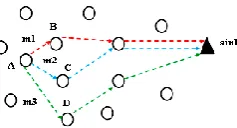
Considering the above relations it can be proved that 7 bits are required to show this message, which cannot be considered as more than three bits for each sub-packet. For example in Fig.1, if B, C and D are the received message m from node A, each of them will execute the above method and calculated sub-packets by mi equation with iϵ{1, 2, 3} and transmit sub-packets to S node instead of m.
Fig. 1. Example of forwarding the main packet after division 𝑊𝐶𝑅𝑇𝑚𝑎𝑥 Indicates the maximum number of CRT components where w is the number of bits in the original packet.
𝑊𝐶𝑅𝑇𝑚𝑎𝑥= 𝑚𝑎𝑥(⌈ 𝑙𝑜𝑔 ( 𝑝𝑖 ) ⌉ (5)
In general, splitting packet to several sub-packets with a low number of bits will reduce energy consumption.
The maximum number of sub-packets bits and theoretical maximum energy reduction factor (MERF) can be obtained from the following equations:
𝑀𝐸𝑅𝐹 =(𝑤−𝑊𝐶𝑅𝑇𝑚𝑎𝑥)
𝑤 (6)
Selecting appropriate primes has the most important role in energy storage.
4. The Proposed Approach
the destination for retransmitting the missing data packet can be an appropriate solution to reduce delay and increase reliability.
The queuing model of the sensor nodes of the proposed scheme is shown in Fig.2. The forwarding mechanism that is used to delivered packets to the destination is described in [18], which is the author’s previous paper.
Fig 2. Queuing model of sensor nodes
In order to achieve a high delivery ratio, minimize network overhead and ensure high reliability, caching sub-packets along the multipath forwarding can be used. In the proposed scheme, the splitting procedure that is used to break up the original message is the Chinese Remainder Theorem (CRT). Two parameters play an essential role to detect whether caching is necessary or not. This method considers the reliability of the link rate as a threshold.
Probability of Error can be calculated as follows [19]:]
𝑃𝑂𝐸 =12∗ (1 − 𝑒𝑟𝑓)√Eb
N0 (7)
where erf is the error function, Eb is a bit of energy derived
and No is the noise power spectral density.
Each node has the ability to count the number of NACK packets that receive from further nodes [20]. Probability of Caching (POC) is obtained by POE and NON [t-1] which refers to Number of NACK packets that node n receives in t-1.
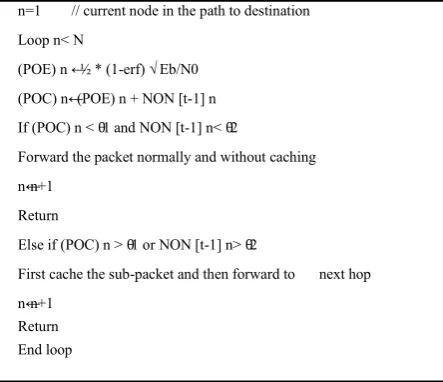
Depending on the type of data that sensors should report to the sink, the Scheduler classifies received packets as need reliability (NR) packet or non-need reliability (NNR) packet and sends them to NRQueue or NNRQueue queues, respectively. By using the algorithm described in Fig.3, the caching information handler can decide whether caching is needed or not. Packet will send the memory of current node to cache for a special period of time if caching condition becomes true.
In WSNs, information that has been collected by the sensors must be delivered in a special time. Otherwise, data will be useless. Successfully forwarding in a packet timeline can be achieved in a balanced network. The proposed method minimizes packet overhead and ensures high throughput by multipath forwarding of sub-packets.
The following equation can be used to calculate the network load balancing when sub-packets are distributed to be forwarded through different multipath [21]:
𝜑(𝑟̅) = (∑𝑁𝑗=1𝑟𝑗𝑝𝑗)2
𝑁 ∑𝑁 (𝑟𝑗𝑝𝑗)2
𝑗=1 (8)
where𝜑 illustrates load balance ratio, the vector 𝑟̅ denotes the traffic rates allocated to all available routes, rj
and pj are respectively the traffic flow and the product of
the path cost allocated to path j.
In the proposed scheme, the main packet will split into several sub-packets only in the source node. Equation (9) presents the transmission cost of each node. It reflects both communication overhead and energy-efficiency [7]:
𝑇𝑟𝑎𝑛𝑠𝑚𝑖𝑠𝑠𝑖𝑜𝑛𝐶𝑜𝑠𝑡 =𝑈.𝑁𝑇 (9)
where N represents the average number of hops in the paths, T shows the total bits each node transmits, and U denotes the number of useful bits that the sink received.
By using (8) the reduction of network overhead is obvious. This paper is going to reduce energy consumption while minimizing the delay. To evaluate the node energy consumption we use following equation:
ET=
∑Mi=1(ei,int−ei,res)
M∗N (10)
where M is the number of nodes, ei, init and ei, res are the
initial and residual energy levels of node i, respectively and N is the number of data packets received by the sink.
Energy is a major factor which impacts the network life time. By reducing energy consumption and delay, the network lifetime will be prolonged. The following equation is used in order to obtain network lifetime:
NLT =∑ni=1(ei,res−ei,n)
eint (11)
where ei,n indicates the energy needed for packet forwarding of node i, and eint represents the initial level of energy.
n=1 // current node in the path to destination Loop n< N
(POE) n ← ½ * (1-erf) √ Eb/N0 (POC) n← (POE) n + NON [t-1] n If (POC) n < θ1 and NON [t-1] n< θ2
Forward the packet normally and without caching n←n+1
Return
Else if (POC) n > θ1 or NON [t-1] n> θ2
First cache the sub-packet and then forward to next hop n←n+1
Return End loop
Fig 3. Caching algorithm at n-th node
5. Performance Evaluation
In this paper, a homogenous WSN has been considered. For the simulation, we assume 100 sensors that are randomly distributed through the sensing area of 100*100 m2. Table 1
lists the main parameters of simulation.
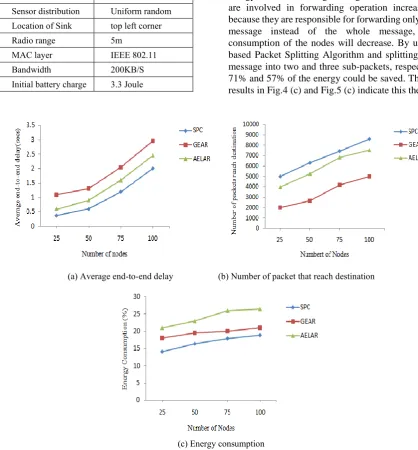
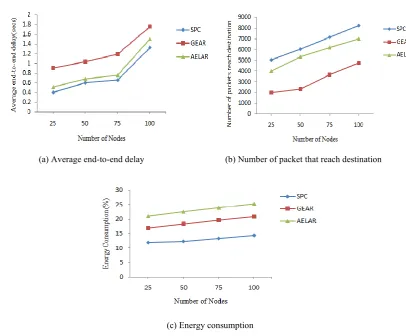
The simulation has been done in two parts; splitting the main packet, respectively into two and three sub-packets. Fig. 4 and Fig. 5 show the performance comparison of AELAR, GEAR, and SPC. Due to the forwarding multipath (equal to the number of sub-packets) with different distances, the average distance will be lower than forwarding from a single path and also whenever the sub-packet is lost, the delay in SPC will be reduced and be lower than the other two protocols because of caching sub-packets in some intermediate nodes and retransmission from those nodes instead of source node as shown in Fig.4 (a) and Fig. 5 (a).
Table 1. Simulation Parameters
Parameter Value Number of nodes 100 Simulation area 100*100 Number of sink 1
Sensor distribution Uniform random Location of Sink top left corner Radio range 5m
MAC layer IEEE 802.11 Bandwidth 200KB/S Initial battery charge 3.3 Joule
To calculate the number of packets that reach the destination, the Data Delivery Ratio can be used [22] and it is express as:
Data Delivery Ratio =Succesfully delivered dataRequired Data (12)
This equation demonstrates both the number of data packets that are sent by the source and the number of data packets received by the sink. In the ideal condition the result should be equal to 1.
Due to caching in SPC scheme the percentage of packets which can successfully be delivered to the destination will increase. This fact is shown in Fig.4 (b) and Fig.5 (b). By getting closer to the ideal condition, high reliable forwarding will be obtained. By splitting the original message into sub-packets and using multipath for transmission, nodes use less energy while forwarding although the number of nodes that are involved in forwarding operation increased. This is because they are responsible for forwarding only a part of the message instead of the whole message, so energy consumption of the nodes will decrease. By using a CRT-based Packet Splitting Algorithm and splitting the original message into two and three sub-packets, respectively about 71% and 57% of the energy could be saved. The simulation results in Fig.4 (c) and Fig.5 (c) indicate this theme.
(a) Average end-to-end delay (b) Number of packet that reach destination
(c) Energy consumption
(a) Average end-to-end delay (b) Number of packet that reach destination
(c) Energy consumption
Fig 5. Simulation results for evaluating the performance of Splitting-packet cashing with 3 sub-packets (a, b, c)
6. Conclusion
This paper describes the splitting of original packets into several sub-packets based on the CRT algorithm, and uses the multipath to forward these sub-packets to the destination. A new Caching approach is proposed which considers two parameters; link error that is calculated as the probability of error and numbers of NACK packets that the current node has received from the next node in past times. The proposed scheme that is called SPC optimizes the tradeoff between the reliability and energy-efficiency, minimizes the network overhead, increases packet reception ratio and prolongs network lifetime.
References
[1] Akyildiz I, Su W, Sankarasubramaniam Y, Cayirci E. Wireless sensor networks: a survey. Computer Networks, 38:393–422, 2002.
[2] Yao-Nan Lien “Hop-by-Hop TCP for Sensor Networks”, International Journal of Computer Networks & Communications (IJCNC), April, Vol.1, No.1, 2009.
[3] Paulo Rogério Pereira, António Grilo, Francisco Rocha, Mário Serafim Nunes, Augusto Casaca, Claude Chaudet, Peter Almström and Mikael Johansson,” End-To-End Reliability in Wireless Sensor Networks: Survey And Research Challenges” EuroFGI Workshop on IP QoS and Traffic Control, P. Pereira (Ed.) Lisbon, Portugal, December 6-7, 2007
[4] J.-H. Hong, C.-H. Wu, C.-W. Wu “RSA Cryptosystem Based on the Chinese Remainder Theorem”, Proc. of Asia and South Pacific Design Automation Conference (ASP-DAC), Yokohama, Japan, January 2001.
[5] Ganesan, D.; Krishnamachari, B.; Woo, A.; Culler, D.; Estrin, D.; Wicker, S. Complex Behavior at Scale: An Experimental Study of Low-Power Wireless Sensor Networks; Technical report; CS TR 02-0013; UCLA: Los Angeles, CA, USA, 2002. [6] Zhao, J.; Govindan, R. Understanding Packet
Delivery Performance in Dense Wireless Sensor Networks. In Proceedings of ACM International Conference on Embedded Networked Sensor Systems, Los Angeles, CA, USA, November, 2003; pp. 1–13.
[7] Jaewan Seo, Moonseong Kim, In Hur, Wook Choi and Hyunseung Choo “DRDT: Distributed and Reliable Data Transmission with Cooperative Nodes for Lossy Wireless Sensor Networks”, 10, 2793-2811, Sensors 2010.
Multipath Routing in Wireless Sensor Networks. ACM Wireless Networks (WINET), 2007.
[10] Couto, D.S.J.D.; Aguayo, D.; Bicket, J.C.; Morris, R. A High-throughput Path Metric for Multi-hop Wireless Routing. Wirel. Netw.11, 419–434, 2007. [11] Emad Felemban, Student Member, Chang-Gun Lee,
Member, and Eylem Ekici” MMSPEED: Multipath Multi-SPEED Protocol for QoS Guarantee of Reliability and Timeliness in Wireless Sensor Networks”, IEEE TRANSACTIONS ON MOBILE COMPUTING, JUNE 2006 VOL. 5, NO. 6
[12] Cao, Q.; Abdelzaher, T.F.; He, T.; Kravets, R. Cluster-Based Forwarding for Reliable End-to-End Delivery in Wireless Sensor Networks. In
Proceedings of IEEE International Conference on Computer Communications, Anchorage, AK, USA, May, pp. 1928–1936, 2007.
[13] C. Kang, X. Shangkon, Sh. Jinglun and W. Gang “An Energy-efficient Multiple Paths Routing Algorithm for Wireless Sensor Networks", IEEE, ICCS, 2008.
[14] S. Madden, M. J. Franklin, J. M. Hellerstein, and W. Hong, “Tag: a tiny aggregation service for ad-hoc sensor networks,” SIGOPS Oper. Syst. Rev, vol. 36, no. SI, pp. 131 146, 2002.
[15] Yuhua Liu and Hao Huang Kaihua Xu “Multi-path-based Distributed TCP Caching for Wireless Sensor Networks”, IEEE DOI, 2007.
[16] Dae-Young Kim and Jinsung Cho” Active Caching: A Transmission Method to Guarantee Desired Communication Reliability in Wireless Sensor Networks”, IEEE COMMUNICATIONS LETTERS,
JUNE, VOL. 13, NO. 6, 2009.
[17] G. Campobello, A. Leonardi, S. Palazzo “On the Use of Chinese Remainder Theorem for Energy Saving in Wireless Sensor Networks.” Proc. of IEEE International Conference on Communications (ICC 2008), Beijing, China, May 2008.
[18] Ali Ghaffari, Maryam Kordlar, Vida Aghakhanloyetakanloo, “Energy-efficient multipath data forwarding in wireless sensor network”,
Australian Journal of Basic and Applied Sciences, 5(8): 523-529, ISSN 1991-8178, 2011.
[19] M. R. Ebenezar Jebarani1and T. Jayanthy,” An Analysis of Various Parameters in Wireless Sensor Networks Using Adaptive FEC Technique”,
International Journal of Ad hoc, Sensor & Ubiquitous Computing (IJASUC), September, Vol.1, No.3, 2010.
[20] Levente Buttyan, Ant´onio M. Grilo “A Secure Distributed Transport Protocol for Wireless Sensor Networks”, Australian Journal of Basic and Applied Sciences, 5(8): 523-529, 2011.
[21] Ye Ming Luz and Vincent W. S. Wong, “An energy-efficient multipath routing protocol for wireless
sensor networks”, International Journal of Communication Sytems, 20:747–766, 2007.