Mohammad Reza Anani sarab*
Assistant Professor in TESOL, Shahid Beheshti University, Tehran, Iran &
Mahsa Seif Reihani
M.A. in TEFL, Shahid Beheshti University, Tehran, Iran
Abstract
The present study aimed at investigating the relationship between test takers’
cognitive and metacognitive strategy use and their second language reading test performance. The researchers employed the following instruments in order to get introspective and retrospective data from the participants: 1) a multiple-choice test on two reading passages, 2) a checklist of specific strategies for immediate introspective use after each item, 3) a questionnaire on more general strategies for retrospective use at the end of the test. The results showed that test-takers used both contributory and non-contributory strategies to get at the correct answer. The
test-takers’ pattern of strategy use revealed a tendency towards the more frequent
use of ‘returning to the passage’ as a contributory strategy and ‘guessing’ as a non -contributory strategy. The results also showed that the -contributory and non-contributory strategies functioned differently when their use was compared across easy and difficult test passages.
Keywords: Test-taking Strategies; Reading Test; Cognitive and Metacognitive Strategies; Test Performance
Introduction
The notion of independent successful learners is closely related to the increasing importance now attached to the learner-centered approach to language teaching, which is based on the assumption that language learners who exercise greater control on their learning will become more successful than those who do not.
*
E-mail address: [email protected]
Corresponding address: Department of English Language and Literature, Shahid Beheshti University, Tehran, Iran
Accordingly, the strategies employed by successful or good language learners have become the focus of attention among teachers and researchers (Fan, 2003).
Language testing (LT) research has also tended to concern itself with providing a model of language ability. Its primary aim has been not only to describe and assess the language ability of an individual, but also to construct a comprehensive theory of variation in language test performance and its correspondence with non-test language use. In recent years, many LT researchers have been concerned with the identification of individual characteristics that may influence variation in performance on language tests (Bachman, 1991).
Since the late 1970s, interest has slowly begun to grow in approaching L2 testing from the point of view of the strategies used by respondents while taking the tests (Cohen, 1998).The purpose of the research on how students go through the process of taking language tests, has been to explore the tester's presumptions about what is being tested and the actual processes that the test-taker goes through. The findings have been very helpful in understanding the weaknesses in tests and in differentiating between successful and unsuccessful test-taking strategies. As mentioned by Cohen (1984, p.71) "due to flaws in the test or due to certain test-taking strategies, respondents may not be displaying a representative performance of their language competence."
In recent years, there has been a growing concern among researchers about the
role of test-taking strategy data in validating language tests (e.g. Purpura, 1997;
Rivers, 2001; Phakiti, 2003; Koda, 2007). This has been due to the insight that tests may produce misleading results because of numerous test-wiseness strategies that test-takers use for obtaining correct answers without fully understanding the text. The picture that has emerged from test validation studies is that the field has progressed beyond the days when tests were validated simply by statistical analysis of correct and incorrect responses. The field has progressed to the point at which the researchers ask crucial questions about what the tests are actually measuring and how the respondents arrive at the answers to language assessment measures. The results have an impact on tests, even to the point that they convince test constructors to eliminate a given test (Cohen, 2007).
The present study was motivated with the underlying assumption that among factors other than language ability which affect language test performance
cognitive background variables are of paramount importance. The purpose was to
identify and characterize the test-takers’ cognitive and metacognitive strategy use
as a possible cause of variation in their language test performance. In specific, it tried to investigate the type and frequency of test-taking strategies and their possible contribution to the outcomes of assessment.
The following research questions guided the study:
1. What are the types and frequency of strategies used by test-takers while taking EFL reading tests?
2. How frequently do contributory and noncontributory strategies used in taking EFL reading tests contribute to correct responses as opposed to incorrect ones?
3. Is there a relationship between the frequency of contributory and noncontributory strategies and the correct and incorrect responses?
4. Is there a relationship between the type of strategies and difficulty of the passage?
Background
Three decades ago, L2 assessment validation research was focused on outcomes of testing, test reliability, the interrelations of subtests and the effects of different test methods on test validity. However, what was missing was test validation in terms
of respondents’behaviors in taking the test; little was known about what they were
actually doing in order to answer the questions and how this corresponded to the abilities one wanted to test. As a result, claims of test validation required attention to how the respondents arrived at their responses, and this meant paying careful attention to the strategies that respondents used while taking a test (Cohen, 2006).
Researchers face a formidable task when they try to obtain information about
respondents’strategy use without being obtrusive. A way out of this problem has
been the use of verbal reports as a primary research tool for this purpose (Faerch and Kasper, 1987; Ericsson and Simon, 1993). The purpose in using verbal reports is to identify the test-taking processes and to determine the effects of test input upon test takers. According to Cohen (1998), the information which is obtained through strategy elicitation techniques can be used for two main purposes: (1) test development through assisting the test constructor in the process of improving the developed test, and (2) interpretation of the test results after the test has been
finalized in order to provide the test takers, the teacher, and the administrators with a perspective on what the test may actually be testing (p.216).
Since the 1980s, there has been a call for the development of language tests that
provide abetter fit between “the tester’s presumptions about what is being tested
and the actual processes that the test taker goes through” (Cohen, 1984, p.70). The desired tests are supposed to reflect the language competence of the test taker in handling the language task, while guarding against opportunities that help test-takers find the right answer for the wrong reason.
The following are the insights gained from research on test-taking strategies:
1 Research on test-taking strategies can be used as a useful tool for
validating and refining notions about the test-taking process. It can help us distinguish language learning strategies from test-taking strategies.
2 Empirical research on test-taking strategies can provide valuable
information on what tests are actually measuring.
3 Such research can be of help in determining how comparable the results
from different test methods and item types are.
4 Research can also help determine whether the performance on the test is
reflective of L2 language behavior or represents behaviors employed for the sake of getting through the test (Cohen, 2007).
Method
The subjects who participated in the present study were 70 female students, all of
whom were taking ‘level 13’ of the language institute in which the study was
conducted. The textbook used in this level was Interchange (Richards, Hull and Proctor 2004) units 5, 6, 7 and 8 of the Student Book 3. The approximate proficiency level of the participants, as reported by the institute, was intermediate. The institute had a rather robust placement procedure in place including a placement test and a form to be filled in by the teachers after the fifth session in which they were supposed to name those learners who were deemed not to have been placed at the right level. The students so named were supposed to be
interviewed again and placed at the right levels. The institute’s strict placement
procedure precluded the homogenization procedure by the researchers.
The following instruments were employed to collect data from the participants: 1) A multiple-choice test of reading comprehension
2) A checklist of specific strategies to be used introspectively by the test-takers after selecting the correct response to each individual item of the reading test
3) A questionnaire on more general strategies to be used retrospectively by the test-takers after the entire reading test items have been tried out
The reading test included two passages; one easy and one difficult. The easy passage was at a linguistic level below the level of the participants, and the difficult one was challenging for the learners, but still not very difficult for them to tackle.
The difficulty level of the reading passages was estimated using the Edward Fry’s
readability Graph (Fry, 1978). The readability level of the reading passages included in the third book of the Interchange book series turned out to be around 9. Based on this criterion, the indices of 7 and 11 were selected for the easy and difficult test passages respectively.
The two test passages were selected from among the reading passages used in University Entrance Exams. Attempts were made to find some general, high-interest topics for both easy and difficult passages. The easy passage was followed by five multiple-choice items and the difficult one with six items. The introspective instrument used in the present study was a checklist developed by Nevo (1989). The checklist included 15 strategies. Each strategy in the checklist was described briefly and was given a number. It also had an option for the respondents to indicate additional strategies which might not have appeared in the list. Some of
the strategies in Nevo’s checklist are considered contributory and some
non-contributory based on the assumption that strategies such as using background knowledge or clues in the text will help test-takers reach the right answer through understanding the relationship between the stem and the alternatives while some other ones such as wild guessing may lead to the correct answer by chance, that is, without any judgmental activity in selecting the correct response.
The more general strategy questionnaire, which was completed after the test, reported the strategies used in the test as a whole rather than the strategies used in dealing with specific items. The general strategy questionnaire included a combination of items taken from the questionnaire developed by Nevo (1989) in which the items were more cognitive strategies and two other questionnaires (Purpura, 1997 and Phakiti, 2003) focusing more on metacognitive strategies. Both questionnaires were translated into Persian (See Appendices A and B) and
conducted after a short training session provided for the participants by one of the researchers. The reading test was taken under time limitations (one minute for each multiple-choice question plus 30 seconds for checking the strategy used for getting at the right answer) to make sure that the strategies had been used under normal testing conditions.
Results and Discussion
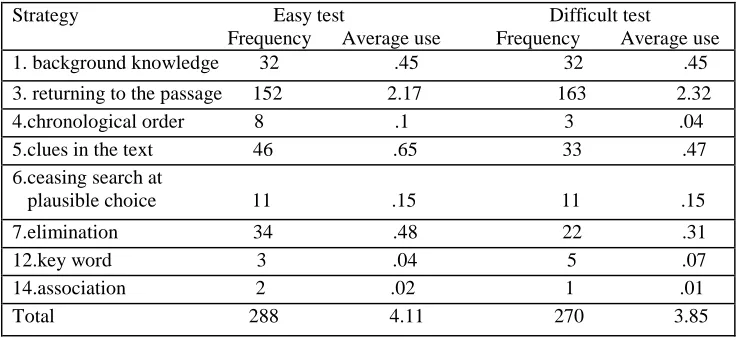
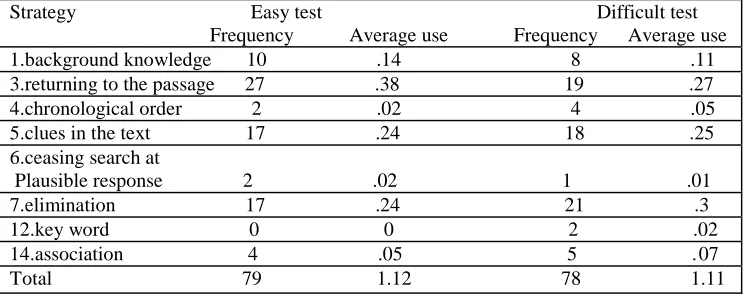
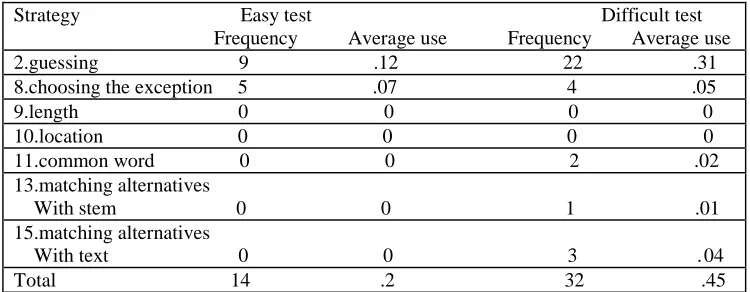
The first research question dealt with the types and frequency of the cognitive and meta-cognitive strategies used by the test-takers while taking the EFL reading comprehension test. They were supposed to answer each item separately and then indicate alongside it which strategy was most instrumental in arriving at an answer (i.e., primary strategy) and, if relevant, the second most instrumental strategy (i.e. secondary strategy). The frequency of use of primary and secondary strategies is presented in two different tables. Tables 1 and 2 present the frequency of use of primary contributory and noncontributory strategies. The frequency of secondary contributory and noncontributory strategies is presented in tables 3 and 4.
Table 1
Frequency and average use per respondent of primary contributory strategies across all test items
Strategy Easy test Difficult test
Frequency Average use Frequency Average use
1. background knowledge 32 .45 32 .45
3. returning to the passage 152 2.17 163 2.32 4.chronological order 8 .1 3 .04
5.clues in the text 46 .65 33 .47
6.ceasing search at plausible choice 11 .15 11 .15
7.elimination 34 .48 22 .31
12.key word 3 .04 5 .07
14.association 2 .02 1 .01 Total 288 4.11 270 3.85
Table 2
Frequency and average use per respondent of primary noncontributory strategies across all test items
Strategy Easy test Difficult test Frequency Average use Frequency Average use
2.guessing 31 .44 123 1.75
8.choosing the exception 3 .04 2 .02
9.length 0 0 0 0 10.location 0 0 0 0
11.common word 1 .01 3 .04
13.matching alternative with stem 5 .07 1 .01
15.matching alternative with text 15 .21 5 .07
Total 55 .78 133 1.9 Table 3 Frequency and average use per respondent of secondary contributory strategies across all test items Strategy Easy test Difficult test Frequency Average use Frequency Average use 1.background knowledge 10 .14 8 .11
3.returning to the passage 27 .38 19 .27
4.chronological order 2 .02 4 .05
5.clues in the text 17 .24 18 .25
6.ceasing search at Plausible response 2 .02 1 .01
7.elimination 17 .24 21 .3
12.key word 0 0 2 .02
14.association 4 .05 5 . 07 Total 79 1.12 78 1.11
Table 4
Frequency and average use per respondent of secondary noncontributory strategies across all test items
Strategy Easy test Difficult test Frequency Average use Frequency Average use 2.guessing 9 .12 22 .31 8.choosing the exception 5 .07 4 .05 9.length 0 0 0 0 10.location 0 0 0 0 11.common word 0 0 2 .02 13.matching alternatives
With stem 0 0 1 .01 15.matching alternatives
With text 0 0 3 . 04 Total 14 .2 32 .45
The most frequently used primary contributory strategy in both easy and difficult tests was 'returning to the passage after reading the question and
multiple-choice alternatives in order to look for the correct answer’. As a primary strategy,
this was employed on average 2.17 times per respondent in the easy test and 2.32 times in the difficult passage. As can be seen in table 2, the most common primary non-contributory strategy used by respondents in both easy and difficult tests was 'guessing'. This strategy was employed on average 1.75 times in the difficult test and 0.44 in the easy one. A check of the figures in tables 1 and 2 also shows that the average use of primary contributory strategies across all test items was higher for the easy test (4.11 times in the easy test and 3.85 times in the difficult test). But the average use of primary noncontributory strategies was higher for the difficult test items. Table 3 also shows that the most frequently used secondary contributory
strategy for the easy test was‘returning to the passage’ and for the difficult testwas
‘elimination’. As presented in table 4, ‘guessing’ was the secondary noncontributory strategy which was used by respondents while taking both easy and difficult tests.
The questionnaire concerning more general strategies, which was to be completed after the test, required a report on cognitive as well as metacognitive strategies used in the test as a whole rather than on specific items. The general strategy questionnaire comprised 19 items, of which number 1 to 12 dealt with cognitive strategies and number 13 to 19 checked metacognitive strategies used by
respondents.
A check of the data revealed that:
1) 71.4 % of the respondents read the instructions before the test. 2) 2.8 % of the students did not read the passages at all.
3) 67.1 % of the respondents read the entire passage thoroughly.
4) 34.2 % of the respondents reported having read the passages superficially. 5) 28.5 % of the subjects reported having read only parts of the passages, just
enough to enable them to answer the questions.
6) 81.4% of the respondents noted main points while reading the passages. 7) 84.2 % of the respondents first read the passage and then the items.
8) 18.5% of the respondents first read the items and then the passage. While the instructions had asked the students to read the passage before answering the questions, almost half of the students (47%) reported either reading the questions first or reading just part of the text and then looking for the corresponding questions.
9) 17.14 % of the respondents read all the items before beginning to answer. 10) 20 % of the respondents read some of the items before answering the
questions.
11) 61.4 % of the respondents read and answered one question at a time. 12) 28.5 % of the respondents read the passages and items several times to
better understand them.
13) 24.2% of the respondents tried to identify easy and difficult test parts. 14) 64.2 % of the respondents spent more time on difficult questions. 15) 30 % of the respondents skipped difficult questions first.
16) 24.2 % of the respondents planned how to complete the test before starting, and then followed the plan.
17) 60 % of the respondents checked their own performance and progress while completing the test.
18) 37.14 % of the respondents checked their work before handing in the test. 19) 44.2% of the respondents thought, after the test, about how they could do
better next time.
A quick check of the first twelve questions which deal with cognitive strategies indicates that the most frequently used cognitive strategy by the respondents was reading the passage first and the second frequently used strategy was that the
subjects noted main points while reading the texts.
The percentages reported for the last seven questions on the general strategy questionnaire shows that the most frequently used metacognitive strategy was that of spending more time on difficult questions.
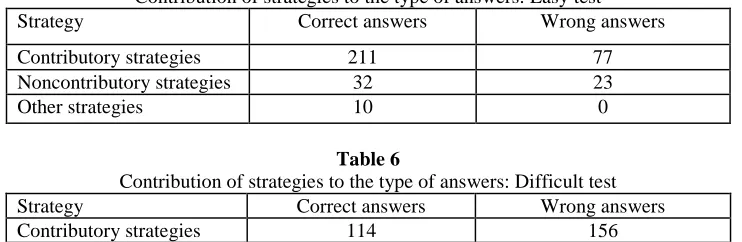
The second question that the research investigated was concerned with the frequency with which strategies used in taking EFL reading tests contributed to the correct or incorrect responses. The frequency of contributory, noncontributory, and other strategies used by the respondents which led to correct and incorrect responses are presented in tables 5 and 6.
Table 5
Contribution of strategies to the type of answers: Easy test
Strategy Correct answers Wrong answers
Contributory strategies 211 77
Noncontributory strategies 32 23
Other strategies 10 0
Table 6
Contribution of strategies to the type of answers: Difficult test
Strategy Correct answers Wrong answers
Contributory strategies 114 156
Noncontributory strategies 24 110
Other strategies 5 3
Tables 5 and 6 show that both contributory and non-contributory strategies led to more correct answers than incorrect ones in the easy test compared with the difficult one. To answer the third research question which dealt with the possible relationship between the two types of strategies and their contribution to correct or incorrect responses, a chi-square test was run. The results are shown in tables 8 and 9.
Table 7
Chi-square test on the contribution of strategies to the type of answers: Easy test
Correct Answers Wrong Answers Contributory strategies 211 77
Noncontributory strategies 32 23
Exact Sig. (2-sided)
Asymp.Sig. (2-sided)
df Value Exact Sig. (1-sided)
Pearson Chi-Square .024 1 5.086(a)
p < .05
Table 8
Chi-square test on the contribution of strategies to the type of answers: Difficult test
Correct Answers Wrong Answers
Contributory strategies 114 156 Noncontributory strategies 24 110
Exact Sig. (2-sided)
Asymp.Sig. (2-sided)
df Value Exact Sig. (1-sided)
Pearson Chi-Square
.000 1 23.535(a)
p < .05
The results of the chi square test run on the frequency of strategies used in the easy test (table 7) show that the two groups of strategies have contributed differently to getting at the correct answers (p < .o5). The contributory strategies have led to correct answers at a much higher rate than the non-contributory strategies. The results of the chi square run on difficult test (table 8) again show that the two types of strategies have contributed differently to getting at the correct answers; however, their contribution is just the opposite of what was reported in
relation to the easy test. In this case, the students’ use of strategies failed to help them find the correct answer. Both types of strategies led more to wrong answers. But the non-contributory strategies led to the wrong answer at a much higher rate than the contributory strategies. This rather unexpected result may be due to the fact that the difficult test was too challenging for the respondents.
To address the fourth research question which was concerned with the relationship between the type of strategies and the difficulty of the test, a chi square test was run on the frequency of contributory and noncontributory strategies in taking the easy and difficult tests as presented in table 9. The results of the chi-square test are summarized in table 10.
Table 9
Use of strategies with easy and difficult tests
Strategy Easy Test Difficult Test
Contributory strategies 288 270
Noncontributory strategies 55 134
Table 10
Chi-square test on the relationship between type of strategies and difficulty of the passage
p<.05
As can be inferred from the results of the chi square test, there is a relationship between the type of strategies used and the difficulty of the test. In the easier test, there was a greater use of contributory strategies than in the difficult one. By contrast, respondents used much more noncontributory strategies while answering the difficult test.
In line with the findings of other studies (Purpura, 1997; Phakiti, 2003; Nikolov,
2006) the present study revealed that respondents employed cognitive and metacognitive strategies in the process of responding to the reading comprehension questions. The most frequently used contributory primary and secondary cognitive strategy in both easy and difficult tests was ‘returning to the passage’ after reading
Exact Sig. (2-sided)
Asymp. Sig. (2-sided)
Df Value Exact Sig. (1-sided) Pearson Chi-square .000 1 27.849(a)
the questions and examining the options. The most frequently used non-contributory primary and secondary strategies used by the respondents while taking both the easy and difficult tests was 'guessing'. These findings support the findings
already reported in the literature with regard to Nevo's (1989) study. In Nevo’s
study‘guessing not based on any particular rationale’ was rare in L1 but in L2 it
was used 1.98 times as a primary strategy. It is possible that the respondents' limited command of the second language compared with the first language led to lack of confidence, which in turn caused them to guess without any particular rational considerations.
The results of the general strategy questionnaire also revealed that the most
frequently used cognitive strategy was ‘reading the passage first’. This finding is
also similar to what is reported by Larson (1981) and Nevo (1989). The most frequently used metacognitive strategy was ‘spending more time on difficult
questions'. In Oxford et al.’s study in 2004, high proficiency learners reported
employing this strategy more than the other learners. The reason for this might be that high proficiency learners and also intermediate learners in this study were more metacognitively aware of the need to go over the difficult parts of the reading passages. It might also mean, as mentioned by Oxford et al. (2004), that a relatively developed competence in reading might leave the learners with more time to go over difficult parts of reading passages.
The results showed that in both tests there was use of contributory and noncontributory strategies, but the average per respondent of contributory strategies on the two tests was higher than the use of noncontributory ones. With regard to the contribution of the strategies used in getting at the correct answer, in the easy test there was a significant relationship between getting the correct answer and using contributory strategies, whereas in the difficult one no such a relationship was found between those two variables. These findings support the
results of Nevo’s study (1989), but add a word of caution about the relationship
between the use of contributory strategies and getting at the correct answer in dealing with difficult texts. It may be the case that this relationship cannot be assumed when the passages seem difficult to the test takers.
The findings of this study also revealed that in the easier test there was greater use of contributory strategies than in the difficult one, but in completing the difficult test questions, noncontributory strategies were used more than the
contributory ones. This finding also confirms the previous outcomes (See Nevo, 1989) that contributory and non-contributory strategies function differently when the variable of text difficulty is added.
Conclusion
During the period of awakened interest in learners’ processing of language, it seems reasonable to pay extra attention to the actual strategies being used in taking tests. There is no doubt that test constructors and test users can receive beneficial feedback from what the given tests are actually prompt respondents to do. It is possible that test takers would become more effective at taking tests if they were informed of what they are actually doing and what they could do to have better results. So research on test-taking can serve as a useful tool for validating the tests and it can provide valuable information about what tests are actually measuring. Such research can be of help in interpreting the test results and determining whether performance on a special test is reflective of L2 behavior in the area assessed or represents behaviors employed for the sake of getting through the test. The study’s insights could ultimately provide language learners with information on effective test-taking strategies, by equipping SL educators with an inventory of strategies for incorporation in their SL classrooms, curricula and materials. Considering the limitations of the study with regard to the number of test items and participants’ selection procedures, the results should be taken consciously and of course more studies are needed to provide more generalizable evidence for test-taking strategies.
Received 1 August 2010 Revised version accepted 12 September 2010
References
Bachman, L. F. (1991). What does language testing have to offer?, TESOL Quarterly, 25(4), 671-704.
Cohen, A. D. (1984). On taking language tests: What the students report, Language Testing, 1(1), 70-81.
Cohen, A. D. (1998). Strategies in learning and using a second language. London: Longman.
Cohen, A. D. (2006). The coming age of research on test-taking strategies, Language Assessment Quarterly, 3(4), 307-331.
Cohen, A. D. (2007). The coming age for research on test-taking strategies. In J. Fox, M. Weshe, D. Bayliss, L. Cheng, C. Turner and C. Doe (Eds.), Language testing reconsidered (pp.80-111). Ottawa: Ottawa University Press.
Ericsson, K. A., & Simon, H. (1993). Protocol analysis: verbal reports as data. Cambridge: MIT Press.
Faerch, C., & Kasper, G. (1987). From product to process–introspective methods
in second language research. In F. Faerch and G. Kasper (Eds.), Introspection in second language research (pp. 5-23). Clevedon: Multilingual Matters Ltd.
Fry, E. B. (1978).Fry’s readability graph. Providence, RI: Jamestown Publishers.
Fan, M.Y. (2003). Frequency of use, perceived usefulness, and actual usefulness of second language vocabulary strategies: A study of Hong Kong learners, Modern Language Journal, 87(2), 222-241.
Koda, K. (2007). Reading and language learning: Crosslinguistic constraints on second language reading development, Language Learning, 57(1), 1-44.
Larson, K. (1981). A study of student test-taking strategies and difficulties. Los Angles: University of California.
Nevo, N. (1989). Test-taking strategies on a multiple-choice test of reading comprehension, Language Testing, 6 (2), 199-215.
Nikolov, M. (2006). Test-taking strategies of 12-and 13- year-old Hungarian learners of EFL: Why whales have migraines, Language Learning, 56 (1), 1-51.
Oxford, R. L., Cho, Y., Leung, S., & Kim, H. J. (2004). Effects of the presence and difficulty of task on strategy use: An exploratory study, IRAL, 42, 1-47.
Phakiti, A. (2003). A closer look at the relationship of cognitive and metacognitive strategy use to EFL reading achievement test performance, Language Testing, 20(1), 26-56.
Purpura, J. E. (1997). An analysis of the relationship between test-takers’ cognitive
and metacognitive strategy use and second language test performance, Language Learning, 47(2), 289-325.
Richards, J. C., Hull, J., & Proctor, S. (2004). Interchange Book Series. Cambridge: Cambridge University Press.
Rivers, W.P. (2001). Autonomy at all costs: An ethnography of metacognitive self-assessment among experienced language learners, Modern Language Journal, 85(2), 279-290.
Appendix A
A checklist of strategies for immediate use after each item
نﺪﻧاﻮﺧ نﻮﻣزآ يا ﮫﻨﯾﺰﮔرﺎﮭﭼ تﻻاﻮﺳ ﮫﺑ ﺎﻤﺷ ﻲﯾﻮﮕﺨﺳﺎﭘ ي هﻮﺤﻧ زا ﻲھﺎﮔآ رﻮﻈﻨﻣ ﮫﺑ ﺮﯾز ي ﮫﻣﺎﻨﺸﺳﺮﭘ ﺖﺳا هﺪﺷ ﮫﯿﮭﺗ
.
رد ﻖﯿﻘﺤﺗ فاﺪھا ﮫﺑ نﺪﯿﺳر رد ار ﺎﻣ ﺪﻧاﻮﺗ ﻲﻣ ﻞﯾذ تﻻاﻮﺳ ﮫﺑ ﺎﻤﺷ ﺦﺳﺎﭘ ﺖﺤﺻ و ﺖﻗد
ﺪھد يرﺎﯾ ﮫﻨﯿﻣز ﻦﯾا
.
ر ﺮﻜﺸﺗ لﺎﻤﻛ ﺎﻤﺷ يرﺎﻜﻤھ زا ﻼﺒﻗ ﻢﯾراد ا
.
1. ﻪﻨﯿﻣز ﺶﯿﭘ /
ﯽﻣﻮﻤﻋ تﺎﻋﻼﻃا :
كرد رﻮﻈﻨﻣ ﻪﺑ هﺪﻨﻧاﻮﺧ ﻂﺳﻮﺗ ﻦﺘﻣ عﻮﺿﻮﻣ ﻪﺑ ﻊﺟار ﯽﻠﺒﻗ تﺎﻋﻼﻃا يروآ دﺎﯾ
هﺪﺷ ﻪﺘﺷﻮﻧ ﺐﻟﺎﻄﻣ .
2. ندز سﺪﺣ :
ﺪﺷﺎﺒﻧ ﯽﺻﺎﺧ ﻖﻄﻨﻣ يﺎﻨﺒﻣ ﺮﺑ ﻪﮐ رﻮﮐ سﺪﺣ .
3 . ﻦﺘﻣ ﻪﺑ ﻪﻌﺣاﺮﻣ :
و تﻻاﻮﺳ نﺪﻧاﻮﺧ زا ﺲﭘ ﺢﯿﺤﺻ ﺦﺳﺎﭘ ﻦﺘﻓﺎﯾ ياﺮﺑ ﻦﺘﻣ ﻪﺑ هرﺎﺑود ﺖﺸﮔزﺎﺑ ﺎﻫ ﻪﻨﯾﺰﮔ
.
4 . ﯽﻧﺎﻣز ﺐﯿﺗﺮﺗ :
ﻦﺘﻣ رد ثداﻮﺣ ﯽﻧﺎﻣز ﯽﻟاﻮﺗ ﻪﺑ ﻪﺟﻮﺗ ﺎﺑ ﺦﺳﺎﭘ ﻦﺘﻓﺎﯾ ياﺮﺑ ﻮﺠﺘﺴﺟ .
5 . ﺦﻧ ﺮﺳ : نآ رد دﻮﺟﻮﻣ يﺎﻫ ﺦﻧﺮﺳ زا هدﺎﻔﺘﺳا و دراد هرﺎﺷا نآ ﻪﺑ ﺮﻈﻧ درﻮﻣ لاﻮﺳ ﻪﮐ ﻦﺘﻣ زا ﯽﺘﻤﺴﻗ ندﺮﮐ اﺪﯿﭘ
لاﻮﺳ ﻪﺑ نداد باﻮﺟ ياﺮﺑ ﺶﺨﺑ .
6 . ﺎﻫ ﻪﻨﯾﺰﮔ ﯽﻣﺎﻤﺗ نﺪﻧاﻮﺧ زا نﺪﯿﺸﮐ ﺖﺳد :
ﺖﺳرد ﺮﻈﻧ ﻪﺑ ﻪﮐ يا ﻪﻨﯾﺰﮔ ﻪﺑ نﺪﯿﺳر مﺎﮕﻨﻫ ﺎﺗ ﺎﻫ ﻪﻨﯾﺰﮔ نﺪﻧاﻮﺧ
ﺎﻫ ﻪﻨﯾﺰﮔ ي ﻪﯿﻘﺑ نﺪﻧاﻮﺧ ﻪﺑ نداﺪﻧ ﻪﻣادا و ﺪﯾآ ﯽﻣ .
7 . ﯽﻓﺬﺣ شور : كرد ﻞﺑﺎﻗ ﺎﯾ ﯽﻘﻄﻨﻣ ﺎﻫ ﻪﻨﯾﺰﮔ ﺮﯾﺎﺳ ﻪﮑﻨﯾا ﻞﯿﻟد ﻪﺑ ﺢﯿﺤﺻ باﻮﺟ ناﻮﻨﻋ ﻪﺑ ﻪﻨﯾﺰﮔ ﮏﯾ بﺎﺨﺘﻧا ﺪﻨﺘﺴﯿﻧ . 8 . ﺎﻨﺜﺘﺳا بﺎﺨﺘﻧا : ﻮﺟ ناﻮﻨﻋ ﻪﺑ ﻪﻨﯾﺰﮔ ﮏﯾ بﺎﺨﺘﻧا ﻪﻨﯾﺰﮔ ﺮﯾﺎﺳ ﺎﺑ نآ توﺎﻔﺗ ﺎﯾ و ندﻮﺑ ﯽﺋﺎﻨﺜﺘﺳا ﻞﯿﻟد ﻪﺑ ﺢﯿﺤﺻ با ﻼﺜﻣ ؛ ﺎﻫ : توﺎﻔﺘﻣ ي هزﻮﺣ ﻞﯿﻟد ﻪﺑ ﺎﯾ شا يرﻮﺘﺳد رﺎﺘﺧﺎﺳ رد توﺎﻔﺗ ، نآ ندﻮﺑ ﯽﻤﺳر ﺮﯿﻏ ﺎﯾ ﯽﻤﺳر ﺮﻃﺎﺧ ﻪﺑ نآ دﺮﺑرﺎﮐ . 9 . ﻪﻨﯾﺰﮔ لﻮﻃ : ﺖﺳﺎﻫ ﻪﻨﯾﺰﮔ ﺮﯾﺎﺳ زا ﺮﺗﺪﻨﻠﺑ ﺎﯾ ﺮﺘﻫﺎﺗﻮﮐ ﻪﮑﻨﯾا ﻞﯿﻟد ﻪﺑ يا ﻪﻨﯾﺰﮔ بﺎﺨﺘﻧا . 10 . ﺤﻣ ﻪﻨﯾﺰﮔ ﻦﺘﻓﺮﮔ راﺮﻗ ﻞ : ﺎﻫ ﻪﻨﯾﺰﮔ ﺮﯾﺎﺳ ﻦﯿﺑ رد نآ ﻦﺘﻓﺮﮔ راﺮﻗ ﻞﺤﻣ ﻞﯿﻟد ﻪﺑ ﻪﻨﯾﺰﮔ ﮏﯾ بﺎﺨﺘﻧا . 11 . ﺞﯾار ﺖﻐﻟ : دراد دﺮﺑرﺎﮐ هﺮﻣزور نﺎﺑز رد ﺎﺒﻟﺎﻏ ﻪﮐ نآ رد ﯽﺘﻐﻟ دﻮﺟو ﻞﯿﻟد ﻪﺑ ﻪﻨﯾﺰﮔ ﮏﯾ بﺎﺨﺘﻧا . 12 . يﺪﯿﻠﮐ ﺖﻐﻟ : ﺖﻐﻟ ناﻮﻨﻋ ﻪﺑ ﻦﺘﻣ رد ﻪﮐ نآ رد ﯽﺘﻐﻟ دﻮﺟو ﻞﯿﻟد ﻪﺑ ﻪﻨﯾﺰﮔ ﮏﯾ بﺎﺨﺘﻧا ﻪﺘﻓر رﺎﮑﺑ يﺪﯿﻠﮐ ﺖﺳا . 13 . ﺎﻫ ﻪﻨﯾﺰﮔ زا ﯽﮑﯾ ﺎﺑ لاﻮﺳ ندﺮﮐ رﻮﺟ : ﺰﯿﻧ لاﻮﺳ رد ﻪﮐ نآ رد ﯽﺗﺎﻐﻟ ﺎﯾ ﺖﻐﻟ دﻮﺟو ﻞﯿﻟد ﻪﺑ ﻪﻨﯾﺰﮔ ﮏﯾ بﺎﺨﺘﻧا ﺪﻧا ﻪﺘﻓر رﺎﮑﺑ . 14 . طﺎﺒﺗرا : ﯽﻋاﺪﺗ ﺮﮕﯾد نﺎﺑز ﺎﯾ ﯽﺳرﺎﻓ نﺎﺑز رد ﯽﺘﻐﻟ ﺪﺷ ﺚﻋﺎﺑ ﻪﮐ نآ رد ﯽﺘﻐﻟ دﻮﺟو ﻞﯿﻟد ﻪﺑ ﻪﻨﯾﺰﮔ ﮏﯾ بﺎﺨﺘﻧا دﻮﺷ . 15 . ﺮﮐ رﻮﺟ ﻦﺘﻣ ﺎﺑ ﻪﻨﯾﺰﮔ ند : ،دراد دﻮﺟو ﺰﯿﻧ ﻦﺘﻣ رد ﻪﮐ نآ رد ﯽﺗﺎﻐﻟ ﺎﯾ ﺖﻐﻟ دﻮﺟو ﻞﯿﻟد ﻪﺑ ﻪﻨﯾﺰﮔ ﮏﯾ بﺎﺨﺘﻧا ﺎﯾ و ، ﺪﻧا هداﻮﻧﺎﺧ ﮏﯾ زا ﻦﺘﻣ رد ﯽﺘﻐﻟ ﺎﺑ ﻪﮐ ﯽﺘﻐﻟ دﻮﺟو ، ﯽﯾﺎﻨﻌﻣ ﺎﯾ ﯽﺗﻮﺻ ﺮﻈﻧ زا ﻦﺘﻣ تﺎﻐﻟ ﺎﺑ ﻪﺑﺎﺸﻣ ﯽﺗﺎﻐﻟ دﻮﺟو دراد طﺎﺒﺗرا ﻦﺘﻣرد ﯽﺗﺎﻐﻟ ﺎﯾ ﺖﻐﻟ ﺎﺑ يدوﺪﺣ ﺎﺗ ﻪﮐ ﯽﺘﻐﻟ دﻮﺟو . 16 . ﺮﮕﯾد يﺎﻬﺷور . Appendix B
A questionnaire on more general strategies
بﺎﺨﺘﻧا ﺎﺑ ار دﻮﺧ ﺦﺳﺎﭘ و ﺪﯿﻧاﻮﺨﺑ ﺖﻗد ﻪﺑ ار ﺮﯾز تﻼﻤﺟ ﯽﻠﺑ ﺎﯾ ﺮﯿﺧ ﺪﯿﻨﮐ ﺺﺨﺸﻣ . 1. مﺪﻧاﻮﺧ ﻦﺘﻣ زا ﻞﺒﻗ ار ﺎﻫ ﻞﻤﻌﻟا رﻮﺘﺳد . ﯽﻠﺑ □ ﺮﯿﺧ □ 2. مﺪﻧاﻮﺨﻧ ار ﻦﺘﻣ ﻼﺻا . ﯽﻠﺑ □ ﺮﯿﺧ □ 3. ﺘﻣ مﺎﻤﺗ مﺪﻧاﻮﺧ ﺖﻗد ﻪﺑ ار ﻦ . ﯽﻠﺑ □ ﺮﯿﺧ □ 4. مﺪﻧاﻮﺧ ﯽﺤﻄﺳ رﻮﻃ ﻪﺑ ار ﻦﺘﻣ . ﯽﻠﺑ □ ﺮﯿﺧ □ 5. مﺪﻧاﻮﺧ ،دﻮﺑ مزﻻ تﻻاﻮﺳ ﻪﺑ ﯽﯾﻮﮕﺨﺳﺎﭘ ياﺮﺑ ﻪﮐ ﯽﯾﺎﺠﻧآ ﺎﺗ ﻂﻘﻓ ار ﻦﺘﻣ زا ﯽﯾﺎﻬﺘﻤﺴﻗ . ﯽﻠﺑ □ ﺮﯿﺧ □ 6. مدﺮﮐ ﻪﺟﻮﺗ ﻦﺘﻣ ﻢﻬﻣ تﺎﮑﻧ ﻪﺑ ،ﻦﺘﻣ نﺪﻧاﻮﺧ مﺎﮕﻨﻫ . ﯽﻠﺑ □ ﺮﯿﺧ □
7. ر ﻦﺘﻣ لوا ار تﻻاﻮﺳ ﺪﻌﺑ مﺪﻧاﻮﺧ ا . ﯽﻠﺑ □ ﺮﯿﺧ □ 8. ار ﻦﺘﻣ ﺪﻌﺑ مﺪﻧاﻮﺧ ار تﻻاﻮﺳ لوا . ﯽﻠﺑ □ ﺮﯿﺧ □ 9. مﺪﻧاﻮﺧ رﺎﺒﮑﯾ ار ﺎﻬﻧآ ي ﻪﻤﻫ تﻻاﻮﺳ ﻪﺑ نداد ﺦﺳﺎﭘ زا ﻞﺒﻗ . ﯽﻠﺑ □ ﺮﯿﺧ □ 10 . مﺪﻧاﻮﺧ ار ﺎﻬﻧآ زا ﯽﻀﻌﺑ تﻻاﻮﺳ ﻪﺑ نداد ﺦﺳﺎﭘ زا ﻞﺒﻗ . ﯽﻠﺑ □ ﺮﯿﺧ □ 11 . ﺦﺳﺎﭘ زا ﻞﺒﻗ مداد ﺦﺳﺎﭘ ﻪﻧﺎﮔاﺪﺟ ﮏﯾ ﺮﻫ ﻪﺑ ﺪﻌﺑ مﺪﻧاﻮﺧ لوا ار ﺎﻬﻧآ ﮏﺗ ﮏﺗ تﻻاﻮﺳ ﻪﺑ نداد . ﯽﻠﺑ □ ﺮﯿﺧ □ 12 . ﻢﻤﻬﻔﺑ ﺮﺘﻬﺑ ار ﺎﻬﻧآ ﺎﺗ مﺪﻧاﻮﺧ رﺎﺑ ﻦﯾﺪﻨﭼ ار تﻻاﻮﺳ و ﻦﺘﻣ . ﯽﻠﺑ □ ﺮﯿﺧ □ 13 . ﻢﻨﮐ ﺺﺨﺸﻣ ار نﻮﻣزآ ﺖﺨﺳ و نﺎﺳآ يﺎﻬﺘﻤﺴﻗ مدﺮﮐ ﯽﻌﺳ . ﯽﻠﺑ □ ﺮﯿﺧ □ 14 . فﺮﺻ ار يﺮﺘﺸﯿﺑ ﺖﻗو مدﺮﮐ ﻞﮑﺸﻣ تﻻاﻮﺳ . ﯽﻠﺑ □ ﺮﯿﺧ □ 15 . مداد باﻮﺟ ﻞﮑﺸﻣ تﻻاﻮﺳ ﻪﺑ ﺲﭙﺳ و نﺎﺳآ تﻻاﻮﺳ ﻪﺑ اﺪﺘﺑا ﯽﯾﻮﮕﺨﺳﺎﭘ مﺎﮕﻨﻫ . ﯽﻠﺑ □ ﺮﯿﺧ □ 16 . ﻪﻣﺎﻧﺮﺑ نﺎﻤﻫ ﻖﺒﻃ ﻢﻫ ﺮﺧآ ﺎﺗ و ﻢﻫﺪﺑ باﻮﺟ تﻻاﻮﺳ ﻪﺑ ﺪﯾﺎﺑ رﻮﻄﭼ ﻪﮐ مدﺮﮐ يﺰﯾر ﻪﻣﺎﻧﺮﺑ نﻮﻣزآ ياﺪﺘﺑا رد مدﺮﮐ ﻞﻤﻋ . ﯽﻠﺑ □ ﺮﯿﺧ □ 17 . ﺤﻧ ﻢﺘﺷاد ﺮﻈﻧ ﺮﯾز نﻮﻣزآ ﻦﯿﺣ رد ار دﻮﺧ ﺖﻓﺮﺸﯿﭘ رد ﯽﯾﻮﮔ ﺦﺳﺎﭘ ي هﻮ . ﯽﻠﺑ □ ﺮﯿﺧ □ 18 . مدﺮﮐ روﺮﻣ ار ﺎﻬﺨﺳﺎﭘ ﻞﻣﺎﮐ رﻮﻃ ﻪﺑ رﺎﺒﮑﯾ ،نﺎﺤﺘﻣا ي ﻪﮔﺮﺑ نداد ﻞﯾﻮﺤﺗ زا ﻞﺒﻗ . ﯽﻠﺑ □ ﺮﯿﺧ □ 19 . هدﺎﻔﺘﺳا يﺪﻌﺑ يﺎﻬﻧﻮﻣزآ رد نﻮﻣزآ ﻦﯾا ﻪﺑﺮﺠﺗ زا ﻢﻧاﻮﺗ ﯽﻣ ﻪﻧﻮﮕﭼ مدﺮﮐ ﺮﮑﻓ نﻮﻣزآ زا ﺪﻌﺑ ﻢﻨﮐ . ﯽﻠﺑ □ ﺮﯿﺧ □