ISSN : 2581-7175 ©IJSRED: All Rights are Reserved Page 790
STUDY ON EFFECTS OF LIGHT WEIGHT AGGREGATES ON
COMPRESSIVE AND FLEXURAL STRENGTH OF CONCRETE
S.Thenmozhia; M.Rajkannanb
a
PG student(Structural Engineering), Civil Department, Paavai Engineering College, Pachal.
b
Assistant Professor, Civil Department, Paavai Engineering College, Pachal.
Abstract:
The present day world is witnessing construction of very challenging and difficult civil engineering structures. In this study comparison has been made between plain cement concrete and light weight concrete having different proportion of aggregates and admixtures. i.e., Expanded Clay Aggregates: 0%, 25%, 50%, 75% and 100% with coarse aggregate, silica fumes 10% and PVA(Poly Vinyl Alcohol) 1.6% of constant replacement with cement and water respectively. It helps to increase the volume of concrete and hence reduce the weight. In Design of concrete structures, light weight concrete plays a prominent role in reducing the density and to increase the thermal insulation. These may relate of both structural integrity & serviceability. More environmental and economical benefits can be achieved if waste materials can be used to replace the fine light weight aggregate.
Key words: Expanded Clay Aggregate, Silica fume, Poly Vinyl Alcohol (PVA), Density, Compressive strength, Flexural strength.
INTRODUCTION
Lightweight concrete is a type of concrete contains expanded light weight aggregates which increase the volume of the mixture while giving additional qualities such as lowering the dead weight.
Lightweight concrete maintains its large voids and not forming laitance layers or cement films when placed on the wall. This research was based on the performance of light weight concrete using expanded clay aggregate. However, sufficient water cement ratio is vital to produce adequate cohesion between cement and water. Lightweight concrete is usually chosen for structural purpose where its use will lead to a lower overall cost of a structure than normal weight concrete
This research report is prepared to show the activities and progress of the lightweight concrete research project. The performance of lightweight concrete such as compressive strength tests, water absorption and density and supplementary tests and comparisons has been made with nominal concrete.
Most of the normal weight aggregate of normal concretes is natural stone such as lime stone and granite. With the increasing amount of concrete used, natural environment and resources are excessively exploited. Synthetic light weight aggregate produced from environmental waste like fly ash, is a viable new source of structural aggregate material. The use of light weight concrete permits greater design flexibility and substantial cost savings, reduced dead load, improved cyclic loading, structural response, longer spans, better fire ratings, thinner sections, smaller size structural members, less reinforcing steel and lower foundations costs. Other inherent advantages of the material are its greater fire resistance, low thermal conductivity, low coefficient of thermal expansion and lower erection and transport costs for prefabricated members.
Structural lightweight aggregate concretes are considered as alternatives to concretes made with dense natural aggregate because of the relatively high strength to unit weight ratio that can be achieved. Other reasons for choosing lightweight concrete as a construction material is more attention is being paid to energy conservation and to the usage of waste materials to replace exhaustible natural sources. Lightweight aggregate, due to their cellular structure, can absorb more water than normal weight aggregate. In a 24-hour absorption test, they generally absorb 5 to 20% by mass of dry aggregate, depending on the pore structure of the aggregate. Normally, under conditions of outdoor storage in stockpiles, total moisture content does not exceed two-thirds of that value.
This means that lightweight aggregate usually absorb water when placed in a concrete mixture, and the resulting rate of absorption is important in proportioning lightweight concrete. Due to this more
absorption of water of light weight aggregate, internal curing will be maintained for a long period.
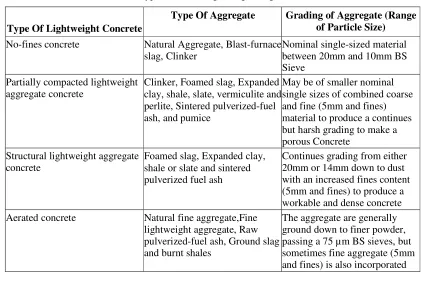
Table 1 Types and Grading of Lightweight Concrete
Type Of Lightweight Concrete
Type Of Aggregate Grading of Aggregate (Range
of Particle Size)
No-fines concrete Natural Aggregate, Blast-furnace slag, Clinker
Nominal single-sized material between 20mm and 10mm BS Sieve
Partially compacted lightweight aggregate concrete
Clinker, Foamed slag, Expanded clay, shale, slate, vermiculite and perlite, Sintered pulverized-fuel ash, and pumice
May be of smaller nominal single sizes of combined coarse and fine (5mm and fines) material to produce a continues but harsh grading to make a porous Concrete
Structural lightweight aggregate concrete
Foamed slag, Expanded clay, shale or slate and sintered pulverized fuel ash
Continues grading from either 20mm or 14mm down to dust with an increased fines content (5mm and fines) to produce a workable and dense concrete Aerated concrete Natural fine aggregate,Fine
lightweight aggregate, Raw pulverized-fuel ash, Ground slag and burnt shales
The aggregate are generally ground down to finer powder, passing a 75 µm BS sieves, but sometimes fine aggregate (5mm and fines) is also incorporated
LITERATURE REVIEW
T. Parhizkar, M. Najimi and A.R. Pourkhorshidi (2011) [1] have presented experimental
investigation on the properties of volcanic pumicelightweight aggregates concretes. To this end, two groups of lightweight concretes(lightweight coarse with natural fine aggregates concrete, and lightweight coarse and fineaggregates concrete) are built and the physical/mechanical and durability aspects of them arestudied. The results of compressive strength, tensile strength and drying shrinkage show thatthese lightweight concretes meet the requirements of the structural lightweight concrete.
N. Sivalinga Rao, Y.Radha Ratna Kumari, V. Bhaskar Desai, B.L.P. Swami (2013) [2]have
studied on Fibre Reinforced Light Weight Aggregate (Natural Pumice Stone) Concrete. In their study, the mix design was M20 and the test results are as follows: More than the target means strength of M 20 concrete is achieved with 20 percent replacement of natural coarse aggregate by pumice aggregate and with 1.5 percent of fibber. Also with 40% pumice and with 0.5% of fibbers average target mean strength of M 20 concrete is achieved.
P.C.Taylor [3] presently a professor at Wuhan University of Technology has said that mineral
admixtures affect the physical and mechanical properties of High Strength Structural Light Concrete. Addition of Fly Ash enhances the compressive strength and splitting tensile strength of HSSLC when FA was more than 20% in cementitious materials, its 28 days compressive strength and splitting tensile strengths are less than those of the concrete without FA. Addition of silica fume enhances the compressive strength about 25% and splitting tensile strength also. Incorporating
Swamy R.H & Lambert G.H (1984) [4] studied above the light weight aggregate and proved that
ISSN : 2581-7175 ©IJSRED: All Rights are Reserved Page 792 MATERIAL PROPERTIES
Cement
In this present work Portland Pozzolana cement confirming to IS 1489.1991 was used. This type of cement is obtained by grounding the Portland cement clinker with fine pozzolanic material and adding possible amount of gypsum. The properties of cement are shown below
Table 2 Properties of Cement
S.No Property Value
1 Specific gravity 2.74
2 Standard consistency 35%
3 Initial setting time 40 min
Silica Fume
It’s a very fine puzzolanic material composed of amorphous silica, which is highly reactive produced from electric arc furnace as by product of production of elemental silica. Silica fume confirming to specifications as per IS 15388:2003 has been used. Properties are shown below in Table 3
Table 3 Properties of Silica Fume
S.No Property Value
1 Specific gravity 2.2
2 SiO2 85% - 90%
EXPANDED CLAY AGGREGATE
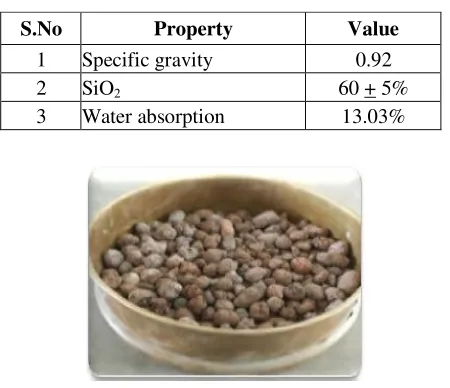
It is a light weight aggregate made by heating clay to around 12000c having the dry density 350kg/m3 approximately, low thermal conductivity, pH nearly 7, high acoustic and fire resistant.
Table 4 Properties of ECA
S.No Property Value
1 Specific gravity 0.92
2 SiO2 60 + 5%
3 Water absorption 13.03%
Coarse aggregate
Coarse aggregates of sizes ranging from 16mm – 20 mm were used confirming to IS383.1970.the various aggregate properties were tested accordingly and their value are shown below
Table 5 Properties of Coarse Aggregates
S.No Property Value
1 Specific Gravity 2.86
2 Water absorption 0.20%
Poly Vinyl Alcohol [PVA]
It’s a water soluble synthetic polymer [C2H4O] which has high flexibility, tensile strength. 7gm
of poly vinyl alcohol was dissolved in 300ml water and was kept aside for 24 hours. The properties of poly vinyl alcohol are shown below
Table 6 Properties of PVA
S.No Property Value
1 Specific gravity 1.19 – 1.26
2 pH Neutral
Poly Vinyl Alcohol [PVA] Water
Mixing of concrete and curing of the prepared specimens was done using water available in college premises.
EXPERIMENTAL PROCEDURE
The experimental investigation is carried based on volume proportions and the cement content was taken to be 394.1kg/m3. Water/cement ratio (w/c) was taken to be 0.45 from previous studies and from various trial mixes. Mix proportion pertaining to 0%, 25%, 50%, 75% and 100% replacement of expanded clay aggregate is considered to carry out investigation. Aggregate sizes ranging from 16 mm - 20 mm were used to prepare the samples of various mix proportions.
Compressive Strength
ISSN : 2581-7175 ©IJSRED: All Rights are Reserved Page 794 properly compacted. All the concrete cubes were de-molded within 24 hours after casting. The demolded test specimens were properly cured in water available in the laboratory at an age of 7 and 28 days. Compression test was conducted on a 2000KN capacity universal testing machine.
Flexural Strength
In this investigation, different concrete mix of ECA replacements as mentioned above is considered to perform the test by-weight basis with 10% of cement replaced by silica fume and 1.6% PVA solution. A 700mm x 150mm x 150mm concrete beam was used as test specimens to determine the flexural strength of concrete beams. The ingredients of concrete were thoroughly mixed till uniform consistency was achieved. The beams were properly compacted. All the concrete beams were de-molded within 24 hours after casting. The demolded test specimens were properly cured in water available in the laboratory at an age of 7 and 28 days. Flexural test was conducted on a -KN capacity flexural testing machine.
RESULTS AND CONCLUSIONS
Compressive Strength
The compressive strength test is carried out as per IS 516:1959 test on hardened concrete. The load is applied without shock and increased continuously at a rate of approximately 140 kg/sq cm/min until the resistance of the specimen to the increasing load breaks down and no greater load can be sustained. The maximum load applied to the specimen shall then be recorded and the appearance of the concrete and any unusual features in the type of failure shall be noted.
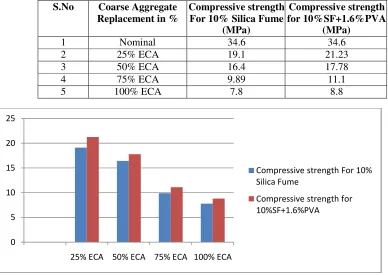
Table 7 Compressive strength for 28 days for various mix proportions
0 5 10 15 20 25
25% ECA 50% ECA 75% ECA 100% ECA
Compressive strength For 10% Silica Fume
Compressive strength for 10%SF+1.6%PVA
S.No Coarse Aggregate
Replacement in %
Compressive strength For 10% Silica Fume
(MPa)
Compressive strength for 10%SF+1.6%PVA
(MPa)
1 Nominal 34.6 34.6
2 25% ECA 19.1 21.23
3 50% ECA 16.4 17.78
4 75% ECA 9.89 11.1
Density
Figure 5.Compressive Strength of Different Mixes
The density of both fresh and hardened concrete is of interest to the parties involved for numerous reasons including its effect on durability, strength and resistance to permeability.Hardened concrete density is determined either by simple dimensional checks, followed by weighing and calculation or by weight in air/water buoyancy methods.
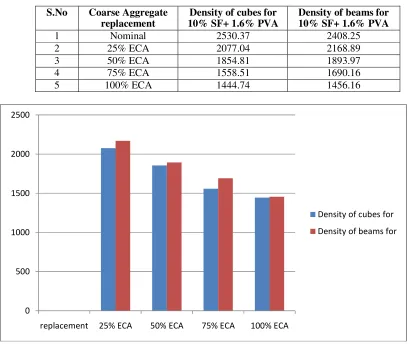
Table 8 Density 28 days for various mix proportions
S.No Coarse Aggregate
replacement
Density of cubes for 10% SF+ 1.6% PVA
Density of beams for 10% SF+ 1.6% PVA
1 Nominal 2530.37 2408.25
2 25% ECA 2077.04 2168.89
3 50% ECA 1854.81 1893.97
4 75% ECA 1558.51 1690.16
5 100% ECA 1444.74 1456.16
Figure 6 Density of Different Mixes
Flexure Strength
The axis of the specimen is carefully aligned with the axis of the loading device. No packing shall be used between the bearing surfaces of the specimen and the rollers. The load shall be applied without shock and increasing continuously at a rate such that the extreme fibre stress increases at approximately 7 kg/sq cm/mm. that is, at a rate of loading of 400 kg/min for the 15·0 cm specimen. The load shall be increased until the specimen fails, and the maximum load applied to the specimen during the test shall be recorded. The appearance of the fractured faces of concrete and any unusual features in the type of failure shall be noted.
0 500 1000 1500 2000 2500
replacement 25% ECA 50% ECA 75% ECA 100% ECA
Density of cubes for
ISSN : 2581-7175 ©IJSRED: All Rights are Reserved Page 796 Table 9 Flexural strength for 28 days for various mix proportions
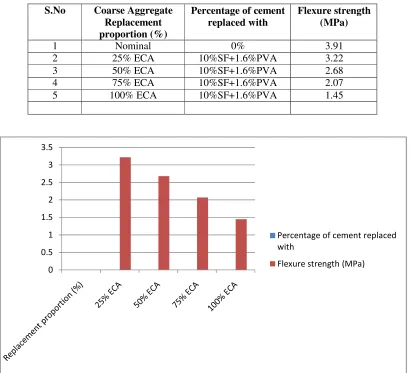
S.No Coarse Aggregate
Replacement proportion (%)
Percentage of cement replaced with
Flexure strength (MPa)
1 Nominal 0% 3.91
2 25% ECA 10%SF+1.6%PVA 3.22
3 50% ECA 10%SF+1.6%PVA 2.68
4 75% ECA 10%SF+1.6%PVA 2.07
5 100% ECA 10%SF+1.6%PVA 1.45
Conclusion
Figure 8 Flexure Strength of Different Mixes
The compressive strength of light weight concrete is lower than the ordinary conventional concrete. Therefore this light weight concrete can be used in places where the external force acting on the structure is minimum. This light weight concrete is only capable to carry its self weight.
The workability of light weight concrete is not good when it is compared to the ordinary conventional concrete. This workability can be improved by introducing microscopic air bubbles into this concrete or air entrainment
The partially light weight concrete may also be used as structural concrete on some cases because it is having the compressive strength value which is suitable for structural.
This light weight concrete has low thermal conductivity and has an ability to absorb sound. So, it can be used for acoustic structures.
The similarly studied can be carried for different design mixes.
0 0.5 1 1.5 2 2.5 3 3.5
Percentage of cement replaced with
An investigation can be made on pre-wetting of the light weight natural pumice aggregate for different mixes.
Studies on fibrous (metallic, nonmetallic and natural) light weight aggregate (Pumice) concretes can be evaluated.
The studies on SSC with light weight aggregate (pumice) can be evaluated)
Behavior of the pumice aggregate concrete mixes with different mineral admixtures can be made.
Durability studies can be carried out by exposing to chloride sulphate and acidic environments.
Elevated temperature studies, freezing, thawing and chloride permeability tests on this particular type of concrete can be studied.
From the above compressive strength results, it is observed that as the percentage of ECA is increasing the compressive and flexure strength is decreasing since, the density of concrete is reduced by addition of ECA
REFERENCES
[1] IS 10262:2009 Concrete Mix Proportioning code book [2] IS 456:2000 plain and reinforced concrete code book
[3] Mohd Roji Samidi,(1997). First report research project on lightweight concrete, Universiti Teknologi Mal aysia, Skudai, Johor Bahru.
[4] Formed Lightweight Concrete. www.pearliteconcreteforrorepair.com [5] Shan Somayuji (1995), Civil Engineering Materials, N.J Prentice
[6] Norizal, Production of Foamed Concrete. USM. www.hsp.usm.my/Norizal/hbp.htm [7] A.M Neville (1985), Properties of concrete, Pitman .
[8] Liew Chung Meng, Introduction to Lightweight Concrete. www.maxpages.com.
[9] Cellular Lightweight Cocrete, Plan City/NCS LLC. www. Neoporsystem.com [10] Flying Concrete-Introduction to Lightweight Concrete, by US Department of Interior
Bereau of Reclamation. www.geocities.com
[11] T. Parhizkar*, M. Najimi and A.R. Pourkhorshidi, “(Application of pumice aggregate in structural lightweight concrete”, asian journal of civil engineering (building and housing) VOL. 13, NO. 1 (2012) PAGES 43-54.
[12] N. Sivalinga Rao, Y.Radha Ratna Kumari, V. Bhaskar Desai, B.L.P. Swami, “Fibre Reinforced Light Weight Aggregate (Natural Pumice Stone) Concrete”, International Journal of Scientific & Engineering Research Volume 4, Issue 5, May-2013 ISSN 2229-5518.
[13] Banthia, N. and Trottier, J., „Concrete reinforced deformed steel fibbers, part 1: Bond-slip mechanisms‟, ACI MaterialJournal 91 (5) (1994) 435-446.
ISSN : 2581-7175 ©IJSRED: All Rights are Reserved Page 798 [15]Balaguru, P.; and Ramakrishnan, V.‟ ‟Properties of lightweight fiber reinforced concrete‟,
Fiber Reinforced concrete-Properties and applications, SP105, American