The University of San Francisco
USF Scholarship: a digital repository @ Gleeson Library |
Geschke Center
Master's Theses Theses, Dissertations, Capstones and Projects
Fall 12-13-2014
REFUGEE RESETTLEMENT AND FAMILY
REUNIFICATION IN CANADA
Yohannes Kenningd Woonssi Sawassi YS Sawassi University of San Francisco, [email protected]
Follow this and additional works at:https://repository.usfca.edu/thes
Part of theInternational and Area Studies Commons
This Thesis is brought to you for free and open access by the Theses, Dissertations, Capstones and Projects at USF Scholarship: a digital repository @ Gleeson Library | Geschke Center. It has been accepted for inclusion in Master's Theses by an authorized administrator of USF Scholarship: a digital repository @ Gleeson Library | Geschke Center. For more information, please [email protected].
Recommended Citation
Sawassi, Yohannes Kenningd Woonssi Sawassi YS, "REFUGEE RESETTLEMENT AND FAMILY REUNIFICATION IN CANADA" (2014).Master's Theses. 140.
1 REFUGEE RESETTLEMENT AND FAMILY REUNIFICATION IN CANADA
A Thesis Presented to:
The Faculty of the College of Arts and Sciences
By
Yohannes Sawassi
In Partial Fulfillment of the Requirements for the Degree
Master of Arts in International Studies
December 2014
University of San Francisco
2 Abstract
This thesis addresses the plight of Sub-Saharan Africans who are now Canadians and are
trying to settle in a new country in order to reunite with their family members. However, rather
than assisting with process of resettlement, current Canadian policy has the opposite effect. It
appears to create a route by which people can sponsor their loved ones, but in reality the nature
of the process is arduous and filled with time delays, regulatory and processing issues and other
kinds of difficulties. Consequently, what therefore appears as a hopeful situation ends up
creating despair. This situation is particularly hard for those who have lived under so many
challenges such as lack of proper food, no health care, racism and threats of violence from
militias. Many of them have lived this way in vain believing that there might be peace and
stability, yet today they still suffer from chronic uncertainty of whether they can see each other
again.
This thesis utilizes primary data collected from refugees in Ottawa and secondary data to
argue that the system that is supposed to help is now failing these people. It shows exactly what
kinds of obstacles are the most problematic to family reunification. It outlines the way that
Canada’s immigration rules and regulations for family reunification via private sponsorship
require a sponsor to have a certain amount of annual income or funds available. This leaves the
low income people of Sub-Saharan origin with no another option but to wait in vain and live a
hand to mouth existence. Looking in detail at these issues, this thesis concludes by proposing
some changes to the system that is causing these problems.
3 Acknowledgments
I would like to thank and express my gratitude to my advisor and supervisor Professor
Anne Bartlett for the useful comments, remarks, and engagement through the learning process of
this master thesis. In addition, I would like to thank the University of San Francisco and the
MAIS program in particular for their academic and financial support. Furthermore, I would like
to thank all the participants in my survey, who have willingly welcomed me, opened their doors
for me, and shared their precious time during the process of interviewing and filling out the
survey questionnaires. Also, I would like to thank my wife who supported me throughout the
entire process, by keeping me harmonious and introduced me to some of her colleagues who
4 REFUGEE RESETTLEMENT AND FAMILY REUNIFICATION IN CANADA
Table of Contents
Abstract………..2
Acknowledgements...……….3
Chapter 1: Introduction 1.1 Background………...7
1.2 Statement of the Problem………...8
1.3 Theoretical Frameworks………..12
1.4 Significance……….15
Chapter 2: Literature Review 2.1 Refugees in Sub-Saharan Africa (why they leave)……….16
2.2 Third-Party reception and resettlement………...18
2.3 Refugee Resettlement to Canada (the third country)………..32
Chapter 3: Methodology 3.1 Choice of Field Site………48
3.2 Objective……….49
3.3 Focus Groups………..51
3.4 Interviews………51
3.5 Limitations………..52
Chapter 4: Data 4.1 Processing and Financial Requirement Data………53
4.2 Private Sponsorship and Impediments ……… 58
4.3 Family Reunification Policies and procedure ………..70
Chapter 5: Discussion 5.1 Impediments of the Private Sponsorship or Family Reunification ………80
5.2 Private Sponsorship Impediments ………..87
5
6.1 Concluding Discussion………..103
Bibliography 7.1 References………..109
Appendices 8.1 Consent………..120
8.2 Interview and Questionnaire Questions Form………...122
8.2 Staff and Representative Interview Questions ……….136
6
“I lived in a refugee camp in Ethiopia for many years. I was dreaming that, one day I would come to a safe and stable industrialized country and live a happy life among my family and relatives. This would be the time for me to be reunited with my family members and relatives since we were separated during the war since the late 1980s. Then after I came to Canada, I thought that it was the moment to sponsor my relatives to join me in Canada. And to my surprise, I found out that it is impossible because the process does not appear to be as I imagined.” 1
1
7 Chapter 1: Introduction
1.1 Background
Across the world, particularly in areas of conflict, people are forced to leave their countries of
origin and migrate to live in other countries. Driving this process are a variety of push and pull
factors that include war and fear of persecution. Fear of persecution may be due to religious
faith, ethnicity, political opinion, sexual orientation, or because they are members of a particular
group. Forced migration due to war happens as a result of conflict or conflict related violence,
which generates insecurity and makes it impossible for those caught up in the violence to remain
where they are. Those forced to flee may be subject to violence from persecutors who hold
opposing interests or, in many cases, from the very state that is supposed to protect them.
If conflict is one reason why people flee, on other occasions people leave in order to
reunite with their families or relatives from whom they are separated. Such people seek to reunite
and reconstitute their family in another location where they can find better living conditions and
job opportunities. This paper is about family reunification and the problems that result from
forced and other types of migration. The focus is on resettled refugees and the ways in which
they attempt to navigate the Canadian Refugee resettlement program from abroad. Specifically,
this thesis analyzes the situation of Sub-Saharan Africans, who in many cases have already
crossed borders inside Africa rendering them refugees, but were subsequently resettled through
UNHCR’s resettlement policy to third country, in what has been termed a “durable solution” for
them. Today some of these people are Canadian citizens, some are permanent residents of
8
In many respects, the plight of the refugee population that I am analyzing is somewhat
different to other refugees. Before these Africans were able to come to Canada, the majority of
them were forced to leave their countries of origin and live as refugees in neighboring countries.
Some of them were living in defined camps under the control of agencies such as the UNHCR.
Others were living in towns where, as a diffuse population, they are far harder to track and
provide services for. Sadly, almost all of them have lost family members, relatives, community
members and friends along the way in this long process. Those who made it to cities such as
Cairo, for example, were able to be resettled to a third party country once they had followed the
UNHCR system. They are, as a result, refugees who have to leave once more.
Canada is one of the main receiving countries for third party repatriation along with
Australia, and the United States. However on reaching Canada, although they are permitted to
reunite with family members it is not an easy process. In Canada, the majority of these
immigrants face serious challenges when they want to reunite with their family members or
relatives, leaving them feeling isolated and unable to fully participate in the country that is now
their host. In this paper I attempt to analyze these challenges more fully and to understand the
processes that exclude them.
1.2 Statement of the problem
The purpose of the paper is to understand the plight of Sub-Saharan Africans who came
to Canada as resettled refugees and want to reunify with family members. At the heart of my
concern is the denial of their rights as part of this process. Thus, such people face horrible
violations of their human rights in their own countries, those who survive flee their countries and
live as refugees in the neighboring countries. Generally, the majority of these refugees live in the
non-9
governmental organizations (NGOs). Also, there are some of them who live as refugees in the
urban cities of the host countries or countries of asylum as well. Since both groups are refugees,
they are under the protection of UNHCR (the UN refugee agency).
In some situations, though these refugees are protected by UNHCR, they still face some
difficulties whether they live in refugee camps or urban cities. Some face insecurity problems in
the host country. Others face poor living conditions in the overcrowded refugee camps. Once in
refugee camps, the situation hardly improves. In most refugee camps, there is lack of insecurity,
proper nutrition, education, and health care. On top of these problems, some live without their
parents, spouses, children, siblings, relatives, and community members. In most cases, this
happens because they were separated when they were fleeing or leaving their countries of origin.
Also, some refugee camps are located in the isolated areas in some host countries. This makes it
difficult and even impossible for those refugees to communicate with other people outside the
refugee camps. As a result, they have no other options, but to continue staying in the camps. In
other host countries, these refugees may stay for several decades in one camp. For example,
some of the Burundian and Rwandan refugees have been staying in the refugee camps in
Tanzania for many decades. Therefore they continue living in limbo in the refugee camps until
some lucky ones among them get one of the UNHCR’s durable solutions (which is mostly a
resettlement to the third country).
The UNHCR has three durable solutions for refugees. They are: local integration,
voluntary repatriation, or a resettlement to a third country. Luckily, some of these refugees may
be offered a resettlement opportunity to a third country. In most cases, many of them are
resettled to industrialized countries such as Canada, United States, United Kingdom, Australia,
10
The subject matter of this paper is third party resettlement of Sub-Saharan African
refugee immigrants to Ottawa, Ontario, Canada. Although resettlement may change their lives
from being refugees to becoming permanent residents and citizens of a new country eventually,
this may not solve their problems. Many of these immigrants in Ottawa still suffer from some of
the same problems they used to face before coming to Canada. Isolation in particular is a big
problem because they are still separated from their family members or relatives. This is because
some arrive in Canada without their family members, relatives, spouses, children, and siblings.
All of these problems are compounded by other issues such as lack of communication
and lack of relevant job skills which would allow them to obtain employment and be able to
sponsor their families. First, they may not know how to communicate in English or French
language. Furthermore, lack of proper education, and work skills mean that the majority of them
live on minimal wage paying jobs in Ottawa and some live on social assistance (welfare).
Adding to these problems is the living cost in Ottawa which is very high compared to many other
Canadian provinces and territories. Basic needs such as rent, transportation, food or groceries,
and clothes are very expensive. The consequence of these accumulated issues is that refugees
face financial problems, loneliness, hopelessness, health deterioration and confusion in some
cases. As a result, for some of them, these problems cause marriage failure and disintegration of
the family unity eventually. After everything that they have gone through, this may make some
of them feel as if they are living in an unsafe place. In serious cases it can make some of these
refugees suicidal.
Where the government is concerned, Canada has been admitting resettled refugees from
abroad for many decades to fulfil its humanitarian obligations. Canada’s immigration system
11
family members through private sponsorship for refugees program. Yet in reality, sponsoring a
family member or relative through Canada’s Private Sponsorship for Refugees program may not
be as easy as it sounds. That is to say, to qualify, a person must have a lot of money, a better
paying job to have high annual income, and if not, one may be in need of getting extra help from
one of the qualified community, faith based, charitable, or humanitarian organizations. Needless
to say, for many of these immigrants, it is not easy to get a private sponsorship support from such
organizations. For this reason, the majority of the resettled sub-Saharan Africans find that it is
impossible to reunite with their separated loved ones to come to Canada. Yet, every year, Canada
welcomes thousands of new immigrants through its immigration programs, further adding to the
problem.
At the heart of my thesis is an analysis of the feasibility of current reunification options
and the implications this has for their ability to actually settle in their new country. For the most
part, today the responsibility for reunification falls on the shoulders of the refugees themselves
rather than the Canadian Government. Yet this policy may have serious consequences to the
social and psychological well-being of those who are stranded far away from their kin. In
particular, because life is hard for new refugees who have been resettled to a third-party country,
it may be some time before they can raise the finance to bring those they have left behind. This
means that the refugees can be living in a liminal situation of neither belonging to one place nor
another for some time.
As a result of this situation I analyze the factors which may prevent refugees from
achieving reunification with their family members and relatives. I look at the issues that prevent
some of these resettled immigrants in Canada from being able to privately sponsor their family
12
to succeed in reuniting with their loved ones – what the effects are on them and their family
members or relatives with whom they got separated and left behind in sub-Saharan Africa. Does
it mean their rights are violated by the immigration system of their new country or it is up to
them whether they succeed in sponsorship or not?
Moreover, to see how these new Canadians and permanent residents deal with the
situation of the reunification, I have interviewed a sample of people living in such circumstances
and asked a limited number to fill out survey questionnaires. The information I obtained is from
both males and females of 18 years old and above, who are originally from Sub-Saharan Africa.
Furthermore, I interviewed a few representatives of the Private Sponsorship Agencies to find out
how do they help these Canadian citizens and permanent residents of Canada and even the
refugee claimants when they want to reunite with their family members left behind. The goal is
to analyze responses and to suggest different policy priorities for such groups in the future.
1.3 Theoretical Frameworks
Canada’s current Immigration Act provides many ways for the new immigrants to
integrate into larger Canadian society. Integration is usually accomplished through a network
that includes federal, provincial, local levels of government together with, refugee settlement
service centers, charitable organizations, faith based organizations and humanitarian providers.
Integration at the local level is also accomplished by communities and groups as well. Yet,
despite this wide array of service providers, many immigrants, especially the ones coming from
Sub-Saharan Africa, do not find it easy to integrate into larger Canadian Society. This is because
many of them still feel that they are not able to live in Canada perfectly and be part of the society
since part of their family members or relatives are not living with them. The reason behind this is
13
Canada’s refugee resettlement program from abroad. Yet, before coming to Canada, many of
them did not know the whereabouts of their family members or relatives because they were
separated from each other during the plight or when part of the family was abruptly fleeing the
country.
Although Canadian Immigration systems allows family reunification for the eligible
permanent residents and the citizens, in practice it is rather difficult to achieve for some of the
immigrants. In the book, The Limits of Citizenship: Migrants, and Postnational Membership in
Europe, Yasemin Soysal argues that the ability of refugees to integrate into society is determined
by the nature of state incorporation strategies. In this paper I argue that the method of
incorporation of refugees in Canada does not help new refugees adapt to the society. While it
appears de jure that the law protects the refugees in question and their human rights, the de facto
application of this law leaves refugees without many options. In particular, I argue that the
failures of the family reunification policy leaves them feeling isolated, stressed and unable to
adjust to the new demands of their host society.
Soysal’s work mainly concentrates on European communities, but many of her comments
might just as well relate to Canada and United States. The only difference may be that, though
the concept of citizenship is supposed to give full rights and liberties and open the ways for the
citizens of the state to peruse things as they were dreaming about, it is not equally applicable to
every individual citizen of the state. For example, unless you are financially well off in Canada,
being granted citizenship does not grantee you everything. Having said this, there are many
Canadians particularly the ones of Sub-Saharan African origin who thought becoming a
Canadian citizen might have given them chances to reunite with their once separated family
14
enough income to qualify. Therefore, sometimes the idea of liberties and rights granted under the
citizenship remains a sort of theoretical concept which is true only by law, but impossible to
actually put in practice as in case of family reunification issue in Canada. In addition, when a
citizen or a permeant resident of a country sees that she or he cannot achieve the most vital
things such as being reunited with the loved ones in her or his new country, he or she may feel as
if his or her status in that country is more temporary, than permanent.
If one issue is refugees’ financial ability, then a second issue is, as Soysal points out, the
integration of the new immigrants and the strategies that states can adopt to assist them. Some of
the rules that exist within a country can both intentionally and unintentionally help and hinder
incorporation. In the case of Canada, the majority of the immigrants who originally come from
Sub-Saharan Africa, may have difficulty incorporating into the main stream Canadian society.
First, these new Canadians and permanent residents live in the country without their family
members or close relatives. Second, the majority of them spent many years in refugee camps
before they came to Canada. That is also why many of them missed better or at least formal
education before coming to Canada. Third, Canada is a bilingual country (English and French
languages). Fourth, it is difficult for them to get better paying jobs and this is due to the luck of
better education, proficiency of both languages or either and for some old age. Fifth is the rules
of the new country which can be so complicated that they disadvantage the very people that they
are supposed to help.
Regardless of these people’s cultural background, traditions, their love and duty towards
their separated family members and relatives is a major obstacle to them integrating into the
society, when they are away from such? Can such a person feel that her rights are being granted
15
State? For such a person, what would be the meaning of the citizenship, integration, assimilation,
and a productive membership of the state? The matter of fact is, though he or she has no other
options, but to accept living in the new country, citizenship rights may seem an unattainable
prospect. Instead, she or he may feel that they are living in limbo. That is, they are neither part of
the new country nor of the old one which forced them to leave.
1.4 Significance
Sometimes we are unable to see unnoticed humanitarian issues taking place under our
nose – even in some developed countries such as Canada, United Sates, and other industrialized
countries. These issues have grave consequences for people we try to incorporate, but somehow
are forced to live in a situation where they can’t fully settle.
Refugees become refugees because their basic needs were deprived by their own states.
That is, they were either prevented from getting equal rights such as education, health care,
security, freedom of speech, legal rights, and protection so on, from their countries of origin.
Yet, after they come to Canada, there are many other obstacles preventing them to live a full and
stable life in Canada. Many of these people came to Canada leaving behind some of their family
members and relatives. They think, coming to Canada, might give them chance to be reunited
with their loved ones and live a normal life. All these factors taken together create a situation in
which these new Canadians eventually find themselves alienated. This thesis draws attention to
16 Chapter 2: Literature Review
Literature Review
This literature review addresses the problems facing Sub-Saharan African Refugees in their
pathway to resettlement. In particular, it utilizes the framework of Yasemin Nuhoglu Soysal2,
who looks at the ways in which migrants are incorporated into host states. She points out that,
there are differences in the ways that new migrants are brought into the polity and given their
rights. My thesis further develops her points by showing the differences between what states say
they do in terms of incorporation and what immigrants encounter in reality. This means, while
immigrants are naturalized in the new country, they still face some problems such as family
reunification or equal rights in terms of job opportunities. In fact, compared to European system
of immigration, Soysal’s work also reflects the issue of other immigrants’, struggle in Canada
and in particular sub-Saharan African origins in Ottawa, Canada.
There are many literatures that are relevant to the issues being examined here. I therefore
split this literature review into three sections. The first is the forced migration literature -- and in
particular in this case, the forced migration literature relating to Sub-Saharan Africa. This part is
therefore entitled “why they leave”. The second section relates to third party reception states and
the “durable solutions” they propose in conjunction with the UNHCR to be finally resettled. I
call this part “third-party resettlement or Refugee Resettlement to Canada”. The final part of this
literature review looks at reception in the final host country. Here I analyze the sorts of policies
that refugees face and analyze the particular circumstances of reception in Canada and in
particular, in Ottawa.
2.1 Refugees in Sub-Saharan Africa (why they leave)
2
17
Throughout the literature on the subject of why refugees leave, writers portray the major
causes of the forced migration and displacement of people in Sub-Saharan African countries as
occurring due to the fight against resources, religious tensions, border issues, ethnic domination
and political contests. However as I argue here, while these may be the most immediate and
obvious reasons why refugees leave, they are backgrounded by much more significant
underlying reasons that are, for the most part, historical in nature.
The factors which contribute to the root causes of forced migration among Sub-Saharan
Africans are mainly related to historical legacies such as slavery and colonialism. These
dynamics created violence due to civil wars which often occur between diverse ethnic
populations. For example, Sudan alone has more than one hundred indigenous spoken
languages3. Mark Doyle4 adds that, Kenya has more than forty ethnic groups. In addition, the
Democratic Republic of Congo has 250 ethnic groups,5 and so on. According to Mahmood
Mamdani, ethnic groups and tribes were often the subject of colonial attempts to map, categorize
and utilize the African population for colonizers needs.6 Sub-Saharan Africa is one of the
continents which was, and is still affected by the problems caused by external influences,
impacts, and policies of the non-African former rulers in Africa. The interference by external
actors has in fact created many instability and insecurity problems on the continent. The issue of
forced migration and its causes is deeply related to insecurity problems in Sub-Saharan African
countries.
3
JRank, Countries and their cultures, 2015. URL= http://www.everyculture.com/Sa-Th/Sudan
4
Mark Doyle, “Kenya stokes tribalism debate”. (BBC News, January 4, 2008.) URL.= http://news.bbc.co.uk/2/hi/africa/7168551.stm
5
Encyclopedia of the Nations - Africa, 2015. URL= ttp://www.nationsencyclopedia.com/Africa/index.html
6
Mamdani Mahmood. Citizen and Subject: Contemporary Africa and the Legacy of Late Colonialism.
18
Africans and Sub-Saharan Africans in particular still suffer from these consequences
until today. Furthermore, although some of these Africans’ problems may be related to some
structural violence such as civil wars, extra and intra-state wars and conflicts, but most of the
root causes are related to historical legacy. Clara Fischer and Ruth Vollmer in Migration and
Displacement in Sub-Saharan Africa argue that part of the causes of Sub-Saharan African
migration can be attributed to poverty and development7 yet even the issue of poverty and
development, the causes are politically rooted in the historical legacies.
2.2 Third-Party reception and resettlement
The net result of this situation is that Sub-Saharan refugees have been forced to flee
situations of violence and persecution from across the entire continent. Contrary to other groups
in history, they do not reach their final location right away. Instead they are funneled through
third party states who have agreements with the UNHCR. Some of the refugees are housed in
camps when they arrive in the third party location; others find themselves living among urban
dwellers in towns. It is in these locations that they wait until they are offered a “durable
solution” from the UNHCR and other entities involved in migration – a point that I will refer to
later in this section.
This section addresses written literature is about problems and difficulties refugees face
in the camps and urban areas in the cities as they wait for third party resettlement. In the
UNHCR Handbook8, historically, the idea of protecting refugees, dates back to the period
1921-1946 and it was at that time, that the international community began to take refugee issues
seriously. Therefore, refugees were protected and assisted based on humanitarian grounds. As a
7
Clara Fischer and Ruth Vollmer (eds.), Migration and Displacement in Sub-Saharan. The
Security-Migration Nexus II, International Conference. Germany: Bonn.13-14 February 2009.
8
UNHCR’s, Handbook and Guidelines on Procedures and Criteria for Determining Refugee Protocol
19
result, the UNHCR Handbook9 about refugee protection says, “The pattern of international
action on behalf of refugees was established by the League of Nations and led to the adoption of
a number of international agreements for their benefit”. In this case, refugees are defined
according “to their national origin, to the territory that they left and to the lack of diplomatic
protection by their former home country”10. During that time, these refugees were called
‘statutory refugees’11.
Yet, the refugee problem was not solved even after the World War II. Therefore, there
was a need to expand the definition of the refugee. For this reason, The Handbook says, 12 “The
Convention relating to the Status of Refugees was adopted by a Conference of Plenipotentiaries
of the United Nations on 28 July 1951, and entered into force on 21 April 1954”. Thus the
refugee definition in this convention was “a person who: As a result of events occurring before 1
January 1951 and owing to well-founded fear of being persecuted... is outside his country of
nationality...”13 .This Convention definition gave less responsibility for the governments to take
care of refugees during that time. Instead, many refugee producing problems occurred later on
and the number of the refugees increased which urged the international community to make the
refugee definition more inclusive. That is why the General Assembly of the United Nations
prepared a Protocol relating to the Status of Refugees on thirty-first of January 1967. The
Protocol became effective “on 4 October 1967”14 .Once more, the aim of the paper is not to
9
UNHCR Handbook, Revised, Geneva, December 2011.
10
(Ibid)
11
UNHCR’s Handbook, Frequent Asked Questions about Resettlement- April 2012. URL=
http://www.unhcr.org/4ac0873d6.pdf.
12
UNHCR, Handbook and Guidelines on Procedures and Criteria for Determining Refugee Protocol
Relating to the Status of Refugees, December 2011.
13
(Ibid)
14
20
explain historical background of the refugees in details, but to give a brief background of
UNHCR’s role in protecting refugees.
The main idea of following a brief historical background of the (UNHCR, 2001-2014) is
that, in fact, the UNHCR has been protecting, helping, assisting, and finding solutions for the
people who are in dire humanitarian situations for a long time. That is to say, it has been doing
this action for over sixty years. Historically, the UN refugee agency started during the outpouring
of displaced people during the ‘World War II’. The aim was to help the people who were
forcibly displaced by the conflict in Europe15. For example at the time, the first biggest numbers
of refugees helped by the UNHCR, from its start were the Hungarians. That is, thousands of
Hungarians became refugees after the forces of the Soviet Union defeated the Hungarian
Revolution in 1956 as in the Handbook. Apart from Europe, there was still a need to expand
UNHCR’s role outside Europe.
That is why the second largest number of the refugees helped by the UNHCR after
Europe were African refugees. Thereafter, its help for refugees continued for more than twenty
years. Also, it had to help refugees produced during the crisis of Asia and Latin America. In the
African case, until today, the UNHCR still helps African refugees. In a UNHCR report about
Africa16 it says “Massive new displacements caused by conflict, violence and human rights
abuses are likely to continue to affect many countries on the continent in 2015.” Further example
15
“established on December 14, 1950 by the United Nations General Assembly with a three year mandate to complete its work and then disband” (Ibid). nevertheless, on 28the of July, a year from its inception, “the United Nations Convention relating to the Status of Refugees – the legal foundation of helping refugees and the basic statue guiding UNHCR’s work – war adopted”
16
UN High Commissioner for Refugees (UNHCR), 2015 UNHCR regional operations profile – Africa.
21
of similar account is in UNHCR Global Appeal for Africa,17 which says, “Maintaining protection
space UNHCR will build a more favourable protection environment by ensuring that people of
concern can avail themselves of fair protection processes and receive documentation”18.
Movements for self-determination during the African uprising for decolonization in 1960s also
produced hundreds of thousands of refugees on the continent.
For example, such were the wars for independence in different parts of Sub-Saharan
Africa that they created massive outflows of people. Some of them are mentioned in the book
Decolonization of Africa by David Birmingham19 who says that these African wars were mainly
meant for the freedom from colonization in Africa. Also Anthony Clayton20 in The French Wars
of Decolonization adds that, apart from Indo-China and Algeria, there was also insurgency
struggle on side of Madagascar fighting for decolonization. He furthermore adds that, part of the
second half of the 20th century includes the wars of independence in the history of the armed
conflict in Africa. This is another evident showing that conflict which produce refugees in
African have the colonial legacy which are also called struggles for decolonization in Africa21. In
this case, in The End of Colonial Rule: Nationalism and Decolonization, Falola Toyin22 says, to
end the colonial ruling system caused many wars of independence in the African history.
Therefore the effects of such wars forced many Africans to flee their countries of origin and
became refugees in other neighboring countries. In addition, although some of the African
17
UN High Commissioner for Refugees (UNHCR), UNHCR Global Appeal 2014 – 2015 – Africa. URL=
http://www.unhcr.org/528a0a180.html
18
UN High Commissioner for Refugees (UNHCR), UNHCR report shows world’s poorest countries host
most refugees. UNHCR 2001 – 2015, Wednesday January 7, 2015. URL=
http://www.unhcr-centraleurope.orgen/news/2015/unhcr-report-shows-worlds-poorest-countries-hostmostrefugees.html
19
Birmingham David. The Decolonization of Africa. London: University College London, 1995.
20
Clayton Anthony. The French Wars of Decolonization. London: Longman, 1994.
21
Clayton Anthony. Frontiersmen: Warfare in Africa since 1950. London Routledge, 1999.
22
Falola Toyin, ed. Africa Vol. 4: The End of Colonial Rule: Nationalism and Decolonization. Durham, NC:
22
independence wars were called insurgency wars, the reality is they were all wars for the struggle
of decolonizing themselves from the European influence23. Again, by the end of the 20th century,
UNHCR continued helping some more victims of war crisis, mainly in Africa, and the Balkans
in Europe. More conflicts once more produced hundreds of thousands of refugees in these two
continents in as in the Handbook. Therefore, since that time, the UNHCR continued helping the
needy in sequence up to the present.
Although in both the UNHCR’s Handbook, 201124 and Guidelines on Procedures and
Criteria for Determining Refugee Status and UNHCR’s Handbook, 200725 For Emergencies,
say, it is the responsibility of the UNHCR, State parties and other UNHCR’s NGOs partners to
protect and take care of refugees in all the aspects of their lives. Yet as it says in the UNHCR
Global Trend 2013, “, War’s Human Cost26. Sometimes the ability or the implementation of the
rules may not be sufficient when the numbers are more than expected. That is why many
refugees in Sub-Saharan Africa are living in dire situations without the help that laws say should
be provided.
When these Africans are forced to flee their countries because their lives are in danger,
insecurity reasons and safety for their families and relatives, they have to find temporary
settlement somewhere. In this case, the first type of settlement has to come through seeking
23
Turner John W. Continent Ablaze: The Insurgency Wars in Africa 1960 to the Present. Johannesburg:
Jonathan Ball, 1998.
24
The UN High Commissioner for Refugees (UNHCR), Handbook and Guidelines on Procedures and
Criteria for Determining Refugee Status under the 1951 Convention and the 1967 Protocol Relating to the Status of Refugees, December 2011. URL= http://www.refworld.org/docid/4f33c8d92.html [accessed 7 April 2015]
25
United Nations High Commissioner for Refugees, Handbook for Emergencies, (Third Edition). Geneva,
February, 2007. URL= http://www.refworld.org/pdfid46a9e29a2.pdf
26
UNHCR Global Trend 2013: War’s Human Cost. URL=
23
refugee status. That is, they seek protection from the international community via the UNHCR27.
In its rules and guidance, UNHCR and its state partners determine the status of these people by
using criterion of United Nations Convention for Refugees status determination as said in the
Handbook. In this way they would be protected by UNHCR28and its other NGOs29. Therefore,
according to 1951 Convention and 1967 Protocol relating to the Status of the Refugees, a refugee
by definition is, “ a person who: As a result of events occurring before 1 January 1951 and owing
to well-founded fear of being persecuted …is outside his country of nationality…” UNHCR30.
That is why UNHCR and its state partners follow this definition when determine the status of a
refugee.
In some countries such as Egypt, it is the UNHCR’s responsibility to determine refugee
status and some partner states have obligations according to the 1951 Convention to determine
the refugee status too. That is, “States therefore have the primary responsibility for determining
the status of individuals who arrive on their territory, and in particular for determining whether
an individual is a convention refugee entitled to international protection.”31 If so and after the
individuals recognized as refugees, they are under the protection of UNHCR and its partners or
host countries. In almost all of the Sub-Saharan countries, it is mostly UNHCR’s responsibility
to find solutions for the refugees. For example, “UNHCR’s mandate has a vital protection
27
UNHCR, Handbook and Guidelines on Procedures and Criteria for Determining Refugees Status.
Switzerland: Geneva, Reissued December, 2011. URL= http://www.unhcr.org/3d58e13b4.html
28
The UN High Commissioner for Refugees (UNHCR), UNHCR Resettlement Handbook: Division of
International Protection. Switzerland: Geneva, Revised Edition, July, (2011:73-103). URL= http://www.unhcr.org/46f7c0ee2.pdf
29
Refugee status at the universal level is governed by the 1951 Convention Relating to the Status of Refugees (hereafter the 1951 Convention) and its 1967 Protocol. State parties to the 1951 Convention have assumed specific obligations towards refugees, including establishing procedures to identity who is a refugee and is therefore entitled to rights and protections afforded under the 1951 Convention.
30
The UN High Commissioner for Refugees (UNHCR), UNHCR, Handbook and Guidelines on Procedures and Criteria for Determining Refugee Status under the 1951 Convention and the 1967 Protocol Relating to the Status of Refugees, December 2011. URL=
http://www.refworld.org/docid/4f33c8d92.html [accessed 7 April 2015]
31
24
function and is the precondition to implementing durable solutions, including resettlement”32.
Yet, sometimes durable solutions are not found easily and refugees are living in protracted
situations in camps and urban cities in the host countries. This means some of them spend
decades in camps and in cities in host countries. This is further explained in UNHCR’s33,
protracted refugees situations. There is also reluctance on the side of third party countries to
accept refugees for resettlement. Furthermore, some resettlement countries have different reasons
not to accept refugees to be resettled in their countries. These are different ideologies about
immigration, existing financial burdens, insecurity issues, and some demand for redefinition of
1951 UNHCR convention for Refugee Status, in the UN report. It is for these and many other
reasons leave Sub-Saharan African refugees in protracted situations.
Moreover, even if UNHCR and its partners are the legal body to protect them, their given
protection is limited or may not be satisfactory in many situations. This shows that, when people
lose their countries of origin or their natural abodes due to the above mentioned reasons, they fall
victims to many problems. Some of the problems they face relate to the situation that refugees
and displaced persons live in. For example, In the Refugee and Labor Movements in
Sub-Saharan Africa, Baker and Zetter34 explain the issues with refugees’ shelter in the region. They
argue that it is difficult to provide proper housing to the refugees because the numbers involved
and building materials expensive in most places. Refugees are also easily targeted by the foreign
state or country of asylum or even their own country such as in the case of internally displaced
32
(Ibid)
33
The UN High Commissioner for Refugees (UNHCR): Protracted refugee situations: The searching for
practical solutions, 2006. URL= http://www.unhcr.org/4444afcb0.html
34
Jonathan Baker and Roger Zetter. Refugee and Labor Movements in Sub-Saharan Africa. Sweden:
25
persons of Darfur in Sudan,35 and in other camps such as in South Sudan and the Democratic
Republic of Congo. 36. That is why sometimes refugees and displaced persons have to be
protected by AU and UN peace keeping forces so as not to be harmed by the government of
Sudan forces and their militia, the Janjaweed. Crinne Meyer37 argues that issues like sexual
assault against women and girls in refugee and displaced camps is a big problem that many
refugees also face.
All of the above factors also create disintegration and separation among families,
communities, societies, or nations of the same country. That is, in some cases, when such crises
take place, it is so abrupt that, the affected people may have no chance to flee the country
together as a whole family, community, society or nation. This means, when such crisis hit,
people flee in different directions in order to save their lives38. Thus, some leave their loved ones
behind and eventually find themselves in a second country where communications between them
are lost. This can be due to the lack of knowing the whereabouts of each other or maybe there is
no means of communications at all. Then they continue living isolated and separated from each
other like that, maybe for dedicates.
Although almost all the refugees’ living situations are bad in the developing countries,
the Sub-Saharan African refugees’ living conditions in the refugee camps and urban cities is the
worst of all. This issue is highlighted by Maja Janmyr39 in Protecting Civilians in Refugee
35
UNHCR country operation profile-Sudan, 2015.
36
UNHCR Global Appeal, 2015.
37
Carinne Meyer. “In Need of Protection” Addressing Sexual Assault against Women and Girls Associated with the Collection of Firewood in Refugee Camps in Sub-Saharan Africa. October 2005. URL= http://www.cpcnetwork.org/wp-content/uploads/2014/25.-SGBV-and-firewood-collection-2006.pdf
38
UNHCR, East and Horn of Africa, 2012.
39
Maja Janmyr. Protecting Civilians in Refugee Camps. Unable and Unwilling UNHCR. Library of
congress, 2013.
26
Camps. That is in many countries, refugees find themselves cornered in very small and remote
places in camps, such as Kakuma, Kenya. They live in the overcrowded tents in the refugee
camps, or in the apartment units or houses if they happen to be living in the urban cities in the
foreign country. In Global Development Mark Anderson adds that this year more Sudanese and
South Sudanese refugees arrived in Ethiopia, but the resources in terms of housing and resources
to sustain them are scarce. Sometimes people find themselves in cities because neighboring
countries do not allow refugee camps in their countries.
One example of this phenomena is Egypt. In this case, there are also thousands of
Sub-Saharan African refugees who live in the cities in Egypt. These are mainly refugees from Sudan,
South Sudan, Ethiopia, Eritrea, Somalia, and others. They too, are under the protection of
UNHCR and its partners such as WFP (World Food Program).40 More information about
UNHCR’s working partners and their roles in such cases can be found in the UNHCR Egypt
Factsheet, 201441. Although the UNHCR and its partners provide some basic needs for the
refugees in cities, still they do not have that much. Refugees in the cities also face the same
issues like other refugees in camps. These are mostly shortage or the lack of proper housing
(overcrowding), no jobs or better jobs, no chance of education for the majority, no good health
care when needed plus many other basic needs.
In addition, although the UNHCR does take care of the refugees, it also does not provide
them with all the necessities of life. Therefore, refugees are obliged to look for other means to
earn a living. Thus, some take whatever is available by low paying or menial jobs. And these
may be the kind of jobs which they never experience in their lives before. It can be jobs such as,
40
UNHCR Global Report, 2013. URL= http://www.unchcr.org/539809d916.html
41
27
cleaning the floors of the houses of other people, or working as servants in the houses of rich
people. Some are even obliged to work as prostitutes. Some refugees living in camps risk their
lives and work as firewood collectors or work as wood cutters and sell them as building materials
to other people. As mentioned earlier, sometimes they get sexually assaulted or attacked by
rebels or militia in those areas. In addition, some of the refugee mothers and girls also find
themselves in a situation that, they are the only bread winners for their family members in the
refugee camps. In such situations, they find themselves playing the role of the households which
might have been totally against their cultural background.
Other problems refugees face in the cities of host countries are arbitrary arrests by the
authorities, maltreatment on the side of host citizens, racism, lack of recognition of their rights
on the side of some authorities, sometimes violation of non-refoulement obligations on the side
of host countries which leads to forcibly return of refugees to their countries of origin such as
happened to some Somali refugees in Kenya, some Sudanese asylum seekers from Egypt, and
Eritrean refugees in Sudan says in the NGO Statement on International Protection, 201242. There
is also denial of registration of some asylum seekers, prevention of employment, revoking of
their status such as happened to some Burundian refugees in Tanzania, and compulsory visa
renewal even on the UNHCR refugee status cards as it happens to all the African refugees in
Egypt as stated in UNHCR document. Further information about such issues can be found in
Advocating Together for Protection, commissioned by the UNHCR in, 201343. More information
about the problems facing these refugees both in camps and urban cities is also in 2014 UNHCR
42
Executive Committee of The High Commissioner’s Program. NGO Statement on International
Protection, Agenda 5. 63rd Meeting 1—5, October 2012. URL= http://www.unhcr.org/5072d2489.html
43
UNHCR Annual Consultations with Non-Governmental-Organizations: Advocating Together for
Protection. International Conference Center, Geneva (ICCG): Report, 11 to 13 June 2013.URL=
28
Annual Consolations with NGOs UNHCR, Rapporteur’s Report, 201444. This report tells more
about how to recognize such problems and how UNHCR and its partners would solve such
problems and also empower women and girls to play an important role in solving some of these
problems. These and other similar issues are the situations refugees face in host countries. If
living standard and aid provided are problems, then violence directed against refugees is another
problem. Refugees and Displaced people suffer from attacks in their refugee camps by either
rebel groups, militias or even government soldier of the host country.
Durable Solutions, although UNHCR’s durable solution for refugees can be Voluntary
Repatriation to the country of origin when there is peace, security and instability, Local
Integration in the country of refuge also when there is security, peace and instability or
Resettlement to the third country. The later one is what I mean by durable solution here.
Therefore, according to UNHCR’s Resettlement Handbook, 199745, durable solution by
definition is providing “solution for the refugees who are unable to return home or to remain in
their country of refugee”. Thus this is the type of durable discussed in this paper. The available
literature in this section is all related to the UNHCR’s role in finding durable solution for
refugees.
Before the advent of the concept of durable solutions most human beings and their
societies have been accepting others humans to take refuge in their places. This was for the
victims who were threatened by other people or persecuted by the authorities of their countries of
44
2014 UNHCR Annual Consolations with NGOs (UNHCR, Rapporteur’s Report, 2014). Report on UNHCR’s Annual Consultations with Non-Governmental Organizations: 17 - 19 June 2014 – Switzerland: Geneva, URL=
https://icvanetwork.org/system/files/versions/2014%20Rapporteur%27s%20Report%20of%20UNHCR%2 0NGO%20Annual%20Consultations.pdf
45
United Nations High Commissioner for Refugees, Resettlement Handbook, 1997. Division of
29
origins or states. Example of such historical protection is the help that was given to people who
leave their normal abodes because of some natural catastrophes such as flood, volcanoes and so
on. Therefore in this case, before the establishment of UNHCR, the protection of victims of war
and other crisis used to be a responsibility of some individuals such as kings, chiefs, or headmen
of the villages or towns to protect and take care of the victims of the persecution and violence. In
most cases, they used to protect the affected people based on the humanitarian understanding
they inherited from their ancestors. For example in Refugee Protection in International Law,
Frances Erikafeller46 says, “The 1951 Convention Relating to the Status of Refugees and the
1967 Protocol to the Convention are the modern legal embodiment to the ancient and universal
tradition of providing sanctuary to those at risk and in danger” and apart from this local people
also used to protect them.
Currently, in most places in the world, this responsibility is now mainly taken by the
UNHCR (United Nations High Commissioner for Refugees). The definition of UNHCR is in the
in the Handbook47. In relation to UNHCR’s services for the refugees and persons in refugees like
situations it protects and gives some solutions to their problems. In this case, more information
and figures showing that UNHCR plays a big role in refugee’s protection are also available in the
UNHCR Document48 it shows data about UNHCR’s protection measures. Apart from protecting
the refugees and displaced persons, UNHCR also has three different durable solutions for some
46
Erikafeller Volker Turk and Frances Nicholson. Refugee Protection in International Law. United
Kingdom: Cambridge University Press, 2003.
47
“The Office of the United Nations High Commissioner for Refugees, more commonly referred to as the UN refugee agency or (UNHCR), was created by the UN General Assembly in 1950 and began work on 1 January 1951. Its status was drafted virtually simultaneously with the 1951 Convention Relating to the Status of Refugees, which became the cornerstone of refugee protection in subsequent decades”, Protecting Refugees and the Role of UNHCR, UNHCR Protecting Refugees, (2012: 15).
48
30
refugees, in this paper the discussion is mainly about the refugee resettlement to third country as
UNHCR’s durable solution.
Looking in detail at durable solutions, the first is Local Integration, which happens if
the refugee host country is deemed safe and willing to accept some refugees to be locally
integrated in that country49. Before refugees’ durable solution in a form of Local Integration
takes place, there has to be legal procedures in place to guarantee refugees’ state of living in that
country. The second is Voluntary Repatriation to the refugees’ country of origin and more
information about this is in the same account of Rosa da Costa. Before this happens, there must
be assurance that country is now safe for the refugees to return and re-establish their lives. Also
repatriation has to be voluntary not by force, otherwise it can be defined as refoulement.
The third solution is resettlement to third country, but this is the last resort and is given to
the refugees who do not have any other chance of durable solutions than this. For example,
according to De Costa, “Resettlement is an important tool of international protection for refugees
at risk in the country where they sought asylum, or separated from family members by conflict
and flight.” In addition, it is also considered, “Where local integration is not an option, and
voluntary repatriation is not viable or feasible in the near future, resettlement may be the only
durable solution available, especially in protracted refugee situations”50. Its definition is, “the
selection and transfer of refugees from a State in which they have sought protection to a third
State that has agreed to admit them – as refugees- with permanent residence status”51. Not only
49
Rosa da Costa. Rights of Refugees in the Context of Integration: Legal Standards and
Recommendations. External Consultant, Division of International Protection Services, June, 2006. URL= http://www.refword.org/pdfif/44bb9b684.pdf
50
(Ibid)
51
The UN High Commissioner for Refugees (UNHCR), Frequent Asked Questions about Resettlement,
November
31
this, that state must also be one of the UNHCR’s third party states as mentioned in the States
Parties to the 1951 Convention Relating to the Status of Refugees and the 1967 Protocol,52 many
states agree to work on the humanitarian issues according this Convention criteria. Further
responsibilities of the resettling country is to accept that “The status provided by the resettlement
State ensures protection against refoulement and provides a resettled refugee and his/her family
or dependants with access to civil, political, economic, social and cultural rights similar to those
enjoyed by nationals”53. Additional benefit of the resettlement is to change a person’s status from
being a refugee to being a citizen of another country. That is, “Resettlement also carries with it
the opportunity to eventually become a naturalized citizen of the resettlement country”54.The
status provided by the resettlement State ensures, safety and the stability of the resettled refugee.
Therefore, in agreement with the UNHCR, some countries accept such option.
In fact, in the UNHCR’s document of Frequent Asked Questions about Resettlement,
there are many resettlement countries in agreement with UNHCR55 to accept resettlement of
refugees. Among these countries, some are more traditional ones such as “Australia, Canada,
New Zealand, and the Netherlands, the Nordic countries (Denmark, Finland, Norway and
Sweden and the United States of America.”56 Yet about ten years ago, other countries also began
to accept some refugee resettlement namely, “Argentina, Brazil, Chile, Iceland, Ireland and the
52
UNHCR, United Nations High Commissioner for Refugees, UNHCR, 2011
States Parties to the 1951 Convention Relating to the Status of Refugees and the 1967 Protocol. Aril 1, 2011. URL= http://www.unhcr.org/protect/PROTECTION/3b73b0d63.pdf
53
The UN High Commissioner for Refugees (UNHCR), Frequent Asked Questions about Resettlement,
November (2013: 2).
54
(Ibid)
55
The UN High Commissioner for Refugees (UNHCR), Frequent Asked Questions about Resettlement,
2012.
56
The UN High Commissioner for Refugees (UNHCR), Frequent Asked Questions about Resettlement,
32
United Kingdom57. Moreover, additional 13 countries also established resettlement program to
receive limited number of refugees since 2007 and these are, “Bulgaria, the Czech Republic,
France, Germany, Hungary, Japan, Paraguay, Portugal, Spain, Romania and Uruguay”58.
According to the UNHCR, Frequent Asked Questions about Resettlement59, the numbers
of the resettled refugees in 2009 – 2013, is 71.411 refugees were resettled in different refugee
resettlement countries in 2013 alone60, but this does not that they are all from Sub-Saharan
Africa. Actually there are many refugees still remaining in Sub-Saharan countries, and in most
cases resettlement to third country is the only durable solution that some Sub-Saharan African
refugees can hope for. Yet, in Sub-Saharan Africa, sometimes it takes a very long time for the
UNHCR to offer such a durable solution for these African refugees. Since there are many
resettlement countries, in this paper the resettlement is about Sub-Saharan African refugees in
Canada. The following is about the refugee resettlement to Canada.
2.3 Refugee Resettlement to Canada (the third country)
In the UNHCR’s Resettlement handbook61, refugee resettlement to Canada is arranged
between the Government of Canada and the UNHCR. That is to say, the 2002 Immigration and
Refugee Protection Act shows that, Canada’s resettlement policy is under the administration of
the Department of Citizenship and Immigration Canada (CIC)62. Since Canada is one of the
advanced countries it has also commitments in helping the affected people through humanitarian
57
(Ibid)
58
(Ibid)
59
UNHCR, Frequent Asked Questions about Resettlement- November 2013. URL=
http://www.unhcr.org/524c31666.pdf
60
UNHCR Global Resettlement Statistical Report 2013. URL= http://www.unchr.org/52693bd09.html
61
UNHCR, UNHCR Resettlement Handbook, Country Chapter - Canada, 2014.
62
Government of Canada, Department of Citizenship and Immigration Act (S.C. 1994, c. 31), 2013. Last
33
assistance at the international level. It has been providing assistance to people fleeing or
displaced from their homelands or natural abodes because of persecution or conflicts. For
example, among its four classes of immigration, which are Economic, Business, family,
refugees, and other immigrants, and these combined together to make 12 categories of
immigrants in total63, it helps thousands of refugees through its refugee resettlement program
every year.
In the IMDB 2008 Immigration Category Profiles, Canada accepts many refugees under
Humanitarian and compassionate cases annually. This is further explained in details in the table.
On the one hand it does offer such help to save lives and protect the victims of the persecution or
forced displacement. For example in its refugee class category, Canada had accepted 2,918,
permanent residents under Humanitarian and Compassionate cases in 2012 alone as is mentioned
in Canada- permanent residents by category in 2008 – 201264. Canada does this in order to meet
its international legal obligation with respect to the refugees and those in need of help during the
crises such as conflicts. Then with the implementation of its Immigration and Refugee
Protection Act 2001, c. 27,65 Canada has strengthened its refugee regulations. Some of this Act’s
objectives are also explained in Bill C-11: The Immigration and Refugee Protection Act66. Also
on 28 of June 2002 Canada made some changes in its immigration regulation according to its
Immigration and Refugee Protection Act 2002 as stated in the Citizenship and Immigration
63
Government of Canada. Citizenship and Immigration Canada: Research and Evaluation, 2012. March 15, 2013. URL= htt://www.cic.gc.ca/english/resources/research/imdb/2008-cat-profiles.asp
64
Preliminary tables – Permanent and temporary residents, 2012. Canada – Permanent residents by
category, 2008 – 2012. February 27, 2013. URL=
http://www.cic.gc.ca/english/resources/statistics/facts2012-preliminary/01.asp
65
Government of Canada, 2007 I-205.Immigration and Refugee Protection Act 2001, c. 27 [Assented to
November 1, 2001]. http://www.ifrc.org/docs/idrl/637EN.pdf
66
Parliament of Canada. Bill C-11: The Immigration and Refugee Protection Act. Government Division. 26 March 2001: Revised 31 January 2002.
34
Canada’s Newsletter (CIC News)67. Some changes are, Canada has emphasised in relation to
refugee settlement on the following principles which is also clarified in Government of Canada,
Country Chapters- UNHCR Resettlement Handbook68:
• A shift toward protection rather than ability to successfully establish
Long term, multi-year planning
• Group processing where possible to increase efficiencies where common group resettlement needs are present
• Rapid family reunification
• Accelerated processing of urgent and vulnerable protection cases
• Balancing inclusiveness with effective management through a closer relationship with partners
In reality, contrary to what has been said, the idea of rapid family reunification does not
happen easily. Further, although in its immigration plan, Canada does resettle the three
categories mentioned, it does not settle high numbers of these quotas and typically resettles
people only according to those cases that are high profile – such as today, Syria. The people who
are resettled are convention refugees, members of the Humanitarian-protected Persons Abroad
Class (also known as HPC), and the persons who are admitted under public policy considerations
due to the compelling nature of their particular situation. They are either a vulnerable group even
within their country of origin, or in a second, or third host country, that is why they are in need
of humanitarian protection through resettlement.
67
Citizenship and Immigration Canada’s Newsletter (CIC News). Q & A: Immigration and Refugee Protection Act, 2002. June, 2002. http://www.cicnews.com/2002/06/immigration-refugee-protection-act-2002-06307.html
68
35
Also in its refugee resettlement program, Canada has an annual target number of
convention refugees who come through the Government-Assisted program.69 The Evaluation of
Government Assisted Refugees (GAR) and Resettlement Assistance Program (RAPs report gives
general ideas about how the government helps these refugees after they arrive in Canada. In this
group Canada selects specific group of refugees from the total UNHCR refugee population.70 In
addition, Canada allows resettlement of refugee and persons in refugee-like situations by
organizations and private individuals as in, Government of Canada’s Guide to the Private
Sponsorship of Refugees Program71. This is undertaken through private sponsorship of refugees
program. This program enables some organizations and private citizens and permanent residents
of Canada to sponsor refugees and persons in refugee-like situations as it is in the CIC document,
Private Sponsorship of Refugees Program72.
When the resettled refugees or persons in refugee-like situations come to Canada under
private sponsorship, the sponsors take their full financial responsibility for the period of one year
and in some cases for three to ten years. This system exists as well as another program Canada
brings in refugees through, is a blended visa office-referred refugee stream. In Canada this
refugee program was introduced in 2013. Under this program, refugees are referred for the
resettlement by the UNHCR to the Canadian Visa Office in the third country.73 Then the office
69
Evaluation of Government Assisted Refugees (GAR) and Resettlement Assistance Program (RAP), October 7, 2011. URL= http://www.cicgc.ca/english/resources/evaluation/gar-rap/summary.asp
70
Government of Canada. Refugees – Statistics and Trends in Canada and BC. AMSSA Info Sheet –
May 17, 2013, Issue 8: URL=
http://www.amssa.org/files/Info_Sheet/AMSSA%20Info%20Sheet%20Issue%208%20-%20Final.pdf
71
Government of Canada’s Guide to the Private Sponsorship of Refugees Program, January 7, 2015.
URL= http://www.cic.gc.ca/ENGLISH/resources/publications/ref-sponsor/index.asp
72
Citizenship and Immigration Canada, Private Sponsorship of Refugees Program. URL=
http://www.cic.gc.ca/english/pdf.pub/ref-sponsor.pdf
73
36
matches their resettlement through private sponsoring organizations in Canada. When they
arrive, they receive some of their financial assistance from the government and some from
private sponsors. Additionally, Canada’s refugee program gives some resettlement chances for
persons who may be admitted under public policy considerations. Similarly, these resettled
immigrants also receive their financial assistance from the government. In the UNHCR
Handbook Country Chapter -Canada, the following tables are examples showing the summary of
Canada’s refugee resettlement targets and programs since 1978. Some also show the latest
targets of 2014 and 2015 as well:
Table 1:
Admission targets for UNHCR submissions: 7,575 Total Resettlement Admission target: 13,900
Source: UNHCR Resettlement Handbook, Country Chapters- Canada, (2014: 2). Table 1 shows Canada’s Immigration Resettlement Admission Targets for 2014.
Table 2:
Admission targets for UNHCR submissions To be confirmed Total Resettlement Admission target To be confirmed
Source: UNHCR Resettlement Handbook, Country Chapters- Canada, (2014: 2). Table 2 shows Canada’s Immigration Resettlement Admission Targets for 2015.
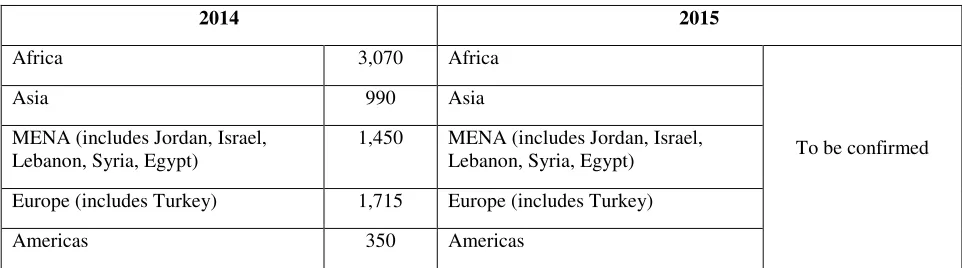
Table 3:
2014 2015
Africa 3,070 Africa Asia 990 Asia MENA (includes Jordan, Israel,
Lebanon, Syria, Egypt)
1,450 MENA (includes Jordan, Israel, Lebanon, Syria, Egypt)
Europe (includes Turkey) 1,715 Europe (includes Turkey) Americas 350 Americas
To be confirmed
Source: UNHCR Resettlement Handbook, Country Chapters- Canada, (2014: 2).