The University of San Francisco
USF Scholarship: a digital repository @ Gleeson Library |
Geschke Center
Master's Theses Theses, Dissertations, Capstones and Projects
2015
Pace, Academic Progress, and the Antecedents of
Student Motivation
Aaron Randall Hiatt
University of San Francisco, [email protected]
Follow this and additional works at:https://repository.usfca.edu/thes
Part of theEducation Policy Commons,Higher Education Commons, and thePublic Policy Commons
This Thesis is brought to you for free and open access by the Theses, Dissertations, Capstones and Projects at USF Scholarship: a digital repository @ Gleeson Library | Geschke Center. It has been accepted for inclusion in Master's Theses by an authorized administrator of USF Scholarship: a digital repository @ Gleeson Library | Geschke Center. For more information, please [email protected].
Recommended Citation
Hiatt, Aaron Randall, "Pace, Academic Progress, and the Antecedents of Student Motivation" (2015).Master's Theses. 186.
PACE, ACADEMIC PROGRESS, AND THE ANTECEDENTS OF STUDENT MOTIVATION
A Thesis
Presented to the Faculty of the School of Education of the University of San Francisco
In partial fulfillment of the requirements for the degree of
MASTER OF ARTS In
Organization and Leadership
By Aaron R. Hiatt
SIGNATURE OF APPROVAL
PACE, ACADEMIC PROGRESS, AND THE ANTECEDENTS OF STUDENT MOTIVATION
A Thesis
Presented to the Faculty of the School of Education of the University of San Francisco
In partial fulfillment of the requirements of the degree of
MASTER OF ARTS In
Organization and Leadership By
Aaron R. Hiatt
Fall 2014 July 15, 2015 APPROVED:
________________________________________ Walter Gmelch, Ph.D.
________________________________________ Patricia Mitchell, Ph.D.
TABLE OF CONTENTS
ACKNOWLEDGMENTS ... vi
Chapters 1. INTRODUCTION ... 1
Statement of the Problem ...2
No Child Left Behind... 4
Persistence/Attrition ... 5
Student Performance and Motivation ... 6
Background and Need for the Study ...7
Policy (No Child Left Behind) ... 8
Persistence... 9
Progress and Completion ... 10
Purpose of the Study ...11
Research Questions ...12
Conceptual Framework ...13
Limitations ...15
Significance to the Field ...16
2. REVIEW OF THE LITERATURE ... 18
Overview ...18
Accountability Policies/No Child Left Behind ... 18
Enrollment Persistence... 21
Student Performance Motivation ... 23
Summary ...27
3. METHODOLOGY ... 28
4. RESULTS ... 31
Student Understanding of Progress Requirements ...31
Course Registration and Completion Tendencies ...33
Course Registration/Drop Pattern Shifts ... 34
Course Completion Efficiency Changes ... 35
Progress Results of Pace Deficient Students ... 42
Student Motivation and Outcomes...44
Progression, Cessation, and Motivation... 45
Motivational Fluidity and Dynamism ... 54
Internal Regulation of Motivation ... 56
5. DISCUSSION, CONCLUSIONS, AND RECOMMENDATIONS ... 61
Recommendations for Future Research ...64
Recommendations to Practice ...65
REFERENCES ...67
APPENDICES ...70
A. INSTITUTIONAL REVIEW BOARD APPROVAL, SAYBROOK UNIVERSITY ...70
LIST OF TABLES
TABLE 1. OF THE DROPPED CREDITS, PERCENTAGE DROPPED BEFORE
THE SELF-DROP DEADLINE ...35 TABLE 2. OF THE CREDITS EARNED, PERCENTAGE EARNED IN
SEMESTER OF INITIAL REGISTRATION ...36 TABLE 3. MEAN DAYS TO COMPLETION OF CANDIDACY QUALIFYING
COURSES REGISTERED IN ACADEMIC YEARS BEFORE AND
AFTER INTRODUCTION OF THE PACE REQUIREMENT ...37 TABLE 4. MEAN DAYS TO COMPLETION OF CANDIDACY QUALIFYING
ACKNOWLEDGMENT
CHAPTER 1 INTRODUCTION
American post-secondary education is in the midst of a transformation owed to a variety of tremendous social, economic, and political forces. The rapid shift from a production to a knowledge-based economy increasingly requires a workforce that is educated beyond the secondary level (Williams, 2007). Post-secondary education, in turn, is responding to provide education that labor markets require. In addition, changing educational demographics, advances in communication technology, and broad public funding of individual education objectives have greatly increased the volume and type of post-secondary education seekers beyond the traditional scope.
While post-secondary student enrollment (especially in nontraditional institutions) has dramatically increased in response to evolving market needs, this growth has been accompanied by an increase in student loan default rates across all post-secondary institution types (U.S. Department of Education, 2012). This and other “program integrity issues” were addressed by federal legislators in a June 2010 notice of proposed rulemaking (Program Integrity Issues, 2010). Subsequently, sweeping regulatory amendments to the Higher Education Act were passed in response to the changing college and federal financial aid dynamic.
Progress, 2011). Using this formula, institutions must regularly measure/monitor student progress in order to determine their federal aid eligibility.
The pace at which a student must progress (for federal aid eligibility purposes) is a function of the maximum federal aid eligibility timeframe for that student’s program. At the undergraduate level, for instance, the maximum federal aid eligibility timeframe is 150% of the number of credits in the student’s program. Thus, to remain eligible for federal aid, an
undergraduate student must minimally/cumulatively complete 67% of all credits attempted. (Consider: a student who successfully completes 67% of the credits they attempt each term is mathematically assured to complete the program before attempting more than 150% of the number of credits in the program.)
While graduate institutions are currently free to determine their own maximum eligibility standard (analogous to the 150% undergraduate standard), the pace rule impacts all
post-secondary levels of Title IV participating institutions. Institutions are now required to have a pace component within their satisfactory academic progress policies, and they are required to measure student progress against it. In the event that a student does not maintain sufficient pace, the institution must suspend disbursements of federal financial aid according to regulation standards (Satisfactory Academic Progress, 2011).
Statement of the Problem
exception to minimum required progress (Higher Education Act of 1965, 2013). If a progress deficient student demonstrated that the deficiency was caused by some extenuating, nonacademic circumstance, the institution was free to classify that student as SAP sufficient and disburse federal financial aid to them. As there was no regulatory limitation on applying the special circumstances exception, institutions were enabled to indefinitely retain and disburse federal aid to progress deficient students. The 2011 academic progress amendments, however, eliminated the special circumstances exception and, consequently, subjective academic progress reviews. Instead, the pace formula was prescribed as the gauge of satisfactory academic progress and financial aid eligibility. Though the regulation does narrowly allow probationary financial aid eligibility in the event of deficient progress, probationary periods are strictly bound by continued progress measurement to the exclusion of any other consideration. In no case may an institution disburse aid beyond the maximum timeframe for completion relative to the pace requirement.
Beginning July 1, 2014, Title IV participating institutions must include pace related student progress data in the normal course of their federal reporting requirements that will allow regulators to determine whether the institutions are disbursing aid in violation of the new federal regulations (William D. Ford Federal Direct Loan Program, 2013). Assuming these institutions are duly incentivized to suspend federal aid disbursements when required under the pace mandate, eligibility and accountability for the disbursements falls directly to students. Under non-negotiable threat of loss of federal assistance, students are now compelled to complete a static, bright line percentage of the credits they attempt, irrespective of their personal or academic circumstances at a given time.
the literature. Among the themes in education research concerning policy, federal regulation, accountability, and student performance, emerge three silos of research.
No Child Left Behind
The No Child Left Behind Act of 2001 (NCLB) offers the closest approximation of the program integrity rules in the 2011 Higher Education Act amendments. To the extent that NCLB is a vehicle for student performance accountability consequences, the literature bears out a narrow range of research problems.
Chief among these problems was the impact that NCLB might have on student performance. Jacob (2005) analyzed the effects that Chicago public school accountability policies of the 1990s had on student high-stakes testing performance. This early preview of school accountability/student performance is paralleled by research determining the extent to which school accountability policies across multiple states affected student performance (Dee & Jacob, 2011; Hanushek & Raymond, 2005).
Reback (2008) explored whether NCLB affected groups of students differently relative to their respective performance levels prior to the school accountability policies. In a similar vein, Springer (2008) sought to ascertain whether performance increases in some groups were correlated with decreases in other groups. With a different focus, Chiang (2009) investigated performance changes among students in underperforming schools that fell under threat of sanction for that reason.
eventual administrative sanctions associated with their performance. Other important
disqualifiers are the age of the affected students (generally, children between 3rd and 8th grades) and the compulsory nature of their enrollment.
Persistence/Attrition
Persistence and attrition (the tendency for post-secondary students to continue or discontinue enrollment, respectively) have been topics of research interest for several decades. To the extent that federal financial aid supports college attendance, there is a conceptually dependent relationship between persistence/attrition and the pace requirement. Certainly, the ability of a student to continue enrollment is now at least partially dependent on the student’s performance.
However, persistence and attrition have typically been researched as functions of other variables. Allen (1999), for example, reviewed patterns of undergraduate persistence between freshman and sophomore years in terms of socio-demographic data and academic predictors including GPA. Grebennikov and Shah (2012) focused specifically on voluntary withdrawal patterns at the freshman level and the subjective reasons determining the choice.
Institution level determinants of persistence and attrition have come under particular scrutiny. De Valero (2001) and Golde (2005) each investigated factors, especially within
academic departments, that have contributed to doctoral student withdrawal trends. Ivankova and Stick (2007) examined drivers of persistence among doctoral students in a distance education context.
However, the value of these lines of research falls short of the question of student performance and actual degree attainment. These are a matter of curriculum completion (one possible outcome of the pace requirement), not mere enrollment status.
Student Performance and Motivation
As the primary bearers of the consequences of deficient pace, post-secondary students are now compelled to perform to a specific standard of credit completion. Under the pace rule, students may, in general, attempt however many (or few) credits they would like in a given enrollment period. The rule requires only that they successfully complete a fixed percentage of the credits they choose to attempt over all enrollment periods. Assuming a student is
academically capable of satisfactorily completing coursework in his or her program, the
student’s pace (as calculated in the completed versus attempted credits ratio) is largely dependent on his or her willingness and ability to perform.
There is minimal research into the antecedents and conditions of post-secondary students’ academic progression, especially as it relates to course load size and performance motivation. Rodwell and Neumann (2008) studied determinants of time-to-completion among graduating doctoral students. In a related piece, Neumann and Rodwell (2009) more closely analyzed the time-to-completion difference between part-time and full-time doctoral graduates. Because the subject of these studies was students who were graduating (not those who failed), the analyses leave much to be known about the relationship between course load size, rate of progress, and degree attainment.
limited by the authors’ defining momentum as credits attempted, not credits actually completed. This definition of momentum is of little value in the context of the pace rule, which requires a calculation of completed credits.
The literature on post-secondary student motivation and performance/achievement is not well developed. Roebken (2007) attempted to identify various outcomes (including achievement levels) among students grouped according to defined goal orientation types. Liu, Bridgeman, and Adler (2012) studied more directly the effects that motivation had in low-stakes testing
conditions. While Liu et al. (2012) subjected participants to specific motivational stimuli, the focus of both studies here was trained on outcomes, not the antecedents or conditions of those outcomes.
The pace rule sets a non-negotiable performance standard that removes institutional judgment from the question of student federal aid eligibility in cases of deficient pace. The shift of eligibility accountability, and the formula that measures for it, raises the topics of
attempted/completed credit volumes and student motivation as issues that are of direct relevance to post-secondary educational attainment. The lack of research in these areas is possibly owed, in part, to the non-existence of the pace rule prior to July 1, 2011.
Background and Need for the Study
The pace rule presents a considerable change in federal posture on institutional satisfactory academic progress policy. Prior to the pace mandate, Title IV participating
to disburse aid in all cases where the student is ineligible. Under the pace regulation, federal aid eligibility is driven exclusively by the student’s progress performance.
The rule has implications that extend in three distinct areas: federal education policy, post-secondary progress/attainment, and student performance motivation. To date, there is no research producing demonstrable results in these areas with respect to each another, such as they are bound under the pace requirement. While there are strains of relevance and promise in these areas individually, when taken together they suggest an omission in knowledge relative to eventual effects of the pace requirement.
Policy (No Child Left Behind)
The effects of consequential education policies are quantified and qualified in the NCLB literature. There is generally consensus among the relevant studies: accountability policies measurably alter school or student performance, depending on which might be measured, and how.
Using results data collected from the Iowa Test of Basic Skills as administered to Chicago Public School children in grades 3–8, for example, Jacob (2005) found generally
significant gains, particularly in math and reading, after a wide-scale school accountability policy was implemented.
Because of the state level differentiation in school accountability structures under NCLB, both Hanushek and Raymond (2005) and Dee and Jacob (2011) assessed student test
Chiang (2009) refined the research criteria to schools that came under threat of sanction for poor student performance. His findings of student performance gains in such cases were consistent with other NCLB performance studies. Of particular note in his research, however, was that performance improvements were strongest among students who performed most poorly prior to the year in which the school fell under threat of sanction.
While the NCLB literature demonstrates measurable student performance changes in cases of consequential federal policy, accountability under the regulation is borne by schools, not students. Student performance changes under NCLB result from schools adapting to the
regulation’s requirements. This materially differentiates NCLB (and other school level accountability structures) from the pace rule, which places the burden of accountability on students themselves to the exclusion of institutional intervention.
Persistence
Persistence and its conceptual counterparts (retention, attrition, time to degree) anchor much of the student enrollment/progress literature. To the extent that a student’s enrollment status may signal progress in the program, these topics roughly locate an area in which the bases and conditions of that progress also reside.
The research has typically attempted to identify causes of persistence or attrition. Golde (2005) focused on the latter. Among factors he found contributing to attrition were poor student integration in the discipline or department, ineffective advising, and lifestyle challenges imposed by doctoral education.
a doctoral distance education study in which faculty, service support, and advising quality were all found to contribute to rates of persistence (Ivankova & Stick, 2007).
There is consistency in the approach and findings in the persistence research, particularly concerning graduate level education as described here. Its objective has been to identify factors that influence the likelihood that a student will either remain in school, or drop out. In the context of the pace regulation and a student’s willingness and ability to progress, however, there exists a critical disconnect between whether or not a student is merely enrolled, and the activity an enrolled student must now undertake in order to preserve his/her eligibility for federal financial aid.
Progress and Completion
There is notably little research attention paid to coursework completion or degree attainment with respect to the impulse of motivation or other student-centric factors. Because enrollment persistency has been the historically entrenched objective, research has served an apparent first order institutional goal of keeping students enrolled. Measurable student
progress/performance, the factors that influence it, and its possible relationship with educational attainment have not been well investigated.
Roebken (2007) determined that student motivational disposition has a bearing on educational outcomes. Using a three dimension framework to group students by defined goal orientation types, associations were identified between goal orientations and resulting levels of satisfaction, academic engagement, and achievement.
Students performed best when they were induced to perceive the most severe consequence associated with their test scores.
The impact of course load size on student progress has received some attention. Neumann and Rodwell (2009) found that, among graduate level completers, part-time students (when adjusted for full-time equivalency) finished faster than full-time students. Attewell et al. (2012) examined the likelihood of degree completion with respect to academic momentum associated with course load size. They found that students enrolling in a full-time course load at the outset of their programs were more likely to complete their degrees than students who enrolled in less than a full-time course load.
Though the topic of student progress in the sense iterated here has not enjoyed a wealth of research attention, the literature that does exist is concentrated in just the last few years. While this may signal a gain in traction, the studies are still quite few and relatively disjointed. If the literature is taken at face value, however, a picture emerges in which student motivation becomes central to performance and progress. This motivation may be triggered by looming consequence, which might result in performance gains. Credit load size may also influence the likelihood of success. The importance of a possible relationship between these assumptions becomes much more vivid in the context of the pace rule, which has untested, direct implications upon student progress performance and the limits of educational funding.
Purpose of the Study
intended to benefit the student. “Having a clear understanding of an institution’s satisfactory progress policy will help students understand the institution’s academic expectations and will increase the likelihood of their academic success” (Program Integrity Issues, 2010, pp. 34821-34822). Accordingly, the purpose of this study was to determine whether the pace rule, as iterated and broadcast in the case institution’s satisfactory academic progress policy, serves the stated public goals of clear student understanding of progress requirements and enhanced likelihood of academic success.
The pace rule presents an untested federal disposition on satisfactory academic progress. Because federal financial aid eligibility is tied directly to a student’s pace, this relatively
anonymous bit of legislation has significant public policy implications, particularly with respect to enrollment trends, degree attainment, and the ability of the nation’s education trust to produce more graduates amid growing demand. Though this study’s design and purpose did not include enrollment and federal aid statistics, a considerable association between post-secondary
enrollment data and federal assistance was assumed.
Research Questions
Following the purpose of this study and its contextual background, three questions guided the research:
1. To what extent does the pace requirement contribute to students’ understanding of the case institution’s academic progress expectations?
2. To what extent is a relationship discernible between enhanced student understanding of progress requirements and course registration or completion tendencies?
While formulation and testing of hypotheses is outside the scope of this study, the research questions are related under the possibility that the interview participants’ course registration behavior may be influenced by their understanding of the pace requirement. In addition, it is expected that participants who tailor their course loads to their individual ability will experience increased motivation to complete their coursework.
Conceptual Framework
The success of this inquiry partially depended on determining student motivational amplitude. The need to assess motivational force poses an apparently significant conceptual hurdle, and particularly within the confines of qualitative design and analysis. To effectively interpret information collected from the research participants and cogently answer the questions driving this study, the model of motivational force must readily accommodate individual
experience and expression.
Hiatt (2015) proposed a model of motivational force specifically framed for the
subjective experience of the individual. This model leverages the human need to self-actualize (Maslow, 1943) to articulate a version of expectancy theory (Vroom, 1964) that is consistent with the human condition. The result is a formula in which motivational force is the product of the squares of the valence that a person associates with an outcome (desire, roughly), and the belief that he/she is capable of achieving the outcome.
individual. Not only does this person-centered expectancy model allow for outside
conceptualization of motivation through individual expressions of desire and ability, it depends on them. With the primacy of subjective experience presumed, Hiatt (2015) suggested that the force of an individual’s motivation defies measurement except by understanding. For this reason, qualitative research approaches may yield meaningful results.
Another important advantage of the Hiatt model is clarity. Because valence and instrumentality may be articulated in lay terms (desire/ability) that require no specialized knowledge or instruction, the researcher was able to freely probe along these themes with certainty that answers would be reliable. High reliability in this person-centered construct, in turn, allows analysis and discussion to wade deeply into the participants’ full reflections. In this sense, reflexive emphasis given by participants is as informationally viable as the rationalized substance of the answers and descriptions, themselves.
Finally, the formula is straightforward and may be applied effectively without the burden of complex mathematics or delicate theory. While Hiatt’s model is written mathematically as the product of the squares of valence and instrumentality, it is not necessary or preferable for the purpose of this study to labor through compounded terms. The model describes motivational force as the product of the equal exponentiation of two components. Distilling away this exponentiation yields a framework of simple valence and instrumentality that is logically analogous to the parent model. If relative motivational force is understood, inferences of capability and/or desire might be made. Similarly, knowledge of any two of the formula’s elements allows a more refined sense of the third.
motivational force. Hiatt’s person-centered expectancy motivation model leverages subjectivity, an apparent paradox of quantifying motivation, to reframe an outside understanding of
motivational force from the perspective of the individual. This tool allows insight into motivation in dynamic circumstances of desire and perceived ability. For the purposes of this study, it
enables assessments of student academic behavior in those circumstances, and interpretation of their actions or omissions from a motivation perspective.
Limitations
The restricted scope designed for clearest and most precise focus is also this study’s primary limitation. There are at least two issues that the reader should take into account when framing this study for other purposes.
First, the case institution is a mixed delivery (primarily distance) graduate school. While the delivery format is particularly relevant to institutions that are growing enrollment or
enhancing existing programs with distance models, graduate education is typically undertaken by students who have already completed at least one post-secondary degree. If undergraduate
enrollment is comprised largely of first-time degree seeking students, then it should not
necessarily be assumed that graduate level student motivation conditions are applicable. Indeed, to the extent that motivation is a phenomenon experienced subjectively within one’s environment at a given point in time, the results here (or in any other institution) may be considered unique.
Second, this research is descriptive and qualitative. While there is an appearance of effects associated with the implementation of the pace rule, insight does not penetrate beyond the information collected to predict outcomes. A primary goal of this study was to determine
Significance to the Field
This study is distinguished and contributes to the field for a number of important reasons. First, it correctly addresses academic progression as the most vital aspect of degree attainment. Because the pace requirement ties financial aid eligibility to measurable progress, this study moves the research discourse beyond unqualified persistence and shifts the focus from the determinants of enrollment status to the determinants of academic engagement.
Furthermore, this study clarifies and emphasizes the role of motivation in assessing student academic behavior and outcomes. Hiatt’s (2015) person-centered expectancy motivation model is introduced here, which is used to gauge interview participants’ relative motivation level and associated academic outcomes. This model moves motivational force away from the
moorings of philosophical abstraction or conceptual typology toward defined amplitude from a person-centered perspective. Its utility allows deductions and predictions to be rendered more easily, and positions future research to more firmly and accurately use motivation as a research implement.
CHAPTER 2
REVIEW OF THE LITERATURE
Overview
It is no longer possible for Title IV participating institutions to review progress-deficient students under a special circumstances clause and continue to disburse federal aid to them for that reason. Under the 2011 Satisfactory Academic Progress amendments, institutions are now prohibited from disbursing federal aid to students who do not maintain sufficient pace. While there is limited provision for institutions to review student appeal of eligibility loss, the
restrictions on aid disbursement in pace deficiency and appeal situations are explicit and finite. With institutional judgment factored out of the progress/eligibility relationship, the responsibility for establishing and maintaining financial aid eligibility falls solely to the student.
These regulatory changes were designed to increase student understanding of progress requirements and improve their chances of academic success (Program Integrity Issues, 2010). The rigidity of the pace requirement and the law’s objective of student success are reconciled by themes including policy impact, accountability, consequence, progress, performance, and motivation. In the context of education research, these themes coalesce in three distinct subject areas: No Child Left Behind, bases of persistence/attrition in higher education, and student motivation research.
Accountability Policies/No Child Left Behind
The scope of literature including policy/regulation and student performance narrows to the No Child Left Behind Act of 2001. The consequential accountability of NCLB signaled a regulatory expectation that student success must result from federal funding. The pace
perspective, with respect to the federal strategy of consequential accountability, the effects of NCLB offer a basis from which the pace rule might be qualified.
Jacob (2005) addressed the topic of results-based educational accountability in the wake of the passage of No Child Left Behind. Citing a distinct lack of empirical results-based
accountability research, the author examined several years of standardized test result information relative to the implementation of a school accountability policy in Chicago Public Schools in 1996. The range of data generally spanned 1994 to 1998 and included students in grades 3 through 8 taking the Iowa Test of Basic Skills.
While the records revealed that generally significant gains were realized (especially in math and reading) after the implementation of the policy, the gains were influenced by factors besides improved student learning. Among these factors were “gaming” behaviors that resulted in a higher performing pool of test takers (such as flunking students in higher numbers at critical grade levels, or reassigning students to special education or foreign language learner status). Other factors included increased student effort in cases where entry to high school was at stake and improvement in selectively emphasized test-taking skills.
among schools that were subject to test performance consequences (sanctions, etc.). The requirement for schools to simply report test results had little impact on those results.
Accountability policy was further isolated as the primary variable associated with performance gains. Differences in per-student spending were examined, for example. However, “the pattern of NAEP scores across states [was] not explained by spending” (Hanushek & Raymond, 2005, p. 310).
This study offered a counterpoint to the school gaming behavior identified in Jacob (2005). An at-large concern has been that schools could manipulate average test scores by selectively funneling students into special education status. However, special education
placements rates were demonstrated here to have a statistically insignificant correlation with the introduction and continuation of accountability policies.
Chiang (2009) examined the testing/performance gains measured in underperforming schools that came under the threat of sanction for that reason. Strongest performance gains were made by students who performed most poorly in the year prior to the sanction-threat year. To determine the extent to which educational reform measures resulted in test score improvements, data in the first year of school sanction threat were compared with subsequent years’ results for the same population of students after they moved on from the elementary level. Year-over-year data indicated that student test improvements in math persisted 1-2 years after the sanction-threat year. While test results in reading also improved in the sanction-threat year, they did not
These studies are representative of the NCLB literature with respect to consequential accountability. While there has been some indication that accountable schools have engaged in gaming behavior (Jacob, 2005), these are subsumed by findings that connect enhanced student learning to school actions under NCLB. Interview information provided by the relevant school principals in Chiang (2009), for example, indicated a reasonably uniform school response to threat of sanction, including “increases in school expenditures on instructional and curricular development, teacher training, and technology surmised to support assessment-driven
instruction” (Chiang, 2009, p. 1046).
Though positive effects of consequential accountability have been demonstrated in the context of NCLB, similar research with respect to the pace rule is absent from the literature. NCLB and the pace rule have little in common apart from consequential accountability. The differences in whom the pace rule affects, and how, require that it be separately charted in policy research.
Enrollment Persistence
When reframed for post-secondary education, persistence (and its variants) emerges as the literature’s dominant feature. Since academic progress can only occur during periods of student enrollment, bases of persistence and attrition are issues relevant to the pace requirement. Graduate education enjoys particular attention in the persistence literature.
Golde (2005) examined underlying causes of doctoral student attrition among four departments at Midwestern University. Research methods included data collection from
factors included, but were not limited to, poor student fit with the department or discipline, student/advisor mismatch, and struggles with the realities of doctoral student life.
The article highlighted areas that might reduce attrition, but it did not directly address the possibility of poor academic performance and/or slow progression as possible underlying causes. However, looming progress requirements (qualifying for candidacy, or completing Incomplete courses) did contribute to attrition, which suggest a possible relationship between progress requirements and persistence.
De Valero (2001) also focused on the department level, but with respect to factors associated with persistence, time-to-graduation, and rates of graduation. Using student records data at a land-grant research university, academic departments were categorized according to their students’ persistence and graduation rates. Interviews conducted with students and faculty indicated that advising quality and departmental climate were associated with persistence and graduation metrics. Department policies were also stated to be relevant. However, no
information about what those policies were, or how they may have differed between departments, was provided.
Like Golde (2005), de Valero (2001) placed the academic department at the center of persistence and attrition trends, depending on the relative quality of the identified department characteristics. Also like Golde (2005), de Valero (2001) touched upon but largely omitted the substance and detail of actual student progress as a possible determinant of persistence and, more importantly, degree attainment.
completed or were still enrolled, and one of whom withdrew shortly after matriculating). The results were largely reflective of other studies’ findings. Faculty, service support, and advising quality were all found to influence persistence. This study was uniquely distinguished by its examination of a distance education program, which is directly relevant to the case institution in the present study.
Persistence has been objectified in several decades of literature. To date, the research assumes a value dichotomy in which persistence sits opposite attrition. Under the terms of the federal pace requirement, which severs a student’s aid eligibility in absence of progress,
unconditioned persistence becomes the very design of attrition. For this reason, research primacy must shift from the determinants of enrollment to the determinants of progress. Persistence must now be considered subsequent, consequent, or incidental to the activity a student undertakes toward degree attainment. From this perspective, there is deep incongruity between the extant literature and the requirements imposed by the pace requirement.
Student Performance Motivation
Student motivation is commonly but incidentally raised in the persistence literature. Ivankova and Stick (2007) found that student motivation, among other factors, contributed to persistence. Similarly, Allen (1999) identified motivation as a factor impacting persistence among minority undergraduate students. Student motivation was cited by 75% of faculty and 42% of students as a “major determinant of student success” in de Valero (2001), but no definition of success was provided (de Valero, 2001, p. 362).
eligibility directly on student progress performance, motivation is the conceptual nexus between the policy’s demand and the student’s performance response.
Motivational cause and student performance effect are found in Liu et al. (2012). They conducted a broad study to determine correlation between student motivation levels and academic performance in low-stakes testing. The ETS Proficiency Profile exam was
administered to several hundred undergraduate test subjects across three differently motivated groups. The control group received no motivation incentive. One test group was told that their scores would be averaged with all other test takers in their institution to inform employers and others about the relative academic quality of their institution (“institutional” condition). A second test group was told that their test scores would be shared with their faculty and
prospective employers to determine academic ability (“personal” condition). Test results strongly correlated student motivation and test results, with the personal condition measured to be the most motivating and yielding the highest performance gains. In this instance, strength of performance was related to the perceived magnitude of the consequence.
Roebken (2007) investigated the effects of student goal orientation on their behavior and academic outcomes. Using data collected from over 2,000 undergraduate survey respondents, the researcher developed a three prong classification system with respect to academic content
mastery, quality performance, or work-avoidance tendencies.
Both Liu et al. (2012) and Roebken (2007) presented definition incompatibilities with respect to the pace requirement. Their concept of performance was a quality measure (GPA, test grades), not volume or speed of coursework completion that are the relevant measures of
performance under the pace requirement. Furthermore, though Roebken’s (2007) goal orientation framework proved useful for determining behavioral and academic outcomes, the research
design omitted antecedents of those motivational dispositions.
Course load size, for example, might bear upon student motivation and/or a student’s ability to progress academically. Neumann and Rodwell (2009) found a stark contrast in time-to-completion between part- and full-time doctoral students at one Australian university, when weighted together in full-time equivalent terms. “Using FTE-weighted graduation times, 19.5% of full-time students [graduated] in four years or less, whereas 72.5% of part-time students completed in four years or less” (Neumann & Rodwell, 2009, p. 61). These figures were raised only with respect to students who had actually completed their programs, however, not those who failed to complete. Because of this exclusion, there are no inferences to be made about part- or full-time status, and relative likelihood of completion.
Another finding suggests variable independence between student satisfaction and their progress. Despite completing much faster than full-time students (in full-time equivalent terms), part-time students were “less satisfied with the infrastructure support provided by their
institutions and departments, and [had] a less favourable perception of the research climate of their department than full-time research students” (Neumann & Rodwell, 2009, p. 63). Though this finding is specific to completers, it significantly blurs the conventionally presumed
The effect of course load size on student progress is also reviewed in Attewell et al. (2012). They described academic momentum as a phenomenon whereby students who
successfully complete coursework at the outset of their programs continue to do so in subsequent terms.
Using data from the National Center for Education Statistics (NCES) and controlling for variables, including the family socioeconomic status, the authors determined that students who enrolled part-time at the outset of their programs were less likely to complete their degrees as compared with students who began their programs at full-time levels. The opposite, however, did not hold true. There was no indication that students attempting high credit totals (18+) in their first term complete their degrees in higher numbers than those enrolling full-time at less than 18 credits.
There are two important points of distinction to be made with respect to the research presented in this thesis. First, the NCES data included only students in 2- and 4-year
undergraduate programs. Momentum trends at the graduate level were not included.
(Additionally, there is no refinement of analysis for, or suggestion of, traditional versus distance student populations.) A second, much more critical distinction was the authors’ interpretation of academic momentum, which they defined as credits attempted (not credits successfully
completed). Completing coursework was interpreted to be the eventuality of the academic momentum of attempting credits.
(Attewell et al., 2012, p. 39). Speed of progress directly implies completing, not just attempting, coursework.
The student performance motivation literature is not well developed and presents incompatibilities with respect to the pace requirement’s role in student performance behavior. Liu et al. (2012) induced student performance behavior in test taking situations only. Roebken (2007) looked more closely at student behavioral disposition and resulting academic outcomes, but suggested that future research determine “how goal orientation develops, changes and how it affects motivational and educational outcomes” (Roebken, 2007, p. 698). Finally, Neumann and Rodwell (2009) and Attewell et al. (2012) suggested that the amount of coursework a student takes has some bearing on completion outcomes. These various studies are related in the pace dynamic, which combines policy demands, defined consequences, and behavioral requirements. However, there is a gap in the literature where these three concepts intersect.
Summary
CHAPTER 3 METHODOLOGY
This research was conducted in a single case institution. Saybrook University is a private, nonprofit graduate institution with master’s and doctoral degree programs in psychology,
organizational systems, human science, and mind-body medicine. It was founded in 1971 and has been continuously accredited by the Western Association of Schools and Colleges since 1984. The full-time enrollment count at the time of the research was approximately 600, with roughly 500 enrolled in distance or mixed delivery programs. The calendar follows a semester model, with a summer term in select programs. The researcher is also the institution’s registrar.
The institution introduced and has enforced a pace requirement as part of a complete revision of its satisfactory academic progress policy effective Fall 2011. The rule applies a 150% standard. Students must successfully complete all credits in their program before attempting more than 150% of the credits in the program. This implies that students must complete,
minimally, 67% of the credits they cumulatively attempt over all semesters of their enrollment to remain eligible for federal assistance. Academic progress is calculated after each semester, including the summer term.
Because the research questions were developed within the confines of student intentional behavior and subjective experience, a portion of this study is driven by qualitative information. Descriptive course completion data are also presented. Information and conclusions reached from these two complementary sources sufficiently illuminate the object of this inquiry.
The interview subject pool was narrowed to students enrolled in a group of
the institution’s student body. In addition, students in these programs enjoy the freedom to design their course schedule each semester.
Interviews were conducted by phone to discuss pace and student motivation. Participants were solicited based on their cumulative pace performance as calculated at the end of the Spring 2014 semester. To ensure the best chance that interview participants had familiarity with the pace policy and possibly clearest perspective on its motivating impact, only students on the margins of the minimum satisfactory pace threshold were solicited for interviews. Two participants persisted under the minimum pace requirement during both Fall 2013 and Spring 2014. Three students had improved themselves to good standing during Spring 2014 after a pace deficient Fall 2013. Two students persisted just above the satisfactory pace threshold over Fall 2013 and Spring 2014. Questions were prepared in advance to determine participant
understanding of the case institution’s pace policy, its impact on their motivation, as well as other bases of their performance motivation. The interviews were recorded and transcribed from audio by the researcher.
Registration and course completion data were mined from the case institution’s records system. These data were collected manually, using no specialized instrumentation. The
CHAPTER 4 RESULTS
Information was collected through interviews conducted individually with seven participants. In addition, course completion data were mined from the institution’s student information system. These information sources were intended to bring answers, as directly as possible, to the first two research questions: To what extent does the pace rule contribute to student understanding of academic progress expectations at the case institution, and to what extent is a relationship discernible between enhanced understanding and course registration or completion tendencies? Interviews also yielded extensive information relative to progress policies and student motivation. That information is presented with respect to person-centered expectancy motivation (Hiatt, 2015) to discern the antecedents and outcomes associated with the participants’ relative motivational force.
Student Understanding of Progress Requirements
Interviews were structured across two primary topics. The first portion of each interview was devoted to determining participant awareness of the pace rule and their familiarity with its requirements. (To reiterate for clarity of this section, pace is the cumulative ratio of credits earned versus credits attempted.) In addition to directly polling students on this topic, the related topics of financial aid need and deficient progress consequences were also explored.
When asked if they had heard of the pace requirement, six of seven participants indicated that they had. However, of these six, none were aware of the pace requirement until they
standing. As the institution only distributed progress notices to progress deficient students, this respondent did not at any time receive a notice indicating good standing or the basis for that status. However, she did indicate awareness that the institution has a satisfactory academic progress policy.
In general, participants’ understanding of the pace rule was vague or incorrect. Only two participants were able to reasonably articulate the policy as a rate of progress driven by the ratio of credits earned versus credits attempted. Only one of these two understood the ratio to be cumulative. This basically correct understanding was significantly outweighed by a
preponderance of misunderstanding among the remaining five. Of these five, four had indicated awareness of the pace rule. While all four understood pace to be an academic progress policy, one described the pace measure incorrectly and three were unable to describe the measure at all.
Six of the seven participants indicated reliance on federal financial aid to fund their enrollment at the case institution. Of these six, all indicated strong or complete dependence on federal aid to remain enrolled. Four indicated that loss of aid would end their enrollment. The remaining two expressed some ability to pay out of pocket in the event of loss of aid, but at considerable financial hardship and only to the extent that they were nearing degree completion. The participant who did not draw federal financial aid was a VA beneficiary with a fully funded tuition benefit.
another consequence.1 Among those who cited both consequences was the only participant who had never actually come into violation of the progress requirements. She was aware of the financial aid consequence “because it happened to one of [her] friends.” Despite having received a notice of progress deficiency at the end of the Fall 2013 semester, the sole participant who had no awareness or understanding at all of the consequences of deficient academic progress was the VA beneficiary receiving no federal student financial aid.
To the extent that interview participants may be representative of the population of students on the margins of progressing satisfactorily at the case institution, the considerable weakness of their understanding of the pace requirement is nonetheless contrasted by their awareness of the consequences of progressing insufficiently. Thus, while the legislation’s stated goal of increased likelihood of student success may not necessarily be served by clear student understanding of the academic progress requirement itself, it may possibly be served by student understanding of the consequences.
Course Registration and Completion Tendencies
Central to the question of the pace requirement’s effectiveness are student success
outcomes that the satisfactory academic progress regulations are intended to realize. With respect to the pace rule itself, the primary measure of student success is the rate of coursework
completion. Related to this measure of success is the possibility that the pace requirement influences students to adapt their attempted credit loads in order to increase the likelihood of maintaining satisfactory pace. Course completion and registration information was collected to determine whether there were identifiable pattern shifts relative to the introduction of the pace requirement at the case institution.
Course Registration/Drop Pattern Shifts
Until the pace rule was implemented at the case institution in Fall 2011, students in programs forming the basis of this study faced no consequence for dropping courses, provided they remained at least half-time status and completed a minimum of six credits per semester. In addition, students were free to drop courses at any point throughout a semester, both before and after the implementation of the pace policy. Beginning in Fall 2010, a deadline was imposed each semester after which point self-drop functionality in the student online portal was disabled. After the self-drop deadline, students effected course drops through the administration. To calculate pace starting in Fall 2011, the case institution used the self-drop deadline as the demarcation for classifying credits as attempted. Courses remaining registered for any length of time beyond the self-drop deadline (including those dropped after the self-drop deadline) were classified and calculated as attempted. For the purposes of discerning possible influence of the pace requirement on student registration behavior, therefore, course drop information was identified as the signal of that influence.
increase coincides with the introduction of the pace rule, which indicates a shift/reduction in course attempt behavior.
Table 1
Of the Dropped Credits, Percentage Dropped Before the Self-Drop Deadline
Department FA 10 SP 11 FA 11 SP 12 FA 12 SP 13 FA 13
Psychology 63.04 62.58 76.80 76.43 80.16 75.32 80.95
Human Science 56.25 50.00 52.63 78.95 78.57 77.78 66.67
Organizational Systems 55.26 67.65 62.16 58.82 87.50 50.00 80.00
Tables 1 and 2 categorize information by department. Breaking out the data by
department is useful for two reasons. First, it allows comparisons between autonomous units of academic authority. Data trends are reinforced when exhibited across these boundaries. Second, although these departments collectively enrolled the majority of the case institution’s student body, the human science and organizational systems departments enrolled far fewer students than the psychology department.2 Isolating the psychology department allows a review of data that is stabilized in sample depth. In Table 1, for example, while the course drop trends are reasonably evident in the human science and organizational systems departments, they corroborate a much clearer pattern shift in the psychology department.
Course Completion Efficiency Changes
By limiting the number of attempted credits that federal financial aid will support, the pace requirement compels students to efficiently complete the credits they do attempt in order to
finish their programs before loss of aid eligibility. If the pace requirement is successful in this regard, course retakes would decrease and completion of courses in a single enrollment period would increase. Table 2 presents the latter of these indicators. After the Fall 2011 semester, when the pace rule became effective, the proportion of credits earned in the original semester of
registration began to increase. While not particularly sharp, the increase is reasonably steady over time, as demonstrated in the psychology department. The significance of this trend,
however, is more apparent when framed across the span of semesters since the student self-drop deadline became effective in Fall 2010. Not only has course attempt behavior changed since the pace rule became effective in Fall 2011, but progress performance gradually has, as well.
Table 2
Of the Credits Earned, Percentage Earned in Semester of Initial Registration
Department FA 10 SP 11 FA 11 SP 12 FA 12 SP 13 FA 13
Psychology 84.10 85.87 85.96 89.08 89.90 87.91 96.57
Human Science 65.12 80.00 79.41 86.49 78.95 96.77 92.11 Organizational Systems 77.42 80.95 84.75 98.18 79.66 92.50 97.62
While these figures demonstrate an overall increase in coursework completion efficiency that is consistent with the introduction of the pace requirement in Fall 2011, the general trend does not accurately describe student behavioral tendencies in all instances. Specifically, the changeover to a pace measure of progress at the case institution presented the opportunity to focus more precisely on its effect among students attempting to qualify for doctoral candidacy.
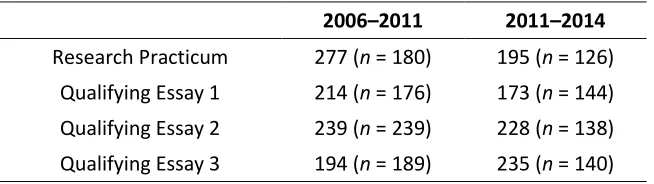
complete at least six credits per semester until the coursework phase of their degrees was complete. Ph.D. students were relieved of the six credit/semester minimum upon entering the doctoral candidacy qualifying phase of their program. They were then free to progress at their leisure, provided they completed their degree prior to exhausting the maximum timeframe of seven total years of enrollment in the program. Effective Fall 2011, however, the four courses comprising the candidacy qualifying phase became subject to the pace measurement each semester. The affected courses are a pilot study (Research Practicum), a dissertation research methodology critique (Qualifying Essay 1), and two literature/content essays (Qualifying Essays 2 and 3).
Table 3
Mean Days to Completion of Candidacy Qualifying Courses Registered in Academic Years
Before and After Introduction of the Pace Requirement
2006–2011 2011–2014
Research Practicum 277 (n = 180) 195 (n = 126) Qualifying Essay 1 214 (n = 176) 173 (n = 144) Qualifying Essay 2 239 (n = 239) 228 (n = 138) Qualifying Essay 3 194 (n = 189) 235 (n = 140)
with the information in Table 2 that suggests an overall gain in course completion efficiency since the pace rule was implemented.
Table 4
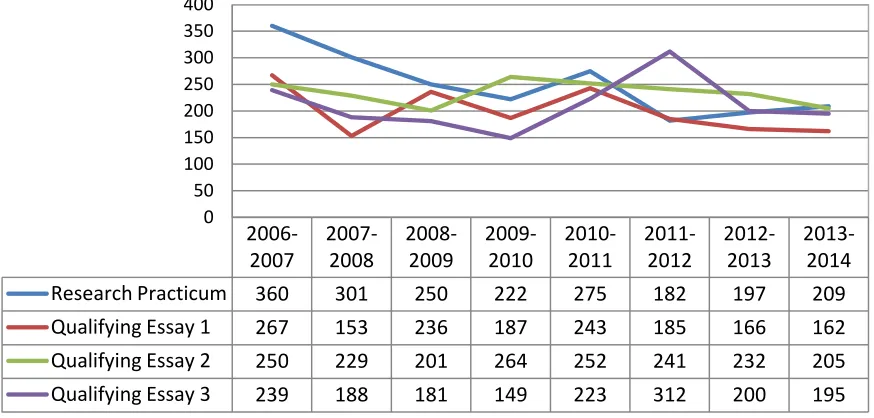
Mean Days to Completion of Candidacy Qualifying Courses Registered by Academic Year
There are strong indications in the data that suggest the changes in mean days to
completion for these courses were influenced by changes in student registration behavior. While the overall mean days to completion for Qualifying Essay 3 increased from 194 (n = 189) to 235 (n = 140), for example, the standard deviation decreased from 210 days to 181 days. The
phenomenon of days to completion condensing at higher mean values does not in and of itself suggest a change in course registration behavior. However, when taken with a comparison of the lower spectrum of days to completion over the two time periods, it does. During the three
academic years prior to the introduction of the pace requirement (2008–11), 12 of 114
Qualifying Essay 3 courses (10.5%) were evaluated for completion in fewer than 10 days from the date of registration. By comparison, during the 3 years following the introduction of the pace rule (2011–14), only two (1.4%) were evaluated for completion in fewer than 10 days after registration (n = 140). To the extent that it is not possible to complete a doctoral candidacy
2006-2007 2007-2008 2008-2009 2009-2010 2010-2011 2011-2012 2012-2013 2013-2014 Research Practicum 360 301 250 222 275 182 197 209 Qualifying Essay 1 267 153 236 187 243 185 166 162 Qualifying Essay 2 250 229 201 264 252 241 232 205 Qualifying Essay 3 239 188 181 149 223 312 200 195
qualifying course in fewer than 10 days, these instances suggest a more extensive incongruence between actual days to completion, and total duration of registration, prior to the introduction of the pace requirement.
Although the incongruence is most obvious in the Qualifying Essay 3 data, it is also apparent among the other three candidacy qualifying courses. In the three academic years preceding the introduction of the pace requirement (2008–11), there was a combined total of 24 instances (5.3%) of candidacy qualifying courses evaluated for completion in fewer than 10 days from the date of registration (n = 453). In the three subsequent years (2011–14), only six of 548 total candidacy qualifying course completions (1.1%) were registered for fewer than 10 days. The lower spectrum of days to completion between the two time periods, in general, is similarly imbalanced. The change in registration behavior is consistent with the introduction of the pace rule, but also with the alteration of registration policy at the case institution specific to candidacy qualifying courses at the time the pace rule became effective. Prior to Fall 2011, students
entering the doctoral candidacy qualifying phase were required to register the research practicum first, and were limited to registering only one qualifying essay course at a time until the research practicum was complete, after which point students were free to register any two qualifying essays simultaneously. The policy of limiting candidacy qualifying courses to two concurrent registrations was lifted beginning in Fall 2011 when progress through the phase became regulated by the pace requirement.
length of time spent in the candidacy qualifying phase was collected.3 Because the 2011–2014 data were unsettled at the time of data collection, it was not possible to compare mean speed of progression through the candidacy qualifying phase between the two time periods. However, omitting the Spring 2014 values from the post-Spring 2011 data enabled a comparison of the medians of the two time periods (before and after introduction of the pace requirement) as a proxy indicator of change of speed of progression.4 Of students beginning the candidacy
qualifying phase prior to the Fall 2011 semester, half completed in 495 days or fewer (n = 174). Of students beginning the candidacy qualifying phase between Fall 2011 and Fall 2013, half completed in 504 days or fewer (n = 101).
The marginal difference in the median figures between the two time periods suggests that it is unlikely that the pace requirement has appreciably altered student speed of progression through the doctoral candidacy qualifying phase. Yet, evidence indicates a trend toward uniformity in mean days to completion among the four courses since the pace requirement was introduced. From this information, it is possible to deduce that students have been registering and working through the candidacy qualifying courses more sequentially under the pace requirement, particularly since 2012. Conversely, the pre-Fall 2011 data indicated a stronger tendency for students to work on candidacy qualifying coursework concurrently during that timeframe. This is supported by evidence that students were more likely to work on their unregistered candidacy qualifying courses, as well as the greater mean days to completion for all but Qualifying Essay 3.
3 This duration was measured as the mean days elapsed between the date on which the first of the four
courses was registered, and the date on which the last of them was evaluated for completion. Periods of student withdrawn status were subtracted from individual totals.
The obsolescence and removal of the limit on concurrent candidacy qualifying course registrations in Fall 2011 (when they became subject to pace measurement) presents a
compelling anomaly in the data if considered apart from the pace requirement. Prior to Fall 2011, students were limited to registering two candidacy qualifying courses concurrently, but data indicate that they also worked on those they were restricted from registering. When the
registration limit was lifted in Fall 2011 and students were free to register any number of them concurrently, the sharp increase in days to completion of Qualifying Essay 3 suggests they did so to some extent. However, after approximately one year, their academic effort began to
synchronize with an emerging tendency of courses to be registered sequentially rather than concurrently. The shift toward sequential progression through the four candidacy qualifying courses defies the expectation that they would register and work concurrently on the courses when permitted to do so after the limit on concurrent registrations was lifted. This adaptive behavior is consistent with the alteration in course drop behavior in Table 1, and signals a change in academic behavioral efficiency that is a hallmark of the design of the pace requirement.
Progress Results of Pace Deficient Students
Between Fall 2011 and Fall 2013, a total of 97 students fell below pace for the first time. As the case institution calculated academic progress every disbursement/enrollment period, it is permitted under regulation to extend a onetime Warning status to such students and disburse aid to them in the following semester (Satisfactory Academic Progress, 2011). Of these 97 first time pace deficient students, none of whom were required to withdraw as a result of the deficiency, 87 remained enrolled. At the end of the subsequent semester, 57 of the 87 remained below the pace threshold again and lost their aid eligibility for that reason. 48 of these 57 remained enrolled in the following semester under a single probationary period afforded to them (Satisfactory Academic Progress, 2011). At the time these data were collected, at least 28 of them had achieved satisfactory progress. In total, of the 87 who remained enrolled after initially falling below the minimum pace threshold, 57 (65.5%) eventually completed the balance of deficient coursework required to resume eligibility for federal financial aid. Only nine of these 57 (15.8%) returned to a pace deficiency at any point after resuming good standing, and at least eight those (88.9%), at the time of data collection, had righted their progress.
Student Motivation and Outcomes
The relationship between student motivation level and academic outcomes in higher education is touched upon in the extent educational research, but is a central feature of the present study. Implicit in the potential of this connection is the assumption that the force of motivation will determine the performance that a student will exert and the level of success that will result. Person-centered expectancy motivation (Hiatt, 2015) is described as the product of the squares of the valence that a person associates with an outcome and his or her belief in ability to achieve the outcome. This model frames motivational force from the subjective experience of the individual, and allows understanding of motivational force to flow through experiential descriptions of desire and ability.
The seven students interviewed for this study were identified as performing on the margins of the minimum pace requirement at the case institution over the Fall 2013 and Spring 2014 semesters. By the pace measure of performance over those two semesters, they fall into three categories. Sandra and Joan5 maintained pace performance just above the minimum standard over both semesters. David, Tracy, and Bill performed below standard in Fall 2013 but righted their progress by the end of Spring 2014. Kristen and Kelly performed below standard over both semesters. Six of the seven funded their enrollment with federal financial aid (David was fully funded by the VA), and all who performed deficiently received notice of the deficiency and its bearing on the case institution’s ability to disburse financial aid.
Personal accounts of the motivational elements under Hiatt (2015) were explored in depth to assess the relationship between the antecedents of motivation and individual participant
outcomes. For the purposes of this presentation, no attempt is made to quantify individual levels of motivation. Instead, a comparative approach is used to highlight, compare, and contrast
participant accounts and individual outcomes. These data are framed across three precepts of the Hiatt model to assess the consistency of the accounts and outcomes in an educational context: (a) Progression and cessation are determined along lines of motivation, (b) Motivation to progress is fluid and dynamic, and (c) Motivational force is regulated internally.
Progression, Cessation, and Motivation
Between the end of the Spring 2014 semester and the point when interviews were
conducted, Kelly had voluntarily withdrawn. Shortly after the interviews were conducted, David also voluntarily withdrew. The remaining five students continued to progress in their degree programs. For comparison purposes, a review of progression and cessation with respect to person-centered expectancy motivation is limited to the two participants who performed above the pace requirement over both Fall 2013 and Spring 2014 (Sandra and Joan), and the two students who ceased their enrollment (Kelly and David).
In cases of student academic success, Hiatt (2015) suggests that the motivation driving that effort will be sourced by the student’s belief in his or her ability to meet the challenge and rigor of higher education. Because no distinction is made between internal or external limiters of ability in person-centered expectancy motivation, belief in ability is determined by
self-assessment of academic potential as well as the perception of environmental obstacles impeding progress. When the topic of ability was discussed in the interviews, all the participants cited environmental challenges. Kelly, however, was the only participant who came to believe herself potentially incapable of completing her program.